Introduction
DNS (Domain Name System) management tools are platforms that allow businesses to control how domain names are translated into IP addresses. In simple terms, they ensure that when users type a website address, they are directed to the correct server quickly and reliably.
Modern DNS management goes far beyond basic record editing. It now plays a critical role in performance optimization, uptime reliability, security protection, and global traffic routing. As organizations increasingly rely on cloud services, distributed infrastructure, and always-on digital experiences, DNS has become a foundational layer of application delivery.
Common Use Cases
- Managing domain records for websites and applications
- Load balancing traffic across multiple servers or regions
- Improving website performance via geo-routing
- Protecting against DDoS attacks and DNS hijacking
- Enabling failover and disaster recovery setups
What Buyers Should Evaluate
- DNS query speed and global network coverage
- Uptime guarantees and reliability (SLA)
- Ease of use and dashboard experience
- Advanced routing (geo, latency-based, failover)
- Security features (DNSSEC, DDoS protection)
- API access and automation capabilities
- Integration with cloud platforms and DevOps tools
- Pricing model and scalability
- Monitoring and analytics features
Best for: DevOps teams, IT administrators, SaaS companies, hosting providers, and enterprises managing multiple domains or high-traffic applications.
Not ideal for: Individuals or small websites with minimal traffic that can rely on basic DNS provided by domain registrars.
Key Trends in DNS Management Tools
- Anycast network expansion: Faster DNS resolution through globally distributed nodes
- Integrated security layers: DNS-based protection against DDoS and spoofing attacks
- Automation-first workflows: API-driven DNS management and infrastructure-as-code support
- Traffic steering intelligence: Latency-based and geo-based routing becoming standard
- Multi-cloud compatibility: Seamless DNS control across AWS, Azure, and other platforms
- Observability improvements: Real-time DNS analytics and performance monitoring
- Edge integration: DNS working closely with CDN and edge computing platforms
- Zero trust alignment: DNS as part of broader network security architecture
- Self-healing infrastructure: Automated failover and health checks
How We Selected These Tools (Methodology)
- Evaluated global adoption and brand credibility
- Compared core DNS features and advanced routing capabilities
- Assessed performance and uptime reputation
- Reviewed security capabilities such as DNSSEC and DDoS protection
- Considered integration capabilities with cloud and DevOps tools
- Ensured representation across enterprise and SMB use cases
- Analyzed ease of use and onboarding experience
- Reviewed ecosystem strength and API support
- Prioritized tools with modern infrastructure and scalability
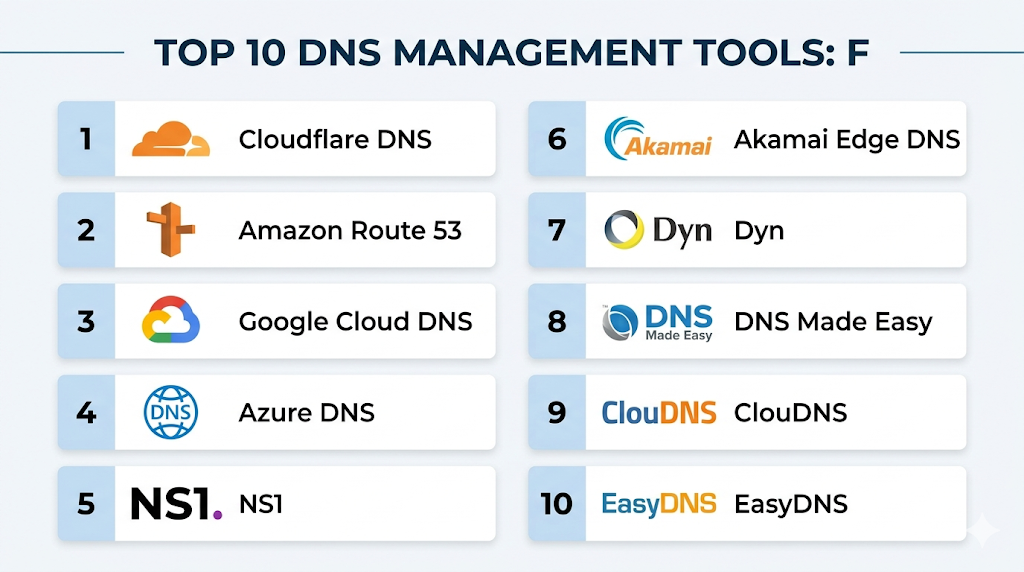
Top DNS Management Tools
#1 — Cloudflare DNS
Short description: A widely used DNS platform offering high-speed resolution, security features, and global Anycast infrastructure for businesses of all sizes.
Key Features
- Global Anycast DNS network
- Built-in DDoS protection
- DNSSEC support
- Fast propagation times
- Traffic routing and load balancing
- Integrated CDN and edge services
Pros
- Extremely fast DNS performance
- Strong security features included
Cons
- Advanced features require paid plans
- Can be complex for beginners
Platforms / Deployment
Web / Cloud
Security & Compliance
DNSSEC, DDoS protection, encryption, RBAC; certifications not publicly stated
Integrations & Ecosystem
Cloudflare integrates deeply with modern web infrastructure and edge services.
- APIs for automation
- CDN and security tools
- DevOps workflows
- Edge computing integrations
Support & Community
Strong documentation, large community, tiered support plans
#2 — Amazon Route 53
Short description: A scalable DNS service designed for cloud-native applications, tightly integrated with AWS.
Key Features
- Highly available DNS service
- Latency-based routing
- Health checks and failover
- Domain registration support
- Traffic flow management
Pros
- Deep AWS integration
- Highly reliable infrastructure
Cons
- Complex pricing model
- Best suited for AWS users
Platforms / Deployment
Cloud
Security & Compliance
Encryption, IAM integration; compliance not publicly stated
Integrations & Ecosystem
Native integration with AWS services makes it ideal for cloud deployments.
- AWS ecosystem
- APIs
- Infrastructure-as-code tools
Support & Community
Extensive documentation and enterprise-grade support
#3 — Google Cloud DNS
Short description: A managed DNS service offering high availability and performance within Google Cloud infrastructure.
Key Features
- Low-latency DNS resolution
- Anycast network
- Managed zones
- Integration with Google Cloud
- High availability
Pros
- Reliable and scalable
- Simple to use within GCP
Cons
- Limited outside Google ecosystem
- Fewer advanced routing features
Platforms / Deployment
Cloud
Security & Compliance
Encryption; compliance not publicly stated
Integrations & Ecosystem
- Google Cloud services
- APIs
- DevOps tools
Support & Community
Good documentation, moderate community
#4 — Azure DNS
Short description: Microsoft’s DNS hosting service designed for enterprise cloud deployments.
Key Features
- High availability DNS hosting
- Integration with Azure services
- DNSSEC support
- Role-based access control
Pros
- Strong enterprise support
- Seamless Azure integration
Cons
- Limited standalone use
- UI complexity
Platforms / Deployment
Cloud
Security & Compliance
RBAC, DNSSEC; compliance not publicly stated
Integrations & Ecosystem
- Azure ecosystem
- APIs
- DevOps tools
Support & Community
Strong enterprise documentation and support
#5 — NS1 (IBM NS1 Connect)
Short description: An advanced DNS platform focused on intelligent traffic routing and performance optimization.
Key Features
- Filter chain routing
- Real-time traffic steering
- Advanced monitoring
- API-first design
- Geo and latency routing
Pros
- Highly customizable routing
- Strong performance optimization
Cons
- Steeper learning curve
- Premium pricing
Platforms / Deployment
Cloud
Security & Compliance
Encryption, RBAC; compliance not publicly stated
Integrations & Ecosystem
- APIs
- DevOps integrations
- Cloud platforms
Support & Community
Enterprise-focused support
#6 — Akamai Edge DNS
Short description: Enterprise-grade DNS service with strong performance and security backed by Akamai’s global network.
Key Features
- Global Anycast network
- DDoS protection
- Traffic management
- High availability
- Edge integration
Pros
- Excellent performance
- Strong security
Cons
- Expensive
- Complex setup
Platforms / Deployment
Cloud
Security & Compliance
DDoS protection, encryption; compliance not publicly stated
Integrations & Ecosystem
- Akamai CDN
- APIs
- Enterprise integrations
Support & Community
Premium enterprise support
#7 — Dyn (Oracle Dyn DNS)
Short description: A reliable DNS platform known for performance and traffic management capabilities.
Key Features
- Managed DNS services
- Traffic steering
- Monitoring tools
- Failover support
Pros
- Strong reliability
- Good traffic management
Cons
- Limited innovation
- Legacy perception
Platforms / Deployment
Cloud
Security & Compliance
Encryption; compliance not publicly stated
Integrations & Ecosystem
- Oracle ecosystem
- APIs
Support & Community
Moderate support and documentation
#8 — DNS Made Easy
Short description: A cost-effective DNS provider focused on performance and uptime.
Key Features
- Fast DNS resolution
- Failover support
- Monitoring tools
- SLA-backed uptime
Pros
- Affordable
- Easy to use
Cons
- Limited advanced features
- Smaller ecosystem
Platforms / Deployment
Cloud
Security & Compliance
DNSSEC; compliance not publicly stated
Integrations & Ecosystem
- APIs
- Basic integrations
Support & Community
Good support for SMB users
#9 — ClouDNS
Short description: A flexible DNS hosting provider offering multiple DNS services for SMBs.
Key Features
- Managed DNS hosting
- DDoS protection
- GeoDNS support
- Monitoring
Pros
- Budget-friendly
- Flexible plans
Cons
- Limited enterprise capabilities
- Smaller ecosystem
Platforms / Deployment
Cloud
Security & Compliance
DDoS protection; compliance not publicly stated
Integrations & Ecosystem
- APIs
- Basic integrations
Support & Community
Moderate support
#10 — EasyDNS
Short description: A DNS management platform focused on simplicity and reliability.
Key Features
- Managed DNS
- Domain management
- Monitoring
- Basic security features
Pros
- Simple to use
- Reliable uptime
Cons
- Limited advanced features
- Smaller scale
Platforms / Deployment
Cloud
Security & Compliance
Basic security; compliance not publicly stated
Integrations & Ecosystem
- APIs
- Domain tools
Support & Community
Good SMB-focused support
Comparison Table (Top 10)
| Tool Name | Best For | Platform(s) Supported | Deployment | Standout Feature | Public Rating |
|---|---|---|---|---|---|
| Cloudflare DNS | All sizes | Web | Cloud | Global Anycast network | N/A |
| Route 53 | AWS users | Web | Cloud | AWS integration | N/A |
| Google Cloud DNS | GCP users | Web | Cloud | Low latency | N/A |
| Azure DNS | Enterprises | Web | Cloud | Azure integration | N/A |
| NS1 | Advanced routing | Web | Cloud | Intelligent traffic steering | N/A |
| Akamai DNS | Enterprises | Web | Cloud | Security + performance | N/A |
| Dyn DNS | Reliability | Web | Cloud | Traffic management | N/A |
| DNS Made Easy | SMB | Web | Cloud | Cost-effective | N/A |
| ClouDNS | Budget users | Web | Cloud | Flexible pricing | N/A |
| EasyDNS | Simplicity | Web | Cloud | Ease of use | N/A |
DNS Management Tools (Scoring Model)
| Tool Name | Core | Ease | Integrations | Security | Performance | Support | Value | Weighted Total |
|---|---|---|---|---|---|---|---|---|
| Cloudflare | 9 | 8 | 9 | 9 | 9 | 8 | 8 | 8.7 |
| Route 53 | 9 | 7 | 9 | 8 | 9 | 8 | 7 | 8.4 |
| Google DNS | 8 | 8 | 8 | 7 | 9 | 7 | 7 | 8.0 |
| Azure DNS | 8 | 7 | 8 | 8 | 8 | 8 | 7 | 7.9 |
| NS1 | 9 | 6 | 8 | 8 | 9 | 7 | 6 | 7.9 |
| Akamai | 9 | 6 | 7 | 9 | 9 | 9 | 6 | 8.1 |
| Dyn | 7 | 7 | 7 | 7 | 8 | 7 | 7 | 7.3 |
| DNS Made Easy | 7 | 8 | 6 | 7 | 8 | 7 | 9 | 7.8 |
| ClouDNS | 7 | 8 | 6 | 7 | 7 | 6 | 9 | 7.6 |
| EasyDNS | 6 | 9 | 5 | 6 | 7 | 7 | 8 | 7.2 |
How to interpret:
- Scores are relative comparisons across tools
- Higher weighted total indicates better overall balance
- Prioritize categories based on your needs
- Enterprise tools score higher on features, SMB tools on value
Which Service Mesh Platforms Is Right for You?
Solo / Freelancer
Basic DNS from registrars or tools like EasyDNS are sufficient.
SMB
Cloudflare or DNS Made Easy offer strong performance with affordability.
Mid-Market
NS1 or Azure DNS provide advanced features with manageable complexity.
Enterprise
Akamai, Route 53, and Cloudflare are ideal for scale and performance.
Budget vs Premium
- Budget: ClouDNS, DNS Made Easy
- Premium: Akamai, NS1
Feature Depth vs Ease of Use
- Advanced: NS1, Route 53
- Easy: Cloudflare, EasyDNS
Integrations & Scalability
- Best integrations: Route 53, Azure
- Highly scalable: Cloudflare, Akamai
Security & Compliance Needs
- High security: Cloudflare, Akamai
- Moderate: Google DNS, ClouDNS
DNS Management Tools (FAQs)
What is DNS management?
It is the process of configuring and controlling DNS records for domains.
How much do DNS tools cost?
Pricing ranges from free tiers to enterprise subscriptions depending on usage.
Do I need DNSSEC?
It is recommended for improved security against spoofing.
Can DNS improve performance?
Yes, through faster resolution and traffic routing.
Is DNS management difficult?
Modern tools simplify it, but advanced setups require expertise.
What is Anycast DNS?
It routes queries to the nearest server for faster response.
Can I switch DNS providers?
Yes, but requires careful migration to avoid downtime.
What are common mistakes?
Incorrect records, lack of monitoring, and ignoring security.
Are free DNS services reliable?
Some are, but may lack advanced features.
Do DNS tools integrate with cloud?
Most modern tools offer strong cloud integrations.
Conclusion
DNS management tools are a critical component of modern infrastructure, impacting performance, reliability, and security. From beginner-friendly platforms to enterprise-grade solutions, the right choice depends on your scale, technical requirements, and budget.
