Introduction
Community Management Platforms are software solutions designed to help organizations build, manage, and grow online communities. These platforms provide tools for discussions, content sharing, moderation, engagement tracking, and member management—all within a centralized environment. In simple terms, they enable brands, creators, and organizations to foster meaningful interactions with their audience.
As businesses increasingly prioritize customer engagement, retention, and brand loyalty, communities have become a strategic asset. Whether it’s a customer support forum, a learning community, or a private membership space, community platforms help organizations scale interactions without relying solely on one-to-one communication.
Common use cases include:
- Customer support communities and knowledge sharing
- Creator-led membership communities
- Product user groups and feedback forums
- Employee or internal communities
- Learning and course-based communities
Key evaluation criteria:
- Community structure (forums, groups, channels)
- User experience and engagement tools
- Moderation and governance capabilities
- Customization and branding
- Integration with CRM, LMS, and marketing tools
- Analytics and reporting
- Monetization features (subscriptions, memberships)
- Scalability and performance
- Security and privacy controls
Best for: SaaS companies, creators, educators, enterprises, and brands looking to build engaged communities around products or content.
Not ideal for: Small teams without a clear community strategy or organizations that only need basic communication tools.
Key Trends in Community Management Platforms
- Shift to owned communities: Brands moving away from reliance on social media platforms
- Monetized communities: Subscription-based memberships and premium content
- AI-powered moderation: Automated content filtering and spam detection
- Gamification: Points, badges, and leaderboards to increase engagement
- Integrated learning + community: Combining LMS and community features
- Mobile-first experiences: Communities optimized for mobile apps
- Creator economy growth: Platforms tailored for influencers and educators
- Data-driven engagement: Analytics to measure participation and retention
- Hybrid communities: Combining events, courses, and discussions
- Privacy and control: Greater emphasis on data ownership and user privacy
How We Selected These Tools (Methodology)
The tools in this list were selected based on:
- Market adoption and brand recognition
- Feature completeness across community management needs
- Ease of use for admins and members
- Customization and branding flexibility
- Integration capabilities with business tools
- Scalability across different community sizes
- Engagement and monetization features
- Vendor ecosystem and innovation
- Support quality and onboarding experience
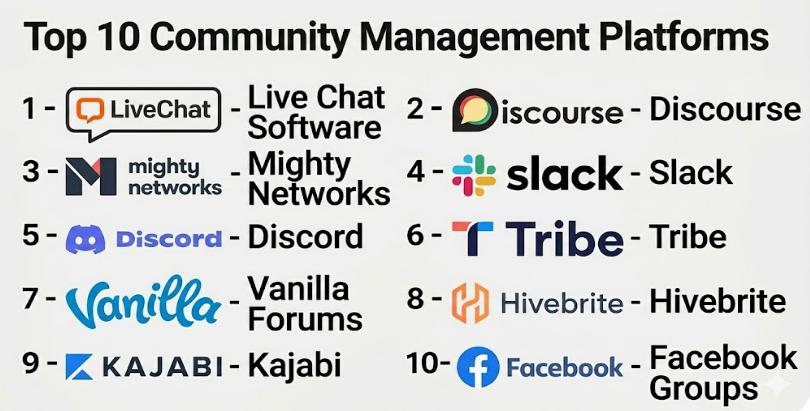
Top 10 Community Management Platforms
#1 — Discourse
Short description: An open-source community platform designed for forums, discussions, and knowledge sharing.
Key Features
- Threaded discussions and categories
- Moderation tools
- Trust levels and user roles
- Plugins and customization
- Notifications and engagement tools
- Analytics
Pros
- Highly customizable
- Strong community features
- Active open-source ecosystem
Cons
- Requires technical setup
- UI customization may take effort
Platforms / Deployment
Web
Cloud / Self-hosted
Security & Compliance
Not publicly stated
Integrations & Ecosystem
Discourse offers extensive integrations and plugins.
- APIs
- SSO integrations
- Third-party plugins
Support & Community
Very strong global community and documentation.
#2 — Circle
Short description: A modern community platform focused on creators and brands building private communities.
Key Features
- Spaces and channels
- Member management
- Live events and discussions
- Custom branding
- Monetization tools
- Analytics
Pros
- Clean and modern UI
- Easy to use
- Strong monetization features
Cons
- Pricing tiers
- Limited deep customization
Platforms / Deployment
Web
Cloud
Security & Compliance
Not publicly stated
Integrations & Ecosystem
- Zapier
- APIs
Support & Community
Strong onboarding and support.
#3 — Mighty Networks
Short description: A community platform combining courses, memberships, and social networking features.
Key Features
- Community feeds
- Courses and memberships
- Mobile apps
- Events and live streaming
- Monetization tools
Pros
- All-in-one platform
- Strong mobile experience
- Monetization options
Cons
- Limited customization
- Pricing
Platforms / Deployment
Web / Mobile
Cloud
Security & Compliance
Not publicly stated
Integrations & Ecosystem
- APIs
- Payment tools
Support & Community
Good support resources.
#4 — Slack (Communities)
Short description: A collaboration tool often used for community building and real-time communication.
Key Features
- Channels and messaging
- File sharing
- Integrations
- Search functionality
- Notifications
Pros
- Easy to use
- Real-time communication
- Strong integrations
Cons
- Not purpose-built for communities
- Limited structure for large communities
Platforms / Deployment
Web / Desktop / Mobile
Cloud
Security & Compliance
Not publicly stated
Integrations & Ecosystem
- Hundreds of integrations
- APIs
Support & Community
Strong ecosystem and support.
#5 — Discord
Short description: A popular platform for building highly engaged, real-time communities.
Key Features
- Voice and text channels
- Roles and permissions
- Bots and automation
- Events
- Moderation tools
Pros
- Highly engaging
- Free to start
- Strong community culture
Cons
- Can become noisy
- Not ideal for structured discussions
Platforms / Deployment
Web / Desktop / Mobile
Cloud
Security & Compliance
Not publicly stated
Integrations & Ecosystem
- Bots
- APIs
Support & Community
Large global community.
#6 — Tribe (Bettermode)
Short description: A customizable community platform for brands and SaaS companies.
Key Features
- Community widgets
- Custom branding
- Moderation tools
- Analytics
- API access
Pros
- Highly customizable
- Good for SaaS communities
- Flexible
Cons
- Requires setup
- Learning curve
Platforms / Deployment
Web
Cloud
Security & Compliance
Not publicly stated
Integrations & Ecosystem
- APIs
- CRM tools
Support & Community
Good support.
#7 — Vanilla Forums
Short description: A community platform designed for customer support and engagement.
Key Features
- Forums and Q&A
- Gamification
- Moderation tools
- Knowledge base
- Analytics
Pros
- Strong support community features
- Scalable
- Enterprise-ready
Cons
- UI customization needed
- Pricing
Platforms / Deployment
Web
Cloud
Security & Compliance
Not publicly stated
Integrations & Ecosystem
- CRM tools
- APIs
Support & Community
Enterprise support.
#8 — Hivebrite
Short description: A community platform focused on professional networks and alumni communities.
Key Features
- Member directories
- Events management
- Content sharing
- Analytics
- Monetization
Pros
- Strong for professional communities
- Scalable
- Feature-rich
Cons
- Pricing
- Setup complexity
Platforms / Deployment
Web / Mobile
Cloud
Security & Compliance
Not publicly stated
Integrations & Ecosystem
- CRM tools
- APIs
Support & Community
Good support.
#9 — Kajabi (Community)
Short description: A platform combining courses, marketing, and community features.
Key Features
- Community spaces
- Course hosting
- Marketing tools
- Payments
- Analytics
Pros
- All-in-one solution
- Strong monetization
- Easy to use
Cons
- Expensive
- Limited deep community features
Platforms / Deployment
Web
Cloud
Security & Compliance
Not publicly stated
Integrations & Ecosystem
- Payment tools
- APIs
Support & Community
Strong support.
#10 — Facebook Groups
Short description: A widely used free platform for building large-scale communities.
Key Features
- Group discussions
- Events
- Moderation tools
- Notifications
- Member management
Pros
- Free
- Large user base
- Easy to set up
Cons
- Limited control
- Algorithm dependency
Platforms / Deployment
Web / Mobile
Cloud
Security & Compliance
Not publicly stated
Integrations & Ecosystem
- Facebook ecosystem
Support & Community
Large global user base.
Comparison Table (Top 10)
| Tool Name | Best For | Platform(s) Supported | Deployment | Standout Feature | Public Rating |
|---|---|---|---|---|---|
| Discourse | Forums | Web | Cloud/Self-hosted | Open-source | N/A |
| Circle | Creators | Web | Cloud | Monetization | N/A |
| Mighty Networks | Creators | Web, Mobile | Cloud | Courses + community | N/A |
| Slack | Teams | Web, Desktop, Mobile | Cloud | Real-time chat | N/A |
| Discord | Communities | Web, Desktop, Mobile | Cloud | Engagement | N/A |
| Tribe | SaaS | Web | Cloud | Customization | N/A |
| Vanilla Forums | Support | Web | Cloud | Q&A forums | N/A |
| Hivebrite | Professional | Web, Mobile | Cloud | Networking | N/A |
| Kajabi | Creators | Web | Cloud | All-in-one | N/A |
| Facebook Groups | General | Web, Mobile | Cloud | Free | N/A |
Evaluation & Scoring of Community Management Platforms
| Tool Name | Core | Ease | Integrations | Security | Performance | Support | Value | Weighted Total |
|---|---|---|---|---|---|---|---|---|
| Discourse | 9 | 6 | 8 | 6 | 8 | 9 | 9 | 8.0 |
| Circle | 8 | 9 | 7 | 6 | 8 | 8 | 8 | 8.0 |
| Mighty Networks | 8 | 8 | 6 | 6 | 8 | 7 | 7 | 7.5 |
| Slack | 7 | 9 | 9 | 7 | 9 | 8 | 7 | 8.0 |
| Discord | 7 | 8 | 7 | 6 | 8 | 7 | 9 | 7.8 |
| Tribe | 8 | 7 | 8 | 6 | 8 | 7 | 7 | 7.6 |
| Vanilla Forums | 8 | 7 | 7 | 6 | 8 | 7 | 7 | 7.6 |
| Hivebrite | 8 | 7 | 7 | 6 | 8 | 7 | 7 | 7.6 |
| Kajabi | 7 | 8 | 6 | 6 | 8 | 7 | 7 | 7.4 |
| Facebook Groups | 6 | 9 | 6 | 5 | 8 | 6 | 10 | 7.6 |
Interpretation:
- Open-source and enterprise tools offer depth but require effort
- Creator tools excel in ease and monetization
- Free platforms provide value but limited control
- Scores are comparative and depend on use case
Which Community Management Platforms Is Right for You?
Solo / Freelancer
- Best: Circle, Discord, Facebook Groups
SMB
- Best: Circle, Tribe, Slack
Mid-Market
- Best: Discourse, Vanilla Forums
Enterprise
- Best: Hivebrite, Discourse
Budget vs Premium
- Budget: Facebook Groups, Discord
- Premium: Hivebrite
Feature Depth vs Ease of Use
- Deep: Discourse
- Easy: Circle
Integrations & Scalability
- Strong integrations: Slack
- Scalable: Discourse
Security & Compliance Needs
- Choose enterprise platforms for strict governance
Frequently Asked Questions (FAQs)
What is a community management platform?
It is software used to build and manage online communities.
Why do businesses need communities?
To improve engagement, retention, and customer loyalty.
Are community platforms free?
Some are free, others are paid with advanced features.
Can communities be monetized?
Yes, many platforms support subscriptions and memberships.
Are these platforms secure?
Most offer standard security features.
Do they support mobile access?
Yes, most platforms are mobile-friendly.
Can they integrate with other tools?
Yes, many support integrations.
What is the best platform for creators?
Circle and Mighty Networks are popular choices.
What should I avoid?
Choosing a platform without scalability.
How long does setup take?
From minutes to weeks depending on complexity.
Conclusion
Community Management Platforms are essential for organizations looking to build meaningful, scalable relationships with their audience. From open-source solutions like Discourse to creator-focused tools like Circle, the right platform depends on your goals, audience, and technical requirements.
