Introduction
GraphQL tooling refers to the ecosystem of platforms, libraries, and developer tools designed to build, manage, test, secure, and scale GraphQL APIs. Unlike traditional REST APIs, GraphQL allows clients to request exactly the data they need, making it more efficient and flexible for modern applications.
As applications become more data-driven and frontend-heavy, GraphQL has gained strong adoption across startups and enterprises alike. However, building and maintaining GraphQL APIs at scale requires specialized tooling for schema management, performance optimization, observability, and developer collaboration.
Common use cases include:
- Building flexible APIs for web and mobile applications
- Aggregating multiple backend services into a single GraphQL layer
- Improving frontend performance with optimized queries
- Managing schema evolution and versioning
- Monitoring API performance and usage
What buyers should evaluate:
- Schema design and management capabilities
- Performance optimization features (caching, query planning)
- Security controls (query depth limiting, authentication)
- Developer experience (IDE, documentation, testing tools)
- Integration with existing backend systems
- Observability and analytics
- Deployment flexibility (cloud, self-hosted)
- Support for federation and microservices
Best for:
Frontend developers, backend engineers, platform teams, and SaaS companies building scalable, data-driven applications with complex APIs.
Not ideal for:
Simple APIs with limited data needs or teams unfamiliar with GraphQL concepts may find REST-based solutions easier to manage.
Key Trends in GraphQL Tooling
- GraphQL federation adoption: Breaking schemas into modular services for scalability
- AI-assisted schema design: Tools suggesting optimizations and detecting inefficiencies
- Edge GraphQL execution: Reducing latency by moving query execution closer to users
- Improved observability: Real-time query monitoring and performance tracking
- Security enhancements: Query cost analysis and rate limiting
- GraphQL + REST hybrid models: Coexistence of both architectures
- Developer-first tooling: Enhanced IDEs, playgrounds, and collaboration tools
- Serverless GraphQL deployments: Simplifying infrastructure management
How We Selected These Tools (Methodology)
We evaluated GraphQL tools based on:
- Market adoption and developer popularity
- Feature completeness (schema, execution, monitoring)
- Performance and scalability capabilities
- Ease of use and developer experience
- Integration ecosystem and extensibility
- Support for modern GraphQL features (federation, subscriptions)
- Deployment flexibility
- Community and enterprise support
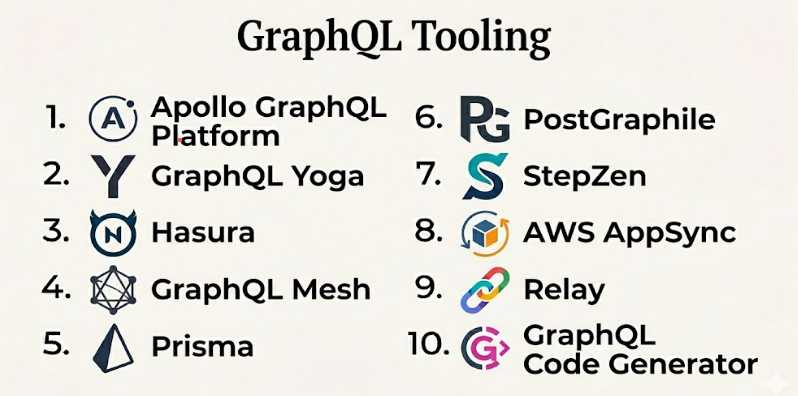
Top 10 GraphQL Tooling
#1 — Apollo GraphQL Platform
Short description: A comprehensive GraphQL platform offering tools for schema management, federation, and observability.
Key Features
- Apollo Server and Client
- Schema registry and versioning
- GraphQL federation
- Performance monitoring
- Developer tools and IDE
Pros
- Industry-standard ecosystem
- Strong federation support
Cons
- Pricing for advanced features
- Complexity at scale
Platforms / Deployment
Cloud / Self-hosted
Security & Compliance
RBAC, authentication support. Compliance: Not publicly stated
Integrations & Ecosystem
Widely integrates across frontend and backend ecosystems:
- React, Angular, Vue
- Node.js backends
- CI/CD tools
- Monitoring tools
Support & Community
Large global community with extensive documentation.
#2 — GraphQL Yoga
Short description: Lightweight and flexible GraphQL server focused on ease of use and performance.
Key Features
- Easy setup
- Built-in subscriptions
- Middleware support
- Performance optimization
- Modern GraphQL features
Pros
- Simple to get started
- Lightweight
Cons
- Fewer enterprise features
- Smaller ecosystem
Platforms / Deployment
Self-hosted
Security & Compliance
Not publicly stated
Integrations & Ecosystem
- Node.js ecosystem
- Middleware tools
- Dev frameworks
Support & Community
Growing open-source community.
#3 — Hasura
Short description: Instant GraphQL APIs over databases with real-time capabilities.
Key Features
- Auto-generated GraphQL APIs
- Real-time subscriptions
- Role-based access control
- Database integrations
- Event triggers
Pros
- Fast setup
- Strong database integration
Cons
- Limited customization
- Dependency on database structure
Platforms / Deployment
Cloud / Self-hosted
Security & Compliance
RBAC, authentication. Compliance: Not publicly stated
Integrations & Ecosystem
- PostgreSQL
- REST APIs
- Cloud services
Support & Community
Active community; good documentation.
#4 — GraphQL Mesh
Short description: Tool for unifying multiple APIs (REST, GraphQL, gRPC) into a single GraphQL endpoint.
Key Features
- API aggregation
- Supports multiple protocols
- Schema stitching
- Extensible plugins
- Developer-friendly
Pros
- Great for integration use cases
- Flexible
Cons
- Requires configuration
- Less enterprise support
Platforms / Deployment
Self-hosted
Security & Compliance
Not publicly stated
Integrations & Ecosystem
- REST APIs
- gRPC
- SOAP
Support & Community
Open-source community support.
#5 — Prisma
Short description: Modern database toolkit that integrates with GraphQL for backend development.
Key Features
- ORM for databases
- Type-safe queries
- Migration tools
- Integration with GraphQL
- Developer-friendly APIs
Pros
- Excellent developer experience
- Strong database tooling
Cons
- Not a full GraphQL platform
- Requires additional tools
Platforms / Deployment
Self-hosted
Security & Compliance
Not publicly stated
Integrations & Ecosystem
- Node.js
- Databases (PostgreSQL, MySQL)
- Backend frameworks
Support & Community
Large developer community.
#6 — PostGraphile
Short description: Tool for building GraphQL APIs directly from PostgreSQL databases.
Key Features
- Auto-generated schema
- Plugin system
- Performance optimization
- PostgreSQL integration
- Custom resolvers
Pros
- Strong performance
- Database-first approach
Cons
- PostgreSQL-specific
- Learning curve
Platforms / Deployment
Self-hosted
Security & Compliance
RBAC. Compliance: Not publicly stated
Integrations & Ecosystem
- PostgreSQL
- Node.js
- Plugins
Support & Community
Active open-source community.
#7 — StepZen
Short description: GraphQL platform focused on API composition and integration.
Key Features
- API federation
- Data stitching
- Serverless deployment
- Schema management
- Security features
Pros
- Easy API composition
- Cloud-native
Cons
- Limited flexibility
- Smaller ecosystem
Platforms / Deployment
Cloud
Security & Compliance
Authentication, encryption. Compliance: Not publicly stated
Integrations & Ecosystem
- REST APIs
- Databases
- Cloud services
Support & Community
Moderate community support.
#8 — AWS AppSync
Short description: Managed GraphQL service with real-time and offline capabilities.
Key Features
- Managed GraphQL APIs
- Real-time subscriptions
- Offline sync
- Integration with AWS services
- Security via IAM
Pros
- Fully managed
- Scalable
Cons
- AWS dependency
- Limited customization
Platforms / Deployment
Cloud
Security & Compliance
IAM, encryption. Compliance: Not publicly stated
Integrations & Ecosystem
- DynamoDB
- Lambda
- S3
Support & Community
Strong AWS ecosystem support.
#9 — Relay
Short description: A GraphQL client framework optimized for React applications.
Key Features
- Data fetching optimization
- Strong typing
- Query batching
- Performance improvements
- Developer tooling
Pros
- High performance
- Optimized for React
Cons
- Complex setup
- Limited to React
Platforms / Deployment
Web
Security & Compliance
Not publicly stated
Integrations & Ecosystem
- React
- Frontend tools
- Build systems
Support & Community
Backed by strong community.
#10 — GraphQL Code Generator
Short description: Tool for generating typed code from GraphQL schemas.
Key Features
- Code generation
- Type safety
- Plugin support
- Multi-language support
- Developer productivity
Pros
- Improves developer efficiency
- Strong typing
Cons
- Not a full platform
- Requires setup
Platforms / Deployment
Self-hosted
Security & Compliance
Not publicly stated
Integrations & Ecosystem
- TypeScript
- GraphQL clients
- Build tools
Support & Community
Active open-source community.
Comparison Table (Top 10)
| Tool Name | Best For | Platform(s) Supported | Deployment | Standout Feature | Public Rating |
|---|---|---|---|---|---|
| Apollo | Full platform | Web | Cloud/Self | Federation | N/A |
| GraphQL Yoga | Lightweight APIs | Node.js | Self | Simplicity | N/A |
| Hasura | DB-driven APIs | Web | Hybrid | Auto APIs | N/A |
| GraphQL Mesh | API aggregation | Node.js | Self | Multi-source | N/A |
| Prisma | DB tooling | Node.js | Self | ORM | N/A |
| PostGraphile | PostgreSQL APIs | Node.js | Self | Performance | N/A |
| StepZen | API composition | Web | Cloud | Federation | N/A |
| AWS AppSync | Managed GraphQL | Web | Cloud | Real-time | N/A |
| Relay | Frontend apps | Web | Client | Optimization | N/A |
| Code Generator | Dev tooling | CLI | Self | Type safety | N/A |
Evaluation & Scoring of GraphQL Tooling Tools
| Tool Name | Core (25%) | Ease (15%) | Integrations (15%) | Security (10%) | Performance (10%) | Support (10%) | Value (15%) | Weighted Total |
|---|---|---|---|---|---|---|---|---|
| Apollo | 9 | 7 | 9 | 8 | 9 | 9 | 7 | 8.4 |
| Yoga | 7 | 9 | 7 | 6 | 8 | 7 | 9 | 7.8 |
| Hasura | 8 | 8 | 8 | 7 | 9 | 8 | 8 | 8.2 |
| Mesh | 7 | 7 | 9 | 6 | 8 | 7 | 8 | 7.6 |
| Prisma | 8 | 9 | 8 | 6 | 8 | 8 | 9 | 8.2 |
| PostGraphile | 8 | 7 | 7 | 7 | 9 | 7 | 8 | 7.8 |
| StepZen | 7 | 8 | 7 | 7 | 8 | 7 | 8 | 7.6 |
| AppSync | 8 | 8 | 8 | 8 | 9 | 8 | 7 | 8.1 |
| Relay | 7 | 6 | 7 | 6 | 9 | 7 | 8 | 7.3 |
| CodeGen | 6 | 8 | 8 | 6 | 7 | 7 | 9 | 7.4 |
How to interpret the scores:
- Scores are comparative, not absolute
- Higher scores indicate better balance across criteria
- Developer tools may score high in ease but lower in core features
- Enterprise platforms prioritize scalability and security
- Choose based on your workflow and architecture
Which GraphQL Tooling Tool Is Right for You?
Solo / Freelancer
- Best: GraphQL Yoga, Code Generator
- Focus on simplicity and speed
SMB
- Best: Hasura, Prisma
- Balance ease and capability
Mid-Market
- Best: Apollo, AppSync
- Need scalability and integrations
Enterprise
- Best: Apollo, Hasura, AppSync
- Focus on governance and performance
Budget vs Premium
- Budget: Yoga, PostGraphile
- Premium: Apollo
Feature Depth vs Ease of Use
- Deep features: Apollo
- Easy to use: Hasura
Integrations & Scalability
- Strong integrations: AppSync, Apollo
- Scalable: Hasura
Security & Compliance Needs
- High security: AppSync
- Moderate: Yoga
Frequently Asked Questions (FAQs)
What is GraphQL tooling?
It includes tools for building, managing, and optimizing GraphQL APIs.
Is GraphQL better than REST?
It depends—GraphQL is more flexible but can be complex.
Are these tools free?
Some are open-source; others offer paid plans.
Can I use GraphQL with existing APIs?
Yes, tools like Mesh enable this.
Is GraphQL secure?
Yes, with proper controls like query limits and authentication.
What is federation?
It allows multiple GraphQL services to combine into one schema.
Do I need a database for GraphQL?
Not necessarily, but many tools integrate with databases.
How hard is it to learn?
Moderate learning curve for beginners.
Can GraphQL scale?
Yes, with proper tooling and architecture.
What are common mistakes?
Over-fetching, poor schema design, and lack of monitoring.
Conclusion
GraphQL tooling has evolved into a powerful ecosystem supporting modern application development. From lightweight servers to enterprise-grade platforms, there are solutions for every stage and scale.
