Introduction
Physics engines are software components that simulate real-world physical behavior in digital environments. They are widely used in game development, simulations, robotics, AR/VR, and animation to replicate motion, collisions, gravity, fluid dynamics, and other physical interactions.
Instead of manually coding every interaction, developers use physics engines to handle complex calculations such as rigid body dynamics, soft body physics, collision detection, and particle systems. This enables more realistic gameplay, immersive simulations, and efficient development workflows.
As interactive applications become more advanced, physics engines play a critical role in delivering real-time performance, accuracy, and scalability across devices.
Common Use Cases
- Game physics (collisions, movement, destructible environments)
- Simulation and training systems
- Robotics and AI testing environments
- AR/VR immersive experiences
- Animation and visual effects
What Buyers Should Evaluate
- Type of physics supported (2D, 3D, rigid body, soft body, fluids)
- Performance and real-time capabilities
- Integration with game engines and frameworks
- Accuracy vs speed trade-offs
- Scalability for large simulations
- Ease of use and documentation
- Cross-platform compatibility
- Licensing and pricing
- Community and ecosystem
Best for: Game developers, simulation engineers, robotics teams, AR/VR developers, and studios building physics-driven experiences.
Not ideal for: Static applications, UI-based tools without physical interactions, or projects that do not require simulation realism.
Key Trends in Physics Engines
- Real-time physics with high-performance optimization
- GPU-accelerated physics simulations
- Integration with AI and machine learning systems
- Improved soft body and fluid simulations
- Cross-platform physics frameworks
- Cloud-based simulation environments
- Physics engines for digital twins and robotics
- Increased use in AR/VR and spatial computing
- Hybrid physics models balancing realism and performance
- Open-source adoption and customization
How We Selected These Tools (Methodology)
- Evaluated adoption across gaming and simulation industries
- Assessed support for 2D and 3D physics systems
- Reviewed performance and scalability capabilities
- Considered integration with popular game engines
- Analyzed documentation and developer experience
- Evaluated open-source vs commercial options
- Considered flexibility for different use cases
- Reviewed ecosystem and community support
- Included both lightweight and enterprise-grade engines
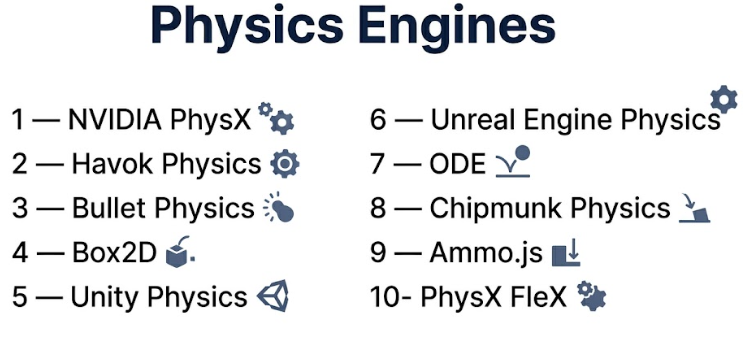
Top 10 Physics Engines
#1 — NVIDIA PhysX
Short description: A widely used physics engine known for high-performance real-time simulation in games and applications.
Key Features
- Rigid body dynamics
- Collision detection
- GPU acceleration
- Particle systems
- Cloth and fluid simulation
- Integration with major engines
Pros
- High performance and scalability
- Industry adoption
Cons
- Complex setup for advanced features
- GPU features may require specific hardware
Platforms / Deployment
Windows / Linux / Console
Self-hosted
Security & Compliance
Not publicly stated
Integrations & Ecosystem
PhysX integrates with major development ecosystems and game engines.
- Unreal Engine
- Unity
- Custom engines
- Simulation platforms
Support & Community
Strong developer community and documentation.
#2 — Havok Physics
Short description: A commercial physics engine widely used in AAA games and simulations.
Key Features
- Rigid body simulation
- Collision detection
- Destruction physics
- Animation tools
- High scalability
Pros
- Proven in large-scale projects
- Reliable and stable
Cons
- Commercial licensing
- Limited public access
Platforms / Deployment
Windows / Console / Mobile
Self-hosted
Security & Compliance
Not publicly stated
Integrations & Ecosystem
- Game engines
- Proprietary pipelines
Support & Community
Enterprise-level support.
#3 — Bullet Physics
Short description: An open-source physics engine supporting real-time simulation for games and visual effects.
Key Features
- Rigid and soft body dynamics
- Collision detection
- Open-source flexibility
- GPU support
- Real-time simulation
Pros
- Free and customizable
- Wide adoption
Cons
- Requires setup and tuning
- Limited official support
Platforms / Deployment
Windows / macOS / Linux
Self-hosted
Security & Compliance
Not publicly stated
Integrations & Ecosystem
- Blender
- Unity
- Custom engines
Support & Community
Active open-source community.
#4 — Box2D
Short description: A lightweight 2D physics engine used for games and simulations.
Key Features
- 2D rigid body physics
- Collision detection
- Joint systems
- Lightweight architecture
- Real-time simulation
Pros
- Easy to use
- High performance for 2D
Cons
- Limited to 2D
- No advanced physics features
Platforms / Deployment
Windows / macOS / Linux / Mobile
Self-hosted
Security & Compliance
Not publicly stated
Integrations & Ecosystem
- Unity
- Game frameworks
Support & Community
Strong community.
#5 — Unity Physics (Built-in)
Short description: A built-in physics system within Unity for handling real-time interactions.
Key Features
- Rigid body physics
- Collision detection
- Character controllers
- Integration with Unity
- Real-time simulation
Pros
- Easy integration
- Beginner-friendly
Cons
- Less customizable than standalone engines
- Performance tuning required
Platforms / Deployment
Multi-platform
Self-hosted
Security & Compliance
Not publicly stated
Integrations & Ecosystem
- Unity ecosystem
- Asset Store
Support & Community
Large community support.
#6 — Unreal Engine Physics
Short description: A physics system integrated into Unreal Engine for high-end simulations.
Key Features
- Chaos physics system
- Destruction simulation
- Rigid body physics
- Cloth simulation
- Real-time interactions
Pros
- High-quality simulations
- Integrated workflow
Cons
- Resource-intensive
- Requires Unreal Engine
Platforms / Deployment
Multi-platform
Self-hosted
Security & Compliance
Not publicly stated
Integrations & Ecosystem
- Unreal Engine tools
- VFX pipelines
Support & Community
Strong developer support.
#7 — ODE (Open Dynamics Engine)
Short description: An open-source physics engine designed for simulating rigid body dynamics.
Key Features
- Rigid body simulation
- Collision detection
- Joint systems
- Open-source
- Real-time capabilities
Pros
- Free and flexible
- Lightweight
Cons
- Limited advanced features
- Older architecture
Platforms / Deployment
Windows / macOS / Linux
Self-hosted
Security & Compliance
Not publicly stated
Integrations & Ecosystem
- Robotics frameworks
- Simulation tools
Support & Community
Moderate community.
#8 — Chipmunk Physics
Short description: A fast and lightweight 2D physics engine used in games and apps.
Key Features
- 2D physics
- Collision detection
- Fast performance
- Easy integration
- Lightweight
Pros
- High performance for 2D
- Simple to integrate
Cons
- Limited to 2D
- Fewer advanced features
Platforms / Deployment
Multi-platform
Self-hosted
Security & Compliance
Not publicly stated
Integrations & Ecosystem
- Game frameworks
- Mobile SDKs
Support & Community
Active community.
#9 — Ammo.js
Short description: A JavaScript port of Bullet Physics for web-based applications.
Key Features
- 3D physics simulation
- Web-based deployment
- Rigid body dynamics
- Collision detection
- Real-time interaction
Pros
- Works in browsers
- Flexible
Cons
- Performance limitations
- Requires optimization
Platforms / Deployment
Web
Cloud
Security & Compliance
Not publicly stated
Integrations & Ecosystem
- WebGL
- Three.js
Support & Community
Growing web developer community.
#10 — PhysX FleX
Short description: A particle-based physics simulation engine for fluids, cloth, and soft bodies.
Key Features
- Unified particle simulation
- Fluid dynamics
- Cloth simulation
- GPU acceleration
- Real-time rendering
Pros
- Advanced simulations
- High visual realism
Cons
- Hardware requirements
- Complex setup
Platforms / Deployment
Windows / Linux
Self-hosted
Security & Compliance
Not publicly stated
Integrations & Ecosystem
- NVIDIA ecosystem
- Simulation tools
Support & Community
Moderate community support.
Comparison Table (Top 10)
| Tool Name | Best For | Platform(s) Supported | Deployment | Standout Feature | Public Rating |
|---|---|---|---|---|---|
| NVIDIA PhysX | Real-time physics | Multi-platform | Self-hosted | GPU acceleration | N/A |
| Havok | AAA simulations | Multi-platform | Self-hosted | Stability | N/A |
| Bullet | Open-source physics | Multi-platform | Self-hosted | Flexibility | N/A |
| Box2D | 2D games | Multi-platform | Self-hosted | Lightweight | N/A |
| Unity Physics | Unity dev | Multi-platform | Self-hosted | Integration | N/A |
| Unreal Physics | High-end games | Multi-platform | Self-hosted | Chaos system | N/A |
| ODE | Simulation | Multi-platform | Self-hosted | Open-source | N/A |
| Chipmunk | 2D apps | Multi-platform | Self-hosted | Speed | N/A |
| Ammo.js | Web physics | Web | Cloud | Browser support | N/A |
| PhysX FleX | Advanced sim | Multi-platform | Self-hosted | Particle physics | N/A |
Evaluation & Scoring of Physics Engines
| Tool Name | Core (25%) | Ease (15%) | Integrations (15%) | Security (10%) | Performance (10%) | Support (10%) | Value (15%) | Weighted Total |
|---|---|---|---|---|---|---|---|---|
| PhysX | 9 | 7 | 9 | 7 | 10 | 9 | 8 | 8.6 |
| Havok | 9 | 6 | 8 | 7 | 9 | 8 | 6 | 8.0 |
| Bullet | 8 | 7 | 8 | 6 | 8 | 7 | 10 | 8.1 |
| Box2D | 7 | 9 | 7 | 6 | 7 | 8 | 10 | 7.9 |
| Unity Physics | 7 | 9 | 9 | 6 | 7 | 9 | 8 | 8.0 |
| Unreal Physics | 8 | 7 | 8 | 6 | 9 | 9 | 7 | 8.1 |
| ODE | 6 | 7 | 6 | 6 | 7 | 6 | 9 | 6.9 |
| Chipmunk | 6 | 8 | 6 | 6 | 7 | 7 | 9 | 7.1 |
| Ammo.js | 6 | 7 | 7 | 6 | 6 | 7 | 9 | 7.0 |
| FleX | 8 | 5 | 7 | 6 | 9 | 6 | 7 | 7.3 |
How to interpret these scores:
- Scores are comparative, not absolute
- Higher scores indicate better balance across features
- Open-source tools often score higher in value
- Enterprise tools excel in performance and scalability
- Choose based on your specific use case
Which Physics Engine Is Right for You?
Solo / Freelancer
- Best: Box2D, Bullet
- Lightweight and cost-effective
SMB
- Best: Unity Physics, Bullet
- Balanced features and usability
Mid-Market
- Best: PhysX, Unreal Physics
- Performance and scalability
Enterprise
- Best: Havok, PhysX
- High-end simulations and reliability
Budget vs Premium
- Budget: Bullet, Box2D
- Premium: Havok
Feature Depth vs Ease of Use
- Deep features: PhysX, Havok
- Easy: Box2D
Integrations & Scalability
- Best: PhysX, Unity Physics
- Strong: Bullet
Security & Compliance Needs
- Stronger: Enterprise tools
- Basic: Open-source engines
Frequently Asked Questions (FAQs)
What is a physics engine?
A software component that simulates physical interactions like movement, collisions, and forces.
Do I need a physics engine?
If your application involves motion or interaction, yes.
Are physics engines free?
Some are open-source, others are commercial.
Which is best for 2D games?
Box2D and Chipmunk are popular choices.
Can I use physics engines in web apps?
Yes, tools like Ammo.js support web environments.
Do they support 3D simulations?
Many engines support full 3D physics.
What about performance?
Depends on engine and hardware optimization.
Can I switch engines later?
Possible but requires rework.
Are physics engines used outside games?
Yes, in robotics, simulations, and training.
How complex are they?
They range from beginner-friendly to highly advanced systems.
Conclusion
Physics engines are essential for creating realistic, interactive, and immersive experiences across games, simulations, and digital environments. From lightweight 2D engines to advanced GPU-accelerated systems, each tool serves different needs depending on complexity and performance requirements.
The best choice depends on your project goals, technical expertise, and performance needs.
