Introduction
Mechanical Design Software refers to specialized tools used to design, model, simulate, and optimize mechanical components and systems. These platforms enable engineers and product designers to create precise 2D drawings and 3D models, reducing errors and accelerating product development cycles.
As industries increasingly rely on digital workflows, these tools have evolved beyond simple drafting into comprehensive platforms that combine CAD, CAM, and CAE capabilities. With the rise of automation, connected manufacturing, and intelligent design workflows, choosing the right mechanical design software is now a strategic decision rather than just a technical one.
Common use cases include:
- Product design and prototyping
- Industrial equipment and machinery modeling
- Automotive and aerospace component development
- Consumer product engineering
- Simulation and stress testing
What buyers should evaluate:
- Modeling capabilities (parametric, direct, surface)
- Simulation and analysis tools
- Ease of use and learning curve
- Integration with manufacturing systems
- Performance with large assemblies
- Collaboration and version control
- Security and access control
- Pricing and licensing models
- Customization and automation capabilities
Best for: Mechanical engineers, CAD designers, manufacturing teams, and R&D departments across industries such as automotive, aerospace, heavy machinery, and electronics.
Not ideal for: Users who only need basic diagramming or drafting. In such cases, lightweight CAD or drawing tools may be more efficient and cost-effective.
Key Trends in Mechanical Design Software
- AI-assisted design workflows: Tools now suggest geometry, optimize parts, and reduce material usage automatically.
- Cloud-first collaboration: Teams can work simultaneously on designs without local installations.
- Integrated simulation: Simulation tools are embedded directly into design workflows.
- Digital twin capabilities: Linking real-world performance data with design models.
- Subscription-based licensing: Flexible pricing replacing traditional perpetual licenses.
- Low-code automation: Engineers can automate repetitive tasks without heavy programming.
- Interoperability improvements: Better support for multiple file formats and cross-platform workflows.
- Security-first architecture: Enhanced encryption, access control, and compliance readiness.
- Mobile and remote access: Design reviews and edits from anywhere.
- Sustainability optimization: Tools help reduce material waste and environmental impact.
How We Selected These Tools (Methodology)
- Considered market adoption and industry reputation
- Evaluated feature completeness across CAD, CAM, and CAE
- Assessed performance with complex assemblies
- Reviewed security and compliance signals where available
- Analyzed integration ecosystems and extensibility
- Compared ease of use for beginners vs experts
- Evaluated support, documentation, and community strength
- Reviewed deployment flexibility (cloud vs desktop vs hybrid)
- Ensured coverage across different business sizes and industries
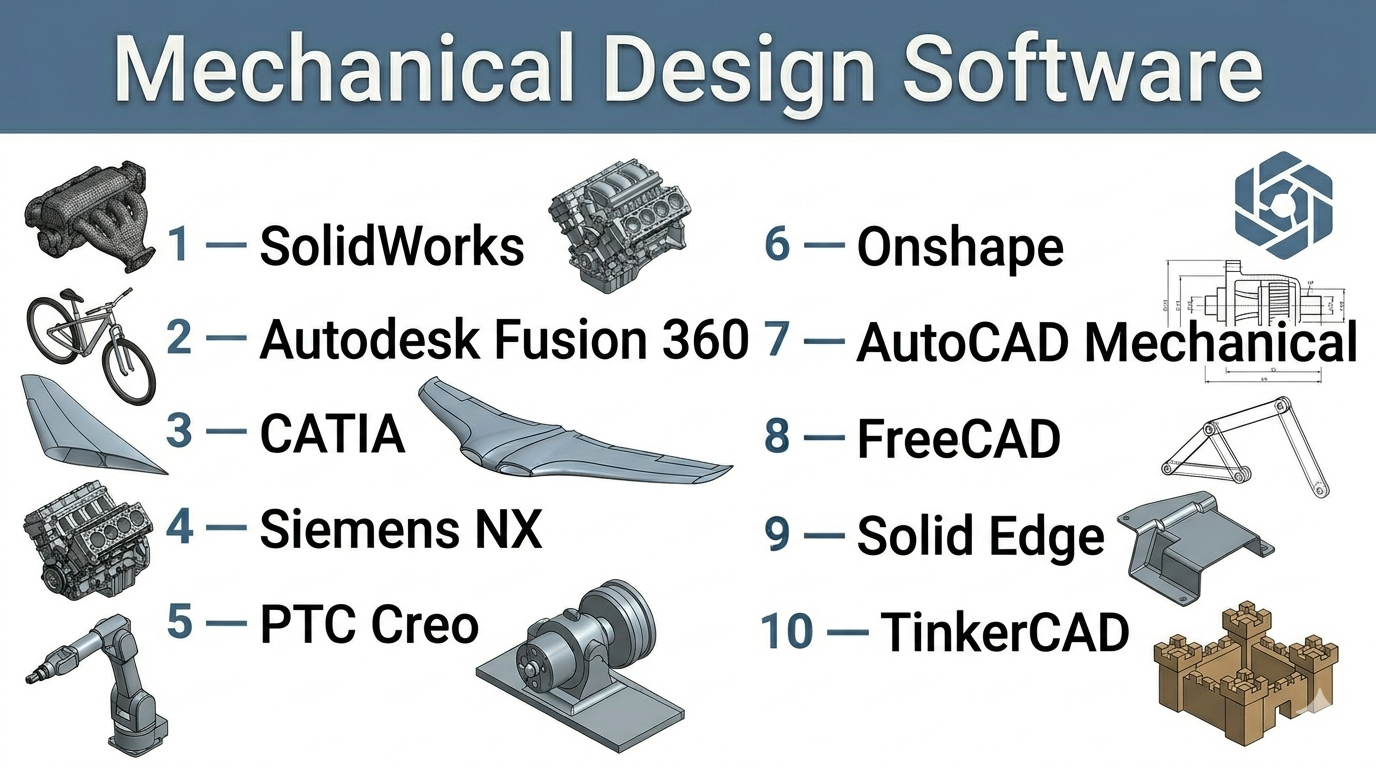
Top 10 Mechanical Design Software Tools
#1 — SolidWorks
Short description: A leading 3D CAD platform widely used for product design and engineering. Ideal for professionals requiring advanced modeling and simulation.
Key Features
- Parametric 3D modeling
- Assembly and motion simulation
- Integrated FEA tools
- Sheet metal and weldment design
- Detailed documentation tools
- Large plugin ecosystem
Pros
- Industry-standard tool
- Strong simulation capabilities
Cons
- Expensive licensing
- Requires powerful hardware
Platforms / Deployment
Windows / Self-hosted
Security & Compliance
SSO, RBAC (varies by deployment)
Integrations & Ecosystem
SolidWorks integrates well with manufacturing and data management systems.
- PDM systems
- ERP tools
- Simulation plugins
- CAM software
Support & Community
Extensive documentation, large global user base, and strong enterprise support.
#2 — Autodesk Fusion 360
Short description: A cloud-based platform combining CAD, CAM, and CAE in a single environment. Suitable for startups and collaborative teams.
Key Features
- Cloud-based modeling
- Generative design tools
- Integrated CAM workflows
- Real-time collaboration
- Simulation and rendering
- Version control
Pros
- All-in-one platform
- Affordable for small teams
Cons
- Internet dependency
- Limited offline functionality
Platforms / Deployment
Web / Windows / macOS / Cloud
Security & Compliance
MFA, encryption (details vary)
Integrations & Ecosystem
Fusion 360 connects with the broader Autodesk ecosystem.
- APIs for customization
- Manufacturing integrations
- Cloud storage tools
Support & Community
Strong community support and learning resources.
#3 — CATIA
Short description: Enterprise-grade CAD software used in complex industries like aerospace and automotive engineering.
Key Features
- Advanced surface modeling
- Systems engineering capabilities
- Multi-disciplinary design
- Integrated simulation
- PLM connectivity
Pros
- Extremely powerful
- Ideal for complex engineering
Cons
- Steep learning curve
- High cost
Platforms / Deployment
Windows / Hybrid
Security & Compliance
Not publicly stated
Integrations & Ecosystem
Designed for enterprise ecosystems.
- PLM systems
- Simulation tools
- Engineering workflows
Support & Community
Enterprise-level training and support.
#4 — Siemens NX
Short description: Advanced engineering software integrating CAD, CAM, and CAE for large-scale industrial use.
Key Features
- Integrated design and manufacturing
- Digital twin capabilities
- Advanced simulation
- Large assembly management
- Automation tools
Pros
- Highly scalable
- Strong performance
Cons
- Complex interface
- Expensive
Platforms / Deployment
Windows / Hybrid
Security & Compliance
Not publicly stated
Integrations & Ecosystem
Part of Siemens ecosystem.
- PLM integration
- APIs
- Manufacturing tools
Support & Community
Strong enterprise support.
#5 — PTC Creo
Short description: Parametric CAD software with advanced simulation and augmented reality features.
Key Features
- Parametric modeling
- Real-time simulation
- AR visualization
- Additive manufacturing support
- Data management
Pros
- Powerful modeling
- Scalable solution
Cons
- Learning curve
- Costly
Platforms / Deployment
Windows / Hybrid
Security & Compliance
Not publicly stated
Integrations & Ecosystem
- PTC ecosystem
- IoT integrations
- APIs
Support & Community
Well-supported with training resources.
#6 — Onshape
Short description: A cloud-native CAD platform designed for real-time collaboration and version control.
Key Features
- Browser-based modeling
- Real-time collaboration
- Version control
- Mobile access
- Data management
Pros
- No installation needed
- Excellent for remote teams
Cons
- Requires constant internet
- Limited offline capabilities
Platforms / Deployment
Web / Cloud
Security & Compliance
SSO, MFA, encryption
Integrations & Ecosystem
Onshape supports modern cloud integrations.
- REST APIs
- Cloud storage tools
- Third-party apps
Support & Community
Growing community and solid documentation.
#7 — AutoCAD Mechanical
Short description: A specialized version of AutoCAD tailored for mechanical drafting and documentation.
Key Features
- 2D drafting tools
- Mechanical libraries
- Standards-based design
- BOM generation
- Annotation tools
Pros
- Familiar interface
- Efficient for drafting
Cons
- Limited 3D capabilities
- Not ideal for complex models
Platforms / Deployment
Windows / macOS / Cloud
Security & Compliance
Varies
Integrations & Ecosystem
Part of Autodesk ecosystem.
- APIs
- Cloud integrations
- Data management tools
Support & Community
Large user base and strong support.
#8 — FreeCAD
Short description: An open-source parametric CAD tool suitable for individuals and small teams.
Key Features
- Parametric modeling
- Modular architecture
- Custom scripting
- Multi-platform support
- Plugin ecosystem
Pros
- Free and open-source
- Highly customizable
Cons
- Less polished UI
- Limited enterprise support
Platforms / Deployment
Windows / macOS / Linux
Security & Compliance
Not publicly stated
Integrations & Ecosystem
Community-driven ecosystem.
- Plugins
- Extensions
- Custom scripts
Support & Community
Community-based support.
#9 — Solid Edge
Short description: Siemens CAD solution combining parametric and direct modeling approaches.
Key Features
- Synchronous technology
- Simulation tools
- Electrical design support
- Data management
- 3D modeling
Pros
- Flexible modeling
- Good performance
Cons
- Smaller community
- Learning curve
Platforms / Deployment
Windows / Hybrid
Security & Compliance
Not publicly stated
Integrations & Ecosystem
- Siemens ecosystem
- PLM tools
- APIs
Support & Community
Moderate documentation and support.
#10 — TinkerCAD
Short description: Beginner-friendly CAD tool designed for simple 3D modeling and education.
Key Features
- Drag-and-drop interface
- Browser-based
- Basic modeling tools
- STL export
- Educational resources
Pros
- Easy to learn
- Free to use
Cons
- Limited advanced features
- Not suitable for professionals
Platforms / Deployment
Web / Cloud
Security & Compliance
Not publicly stated
Integrations & Ecosystem
- Basic file export
- Limited integrations
Support & Community
Strong for beginners and education.
Comparison Table (Top 10)
| Tool Name | Best For | Platform(s) Supported | Deployment | Standout Feature | Public Rating |
|---|---|---|---|---|---|
| SolidWorks | Professional engineers | Windows | Self-hosted | Advanced simulation | N/A |
| Fusion 360 | Startups & SMBs | Web, Windows, macOS | Cloud | All-in-one platform | N/A |
| CATIA | Enterprise engineering | Windows | Hybrid | Complex system design | N/A |
| Siemens NX | Large enterprises | Windows | Hybrid | Digital twin | N/A |
| PTC Creo | Product teams | Windows | Hybrid | AR visualization | N/A |
| Onshape | Remote teams | Web | Cloud | Real-time collaboration | N/A |
| AutoCAD Mechanical | Drafting | Windows, macOS | Cloud | Mechanical libraries | N/A |
| FreeCAD | Individuals | Windows, macOS, Linux | Self-hosted | Open-source | N/A |
| Solid Edge | SMB engineers | Windows | Hybrid | Synchronous tech | N/A |
| TinkerCAD | Beginners | Web | Cloud | Ease of use | N/A |
Evaluation & Scoring of Mechanical Design Software
| Tool Name | Core (25%) | Ease (15%) | Integrations (15%) | Security (10%) | Performance (10%) | Support (10%) | Value (15%) | Weighted Total |
|---|---|---|---|---|---|---|---|---|
| SolidWorks | 9 | 7 | 8 | 7 | 9 | 9 | 6 | 8.0 |
| Fusion 360 | 8 | 8 | 8 | 7 | 7 | 8 | 8 | 7.8 |
| CATIA | 10 | 5 | 9 | 8 | 9 | 8 | 5 | 8.1 |
| Siemens NX | 10 | 5 | 9 | 8 | 9 | 8 | 5 | 8.1 |
| PTC Creo | 9 | 6 | 8 | 7 | 8 | 8 | 6 | 7.7 |
| Onshape | 8 | 9 | 7 | 8 | 7 | 7 | 8 | 7.8 |
| AutoCAD Mechanical | 7 | 8 | 7 | 7 | 7 | 8 | 7 | 7.3 |
| FreeCAD | 6 | 6 | 6 | 6 | 6 | 6 | 9 | 6.5 |
| Solid Edge | 8 | 7 | 7 | 7 | 8 | 7 | 7 | 7.5 |
| TinkerCAD | 5 | 10 | 5 | 6 | 5 | 7 | 9 | 6.8 |
How to interpret these scores:
- These scores are comparative, not absolute performance indicators.
- Enterprise tools score higher in features and performance but lower in value.
- Cloud-based tools excel in usability and collaboration.
- Open-source tools rank higher in cost-effectiveness but lower in enterprise readiness.
- Always prioritize tools based on your specific use case and business needs.
Which Mechanical Design Software Is Right for You?
Solo / Freelancer
- Best choices: Fusion 360, Onshape, FreeCAD
- Focus on affordability, ease of learning, and flexibility
SMB
- Best choices: Solid Edge, Fusion 360, Onshape
- Balanced need for cost and capability
Mid-Market
- Best choices: SolidWorks, PTC Creo
- Need scalability and integration
Enterprise
- Best choices: CATIA, Siemens NX
- Focus on performance, complexity, and security
Budget vs Premium
- Budget: FreeCAD, TinkerCAD
- Premium: CATIA, Siemens NX
Feature Depth vs Ease of Use
- Deep features: CATIA, NX
- Ease of use: TinkerCAD, Onshape
Integrations & Scalability
- Strong ecosystems: SolidWorks, Siemens NX
- Growing ecosystems: Onshape
Security & Compliance Needs
- Enterprise-ready: CATIA, Siemens NX
- Moderate: Fusion 360, Onshape
Frequently Asked Questions (FAQs)
What is mechanical design software?
It is software used to create, simulate, and optimize mechanical parts and systems in 2D and 3D.
How much does it cost?
Costs vary widely. Some tools are free, while enterprise solutions require significant investment.
Which tool is best for beginners?
TinkerCAD and Fusion 360 are commonly recommended due to ease of use.
Can I use these tools offline?
Desktop tools support offline use, while cloud tools require internet access.
Do these tools support simulation?
Most advanced tools include built-in simulation capabilities.
What industries use these tools?
Automotive, aerospace, manufacturing, and electronics industries widely use them.
Are cloud tools secure?
Most include encryption and access control, but details vary by vendor.
Can I switch between tools easily?
Switching is possible but can involve file compatibility challenges.
Do I need training?
Yes, especially for advanced tools like CATIA or Siemens NX.
What should I avoid when choosing a tool?
Avoid ignoring integration needs, scalability, and long-term costs.
Conclusion
Mechanical design software plays a critical role in modern engineering and product development. From simple drafting tools to complex enterprise systems, the right choice depends on your specific requirements, budget, and workflow.
There is no single “best” solution—only the one that aligns with your team’s needs and goals. Enterprise platforms offer depth and scalability, while cloud-based tools provide flexibility and collaboration. Open-source options remain valuable for cost-sensitive users.
