Introduction
Remote Monitoring & Management (RMM) tools are software platforms that allow IT teams and managed service providers (MSPs) to monitor, manage, and maintain endpoints, networks, and systems remotely. In simple terms, RMM tools enable administrators to proactively identify issues, automate maintenance tasks, and resolve problems without needing physical access to devices.
As organizations increasingly adopt distributed work environments and cloud infrastructure, RMM tools have become essential for maintaining system health, security, and performance at scale. Modern RMM platforms go beyond basic monitoring—they incorporate automation, patch management, scripting, and AI-driven insights to reduce downtime and improve operational efficiency.
Common use cases include:
- Monitoring servers, endpoints, and network devices
- Remote troubleshooting and IT support
- Patch management and software updates
- Endpoint security and compliance management
- IT automation and scripting
Key evaluation criteria buyers should consider:
- Real-time monitoring and alerting capabilities
- Remote access and control features
- Patch management automation
- Endpoint and network visibility
- Security and compliance features
- Automation and scripting flexibility
- Integration with PSA, ITSM, and security tools
- Scalability for large environments
- Ease of deployment and use
- Pricing and licensing model
Best for: Managed Service Providers (MSPs), IT departments, system administrators, and enterprises managing distributed infrastructure and endpoints.
Not ideal for: Small teams with minimal IT infrastructure or organizations that rely entirely on fully managed cloud services without endpoint control requirements.
Key Trends in Portfolio & Remote Monitoring & Management (RMM) Tools for the Future
- AI-driven monitoring and anomaly detection: Identifying issues before they impact users
- Automation-first operations: Script-based and policy-driven automation reducing manual work
- Security integration: RMM tools increasingly bundling endpoint detection and response (EDR)
- Cloud-native RMM platforms: Faster deployment and scalability
- Unified IT management: Combining RMM, PSA, and ITSM capabilities
- Zero-trust security alignment: Stronger authentication and access controls
- Remote workforce enablement: Improved support for distributed teams
- Patch automation advancements: Intelligent patch prioritization and deployment
- Integration with DevOps workflows: Bridging IT operations and development
- Usage-based pricing models: Flexible billing aligned with device count
How We Selected These Tools (Methodology)
- Evaluated market adoption among MSPs and IT teams
- Assessed feature completeness, including monitoring, automation, and patching
- Reviewed performance and reliability indicators
- Considered security capabilities and compliance support
- Analyzed integration ecosystems with PSA, ITSM, and security tools
- Included tools suitable for SMB, mid-market, and enterprise environments
- Balanced ease of use and advanced automation capabilities
- Evaluated scalability and deployment models
- Reviewed support, documentation, and community strength
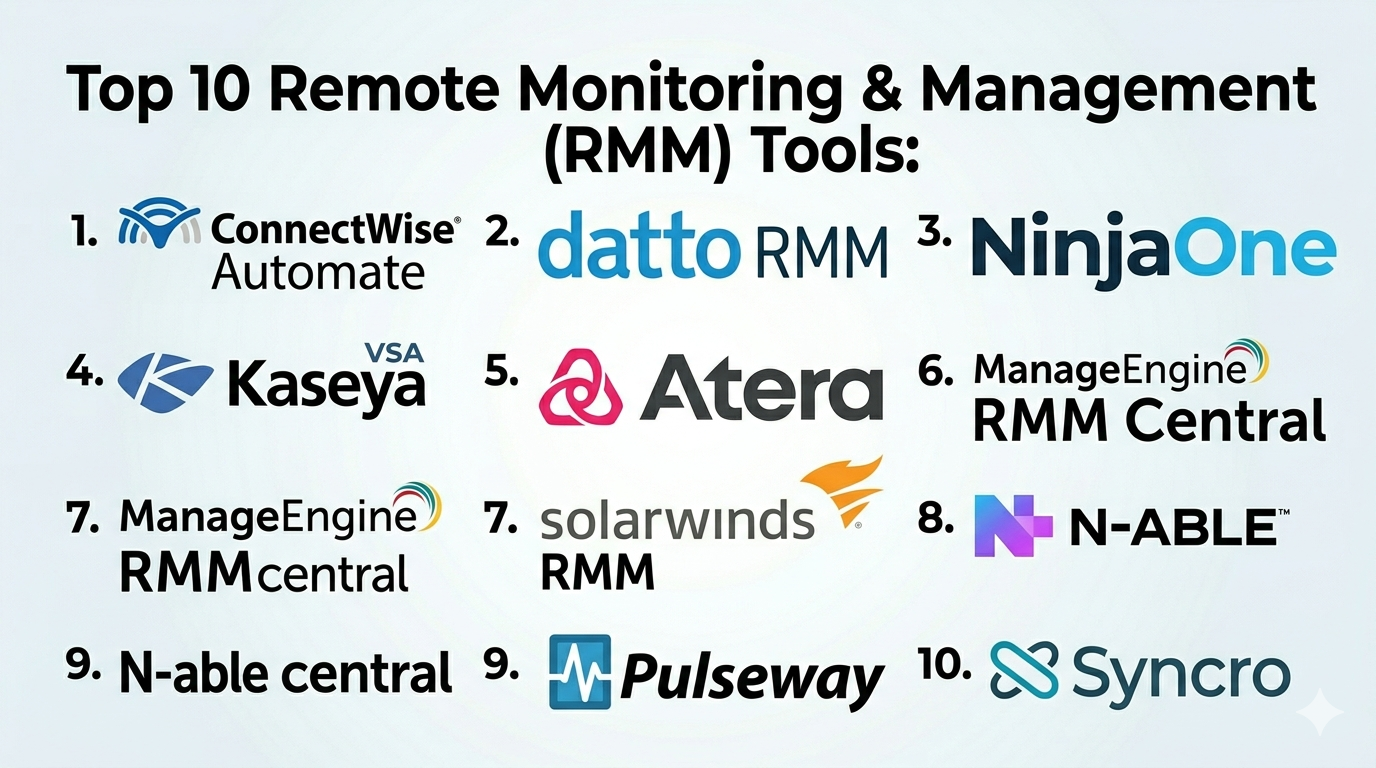
Top 10 Remote Monitoring & Management (RMM) Tools
#1 — ConnectWise Automate
Short description: A powerful RMM platform designed for MSPs, offering deep automation and scripting capabilities.
Key Features
- Advanced endpoint monitoring
- Remote control and support
- Patch management
- Automation scripting engine
- Asset management
- Alerts and reporting
Pros
- Highly customizable automation
- Strong MSP-focused features
Cons
- Steep learning curve
- Complex setup
Platforms / Deployment
Web / Windows
Cloud / On-premise
Security & Compliance
- SSO, encryption
- Compliance varies
Integrations & Ecosystem
ConnectWise integrates with PSA and security tools.
- ConnectWise PSA
- Third-party security tools
- APIs
Support & Community
Strong MSP community and documentation.
#2 — Datto RMM
Short description: A cloud-based RMM solution known for ease of use and strong automation features.
Key Features
- Remote monitoring and alerts
- Patch management
- Remote access tools
- Automation policies
- Reporting dashboards
Pros
- Easy to deploy
- Reliable performance
Cons
- Limited customization compared to competitors
- Pricing not transparent
Platforms / Deployment
Web
Cloud
Security & Compliance
- Encryption, SSO
- Compliance varies
Integrations & Ecosystem
- PSA integrations
- Security tools
- APIs
Support & Community
Good MSP-focused support.
#3 — NinjaOne
Short description: A modern RMM platform focused on simplicity, automation, and endpoint management.
Key Features
- Endpoint monitoring
- Patch management
- Remote access
- Automation workflows
- Backup management
Pros
- Intuitive interface
- Strong automation features
Cons
- Limited advanced customization
- Pricing varies
Platforms / Deployment
Web
Cloud
Security & Compliance
- Encryption, SSO
- Compliance varies
Integrations & Ecosystem
- IT tools
- Backup solutions
- APIs
Support & Community
Strong support and onboarding.
#4 — Kaseya VSA
Short description: A comprehensive RMM solution offering automation, monitoring, and endpoint management for enterprises and MSPs.
Key Features
- Endpoint monitoring
- Patch management
- Automation workflows
- Remote control
- Reporting tools
Pros
- Comprehensive feature set
- Scalable
Cons
- Interface complexity
- Learning curve
Platforms / Deployment
Web / Windows
Cloud / On-premise
Security & Compliance
- Encryption, SSO
- Compliance varies
Integrations & Ecosystem
- Kaseya ecosystem
- APIs
Support & Community
Enterprise-level support.
#5 — Atera
Short description: An all-in-one RMM and PSA platform designed for small IT teams and MSPs.
Key Features
- Remote monitoring
- Patch management
- Remote access
- Ticketing system
- Automation
Pros
- Simple pricing model
- Easy to use
Cons
- Limited enterprise features
- Fewer advanced capabilities
Platforms / Deployment
Web
Cloud
Security & Compliance
Not publicly stated
Integrations & Ecosystem
- PSA tools
- APIs
Support & Community
Good support for SMB users.
#6 — ManageEngine RMM Central
Short description: A centralized RMM platform offering endpoint management and monitoring capabilities.
Key Features
- Endpoint monitoring
- Patch management
- Remote control
- Asset management
- Reporting
Pros
- Strong endpoint management
- Affordable
Cons
- UI may feel outdated
- Limited automation depth
Platforms / Deployment
Web
Cloud / On-premise
Security & Compliance
Not publicly stated
Integrations & Ecosystem
- ManageEngine suite
- APIs
Support & Community
Reliable enterprise support.
#7 — SolarWinds RMM
Short description: A cloud-based RMM platform focused on monitoring, automation, and security.
Key Features
- Remote monitoring
- Patch management
- Automation scripts
- Security tools
- Reporting
Pros
- Strong monitoring capabilities
- Integrated security features
Cons
- Pricing complexity
- Learning curve
Platforms / Deployment
Web
Cloud
Security & Compliance
- Encryption, SSO
- Compliance varies
Integrations & Ecosystem
- IT tools
- APIs
Support & Community
Strong documentation and support.
#8 — N-able N-central
Short description: An enterprise-grade RMM solution designed for MSPs with advanced automation and scalability.
Key Features
- Endpoint monitoring
- Automation policies
- Patch management
- Remote access
- Reporting
Pros
- Scalable for large environments
- Strong automation
Cons
- Complex setup
- Requires expertise
Platforms / Deployment
Web
Cloud / On-premise
Security & Compliance
- Encryption, SSO
- Compliance varies
Integrations & Ecosystem
- PSA integrations
- APIs
Support & Community
Strong MSP support.
#9 — Pulseway
Short description: A mobile-first RMM tool offering real-time monitoring and remote management.
Key Features
- Mobile monitoring app
- Real-time alerts
- Remote control
- Patch management
- Automation
Pros
- Strong mobile capabilities
- Easy to use
Cons
- Limited enterprise features
- Smaller ecosystem
Platforms / Deployment
Web / Mobile
Cloud / On-premise
Security & Compliance
Not publicly stated
Integrations & Ecosystem
- IT tools
- APIs
Support & Community
Good support for SMBs.
#10 — Syncro
Short description: An RMM and PSA platform designed for small MSPs with integrated ticketing and automation.
Key Features
- Remote monitoring
- Patch management
- Ticketing system
- Automation
- Reporting
Pros
- All-in-one platform
- Affordable
Cons
- Limited scalability
- Fewer enterprise features
Platforms / Deployment
Web
Cloud
Security & Compliance
Not publicly stated
Integrations & Ecosystem
- PSA tools
- APIs
Support & Community
Strong SMB support.
Comparison Table (Top 10)
| Tool Name | Best For | Platform(s) Supported | Deployment | Standout Feature | Public Rating |
|---|---|---|---|---|---|
| ConnectWise Automate | MSPs | Web, Windows | Hybrid | Automation engine | N/A |
| Datto RMM | SMB/MSP | Web | Cloud | Ease of use | N/A |
| NinjaOne | SMB/MSP | Web | Cloud | Simplicity | N/A |
| Kaseya VSA | Enterprise | Web, Windows | Hybrid | Scalability | N/A |
| Atera | SMB | Web | Cloud | Pricing model | N/A |
| ManageEngine RMM | IT teams | Web | Hybrid | Endpoint mgmt | N/A |
| SolarWinds RMM | MSPs | Web | Cloud | Monitoring | N/A |
| N-able N-central | Enterprise MSP | Web | Hybrid | Automation | N/A |
| Pulseway | SMB | Web, Mobile | Hybrid | Mobile-first | N/A |
| Syncro | Small MSP | Web | Cloud | All-in-one | N/A |
Remote Monitoring & Management (RMM) Tools
| Tool Name | Core (25%) | Ease (15%) | Integrations (15%) | Security (10%) | Performance (10%) | Support (10%) | Value (15%) | Weighted Total |
|---|---|---|---|---|---|---|---|---|
| ConnectWise | 9 | 6 | 9 | 8 | 9 | 9 | 7 | 8.4 |
| Datto RMM | 8 | 8 | 8 | 8 | 8 | 8 | 7 | 7.9 |
| NinjaOne | 8 | 9 | 8 | 8 | 8 | 8 | 8 | 8.2 |
| Kaseya VSA | 9 | 6 | 8 | 8 | 9 | 8 | 7 | 8.1 |
| Atera | 7 | 9 | 7 | 6 | 7 | 7 | 9 | 7.7 |
| ManageEngine | 7 | 7 | 7 | 7 | 8 | 8 | 8 | 7.6 |
| SolarWinds | 8 | 7 | 8 | 8 | 8 | 8 | 7 | 7.9 |
| N-able N-central | 9 | 6 | 8 | 8 | 9 | 9 | 7 | 8.2 |
| Pulseway | 7 | 9 | 7 | 6 | 7 | 7 | 8 | 7.5 |
| Syncro | 7 | 8 | 7 | 6 | 7 | 7 | 9 | 7.6 |
How to interpret scores:
- Scores are comparative across tools
- Higher scores indicate better overall capability
- Enterprise tools rank higher in features and scalability
- SMB tools excel in ease of use and value
- Choose based on operational needs, not just scores
Which Remote Monitoring & Management (RMM) Tools Is Right for You?
Solo / Freelancer
- Best choices: Atera, Syncro
- Focus on affordability and simplicity
SMB
- Best choices: NinjaOne, Pulseway, Atera
- Balance usability and automation
Mid-Market
- Best choices: Datto RMM, SolarWinds
- Need reliability and integrations
Enterprise
- Best choices: ConnectWise Automate, Kaseya VSA, N-able N-central
- Prioritize scalability and automation
Budget vs Premium
- Budget: Syncro, Atera
- Premium: ConnectWise, Kaseya
Feature Depth vs Ease of Use
- Easy: NinjaOne, Pulseway
- Advanced: ConnectWise, N-central
Integrations & Scalability
- Strong: ConnectWise, Kaseya
- Flexible: NinjaOne
Security & Compliance Needs
- High: Enterprise RMM tools
- Moderate: SMB-focused tools
Frequently Asked Questions (FAQs)
What is RMM software?
It allows IT teams to monitor and manage systems remotely.
Who uses RMM tools?
MSPs, IT teams, and system administrators.
Are RMM tools cloud-based?
Most are cloud-based, with some hybrid options.
Do they support automation?
Yes, automation is a core feature.
Can small businesses use RMM tools?
Yes, many tools are designed for SMBs.
What integrations are important?
PSA, ITSM, and security tools.
How long does setup take?
From hours to weeks depending on complexity.
Are these tools secure?
Most offer encryption and access controls.
Can I manage multiple clients?
Yes, especially with MSP-focused tools.
What is the pricing model?
Typically per-device or per-technician.
Conclusion
Remote Monitoring & Management (RMM) tools are essential for modern IT operations, enabling proactive monitoring, automation, and remote support at scale. From SMB-friendly solutions to enterprise-grade platforms, these tools help reduce downtime, improve efficiency, and enhance security.
