Introduction
Newsletter Platforms help creators, businesses, marketers, publishers, and communities create, send, manage, and grow email newsletters. In simple words, these tools allow users to collect subscribers, design emails, send campaigns, automate communication, segment audiences, and track performance.
They matter because newsletters are still one of the most direct ways to build trust with an audience. Social media reach can change anytime, but an email subscriber list gives businesses and creators more control over communication. Modern newsletter platforms now include automation, AI writing help, audience segmentation, paid subscriptions, landing pages, analytics, and monetization features.
Best for: Creators, SaaS companies, marketers, agencies, publishers, coaches, educators, founders, ecommerce brands, and communities that want to build a direct audience.
Not ideal for: Teams that only need internal email updates, businesses with no audience-building strategy, or users who need only one-time transactional emails instead of regular newsletter communication.
Key Trends in Newsletter Platforms
- Creator monetization is becoming more important through paid subscriptions, sponsorships, and premium content.
- AI-assisted writing is helping users draft subject lines, newsletter content, and audience segments faster.
- Audience segmentation is now expected because generic newsletters often perform poorly.
- Automation workflows are growing for welcome emails, onboarding sequences, lead nurturing, and product education.
- Deliverability tools are becoming more important as inbox rules become stricter.
- Newsletter landing pages are now common so users can grow lists without needing a full website.
- Community-driven newsletters are increasing, especially for niche audiences and expert-led content.
- Privacy and consent management are now critical for responsible email marketing.
- Analytics are moving beyond opens and clicks toward engagement, revenue, subscriber growth, and retention.
- All-in-one newsletter ecosystems are growing, combining email, website, forms, payments, and audience management.
How We Selected These Tools (Methodology)
- Selected tools with strong recognition in newsletter publishing, email marketing, creator newsletters, and audience growth.
- Balanced creator-focused platforms, business email marketing tools, ecommerce-friendly tools, and publisher-oriented platforms.
- Evaluated newsletter creation, list management, automation, segmentation, analytics, and monetization features.
- Considered usability for beginners, creators, small businesses, agencies, and enterprise marketing teams.
- Reviewed integration strength with websites, CRM tools, ecommerce systems, forms, and automation platforms.
- Considered deliverability-related features, compliance controls, and subscriber management.
- Compared value across free, low-cost, mid-market, and premium use cases.
- Avoided invented ratings, unsupported certifications, and uncertain security claims.
- Marked uncertain details as “Not publicly stated” or “Varies / N/A”.
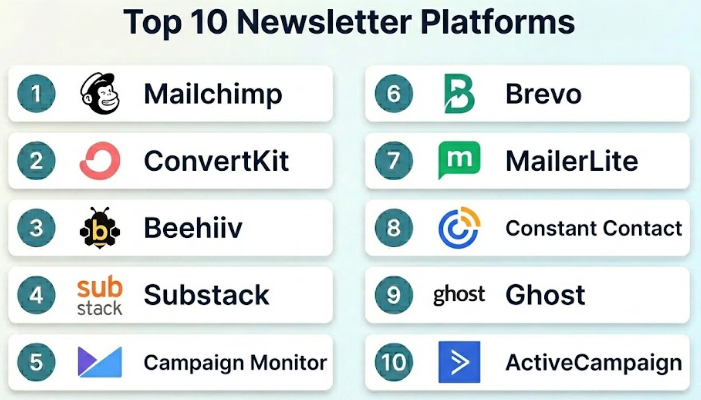
Top 10 Newsletter Platforms
#1 — Mailchimp
Short description :
Mailchimp is one of the most widely known newsletter and email marketing platforms for small businesses, creators, agencies, and growing brands. It helps users design newsletters, manage audiences, create signup forms, automate campaigns, and track performance. Mailchimp is often used by businesses that want a simple email marketing tool with templates and beginner-friendly workflows. It also supports customer journeys, segmentation, landing pages, and basic marketing automation. It is a strong option for users who want a familiar newsletter platform with broad adoption.
Key Features
- Drag-and-drop newsletter builder
- Email templates
- Audience segmentation
- Signup forms and landing pages
- Basic marketing automation
- Campaign analytics
- Integrations with ecommerce and marketing tools
Pros
- Easy for beginners to start.
- Broad ecosystem and many integrations.
- Good for small business newsletters and marketing campaigns.
Cons
- Pricing can increase as the subscriber list grows.
- Advanced automation may require higher plans.
- Some users may find the interface complex over time.
Platforms / Deployment
Web / Cloud / iOS / Android
Security & Compliance
MFA and account security controls may be available. Specific certifications: Not publicly stated.
Integrations & Ecosystem
Mailchimp connects with many marketing, ecommerce, website, and automation tools.
- Ecommerce platforms
- Website builders
- CRM tools
- Signup forms
- Social media tools
- Automation platforms
Support & Community
Mailchimp provides documentation, tutorials, and support resources. Support depth may vary by plan.
#2 — ConvertKit
Short description :
ConvertKit is a newsletter and email marketing platform built mainly for creators, writers, coaches, educators, podcasters, and online businesses. It helps users build subscriber lists, send newsletters, create landing pages, and automate email sequences. ConvertKit is especially useful for creators who want simple audience segmentation and monetization workflows. It focuses on clean writing, subscriber relationships, and creator-led business growth. It is a strong choice for people who want newsletters without heavy enterprise complexity.
Key Features
- Newsletter editor
- Creator-focused email automation
- Landing pages and forms
- Subscriber tagging
- Audience segmentation
- Paid newsletter and product support
- Creator-friendly workflows
Pros
- Strong fit for creators and personal brands.
- Simple tagging and segmentation model.
- Good for audience building and digital products.
Cons
- Design customization may feel limited for some brands.
- Not ideal for complex enterprise campaigns.
- Ecommerce depth may require integrations.
Platforms / Deployment
Web / Cloud
Security & Compliance
Not publicly stated.
Integrations & Ecosystem
ConvertKit works well with creator tools, websites, and digital product platforms.
- Website builders
- Landing page tools
- Payment tools
- Course platforms
- Automation tools
- Form builders
Support & Community
ConvertKit offers documentation, learning resources, and creator-focused support. Its creator community is one of its strengths.
#3 — Beehiiv
Short description :
Beehiiv is a newsletter platform designed for creators, publishers, media brands, and newsletter-first businesses. It helps users write, publish, grow, and monetize newsletters from one platform. Beehiiv is known for features like referral programs, audience growth tools, analytics, paid subscriptions, and newsletter websites. It is especially useful for users who want to build a newsletter as a media asset rather than only send email campaigns. It is a strong fit for modern newsletter operators focused on growth and monetization.
Key Features
- Newsletter publishing
- Built-in website support
- Referral program features
- Subscriber analytics
- Paid newsletter support
- Audience segmentation
- Growth and monetization tools
Pros
- Strong for newsletter-first businesses.
- Useful growth and referral features.
- Good fit for creators and publishers.
Cons
- May not be ideal for traditional ecommerce email marketing.
- Some advanced workflows may require higher plans.
- New users may need time to understand growth features.
Platforms / Deployment
Web / Cloud
Security & Compliance
Not publicly stated.
Integrations & Ecosystem
Beehiiv fits well with creator, media, and publishing workflows.
- Website publishing workflows
- Referral systems
- Payment workflows
- Analytics tools
- Automation tools
- Content publishing systems
Support & Community
Beehiiv provides documentation, support resources, and community learning for newsletter creators and publishers.
#4 — Substack
Short description :
Substack is a newsletter and publishing platform built for writers, journalists, creators, and independent publishers. It allows users to publish free or paid newsletters and build a direct subscriber relationship. Substack is simple to use and works well for people who want to focus mainly on writing and audience growth. It includes publishing, email distribution, subscriber management, and paid subscription support. It is especially useful for individual writers and niche content creators.
Key Features
- Newsletter publishing
- Free and paid subscriptions
- Simple writing interface
- Subscriber management
- Public archive
- Creator profile and publication page
- Community and discussion features
Pros
- Very simple for writers and creators.
- Good for paid newsletter monetization.
- No heavy technical setup required.
Cons
- Limited design customization.
- Less suitable for complex marketing automation.
- Platform control may feel limited for advanced brands.
Platforms / Deployment
Web / Cloud / iOS / Android
Security & Compliance
Not publicly stated.
Integrations & Ecosystem
Substack is more self-contained than many marketing platforms but supports creator publishing workflows.
- Newsletter publishing
- Paid subscription workflows
- Public content archives
- Creator communities
- Podcast-style publishing options
- Basic sharing workflows
Support & Community
Substack provides help resources and a large creator ecosystem. Support options may vary.
#5 — Campaign Monitor
Short description :
Campaign Monitor is an email marketing and newsletter platform used by businesses, agencies, and marketing teams. It helps users create professional email campaigns, manage subscribers, segment audiences, and track campaign performance. Campaign Monitor is suitable for teams that want polished email design and reliable campaign workflows. Agencies may find it useful for managing email campaigns for multiple clients. It is a practical option for brands that value design control and marketing campaign structure.
Key Features
- Email campaign builder
- Professional templates
- Subscriber segmentation
- Automation workflows
- Analytics and reporting
- Signup forms
- Agency-friendly workflows
Pros
- Good email design experience.
- Useful for agencies and marketing teams.
- Strong for campaign-based newsletters.
Cons
- May not be as creator-focused as newer platforms.
- Advanced automation may require higher plans.
- Pricing can depend on list size and sending needs.
Platforms / Deployment
Web / Cloud
Security & Compliance
Not publicly stated.
Integrations & Ecosystem
Campaign Monitor integrates with common marketing, CRM, and website tools.
- CRM systems
- Website forms
- Ecommerce tools
- Analytics tools
- Automation platforms
- Agency workflows
Support & Community
Campaign Monitor provides documentation, customer support, and email marketing learning resources.
#6 — Brevo
Short description :
Brevo is a marketing platform that includes newsletters, email campaigns, automation, SMS marketing, CRM features, and transactional email capabilities. It is useful for small businesses, startups, ecommerce brands, and marketing teams that want more than a basic newsletter tool. Brevo supports email design, segmentation, automation workflows, and customer communication across multiple channels. It is a good choice for teams that want practical marketing automation without heavy enterprise complexity. It can support both newsletters and broader customer engagement.
Key Features
- Newsletter campaigns
- Email marketing automation
- SMS marketing support
- Contact management
- CRM-style features
- Transactional email support
- Campaign analytics
Pros
- Good multi-channel marketing support.
- Useful for small businesses and ecommerce teams.
- Combines newsletters with automation and CRM features.
Cons
- Interface may take time to learn.
- Advanced use cases may require higher plans.
- Not as creator-focused as Substack or ConvertKit.
Platforms / Deployment
Web / Cloud
Security & Compliance
Not publicly stated.
Integrations & Ecosystem
Brevo fits into marketing, ecommerce, and customer communication workflows.
- Ecommerce platforms
- CRM tools
- Website forms
- SMS workflows
- Transactional email systems
- Automation platforms
Support & Community
Brevo provides documentation, support resources, and onboarding materials. Support options may vary by plan.
#7 — MailerLite
Short description :
MailerLite is a newsletter and email marketing platform known for simplicity, affordability, and clean design. It is used by creators, small businesses, bloggers, ecommerce stores, and agencies. MailerLite helps users create newsletters, landing pages, forms, automations, and subscriber segments. It is a strong option for users who want a practical newsletter platform without too much complexity. It is especially useful for small teams that need good value and simple workflows.
Key Features
- Drag-and-drop newsletter builder
- Landing pages and signup forms
- Email automation
- Subscriber segmentation
- Campaign analytics
- Website builder features
- Ecommerce integrations
Pros
- Easy to use and beginner-friendly.
- Good value for small businesses and creators.
- Clean interface and practical newsletter tools.
Cons
- Advanced enterprise features may be limited.
- Some complex automations may need workarounds.
- Support options may vary by plan.
Platforms / Deployment
Web / Cloud
Security & Compliance
Not publicly stated.
Integrations & Ecosystem
MailerLite connects well with creator, website, and ecommerce tools.
- Website builders
- Ecommerce platforms
- Form tools
- Automation platforms
- Landing page workflows
- CRM-style tools
Support & Community
MailerLite provides documentation, tutorials, and customer support resources. It is known for being approachable for beginners.
#8 — Constant Contact
Short description :
Constant Contact is an email marketing and newsletter platform used by small businesses, nonprofits, local organizations, and service providers. It helps users create newsletters, manage contacts, send campaigns, build signup forms, and review engagement reports. Constant Contact is especially useful for businesses that need a straightforward email marketing platform with support and templates. It is good for users who value guidance and simple campaign management. It can support newsletters, promotions, announcements, and event communication.
Key Features
- Newsletter builder
- Email templates
- Contact management
- Signup forms
- Campaign reporting
- Event and promotional email support
- Marketing automation features
Pros
- Good fit for small businesses and nonprofits.
- Simple campaign creation process.
- Helpful templates and support resources.
Cons
- May feel less modern than some creator-first tools.
- Advanced automation depth may be limited.
- Pricing may increase with list size.
Platforms / Deployment
Web / Cloud / iOS / Android
Security & Compliance
Not publicly stated.
Integrations & Ecosystem
Constant Contact supports small business marketing workflows.
- Website tools
- Ecommerce platforms
- Social media tools
- Contact forms
- Event workflows
- CRM-style integrations
Support & Community
Constant Contact provides support resources, tutorials, and customer assistance. It is often used by non-technical business users.
#9 — Ghost
Short description :
Ghost is a publishing and newsletter platform built for independent publishers, creators, media businesses, and content teams. It combines website publishing, newsletter delivery, memberships, and paid subscriptions. Ghost is especially useful for users who want more ownership and control over their content platform compared with closed newsletter networks. It can be used for blogs, newsletters, paid communities, and publication-style websites. It is a strong choice for serious content-led businesses.
Key Features
- Website and newsletter publishing
- Membership management
- Paid subscription support
- Content management system
- Email newsletter delivery
- Custom themes
- Publisher-focused workflows
Pros
- Strong for content ownership and publishing.
- Good fit for paid memberships and publications.
- More flexible than simple newsletter-only tools.
Cons
- Setup may be more technical depending on deployment.
- Not as simple as Substack for beginners.
- Advanced customization may require developer support.
Platforms / Deployment
Web / Cloud / Self-hosted
Security & Compliance
Not publicly stated.
Integrations & Ecosystem
Ghost fits well with publisher, membership, and content business workflows.
- Payment tools
- Analytics tools
- Publishing workflows
- Membership systems
- Theme customization
- Automation tools
Support & Community
Ghost has documentation, community resources, and support options depending on hosting choice.
#10 — ActiveCampaign
Short description :
ActiveCampaign is a marketing automation platform that includes newsletters, email campaigns, CRM features, segmentation, and advanced automation workflows. It is useful for businesses that want newsletters as part of a larger customer journey. ActiveCampaign is strong for lead nurturing, lifecycle marketing, customer segmentation, and behavior-based email automation. It may be more powerful than needed for simple newsletters, but it is valuable for teams that want deeper automation. It is best suited for growing businesses with structured marketing needs.
Key Features
- Newsletter campaigns
- Advanced email automation
- CRM features
- Behavioral segmentation
- Lead nurturing workflows
- Campaign analytics
- Customer journey automation
Pros
- Strong automation capabilities.
- Good for lifecycle marketing and lead nurturing.
- Useful for growing businesses with complex workflows.
Cons
- May feel complex for simple newsletter needs.
- Setup takes planning.
- Pricing may increase with contacts and features.
Platforms / Deployment
Web / Cloud / iOS / Android
Security & Compliance
Not publicly stated.
Integrations & Ecosystem
ActiveCampaign connects with sales, marketing, ecommerce, and customer communication tools.
- CRM tools
- Ecommerce platforms
- Website forms
- Automation platforms
- Sales tools
- Customer journey workflows
Support & Community
ActiveCampaign provides documentation, learning resources, onboarding support, and customer support options depending on plan.
Comparison Table (Top 10)
| Tool Name | Best For | Platform(s) Supported | Deployment | Standout Feature | Public Rating |
|---|---|---|---|---|---|
| Mailchimp | Small business newsletters | Web / iOS / Android | Cloud | Beginner-friendly email marketing ecosystem | N/A |
| ConvertKit | Creators and educators | Web | Cloud | Creator-focused automation and tagging | N/A |
| Beehiiv | Newsletter-first creators and publishers | Web | Cloud | Growth and monetization tools | N/A |
| Substack | Writers and independent publishers | Web / iOS / Android | Cloud | Simple paid newsletter publishing | N/A |
| Campaign Monitor | Agencies and marketing teams | Web | Cloud | Professional campaign design | N/A |
| Brevo | Small business multi-channel marketing | Web | Cloud | Newsletter plus SMS and automation | N/A |
| MailerLite | Budget-friendly newsletters | Web | Cloud | Simple newsletter and landing page tools | N/A |
| Constant Contact | Small businesses and nonprofits | Web / iOS / Android | Cloud | Easy templates and small business support | N/A |
| Ghost | Content-led publishers | Web | Cloud / Self-hosted | Publishing, newsletters, and memberships | N/A |
| ActiveCampaign | Advanced marketing automation | Web / iOS / Android | Cloud | Deep automation and segmentation | N/A |
Evaluation & Newsletter Platforms
| Tool Name | Core (25%) | Ease (15%) | Integrations (15%) | Security (10%) | Performance (10%) | Support (10%) | Value (15%) | Weighted Total (0–10) |
|---|---|---|---|---|---|---|---|---|
| Mailchimp | 8 | 8 | 9 | 7 | 8 | 8 | 7 | 7.90 |
| ConvertKit | 8 | 9 | 8 | 6 | 8 | 8 | 8 | 7.95 |
| Beehiiv | 8 | 8 | 7 | 6 | 8 | 8 | 8 | 7.65 |
| Substack | 7 | 10 | 6 | 6 | 8 | 7 | 9 | 7.75 |
| Campaign Monitor | 8 | 8 | 8 | 7 | 8 | 8 | 7 | 7.75 |
| Brevo | 8 | 8 | 8 | 7 | 8 | 8 | 8 | 7.90 |
| MailerLite | 8 | 9 | 8 | 6 | 8 | 8 | 9 | 8.05 |
| Constant Contact | 7 | 8 | 7 | 6 | 7 | 8 | 7 | 7.15 |
| Ghost | 8 | 7 | 7 | 7 | 8 | 7 | 8 | 7.55 |
| ActiveCampaign | 9 | 7 | 9 | 7 | 8 | 8 | 7 | 7.95 |
These scores are comparative and should not be treated as a universal ranking. MailerLite may be a better value for small teams, while ActiveCampaign may be stronger for advanced automation. Substack may be best for writers who want simplicity, while Ghost may be stronger for publishers who want more ownership. Always test the platform with your real audience, email content, automation needs, and budget before choosing.
Which Newsletter Platforms
Solo / Freelancer
Solo users usually need simplicity, low cost, and fast publishing. Substack, ConvertKit, Beehiiv, MailerLite, and Ghost are good options depending on whether the user wants simple writing, creator monetization, or more ownership over publishing.
SMB
Small and medium businesses usually need templates, forms, list management, basic automation, and reporting. Mailchimp, MailerLite, Brevo, Constant Contact, and HubSpot-style alternatives can work well for regular business newsletters and customer updates.
Mid-Market
Mid-market teams often need stronger segmentation, automation, integrations, and campaign reporting. ActiveCampaign, Mailchimp, Brevo, Campaign Monitor, and ConvertKit can be useful depending on whether the focus is marketing automation, design, or audience growth.
Enterprise
Enterprise teams should prioritize access controls, compliance, deliverability, integrations, reporting, and workflow governance. ActiveCampaign, Mailchimp, Campaign Monitor, and Brevo may fit larger marketing teams, while Ghost may fit content-led publishing teams with technical support.
Budget vs Premium
Budget-focused users may prefer MailerLite, Substack, Beehiiv, or ConvertKit depending on list size and feature needs. Premium buyers may prefer ActiveCampaign, Mailchimp, Campaign Monitor, or enterprise-ready marketing automation tools.
Feature Depth vs Ease of Use
For ease of use, Substack, MailerLite, ConvertKit, and Constant Contact are strong options. For feature depth, ActiveCampaign, Mailchimp, Brevo, Ghost, and Campaign Monitor offer broader workflows.
Integrations & Scalability-
For integration-heavy workflows, choose platforms that connect well with CRM tools, ecommerce platforms, forms, analytics, payment systems, and automation tools. Mailchimp, ActiveCampaign, Brevo, ConvertKit, and Ghost are strong candidates depending on the business model.
Security & Compliance Needs
Security-focused teams should check MFA, role-based permissions, consent management, unsubscribe handling, data retention, audit controls, and regional privacy requirements. Do not assume compliance unless the vendor clearly provides documentation.
Frequently Asked Questions (FAQs)
1. What is a Newsletter Platform?
A Newsletter Platform is a tool used to create, send, manage, and track email newsletters. It helps users collect subscribers, design emails, organize lists, and measure performance.
2. How is a Newsletter Platform different from normal email?
Normal email is used for one-to-one communication. Newsletter platforms are built for sending emails to many subscribers while managing consent, unsubscribes, segmentation, analytics, and templates.
3. What pricing models are common?
Common pricing models include free plans, subscriber-based pricing, email volume pricing, feature-based pricing, and paid subscription revenue sharing. Pricing usually increases as the subscriber list grows.
4. Which platform is best for creators?
Creators often prefer ConvertKit, Beehiiv, Substack, MailerLite, or Ghost. The best choice depends on whether the creator wants simple writing, paid subscriptions, automation, audience growth, or publishing control.
5. Which platform is best for small businesses?
Small businesses often choose Mailchimp, MailerLite, Brevo, Constant Contact, or Campaign Monitor. These tools provide templates, contact management, signup forms, and campaign reporting.
6. Can Newsletter Platforms help with automation?
Yes. Many platforms support welcome emails, onboarding sequences, lead nurturing, behavior-based emails, and customer journey workflows. ActiveCampaign, Brevo, Mailchimp, ConvertKit, and MailerLite are useful for automation.
7. What is the biggest mistake when choosing a Newsletter Platform?
The biggest mistake is choosing only based on price. Buyers should also review deliverability, list growth tools, automation, segmentation, integrations, support, and long-term scalability.
8. Are Newsletter Platforms secure?
Security depends on the provider. Teams should review MFA, access controls, data protection, unsubscribe handling, privacy settings, and compliance documentation before using a platform for sensitive audiences.
9. Can I monetize a newsletter?
Yes. Platforms like Substack, Beehiiv, ConvertKit, and Ghost support newsletter monetization in different ways. Monetization may include paid subscriptions, sponsorships, digital products, or memberships.
10. Can I switch from one Newsletter Platform to another?
Yes, but switching should be planned carefully. Export subscribers, tags, segments, templates, forms, automations, and performance history where possible. Also test deliverability after migration.
Conclusion
Newsletter Platforms help businesses, creators, publishers, and communities build stronger direct relationships with their audience. The best platform depends on the user’s goal. A writer may prefer Substack because it is simple and publishing-focused. A creator may choose ConvertKit or Beehiiv for audience growth and monetization. A small business may prefer Mailchimp, MailerLite, Brevo, or Constant Contact for templates, forms, and easy campaigns. A growing marketing team may choose ActiveCampaign or Campaign Monitor for deeper automation and campaign control. There is no single best newsletter platform for everyone.
