Introduction
Listings Management Tools help businesses manage their name, address, phone number, website, opening hours, categories, photos, services, and location details across search engines, maps, directories, review platforms, voice assistants, and local discovery sites. In simple words, these tools keep business information accurate everywhere customers search.
For local SEO, listing accuracy is very important. If a customer finds the wrong phone number, old address, incorrect hours, or duplicate listing, it can reduce trust and lead to lost business. Listings management tools help brands fix inconsistent information, manage multiple locations, improve local visibility, monitor reviews, and keep business profiles updated from one dashboard.
Best for: local businesses, franchises, restaurants, clinics, retail chains, service companies, agencies, real estate firms, hospitality brands, and multi-location enterprises.
Not ideal for: businesses with no physical location, teams that only need website SEO, or companies that already manage a very small number of listings manually without issue.
Key Trends in Listings Management Tools Local SEO
- Google Business Profile optimization is now central to local SEO because many customers discover businesses directly through maps and search results.
- Multi-location listing control is becoming essential for franchises, retail chains, healthcare networks, and service brands.
- AI-assisted profile optimization is helping teams improve categories, descriptions, photos, services, and local content.
- Review management and listings management are merging because local visibility and customer trust are closely connected.
- Duplicate listing cleanup remains important because duplicate or outdated profiles can confuse customers and search engines.
- Voice search and map-based discovery are increasing the need for accurate business data across multiple platforms.
- Local SEO reporting dashboards are becoming more useful for tracking rankings, visibility, calls, clicks, directions, and profile engagement.
- Agency white-label reporting is growing as SEO agencies manage listings for many clients.
- Data governance and approval workflows are becoming more important for enterprises managing many locations.
- Integration with CRM, store locator, review, and analytics systems is now a key buying factor.
How We Selected These Tools
- Market recognition among local SEO, reputation management, and multi-location marketing teams.
- Strength of listing distribution and business data synchronization.
- Google Business Profile management capabilities.
- Duplicate detection and cleanup support.
- Multi-location scalability and location-level reporting.
- Review monitoring and response features where available.
- Integration with local SEO, analytics, CRM, and agency workflows.
- Ease of use for small businesses and non-technical teams.
- Enterprise readiness, access controls, and governance where known.
- Overall value for local visibility, accuracy, and operational efficiency.
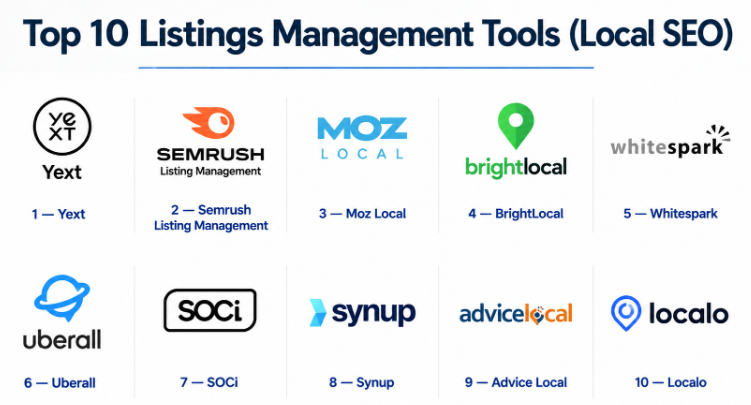
Top 10 Listings Management Tools Local SEO
#1 — Yext
Short description :
Yext is one of the most recognized listings management and digital presence platforms for local SEO. It helps businesses manage business information across directories, maps, search engines, apps, and local discovery platforms. Yext is especially useful for multi-location brands that need centralized control over location data. It supports local listings, reviews, local pages, analytics, and knowledge management workflows. It is a strong option for enterprises, franchises, healthcare networks, retail brands, restaurants, and service companies that need accurate local information at scale.
Key Features
- Centralized business listing management.
- Google Business Profile support.
- Location data synchronization.
- Duplicate listing management.
- Review monitoring and response workflows.
- Local pages and store locator capabilities.
- Analytics and reporting dashboards.
Pros
- Strong fit for multi-location brands.
- Good control over business information accuracy.
- Useful local SEO and reputation workflows in one platform.
Cons
- May be costly for smaller businesses.
- Can be more advanced than simple listing needs.
- Setup requires clean location data and process planning.
Platforms / Deployment
Web / Cloud
Security & Compliance
Enterprise security features may vary by plan and agreement. Specific certifications are Not publicly stated.
Integrations & Ecosystem
Yext fits into local SEO, digital presence, and multi-location marketing workflows.
- Google Business Profile workflows.
- Local directory distribution.
- Store locator and local pages.
- Review management workflows.
- Analytics and reporting exports.
- Enterprise marketing system connections may vary.
Support & Community
Yext provides documentation, onboarding, and business support. Enterprise support may vary by contract, package, and customer size.
#2 — Semrush Listing Management
Short description :
Semrush Listing Management is a local SEO tool that helps businesses distribute and manage listing information across directories. It is useful for small businesses, agencies, marketers, and SEO teams that already use Semrush for broader SEO work. The tool helps improve listing consistency, manage business data, monitor local visibility, and track online presence. It is especially practical for teams that want local listing management alongside keyword research, competitor analysis, and SEO reporting. It is a good option for agencies and SMBs that need listing control without a heavy enterprise platform.
Key Features
- Local listing distribution.
- Business data management.
- Local SEO visibility tracking.
- Directory listing updates.
- Review monitoring features may vary.
- Location performance reporting.
- Integration with broader SEO workflows.
Pros
- Good fit for SEO teams and agencies.
- Useful when combined with broader SEO tools.
- Practical for SMB local SEO management.
Cons
- Directory coverage may vary by region.
- Advanced enterprise governance may be limited.
- Some features may depend on package.
Platforms / Deployment
Web / Cloud
Security & Compliance
Security and compliance details are Not publicly stated.
Integrations & Ecosystem
Semrush Listing Management works best for teams that manage local SEO as part of a wider SEO strategy.
- SEO reporting workflows.
- Local listing distribution.
- Directory data management.
- Review monitoring where available.
- Local visibility tracking.
- Agency reporting workflows.
Support & Community
Semrush has documentation, learning resources, and support options. Support levels may vary by subscription and region.
#3 — Moz Local
Short description :
Moz Local is a listings management tool focused on helping businesses improve local search visibility by managing business information across directories, search engines, and data aggregators. It is useful for small businesses, agencies, and multi-location companies that need consistent local data. Moz Local helps manage listings, detect inconsistencies, monitor visibility, and support local SEO reporting. It is especially helpful for teams that want a straightforward local listing management solution. The tool is a practical fit for businesses that care about local search accuracy without needing a very complex enterprise suite.
Key Features
- Business listing management.
- Local data distribution.
- Duplicate listing detection.
- Google Business Profile support may vary by package.
- Review monitoring capabilities may vary.
- Local SEO reporting.
- Location data accuracy tracking.
Pros
- Practical for local SEO teams.
- Easier to use than some enterprise platforms.
- Good fit for SMBs and agencies.
Cons
- Advanced multi-location controls may vary.
- Directory coverage should be validated by region.
- May need other tools for deeper review management.
Platforms / Deployment
Web / Cloud
Security & Compliance
Security and compliance details are Not publicly stated.
Integrations & Ecosystem
Moz Local fits into local SEO workflows for businesses and agencies.
- Directory listing management.
- Local SEO reporting.
- Google Business Profile support where available.
- Duplicate tracking.
- Data accuracy monitoring.
- Agency local SEO workflows.
Support & Community
Moz has a strong SEO community and educational resources. Support levels may vary by plan and product package.
#4 — BrightLocal
Short description :
BrightLocal is a local SEO platform that supports listings management, citation building, local rank tracking, review monitoring, and SEO reporting. It is widely used by agencies, consultants, local marketers, and small businesses. BrightLocal is especially useful for teams that need local SEO tools beyond listings, including audits and reporting. It helps businesses understand local visibility, fix listing problems, track rankings, and monitor reviews. It is a strong fit for agencies managing local SEO campaigns for multiple clients.
Key Features
- Citation building and listing management.
- Local SEO audits.
- Local rank tracking.
- Review monitoring.
- Google Business Profile audit support.
- White-label reporting.
- Agency client management features.
Pros
- Strong fit for local SEO agencies.
- Good balance of listings, rankings, and reviews.
- Useful white-label reporting options.
Cons
- Not as enterprise-heavy as some multi-location platforms.
- Listing distribution depth may vary by package.
- Requires SEO knowledge to get full value.
Platforms / Deployment
Web / Cloud
Security & Compliance
Security and compliance details are Not publicly stated.
Integrations & Ecosystem
BrightLocal is built around agency-friendly local SEO workflows.
- Citation management.
- Local rank tracking.
- Review monitoring.
- Google Business Profile audit workflows.
- White-label reports.
- Client campaign reporting.
Support & Community
BrightLocal has useful documentation, educational content, and support resources for local SEO professionals and agencies.
#5 — Whitespark
Short description :
Whitespark is a local SEO toolset known for citation building, local rank tracking, reputation tools, and local search support. It is useful for agencies, consultants, local businesses, and marketers who want to improve local visibility through citations and listings. Whitespark is especially respected among local SEO professionals for citation research and local ranking tools. It helps teams find citation opportunities, track local performance, and improve business information consistency. It is a good choice for SEO-focused teams that want hands-on local search improvement.
Key Features
- Citation building and citation research.
- Local rank tracking.
- Reputation and review tools.
- Local SEO campaign support.
- Competitor citation analysis.
- Location visibility tracking.
- Agency-friendly workflows.
Pros
- Strong local SEO focus.
- Useful for citation research and building.
- Good fit for consultants and agencies.
Cons
- May require more manual SEO expertise.
- Not a full enterprise listings platform.
- Broader directory sync may vary by service.
Platforms / Deployment
Web / Cloud
Security & Compliance
Security and compliance details are Not publicly stated.
Integrations & Ecosystem
Whitespark works well for local SEO professionals focused on citations, rankings, and reputation signals.
- Citation building workflows.
- Local rank tracking.
- Competitor citation research.
- Review management support.
- Local SEO reporting.
- Agency campaign processes.
Support & Community
Whitespark has a strong reputation among local SEO practitioners. Support and service levels may vary by tool or service package.
#6 — Uberall
Short description :
Uberall is a location marketing and listings management platform designed for multi-location businesses, franchises, agencies, and enterprises. It helps brands manage listings, local pages, reviews, social engagement, and local customer experience. Uberall is useful for companies that need to control business data across many locations and improve local discovery. It is especially relevant for retail chains, restaurants, financial services, healthcare, and service brands. The platform is a strong fit where listings management must connect with broader location marketing.
Key Features
- Listings management across directories.
- Location data control.
- Review management.
- Local pages and store locator support.
- Social and engagement features may vary.
- Multi-location dashboards.
- Local performance reporting.
Pros
- Strong for multi-location brands.
- Combines listings, reviews, and local engagement.
- Good fit for enterprise location marketing.
Cons
- May be too advanced for single-location businesses.
- Pricing may vary significantly by scale.
- Setup requires accurate location data.
Platforms / Deployment
Web / Cloud
Security & Compliance
Enterprise security features may vary by agreement. Specific certifications are Not publicly stated.
Integrations & Ecosystem
Uberall supports local marketing and location data workflows.
- Directory listing networks.
- Review platforms.
- Local pages.
- Store locator workflows.
- Reporting dashboards.
- Enterprise marketing integrations may vary.
Support & Community
Uberall typically supports multi-location and enterprise users with onboarding, support, and customer success resources. Support levels may vary by contract.
#7 — SOCi
Short description :
SOCi is a localized marketing platform that supports listings, reviews, local social media, and reputation workflows for multi-location brands. It is often used by franchises, restaurants, retailers, healthcare groups, property management companies, and service businesses. SOCi helps brands maintain local presence while giving teams centralized control and governance. It is useful for managing location data, responding to reviews, publishing local content, and reporting performance. SOCi is a strong choice for brands that need listings management connected with localized marketing execution.
Key Features
- Multi-location listings management.
- Review monitoring and response workflows.
- Local social media management.
- Approval and governance workflows.
- Location-level reporting.
- Brand consistency tools.
- Localized marketing support.
Pros
- Strong fit for franchises and multi-location brands.
- Combines listings, reviews, and social workflows.
- Good governance for distributed teams.
Cons
- May be too broad for small businesses.
- Pricing may not fit low-volume users.
- Requires planning for multi-location workflows.
Platforms / Deployment
Web / Cloud
Security & Compliance
Security capabilities may vary by plan and agreement. Specific certifications are Not publicly stated.
Integrations & Ecosystem
SOCi fits into localized marketing workflows for distributed businesses.
- Directory listings.
- Review management.
- Local social media.
- Approval workflows.
- Location reporting.
- Enterprise marketing integrations may vary.
Support & Community
SOCi generally provides onboarding and support for larger brands and multi-location teams. Support levels may vary by package.
#8 — Synup
Short description :
Synup is a listings management and local marketing platform that helps businesses manage location data, reviews, rankings, and local visibility. It is used by local businesses, agencies, franchises, and multi-location brands. Synup helps teams keep business information accurate across directories and track local search performance. It also supports reputation and customer feedback workflows depending on package. Synup is a practical choice for teams that need listings, reviews, and local SEO insights in one platform.
Key Features
- Listings management and synchronization.
- Location data accuracy tracking.
- Review monitoring.
- Local SEO analytics.
- Ranking and visibility reporting.
- Multi-location support.
- Agency-friendly workflows.
Pros
- Good balance of listings and local SEO insights.
- Useful for agencies and multi-location businesses.
- Practical reporting for local visibility.
Cons
- Directory coverage should be validated by region.
- Advanced features may vary by plan.
- May need onboarding for larger setups.
Platforms / Deployment
Web / Cloud
Security & Compliance
Security and compliance details are Not publicly stated.
Integrations & Ecosystem
Synup supports local SEO, listings, and reputation workflows.
- Directory listing networks.
- Review monitoring.
- Local SEO reporting.
- Rank tracking workflows.
- Multi-location dashboards.
- Agency client reporting.
Support & Community
Synup provides support and onboarding resources. Support quality may vary by plan and business size.
#9 — Advice Local
Short description :
Advice Local is a listings management and local presence platform used by agencies, local marketers, and businesses that need citation building, directory distribution, and local data management. It helps businesses improve online visibility by distributing accurate business information across local directories and data sources. Advice Local is especially useful for agencies managing listing accuracy for multiple clients. It supports local SEO workflows, citation management, and location data consistency. It is a good fit for teams that want practical local listing services.
Key Features
- Listings distribution.
- Citation management.
- Local presence management.
- Data accuracy workflows.
- Agency-focused tools.
- Reporting support.
- Directory submission services.
Pros
- Useful for agencies and local SEO providers.
- Strong focus on citation and listing accuracy.
- Practical for local presence improvement.
Cons
- May not be as broad as full enterprise location platforms.
- Advanced review management may require other tools.
- Feature depth may vary by package.
Platforms / Deployment
Web / Cloud
Security & Compliance
Security and compliance details are Not publicly stated.
Integrations & Ecosystem
Advice Local supports citation building and listing distribution workflows.
- Local directory submissions.
- Citation management.
- Local SEO reporting.
- Agency client workflows.
- Business data distribution.
- Location visibility support.
Support & Community
Advice Local provides service and support resources for agencies and businesses. Support levels may vary by package and service scope.
#10 — Localo
Short description :
Localo is a local SEO tool focused on helping businesses improve Google Business Profile visibility, local rankings, and location performance. It is especially useful for small businesses, local marketers, and agencies that want practical local SEO recommendations. Localo helps track ranking positions, optimize local profiles, and understand how a business appears in local search. It is not a traditional enterprise listings distribution platform, but it is useful for local SEO improvement. Businesses that care mainly about Google Business Profile performance may find it practical.
Key Features
- Google Business Profile optimization support.
- Local rank tracking.
- Local SEO recommendations.
- Competitor visibility insights.
- Location performance tracking.
- Simple reporting.
- Practical local search guidance.
Pros
- Easy for small businesses to understand.
- Useful for Google Business Profile improvement.
- Practical local SEO recommendations.
Cons
- Not a full listings distribution platform.
- Limited enterprise listing governance.
- Directory network support may be limited.
Platforms / Deployment
Web / Cloud
Security & Compliance
Security and compliance details are Not publicly stated.
Integrations & Ecosystem
Localo fits into Google-focused local SEO workflows.
- Google Business Profile optimization.
- Local ranking tracking.
- Competitor visibility analysis.
- Local SEO reporting.
- Small business workflows.
- Agency local SEO support.
Support & Community
Localo provides support resources for local businesses and marketers. Support levels may vary by plan.
Comparison Table Top 10
| Tool Name | Best For | Platform(s) Supported | Deployment | Standout Feature | Public Rating |
|---|---|---|---|---|---|
| Yext | Enterprise listings and digital presence | Web | Cloud | Centralized business data control | N/A |
| Semrush Listing Management | SEO teams and agencies | Web | Cloud | Listings inside broader SEO workflow | N/A |
| Moz Local | SMBs and local SEO teams | Web | Cloud | Local data distribution and accuracy tracking | N/A |
| BrightLocal | Local SEO agencies | Web | Cloud | Citations, rankings, audits, and reports | N/A |
| Whitespark | Citation-focused local SEO | Web | Cloud | Citation research and local rank tracking | N/A |
| Uberall | Multi-location location marketing | Web | Cloud | Listings, reviews, and local engagement | N/A |
| SOCi | Franchises and distributed brands | Web | Cloud | Localized marketing and governance | N/A |
| Synup | Listings and local visibility tracking | Web | Cloud | Listings, reviews, and local SEO analytics | N/A |
| Advice Local | Agencies and citation management | Web | Cloud | Local directory distribution services | N/A |
| Localo | Google Business Profile optimization | Web | Cloud | Local ranking and profile improvement | N/A |
Evaluation & Listings Management Tools Local SEO
| Tool Name | Core (25%) | Ease (15%) | Integrations (15%) | Security (10%) | Performance (10%) | Support (10%) | Value (15%) | Weighted Total (0–10) |
|---|---|---|---|---|---|---|---|---|
| Yext | 9 | 7 | 8 | 7 | 8 | 8 | 7 | 7.85 |
| Semrush Listing Management | 8 | 8 | 8 | 7 | 8 | 8 | 8 | 7.90 |
| Moz Local | 8 | 8 | 7 | 6 | 8 | 7 | 8 | 7.55 |
| BrightLocal | 8 | 9 | 7 | 6 | 8 | 8 | 9 | 8.00 |
| Whitespark | 8 | 8 | 6 | 6 | 8 | 8 | 8 | 7.45 |
| Uberall | 9 | 7 | 8 | 7 | 8 | 8 | 7 | 7.85 |
| SOCi | 8 | 7 | 8 | 7 | 8 | 8 | 7 | 7.60 |
| Synup | 8 | 8 | 7 | 6 | 8 | 7 | 8 | 7.55 |
| Advice Local | 7 | 8 | 6 | 6 | 7 | 8 | 8 | 7.20 |
| Localo | 6 | 9 | 5 | 6 | 7 | 7 | 8 | 6.95 |
These scores are comparative and should be used as a practical shortlist guide. A higher score does not always mean the tool is best for every business. For example, Yext and Uberall may be stronger for enterprise location data control, while BrightLocal and Whitespark may be better for agencies and local SEO consultants. Localo may be practical for Google Business Profile improvement, even if it is not a full listings distribution platform.
Which Listings Management Tools Local SEO
Solo / Freelancer
Solo professionals and freelancers usually need simple local visibility tracking, Google Business Profile improvement, and basic citation management. Localo, BrightLocal, Whitespark, and Moz Local can be practical options.
If the main goal is Google Business Profile optimization, Localo may be useful. If the goal is citation research and local SEO reporting, BrightLocal or Whitespark may be stronger.
SMB
Small and mid-sized businesses need accurate listings, clean business information, review visibility, and simple reporting. Moz Local, Semrush Listing Management, BrightLocal, Synup, and Localo are good tools to compare.
SMBs should focus on ease of use, directory coverage, pricing, Google Business Profile support, and whether the tool helps fix duplicate or incorrect listings.
Mid-Market
Mid-market brands often need stronger reporting, multi-location support, listing accuracy, and review visibility. Yext, Uberall, SOCi, Synup, and Semrush Listing Management are useful options.
These businesses should check location-level dashboards, user permissions, review workflows, analytics exports, and integration with marketing or CRM systems.
Enterprise
Enterprises need centralized control, governance, permissions, multi-location workflows, duplicate suppression, support, and scalable reporting. Yext, Uberall, SOCi, and Synup are strong enterprise-focused options.
Enterprise buyers should involve local marketing, operations, IT, compliance, and customer experience teams before final selection.
Budget vs Premium
Budget-conscious teams can evaluate Localo, BrightLocal, Whitespark, Moz Local, or Advice Local depending on their needs.
Premium buyers should evaluate Yext, Uberall, SOCi, Synup, and Semrush Listing Management when they need scale, integrations, automation, and advanced reporting.
Feature Depth vs Ease of Use
For feature depth, Yext, Uberall, SOCi, Synup, and Semrush Listing Management are stronger options.
For ease of use, BrightLocal, Moz Local, Localo, Whitespark, and Advice Local may be easier for smaller businesses or agencies.
Integrations & Scalability-
Teams should evaluate integrations with Google Business Profile, review tools, CRM systems, store locators, analytics platforms, local pages, social tools, and reporting dashboards.
Scalability also depends on location count, user roles, approval workflows, duplicate management, data exports, API access, and local reporting needs.
Security & Compliance Needs
Security-focused buyers should ask about SSO, MFA, RBAC, audit logs, encryption, data retention, user permissions, and approval workflows.
Enterprises, healthcare networks, financial service firms, and franchise groups should validate security and governance before connecting large location datasets.
Frequently Asked Questions FAQs
1. What is a listings management tool?
A listings management tool helps businesses manage their name, address, phone number, hours, website, categories, photos, and other location details across online directories, maps, and search platforms.
2. Why is listings management important for local SEO?
Accurate listings help customers and search platforms trust your business information. Wrong addresses, duplicate profiles, or inconsistent phone numbers can reduce visibility and customer confidence.
3. What is NAP consistency?
NAP means name, address, and phone number. NAP consistency means your business details are the same across directories, maps, websites, and local platforms.
4. Do small businesses need listings management software?
Yes, if they depend on local customers. A small business can benefit from accurate listings, better map visibility, review monitoring, and reduced manual work.
5. Can listings management tools improve Google Business Profile performance?
They can help by keeping profile data accurate, supporting updates, tracking visibility, and improving consistency. However, results also depend on reviews, proximity, relevance, content quality, and competition.
6. What is the biggest mistake in listings management?
The biggest mistake is setting up listings once and never checking them again. Business hours, services, phone numbers, categories, and addresses can change, so listings need ongoing maintenance.
7. Are listings management tools useful for franchises?
Yes. Franchises often need centralized control with local flexibility. Tools like Yext, Uberall, SOCi, and Synup can help manage many locations with better governance.
8. What integrations matter most?
Important integrations include Google Business Profile, review platforms, CRM systems, local pages, store locator tools, analytics dashboards, social platforms, and agency reporting tools.
9. Can these tools remove duplicate listings?
Many listings management tools help detect, suppress, or clean up duplicates, but the process may vary by directory and provider. Buyers should confirm duplicate management capabilities before purchase.
10. How long does listings cleanup take?
Listings cleanup can take time because different directories update at different speeds. Teams should expect gradual improvements rather than instant changes across every platform.
Conclusion
Listings Management Tools are important for businesses that want stronger local SEO, cleaner business information, better map visibility, and more consistent customer trust. The best tool depends on business size, number of locations, budget, local SEO maturity, and workflow needs. Enterprises and multi-location brands may prefer Yext, Uberall, SOCi, or Synup, while agencies may choose BrightLocal, Whitespark, Semrush Listing Management, or Advice Local. Small businesses focused on Google Business Profile improvement may find Localo, Moz Local, or BrightLocal more practical.
