Introduction
Lead generation platforms help businesses find, capture, qualify, and manage potential customers. In simple words, these tools help sales and marketing teams discover people or companies who may be interested in their products or services. They can support website forms, landing pages, contact databases, email campaigns, chatbots, intent data, lead scoring, CRM syncing, and sales outreach.
In business environment, lead generation matters because buyers are more selective, advertising costs are higher, and sales teams need better-quality leads instead of just more leads. A good platform helps teams reduce manual work, improve targeting, and connect lead activity with real pipeline.
Common use cases include B2B prospecting, inbound lead capture, email list building, webinar lead collection, website visitor conversion, sales outreach, and lead qualification.
Buyers should evaluate data quality, CRM integrations, automation, lead scoring, compliance, ease of use, reporting, pricing, support, and scalability.
Best for: sales teams, marketing teams, founders, agencies, SaaS companies, B2B service providers, and growing businesses that need a steady flow of qualified leads.
Not ideal for: teams without a clear target audience, businesses with no sales process, or companies that only rely on referrals and do not need active lead generation.
Key Trends in Lead Generation Platforms
- AI-assisted lead scoring is helping teams identify which leads are more likely to convert.
- Data enrichment is becoming more important because incomplete lead records slow down sales teams.
- Intent-based prospecting is growing, especially for B2B companies targeting active buyers.
- Privacy-first lead generation is now critical due to stricter data and consent expectations.
- CRM-native workflows are becoming standard, helping sales teams avoid switching between tools.
- Chat and conversational lead capture are replacing static website forms in many industries.
- Multi-channel lead generation is growing across email, LinkedIn, ads, website, events, and webinars.
- Quality is becoming more important than volume, with teams focusing on qualified pipeline instead of raw lead count.
- Automation is reducing manual follow-up, especially for lead routing, nurturing, and qualification.
- Revenue attribution is improving, helping teams understand which lead sources actually create customers.
How We Selected These Tools Methodology
The tools were selected using practical evaluation logic based on:
- Market adoption and recognition among sales and marketing teams.
- Strength of core lead generation features.
- Data quality and prospecting capabilities.
- Lead capture, automation, and qualification features.
- CRM and marketing automation integrations.
- Fit for SMB, mid-market, and enterprise teams.
- Reporting, pipeline visibility, and performance tracking.
- Security and compliance posture where confidently known.
- Ease of implementation and daily usability.
- Overall value for different lead generation strategies.
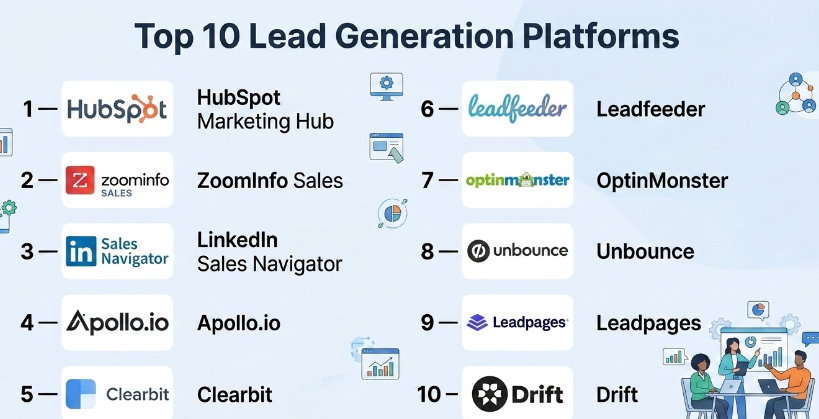
Top 10 Lead Generation Platforms
#1 — HubSpot Marketing Hub
Short description :
HubSpot Marketing Hub is a popular lead generation and marketing automation platform for businesses that want forms, landing pages, email marketing, CRM, workflows, and reporting in one system. It is especially useful for SMB and mid-market teams that want an easy-to-use platform without building a complex tool stack. HubSpot helps capture inbound leads, nurture them, score them, and pass them to sales. It is also strong for content-driven lead generation. Larger enterprises may need advanced customization depending on their process.
Key Features
- Landing pages and website forms.
- Email marketing and lead nurturing.
- CRM-native lead management.
- Lead scoring and segmentation.
- Marketing automation workflows.
- Reporting dashboards.
- Ad and campaign tracking.
Pros
- Easy to use for marketing and sales teams.
- Strong CRM and marketing connection.
- Good for inbound lead generation.
Cons
- Advanced features may require higher plans.
- Pricing can increase as usage grows.
- Complex enterprise workflows may need careful setup.
Platforms / Deployment
Web, iOS, Android. Cloud.
Security & Compliance
HubSpot provides security features such as access controls and account protection options. Specific compliance details should be verified directly.
Integrations & Ecosystem
HubSpot has a strong ecosystem for sales, marketing, service, and operations workflows.
- CRM tools
- Email platforms
- Ad platforms
- Website forms
- Analytics tools
- Sales engagement tools
Support & Community
HubSpot has strong documentation, learning resources, community support, partner agencies, and paid support options.
#2 — ZoomInfo Sales
Short description :
ZoomInfo Sales is a B2B prospecting and lead intelligence platform used by sales and marketing teams to find company and contact data. It is useful for teams that need accurate prospect lists, account research, buyer intent signals, and outreach preparation. ZoomInfo is especially valuable for B2B companies selling to specific industries, roles, or account segments. It helps reduce manual research and improves outbound lead generation. Teams should carefully manage data usage and compliance processes.
Key Features
- B2B company and contact database.
- Advanced search and filtering.
- Intent and account insights.
- Data enrichment.
- CRM syncing.
- Sales prospecting workflows.
- Lead list building.
Pros
- Strong B2B data coverage.
- Useful for outbound sales teams.
- Helps improve account and contact research.
Cons
- May be expensive for smaller teams.
- Data accuracy should still be validated.
- Requires responsible data governance.
Platforms / Deployment
Web. Cloud.
Security & Compliance
Enterprise security controls are expected, but specific certifications and compliance details should be verified directly.
Integrations & Ecosystem
ZoomInfo connects well with sales and marketing systems.
- CRM platforms
- Sales engagement tools
- Marketing automation tools
- Data enrichment workflows
- Account intelligence systems
- Outreach platforms
Support & Community
ZoomInfo provides onboarding, documentation, customer support, and training resources. It has strong visibility in B2B sales communities.
#3 — LinkedIn Sales Navigator
Short description :
LinkedIn Sales Navigator is a sales prospecting platform built around LinkedIn’s professional network. It helps sales teams identify decision-makers, save leads, track account activity, and find warm outreach opportunities. It is highly useful for B2B lead generation, relationship-based selling, and account research. Teams use it to identify prospects by job role, company, industry, geography, and activity. It works best when combined with a CRM and structured outreach process.
Key Features
- Advanced lead and account search.
- Saved leads and account lists.
- Buyer activity insights.
- Relationship-based prospecting.
- Lead recommendations.
- CRM sync options.
- Account tracking and alerts.
Pros
- Strong professional network data.
- Useful for relationship-based selling.
- Great for B2B prospect research.
Cons
- Not a complete marketing automation platform.
- Outreach still needs careful personalization.
- CRM and email workflows may require additional tools.
Platforms / Deployment
Web, iOS, Android. Cloud.
Security & Compliance
LinkedIn provides account security controls. Specific enterprise compliance details should be verified directly.
Integrations & Ecosystem
LinkedIn Sales Navigator works well with CRM and sales tools.
- CRM platforms
- Sales engagement tools
- Account research workflows
- Email outreach tools
- Sales intelligence workflows
- Team collaboration processes
Support & Community
LinkedIn provides help documentation, onboarding resources, and enterprise support options. It has a very large professional user base.
#4 — Apollo.io
Short description :
Apollo.io is a sales intelligence and engagement platform used for prospecting, contact discovery, email outreach, sequencing, and lead management. It is popular with startups, SMBs, and growth teams because it combines data and outreach in one platform. Apollo helps users build prospect lists, enrich data, create email sequences, and track engagement. It is useful for outbound lead generation and sales development teams. Data accuracy and outreach compliance should always be managed carefully.
Key Features
- Contact and company database.
- Email sequencing.
- Lead enrichment.
- Sales engagement workflows.
- Prospect list building.
- CRM integrations.
- Analytics and performance tracking.
Pros
- Good balance of data and outreach features.
- Useful for startups and SMB sales teams.
- Helps reduce tool switching.
Cons
- Data quality can vary by region or industry.
- Outreach deliverability requires careful management.
- Advanced team governance may need higher plans.
Platforms / Deployment
Web. Cloud.
Security & Compliance
Security controls are available, but specific certifications should be verified directly. Some details are not publicly stated.
Integrations & Ecosystem
Apollo connects prospecting, CRM, and outreach workflows.
- Salesforce
- HubSpot
- Email platforms
- Sales engagement tools
- Data enrichment workflows
- Workflow automation tools
Support & Community
Apollo provides documentation, help resources, and customer support options. It has strong adoption among sales development and growth teams.
#5 — Clearbit
Short description :
Clearbit is a B2B data enrichment and lead intelligence platform used to improve lead records, identify website visitors, and personalize marketing workflows. It is especially useful for teams that already capture leads but need better company and contact context. Clearbit helps marketing and sales teams understand who is visiting, which companies match the ideal customer profile, and how to route or qualify leads. It is strong for enrichment-driven lead generation. It may need other tools for outreach or campaign execution.
Key Features
- Lead and account enrichment.
- Website visitor identification.
- Company data enrichment.
- Segmentation support.
- Lead routing signals.
- CRM and marketing integrations.
- Personalization data.
Pros
- Strong for improving lead data quality.
- Useful for inbound qualification.
- Helps reduce incomplete CRM records.
Cons
- Not a full outreach platform.
- Works best with existing traffic or lead flow.
- Data coverage may vary by market.
Platforms / Deployment
Web. Cloud.
Security & Compliance
Security and privacy controls should be verified directly. Some details are not publicly stated.
Integrations & Ecosystem
Clearbit is designed to enrich existing revenue systems.
- CRM platforms
- Marketing automation tools
- Website personalization tools
- Analytics platforms
- Lead routing workflows
- Data operations systems
Support & Community
Support includes documentation and customer support options. Community strength is strongest among marketing operations and revenue operations teams.
#6 — Leadfeeder
Short description :
Leadfeeder is a website visitor identification and lead generation platform that helps businesses understand which companies are visiting their website. It is useful for B2B sales teams that want to turn anonymous website traffic into account-level sales opportunities. Leadfeeder helps identify company visits, track page behavior, and notify sales teams when target accounts show interest. It works well for companies with meaningful website traffic. It is less useful for businesses with low traffic or mainly consumer-focused audiences.
Key Features
- Website visitor identification.
- Company-level tracking.
- Lead scoring based on behavior.
- CRM integration.
- Sales alerts.
- Page-level engagement insights.
- Account filtering.
Pros
- Helps convert website traffic into leads.
- Useful for B2B sales follow-up.
- Easy to understand for sales teams.
Cons
- Depends on website traffic volume.
- Does not identify every individual visitor.
- Needs CRM follow-up process to create value.
Platforms / Deployment
Web. Cloud.
Security & Compliance
Security and privacy details should be verified directly. Some details are not publicly stated.
Integrations & Ecosystem
Leadfeeder fits into sales and marketing workflows focused on website-driven lead generation.
- CRM tools
- Email tools
- Website analytics
- Sales alerts
- Marketing automation tools
- Workflow automation platforms
Support & Community
Leadfeeder provides documentation, onboarding resources, and customer support options. It is well known among B2B website-driven sales teams.
#7 — OptinMonster
Short description :
OptinMonster is a lead capture and conversion optimization platform used to turn website visitors into subscribers, leads, or customers. It is commonly used for popups, forms, exit-intent campaigns, banners, and targeted offers. It is useful for bloggers, ecommerce teams, SaaS companies, agencies, and small businesses that want more leads from existing website traffic. The platform focuses on conversion rather than full CRM or sales prospecting. It works best when connected with email marketing or CRM tools.
Key Features
- Popup and lead capture forms.
- Exit-intent campaigns.
- Targeted onsite messages.
- A/B testing.
- Audience segmentation.
- Campaign analytics.
- Email marketing integrations.
Pros
- Strong for website lead capture.
- Easy to deploy for marketing teams.
- Good for improving conversion rates.
Cons
- Not a full lead management platform.
- Can affect user experience if overused.
- Needs traffic to generate meaningful results.
Platforms / Deployment
Web. Cloud.
Security & Compliance
Security details should be verified directly. Some details are not publicly stated.
Integrations & Ecosystem
OptinMonster integrates with common marketing and website tools.
- Email marketing platforms
- CRM tools
- Website builders
- Ecommerce platforms
- Analytics tools
- Form workflows
Support & Community
OptinMonster offers documentation, support resources, and customer support options. It is commonly used by digital marketers and website owners.
#8 — Unbounce
Short description :
Unbounce is a landing page and conversion platform used to create campaign pages, capture leads, and test messaging. It is useful for marketers running paid ads, product campaigns, webinars, downloadable content, and lead magnets. Unbounce helps teams build landing pages without heavy developer support. It also supports testing and optimization to improve lead conversion. It is not a full prospecting database or CRM, so it works best with marketing automation and sales tools.
Key Features
- Landing page builder.
- Lead capture forms.
- A/B testing.
- AI-assisted copy and optimization features.
- Campaign analytics.
- Conversion optimization tools.
- Marketing integrations.
Pros
- Strong for campaign landing pages.
- Easy for marketing teams to use.
- Useful for testing offers and messaging.
Cons
- Not a full CRM or prospecting tool.
- Needs traffic from ads, email, or SEO.
- Advanced personalization may require setup.
Platforms / Deployment
Web. Cloud.
Security & Compliance
Security features are available, but specific compliance details should be verified directly.
Integrations & Ecosystem
Unbounce connects landing pages with lead management systems.
- CRM platforms
- Email marketing tools
- Marketing automation platforms
- Analytics tools
- Ad platforms
- Workflow automation tools
Support & Community
Unbounce provides documentation, templates, learning resources, and customer support options. It has strong recognition among performance marketers.
#9 — Leadpages
Short description :
Leadpages is a landing page and lead capture platform designed for small businesses, creators, agencies, and marketing teams. It helps users build landing pages, popups, alert bars, and lead forms without needing advanced technical skills. Leadpages is useful for webinars, downloads, offers, signups, and simple lead generation funnels. It is a practical choice for teams that need fast page creation and simple conversion workflows. It may not be enough for complex enterprise lead management.
Key Features
- Landing page builder.
- Lead capture forms.
- Popups and alert bars.
- Templates for campaigns.
- Basic analytics.
- Payment and signup support.
- Email and CRM integrations.
Pros
- Easy for small teams to use.
- Good for quick campaign launches.
- Helpful for simple lead generation funnels.
Cons
- Less advanced than enterprise platforms.
- Limited for complex sales workflows.
- Requires separate CRM or email tool for nurturing.
Platforms / Deployment
Web. Cloud.
Security & Compliance
Security details should be verified directly. Some details are not publicly stated.
Integrations & Ecosystem
Leadpages connects with marketing and sales tools for simple lead capture workflows.
- Email marketing platforms
- CRM tools
- Webinar tools
- Analytics tools
- Payment tools
- Website platforms
Support & Community
Leadpages provides templates, documentation, learning resources, and customer support options. It is popular among small business marketers and creators.
#10 — Drift
Short description :
Drift is a conversational marketing and sales platform that helps businesses capture, qualify, and route leads through website chat and automated conversations. It is useful for B2B companies that want to convert website visitors in real time instead of relying only on static forms. Drift can help qualify prospects, book meetings, answer questions, and connect visitors with sales teams. It works best for companies with meaningful website traffic and clear sales routing rules. It may be too advanced for teams that only need basic forms.
Key Features
- Website chat and conversational lead capture.
- Chatbots for qualification.
- Meeting booking workflows.
- Lead routing.
- Account-based conversations.
- CRM and sales integrations.
- Conversation analytics.
Pros
- Strong for real-time website lead conversion.
- Helps reduce friction in lead capture.
- Useful for sales-ready visitor engagement.
Cons
- Requires good conversation design.
- Value depends on website traffic quality.
- May need sales team readiness for fast follow-up.
Platforms / Deployment
Web. Cloud.
Security & Compliance
Security controls are expected, but specific certifications and compliance details should be verified directly.
Integrations & Ecosystem
Drift connects website engagement with sales and marketing workflows.
- CRM platforms
- Marketing automation tools
- Calendar tools
- Sales engagement systems
- Analytics platforms
- Account-based workflows
Support & Community
Drift provides onboarding resources, documentation, customer support, and sales enablement guidance. It is recognized among conversational marketing teams.
Comparison Table Top 10
| Tool Name | Best For | Platform(s) Supported | Deployment | Standout Feature | Public Rating |
|---|---|---|---|---|---|
| HubSpot Marketing Hub | Inbound lead generation and CRM-based marketing | Web, iOS, Android | Cloud | All-in-one lead capture and nurturing | N/A |
| ZoomInfo Sales | B2B prospecting and contact intelligence | Web | Cloud | Large B2B company and contact database | N/A |
| LinkedIn Sales Navigator | Relationship-based B2B prospecting | Web, iOS, Android | Cloud | Professional network-based lead discovery | N/A |
| Apollo.io | Outbound prospecting and sales engagement | Web | Cloud | Prospect database plus email sequencing | N/A |
| Clearbit | Lead enrichment and visitor intelligence | Web | Cloud | Data enrichment for inbound leads | N/A |
| Leadfeeder | Website visitor identification | Web | Cloud | Company-level website visitor tracking | N/A |
| OptinMonster | Website lead capture and conversion | Web | Cloud | Popups and exit-intent campaigns | N/A |
| Unbounce | Landing pages and paid campaign leads | Web | Cloud | Conversion-focused landing page builder | N/A |
| Leadpages | Simple landing pages for SMBs | Web | Cloud | Fast lead capture page creation | N/A |
| Drift | Conversational lead generation | Web | Cloud | Real-time chat-based lead qualification | N/A |
Evaluation & Lead Generation Platforms
| Tool Name | Core (25%) | Ease (15%) | Integrations (15%) | Security (10%) | Performance (10%) | Support (10%) | Value (15%) | Weighted Total (0–10) |
|---|---|---|---|---|---|---|---|---|
| HubSpot Marketing Hub | 9 | 9 | 9 | 8 | 8 | 9 | 8 | 8.60 |
| ZoomInfo Sales | 9 | 7 | 8 | 8 | 8 | 8 | 7 | 8.00 |
| LinkedIn Sales Navigator | 8 | 8 | 7 | 8 | 8 | 8 | 8 | 7.85 |
| Apollo.io | 8 | 8 | 8 | 7 | 8 | 7 | 9 | 8.00 |
| Clearbit | 8 | 7 | 8 | 7 | 8 | 7 | 7 | 7.50 |
| Leadfeeder | 7 | 8 | 8 | 7 | 8 | 7 | 8 | 7.60 |
| OptinMonster | 7 | 9 | 8 | 7 | 8 | 8 | 8 | 7.85 |
| Unbounce | 8 | 8 | 8 | 8 | 8 | 8 | 7 | 7.85 |
| Leadpages | 7 | 9 | 7 | 7 | 8 | 8 | 8 | 7.65 |
| Drift | 8 | 8 | 8 | 8 | 8 | 8 | 7 | 7.85 |
These scores are comparative and should be used as a starting point, not a final decision. A tool with a higher score may not be the right fit if your lead generation strategy is different. For example, outbound teams may prefer Apollo or ZoomInfo, while inbound teams may prefer HubSpot, Unbounce, OptinMonster, or Drift. Always test the platform with your real workflow, CRM, audience, and sales process.
Which Lead Generation Platform Is Right for You?
Solo / Freelancer
Solo professionals should avoid complex and expensive lead generation stacks. A simple landing page tool, CRM, and outreach system may be enough. Leadpages, HubSpot, LinkedIn Sales Navigator, or Apollo can work well depending on whether the focus is inbound, outbound, or relationship-based selling.
SMB
SMBs should choose tools that are easy to set up and manage. HubSpot is strong for all-in-one inbound lead generation. Apollo is useful for outbound prospecting. OptinMonster and Unbounce are good for converting website traffic and paid ad visitors into leads.
Mid-Market
Mid-market companies usually need stronger CRM integration, lead scoring, automation, reporting, and sales handoff. HubSpot, ZoomInfo, Apollo, Clearbit, Drift, and Unbounce can be strong options depending on whether the team needs data, landing pages, chat, or outbound workflows.
Enterprise
Enterprise teams should prioritize governance, security, data quality, CRM integration, reporting, and scalability. ZoomInfo, HubSpot, LinkedIn Sales Navigator, Clearbit, and Drift are useful options depending on the lead generation strategy and existing revenue stack.
Budget vs Premium
Budget-conscious teams should start with tools that solve one clear problem. For example, Leadpages for landing pages, Apollo for outbound prospecting, or OptinMonster for website conversion. Premium tools like ZoomInfo and advanced HubSpot plans make sense when the team has enough sales capacity and process maturity.
Feature Depth vs Ease of Use
Feature-rich platforms can support complex lead generation programs, but they may require more setup and training. Easy tools are better for fast execution. The best choice depends on whether your biggest problem is finding leads, capturing leads, qualifying leads, or nurturing leads.
Integrations & Scalability-
Lead generation tools must connect smoothly with CRM, email marketing, sales engagement, analytics, and reporting systems. Poor integration leads to duplicate records, missed follow-ups, and unclear attribution. Always test CRM sync and lead routing before committing.
Security & Compliance Needs
Teams handling customer data should review access controls, data retention, consent management, encryption, user permissions, and compliance documentation. This is especially important for companies working in regulated industries or selling across multiple regions.
Frequently Asked Questions FAQs
1. What is a lead generation platform?
A lead generation platform helps businesses find, capture, qualify, and manage potential customers. It can support forms, landing pages, contact discovery, chat, email campaigns, data enrichment, and CRM syncing.
2. How much do lead generation platforms cost?
Pricing varies widely based on features, contact volume, users, data access, automation, and support level. Some tools are affordable for small teams, while enterprise platforms require larger budgets.
3. What is the difference between inbound and outbound lead generation?
Inbound lead generation captures people who come to your website, content, ads, or events. Outbound lead generation involves actively finding and contacting potential buyers through email, phone, LinkedIn, or sales campaigns.
4. Which lead generation platform is best for small businesses?
Small businesses often benefit from HubSpot, Leadpages, OptinMonster, Apollo, or LinkedIn Sales Navigator. The right choice depends on whether the business needs website leads, outbound leads, or simple CRM-based nurturing.
5. Do lead generation platforms replace CRM tools?
No. Most lead generation platforms work with CRM tools. The lead generation platform helps capture or find leads, while the CRM stores lead records, tracks sales activity, and manages pipeline.
6. What is the biggest mistake in lead generation?
The biggest mistake is focusing only on lead volume. A large number of poor-quality leads wastes sales time. Teams should focus on qualified leads that match the ideal customer profile and show buying interest.
7. Are lead generation platforms secure?
Many platforms offer security controls, but buyers should verify details directly. Important checks include user permissions, encryption, SSO, MFA, data handling policies, and compliance documentation.
8. How long does implementation take?
Simple tools can be set up quickly, while larger platforms may take weeks or months. Implementation depends on CRM setup, integrations, tracking, campaign structure, lead routing, and team training.
9. What integrations are most important?
The most important integrations are CRM, email marketing, sales engagement, analytics, advertising platforms, website forms, and workflow automation tools. Good integrations help prevent data gaps and manual work.
10. When should a company switch lead generation tools?
A company should switch when the current tool cannot support scale, integrations, reporting, lead quality, compliance, or team workflow. Before switching, review data migration, CRM sync, and user adoption risk.
Conclusion
Lead generation platforms can help businesses build a stronger and more predictable pipeline, but the best tool depends on the company’s sales model, target audience, budget, team size, and existing systems. HubSpot is strong for inbound and CRM-based lead generation, ZoomInfo and Apollo are useful for B2B prospecting, LinkedIn Sales Navigator is valuable for relationship-based selling, Clearbit improves lead data quality, and tools like Unbounce, Leadpages, OptinMonster, and Drift help convert website visitors into leads. No platform can fix unclear messaging, poor targeting, or weak follow-up.
