Introduction
Lead enrichment tools help businesses add missing, useful details to lead records. In simple words, they take a basic lead such as a name, email, domain, or company name and enrich it with data like job title, company size, industry, location, technology stack, social profile, buying signals, and firmographic details.
In a modern sales and marketing environment, lead enrichment matters because teams cannot depend only on manual research. Buyers move fast, data becomes outdated quickly, and sales teams need better context before outreach. Lead enrichment tools help improve targeting, personalization, lead scoring, account-based marketing, routing, and CRM hygiene.
Common use cases include improving CRM records, qualifying inbound leads, personalizing email campaigns, identifying decision-makers, cleaning duplicate data, and building better sales segments.
Buyers should evaluate data accuracy, coverage, freshness, compliance, CRM integrations, API quality, pricing model, automation, ease of use, and support quality.
Best for: Sales teams, marketing teams, revenue operations, founders, demand generation teams, B2B SaaS companies, agencies, and enterprises that depend on high-quality lead data.
Not ideal for: Very small teams with low lead volume, businesses that already have verified first-party customer data, or teams that only need simple email collection without enrichment.
Key Trends in Lead Enrichment Tools
- AI-powered data matching is becoming more common, helping teams identify missing fields, suggest better segments, and reduce manual research.
- Real-time enrichment APIs are important for sign-up forms, product-led growth workflows, chatbots, and lead routing.
- Compliance-first data sourcing is now a major buyer requirement because privacy expectations are higher.
- CRM-native enrichment is growing as teams want clean data directly inside Salesforce, HubSpot, and other CRM systems.
- Intent and buying signal enrichment is becoming more valuable than basic contact data alone.
- Waterfall enrichment models are popular because teams want to combine multiple data sources for better coverage.
- Usage-based pricing is common, especially when enrichment is tied to API calls, credits, or record volume.
- Data freshness monitoring is becoming important because job titles, company size, and roles change frequently.
- Integration depth matters more than simple exports because teams want automated workflows across sales, marketing, and data tools.
- Security, consent, and auditability are now part of tool selection, especially for enterprise buyers.
How We Selected These Tools (Methodology)
- Tools were chosen based on broad market recognition in B2B lead enrichment, sales intelligence, revenue operations, and data enrichment.
- The list balances enterprise platforms, SMB-friendly tools, developer-friendly data APIs, and sales-focused databases.
- Feature completeness was considered, including contact enrichment, company enrichment, firmographics, technographics, intent signals, and CRM sync.
- Integration strength was evaluated based on common ecosystem fit with CRM, marketing automation, sales engagement, and data warehouse workflows.
- Security posture was considered where publicly known, but uncertain certifications are marked as “Not publicly stated.”
- Customer fit was considered across solo users, SMBs, mid-market teams, and enterprises.
- Practical usability was considered, including ease of search, enrichment automation, exports, and workflow setup.
- Pricing flexibility and value were considered at a comparative level without guessing private pricing details.
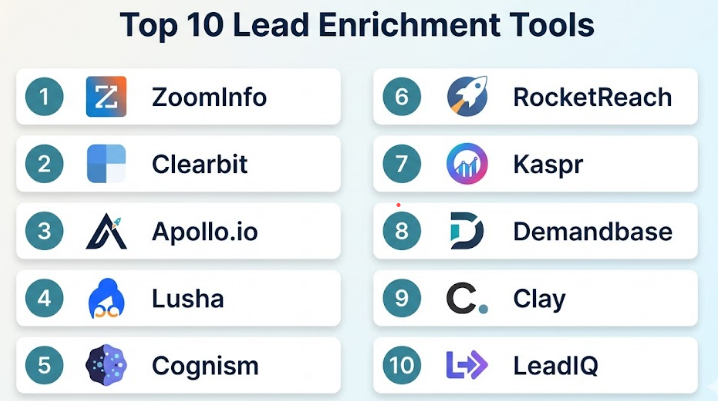
Top 10 Lead Enrichment Tools
#1 — ZoomInfo
Short description :
ZoomInfo is a well-known B2B intelligence and lead enrichment platform used by sales, marketing, and revenue teams. It helps enrich contacts and accounts with company data, professional details, firmographics, intent signals, and market intelligence. It is often used by mid-market and enterprise teams that need large-scale prospecting and account research. ZoomInfo is suitable for organizations that want both database access and enrichment workflows. It is especially useful when sales teams need detailed company and contact context before outreach.
Key Features
- B2B contact and company enrichment
- Firmographic and professional profile data
- Intent and buying signal capabilities
- CRM and sales engagement integrations
- Account-based sales and marketing support
- Data management and list-building workflows
- Advanced search and segmentation
Pros
- Strong fit for larger sales and marketing teams.
- Broad B2B database and enrichment capabilities.
- Useful for account-based marketing and outbound sales.
Cons
- Can be expensive for small teams.
- Requires governance to avoid poor targeting or overuse.
- Data accuracy may vary by region and industry.
Platforms / Deployment
Web / Cloud
Security & Compliance
SSO, role-based access, and enterprise security controls may be available depending on plan. Specific certifications: Not publicly stated here.
Integrations & Ecosystem
ZoomInfo fits well into sales and revenue technology stacks, especially where CRM and sales engagement tools are central.
- Salesforce
- HubSpot
- Sales engagement tools
- Marketing automation platforms
- Data workflows and APIs
- Revenue operations systems
Support & Community
ZoomInfo generally offers customer support, onboarding, documentation, and enterprise support options. Support quality may vary by package and customer size.
#2 — Clearbit
Short description :
Clearbit is a lead and company enrichment platform known for helping teams enrich records using email, domain, or company-level information. It is useful for marketing, sales, growth, and product-led teams that want real-time enrichment inside forms, CRMs, and routing workflows. Clearbit is often used for identifying company size, industry, location, and other business attributes. It is especially helpful for improving inbound lead qualification and personalization. Teams use it to reduce form friction and improve segmentation.
Key Features
- Real-time lead and company enrichment
- Email and domain-based enrichment
- Firmographic data enrichment
- API-based enrichment workflows
- CRM and marketing automation support
- Lead routing and segmentation use cases
- Useful for product-led growth workflows
Pros
- Strong API and automation use cases.
- Good fit for inbound marketing and PLG teams.
- Helps reduce long forms by enriching after capture.
Cons
- Coverage may vary by market and geography.
- Some advanced workflows may need technical setup.
- Pricing may not suit very small teams.
Platforms / Deployment
Web / Cloud
Security & Compliance
Security controls may vary by plan. Specific certifications: Not publicly stated here.
Integrations & Ecosystem
Clearbit works well where enrichment needs to happen automatically across marketing and sales systems.
- Salesforce
- HubSpot
- Marketo
- Segment-style data workflows
- APIs
- Web forms and routing workflows
Support & Community
Documentation and developer resources are usually important parts of the Clearbit ecosystem. Support options may vary by customer plan.
#3 — Apollo.io
Short description :
Apollo.io combines lead database access, enrichment, prospecting, and sales engagement features in one platform. It is popular with startups, SMBs, and sales teams that want both contact discovery and outreach workflows. Apollo helps users find prospects, enrich contact information, verify emails, build lists, and run outbound sequences. It is useful for teams that want a practical tool without buying several separate systems. Apollo is often chosen for its balance of database, usability, and sales workflow features.
Key Features
- Contact and account database
- Lead enrichment and email discovery
- Email verification capabilities
- Sales engagement and sequencing
- CRM integrations
- Filters for job title, company, location, and industry
- List building and export workflows
Pros
- Good value for many SMB and growth teams.
- Combines enrichment and outreach in one platform.
- Easy for sales teams to adopt.
Cons
- Enterprise governance may require more review.
- Data accuracy can vary by segment.
- Teams may outgrow simpler workflows at scale.
Platforms / Deployment
Web / Cloud
Security & Compliance
Security features may include role-based controls and account-level permissions depending on plan. Specific certifications: Not publicly stated here.
Integrations & Ecosystem
Apollo is strong for sales workflows because it connects enrichment with outreach and CRM updates.
- Salesforce
- HubSpot
- Gmail
- Outlook
- Sales engagement workflows
- API access depending on plan
Support & Community
Apollo offers documentation, help resources, and support options. Community and educational content are useful for sales users.
#4 — Lusha
Short description :
Lusha is a sales intelligence and lead enrichment tool focused on helping teams find contact and company information. It is commonly used by sales representatives, recruiters, business development teams, and SMBs. Lusha helps users enrich leads with emails, phone numbers, company details, and decision-maker information. It is practical for prospecting and quick contact discovery. Teams often use it to support outbound campaigns and CRM updates.
Key Features
- Contact data enrichment
- Company information enrichment
- Email and phone number discovery
- Browser extension support
- CRM integrations
- Prospect list building
- Basic segmentation and filtering
Pros
- Easy to use for sales prospecting.
- Useful browser extension experience.
- Good for quick contact discovery.
Cons
- Data coverage may vary by region.
- May not be deep enough for complex enterprise enrichment.
- Credit-based pricing can become limiting at scale.
Platforms / Deployment
Web / Cloud
Security & Compliance
Security and compliance details vary by plan. Specific certifications: Not publicly stated here.
Integrations & Ecosystem
Lusha works best as a practical sales prospecting and enrichment layer.
- Salesforce
- HubSpot
- Browser extension workflows
- Sales tools
- CSV export workflows
- API options depending on plan
Support & Community
Lusha provides standard support resources, help documentation, and onboarding materials. Enterprise support may vary by plan.
#5 — Cognism
Short description :
Cognism is a B2B sales intelligence and lead enrichment platform often used by revenue teams that need compliant prospecting data. It focuses on contact data, company data, sales triggers, and outreach support. Cognism is suitable for companies that care about data quality, regional coverage, and compliance-aware prospecting. It is often considered by sales teams operating in markets where data privacy and consent are important. The platform helps teams build targeted lists and enrich CRM records.
Key Features
- B2B contact and company enrichment
- Sales intelligence and prospecting
- Firmographic filtering
- Intent and trigger-based insights
- CRM integrations
- Data quality and verification workflows
- Support for outbound sales teams
Pros
- Strong fit for compliance-conscious sales teams.
- Useful for B2B prospecting and CRM enrichment.
- Good for targeted account and contact discovery.
Cons
- May be more suitable for sales-led teams than casual users.
- Pricing details may require sales consultation.
- Data coverage may differ by region and vertical.
Platforms / Deployment
Web / Cloud
Security & Compliance
Compliance-focused positioning is a key part of Cognism’s value. Specific certifications: Not publicly stated here.
Integrations & Ecosystem
Cognism connects with core sales and marketing workflows.
- Salesforce
- HubSpot
- Sales engagement tools
- CRM enrichment workflows
- Export workflows
- API options depending on plan
Support & Community
Cognism typically supports business customers with onboarding and account support. Documentation and support depth may depend on package.
#6 — RocketReach
Short description :
RocketReach is a contact discovery and lead enrichment tool used to find professional emails, phone numbers, and company information. It is used by sales teams, recruiters, founders, agencies, and business development professionals. RocketReach is helpful when users need to search people or companies and enrich limited information into usable contact records. It is practical for targeted prospecting and research. It can also support recruiting and partnership outreach use cases.
Key Features
- Professional contact discovery
- Email and phone lookup
- Company and people search
- Browser extension workflows
- Bulk lookup features
- API availability
- CRM and export support
Pros
- Useful for individual users and teams.
- Simple contact search experience.
- Supports both sales and recruiting use cases.
Cons
- Not as deep as full enterprise revenue intelligence platforms.
- Data accuracy may vary by contact type.
- Credit usage must be managed carefully.
Platforms / Deployment
Web / Cloud
Security & Compliance
Security details: Not publicly stated.
Integrations & Ecosystem
RocketReach is useful for lightweight enrichment and contact discovery workflows.
- CRM exports
- Browser extension
- Bulk lookup
- API workflows
- Recruiting workflows
- Sales prospecting tools
Support & Community
Support and documentation are available, but enterprise-level support depth may vary by plan.
#7 — Kaspr
Short description :
Kaspr is a lead enrichment and contact data tool commonly used by sales teams and recruiters. It helps users find professional contact details, enrich profiles, and build prospect lists. Kaspr is especially useful for teams that rely on browser-based prospecting and quick data capture. It supports outbound sales workflows where users need emails, phone numbers, and company context. It is often a practical option for smaller teams that need easy contact enrichment.
Key Features
- Contact enrichment
- Email and phone number discovery
- Browser extension support
- Prospect list creation
- CRM export workflows
- Team collaboration features
- Sales and recruiting use cases
Pros
- Easy for sales users to start with.
- Useful for fast prospecting workflows.
- Good fit for LinkedIn-style research processes.
Cons
- May not offer the same depth as enterprise platforms.
- Data coverage can vary by geography.
- Advanced governance may be limited compared with larger tools.
Platforms / Deployment
Web / Cloud
Security & Compliance
Security details: Not publicly stated.
Integrations & Ecosystem
Kaspr works well for users who need enrichment directly during prospect research.
- Browser extension workflows
- CRM exports
- Sales prospecting workflows
- Recruiting workflows
- Team lists
- Data export options
Support & Community
Kaspr offers help resources and support options. Support depth may depend on the selected plan.
#8 — Demandbase
Short description :
Demandbase is an account-based marketing and B2B go-to-market platform that includes account intelligence and enrichment capabilities. It is best suited for mid-market and enterprise teams that focus on account-based selling, intent data, advertising, and sales-marketing alignment. Demandbase helps teams understand target accounts, prioritize opportunities, and enrich account-level data. It is stronger for account intelligence than simple contact lookup. Companies with mature ABM programs can benefit most from it.
Key Features
- Account intelligence and enrichment
- ABM campaign support
- Intent and engagement signals
- Sales and marketing alignment workflows
- Account scoring and segmentation
- CRM and marketing automation integrations
- Enterprise go-to-market orchestration
Pros
- Strong fit for ABM-focused teams.
- Good account-level enrichment and intent context.
- Useful for enterprise sales and marketing alignment.
Cons
- May be too complex for small teams.
- Implementation requires planning and clean processes.
- Not ideal if only basic contact enrichment is needed.
Platforms / Deployment
Web / Cloud
Security & Compliance
Enterprise security controls may be available. Specific certifications: Not publicly stated here.
Integrations & Ecosystem
Demandbase is designed for connected B2B go-to-market workflows.
- Salesforce
- Marketing automation tools
- Advertising workflows
- Sales intelligence workflows
- ABM platforms
- Data and reporting tools
Support & Community
Demandbase typically provides enterprise onboarding, account support, and documentation. Implementation support may be important for success.
#9 — Clay
Short description :
Clay is a modern data enrichment and workflow automation platform used by growth teams, sales teams, agencies, and operators. It helps users combine multiple enrichment sources, build custom prospecting workflows, use AI for research, and automate data preparation. Clay is especially useful for teams that want flexible enrichment rather than a fixed database-only tool. It supports creative workflows like waterfall enrichment, account research, lead scoring, and personalized outbound preparation.
Key Features
- Multi-source enrichment workflows
- Waterfall enrichment
- AI-assisted research and personalization
- Spreadsheet-style workflow interface
- API and automation support
- CRM and sales tool integrations
- Flexible data operations for GTM teams
Pros
- Very flexible for custom enrichment workflows.
- Strong for growth teams and agencies.
- Useful when combining many data sources.
Cons
- Can require learning and experimentation.
- Not ideal for teams wanting only a simple database search.
- Costs can increase with heavy enrichment usage.
Platforms / Deployment
Web / Cloud
Security & Compliance
Security details: Not publicly stated.
Integrations & Ecosystem
Clay’s strength is its ability to connect multiple data sources and workflows.
- CRM tools
- Sales engagement tools
- Data providers
- Web research workflows
- APIs
- Automation platforms
Support & Community
Clay has strong educational content and community-driven learning around GTM workflows. Support options may vary by plan.
#10 — LeadIQ
Short description :
LeadIQ is a sales prospecting and lead enrichment tool focused on helping sales teams capture, enrich, and sync prospect data into CRM and outreach tools. It is useful for SDRs, BDRs, account executives, and revenue teams that need cleaner prospecting workflows. LeadIQ helps users collect contact details, reduce manual data entry, and prepare outreach lists. It is best for teams that want sales workflow efficiency along with enrichment. It works well in environments where reps research prospects and push data into CRM quickly.
Key Features
- Contact capture and enrichment
- Prospecting workflow support
- CRM sync
- Sales engagement integrations
- Email discovery
- Data cleaning and workflow automation
- Team-based prospecting support
Pros
- Strong sales workflow focus.
- Helps reduce manual CRM entry.
- Good for SDR and outbound teams.
Cons
- May not be deep enough for advanced ABM intelligence.
- Data accuracy can vary by segment.
- Best results require disciplined sales processes.
Platforms / Deployment
Web / Cloud
Security & Compliance
Security details: Not publicly stated.
Integrations & Ecosystem
LeadIQ fits into sales development workflows where CRM and outreach systems are central.
- Salesforce
- HubSpot
- Outreach-style sales tools
- Salesloft-style workflows
- Browser-based prospecting
- Data export workflows
Support & Community
LeadIQ offers documentation, onboarding resources, and support options. Team support may vary by package.
Comparison Table (Top 10)
| Tool Name | Best For | Platform(s) Supported | Deployment | Standout Feature | Public Rating |
|---|---|---|---|---|---|
| ZoomInfo | Enterprise sales and marketing teams | Web | Cloud | Large B2B intelligence database | N/A |
| Clearbit | Inbound enrichment and PLG workflows | Web | Cloud | Real-time enrichment API | N/A |
| Apollo.io | SMB and growth sales teams | Web | Cloud | Enrichment plus sales engagement | N/A |
| Lusha | Quick prospecting and contact discovery | Web | Cloud | Simple contact enrichment | N/A |
| Cognism | Compliance-conscious B2B sales teams | Web | Cloud | Sales intelligence with compliance focus | N/A |
| RocketReach | Sales, recruiting, and founder outreach | Web | Cloud | People and company contact lookup | N/A |
| Kaspr | Browser-based prospecting | Web | Cloud | Fast contact capture workflows | N/A |
| Demandbase | Enterprise ABM teams | Web | Cloud | Account intelligence and intent context | N/A |
| Clay | Growth teams and GTM operators | Web | Cloud | Flexible multi-source enrichment workflows | N/A |
| LeadIQ | SDR and outbound sales teams | Web | Cloud | Prospect capture and CRM sync | N/A |
Evaluation & Lead Enrichment Tools
| Tool Name | Core (25%) | Ease (15%) | Integrations (15%) | Security (10%) | Performance (10%) | Support (10%) | Value (15%) | Weighted Total (0–10) |
|---|---|---|---|---|---|---|---|---|
| ZoomInfo | 9 | 7 | 9 | 8 | 8 | 8 | 7 | 8.10 |
| Clearbit | 8 | 8 | 9 | 7 | 8 | 7 | 7 | 7.80 |
| Apollo.io | 8 | 9 | 8 | 7 | 8 | 8 | 9 | 8.20 |
| Lusha | 7 | 9 | 7 | 6 | 7 | 7 | 8 | 7.45 |
| Cognism | 8 | 8 | 8 | 8 | 8 | 8 | 7 | 7.85 |
| RocketReach | 7 | 8 | 7 | 6 | 7 | 7 | 8 | 7.25 |
| Kaspr | 7 | 8 | 7 | 6 | 7 | 7 | 8 | 7.25 |
| Demandbase | 9 | 7 | 9 | 8 | 8 | 8 | 6 | 7.95 |
| Clay | 9 | 7 | 9 | 6 | 8 | 8 | 8 | 8.05 |
| LeadIQ | 7 | 8 | 8 | 6 | 7 | 7 | 8 | 7.40 |
These scores are comparative, not absolute. A higher score does not mean the tool is the best for every business. For example, Demandbase may be excellent for ABM teams but unnecessary for a small sales team. Apollo.io may offer strong value for SMBs, while ZoomInfo may be better for enterprise-scale revenue teams. Always validate data quality, integrations, compliance, and pricing through a pilot before making a final decision.
Which Lead Enrichment Tools
Solo / Freelancer
Solo users usually need simple contact discovery, low setup effort, and affordable pricing. Tools like Apollo.io, RocketReach, Lusha, and Kaspr can be practical choices because they are easier to start with and support prospecting without heavy implementation.
SMB
SMBs need a balance of data quality, usability, and cost control. Apollo.io, Lusha, LeadIQ, and Clearbit are strong options depending on whether the team focuses on outbound sales, inbound enrichment, or CRM data improvement.
Mid-Market
Mid-market teams often need better workflow automation, stronger CRM sync, team permissions, and data governance. ZoomInfo, Cognism, Clearbit, Apollo.io, and Clay can work well depending on the sales motion and data operations maturity.
Enterprise
Enterprise buyers should prioritize security, compliance, integrations, account governance, auditability, and support. ZoomInfo, Demandbase, Cognism, and Clearbit are often better fits for larger teams with structured revenue operations.
Budget vs Premium
Budget-conscious teams should look at Apollo.io, RocketReach, Lusha, Kaspr, or LeadIQ. Premium buyers with larger teams and deeper data needs may consider ZoomInfo, Demandbase, Cognism, or advanced Clearbit workflows.
Feature Depth vs Ease of Use
For feature depth, ZoomInfo, Demandbase, Clay, and Cognism stand out. For ease of use, Apollo.io, Lusha, RocketReach, Kaspr, and LeadIQ may feel simpler for daily sales users.
Integrations & Scalability-
If integrations are critical, prioritize tools that connect cleanly with CRM, sales engagement, marketing automation, and APIs. Clearbit, ZoomInfo, Demandbase, Clay, Apollo.io, and LeadIQ are strong candidates for connected workflows.
Security & Compliance Needs
If security and compliance are major concerns, evaluate SSO, MFA, RBAC, audit logs, data handling, consent practices, and regional privacy requirements. Enterprise teams should request security documentation before purchase and avoid relying only on marketing claims.
Frequently Asked Questions (FAQs)
1. What is a lead enrichment tool?
A lead enrichment tool adds missing information to a lead or company record. For example, it can take an email address and return company name, job title, industry, location, company size, and other useful details.
2. How do lead enrichment tools usually price their products?
Many tools use credit-based pricing, seat-based pricing, usage-based pricing, or custom enterprise pricing. Some platforms charge based on enriched records, API calls, exports, or database access.
3. Are lead enrichment tools only for sales teams?
No. Sales teams use them heavily, but marketing, revenue operations, customer success, recruiting, and growth teams also use enrichment data for segmentation, routing, personalization, and reporting.
4. What is the biggest mistake when buying a lead enrichment tool?
The biggest mistake is choosing based only on database size. Buyers should test data accuracy, CRM fit, compliance, workflow automation, and regional coverage before committing.
5. How long does implementation usually take?
Simple tools can be adopted in a few hours or days. Enterprise tools may require CRM mapping, permission setup, data governance, field rules, workflow testing, and team training.
6. Are lead enrichment tools secure?
Security depends on the vendor and plan. Buyers should check SSO, MFA, encryption, audit logs, RBAC, data handling policies, and compliance documentation before using the tool at scale.
7. Can lead enrichment tools integrate with CRM systems?
Yes, many lead enrichment tools integrate with Salesforce, HubSpot, and other CRM systems. Some also connect with marketing automation, sales engagement, data warehouses, and workflow automation tools.
8. Can these tools improve lead scoring?
Yes. Enriched data such as company size, industry, role, location, and intent signals can improve lead scoring. However, scoring rules should be tested regularly to avoid poor qualification.
9. What are alternatives to lead enrichment tools?
Alternatives include manual research, first-party form data, customer surveys, CRM data cleaning services, data warehouse enrichment, and industry-specific databases. The best alternative depends on lead volume and accuracy needs.
10. How should a company switch from one enrichment tool to another?
Start by auditing current data fields, exporting existing mappings, testing the new tool on a sample dataset, comparing accuracy, and validating CRM sync. Avoid switching all workflows at once without testing.
Conclusion
Lead enrichment tools are now an important part of modern sales, marketing, and revenue operations because clean and complete data directly affects targeting, personalization, qualification, and pipeline quality. However, there is no single best tool for every company. A small outbound team may prefer Apollo.io, Lusha, RocketReach, Kaspr, or LeadIQ because they are easier to start with. A larger enterprise team may need ZoomInfo, Demandbase, Cognism, Clearbit, or Clay because they offer deeper workflows, broader enrichment options, or stronger account intelligence. The right choice depends on your lead volume, region, sales motion, CRM setup, compliance needs, and budget.
