Introduction
IVR (Interactive Voice Response) & Voice Bot Platforms help businesses automate voice-based customer interactions using pre-built workflows, speech recognition, and AI-driven conversational systems. Instead of relying entirely on human agents, these platforms allow customers to navigate menus, get answers, complete actions, or be routed intelligently—all through voice.
Modern IVR systems have evolved significantly from rigid keypad menus to AI-powered voice bots capable of understanding natural language. This shift enables faster resolution times, reduced operational costs, and more scalable customer support operations.
Common use cases include:
- Automated customer support (FAQs, account queries)
- Intelligent call routing and IVR menus
- Appointment booking and reminders
- Payment processing and verification
- Lead qualification and outbound voice campaigns
What buyers should evaluate:
- Speech recognition accuracy (ASR)
- Natural language understanding (NLU/NLP)
- Ease of IVR flow design (low-code/no-code builders)
- AI voice bot capabilities
- Integration with CRM and contact center tools
- Multilingual support
- Analytics and reporting
- Scalability and concurrent call handling
- Security and compliance features
- Deployment flexibility (cloud vs on-premise)
Best for: Enterprises, BPOs, telecom providers, banks, healthcare organizations, and growing businesses handling high call volumes.
Not ideal for: Small teams with minimal call traffic or businesses that require high-touch human interaction for every customer conversation.
Key Trends in IVR & Voice Bot Platforms
- Conversational AI replacing traditional IVR: Natural language interactions instead of keypad navigation
- AI voice bots handling complex queries: Reducing dependency on human agents
- Speech analytics and sentiment detection: Real-time insights into customer intent
- Omnichannel convergence: Voice bots integrated with chatbots and messaging apps
- Low-code/no-code platforms: Easier IVR and bot creation without deep technical skills
- Hyper-personalization: Using CRM data to tailor responses
- Multilingual and regional expansion: Supporting global user bases
- Cloud-first infrastructure: Faster deployment and scalability
- Self-service optimization: Reducing call center workload
- Security and compliance focus: Protecting sensitive voice and customer data
How We Selected These Tools (Methodology)
- Evaluated market adoption and industry credibility
- Assessed AI, NLP, and voice automation capabilities
- Reviewed speech recognition accuracy and performance
- Considered ease of IVR flow design and usability
- Analyzed integration ecosystem and API availability
- Ensured coverage across SMB, mid-market, and enterprise
- Evaluated scalability and reliability
- Reviewed security and compliance posture
- Assessed support quality and documentation
- Compared overall value for cost
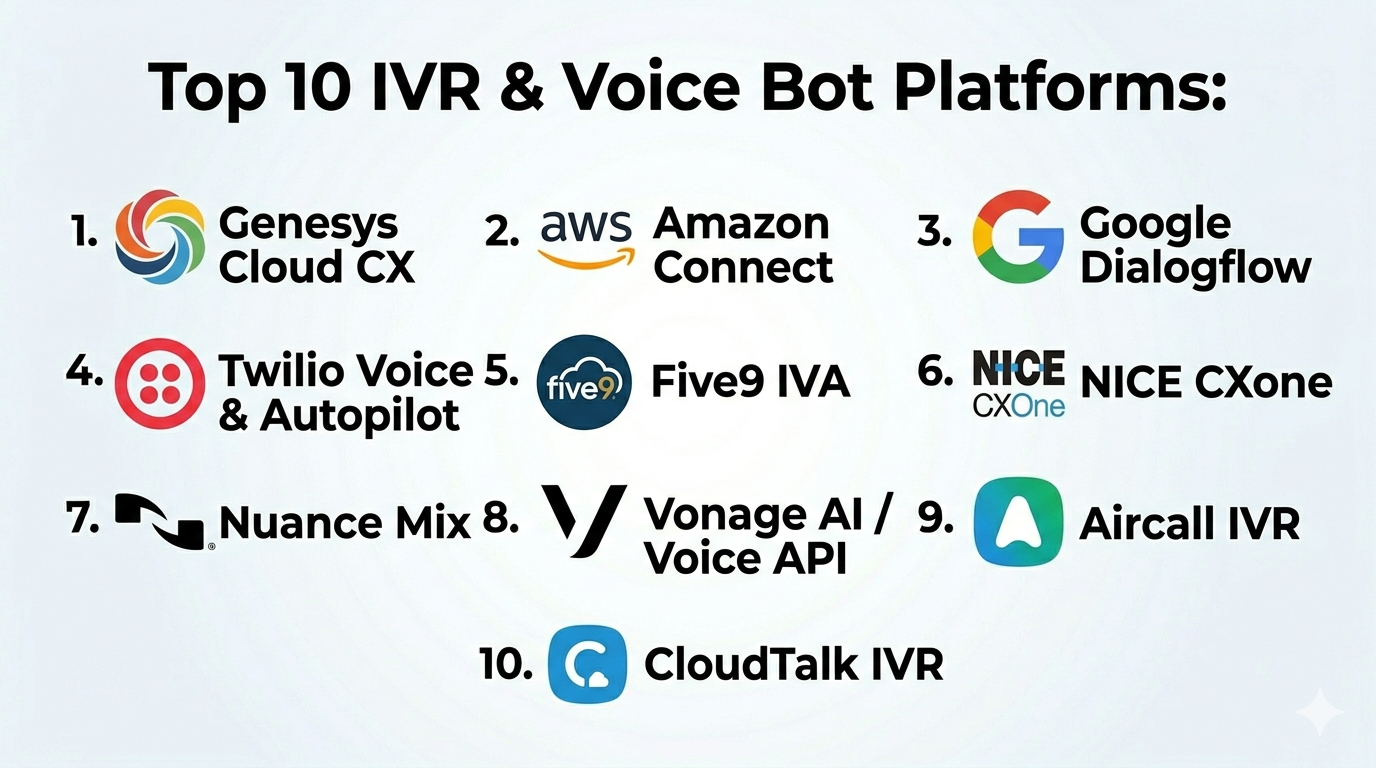
Top 10 IVR & Voice Bot Platforms
#1 — Genesys Cloud CX
Short description: A leading enterprise-grade platform offering advanced IVR and AI-powered voice bots for customer experience management.
Key Features
- AI-powered voice bots
- Advanced IVR routing
- Speech and sentiment analytics
- Omnichannel integration
- Workflow automation
- Multilingual support
Pros
- Highly scalable
- Strong AI and analytics
Cons
- Complex implementation
- Premium pricing
Platforms / Deployment
Web / Mobile
Cloud
Security & Compliance
Varies / Not publicly stated
Integrations & Ecosystem
Deep integrations with enterprise systems and APIs.
- CRM platforms
- Contact center tools
- APIs and SDKs
Support & Community
Enterprise-grade support with strong global presence.
#2 — Amazon Connect
Short description: A cloud-based contact center service with built-in IVR and AI voice bot capabilities.
Key Features
- AI voice bots via Amazon Lex
- Scalable IVR workflows
- Pay-as-you-go pricing
- Real-time analytics
- Omnichannel capabilities
Pros
- Highly scalable
- Flexible pricing model
Cons
- Requires technical expertise
- AWS dependency
Platforms / Deployment
Web
Cloud
Security & Compliance
Varies / Not publicly stated
Integrations & Ecosystem
- AWS ecosystem
- APIs
- CRM integrations
Support & Community
Extensive documentation and developer resources.
#3 — Google Dialogflow
Short description: A conversational AI platform for building voice bots and IVR systems using advanced NLP.
Key Features
- Natural language understanding
- Voice bot creation
- Context-aware conversations
- Multilingual support
- Telephony integrations
Pros
- Strong NLP engine
- Developer-friendly
Cons
- Requires development effort
- Not a full contact center
Platforms / Deployment
Web
Cloud
Security & Compliance
Varies / Not publicly stated
Integrations & Ecosystem
- Google Cloud
- APIs
- Telephony integrations
Support & Community
Strong developer community.
#4 — Twilio Voice & Autopilot
Short description: A developer-first platform for building customizable IVR systems and voice bots.
Key Features
- Programmable voice APIs
- Custom IVR workflows
- AI bot capabilities
- Global telephony
- Real-time call control
Pros
- Highly customizable
- Flexible APIs
Cons
- Requires coding
- Complex setup
Platforms / Deployment
Web
Cloud
Security & Compliance
Varies / Not publicly stated
Integrations & Ecosystem
- APIs and SDKs
- CRM integrations
- Developer tools
Support & Community
Strong developer ecosystem.
#5 — Five9 IVA
Short description: An AI-driven virtual agent platform for automating customer interactions and enhancing IVR systems.
Key Features
- AI voice bots
- Intelligent routing
- Natural language processing
- Omnichannel automation
- Analytics and reporting
Pros
- Enterprise-ready
- Advanced AI capabilities
Cons
- Expensive
- Setup complexity
Platforms / Deployment
Web
Cloud
Security & Compliance
Varies / Not publicly stated
Integrations & Ecosystem
- CRM systems
- APIs
- Contact center tools
Support & Community
Enterprise support and onboarding.
#6 — NICE CXone
Short description: A comprehensive contact center platform with strong IVR and AI capabilities.
Key Features
- AI-driven IVR
- Voice bot automation
- Speech analytics
- Workforce management integration
- Omnichannel support
Pros
- Deep analytics
- Enterprise scalability
Cons
- Complex setup
- High cost
Platforms / Deployment
Web
Cloud
Security & Compliance
Varies / Not publicly stated
Integrations & Ecosystem
- CRM tools
- APIs
Support & Community
Enterprise-level support.
#7 — Nuance Mix
Short description: A conversational AI platform specializing in advanced speech recognition and voice biometrics.
Key Features
- Speech recognition
- Voice biometrics
- AI-driven conversations
- IVR design tools
- Multilingual support
Pros
- Industry-leading speech tech
- Strong security features
Cons
- Enterprise-focused
- Expensive
Platforms / Deployment
Web
Cloud
Security & Compliance
Varies / Not publicly stated
Integrations & Ecosystem
- Enterprise systems
- APIs
Support & Community
Strong enterprise support.
#8 — Vonage AI / Voice API
Short description: API-driven platform for building IVR systems and voice bots with flexibility.
Key Features
- Voice APIs
- IVR workflows
- AI integrations
- Global telephony
- Real-time analytics
Pros
- Flexible APIs
- Developer-friendly
Cons
- Requires development effort
- Limited out-of-box UI
Platforms / Deployment
Web
Cloud
Security & Compliance
Varies / Not publicly stated
Integrations & Ecosystem
- APIs
- CRM integrations
Support & Community
Developer-focused support.
#9 — Aircall IVR
Short description: A simple IVR solution integrated into Aircall’s cloud phone system.
Key Features
- IVR routing
- Call flow builder
- CRM integrations
- Analytics
- Call tagging
Pros
- Easy setup
- User-friendly
Cons
- Limited AI capabilities
- Not enterprise-grade
Platforms / Deployment
Web / Desktop / Mobile
Cloud
Security & Compliance
Encryption, GDPR (publicly known)
Integrations & Ecosystem
- Salesforce
- HubSpot
- Zendesk
Support & Community
Good onboarding and support.
#10 — CloudTalk IVR
Short description: A lightweight IVR platform designed for SMBs with simple call routing needs.
Key Features
- IVR builder
- Call routing
- Analytics
- Call recording
- CRM integrations
Pros
- Affordable
- Easy to implement
Cons
- Limited AI features
- Smaller ecosystem
Platforms / Deployment
Web / Desktop / Mobile
Cloud
Security & Compliance
Not publicly stated
Integrations & Ecosystem
- CRM tools
- APIs
Support & Community
Good SMB-focused support.
Comparison Table (Top 10)
| Tool Name | Best For | Platform(s) Supported | Deployment | Standout Feature | Public Rating |
|---|---|---|---|---|---|
| Genesys Cloud CX | Enterprise | Web, Mobile | Cloud | AI voice bots | N/A |
| Amazon Connect | Developers | Web | Cloud | Pay-as-you-go IVR | N/A |
| Google Dialogflow | AI builders | Web | Cloud | NLP engine | N/A |
| Twilio Voice | Developers | Web | Cloud | Programmable IVR | N/A |
| Five9 IVA | Enterprise | Web | Cloud | Virtual agents | N/A |
| NICE CXone | Enterprise | Web | Cloud | AI analytics | N/A |
| Nuance Mix | Enterprise | Web | Cloud | Speech recognition | N/A |
| Vonage AI | Developers | Web | Cloud | Voice APIs | N/A |
| Aircall IVR | SMB | Web, Desktop, Mobile | Cloud | Ease of use | N/A |
| CloudTalk IVR | SMB | Web, Desktop, Mobile | Cloud | Simplicity | N/A |
IVR & Voice Bot Platforms
| Tool Name | Core (25%) | Ease (15%) | Integrations (15%) | Security (10%) | Performance (10%) | Support (10%) | Value (15%) | Weighted Total |
|---|---|---|---|---|---|---|---|---|
| Genesys Cloud CX | 9 | 7 | 9 | 8 | 9 | 8 | 7 | 8.2 |
| Amazon Connect | 8 | 6 | 9 | 7 | 9 | 7 | 8 | 7.9 |
| Google Dialogflow | 8 | 7 | 8 | 7 | 8 | 7 | 8 | 7.8 |
| Twilio Voice | 8 | 6 | 9 | 7 | 8 | 7 | 8 | 7.8 |
| Five9 IVA | 9 | 7 | 8 | 8 | 9 | 8 | 7 | 8.1 |
| NICE CXone | 9 | 6 | 8 | 8 | 9 | 8 | 6 | 7.9 |
| Nuance Mix | 9 | 6 | 7 | 8 | 9 | 8 | 6 | 7.8 |
| Vonage AI | 8 | 7 | 8 | 6 | 8 | 7 | 7 | 7.5 |
| Aircall IVR | 7 | 9 | 8 | 7 | 8 | 8 | 8 | 7.9 |
| CloudTalk IVR | 7 | 9 | 7 | 6 | 7 | 7 | 8 | 7.5 |
How to interpret:
- Scores are relative comparisons across tools
- Higher totals indicate balanced performance
- Some tools excel in AI, others in usability
- Choose based on your specific use case and scale
Which IVR & Voice Bot Platform Is Right for You?
Solo / Freelancer
- Best: CloudTalk IVR, Aircall IVR
- Focus on simplicity and affordability
SMB
- Best: Aircall, CloudTalk
- Easy setup with essential integrations
Mid-Market
- Best: Amazon Connect, Dialogflow
- Balance of customization and scalability
Enterprise
- Best: Genesys Cloud CX, NICE CXone, Five9 IVA
- Advanced AI, automation, and global scalability
Budget vs Premium
- Budget: CloudTalk, Aircall
- Premium: Genesys, NICE, Nuance
Feature Depth vs Ease of Use
- Feature-rich: Genesys, NICE, Five9
- Easy: Aircall, CloudTalk
Integrations & Scalability
- Best: Twilio, Amazon Connect, Genesys
Security & Compliance Needs
- Stronger: Nuance, NICE, Genesys
Frequently Asked Questions (FAQs)
What is an IVR system?
An IVR system allows callers to interact with automated menus using voice or keypad inputs.
What is a voice bot?
A voice bot uses AI to understand and respond to spoken language naturally.
How much do IVR platforms cost?
Pricing varies based on usage, features, and call volume.
Are voice bots better than traditional IVR?
They offer more natural interactions and better automation.
Can IVR integrate with CRM systems?
Yes, most platforms support CRM integrations.
Do I need coding skills?
Some platforms are no-code, others require development expertise.
How accurate is speech recognition?
Accuracy varies depending on platform and language support.
Can IVR handle multiple languages?
Yes, many platforms support multilingual interactions.
Is IVR secure?
Most platforms provide security features, but levels vary.
When should I upgrade?
When you need better automation, scalability, or AI capabilities.
Conclusion
IVR & Voice Bot Platforms are transforming customer communication by enabling intelligent, automated voice interactions at scale. With advancements in AI and speech recognition, businesses can now deliver faster, more efficient, and personalized support.
