Introduction
Invoice-to-Cash (I2C) platforms help businesses manage the financial process from invoice generation to payment collection and cash reconciliation. These platforms automate invoicing, payment tracking, collections, dispute management, cash application, and accounts receivable workflows. In simple terms, Invoice-to-Cash software helps organizations improve cash flow while reducing manual finance operations.
In 2026, Invoice-to-Cash platforms have become increasingly important as businesses deal with higher transaction volumes, subscription billing models, digital payment ecosystems, and global financial operations. Modern I2C platforms now use AI-driven collections, automated invoice matching, predictive payment analytics, and workflow automation to improve operational efficiency and reduce overdue receivables.
Common real-world use cases include:
- Automating invoice creation and delivery
- Managing accounts receivable workflows
- Streamlining payment collection processes
- Improving cash application and reconciliation
- Reducing invoice disputes and delays
- Supporting subscription and recurring billing operations
When evaluating Invoice-to-Cash platforms, buyers should consider:
- Invoice automation capabilities
- Payment processing integrations
- Accounts receivable management
- Collections and dispute workflows
- ERP and CRM integrations
- Cash application automation
- AI-powered analytics and forecasting
- Security and compliance features
- Scalability for enterprise finance operations
- Reporting and operational visibility
Best for: Enterprise finance teams, SaaS companies, healthcare providers, telecom organizations, distributors, manufacturers, and businesses managing large invoice volumes or complex receivables operations.
Not ideal for: Very small businesses with basic invoicing requirements or organizations already using lightweight accounting tools that adequately handle payment workflows.
Key Trends in Invoice-to-Cash Platforms
- AI-powered collections are improving payment recovery and reducing overdue balances.
- Automated cash application is minimizing manual reconciliation work.
- Predictive analytics are helping finance teams forecast cash flow more accurately.
- Embedded payment options are improving customer payment experiences.
- Subscription billing support is becoming increasingly important for SaaS businesses.
- API-first integration strategies are improving interoperability with ERP and CRM ecosystems.
- Workflow automation is reducing manual invoice approvals and dispute handling.
- Real-time payment tracking is improving finance visibility and operational decision-making.
- Security expectations increasingly include MFA, SSO, RBAC, encryption, and audit logging.
- Global compliance and tax automation capabilities are expanding for multinational operations.
How We Selected These Tools (Methodology)
The tools in this list were selected using operational, technical, and financial workflow evaluation criteria relevant to modern Invoice-to-Cash operations.
Selection criteria included:
- Market adoption and enterprise visibility
- Breadth of invoice and receivables automation features
- Payment processing and ERP integration depth
- Workflow automation flexibility
- Security and governance capabilities
- Scalability across SMB and enterprise environments
- AI and analytics functionality
- Vendor ecosystem maturity
- Reporting and finance visibility tools
- Support quality and onboarding resources
The final list includes enterprise-grade finance platforms as well as cloud-native invoicing and receivables solutions suitable for growing businesses.
Invoice-to-Cash Platforms
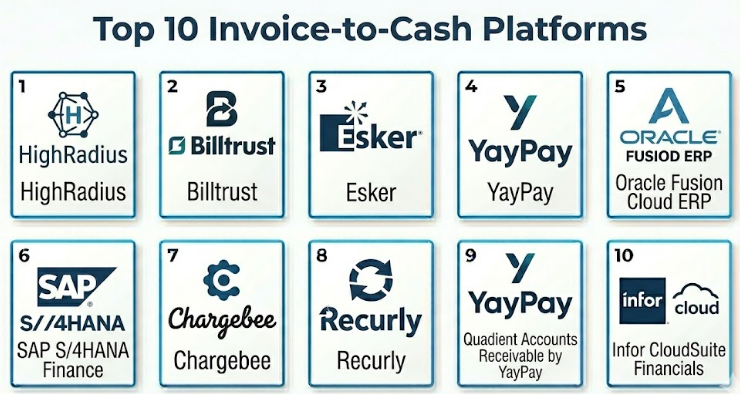
#1 — HighRadius
Short description :
HighRadius is one of the leading AI-powered Invoice-to-Cash platforms focused on accounts receivable automation, collections management, and cash application workflows. The platform helps enterprises streamline invoicing, payment reconciliation, and dispute resolution while improving cash flow visibility. HighRadius is commonly adopted by large finance teams seeking automation and operational efficiency across receivables processes. Its AI-driven workflows reduce manual tasks and improve payment forecasting accuracy.
Key Features
- AI-powered collections
- Cash application automation
- Invoice processing
- Payment reconciliation
- Dispute management
- AR analytics and forecasting
- Workflow automation
Pros
- Strong AI-driven finance automation
- Excellent enterprise scalability
- Advanced collections workflows
Cons
- Enterprise-focused pricing
- Complex implementation for large deployments
- Requires finance process alignment
Platforms / Deployment
- Web
- Cloud
Security & Compliance
- SSO/SAML
- MFA
- RBAC
- Audit logs
- Encryption
- Enterprise governance support
Integrations & Ecosystem
HighRadius integrates with ERP, CRM, and payment ecosystems for finance automation.
- SAP
- Oracle
- NetSuite
- Salesforce
- APIs
Support & Community
HighRadius provides onboarding assistance, implementation services, enterprise support, and finance workflow consulting.
#2 — Billtrust
Short description :
Billtrust is a cloud-based Invoice-to-Cash platform focused on billing automation, digital invoicing, payment processing, and accounts receivable management. The platform helps organizations modernize invoice delivery and payment collection workflows while improving operational efficiency. Billtrust is widely used by mid-market and enterprise businesses handling large invoice volumes.
Key Features
- Invoice automation
- Digital payment processing
- Cash application
- Collections management
- AR analytics
- Workflow automation
- Customer payment portals
Pros
- Strong digital invoicing capabilities
- Good payment processing support
- Improves receivables efficiency
Cons
- Limited ERP functionality
- Some advanced workflows require customization
- Enterprise scaling may increase costs
Platforms / Deployment
- Web
- Cloud
Security & Compliance
- SSO
- MFA
- Encryption
- Audit logs
- GDPR support
- SOC compliance support
Integrations & Ecosystem
Billtrust integrates with ERP and finance systems for invoice and payment workflows.
- NetSuite
- SAP
- Oracle
- Microsoft Dynamics
- APIs
Support & Community
Billtrust offers onboarding programs, implementation support, and customer success services.
#3 — Esker
Short description :
Esker provides AI-enhanced Invoice-to-Cash automation designed to streamline invoicing, collections, payment tracking, and accounts receivable workflows. The platform helps finance teams reduce manual processes while improving operational visibility and cash flow forecasting. Esker is commonly adopted by organizations modernizing finance operations without deploying full ERP replacements.
Key Features
- Invoice automation
- Collections workflows
- AI-powered finance automation
- Payment tracking
- Workflow approvals
- AR analytics
- Document management
Pros
- Strong workflow automation
- Good usability for finance teams
- AI-enhanced operational visibility
Cons
- Advanced integrations may require consulting support
- Limited ERP breadth
- Enterprise customization complexity
Platforms / Deployment
- Web
- Cloud
Security & Compliance
- SSO
- MFA
- RBAC
- Encryption
- Audit logs
- GDPR support
Integrations & Ecosystem
Esker integrates with ERP and finance ecosystems for receivables automation.
- SAP
- Oracle
- NetSuite
- Microsoft Dynamics
- APIs
Support & Community
Esker provides onboarding support, technical documentation, and enterprise assistance programs.
#4 — YayPay
Short description :
YayPay is an Invoice-to-Cash and accounts receivable automation platform focused on collections management, payment tracking, and cash flow forecasting. The platform helps finance teams automate receivables operations while improving customer payment visibility and forecasting accuracy. YayPay is commonly used by mid-market finance organizations seeking operational efficiency improvements.
Key Features
- Collections automation
- Cash flow forecasting
- AR analytics
- Payment tracking
- Workflow automation
- Invoice management
- Customer payment insights
Pros
- Strong collections visibility
- Good forecasting capabilities
- User-friendly finance workflows
Cons
- Smaller ecosystem compared to enterprise ERP vendors
- Limited operational breadth beyond AR workflows
- Enterprise governance depth may vary
Platforms / Deployment
- Web
- Cloud
Security & Compliance
- SSO
- MFA
- Encryption
- Audit logs
- GDPR support
- Not publicly stated for additional certifications
Integrations & Ecosystem
YayPay integrates with accounting and ERP ecosystems.
- NetSuite
- QuickBooks
- Sage
- Salesforce
- APIs
Support & Community
YayPay offers onboarding support and customer assistance focused on finance operations.
#5 — Oracle Fusion Cloud ERP
Short description :
Oracle Fusion Cloud ERP includes enterprise-grade Invoice-to-Cash capabilities designed for large-scale finance and operations environments. The platform supports invoicing, receivables management, payment reconciliation, collections workflows, and financial analytics. Oracle emphasizes automation, governance, and operational visibility for multinational organizations.
Key Features
- Invoice automation
- Receivables management
- Payment reconciliation
- Collections workflows
- Workflow automation
- Financial analytics
- Enterprise reporting
Pros
- Strong enterprise finance functionality
- Advanced analytics capabilities
- Deep Oracle ecosystem integration
Cons
- Complex implementation requirements
- Requires specialized administration
- Premium enterprise pricing
Platforms / Deployment
- Web
- Cloud
Security & Compliance
- SSO/SAML
- MFA
- RBAC
- Encryption
- Audit logs
- Enterprise governance capabilities
Integrations & Ecosystem
Oracle Fusion Cloud ERP integrates with enterprise finance and operational systems.
- Oracle ERP
- Salesforce
- SAP
- Workday
- APIs
Support & Community
Oracle provides onboarding resources, enterprise support programs, and implementation services.
#6 — SAP S/4HANA Finance
Short description :
SAP S/4HANA Finance includes Invoice-to-Cash functionality designed for enterprise invoicing, accounts receivable automation, collections management, and payment reconciliation. The platform supports global finance operations with strong ERP integration and operational governance. SAP is widely adopted by multinational enterprises with complex finance requirements.
Key Features
- Invoice management
- Accounts receivable automation
- Payment reconciliation
- Collections workflows
- Financial reporting
- Workflow automation
- ERP-driven analytics
Pros
- Strong enterprise scalability
- Deep finance and ERP integration
- Advanced operational governance
Cons
- Complex implementation timelines
- Requires SAP ecosystem expertise
- Enterprise licensing costs
Platforms / Deployment
- Web
- Cloud / Hybrid
Security & Compliance
- SSO/SAML
- MFA
- RBAC
- Audit logs
- Encryption
- Enterprise governance support
Integrations & Ecosystem
SAP S/4HANA Finance integrates closely with SAP and enterprise operational ecosystems.
- SAP ERP
- SAP Ariba
- Salesforce
- Microsoft Dynamics
- APIs
Support & Community
SAP provides enterprise onboarding, technical support, and implementation partner ecosystems.
#7 — Chargebee
Short description :
Chargebee is widely recognized for subscription billing and recurring revenue management. The platform supports invoice automation, payment collection, recurring billing workflows, and revenue analytics for SaaS and subscription-driven businesses. Chargebee is often selected by growing companies seeking flexible recurring billing operations.
Key Features
- Subscription billing
- Invoice automation
- Payment management
- Revenue analytics
- Dunning management
- Tax management support
- Workflow automation
Pros
- Strong recurring billing support
- Good usability for SaaS businesses
- Flexible subscription management
Cons
- Limited enterprise ERP depth
- Some advanced governance features may require additional systems
- Enterprise workflow complexity may vary
Platforms / Deployment
- Web
- Cloud
Security & Compliance
- SSO
- MFA
- Encryption
- Audit logs
- GDPR support
- SOC compliance support
Integrations & Ecosystem
Chargebee integrates with CRM, accounting, and payment platforms.
- Salesforce
- Stripe
- QuickBooks
- NetSuite
- APIs
Support & Community
Chargebee offers onboarding assistance, documentation resources, and customer support programs.
#8 — Recurly
Short description :
Recurly is a subscription billing and recurring revenue platform focused on automating invoicing, payment collection, and subscription management workflows. It is widely used by digital businesses and SaaS organizations seeking simplified recurring billing operations. Recurly emphasizes operational usability and recurring revenue optimization.
Key Features
- Subscription management
- Recurring billing
- Invoice automation
- Payment workflows
- Revenue analytics
- Dunning management
- Workflow automation
Pros
- User-friendly recurring billing workflows
- Good fit for digital subscription businesses
- Simplified operational management
Cons
- Limited enterprise finance functionality
- Smaller ERP ecosystem
- Complex pricing models may require additional tools
Platforms / Deployment
- Web
- Cloud
Security & Compliance
- SSO
- MFA
- Encryption
- Audit logs
- GDPR support
- PCI-focused payment security support
Integrations & Ecosystem
Recurly integrates with CRM, payment, and accounting ecosystems.
- Salesforce
- Stripe
- PayPal
- NetSuite
- APIs
Support & Community
Recurly provides onboarding assistance, technical documentation, and customer support services.
#9 — Quadient Accounts Receivable by YayPay
Short description :
Quadient Accounts Receivable by YayPay helps finance teams automate collections, invoice tracking, payment forecasting, and customer communications. The platform combines AR visibility with workflow automation to improve operational efficiency and cash flow management. It is commonly adopted by mid-market finance organizations modernizing receivables operations.
Key Features
- Collections automation
- AR forecasting
- Invoice management
- Customer payment tracking
- Workflow automation
- Payment insights
- Analytics dashboards
Pros
- Strong AR visibility
- Good forecasting tools
- Finance-focused usability
Cons
- Limited ERP operational breadth
- Smaller ecosystem than enterprise vendors
- Advanced customization may vary
Platforms / Deployment
- Web
- Cloud
Security & Compliance
- SSO
- MFA
- Encryption
- Audit logs
- GDPR support
- Not publicly stated for additional certifications
Integrations & Ecosystem
Quadient Accounts Receivable integrates with ERP and accounting ecosystems.
- NetSuite
- Sage
- QuickBooks
- Salesforce
- APIs
Support & Community
The platform offers onboarding assistance and finance-focused customer support programs.
#10 — Infor CloudSuite Financials
Short description :
Infor CloudSuite Financials provides enterprise finance and Invoice-to-Cash functionality designed for organizations managing large operational and receivables workflows. The platform supports invoicing, payment processing, collections management, and financial reporting while integrating closely with broader ERP operations.
Key Features
- Invoice management
- Payment workflows
- Receivables automation
- Financial reporting
- Workflow automation
- ERP analytics
- Collections management
Pros
- Strong enterprise operational visibility
- Good industry-specific ERP capabilities
- Scalable finance workflows
Cons
- Complex implementation process
- Advanced customization may require consulting
- Enterprise pricing structure
Platforms / Deployment
- Web
- Cloud / Hybrid
Security & Compliance
- SSO/SAML
- MFA
- RBAC
- Audit logs
- Encryption
- Enterprise governance support
Integrations & Ecosystem
Infor CloudSuite Financials integrates with ERP, CRM, and enterprise operational systems.
- Salesforce
- SAP
- Oracle
- Microsoft Dynamics
- APIs
Support & Community
Infor provides onboarding resources, enterprise support programs, and implementation partner ecosystems.
Comparison Table (Top 10)
| Tool Name | Best For | Platform(s) Supported | Deployment | Standout Feature | Public Rating |
|---|---|---|---|---|---|
| HighRadius | Enterprise AR automation | Web | Cloud | AI-powered collections | N/A |
| Billtrust | Digital invoicing operations | Web | Cloud | Payment automation workflows | N/A |
| Esker | Finance workflow automation | Web | Cloud | AI-enhanced invoice processing | N/A |
| YayPay | Mid-market collections management | Web | Cloud | Cash flow forecasting | N/A |
| Oracle Fusion Cloud ERP | Enterprise finance operations | Web | Cloud | Advanced finance analytics | N/A |
| SAP S/4HANA Finance | Global enterprise finance teams | Web | Cloud, Hybrid | Deep ERP integration | N/A |
| Chargebee | SaaS recurring billing | Web | Cloud | Flexible subscription invoicing | N/A |
| Recurly | Digital subscription businesses | Web | Cloud | Simplified recurring billing | N/A |
| Quadient Accounts Receivable by YayPay | AR forecasting workflows | Web | Cloud | Customer payment visibility | N/A |
| Infor CloudSuite Financials | Enterprise financial operations | Web | Cloud, Hybrid | Industry-focused ERP workflows | N/A |
Evaluation & Invoice-to-Cash Platforms
| Tool Name | Core (25%) | Ease (15%) | Integrations (15%) | Security (10%) | Performance (10%) | Support (10%) | Value (15%) | Weighted Total (0–10) |
|---|---|---|---|---|---|---|---|---|
| HighRadius | 9.5 | 7.5 | 8.5 | 9 | 9 | 8.5 | 7 | 8.5 |
| Billtrust | 8 | 8 | 7.5 | 8 | 8 | 8 | 8 | 7.9 |
| Esker | 8.5 | 8 | 8 | 8 | 8 | 8 | 8 | 8.1 |
| YayPay | 7.5 | 8 | 7 | 7.5 | 7.5 | 7.5 | 8 | 7.5 |
| Oracle Fusion Cloud ERP | 9 | 6.5 | 9 | 9 | 9 | 8.5 | 6.5 | 8.2 |
| SAP S/4HANA Finance | 9.5 | 6.5 | 9.5 | 9.5 | 9 | 9 | 6.5 | 8.6 |
| Chargebee | 8 | 8.5 | 8 | 8 | 8 | 8 | 8.5 | 8.1 |
| Recurly | 7.5 | 8.5 | 7.5 | 8 | 7.5 | 8 | 8.5 | 7.9 |
| Quadient Accounts Receivable by YayPay | 7.5 | 8 | 7 | 7.5 | 7.5 | 7.5 | 8 | 7.5 |
| Infor CloudSuite Financials | 8.5 | 6.5 | 8.5 | 8.5 | 8.5 | 8 | 7 | 7.9 |
These scores are comparative and intended to help businesses evaluate trade-offs between finance automation, usability, integration depth, and enterprise governance. ERP-focused platforms generally score higher in scalability and governance, while cloud-native billing and AR tools often prioritize usability and operational flexibility.
Which Invoice-to-Cash Platforms
Solo / Freelancer
Freelancers and small businesses with low invoice volumes may not require enterprise-grade Invoice-to-Cash systems. Lightweight invoicing or accounting software may be sufficient.
SMB
SMBs often benefit from platforms balancing automation with ease of use. Chargebee, Recurly, and Billtrust are strong options for growing businesses.
Mid-Market
Mid-market organizations typically require better forecasting, collections automation, and operational analytics. Esker, YayPay, and HighRadius provide strong finance workflow capabilities.
Enterprise
Large enterprises generally prioritize scalability, governance, ERP integration, and global finance visibility. SAP S/4HANA Finance, Oracle Fusion Cloud ERP, and Infor CloudSuite Financials are strong enterprise-focused solutions.
Budget vs Premium
- Budget-friendly operational tools: Recurly, YayPay
- Mid-range finance automation: Billtrust, Chargebee
- Premium enterprise platforms: SAP S/4HANA Finance, Oracle Fusion Cloud ERP
Businesses should evaluate operational costs and implementation complexity alongside licensing expenses.
Feature Depth vs Ease of Use
- Feature-rich enterprise systems: SAP S/4HANA Finance, Oracle Fusion Cloud ERP
- Easier-to-use platforms: Recurly, Chargebee
- Balanced finance automation: HighRadius, Esker
Highly customizable enterprise systems generally require longer onboarding and implementation timelines.
Integrations & Scalability
Organizations already using SAP, Oracle, or NetSuite ecosystems may benefit from native integration advantages. Businesses planning operational growth should prioritize APIs and workflow extensibility.
Security & Compliance Needs
Organizations handling customer payment and financial data should prioritize:
- MFA and SSO support
- Audit logging
- RBAC controls
- Encryption standards
- Financial governance workflows
Enterprise-focused platforms generally provide stronger governance and compliance tooling.
Frequently Asked Questions (FAQs)
1. What is an Invoice-to-Cash platform?
An Invoice-to-Cash platform helps businesses automate invoicing, payment collection, accounts receivable workflows, reconciliation, and financial reporting operations.
2. Why are Invoice-to-Cash platforms important in 2026?
Businesses increasingly require automation, AI-driven collections, recurring billing support, and real-time financial visibility to manage growing transaction complexity.
3. How do I2C platforms differ from accounting software?
Accounting software mainly handles bookkeeping and reporting, while Invoice-to-Cash platforms automate operational finance workflows like invoicing, collections, and reconciliation.
4. Which industries benefit most from Invoice-to-Cash software?
SaaS, healthcare, manufacturing, telecom, logistics, ecommerce, and enterprise finance organizations commonly use Invoice-to-Cash platforms.
5. Are these platforms suitable for SMBs?
Yes. Several cloud-native vendors offer scalable solutions suitable for SMBs seeking invoice automation and recurring billing functionality.
6. What integrations are most important?
ERP systems, CRM platforms, payment gateways, accounting tools, and analytics platforms are often essential integrations.
7. What security features should buyers prioritize?
Important features include MFA, SSO, RBAC, audit logs, encryption, and financial governance capabilities.
8. Can these platforms automate collections and reconciliation?
Yes. Most modern Invoice-to-Cash platforms automate collections workflows, cash application, invoice tracking, and payment reconciliation.
9. How long does implementation usually take?
Implementation timelines depend on operational complexity and integration requirements. SMB deployments may take weeks, while enterprise rollouts can require months.
10. What are common mistakes when selecting an Invoice-to-Cash platform?
Common mistakes include underestimating integration complexity, over-customizing workflows too early, and choosing enterprise-grade systems for relatively simple finance operations.
Conclusion
Invoice-to-Cash platforms have become essential components of modern finance operations, helping businesses automate invoicing, payment collection, accounts receivable management, and reconciliation workflows. Today’s leading platforms combine AI-driven automation, operational analytics, recurring billing support, and finance visibility into centralized systems designed to improve cash flow and reduce manual operational overhead.
