Introduction
Influencer Affiliate Platforms help brands manage influencer-driven affiliate programs where creators promote products and earn commissions for sales, leads, signups, or other tracked actions. In simple words, these platforms connect influencer marketing with performance-based affiliate tracking, so brands can measure which creators actually drive results.
Traditional influencer marketing often focuses on reach, impressions, views, and engagement. Influencer affiliate marketing goes deeper by tying creator activity to measurable outcomes such as purchases, subscriptions, app installs, trial signups, booked demos, or revenue. This makes it useful for brands that want creator partnerships but also need clear performance tracking.
Real-world use cases include:
- Giving influencers unique affiliate links or coupon codes
- Tracking creator-driven sales and conversions
- Managing commissions, rewards, and payouts
- Running ambassador programs for loyal creators
- Recruiting influencers for product campaigns
- Measuring revenue from creator partnerships
- Managing gifting, product seeding, and affiliate promotions
Buyers should evaluate:
- Influencer discovery and recruitment
- Affiliate tracking links and coupon code tracking
- Commission and payout management
- Campaign management workflows
- Creator communication tools
- Fraud prevention and attribution accuracy
- Ecommerce and CRM integrations
- Analytics and revenue reporting
- Product gifting and seeding workflows
- Contract and content approval tools
- Creator portal experience
- Pricing, scalability, and support quality
Best for: ecommerce brands, DTC companies, SaaS businesses, beauty brands, fashion brands, fitness brands, consumer products, subscription businesses, marketplaces, creator-led brands, and companies that want measurable influencer-driven growth.
Not ideal for: brands with poor product-market fit, weak customer experience, unclear commission economics, or no plan to manage creators consistently. Influencer affiliate platforms work best when the product is easy to recommend and the reward structure is attractive.
Key Trends in Influencer Affiliate Platforms
- Performance-based influencer marketing is growing: Brands want influencer campaigns that connect directly to sales, signups, revenue, and customer acquisition.
- Affiliate and influencer workflows are merging: Many platforms now support creator discovery, affiliate tracking, gifting, content management, commissions, and payouts together.
- Coupon code tracking remains important: Many influencer purchases happen after viewers remember a creator’s code, so coupon tracking is still valuable alongside links.
- Creator storefronts are becoming popular: Some platforms let influencers build curated product pages or shops, making affiliate promotion more natural.
- Micro-influencers are becoming more valuable: Smaller creators often have stronger trust, niche audiences, and better conversion quality than broad celebrity-style campaigns.
- Gifting and product seeding are becoming structured: Brands need to track who received products, who posted, what content was created, and what sales resulted.
- Attribution windows are becoming more advanced: Brands want to understand first-click, last-click, coupon usage, repeat purchases, and creator-assisted sales.
- Fraud prevention matters more: Fake followers, fake clicks, self-referrals, coupon abuse, and duplicate commissions can damage campaign profitability.
- Influencer CRM is becoming essential: Brands need a central place to manage creator relationships, notes, rates, content, approvals, and performance history.
- Revenue analytics are replacing vanity metrics: Views and likes still matter, but brands increasingly care about conversion rate, customer quality, average order value, and creator ROI.
How We Selected These Tools Methodology
The tools below were selected based on influencer affiliate relevance, market recognition, campaign management depth, tracking capability, ecommerce fit, creator workflow, and practical value for different business sizes.
- Influencer affiliate capability: Tools were reviewed for creator tracking, affiliate links, promo codes, commissions, and revenue attribution.
- Creator management: Influencer recruitment, communication, CRM, gifting, campaign workflows, and relationship tracking were considered.
- Ecommerce fit: Shopify, WooCommerce, BigCommerce, Amazon-style workflows, and DTC commerce use cases were considered.
- Attribution quality: Link tracking, coupon tracking, conversion tracking, and reporting depth were reviewed.
- Payout and commission support: Commission rules, approval workflows, payment options, and partner dashboards were considered.
- Campaign analytics: Revenue, conversions, creator performance, content output, and ROI reporting were evaluated.
- Scalability: Platforms for small brands, growing ecommerce companies, agencies, and enterprise programs were included.
- Fraud controls: Duplicate tracking, coupon abuse protection, fake engagement awareness, and approval workflows were considered.
- Ease of use: Admin dashboard, creator onboarding, campaign setup, and integration workflow were reviewed.
- Practical buyer fit: The goal is not one universal winner, but a useful comparison based on influencer program goals.
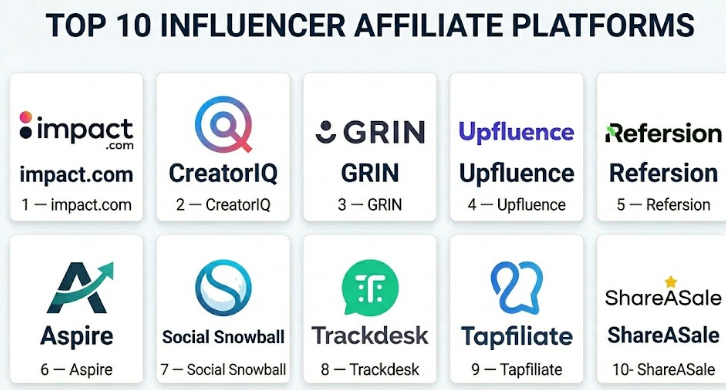
Top 10 Influencer Affiliate Platforms
#1 — impact.com
Short description :
impact.com is a partnership management platform used by brands to manage affiliates, influencers, creators, publishers, ambassadors, and strategic partners. It helps businesses track partner-driven conversions, manage contracts, set commission rules, measure performance, and automate payouts. The platform is especially useful for mature brands that want influencer affiliate campaigns connected with broader partnership management. It supports detailed attribution, reporting, and partner lifecycle workflows. impact.com is a strong option for brands that need enterprise-grade affiliate and influencer partnership management.
Key Features
- Affiliate and influencer partner management
- Tracking links and attribution workflows
- Commission and contract management
- Partner onboarding and recruitment
- Performance analytics and reporting
- Fraud and compliance controls
- Payout and finance workflow support
Pros
- Strong full-cycle partnership management
- Good for mature affiliate and influencer programs
- Useful analytics and attribution depth
Cons
- May be too advanced for small brands
- Implementation requires planning and setup
- Pricing and contract terms should be reviewed carefully
Platforms / Deployment
Web
Cloud deployment
Security & Compliance
Handles partner data, tracking data, commission records, contracts, and payout workflows. Specific certifications such as SOC 2, ISO 27001, GDPR, or PCI-related details should be verified directly.
Not publicly stated.
Integrations & Ecosystem
impact.com fits brands that want influencer and affiliate programs connected to a broader partnership ecosystem.
- Ecommerce platforms
- CRM systems
- Analytics tools
- Partner portals
- Affiliate tracking workflows
- Payout and finance systems
Support & Community
impact.com provides business-focused onboarding and partner program support. It is best for brands that need structured partnership operations and advanced reporting.
#2 — CreatorIQ
Short description :
CreatorIQ is an influencer marketing platform used by brands and agencies to manage creator discovery, campaign workflows, reporting, content approvals, and influencer relationships. While it is more influencer marketing focused than pure affiliate software, it can support performance-led creator programs when connected with tracking and commerce workflows. CreatorIQ is especially useful for larger brands managing many creators across campaigns, regions, and teams. It helps centralize influencer data, campaign communication, and performance reporting. It is a strong fit for brands that want influencer relationship management with measurable business outcomes.
Key Features
- Influencer discovery and creator database
- Campaign management workflows
- Creator relationship management
- Content tracking and approval support
- Performance reporting
- Audience and engagement insights
- Enterprise team collaboration features
Pros
- Strong influencer CRM and campaign management
- Good for agencies and enterprise brands
- Useful for managing large creator programs
Cons
- Affiliate payout depth may require integrations
- May be too advanced for small businesses
- Best value depends on influencer program maturity
Platforms / Deployment
Web
Cloud deployment
Security & Compliance
Handles influencer data, campaign records, content, performance analytics, and relationship workflows. Specific security and compliance details should be verified directly.
Not publicly stated.
Integrations & Ecosystem
CreatorIQ fits influencer programs that need structured creator management and campaign visibility.
- Social platform data workflows
- Ecommerce and performance integrations
- Creator CRM
- Campaign reporting
- Content approval workflows
- Agency collaboration systems
Support & Community
CreatorIQ generally serves professional influencer marketing teams and agencies. It is best for larger teams managing creator relationships at scale.
#3 — GRIN
Short description :
GRIN is a creator management platform designed for ecommerce brands that want to manage influencer relationships, product gifting, affiliate links, discount codes, campaigns, and creator performance. It is especially popular among DTC brands that work closely with creators to drive product awareness and sales. GRIN helps brands manage outreach, communication, product shipments, content collection, affiliate tracking, and performance reporting. It is useful when influencer marketing and affiliate revenue need to work together. GRIN is a strong option for ecommerce brands building long-term creator programs.
Key Features
- Influencer CRM and relationship management
- Product gifting and seeding workflows
- Affiliate links and discount code tracking
- Campaign management
- Creator communication tools
- Content collection and usage tracking
- Ecommerce performance reporting
Pros
- Strong fit for ecommerce creator programs
- Useful gifting and creator relationship workflows
- Good for DTC brands managing many creators
Cons
- May be more than very small brands need
- Requires consistent creator management effort
- Pricing and integration requirements should be reviewed
Platforms / Deployment
Web
Cloud deployment
Security & Compliance
Handles creator contact data, campaign details, ecommerce data, product gifting records, and affiliate tracking information. Specific certifications and compliance details should be verified directly.
Not publicly stated.
Integrations & Ecosystem
GRIN fits ecommerce influencer affiliate workflows.
- Shopify-style ecommerce workflows
- Creator CRM
- Product gifting systems
- Affiliate links and coupon codes
- Content libraries
- Sales performance reporting
Support & Community
GRIN provides ecommerce-focused influencer program support and resources. It is best for brands ready to build ongoing creator partnerships.
#4 — Upfluence
Short description :
Upfluence is an influencer marketing and affiliate-focused platform that helps brands discover influencers, manage campaigns, track performance, and work with creators across ecommerce and social channels. It is useful for brands that want influencer recruitment, creator communication, affiliate tracking, and campaign reporting in one place. Upfluence is especially relevant for ecommerce brands because it can help identify influential customers and turn them into ambassadors. It is a good option for teams that want influencer discovery plus measurable campaign performance. Upfluence works well for brands that combine creator marketing with sales tracking.
Key Features
- Influencer discovery and search
- Campaign and outreach management
- Affiliate tracking and creator performance
- Ecommerce customer influencer identification
- Creator relationship management
- Coupon and sales tracking support
- Reporting and analytics
Pros
- Good mix of influencer discovery and affiliate workflows
- Useful for ecommerce brands and agencies
- Can help identify creators from customer base
Cons
- Advanced setup may require onboarding
- Data quality should be validated for target niche
- Pricing should be evaluated against campaign volume
Platforms / Deployment
Web
Cloud deployment
Security & Compliance
Handles influencer profiles, customer-related signals, campaign records, tracking data, and performance analytics. Specific certifications and compliance details should be verified directly.
Not publicly stated.
Integrations & Ecosystem
Upfluence fits influencer affiliate campaigns across ecommerce and social channels.
- Ecommerce platforms
- Influencer discovery tools
- Outreach workflows
- Affiliate tracking
- Coupon tracking
- Campaign reporting
Support & Community
Upfluence provides support and resources for influencer marketing teams. It is best for brands that need discovery, outreach, and sales tracking together.
#5 — Refersion
Short description :
Refersion is an affiliate and influencer marketing platform used by ecommerce brands to track referrals, affiliate sales, influencer promo codes, and commission payments. It is especially useful for Shopify-style stores, DTC brands, and online merchants that want to manage influencers as performance partners. Refersion helps brands create affiliate programs, onboard creators, generate tracking links and codes, approve commissions, and analyze partner sales. It is a practical option for brands that want affiliate tracking with influencer-friendly workflows. Refersion is a strong fit for ecommerce businesses moving from manual creator tracking to structured affiliate management.
Key Features
- Affiliate and influencer tracking
- Referral links and coupon code tracking
- Commission management
- Affiliate portal
- Ecommerce integration support
- Order and revenue attribution
- Payout workflow support
Pros
- Strong ecommerce affiliate tracking
- Good for influencer promo code programs
- Practical for DTC brands and online stores
Cons
- Influencer discovery may be limited compared with dedicated influencer platforms
- Larger programs may need deeper creator CRM features
- Payout and tax workflows should be reviewed carefully
Platforms / Deployment
Web
Cloud deployment
Security & Compliance
Handles affiliate data, customer purchase tracking, commission records, and payment-related workflows. Specific security and compliance details should be verified directly.
Not publicly stated.
Integrations & Ecosystem
Refersion fits ecommerce affiliate and influencer sales tracking.
- Ecommerce platforms
- Affiliate portals
- Coupon code workflows
- Commission tracking
- Payout systems
- Sales reporting
Support & Community
Refersion provides ecommerce and affiliate-focused support resources. It is best for stores that want creator-driven sales attribution.
#6 — Aspire
Short description :
Aspire is an influencer marketing platform built for brands that want to manage creator discovery, outreach, gifting, campaign collaboration, content, affiliate programs, and performance reporting. It is especially useful for ecommerce and consumer brands that use influencers for both awareness and conversion. Aspire helps brands build creator communities, manage product seeding, track content, and measure creator-driven performance. It is a strong option for brands that want to manage influencer relationships and affiliate outcomes in one creator workflow. Aspire is best for teams that view creators as long-term growth partners.
Key Features
- Creator discovery and recruitment
- Influencer CRM and communication
- Product gifting and campaign workflows
- Affiliate and sales tracking support
- Content approval and management
- Creator community tools
- Performance reporting
Pros
- Strong for creator relationship management
- Good for ecommerce and consumer brands
- Useful for combining gifting, content, and affiliate tracking
Cons
- May be too complex for very small teams
- Requires active creator management strategy
- Pricing and feature availability should be reviewed directly
Platforms / Deployment
Web
Cloud deployment
Security & Compliance
Handles creator data, campaign details, product gifting records, content files, affiliate tracking, and performance data. Specific certifications and compliance details should be verified directly.
Not publicly stated.
Integrations & Ecosystem
Aspire fits influencer affiliate workflows where relationships and content matter.
- Ecommerce systems
- Creator CRM
- Product gifting workflows
- Affiliate tracking
- Content libraries
- Campaign reporting
Support & Community
Aspire provides creator marketing support and resources. It is best for brands that want to build ongoing influencer communities.
#7 — Social Snowball
Short description :
Social Snowball is an affiliate and referral platform built mainly for ecommerce brands that want to turn customers, creators, and influencers into revenue-driving advocates. It helps brands create affiliate programs, generate referral links and codes, track conversions, manage commissions, and automate creator payouts. It is especially useful for DTC brands that want influencer affiliate programs connected closely with ecommerce purchases. Social Snowball is practical for brands that want to scale creator and customer advocacy without relying on manual tracking. It is a strong fit for fast-growing ecommerce stores.
Key Features
- Affiliate and referral program management
- Creator and customer advocate onboarding
- Referral links and discount code tracking
- Commission automation
- Ecommerce attribution
- Payout workflow support
- Analytics and performance reporting
Pros
- Strong fit for DTC ecommerce brands
- Useful for customer-to-affiliate workflows
- Practical automation for creator commissions
Cons
- Less suitable for non-ecommerce businesses
- Creator discovery may need separate tools
- Program economics must be planned carefully
Platforms / Deployment
Web
Cloud deployment
Security & Compliance
Handles customer and creator data, referral activity, commission records, ecommerce purchase data, and payout-related details. Specific compliance details should be verified directly.
Not publicly stated.
Integrations & Ecosystem
Social Snowball fits ecommerce affiliate and creator advocacy workflows.
- Shopify-style ecommerce workflows
- Referral links and codes
- Creator and customer affiliate portals
- Commission automation
- Payout tools
- Sales analytics
Support & Community
Social Snowball provides ecommerce-focused support and resources. It is best for brands that want automated creator and customer affiliate programs.
#8 — Trackdesk
Short description :
Trackdesk is an affiliate tracking platform that helps businesses manage affiliate programs, partners, referrals, commissions, and performance reporting. It can be used by SaaS companies, ecommerce businesses, agencies, and digital product sellers that need structured affiliate management. For influencer affiliate programs, Trackdesk can help create tracking links, manage commissions, and track partner performance. It is more affiliate-focused than influencer-discovery focused, so it works best when a brand already has creators or partners to onboard. Trackdesk is a good option for teams needing practical affiliate tracking infrastructure.
Key Features
- Affiliate tracking and link management
- Commission rules and partner management
- Partner portal
- Conversion tracking
- Reporting and analytics
- Integration and API support
- Multi-program management options
Pros
- Strong practical affiliate tracking
- Useful for SaaS and ecommerce programs
- Good for brands with existing creator partners
Cons
- Not a full influencer discovery platform
- Creator relationship workflows may be limited
- Payout and compliance details should be reviewed
Platforms / Deployment
Web / API
Cloud deployment
Security & Compliance
Handles affiliate data, conversion tracking, commission records, program data, and partner activity. Specific certifications and compliance details should be verified directly.
Not publicly stated.
Integrations & Ecosystem
Trackdesk fits businesses needing structured affiliate infrastructure.
- SaaS platforms
- Ecommerce systems
- Partner portals
- Tracking links
- Commission workflows
- Analytics and reporting
Support & Community
Trackdesk provides affiliate program support resources. It is best for businesses that need tracking and partner management more than creator discovery.
#9 — Tapfiliate
Short description :
Tapfiliate is an affiliate tracking platform used by SaaS companies, ecommerce brands, digital product businesses, and subscription companies to create and manage affiliate programs. It supports affiliate links, coupon tracking, commission rules, partner portals, and performance reporting. For influencer affiliate campaigns, Tapfiliate can help brands onboard creators as affiliates and track sales or conversions. It is especially useful for businesses that want lightweight affiliate infrastructure without building custom tracking. Tapfiliate is a practical option for brands that already know which creators they want to work with.
Key Features
- Affiliate link tracking
- Coupon and referral code tracking
- Commission rule management
- Affiliate portal
- SaaS and ecommerce integrations
- Performance reporting
- API and webhook support
Pros
- Good for SaaS and ecommerce affiliate programs
- Practical for influencer code and link tracking
- Flexible commission setup
Cons
- Influencer discovery is not the main focus
- Larger programs may need deeper CRM features
- Payout workflows may require additional tools
Platforms / Deployment
Web / API
Cloud deployment
Security & Compliance
Handles affiliate data, tracking events, commission records, and integration data. Specific certifications and compliance practices should be verified directly.
Not publicly stated.
Integrations & Ecosystem
Tapfiliate fits affiliate tracking for creator and partner programs.
- Ecommerce platforms
- SaaS billing systems
- Coupon workflows
- Partner portals
- API integrations
- Analytics tools
Support & Community
Tapfiliate provides affiliate program documentation and support resources. It is best for businesses that need reliable tracking and partner portals.
#10 — ShareASale
Short description :
ShareASale is an affiliate network that connects merchants with affiliates, publishers, bloggers, and content creators. It is useful for brands that want access to an existing affiliate network rather than only managing direct influencer relationships. Merchants can list programs, set commission rules, track affiliate performance, and pay commissions through the network workflow. For influencer affiliate marketing, ShareASale can help brands reach bloggers, niche publishers, content creators, and affiliate marketers who promote products through content. It is a strong option for brands that want affiliate network reach alongside direct creator partnerships.
Key Features
- Affiliate network marketplace
- Merchant program listing
- Affiliate recruitment opportunities
- Tracking links and commission management
- Performance reporting
- Payment workflow support
- Publisher and content creator access
Pros
- Access to an existing affiliate network
- Useful for bloggers, publishers, and content affiliates
- Good for brands that want network-based recruitment
Cons
- Less focused on modern influencer CRM workflows
- Network competition can be high
- Brands still need strong program terms and creative assets
Platforms / Deployment
Web
Cloud deployment
Security & Compliance
Handles merchant data, affiliate data, tracking records, commission information, and payout workflows. Specific certifications and compliance details should be verified directly.
Not publicly stated.
Integrations & Ecosystem
ShareASale fits brands looking for affiliate network distribution.
- Affiliate network marketplace
- Merchant tracking
- Publisher recruitment
- Commission workflows
- Performance reporting
- Payout operations
Support & Community
ShareASale has strong affiliate network recognition. It is best for merchants that want to recruit affiliates and content publishers through a network model.
Comparison Table Top 10
| Tool Name | Best For | Platform(s) Supported | Deployment | Standout Feature | Public Rating |
|---|---|---|---|---|---|
| impact.com | Enterprise influencer and affiliate partnerships | Web | Cloud | Full partnership lifecycle management | N/A |
| CreatorIQ | Enterprise influencer relationship management | Web | Cloud | Creator discovery and campaign CRM | N/A |
| GRIN | Ecommerce influencer affiliate programs | Web | Cloud | Product gifting plus affiliate tracking | N/A |
| Upfluence | Influencer discovery with ecommerce tracking | Web | Cloud | Find creators and track sales performance | N/A |
| Refersion | Ecommerce affiliate and influencer sales tracking | Web | Cloud | Promo code and commission tracking | N/A |
| Aspire | Creator relationship and affiliate campaigns | Web | Cloud | Gifting, content, and creator workflow management | N/A |
| Social Snowball | DTC customer and creator affiliate programs | Web | Cloud | Turn customers and creators into affiliates | N/A |
| Trackdesk | Affiliate infrastructure for creators and partners | Web, API | Cloud | Partner portal and commission tracking | N/A |
| Tapfiliate | SaaS and ecommerce affiliate tracking | Web, API | Cloud | Flexible affiliate links and coupon tracking | N/A |
| ShareASale | Affiliate network recruitment | Web | Cloud | Access to existing affiliate publishers | N/A |
Evaluation & Influencer Affiliate Platforms
| Tool Name | Core 25% | Ease 15% | Integrations 15% | Security 10% | Performance 10% | Support 10% | Value 15% | Weighted Total 0–10 |
|---|---|---|---|---|---|---|---|---|
| impact.com | 9.3 | 7.8 | 9.0 | 8.7 | 8.8 | 8.5 | 7.7 | 8.55 |
| CreatorIQ | 8.8 | 7.8 | 8.5 | 8.5 | 8.6 | 8.5 | 7.5 | 8.31 |
| GRIN | 9.0 | 8.0 | 8.8 | 8.3 | 8.7 | 8.4 | 8.0 | 8.50 |
| Upfluence | 8.7 | 8.0 | 8.5 | 8.2 | 8.5 | 8.2 | 8.0 | 8.34 |
| Refersion | 8.3 | 8.5 | 8.5 | 8.0 | 8.4 | 8.0 | 8.4 | 8.33 |
| Aspire | 8.8 | 8.0 | 8.5 | 8.2 | 8.5 | 8.4 | 8.0 | 8.36 |
| Social Snowball | 8.5 | 8.7 | 8.3 | 8.0 | 8.5 | 8.2 | 8.5 | 8.42 |
| Trackdesk | 8.2 | 8.5 | 8.3 | 8.0 | 8.3 | 8.0 | 8.5 | 8.28 |
| Tapfiliate | 8.2 | 8.4 | 8.3 | 8.0 | 8.3 | 8.0 | 8.3 | 8.22 |
| ShareASale | 8.4 | 7.8 | 8.0 | 8.2 | 8.4 | 8.0 | 8.0 | 8.13 |
These scores are comparative and should be used as a starting point. Ecommerce brands may rate GRIN, Upfluence, Refersion, Aspire, or Social Snowball higher because creator gifting, coupon tracking, and product sales matter. SaaS and digital product companies may prefer Trackdesk, Tapfiliate, or impact.com. Enterprise teams may value impact.com or CreatorIQ because governance, campaign scale, and reporting depth matter more.
Which Influencer Affiliate Platform Should You Choose?
Solo / Small Brand
A small brand should start with a platform that is easy to manage and does not require heavy implementation. Refersion, Tapfiliate, Trackdesk, or Social Snowball can be practical options depending on the store and campaign model.
At this stage, the goal should be simple: give creators trackable links or codes, define the commission clearly, approve payouts carefully, and learn which creators actually convert.
Ecommerce Brand
Ecommerce brands should compare GRIN, Upfluence, Refersion, Aspire, and Social Snowball. These tools are useful for tracking influencer-driven sales, product gifting, coupon codes, and creator relationships.
For ecommerce, the most important decision is commission economics. The reward must motivate creators but still leave enough margin after product cost, shipping, discounts, platform fees, and returns.
SaaS Company
SaaS companies should evaluate Tapfiliate, Trackdesk, impact.com, and PartnerStack-style affiliate systems depending on program maturity. SaaS influencer affiliates may promote trials, demos, subscriptions, or annual plans.
SaaS teams should track not only signups but also qualified trials, paid conversions, churn, customer lifetime value, and commission eligibility rules.
DTC Consumer Brand
DTC brands should prioritize product gifting, creator CRM, discount code tracking, content collection, and revenue attribution. GRIN, Aspire, Upfluence, Social Snowball, and Refersion are strong options.
DTC brands should also measure content quality, repeat creator performance, average order value, and customer retention from influencer-driven purchases.
Enterprise
Enterprise brands need governance, permissions, contracts, multi-team workflows, global campaigns, fraud controls, detailed attribution, and finance alignment. impact.com, CreatorIQ, GRIN, Aspire, and Upfluence are strong platforms to evaluate.
Enterprise buyers should involve influencer marketing, affiliate marketing, ecommerce, legal, finance, analytics, compliance, and customer acquisition teams.
Budget vs Premium
Budget-focused teams should start with affiliate tracking tools before investing in heavy influencer CRM systems. If the brand already knows its creators, Tapfiliate, Trackdesk, Refersion, or Social Snowball may be enough.
Premium platforms are useful when the brand needs influencer discovery, campaign management, gifting workflows, content approval, creator CRM, and deeper reporting.
Feature Depth vs Ease of Use
Refersion, Trackdesk, and Tapfiliate are practical for affiliate tracking. Social Snowball is strong for DTC creator and customer advocacy. GRIN, Aspire, and Upfluence provide deeper influencer relationship workflows. CreatorIQ and impact.com are stronger for enterprise-level programs.
The best tool depends on whether the main need is creator discovery, gifting, affiliate tracking, payout management, campaign reporting, or full partnership management.
Integrations & Scalability
Influencer affiliate platforms may need to connect with ecommerce stores, CRM systems, payment tools, affiliate payout platforms, email marketing, analytics tools, product catalogs, influencer databases, and customer data platforms.
Scalability also means handling more creators, more campaigns, more discount codes, more commission rules, more approvals, more content assets, and more attribution complexity.
Security & Compliance Needs
Influencer affiliate platforms process creator data, customer purchase data, commission records, campaign content, contracts, coupon codes, and payout information. Buyers should review user permissions, data retention, privacy controls, fraud prevention, and audit logs.
Brands should also define disclosure rules, sponsored content requirements, commission terms, content usage rights, and payout eligibility before launching campaigns.
Frequently Asked Questions FAQs
1. What is an Influencer Affiliate Platform?
An Influencer Affiliate Platform helps brands manage creators who promote products and earn commissions based on tracked sales, signups, leads, or other conversions. It combines influencer marketing with affiliate performance tracking.
2. How is influencer affiliate marketing different from normal influencer marketing?
Normal influencer marketing often pays creators for content, reach, or campaign participation. Influencer affiliate marketing pays creators based on performance, such as sales, signups, subscriptions, or tracked conversions.
3. What features should I look for first?
Start with affiliate link tracking, coupon code tracking, commission rules, creator onboarding, payout workflow, ecommerce or CRM integrations, fraud controls, and revenue reporting.
4. Which platform is best for ecommerce brands?
GRIN, Upfluence, Refersion, Aspire, Social Snowball, and impact.com are strong options for ecommerce influencer affiliate programs. The best choice depends on store size, creator volume, and campaign complexity.
5. Which platform is best for SaaS companies?
Tapfiliate, Trackdesk, impact.com, and similar affiliate platforms can work well for SaaS influencer affiliate programs. SaaS teams should track trial quality, paid conversions, and customer retention.
6. Which platform is best for influencer discovery?
CreatorIQ, Upfluence, Aspire, and GRIN are strong options when influencer discovery and creator relationship management are important. Affiliate-only tools may not provide deep creator discovery.
7. Which platform is best for coupon code tracking?
Refersion, GRIN, Social Snowball, Tapfiliate, and many ecommerce-focused affiliate platforms can support coupon or promo code tracking. Brands should test how codes connect with orders and commissions.
8. What rewards work best for influencer affiliates?
Common rewards include percentage commissions, fixed payouts per sale, recurring commissions, product credits, free products, bonuses, performance tiers, and exclusive partner perks. The best reward depends on product margin and creator motivation.
9. What are common mistakes in influencer affiliate programs?
Common mistakes include unclear commission rules, weak creator onboarding, poor tracking setup, delayed payouts, low-quality creator selection, no disclosure guidance, and focusing only on follower count instead of conversion quality.
10. Can influencer affiliate platforms prevent fraud?
Some platforms provide fraud controls, duplicate checks, suspicious activity detection, coupon misuse prevention, and approval workflows. However, brands still need clear program rules and manual review for edge cases.
Conclusion
Influencer Affiliate Platforms help brands turn creator relationships into measurable growth by combining influencer marketing with affiliate tracking, commissions, coupon codes, gifting workflows, and performance reporting. The best platform depends on the brand’s size, product type, creator strategy, and tracking needs. impact.com is strong for enterprise partnership management. CreatorIQ is useful for large-scale influencer relationship management. GRIN, Aspire, and Upfluence are strong for ecommerce influencer programs with gifting and creator CRM workflows. Refersion, Trackdesk, and Tapfiliate are practical for affiliate tracking. Social Snowball is useful for DTC brands turning customers and creators into advocates. ShareASale is useful for brands that want affiliate network access.
