Introduction
Endpoint Protection Platforms (EPP) are cybersecurity solutions designed to protect devices (endpoints) such as laptops, desktops, servers, and mobile devices from threats like malware, ransomware, phishing, and zero-day attacks. Unlike traditional antivirus tools, EPP solutions provide advanced threat detection, prevention, and response capabilities using AI, behavioral analytics, and cloud intelligence.
As businesses increasingly rely on distributed workforces and cloud-based systems, securing endpoints has become a critical security priority. Modern EPP solutions help organizations prevent breaches, reduce attack surfaces, and ensure compliance with security standards.
Common Use Cases
- Protecting employee devices in remote or hybrid work environments
- Preventing ransomware and malware attacks
- Securing endpoints in regulated industries (finance, healthcare)
- Monitoring endpoint activity for suspicious behavior
- Ensuring compliance with cybersecurity policies
What Buyers Should Evaluate
- Threat detection capabilities (AI, behavior-based detection)
- Real-time protection and response
- Endpoint coverage (Windows, macOS, Linux, mobile)
- Integration with SIEM, XDR, and other security tools
- Ease of deployment and management
- Performance impact on devices
- Scalability across distributed teams
- Reporting and analytics
- Compliance and security certifications
- Pricing model (per endpoint, subscription-based)
Best for: IT managers, security teams, enterprises, and SMBs managing multiple devices across distributed environments.
Not ideal for: Individual users or very small teams that only need basic antivirus protection.
Key Trends in Endpoint Protection Platforms (EPP)
- AI-driven threat detection: Behavioral analytics replacing signature-based detection
- Integration with XDR platforms: Unified security visibility across endpoints, networks, and cloud
- Zero Trust security models: Continuous verification of devices and users
- Cloud-native deployment: Centralized management and scalability
- Automation in threat response: Reducing manual intervention
- Ransomware protection enhancements: Rollback and recovery features
- Endpoint visibility and telemetry: Deep monitoring for proactive defense
- Lightweight agents: Reduced system performance impact
- Unified security platforms: Combining EPP, EDR, and MDR capabilities
- API-first ecosystems: Seamless integration with modern security stacks
How We Selected These Tools (Methodology)
- Evaluated market leadership and adoption across industries
- Assessed core EPP capabilities and innovation
- Reviewed security effectiveness and threat detection performance
- Considered ease of deployment and usability
- Analyzed integration ecosystems and extensibility
- Examined scalability and performance impact
- Balanced tools across enterprise, mid-market, and SMB segments
- Factored in support quality and community presence
Top Endpoint Protection Platforms (EPP)
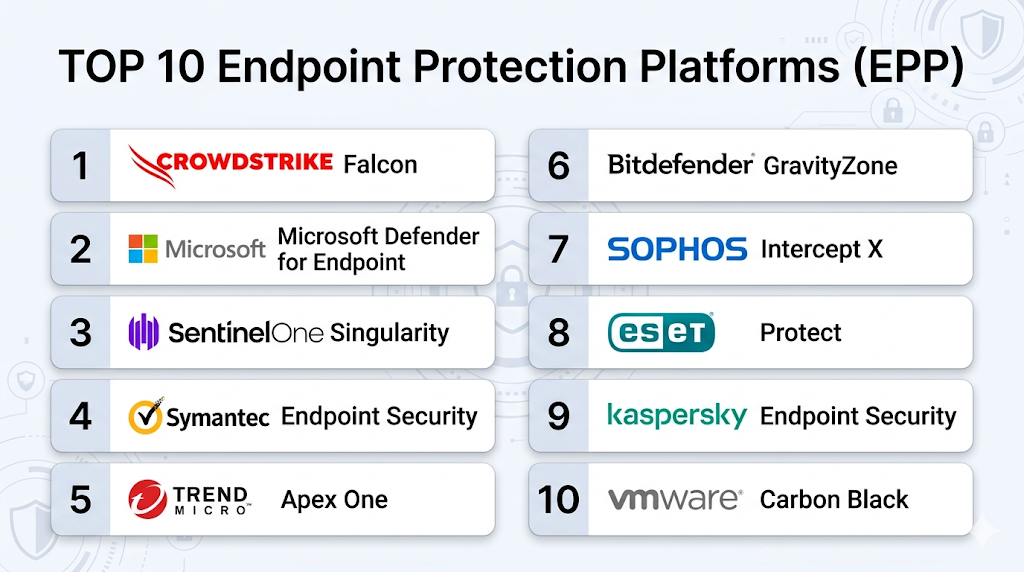
#1 — CrowdStrike Falcon
Short description: A leading cloud-native EPP platform offering advanced threat detection and endpoint security for enterprises.
Key Features
- AI-driven threat detection
- Real-time endpoint monitoring
- Cloud-native architecture
- Threat intelligence integration
- Device control and firewall management
- Endpoint detection and response (EDR)
Pros
- Excellent threat detection accuracy
- Lightweight agent with minimal performance impact
Cons
- Premium pricing
- Requires expertise for full utilization
Platforms / Deployment
Windows / macOS / Linux / Cloud
Security & Compliance
MFA, encryption, audit logs
Compliance varies
Integrations & Ecosystem
Strong ecosystem with security tools and APIs.
- SIEM platforms
- Cloud services
- Threat intelligence feeds
Support & Community
Enterprise-grade support with strong documentation
#2 — Microsoft Defender for Endpoint
Short description: Integrated endpoint protection solution within the Microsoft security ecosystem.
Key Features
- Advanced threat protection
- Integration with Microsoft ecosystem
- Automated investigation and response
- Endpoint vulnerability management
- Behavioral analytics
Pros
- Seamless integration with Microsoft tools
- Strong enterprise capabilities
Cons
- Best suited for Microsoft environments
- Complex configuration
Platforms / Deployment
Windows / macOS / Linux / Cloud
Security & Compliance
MFA, RBAC, audit logs
Compliance varies
Integrations & Ecosystem
Deep Microsoft integrations
- Azure
- Microsoft 365
- Security tools
Support & Community
Strong enterprise support
#3 — SentinelOne Singularity
Short description: Autonomous endpoint security platform powered by AI and automation.
Key Features
- AI-based threat detection
- Autonomous response
- Ransomware rollback
- Endpoint visibility
- Behavioral monitoring
Pros
- Strong automation capabilities
- Fast incident response
Cons
- Higher cost
- Learning curve
Platforms / Deployment
Windows / macOS / Linux / Cloud
Security & Compliance
MFA, encryption
Compliance varies
Integrations & Ecosystem
Integrates with SIEM and XDR platforms
Support & Community
Good enterprise support
#4 — Symantec Endpoint Security (Broadcom)
Short description: Enterprise-grade endpoint protection with a long-standing market presence.
Key Features
- Malware protection
- Threat intelligence
- Endpoint hardening
- Device control
- Network protection
Pros
- Proven reliability
- Comprehensive protection
Cons
- Legacy complexity
- Interface may feel outdated
Platforms / Deployment
Windows / macOS / Linux
Security & Compliance
MFA, encryption
Compliance varies
Integrations & Ecosystem
Enterprise integrations with security tools
Support & Community
Enterprise support
#5 — Trend Micro Apex One
Short description: Endpoint protection platform with strong threat intelligence and automation.
Key Features
- Behavior monitoring
- Ransomware protection
- Web reputation services
- Endpoint detection
- Application control
Pros
- Strong threat intelligence
- Good performance
Cons
- Complex setup
- UI can be overwhelming
Platforms / Deployment
Windows / macOS / Cloud
Security & Compliance
Encryption, audit logs
Compliance varies
Integrations & Ecosystem
Integrates with SIEM and cloud tools
Support & Community
Strong support
#6 — Bitdefender GravityZone
Short description: Advanced endpoint security platform for SMBs and enterprises.
Key Features
- Machine learning detection
- Anti-exploit protection
- Risk analytics
- Endpoint control
- Patch management
Pros
- Strong value for money
- High detection rates
Cons
- Interface complexity
- Requires tuning
Platforms / Deployment
Windows / macOS / Linux / Cloud
Security & Compliance
Encryption, RBAC
Compliance varies
Integrations & Ecosystem
APIs and integrations with security tools
Support & Community
Good documentation
#7 — Sophos Intercept X
Short description: Endpoint protection platform focused on anti-ransomware and exploit prevention.
Key Features
- Deep learning malware detection
- Anti-ransomware protection
- Exploit prevention
- Root cause analysis
- Managed threat response
Pros
- Strong ransomware defense
- Easy to manage
Cons
- Limited customization
- Performance impact on older systems
Platforms / Deployment
Windows / macOS / Linux / Cloud
Security & Compliance
Encryption, MFA
Compliance varies
Integrations & Ecosystem
Integrates with Sophos ecosystem
Support & Community
Strong support
#8 — ESET Protect
Short description: Lightweight endpoint protection solution with strong malware detection.
Key Features
- Malware detection
- Endpoint management
- Device control
- Cloud sandboxing
- Reporting tools
Pros
- Lightweight and efficient
- Affordable
Cons
- Limited advanced features
- Basic UI
Platforms / Deployment
Windows / macOS / Linux
Security & Compliance
Encryption
Compliance varies
Integrations & Ecosystem
Basic integrations
Support & Community
Good support
#9 — Kaspersky Endpoint Security
Short description: Comprehensive endpoint protection with strong malware detection capabilities.
Key Features
- Threat detection
- Endpoint control
- Encryption tools
- Behavior analysis
- Patch management
Pros
- High detection accuracy
- Feature-rich
Cons
- Regulatory concerns in some regions
- Complex interface
Platforms / Deployment
Windows / macOS / Linux
Security & Compliance
Encryption
Compliance varies
Integrations & Ecosystem
Integrates with enterprise tools
Support & Community
Strong support
#10 — VMware Carbon Black
Short description: Cloud-native endpoint security platform focused on threat hunting and prevention.
Key Features
- Threat detection
- Endpoint visibility
- Behavioral analytics
- Incident response
- Cloud-native architecture
Pros
- Strong threat visibility
- Good integration with VMware ecosystem
Cons
- Complex deployment
- Higher cost
Platforms / Deployment
Windows / macOS / Linux / Cloud
Security & Compliance
MFA, encryption
Compliance varies
Integrations & Ecosystem
Integrates with VMware and security tools
Support & Community
Enterprise support
Comparison Table (Top 10)
| Tool Name | Best For | Platform(s) Supported | Deployment | Standout Feature | Public Rating |
|---|---|---|---|---|---|
| CrowdStrike Falcon | Enterprise security | Windows, macOS, Linux | Cloud | AI threat detection | N/A |
| Microsoft Defender | Microsoft users | Windows, macOS, Linux | Cloud | Ecosystem integration | N/A |
| SentinelOne | Automation | Windows, macOS, Linux | Cloud | Autonomous response | N/A |
| Symantec | Enterprises | Windows, macOS, Linux | Hybrid | Proven reliability | N/A |
| Trend Micro | Threat intelligence | Windows, macOS | Cloud | Behavior monitoring | N/A |
| Bitdefender | SMB & enterprise | Windows, macOS, Linux | Cloud | Risk analytics | N/A |
| Sophos | Ransomware defense | Windows, macOS, Linux | Cloud | Anti-ransomware | N/A |
| ESET | SMBs | Windows, macOS, Linux | Hybrid | Lightweight agent | N/A |
| Kaspersky | Advanced detection | Windows, macOS, Linux | Hybrid | High accuracy | N/A |
| VMware Carbon Black | Threat hunting | Windows, macOS, Linux | Cloud | Endpoint visibility | N/A |
Endpoint Protection Platforms (EPP)
Scoring Table
| Tool Name | Core (25%) | Ease (15%) | Integrations (15%) | Security (10%) | Performance (10%) | Support (10%) | Value (15%) | Weighted Total |
|---|---|---|---|---|---|---|---|---|
| CrowdStrike | 10 | 8 | 9 | 10 | 9 | 9 | 7 | 9.0 |
| Microsoft Defender | 9 | 7 | 10 | 9 | 9 | 9 | 8 | 8.9 |
| SentinelOne | 9 | 7 | 8 | 9 | 9 | 8 | 7 | 8.5 |
| Symantec | 8 | 6 | 8 | 9 | 8 | 8 | 6 | 7.8 |
| Trend Micro | 8 | 6 | 8 | 8 | 8 | 8 | 7 | 7.8 |
| Bitdefender | 8 | 7 | 7 | 8 | 8 | 7 | 9 | 7.9 |
| Sophos | 8 | 8 | 7 | 8 | 7 | 8 | 8 | 7.9 |
| ESET | 7 | 8 | 6 | 7 | 8 | 7 | 9 | 7.6 |
| Kaspersky | 8 | 6 | 7 | 8 | 8 | 7 | 8 | 7.7 |
| VMware Carbon Black | 9 | 6 | 8 | 9 | 8 | 7 | 6 | 8.0 |
How to interpret scores:
- Scores are comparative across tools, not absolute benchmarks
- Enterprise tools score higher in security and core features
- SMB-friendly tools perform better in ease and value
- Choose based on your organization’s priorities and scale
Which Endpoint Protection Platform Is Right for You?
Solo / Freelancer
- Consider ESET or Bitdefender
- Lightweight, affordable, and easy to manage
SMB
- Sophos or Bitdefender
- Balance of protection and usability
Mid-Market
- Trend Micro or SentinelOne
- Strong threat detection with scalability
Enterprise
- CrowdStrike, Microsoft Defender, VMware Carbon Black
- Advanced security and large-scale management
Budget vs Premium
- Budget: ESET, Bitdefender
- Premium: CrowdStrike, SentinelOne
Feature Depth vs Ease of Use
- Feature-rich: CrowdStrike, SentinelOne
- Easy-to-use: Sophos, ESET
Integrations & Scalability
- Microsoft ecosystem: Defender
- Cloud-native: CrowdStrike
Security & Compliance Needs
- High compliance: CrowdStrike, Microsoft Defender
- Moderate: Bitdefender, Sophos
Endpoint Protection Platforms (EPP)
What is an Endpoint Protection Platform?
EPP is a security solution designed to protect devices from cyber threats like malware and ransomware.
How is EPP different from antivirus?
EPP includes advanced features like behavioral detection, automation, and threat intelligence beyond traditional antivirus.
How is EPP priced?
Usually priced per endpoint on a subscription basis.
Is EPP suitable for small businesses?
Yes, many solutions offer SMB-friendly pricing and features.
What is EDR?
Endpoint Detection and Response focuses on detecting and responding to threats after they occur.
Can EPP prevent ransomware?
Yes, modern EPP tools include ransomware protection and rollback features.
How long does deployment take?
From a few hours to several weeks depending on complexity.
What are common mistakes?
Ignoring endpoint visibility, poor configuration, and lack of integration.
Can EPP integrate with SIEM tools?
Yes, most enterprise solutions support SIEM integrations.
Is cloud-based EPP better?
Cloud EPP offers better scalability and centralized management.
Conclusion
Endpoint Protection Platforms play a critical role in modern cybersecurity by protecting devices, preventing breaches, and enabling rapid response to threats across distributed environments. The right solution depends heavily on your organization’s size, security maturity, and existing ecosystem—whether that’s a lightweight tool for small teams or an enterprise-grade platform with advanced threat intelligence and automation. Instead of looking for a single “best” option, organizations should focus on aligning capabilities with their risk profile, testing integrations with current systems, and evaluating performance impact on endpoints. A practical next step is to shortlist two or three platforms, run controlled pilots, and validate how well they meet your security, usability, and scalability requirements in real-world conditions.
