Introduction
Domain Registration Platforms are online services that help people and businesses search, buy, register, renew, transfer, and manage domain names. A domain name is the web address people type to reach a website, such as a company site, blog, SaaS product, store, portfolio, or customer portal.
In a modern digital business, domain management is no longer just about buying a name. Companies now need DNS control, privacy protection, security locks, email setup, SSL support, API access, portfolio management, and brand protection. For founders, marketers, IT teams, developers, and agencies, the right platform can reduce risk, save time, and keep digital assets organized.
Best for: founders, SMBs, agencies, developers, IT teams, ecommerce brands, SaaS companies, and enterprises managing one or many domains.
Not ideal for: users who only need a temporary web page, businesses that already use a fully managed website builder, or enterprises that require advanced corporate domain governance from a specialist brand-protection provider.
Key Trends in Domain Registration Platforms
- Security-first domain management is becoming more important, with MFA, domain lock, registry lock, DNSSEC, and account protection features now expected.
- AI-powered name suggestions are growing, helping founders generate brandable domain ideas faster.
- Privacy protection is now a major buyer concern, especially for individuals, small businesses, and public-facing founders.
- DNS performance and uptime matter more because domains are connected to websites, apps, APIs, email, and customer portals.
- Developer-friendly APIs are important for SaaS teams, resellers, agencies, and companies managing domains at scale.
- Bundled services are common, including hosting, email, SSL, website builders, ecommerce, and marketing tools.
- Transparent renewal pricing is becoming a key evaluation factor because low first-year pricing can increase later.
- Portfolio management tools are more useful for companies managing many domains across brands, campaigns, and regions.
- Compliance and data protection expectations are rising, especially for global companies handling customer-facing domains.
- Integration with cloud and website platforms is now expected, especially for users connecting domains to hosting, CDN, email, and SaaS tools.
How We Selected These Tools
- We considered platforms with strong market recognition and broad user adoption.
- We prioritized tools that support domain search, registration, renewal, transfer, and DNS management.
- We included a balanced mix of beginner-friendly, SMB-focused, developer-first, and enterprise-ready options.
- We reviewed practical fit across freelancers, startups, agencies, ecommerce teams, developers, and larger organizations.
- We considered security signals such as MFA, domain locking, DNSSEC support, and account protection options.
- We looked at ecosystem strength, including hosting, email, SSL, APIs, and third-party integrations.
- We avoided guessing public ratings, certifications, or compliance claims where details are not confidently known.
- We considered support quality, documentation, usability, and management experience.
- We gave preference to platforms that are useful beyond simple domain buying.
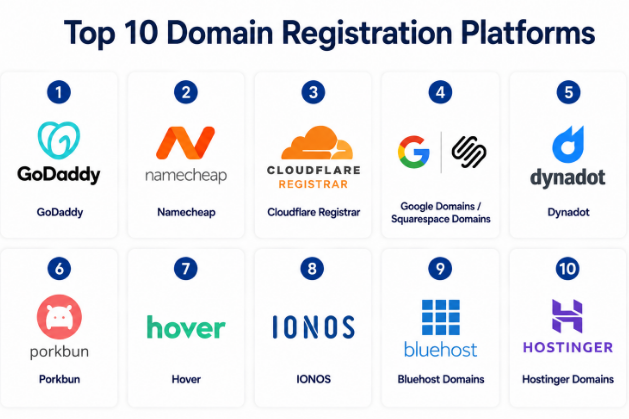
Top 10 Domain Registration Platforms
#1 — GoDaddy
Short description :
GoDaddy is one of the most widely known domain registration platforms for individuals, startups, small businesses, and agencies. It offers domain search, registration, transfers, renewals, DNS management, domain privacy, hosting, email, SSL, and website tools. The platform is designed for users who want many web services in one account. It is especially useful for non-technical users who prefer guided setup. GoDaddy is also popular among businesses that want a simple path from domain purchase to website launch.
Key Features
- Domain search, registration, renewal, and transfer tools.
- Large extension coverage across common and niche domains.
- DNS management for websites, email, and apps.
- Domain privacy options.
- Website builder, hosting, email, and SSL add-ons.
- Domain auction and aftermarket services.
- Account security features such as MFA.
Pros
- Beginner-friendly interface with many guided setup options.
- Strong ecosystem for domains, hosting, email, and website tools.
- Useful for users who want everything in one platform.
Cons
- Add-on offers can feel heavy for some users.
- Renewal pricing should be reviewed carefully.
- Advanced users may prefer cleaner developer-focused platforms.
Platforms / Deployment
Web / iOS / Android
Cloud
Security & Compliance
MFA, domain lock, privacy protection, DNSSEC support for eligible domains.
SOC 2, ISO 27001, HIPAA: Not publicly stated.
Integrations & Ecosystem
GoDaddy works well as an all-in-one web presence platform. It supports common website, email, hosting, SSL, and business tools.
- Website builder
- Hosting services
- Professional email
- SSL certificates
- DNS tools
- Domain aftermarket
Support & Community
GoDaddy provides documentation, help articles, customer support, and onboarding guidance. Support availability can vary by region and plan.
#2 — Namecheap
Short description :
Namecheap is a popular domain registration platform known for simple pricing, domain privacy, DNS management, and beginner-friendly domain buying. It is widely used by individuals, bloggers, developers, startups, and small businesses. The platform also offers hosting, email, SSL, VPN, and security-related services. Namecheap is suitable for users who want a clean domain management experience without too much complexity. It is also a strong option for budget-conscious buyers.
Key Features
- Domain search, registration, transfer, and renewal.
- Free or included privacy protection on many eligible domains.
- DNS management and domain forwarding.
- Hosting, email, SSL, and security add-ons.
- Marketplace and domain auction options.
- Bulk domain search and management.
- Two-factor authentication support.
Pros
- Simple and friendly interface.
- Good fit for budget-conscious domain buyers.
- Privacy protection is a strong practical benefit.
Cons
- Enterprise-grade governance may be limited.
- Some advanced DNS or hosting needs may require other tools.
- Support experience can vary during high-demand periods.
Platforms / Deployment
Web
Cloud
Security & Compliance
Two-factor authentication, domain lock, privacy protection, DNSSEC support for supported domains.
SOC 2, ISO 27001, HIPAA: Not publicly stated.
Integrations & Ecosystem
Namecheap offers a broad ecosystem around domains, hosting, email, and security services.
- Shared hosting
- WordPress hosting
- Business email
- SSL certificates
- DNS tools
- Domain marketplace
Support & Community
Namecheap offers documentation, live support options, help center content, and an active user base. It is easy for beginners to find basic setup guidance.
#3 — Cloudflare Registrar
Short description :
Cloudflare Registrar is a domain registration service connected to Cloudflare’s broader security, DNS, CDN, and performance ecosystem. It is especially useful for developers, technical teams, SaaS companies, and businesses already using Cloudflare. The platform focuses on domain registration and management with strong DNS and security capabilities. It is not designed as a traditional all-in-one hosting marketplace. It is best for users who value security, performance, and technical control.
Key Features
- Domain registration and transfer support.
- Integration with Cloudflare DNS.
- DNSSEC and security-focused domain management.
- Strong performance and CDN ecosystem.
- Account security controls.
- Useful for technical teams managing web infrastructure.
- API-friendly ecosystem.
Pros
- Excellent fit for users already using Cloudflare.
- Strong DNS performance and security ecosystem.
- Good choice for developers and technical teams.
Cons
- Not as beginner-focused as some traditional registrars.
- Extension support may not cover every need.
- Not ideal for users wanting bundled website builder features.
Platforms / Deployment
Web
Cloud
Security & Compliance
MFA, DNSSEC, account security controls, domain security features.
SOC 2, ISO 27001: Cloudflare has publicly known security and compliance programs, but exact registrar-specific scope should be verified.
HIPAA: Not publicly stated for registrar use.
Integrations & Ecosystem
Cloudflare Registrar connects strongly with Cloudflare’s infrastructure ecosystem.
- Cloudflare DNS
- CDN services
- Web security tools
- Zero Trust ecosystem
- API access
- Developer workflows
Support & Community
Cloudflare provides documentation, developer resources, community forums, and paid support tiers depending on the plan.
#4 — Google Domains / Squarespace Domains
Short description :
Squarespace Domains became important for users familiar with Google Domains because domain customers were migrated into the Squarespace ecosystem. It is suitable for creators, small businesses, website owners, and users who want easy domain management with website-building options. The platform offers domain registration, DNS management, email-related setup, and connection to website tools. It is especially useful for users who want domains connected with a polished website-building experience. Technical teams may still compare it with developer-first platforms before choosing.
Key Features
- Domain search, registration, renewal, and transfer.
- DNS management for websites and email.
- Domain privacy options where available.
- Integration with website-building workflows.
- Easy setup for non-technical users.
- Email connection options.
- Centralized web presence management.
Pros
- Good fit for creators and small businesses.
- Clean experience for website-focused users.
- Helpful for users building a site and buying a domain together.
Cons
- Less developer-focused than API-first platforms.
- May not be ideal for large domain portfolios.
- Advanced enterprise controls may be limited.
Platforms / Deployment
Web
Cloud
Security & Compliance
MFA availability depends on account setup. Domain privacy and DNS management are available for eligible domains.
SOC 2, ISO 27001, HIPAA: Not publicly stated.
Integrations & Ecosystem
Squarespace Domains fits best within the Squarespace website and commerce ecosystem.
- Squarespace websites
- Email setup workflows
- DNS records
- Domain forwarding
- Website builder tools
- Commerce features
Support & Community
Squarespace provides help center content, onboarding guides, and customer support. Community strength is strongest around website building and small business use cases.
#5 — Dynadot
Short description :
Dynadot is a domain registrar popular with domain investors, small businesses, agencies, and users who manage multiple domains. It offers domain registration, transfers, auctions, marketplace tools, DNS management, privacy options, and bulk controls. The platform is practical for users who want domain buying and portfolio management without unnecessary complexity. It is also known for supporting domain investors who need marketplace and auction features. Dynadot is a strong choice for users managing more than one domain over time.
Key Features
- Domain registration, transfer, and renewal.
- Bulk domain search and management.
- Domain marketplace and auction tools.
- DNS management and forwarding.
- Privacy protection options.
- Website and email-related add-ons.
- Account security features.
Pros
- Useful for domain portfolio management.
- Good fit for domain investors and agencies.
- Practical bulk tools for managing many domains.
Cons
- Interface may feel more functional than polished.
- Not as strong as all-in-one website platforms for beginners.
- Enterprise compliance details are limited.
Platforms / Deployment
Web
Cloud
Security & Compliance
Two-factor authentication, domain lock, privacy protection, DNSSEC support for eligible domains.
SOC 2, ISO 27001, HIPAA: Not publicly stated.
Integrations & Ecosystem
Dynadot has a domain-focused ecosystem with useful tools for buyers, sellers, and portfolio managers.
- DNS management
- Domain marketplace
- Domain auctions
- Website builder
- Email forwarding
- Bulk management tools
Support & Community
Dynadot provides documentation and customer support options. Its community is strongest among domain buyers, sellers, and portfolio-focused users.
#6 — Porkbun
Short description :
Porkbun is a domain registration platform known for simple pricing, clean usability, and a friendly user experience. It is popular with developers, creators, startups, and small businesses that want domain buying without a complicated process. The platform supports domain registration, DNS, forwarding, SSL-related features, email options, and privacy protection for eligible domains. Porkbun is a strong option for users who want an easy registrar with practical tools. It is especially useful for smaller teams that value simplicity and transparency.
Key Features
- Domain search, registration, renewal, and transfer.
- DNS management and forwarding.
- Privacy protection for eligible domains.
- Email and hosting-related options.
- SSL-related domain support.
- Simple account management.
- Developer-friendly DNS controls.
Pros
- Clean and simple user experience.
- Good fit for small teams and creators.
- Pricing is often seen as straightforward.
Cons
- Enterprise-grade account governance may be limited.
- Support and ecosystem are smaller than large registrars.
- Not ideal for complex multinational domain programs.
Platforms / Deployment
Web
Cloud
Security & Compliance
Two-factor authentication, domain lock, privacy protection, DNSSEC support for supported domains.
SOC 2, ISO 27001, HIPAA: Not publicly stated.
Integrations & Ecosystem
Porkbun focuses on practical domain management with useful adjacent services.
- DNS records
- URL forwarding
- Email forwarding
- SSL support
- Hosting-related options
- API access
Support & Community
Porkbun provides help documentation and customer support. Its community reputation is strongest among creators, developers, and small business users.
#7 — Hover
Short description :
Hover is a clean domain registration platform designed for people who want a simple and focused domain management experience. It is useful for professionals, small businesses, freelancers, creators, and teams that do not want a crowded interface. Hover focuses on domains, email, forwarding, and DNS management rather than heavy upselling. It is a good choice for users who value clarity and ease of management. Larger technical teams may compare it with more API-driven or infrastructure-focused tools.
Key Features
- Domain search, registration, renewal, and transfer.
- DNS management and forwarding.
- Email service options.
- Privacy protection for eligible domains.
- Clean dashboard experience.
- Domain portfolio management basics.
- Account security options.
Pros
- Simple and clean user interface.
- Good for non-technical users.
- Less cluttered than many large platforms.
Cons
- Fewer bundled business tools than larger providers.
- May not fit advanced developer automation needs.
- Enterprise compliance details are limited.
Platforms / Deployment
Web
Cloud
Security & Compliance
Two-factor authentication, domain privacy options, domain locking.
SOC 2, ISO 27001, HIPAA: Not publicly stated.
Integrations & Ecosystem
Hover keeps the ecosystem focused around domains and email rather than broad hosting bundles.
- DNS management
- Email services
- Domain forwarding
- Website connection workflows
- Privacy protection
- Account security tools
Support & Community
Hover provides support resources and customer assistance. It is known for a simpler experience, especially for users who want basic domain management without heavy technical setup.
#8 — IONOS
Short description :
IONOS is a web services provider offering domain registration, hosting, email, cloud servers, website tools, and business services. It is suitable for small businesses, growing companies, agencies, and users who want domains bundled with hosting and infrastructure. IONOS works well for buyers who want a single vendor for domains, websites, email, and related services. The platform can serve both non-technical users and more technical teams. It is useful for businesses that expect to grow from a basic domain into broader web infrastructure.
Key Features
- Domain registration, renewal, and transfer.
- DNS management.
- Hosting and cloud infrastructure options.
- Business email and productivity-related services.
- SSL and website tools.
- Support for small business web presence.
- Security and account protection options.
Pros
- Broad ecosystem beyond domain registration.
- Useful for SMBs that need hosting and email together.
- Can support both simple and more advanced web needs.
Cons
- Interface and product catalog may feel complex to beginners.
- Renewal and bundled pricing should be reviewed carefully.
- Some users may prefer specialist registrars for domain-only needs.
Platforms / Deployment
Web / iOS / Android
Cloud
Security & Compliance
MFA and account security features are available. SSL and domain security options are available.
SOC 2, ISO 27001, HIPAA: Not publicly stated for general domain registration use.
Integrations & Ecosystem
IONOS has a broad ecosystem for web presence and business infrastructure.
- Hosting services
- Cloud servers
- Business email
- SSL certificates
- Website builder
- DNS management
Support & Community
IONOS provides documentation, customer support, onboarding resources, and service guidance. Support options may vary by country and product.
#9 — Bluehost Domains
Short description :
Bluehost is best known as a hosting provider, but it also offers domain registration and domain management services. It is useful for bloggers, small businesses, creators, and WordPress-focused users who want domain and hosting setup in one place. Bluehost is especially helpful for users who are starting a website and want guided steps. It may not be the best choice for advanced domain portfolio management, but it is practical for website-first buyers. Users should compare renewal pricing and add-ons before purchasing.
Key Features
- Domain registration and transfer.
- DNS management.
- Hosting and WordPress-focused services.
- SSL-related options.
- Email and website setup tools.
- Beginner-friendly onboarding.
- Account management dashboard.
Pros
- Good for users launching a website quickly.
- Strong fit for WordPress-oriented projects.
- Helpful onboarding for beginners.
Cons
- Less ideal for domain investors or large portfolios.
- Add-ons and renewals should be reviewed carefully.
- Developer automation may be limited compared with API-first registrars.
Platforms / Deployment
Web
Cloud
Security & Compliance
MFA and account security options may be available. SSL and domain privacy options are available depending on plan and domain eligibility.
SOC 2, ISO 27001, HIPAA: Not publicly stated.
Integrations & Ecosystem
Bluehost works well for users who want a domain connected to a hosted website.
- WordPress hosting
- Website builder tools
- Email options
- SSL certificates
- DNS management
- Marketing tools
Support & Community
Bluehost offers documentation, onboarding resources, and customer support. Community strength is strongest around website hosting and WordPress users.
#10 — Hostinger Domains
Short description :
Hostinger offers domain registration as part of its broader hosting, website builder, email, and online business ecosystem. It is a strong option for beginners, small businesses, bloggers, and ecommerce starters who want a domain connected to hosting quickly. The platform focuses on affordability, ease of setup, and simple website deployment. Hostinger is helpful for users who want a domain, hosting, email, and website tools in one place. Advanced domain portfolio managers may prefer more specialized registrar tools.
Key Features
- Domain search, registration, and transfer.
- DNS management.
- Hosting and website builder options.
- Email services.
- SSL-related support.
- Beginner-friendly dashboard.
- Website launch workflows.
Pros
- Good fit for budget-conscious website owners.
- Simple setup for domain plus hosting.
- Useful for beginners and small businesses.
Cons
- Not designed mainly for enterprise domain governance.
- Advanced registrar controls may be limited.
- Renewal and bundled pricing should be checked carefully.
Platforms / Deployment
Web
Cloud
Security & Compliance
MFA and security options may be available. SSL support and domain privacy options vary by plan and domain eligibility.
SOC 2, ISO 27001, HIPAA: Not publicly stated.
Integrations & Ecosystem
Hostinger’s ecosystem is strongest around launching and managing websites.
- Web hosting
- Website builder
- Email services
- SSL certificates
- DNS management
- Ecommerce site tools
Support & Community
Hostinger provides help documentation, tutorials, and support options. Its community is strongest among beginners, bloggers, and small business website owners.
Comparison Table
| Tool Name | Best For | Platform(s) Supported | Deployment | Standout Feature | Public Rating |
|---|---|---|---|---|---|
| GoDaddy | Beginners, SMBs, agencies | Web / iOS / Android | Cloud | Large domain and web services ecosystem | N/A |
| Namecheap | Budget-conscious users, startups | Web | Cloud | Simple pricing and privacy-focused domain management | N/A |
| Cloudflare Registrar | Developers, SaaS teams, technical businesses | Web | Cloud | Strong DNS, CDN, and security ecosystem | N/A |
| Squarespace Domains | Creators and website-focused businesses | Web | Cloud | Easy website and domain connection | N/A |
| Dynadot | Domain investors and portfolio owners | Web | Cloud | Bulk tools, auctions, and marketplace features | N/A |
| Porkbun | Developers, creators, small teams | Web | Cloud | Simple domain buying and practical DNS tools | N/A |
| Hover | Professionals and simple domain users | Web | Cloud | Clean, focused domain management | N/A |
| IONOS | SMBs needing domains, hosting, and email | Web / iOS / Android | Cloud | Broad business web services ecosystem | N/A |
| Bluehost Domains | WordPress users and new website owners | Web | Cloud | Domain plus hosting onboarding | N/A |
| Hostinger Domains | Budget website owners and beginners | Web | Cloud | Affordable domain and hosting bundle | N/A |
Evaluation & Domain Registration Platforms
| Tool Name | Core (25%) | Ease (15%) | Integrations (15%) | Security (10%) | Performance (10%) | Support (10%) | Value (15%) | Weighted Total (0–10) |
|---|---|---|---|---|---|---|---|---|
| GoDaddy | 9 | 8 | 9 | 8 | 8 | 8 | 7 | 8.20 |
| Namecheap | 8 | 9 | 7 | 8 | 8 | 8 | 9 | 8.10 |
| Cloudflare Registrar | 8 | 7 | 9 | 9 | 10 | 8 | 8 | 8.35 |
| Squarespace Domains | 7 | 9 | 7 | 7 | 8 | 8 | 7 | 7.55 |
| Dynadot | 8 | 7 | 7 | 8 | 8 | 7 | 8 | 7.65 |
| Porkbun | 8 | 9 | 7 | 8 | 8 | 7 | 9 | 8.00 |
| Hover | 7 | 9 | 6 | 7 | 8 | 8 | 7 | 7.35 |
| IONOS | 8 | 7 | 8 | 8 | 8 | 8 | 8 | 7.85 |
| Bluehost Domains | 7 | 8 | 7 | 7 | 8 | 8 | 7 | 7.40 |
| Hostinger Domains | 7 | 8 | 7 | 7 | 8 | 7 | 9 | 7.55 |
These scores are comparative, not absolute. A higher score does not mean the tool is best for every buyer. For example, Cloudflare may be stronger for technical DNS and security use cases, while Squarespace Domains may be easier for website-focused creators. Buyers should use the score as a shortlist guide, then validate pricing, renewal cost, DNS needs, security controls, and support quality before choosing.
Which Domain Registration Platforms
Solo / Freelancer
Solo users and freelancers usually need a simple platform with fair pricing, domain privacy, easy DNS setup, and basic email or website connection. Namecheap, Porkbun, Hover, Hostinger Domains, and Squarespace Domains are strong options for this group. The best choice depends on whether the user wants only a domain or a complete website setup.
SMB
Small and medium businesses often need domains, DNS, email, SSL, hosting, and support in one place. GoDaddy, IONOS, Bluehost, Hostinger, and Namecheap are practical choices. SMBs should review renewal pricing, privacy protection, email setup, and support before buying.
Mid-Market
Mid-market companies usually manage multiple domains, campaigns, landing pages, regional domains, and product domains. Cloudflare Registrar, GoDaddy, Namecheap, Dynadot, and IONOS can fit depending on technical needs. Companies with engineering teams may prefer Cloudflare for DNS and security depth.
Enterprise
Enterprises need stronger account controls, security governance, auditability, brand protection, DNS reliability, and domain portfolio oversight. Cloudflare Registrar is strong for technical and security-first teams. GoDaddy and IONOS may fit broader business service needs. Large enterprises may also need specialist corporate domain management services beyond standard registrars.
Budget vs Premium
Budget-focused users should compare Namecheap, Porkbun, Hostinger, and Dynadot. Premium-focused buyers may prefer GoDaddy, Cloudflare, IONOS, or Squarespace depending on support, ecosystem, and business needs. Always compare first-year and renewal pricing separately.
Feature Depth vs Ease of Use
For deep technical control, Cloudflare Registrar is a strong choice. For easy setup, Squarespace Domains, Hover, Bluehost, and Hostinger are better suited. For balanced domain management with practical pricing, Namecheap and Porkbun are strong options.
Integrations & Scalability-
If integrations and scalability matter, evaluate DNS tools, API access, hosting connections, email setup, SSL support, and automation options. Cloudflare is strong for technical scalability. GoDaddy, IONOS, Bluehost, and Hostinger are stronger for bundled website and business services.
Security & Compliance Needs
Security-focused buyers should look for MFA, domain locking, DNSSEC, account recovery controls, role access, audit logs, and strong DNS reliability. Cloudflare is strong for DNS and security workflows. Businesses with strict compliance needs should verify exact compliance scope directly before purchase.
Frequently Asked Questions
1. What is a domain registration platform?
A domain registration platform helps you search, buy, renew, transfer, and manage domain names. It usually also includes DNS settings, privacy protection, forwarding, and sometimes hosting or email services.
2. How do domain registration platforms make money?
Most platforms charge for domain registration, annual renewals, transfers, privacy add-ons, email, hosting, SSL, and website services. Some offer low first-year pricing but higher renewal rates, so renewal cost should always be checked.
3. What is the biggest mistake when buying a domain?
The biggest mistake is choosing a domain based only on first-year price. Buyers should also check renewal cost, transfer rules, privacy protection, DNS features, and support quality.
4. Is domain privacy important?
Yes, domain privacy can help protect personal or business contact details from public exposure where supported. It is especially useful for freelancers, founders, small businesses, and public-facing website owners.
5. Can I move my domain to another registrar later?
Yes, most domains can be transferred to another registrar after meeting transfer rules and waiting periods. Before switching, check domain lock status, authorization code availability, renewal timing, and email access.
6. Which platform is best for developers?
Cloudflare Registrar is strong for developers because of its DNS, security, and infrastructure ecosystem. Porkbun and Namecheap are also practical choices for developers who want simple pricing and useful DNS controls.
7. Which platform is best for beginners?
GoDaddy, Squarespace Domains, Bluehost, Hostinger, and Hover are beginner-friendly choices. They offer guided setup and are useful for users who want to connect a domain to a website quickly.
8. Do I need hosting from the same company as my domain?
No, you can buy a domain from one company and host your website elsewhere. However, using the same provider can make setup easier for beginners.
9. What security features should I look for?
Look for MFA, domain lock, DNSSEC, strong password controls, account recovery protection, privacy protection, and clear transfer controls. Businesses managing important domains should also review access management and support response quality.
10. Are cheap domains safe to buy?
Cheap domains can be safe if the registrar is reputable and offers proper account security, DNS control, privacy options, and transparent renewal pricing. Avoid choosing only by the first-year price.
Conclusion
The best domain registration platform depends on your business size, technical needs, budget, security expectations, and long-term domain strategy. A freelancer may value simple pricing and privacy protection, while a SaaS company may care more about DNS reliability, API access, security controls, and scalable infrastructure. A small business may prefer an all-in-one provider with hosting, email, SSL, and website tools, while an enterprise may need stricter governance, portfolio control, and compliance review. GoDaddy, Namecheap, Cloudflare Registrar, Squarespace Domains, Dynadot, Porkbun, Hover, IONOS, Bluehost, and Hostinger all serve different buyer needs.
