Introduction
Data Enrichment APIs help businesses improve incomplete or basic data records by adding useful information automatically. In simple words, these APIs take inputs like an email address, domain name, phone number, company name, IP address, or customer profile and return more details such as job title, company size, industry, location, social profile, firmographics, technographics, risk signals, and contact details.
They matter now because modern sales, marketing, product, and data teams cannot depend only on manual research. Customer and lead data changes quickly. People change jobs, companies grow, markets shift, and CRM records become outdated. Data Enrichment APIs help teams keep systems cleaner, make faster decisions, personalize communication, improve lead scoring, and build better automation.
Buyers should evaluate data accuracy, API reliability, response speed, compliance, documentation, integration options, pricing model, global coverage, data freshness, and support quality.
Best for: SaaS companies, sales teams, marketing teams, RevOps teams, developers, data teams, growth teams, agencies, and enterprises that need automated enrichment at scale.
Not ideal for: Very small teams with low data volume, companies that only need manual research, or businesses without any CRM, marketing, or application workflow where enrichment can create value.
Key Trends in Data Enrichment APIs
- Real-time enrichment is becoming important for sign-up forms, demo requests, onboarding flows, and lead routing.
- AI-assisted data matching is helping teams identify missing fields, match company records, and personalize outreach faster.
- Waterfall enrichment is growing because teams often combine multiple APIs to improve data coverage and accuracy.
- Compliance-first data handling is now a major requirement, especially for teams working across different privacy regions.
- Developer-friendly APIs with clean schemas, better documentation, and flexible endpoints are becoming easier to adopt.
- CRM-native enrichment is now expected because teams want enriched data directly inside Salesforce, HubSpot, and similar systems.
- Usage-based pricing is common because teams want to pay based on API calls, records enriched, or monthly credit limits.
- Technographic enrichment is becoming more valuable for B2B teams that want to know what tools a company uses.
- Data freshness monitoring is becoming important because old enrichment data can damage sales quality and reporting.
- AI workflow builders are using enrichment APIs to power personalized campaigns, scoring models, and customer intelligence workflows.
How We Selected These Tools (Methodology)
- Selected tools with strong recognition in data enrichment, sales intelligence, identity resolution, and B2B data workflows.
- Balanced enterprise platforms, developer-first APIs, SMB-friendly tools, and workflow-based enrichment platforms.
- Evaluated feature completeness across person enrichment, company enrichment, email enrichment, firmographics, technographics, and identity data.
- Considered API usability, documentation quality, response consistency, and integration flexibility.
- Looked at ecosystem fit with CRM, marketing automation, sales engagement, data warehouses, and custom applications.
- Considered customer fit across solo users, SMBs, mid-market companies, and enterprises.
- Reviewed security and compliance positioning where confidently known; uncertain details are marked as “Not publicly stated.”
- Compared practical value, scalability, ease of implementation, and support availability.
- Avoided invented ratings, private claims, or unsupported compliance assumptions.
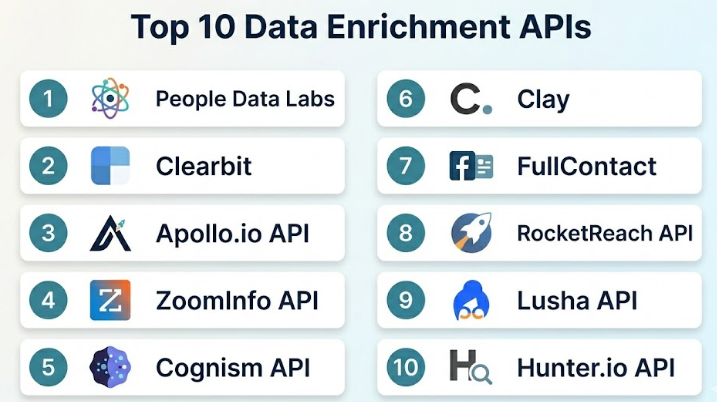
Top 10 Data Enrichment APIs
#1 — People Data Labs
Short description :
People Data Labs is a developer-focused data enrichment API platform built for people and company data. It is commonly used by engineering teams, data teams, RevOps teams, AI product builders, and SaaS companies that need structured enrichment at scale. The platform supports person enrichment, company enrichment, search, and audience-building workflows. It is useful when teams want API-level flexibility instead of only a visual sales database. Businesses can use it to enrich CRM records, power internal tools, support AI workflows, and improve customer intelligence systems.
Key Features
- Person enrichment API
- Company enrichment API
- Search and audience-building capabilities
- Bulk enrichment support
- Structured data schemas
- Developer-focused API workflows
- Useful for CRM, data warehouse, and product workflows
Pros
- Strong fit for technical and data-driven teams.
- Flexible API structure for custom workflows.
- Useful for large-scale enrichment pipelines.
Cons
- Requires technical setup and engineering support.
- Not ideal for teams wanting only a simple sales dashboard.
- Data quality may vary depending on region and record type.
Platforms / Deployment
Web / Cloud
Security & Compliance
Not publicly stated.
Integrations & Ecosystem
People Data Labs works well in custom data and software environments where teams want enrichment inside their own systems.
- CRM systems
- Data warehouses
- Internal applications
- AI workflows
- Custom APIs
- Data pipelines
Support & Community
People Data Labs provides developer documentation and support resources. Enterprise support may vary by contract and plan.
#2 — Clearbit
Short description :
Clearbit is a well-known enrichment platform used for real-time lead, company, and account enrichment. It is helpful for marketing teams, product-led growth teams, RevOps teams, and SaaS businesses that want to enrich users or leads from email addresses, domains, or company data. Teams use Clearbit to reduce form friction, improve lead routing, personalize onboarding, and keep CRM records cleaner. It is a strong choice when enrichment needs to happen automatically during signup, demo requests, or inbound lead capture. Clearbit is also useful for teams that want enrichment connected to marketing and sales systems.
Key Features
- Real-time lead enrichment
- Company enrichment
- Domain and email-based enrichment
- API-based enrichment workflows
- Lead routing support
- CRM and marketing automation integrations
- Useful for inbound and product-led workflows
Pros
- Strong fit for real-time inbound enrichment.
- Good for SaaS, marketing, and PLG workflows.
- Useful for reducing long forms and improving qualification.
Cons
- May require technical setup for advanced workflows.
- Pricing may not suit very small teams.
- Coverage can vary by geography and industry.
Platforms / Deployment
Web / Cloud
Security & Compliance
Not publicly stated.
Integrations & Ecosystem
Clearbit fits well inside sales, marketing, and product-led growth workflows.
- Salesforce
- HubSpot
- Marketing automation tools
- Web forms
- APIs
- Product onboarding workflows
Support & Community
Clearbit provides documentation and support resources. Support depth may vary by plan and customer size.
#3 — Apollo.io API
Short description :
Apollo.io API supports data enrichment along with prospecting and sales engagement workflows. It is useful for SMBs, startups, outbound sales teams, and growth teams that want contact data, company data, and outreach workflows in one ecosystem. Apollo can help enrich leads, verify emails, build prospect lists, and connect enriched records to CRM systems. It is practical for teams that want both enrichment and sales execution support. Apollo is often chosen by teams that need a balance of usability, cost, and sales workflow coverage.
Key Features
- Contact and account enrichment
- Email discovery and verification
- Prospecting database access
- Sales engagement workflows
- CRM integrations
- Bulk enrichment support
- Useful filters for role, company, industry, and location
Pros
- Good value for many small and growing sales teams.
- Combines enrichment with outreach workflows.
- Easy for sales users to adopt.
Cons
- Data accuracy may vary across regions.
- API usage limits may matter for high-volume workflows.
- Advanced enterprise governance may require careful review.
Platforms / Deployment
Web / Cloud
Security & Compliance
Not publicly stated.
Integrations & Ecosystem
Apollo connects enrichment with prospecting and outbound sales activity.
- Salesforce
- HubSpot
- Gmail
- Outlook
- Sales engagement workflows
- API workflows
Support & Community
Apollo provides documentation, learning resources, and support options. Support quality may vary by subscription level.
#4 — ZoomInfo API
Short description :
ZoomInfo API supports enterprise-grade B2B data enrichment, sales intelligence, and account intelligence workflows. It is commonly used by larger sales, marketing, and RevOps teams that need broad company and contact intelligence at scale. The API can support CRM enrichment, lead scoring, account-based marketing, prospecting, and data quality workflows. ZoomInfo is better suited for organizations with mature revenue operations and larger budgets. It is especially valuable when teams need strong B2B company context and buying signals.
Key Features
- B2B contact enrichment
- Company intelligence enrichment
- Firmographic data
- Intent and buying signal support
- CRM enrichment workflows
- Account-based marketing support
- Revenue intelligence use cases
Pros
- Strong fit for enterprise revenue teams.
- Broad B2B intelligence capabilities.
- Useful for ABM and large-scale CRM enrichment.
Cons
- May be expensive for smaller teams.
- Implementation can require planning and governance.
- Not ideal if only basic email enrichment is needed.
Platforms / Deployment
Web / Cloud
Security & Compliance
Not publicly stated.
Integrations & Ecosystem
ZoomInfo works well in enterprise sales and marketing technology stacks.
- Salesforce
- Marketing automation platforms
- Sales engagement tools
- CRM enrichment workflows
- Revenue operations systems
- API workflows
Support & Community
ZoomInfo generally provides onboarding, customer success, documentation, and support options. Enterprise support may vary by plan.
#5 — Cognism API
Short description :
Cognism API is focused on B2B sales intelligence and data enrichment, with a strong fit for teams that care about compliant prospecting and verified business contact data. It is used by sales teams, marketing teams, and revenue operations teams for contact enrichment, company enrichment, and outbound sales workflows. Cognism is especially useful for organizations selling into markets where privacy and data quality are important. It can support CRM enrichment, targeted list building, and account research. The tool is best for teams that need a structured B2B data provider rather than a simple lookup tool.
Key Features
- B2B contact enrichment
- Company enrichment
- Sales intelligence workflows
- CRM synchronization
- Firmographic filtering
- Prospecting support
- Data quality and verification workflows
Pros
- Strong fit for B2B outbound teams.
- Useful for compliance-conscious organizations.
- Supports sales and revenue operations workflows.
Cons
- May be more suitable for sales-led teams than casual users.
- Pricing may require direct consultation.
- Coverage can vary by market and industry.
Platforms / Deployment
Web / Cloud
Security & Compliance
Not publicly stated.
Integrations & Ecosystem
Cognism connects with common revenue and sales operations systems.
- Salesforce
- HubSpot
- CRM workflows
- Sales engagement tools
- Data exports
- API workflows
Support & Community
Cognism provides onboarding and customer support resources. Support depth may depend on the selected plan and customer size.
#6 — Clay
Short description :
Clay is a flexible data enrichment and workflow automation platform used by growth teams, GTM teams, agencies, and sales operators. It helps users combine multiple enrichment sources, create waterfall workflows, and use AI-assisted research for personalization. Clay is useful when teams want more control than a single enrichment database can provide. It works like a flexible workspace for building custom enrichment workflows. Teams often use it for prospect research, lead scoring, outbound personalization, and account research automation.
Key Features
- Multi-source data enrichment
- Waterfall enrichment workflows
- AI-assisted research and personalization
- Spreadsheet-style workflow builder
- API and automation support
- CRM and sales tool integrations
- Custom GTM data operations
Pros
- Very flexible for advanced enrichment workflows.
- Strong for growth teams and agencies.
- Useful for combining many data sources.
Cons
- Has a learning curve for new users.
- Can become complex without clear process design.
- Costs can increase with heavy enrichment usage.
Platforms / Deployment
Web / Cloud
Security & Compliance
Not publicly stated.
Integrations & Ecosystem
Clay is strong when teams want to connect many tools into one enrichment workflow.
- CRM systems
- Sales engagement tools
- Data providers
- APIs
- Automation platforms
- AI workflows
Support & Community
Clay has strong educational content and community-driven learning around GTM workflows. Support options may vary by plan.
#7 — FullContact
Short description :
FullContact is a data enrichment and identity resolution platform used to enrich customer profiles and connect fragmented identity data. It is useful for teams that need more than basic lead enrichment, especially when customer identity, profile completion, and personalization are important. Businesses may use it to improve customer records, unify profile information, and support customer intelligence workflows. It is often more relevant for identity enrichment than simple sales prospecting. FullContact can be helpful for marketing, data, and customer experience teams.
Key Features
- Identity resolution
- Customer profile enrichment
- Contact data matching
- Audience intelligence workflows
- API-first enrichment support
- Profile unification
- Personalization support
Pros
- Strong for identity and profile enrichment use cases.
- Useful for customer intelligence workflows.
- Good fit for teams managing fragmented user data.
Cons
- Less focused on simple outbound prospecting.
- May require technical and data process setup.
- Pricing and package details may require consultation.
Platforms / Deployment
Web / Cloud
Security & Compliance
Not publicly stated.
Integrations & Ecosystem
FullContact fits well with identity, customer data, and personalization systems.
- Customer data platforms
- CRM systems
- Marketing automation tools
- APIs
- Data workflows
- Personalization systems
Support & Community
FullContact provides documentation and support resources. Enterprise support may vary by customer agreement.
#8 — RocketReach API
Short description :
RocketReach API helps teams discover and enrich professional contact information. It is useful for sales teams, recruiters, agencies, founders, and business development professionals who need email, phone, and company details. The API can support people lookup, company search, and lightweight enrichment workflows. It is practical for teams that need contact discovery without a complex enterprise platform. RocketReach is also useful for recruiting and partnership outreach use cases.
Key Features
- Professional contact enrichment
- Email and phone discovery
- People and company search
- Bulk lookup support
- API access
- Recruiting and sales use cases
- Export workflows
Pros
- Simple and practical for contact discovery.
- Useful across sales and recruiting teams.
- Easier to adopt than many enterprise platforms.
Cons
- Not as deep as enterprise revenue intelligence tools.
- Data quality may vary by contact type.
- Credit usage must be managed carefully.
Platforms / Deployment
Web / Cloud
Security & Compliance
Not publicly stated.
Integrations & Ecosystem
RocketReach supports lightweight enrichment workflows across sales and recruiting.
- CRM exports
- API workflows
- Recruiting systems
- Prospecting tools
- Browser-based workflows
- Data exports
Support & Community
RocketReach provides documentation and customer support resources. Support depth may vary by subscription level.
#9 — Lusha API
Short description :
Lusha API provides contact and company enrichment for sales prospecting and outbound workflows. It is used by sales representatives, recruiters, SDR teams, and SMBs that need quick access to business contact details. Lusha can enrich leads with email addresses, phone numbers, company details, and role information. It is practical for teams that want a simple sales-focused enrichment solution. Lusha is better suited for straightforward prospecting than complex data engineering workflows.
Key Features
- Contact enrichment API
- Company enrichment
- Email and phone discovery
- Browser extension support
- CRM synchronization
- Prospect list building
- Bulk enrichment support
Pros
- Easy to use for sales teams.
- Good fit for SMB prospecting.
- Helpful browser-based workflows.
Cons
- May not be deep enough for enterprise data teams.
- Regional data coverage can vary.
- Credit-based usage may become limiting.
Platforms / Deployment
Web / Cloud
Security & Compliance
Not publicly stated.
Integrations & Ecosystem
Lusha supports common sales and CRM workflows.
- Salesforce
- HubSpot
- Browser workflows
- CRM exports
- API workflows
- Sales prospecting systems
Support & Community
Lusha provides standard support resources and onboarding documentation. Support depth may vary by plan.
#10 — Hunter.io API
Short description :
Hunter.io API is focused on email discovery and email verification rather than broad company intelligence. It is useful for marketers, founders, agencies, recruiters, and sales teams that need to find or verify professional email addresses. Hunter.io is practical for lightweight enrichment workflows where email quality is the main requirement. It can support outbound preparation, domain-based email discovery, and verification automation. It is best for teams that need focused email enrichment instead of a complete B2B intelligence platform.
Key Features
- Email discovery API
- Email verification
- Domain search
- Bulk lookup
- Outreach preparation support
- CRM workflow support
- Simple developer integration
Pros
- Strong for email-focused enrichment.
- Easy API setup.
- Good value for lightweight workflows.
Cons
- Limited firmographic and technographic depth.
- Not ideal for full account intelligence.
- Less suitable for enterprise ABM use cases.
Platforms / Deployment
Web / Cloud
Security & Compliance
Not publicly stated.
Integrations & Ecosystem
Hunter.io works well in email prospecting and verification workflows.
- CRM systems
- Outreach tools
- API workflows
- Marketing systems
- Prospecting workflows
- Data exports
Support & Community
Hunter.io provides documentation, support resources, and developer-focused guidance.
Comparison Table (Top 10)
| Tool Name | Best For | Platform(s) Supported | Deployment | Standout Feature | Public Rating |
|---|---|---|---|---|---|
| People Data Labs | Developer-first enrichment workflows | Web | Cloud | Structured people and company APIs | N/A |
| Clearbit | Real-time inbound enrichment | Web | Cloud | Email and domain-based enrichment | N/A |
| Apollo.io API | SMB sales enrichment | Web | Cloud | Enrichment with sales engagement | N/A |
| ZoomInfo API | Enterprise B2B intelligence | Web | Cloud | Large-scale account and contact intelligence | N/A |
| Cognism API | Compliance-conscious B2B sales teams | Web | Cloud | Sales intelligence and verified data workflows | N/A |
| Clay | GTM enrichment automation | Web | Cloud | Multi-source waterfall enrichment | N/A |
| FullContact | Identity resolution and profile enrichment | Web | Cloud | Customer identity enrichment | N/A |
| RocketReach API | Contact discovery and recruiting workflows | Web | Cloud | Professional email and phone lookup | N/A |
| Lusha API | SMB prospecting teams | Web | Cloud | Simple contact enrichment | N/A |
| Hunter.io API | Email discovery and verification | Web | Cloud | Email-focused enrichment API | N/A |
Evaluation & Data Enrichment APIs
| Tool Name | Core (25%) | Ease (15%) | Integrations (15%) | Security (10%) | Performance (10%) | Support (10%) | Value (15%) | Weighted Total (0–10) |
|---|---|---|---|---|---|---|---|---|
| People Data Labs | 9 | 7 | 8 | 7 | 9 | 8 | 9 | 8.30 |
| Clearbit | 8 | 8 | 9 | 7 | 9 | 8 | 7 | 8.00 |
| Apollo.io API | 8 | 9 | 8 | 7 | 8 | 8 | 9 | 8.20 |
| ZoomInfo API | 9 | 7 | 9 | 8 | 8 | 8 | 6 | 7.95 |
| Cognism API | 8 | 8 | 8 | 8 | 8 | 8 | 7 | 7.85 |
| Clay | 9 | 7 | 9 | 6 | 8 | 8 | 8 | 8.05 |
| FullContact | 8 | 7 | 8 | 8 | 8 | 7 | 7 | 7.65 |
| RocketReach API | 7 | 8 | 7 | 6 | 7 | 7 | 8 | 7.25 |
| Lusha API | 7 | 8 | 7 | 6 | 7 | 7 | 8 | 7.25 |
| Hunter.io API | 7 | 9 | 7 | 6 | 8 | 7 | 9 | 7.65 |
The scores are comparative and should be used as a starting point, not as a final buying decision. A higher score does not mean the tool is best for every business. For example, People Data Labs may be strong for developer-first enrichment, while Hunter.io may be better for simple email verification. Clay may be excellent for advanced workflows, but it may require more setup. Always test the tool with your real data before buying.
Which Data Enrichment APIs
Solo / Freelancer
Solo users usually need low-cost, simple, and easy-to-use tools. Hunter.io API, RocketReach API, Lusha API, and Apollo.io API can be good options because they are useful for prospecting, email discovery, and lightweight enrichment without heavy setup.
SMB
SMBs need a good balance of price, usability, and enrichment quality. Apollo.io API, Clearbit, Lusha API, and Hunter.io API can help sales and marketing teams enrich leads, verify emails, and update CRM data with less manual effort.
Mid-Market
Mid-market teams often need better workflow automation, stronger CRM integrations, and scalable enrichment processes. People Data Labs, Clearbit, Clay, Cognism API, and Apollo.io API can be useful depending on the company’s sales process and technical maturity.
Enterprise
Enterprise teams should focus on governance, security, compliance, scalability, and integration depth. ZoomInfo API, Cognism API, People Data Labs, FullContact, and Clearbit are better suited for larger organizations that need structured enrichment workflows.
Budget vs Premium
Budget-focused users should consider Hunter.io API, Apollo.io API, RocketReach API, and Lusha API. Premium buyers with deeper data, compliance, and enterprise workflow needs may prefer ZoomInfo API, Cognism API, People Data Labs, or Clearbit.
Feature Depth vs Ease of Use
For deeper enrichment and flexible workflows, People Data Labs, Clay, ZoomInfo API, and Clearbit are strong options. For simpler onboarding and daily use, Apollo.io API, Hunter.io API, RocketReach API, and Lusha API are easier starting points.
Integrations & Scalability-
If integration and scalability matter most, choose tools with strong APIs, CRM sync, documentation, and automation support. People Data Labs, Clearbit, Clay, ZoomInfo API, and Cognism API are good choices for larger workflows.
Security & Compliance Needs
Security-focused buyers should check SSO, MFA, RBAC, encryption, audit logs, data handling policies, GDPR readiness, and vendor security documentation. Do not assume compliance claims unless the vendor clearly provides proof.
Frequently Asked Questions (FAQs)
1. What is a Data Enrichment API?
A Data Enrichment API adds missing details to an existing record. For example, it can take an email address or company domain and return information like company name, industry, employee size, job title, location, and other useful fields.
2. How do Data Enrichment APIs help sales teams?
They help sales teams understand leads better before outreach. Sales reps can use enriched data to personalize messages, prioritize better-fit accounts, and avoid wasting time on incomplete or low-quality records.
3. Are Data Enrichment APIs only useful for developers?
No. Developers often implement the API, but the value is used by sales, marketing, RevOps, product, and customer success teams. Once integrated, enrichment can run automatically inside CRM, forms, workflows, and dashboards.
4. What pricing models are common for Data Enrichment APIs?
Common pricing models include API credits, monthly record limits, usage-based pricing, seat-based pricing, and custom enterprise contracts. Buyers should check whether unused credits roll over and how overage charges work.
5. How long does onboarding take?
Simple API setup may take a few hours or days. Larger implementations can take longer because teams need to map fields, test response quality, connect CRM systems, define rules, and validate compliance requirements.
6. What is the biggest mistake companies make with enrichment APIs?
The biggest mistake is trusting enriched data without testing it. Teams should always validate accuracy using real CRM records, review match rates, check outdated fields, and monitor data quality over time.
7. Can Data Enrichment APIs improve lead scoring?
Yes. Enriched fields like company size, industry, region, job role, funding stage, and technology stack can improve lead scoring. However, the scoring model should be reviewed regularly because markets and buyer behavior change.
8. Are Data Enrichment APIs secure?
Security depends on the vendor. Buyers should ask about encryption, access controls, audit logs, data retention, privacy policies, and compliance documentation before sending sensitive business or customer data.
9. Can these APIs integrate with Salesforce and HubSpot?
Yes, many enrichment APIs integrate with Salesforce, HubSpot, and other CRM systems. Some tools provide direct integrations, while others require custom API work or middleware automation.
10. What are good alternatives to Data Enrichment APIs?
Alternatives include manual research, CRM data cleaning services, first-party form data, customer surveys, data warehouse matching, public business directories, and sales intelligence platforms with built-in enrichment.
Conclusion
Data Enrichment APIs are powerful tools for improving lead data, customer records, CRM quality, and automation workflows. They help teams move faster by reducing manual research and giving sales, marketing, product, and data teams better context. However, the best API depends on the business situation. A small team may prefer Hunter.io API, Apollo.io API, Lusha API, or RocketReach API because they are easier to start with. A technical or data-heavy team may prefer People Data Labs or Clay because they offer more flexibility. Larger enterprise teams may choose ZoomInfo API, Cognism API, Clearbit, or FullContact because they need stronger workflows, broader data, and better operational control.
