Introduction
Configure, Price, Quote (CPQ) software for manufacturing simplifies the complex process of designing customized products, calculating accurate pricing, and generating sales-ready quotes. Manufacturers often face intricate product configurations, frequent changes in material costs, and diverse customer requirements. CPQ tools streamline these challenges, ensuring faster quote generation, fewer errors, and improved customer satisfaction.
Why it matters now: In the modern manufacturing landscape, businesses need to operate with agility and precision. Rapid product cycles, increasing customization demands, and digital transformation initiatives mean traditional manual quoting processes are often too slow and error-prone. CPQ platforms equipped with AI and automation help manufacturers maintain competitiveness while reducing operational friction.
Real-world use cases:
- Automating quotes for complex assemblies with multiple options.
- Integrating pricing rules across global markets with fluctuating costs.
- Reducing errors in sales proposals for made-to-order products.
- Enabling real-time collaboration between sales, engineering, and production teams.
- Streamlining approval workflows for discounts and special configurations.
Evaluation criteria for buyers:
- Feature completeness (configuration, pricing, quoting)
- Ease of use and user experience
- Integration capabilities with ERP, CRM, and PLM systems
- Security and compliance (data protection, access control)
- Scalability for different company sizes
- Support, community, and training resources
- Deployment flexibility (cloud, on-premise, hybrid)
- AI and automation capabilities
- Cost-effectiveness
- Analytics and reporting capabilities
Best for: Manufacturers with complex products, multi-tier pricing structures, and high customization needs; sales teams that handle large volumes of quotes; medium to large enterprises requiring integration with ERP/CRM systems.
Not ideal for: Small manufacturers with simple product offerings; companies with low quote volume where manual processes are sufficient; businesses not ready to invest in integration and training.
Key Trends in CPQ for Manufacturing
- Increasing adoption of AI-driven pricing and recommendation engines.
- Automation of approval workflows for faster quote generation.
- Embedded analytics for real-time quote and sales insights.
- Integration with ERP, CRM, and PLM platforms for end-to-end visibility.
- Enhanced user experience with low-code/no-code configuration interfaces.
- Cloud-first deployment models with hybrid options for sensitive data.
- Mobile-enabled quoting for field sales teams.
- Advanced rules management for discounts, promotions, and contracts.
- Focus on compliance and data security, especially in regulated industries.
- Subscription-based pricing and SaaS delivery models.
How We Selected These Tools (Methodology)
- Reviewed market adoption and mindshare among manufacturing CPQ vendors.
- Evaluated feature completeness including configuration, pricing, and quoting.
- Assessed reliability and performance based on user reviews and case studies.
- Verified security posture signals and compliance capabilities.
- Considered integration and ecosystem support for ERP, CRM, and PLM.
- Analyzed customer fit across segments: SMB, mid-market, enterprise.
- Included AI/automation capabilities and reporting features.
- Balanced enterprise-grade and scalable SMB solutions.
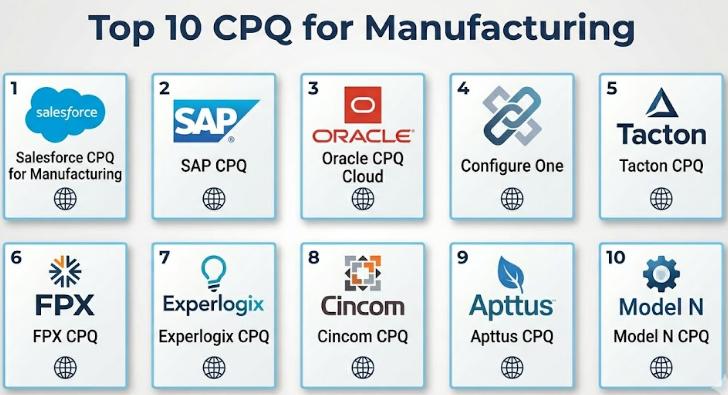
#1 — Salesforce CPQ for Manufacturing
Short description: Salesforce CPQ streamlines complex product configurations and automates pricing for manufacturing sales teams. Ideal for companies already using Salesforce CRM, it enables fast, accurate quoting while integrating seamlessly with CRM data.
Key Features
- Guided selling and product configuration rules
- Automated pricing and discounting
- Quote generation with templates
- Integration with Salesforce CRM and ERP connectors
- Contract and subscription management
- AI-based recommendations for upselling
- Analytics and reporting dashboards
Pros
- Deep integration with Salesforce ecosystem
- Highly configurable for complex product rules
- Strong AI and automation features
Cons
- High cost for smaller manufacturers
- Steeper learning curve for new users
- Limited offline quoting capabilities
Platforms / Deployment
- Web / Windows / macOS / iOS / Android
- Cloud
Security & Compliance
- SSO/SAML, MFA, encryption, RBAC
- SOC 2, ISO 27001, GDPR
Integrations & Ecosystem
Strong integration with Salesforce CRM and ERP systems.
- ERP connectors
- API for third-party apps
- AppExchange ecosystem
Support & Community
Comprehensive documentation, extensive training, active community forums, and tiered support.
#2 — SAP CPQ
Short description: SAP CPQ offers manufacturers a robust solution for complex product configuration, pricing, and quoting, leveraging SAP ERP integration for end-to-end process alignment.
Key Features
- Advanced configuration rules
- Real-time pricing calculations
- Quote and proposal generation
- Integration with SAP S/4HANA and CRM
- Contract management
- Mobile access for field teams
Pros
- Tight integration with SAP ecosystem
- Supports large-scale, complex product configurations
- Strong reporting and analytics
Cons
- Higher implementation cost
- Complexity can be overwhelming for small teams
- Requires SAP ERP for full functionality
Platforms / Deployment
- Web / Windows
- Cloud / Hybrid
Security & Compliance
- Not publicly stated
Integrations & Ecosystem
Works closely with SAP ERP and CRM, plus APIs for other enterprise systems.
- SAP S/4HANA
- Third-party ERP connectors
- REST APIs
Support & Community
Varies / Not publicly stated
#3 — Oracle CPQ Cloud
Short description: Oracle CPQ Cloud enables manufacturers to automate quoting, streamline approvals, and integrate pricing rules across global markets. Suitable for large enterprises managing complex product portfolios.
Key Features
- Guided selling
- Product configuration and pricing
- Quote, contract, and proposal management
- ERP and CRM integrations
- Analytics dashboards
- AI-driven pricing recommendations
Pros
- Scalable for large enterprises
- Supports complex pricing and configurations
- Cloud-native with global deployment
Cons
- Complex setup for SMBs
- Can require extensive training
- Premium pricing
Platforms / Deployment
- Web / Windows / macOS
- Cloud
Security & Compliance
- SSO, MFA, encryption, audit logs
- Not publicly stated for ISO/SOC
Integrations & Ecosystem
Oracle ERP, CRM, and third-party connectors.
- Oracle NetSuite
- REST APIs
- ERP integrations
Support & Community
Documentation, customer support tiers, Oracle community forum.
#4 — Configure One
Short description: Configure One provides a flexible CPQ solution for manufacturers, emphasizing configurability, ERP integration, and visual product design tools.
Key Features
- Visual product configuration
- Pricing engine with rules
- Quote and proposal templates
- ERP integrations
- Workflow automation
- Mobile quoting
- Reporting and analytics
Pros
- Highly visual and user-friendly
- Supports complex manufacturing workflows
- Flexible integration options
Cons
- May require customization for unique workflows
- Moderate pricing for SMBs
- Learning curve for advanced features
Platforms / Deployment
- Web / Windows
- Cloud / On-premise
Security & Compliance
- Not publicly stated
Integrations & Ecosystem
ERP connectors and APIs for PLM/CRM.
- Microsoft Dynamics ERP
- Custom API integrations
- PLM connectors
Support & Community
Varies / Not publicly stated
#5 — Tacton CPQ
Short description: Tacton CPQ specializes in manufacturing, providing AI-driven configuration, pricing, and quoting, especially for complex engineering products.
Key Features
- 3D product configuration
- AI-based pricing recommendations
- Quote generation
- Integration with ERP/CRM
- Guided selling
- Analytics and dashboards
Pros
- Ideal for engineer-to-order products
- AI-driven recommendations
- Strong visualization capabilities
Cons
- Implementation complexity
- Higher cost
- Limited SMB focus
Platforms / Deployment
- Web / Windows / macOS
- Cloud
Security & Compliance
- Not publicly stated
Integrations & Ecosystem
ERP and CAD integrations.
- SAP ERP
- Salesforce CRM
- CAD connectors
Support & Community
Documentation, tiered support, community forums.
#6 — FPX CPQ
Short description: FPX CPQ provides manufacturers with a flexible CPQ solution that combines configuration, pricing, and quoting with workflow automation and analytics.
Key Features
- Product configuration rules engine
- Dynamic pricing
- Quote and proposal management
- Workflow automation
- ERP/CRM integrations
- Analytics dashboards
Pros
- Flexible and scalable
- Strong workflow automation
- Suitable for mid-market to enterprise
Cons
- Less visually oriented
- Implementation requires IT support
- Learning curve for advanced features
Platforms / Deployment
- Web
- Cloud
Security & Compliance
- Not publicly stated
Integrations & Ecosystem
- Salesforce CRM
- ERP connectors
- APIs for custom workflows
Support & Community
Varies / Not publicly stated
#7 — Experlogix CPQ
Short description: Experlogix CPQ helps manufacturers automate product configuration, pricing, and quoting with integration to CRM and ERP systems, supporting complex business rules.
Key Features
- Guided selling
- Dynamic pricing engine
- Quote and proposal automation
- ERP and CRM integrations
- Workflow automation
- Reporting and analytics
Pros
- Deep ERP/CRM integration
- Scales well for complex products
- Rule-based configuration
Cons
- Setup can be complex
- Visual interface less advanced
- Costs for full-feature deployments
Platforms / Deployment
- Web / Windows
- Cloud / On-premise
Security & Compliance
- Not publicly stated
Integrations & Ecosystem
- Microsoft Dynamics
- Salesforce
- ERP connectors
Support & Community
Documentation and support tiers available.
#8 — Cincom CPQ
Short description: Cincom CPQ is a mature solution for manufacturers needing configurability, pricing accuracy, and quote automation integrated with enterprise systems.
Key Features
- Guided selling
- Configuration rules engine
- Dynamic pricing
- Quote management
- ERP integration
- Analytics dashboards
- Workflow automation
Pros
- Established enterprise solution
- Strong configuration capabilities
- Reliable ERP integrations
Cons
- High cost for smaller firms
- May require consulting for setup
- Moderate user interface
Platforms / Deployment
- Web / Windows
- Cloud / On-premise
Security & Compliance
- Not publicly stated
Integrations & Ecosystem
- ERP connectors
- CRM integrations
- API extensibility
Support & Community
Documentation and consulting support.
#9 — Apttus CPQ
Short description: Apttus CPQ focuses on manufacturing enterprises requiring automated quote generation, complex pricing, and integration with Salesforce and ERP systems.
Key Features
- Guided selling
- Pricing engine
- Quote and contract management
- Workflow automation
- Salesforce integration
- Analytics dashboards
Pros
- Tight Salesforce ecosystem integration
- Handles complex pricing rules
- Cloud-native platform
Cons
- Complex configuration for SMBs
- Premium pricing
- Some features require customization
Platforms / Deployment
- Web
- Cloud
Security & Compliance
- Not publicly stated
Integrations & Ecosystem
- Salesforce CRM
- ERP connectors
- APIs for third-party tools
Support & Community
Documentation and support tiers.
#10 — Model N CPQ
Short description: Model N CPQ serves manufacturers with revenue management and CPQ needs, providing tools for configuration, pricing, quoting, and compliance with global regulations.
Key Features
- Product configuration
- Pricing engine
- Quote generation
- Revenue management
- ERP integrations
- Analytics and reporting
Pros
- Strong compliance focus
- Suitable for regulated industries
- Enterprise-grade scalability
Cons
- Learning curve for new users
- Cost may be high for SMBs
- Implementation complexity
Platforms / Deployment
- Web
- Cloud
Security & Compliance
- Not publicly stated
Integrations & Ecosystem
- ERP and CRM integrations
- API support for extensions
- Analytics connectors
Support & Community
Documentation and support available.
Comparison Table (Top 10)
| Tool Name | Best For | Platform(s) Supported | Deployment | Standout Feature | Public Rating |
|---|---|---|---|---|---|
| Salesforce CPQ | Enterprise, Salesforce users | Web, Windows, macOS, iOS, Android | Cloud | AI-powered recommendations | N/A |
| SAP CPQ | Large manufacturing enterprises | Web, Windows | Cloud/Hybrid | ERP integration with S/4HANA | N/A |
| Oracle CPQ Cloud | Global manufacturers | Web, Windows, macOS | Cloud | Global pricing rules | N/A |
| Configure One | SMB to enterprise | Web, Windows | Cloud/On-premise | Visual configuration | N/A |
| Tacton CPQ | Engineer-to-order manufacturers | Web, Windows, macOS | Cloud | 3D configuration | N/A |
| FPX CPQ | Mid-market to enterprise | Web | Cloud | Workflow automation | N/A |
| Experlogix CPQ | ERP/CRM integrated enterprises | Web, Windows | Cloud/On-premise | Rule-based configuration | N/A |
| Cincom CPQ | Large enterprises | Web, Windows | Cloud/On-premise | Mature configuration engine | N/A |
| Apttus CPQ | Salesforce ecosystem | Web | Cloud | Quote & contract automation | N/A |
| Model N CPQ | Regulated industries | Web | Cloud | Revenue management & compliance | N/A |
Evaluation & CPQ for Manufacturing
| Tool Name | Core (25%) | Ease (15%) | Integrations (15%) | Security (10%) | Performance (10%) | Support (10%) | Value (15%) | Weighted Total (0–10) |
|---|---|---|---|---|---|---|---|---|
| Salesforce CPQ | 9 | 8 | 9 | 8 | 9 | 8 | 7 | 8.6 |
| SAP CPQ | 9 | 7 | 9 | 8 | 9 | 7 | 6 | 8.1 |
| Oracle CPQ Cloud | 8 | 7 | 8 | 8 | 8 | 7 | 6 | 7.7 |
| Configure One | 8 | 8 | 7 | 7 | 8 | 7 | 7 | 7.7 |
| Tacton CPQ | 9 | 7 | 8 | 7 | 8 | 7 | 6 | 7.7 |
| FPX CPQ | 8 | 8 | 7 | 7 | 7 | 7 | 7 | 7.5 |
| Experlogix CPQ | 8 | 7 | 8 | 7 | 8 | 7 | 6 | 7.4 |
| Cincom CPQ | 8 | 7 | 7 | 7 | 8 | 7 | 6 | 7.3 |
| Apttus CPQ | 8 | 7 | 8 | 7 | 8 | 7 | 6 | 7.4 |
| Model N CPQ | 8 | 7 | 7 | 8 | 8 | 7 | 6 | 7.4 |
Interpretation: Higher weighted scores indicate stronger overall capability across key CPQ criteria. These scores are comparative and should guide shortlisting rather than define a single “best” solution.
Which CPQ for Manufacturing
Solo / Freelancer
Simpler tools like Configure One or FPX CPQ provide easier onboarding and lightweight configuration without heavy ERP dependencies.
SMB
Configure One, FPX CPQ, and Experlogix CPQ balance functionality with cost-effectiveness for small-to-medium manufacturers.
Mid-Market
Salesforce CPQ and Tacton CPQ deliver more sophisticated features, integration, and AI-driven pricing for growing teams.
Enterprise
SAP CPQ, Oracle CPQ, Model N CPQ, and Cincom CPQ provide scalable, end-to-end integration, regulatory compliance, and advanced analytics.
Budget vs Premium
Budget-conscious teams can consider FPX CPQ and Configure One; premium options with extensive enterprise features include Salesforce CPQ, SAP CPQ, Oracle CPQ.
Feature Depth vs Ease of Use
Tools like Tacton CPQ and Salesforce CPQ excel in depth but require training; Configure One emphasizes ease-of-use with sufficient feature coverage.
Integrations & Scalability
SAP CPQ, Oracle CPQ, and Salesforce CPQ offer robust ERP/CRM/PLM integration and enterprise scalability.
Security & Compliance Needs
For regulated industries, Model N CPQ provides strong revenue management and compliance focus; Salesforce and SAP CPQ also offer security standards and GDPR compliance.
Frequently Asked Questions (FAQs)
1. What is CPQ for manufacturing?
CPQ software streamlines product configuration, pricing, and quoting processes, allowing manufacturers to generate accurate sales proposals quickly and consistently.
2. How does CPQ integrate with ERP systems?
Most CPQ solutions connect with ERP systems to synchronize inventory, pricing, and product data, ensuring quotes reflect real-time availability and costs.
3. Are CPQ tools suitable for small manufacturers?
Yes, but simpler CPQ solutions like Configure One or FPX CPQ are often more appropriate, while enterprise-grade solutions may be overkill.
4. How long does it take to implement CPQ software?
Implementation varies by tool complexity, integrations, and organizational readiness, ranging from weeks for SMB tools to several months for enterprise deployments.
5. What pricing models do CPQ platforms use?
Common models include subscription-based SaaS pricing, user-based licenses, or tiered enterprise licensing; specific costs vary by vendor.
6. Can CPQ handle complex product configurations?
Yes, leading CPQ tools support multi-level options, engineering rules, and dependencies to manage highly complex manufacturing products.
7. What security measures are in place for CPQ?
Top CPQ solutions offer SSO/SAML, MFA, encryption, role-based access, and compliance with standards like SOC 2, ISO 27001, or GDPR when applicable.
8. Can CPQ improve sales efficiency?
Absolutely, CPQ reduces errors, accelerates quote turnaround, and automates workflows, leading to faster deal closures.
9. How do I switch CPQ vendors?
Switching requires data migration, reconfiguration of pricing/rules, and training users; planning and testing are essential to minimize disruptions.
10. Are mobile quoting features available?
Many CPQ platforms support mobile access, enabling sales teams to configure, price, and quote products on-the-go from tablets or smartphones.
Conclusion
CPQ for manufacturing is no longer optional; it is a critical enabler for faster, more accurate, and scalable sales processes. Choosing the right CPQ solution depends on company size, product complexity, integration requirements, and budget. Enterprises benefit from SAP CPQ, Oracle CPQ, or Salesforce CPQ, while SMBs may find Configure One or FPX CPQ more practical.
