Introduction
Cloud Backup Tools are software solutions that automatically store copies of your data in remote cloud environments, ensuring it can be recovered in case of data loss, cyberattacks, hardware failure, or accidental deletion. Unlike traditional backups, cloud-based solutions provide offsite protection, scalability, and accessibility from anywhere.
In today’s digital-first environment, businesses rely heavily on data for operations, analytics, and customer experience. With the rise of ransomware, hybrid work, and multi-cloud environments, cloud backup has become a critical part of any organization’s disaster recovery and business continuity strategy.
Real-world use cases include:
- Backing up business-critical files and databases
- Protecting endpoints (laptops, desktops) for remote teams
- Disaster recovery for servers and virtual machines
- Safeguarding SaaS application data (e.g., email, documents)
- Long-term archival and compliance storage
Key evaluation criteria buyers should consider:
- Backup automation and scheduling
- Storage scalability and flexibility
- Recovery speed and options (RTO/RPO)
- Security features (encryption, MFA, access control)
- Supported workloads (endpoints, servers, SaaS apps)
- Ease of use and deployment
- Pricing model (per GB, per user, etc.)
- Integration with existing IT infrastructure
- Compliance and reporting capabilities
Best for: IT administrators, SMBs, enterprises, MSPs, and organizations handling critical or sensitive data across distributed environments.
Not ideal for: Individual users with minimal storage needs or those relying solely on basic cloud storage (e.g., file sync tools without backup/versioning capabilities).
Key Trends in Cloud Backup Tools
- Ransomware protection and immutable backups: Increasing focus on preventing backup tampering.
- SaaS application backup expansion: Tools now protect platforms like email and collaboration suites.
- AI-driven anomaly detection: Identifying unusual activity that may indicate data corruption or attacks.
- Hybrid and multi-cloud support: Seamless backup across multiple cloud providers and on-prem systems.
- Instant recovery capabilities: Faster restore times for critical systems.
- Zero-trust security models: Stronger identity and access controls.
- Automation-first design: Minimal manual intervention required.
- Granular recovery options: File-level, system-level, and point-in-time restores.
- Compliance-ready storage: Built-in support for regulatory requirements.
- Flexible pricing models: Pay-as-you-go and subscription-based options.
How We Selected These Tools (Methodology)
We selected the top cloud backup tools based on:
- Market adoption and brand recognition
- Breadth of supported workloads (endpoints, servers, SaaS)
- Automation and scheduling capabilities
- Recovery performance and flexibility
- Security features and data protection mechanisms
- Integration with enterprise ecosystems
- Ease of deployment and usability
- Scalability for growing organizations
- Vendor support and documentation quality
- Suitability across SMB, mid-market, and enterprise segments
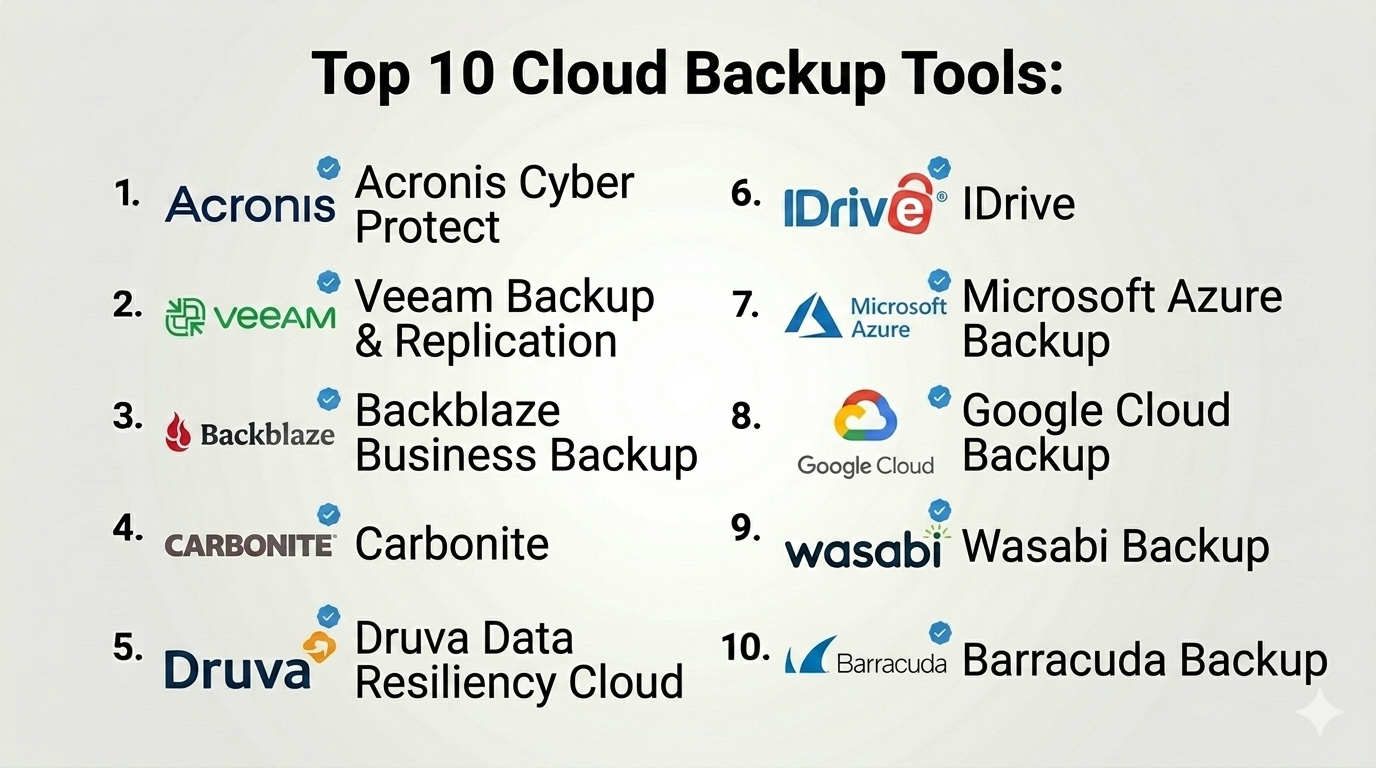
Top 10 Cloud Backup Tools
#1 — Acronis Cyber Protect
Short description: A unified backup and cybersecurity platform designed for businesses needing integrated data protection and threat defense.
Key Features
- Full image and file-level backup
- Ransomware protection
- AI-based threat detection
- Disaster recovery capabilities
- Backup for endpoints, servers, and virtual machines
- Centralized management console
- Flexible storage options
Pros
- Combines backup and security
- Strong disaster recovery features
Cons
- Can be complex to configure
- Pricing varies by features
Platforms / Deployment
Windows / macOS / Linux
Cloud / Hybrid
Security & Compliance
Encryption, MFA, RBAC, audit logs
Compliance certifications: Not publicly stated
Integrations & Ecosystem
Acronis integrates with a variety of IT and security tools.
- Virtualization platforms
- Cloud storage providers
- Endpoint protection tools
Support & Community
Enterprise-grade support with extensive documentation.
#2 — Veeam Backup & Replication
Short description: A leading backup solution for virtualized environments and enterprise workloads.
Key Features
- VM backup and replication
- Instant recovery
- Continuous data protection
- Cloud and hybrid support
- Backup verification
- Advanced scheduling
- Disaster recovery orchestration
Pros
- Strong virtualization support
- Reliable performance
Cons
- Learning curve for new users
- Licensing complexity
Platforms / Deployment
Windows / Linux
Cloud / On-premise / Hybrid
Security & Compliance
Encryption, RBAC, audit logs
Compliance certifications: Not publicly stated
Integrations & Ecosystem
- VMware, Hyper-V
- Cloud providers
- Enterprise storage systems
Support & Community
Large global community and strong support ecosystem.
#3 — Backblaze Business Backup
Short description: A simple and cost-effective cloud backup solution for businesses and individuals.
Key Features
- Unlimited backup storage
- Automatic backup
- File versioning
- Easy restore options
- Endpoint backup
- Web-based management
- External drive support
Pros
- Affordable pricing
- Easy to use
Cons
- Limited advanced features
- Not ideal for complex environments
Platforms / Deployment
Windows / macOS
Cloud
Security & Compliance
Encryption, MFA
Compliance certifications: Not publicly stated
Integrations & Ecosystem
- Basic API access
- Limited enterprise integrations
Support & Community
Good documentation; moderate support.
#4 — Carbonite
Short description: A cloud backup solution focused on SMBs and simple deployment.
Key Features
- Automatic cloud backup
- File and system backup
- Remote access
- Disaster recovery options
- Endpoint protection
- Backup scheduling
- Data encryption
Pros
- Easy setup
- SMB-friendly
Cons
- Limited scalability
- Fewer advanced features
Platforms / Deployment
Windows / macOS
Cloud
Security & Compliance
Encryption, MFA
Compliance certifications: Not publicly stated
Integrations & Ecosystem
- Basic integrations
- Limited API capabilities
Support & Community
Strong SMB-focused support.
#5 — Druva Data Resiliency Cloud
Short description: A fully cloud-native backup platform designed for enterprise data protection.
Key Features
- SaaS-based backup
- Endpoint and server backup
- Cloud workload protection
- Automated compliance reporting
- Ransomware protection
- Data governance features
- Centralized management
Pros
- Cloud-native architecture
- Strong compliance features
Cons
- Pricing may be higher
- Requires onboarding time
Platforms / Deployment
Windows / macOS / Linux
Cloud
Security & Compliance
Encryption, RBAC, MFA
Compliance certifications: Not publicly stated
Integrations & Ecosystem
- SaaS platforms
- Cloud providers
- Enterprise tools
Support & Community
Enterprise-level support.
#6 — IDrive
Short description: A versatile backup solution supporting multiple devices and storage types.
Key Features
- Multi-device backup
- File versioning
- Disk image backup
- Continuous backup
- Remote management
- Hybrid backup support
- Data syncing
Pros
- Affordable plans
- Wide platform support
Cons
- Interface can be complex
- Performance varies
Platforms / Deployment
Windows / macOS / Linux / iOS / Android
Cloud / Hybrid
Security & Compliance
Encryption, MFA
Compliance certifications: Not publicly stated
Integrations & Ecosystem
- Basic APIs
- Limited enterprise integrations
Support & Community
Decent support and documentation.
#7 — Microsoft Azure Backup
Short description: A cloud backup service integrated into the Microsoft Azure ecosystem.
Key Features
- Backup for Azure workloads
- On-premise backup support
- Policy-based management
- Long-term retention
- Encryption
- Monitoring and alerts
- Integration with Azure services
Pros
- Deep Azure integration
- Scalable infrastructure
Cons
- Best suited for Azure users
- Complexity for beginners
Platforms / Deployment
Cloud / Hybrid
Security & Compliance
Encryption, RBAC, MFA
Compliance certifications: Not publicly stated
Integrations & Ecosystem
- Azure services
- Microsoft ecosystem tools
- APIs
Support & Community
Strong enterprise support.
#8 — Google Cloud Backup (Backup and DR)
Short description: A backup and disaster recovery solution within the Google Cloud ecosystem.
Key Features
- Backup for cloud workloads
- Policy-based automation
- Disaster recovery
- Monitoring tools
- Integration with Google Cloud
- Scalable storage
- Secure backups
Pros
- Strong cloud integration
- Scalable
Cons
- Limited outside Google ecosystem
- Requires cloud expertise
Platforms / Deployment
Cloud
Security & Compliance
Encryption, IAM controls
Compliance certifications: Not publicly stated
Integrations & Ecosystem
- Google Cloud services
- APIs
Support & Community
Enterprise-grade support.
#9 — Wasabi Backup (via partners)
Short description: A cost-effective cloud storage platform often used for backup via third-party tools.
Key Features
- Low-cost storage
- High durability
- No egress fees (varies)
- S3-compatible storage
- Fast data access
- Scalable storage
- Integration-friendly
Pros
- Affordable storage
- High performance
Cons
- Requires third-party tools
- Not a standalone backup solution
Platforms / Deployment
Cloud
Security & Compliance
Encryption
Compliance certifications: Not publicly stated
Integrations & Ecosystem
- Backup software integrations
- S3-compatible tools
Support & Community
Support varies by implementation.
#10 — Barracuda Backup
Short description: A backup solution combining cloud and appliance-based deployment for businesses.
Key Features
- Cloud and on-prem backup
- Disaster recovery
- Email protection
- Data deduplication
- Centralized management
- Backup scheduling
- Security features
Pros
- Hybrid flexibility
- Strong security focus
Cons
- Appliance dependency in some cases
- Higher cost
Platforms / Deployment
Cloud / On-premise / Hybrid
Security & Compliance
Encryption, RBAC
Compliance certifications: Not publicly stated
Integrations & Ecosystem
- Email platforms
- Cloud providers
- IT tools
Support & Community
Enterprise support available.
Comparison Table (Top 10)
| Tool Name | Best For | Platform(s) Supported | Deployment | Standout Feature | Public Rating |
|---|---|---|---|---|---|
| Acronis | Security + backup | Multi-platform | Hybrid | AI ransomware protection | N/A |
| Veeam | Enterprises | Windows/Linux | Hybrid | VM backup | N/A |
| Backblaze | SMBs | Windows/macOS | Cloud | Unlimited backup | N/A |
| Carbonite | SMBs | Windows/macOS | Cloud | Simple setup | N/A |
| Druva | Enterprises | Multi-platform | Cloud | Cloud-native backup | N/A |
| IDrive | Individuals/SMBs | Multi-platform | Hybrid | Multi-device backup | N/A |
| Azure Backup | Azure users | Cloud/Hybrid | Cloud | Azure integration | N/A |
| Google Backup | GCP users | Cloud | Cloud | Google ecosystem | N/A |
| Wasabi | Storage-focused | Cloud | Cloud | Low-cost storage | N/A |
| Barracuda | Hybrid backup | Multi-platform | Hybrid | Appliance + cloud | N/A |
Cloud Backup Tools Scoring
| Tool Name | Core | Ease | Integrations | Security | Performance | Support | Value | Weighted Total |
|---|---|---|---|---|---|---|---|---|
| Acronis | 9 | 7 | 8 | 9 | 8 | 8 | 7 | 8.2 |
| Veeam | 9 | 6 | 9 | 8 | 9 | 8 | 7 | 8.3 |
| Backblaze | 7 | 9 | 6 | 7 | 7 | 7 | 9 | 7.7 |
| Carbonite | 7 | 9 | 6 | 7 | 7 | 7 | 8 | 7.5 |
| Druva | 9 | 7 | 8 | 9 | 8 | 8 | 7 | 8.3 |
| IDrive | 8 | 7 | 7 | 7 | 7 | 7 | 9 | 7.8 |
| Azure Backup | 8 | 6 | 9 | 9 | 9 | 8 | 7 | 8.2 |
| Google Backup | 8 | 6 | 8 | 9 | 9 | 8 | 7 | 8.1 |
| Wasabi | 7 | 7 | 8 | 8 | 8 | 7 | 9 | 7.9 |
| Barracuda | 8 | 7 | 7 | 8 | 8 | 8 | 7 | 7.9 |
Interpretation:
- Scores reflect relative strengths across categories
- Enterprise tools score higher in security and performance
- SMB tools score higher in ease and value
- Always match tool strengths to your needs
Which Cloud Backup Tools Is Right for You?
Solo / Freelancer
Use simple tools like Backblaze or IDrive for affordability and ease.
SMB
Carbonite, Acronis, or IDrive offer balanced features and cost.
Mid-Market
Automated and scalable tools like Druva or Veeam are ideal.
Enterprise
Azure Backup, Veeam, or Acronis provide enterprise-grade features.
Budget vs Premium
- Budget: Backblaze, IDrive
- Premium: Acronis, Druva
Feature Depth vs Ease of Use
- Easy: Backblaze, Carbonite
- Advanced: Veeam, Azure
Integrations & Scalability
Choose Azure or Google tools if already in their ecosystems.
Security & Compliance Needs
Pick tools with strong encryption, RBAC, and compliance reporting.
Frequently Asked Questions (FAQs)
What is cloud backup?
It’s storing data copies in remote cloud servers for recovery purposes.
Is cloud backup secure?
Yes, most tools offer encryption and access controls.
How much does it cost?
Pricing varies based on storage, users, and features.
Can I restore individual files?
Yes, most tools support granular recovery.
How often should backups run?
Daily or continuous backups are recommended.
What is ransomware protection?
It prevents unauthorized encryption or deletion of backups.
Can I back up SaaS apps?
Some tools support SaaS backups.
Is hybrid backup better?
It offers both local and cloud redundancy.
How long does recovery take?
Depends on data size and tool performance.
Can I switch providers?
Yes, but migration planning is required.
Conclusion
Cloud backup tools are essential for protecting modern business data against loss, cyber threats, and operational disruptions. From simple SMB solutions to enterprise-grade platforms, the market offers a wide range of options tailored to different needs.
