Introduction
Channel Sales Management tools help businesses manage indirect sales networks that include distributors, resellers, affiliates, wholesalers, referral partners, and channel partners. These platforms centralize partner onboarding, deal registration, sales tracking, partner enablement, incentive management, and analytics into one unified system.
In channel-driven revenue models continue to expand across SaaS, manufacturing, telecom, cybersecurity, healthcare technology, and enterprise software industries. Businesses increasingly rely on partner ecosystems to scale globally without building large direct sales teams. Modern channel sales management platforms now include AI-driven forecasting, automated partner onboarding, partner performance analytics, co-selling workflows, and advanced integration ecosystems.
Real-world use cases include:
- Managing reseller and distributor programs
- Tracking indirect sales pipelines
- Automating deal registration workflows
- Running partner incentive programs
- Enabling partner training and certifications
- Managing channel marketing campaigns
When evaluating Channel Sales Management tools, buyers should consider:
- Ease of partner onboarding
- CRM and ERP integrations
- Deal registration capabilities
- Reporting and analytics depth
- Incentive and commission management
- Workflow automation
- Scalability for global channel ecosystems
- Security and compliance features
- Mobile accessibility
- Customization and API support
Best for: SaaS vendors, manufacturers, telecom companies, cybersecurity providers, wholesalers, and enterprises with large indirect sales ecosystems.
Not ideal for: Small businesses with minimal channel activity or companies relying almost entirely on direct sales. Lightweight CRM workflows may be sufficient in those cases.
Key Trends in Channel Sales Management Tools
- AI-powered channel forecasting is improving pipeline visibility and partner performance analysis.
- Automated partner onboarding and certification workflows are reducing operational overhead.
- Embedded analytics dashboards now provide real-time revenue attribution and sales insights.
- Co-selling integrations with CRM platforms are becoming increasingly important.
- Channel marketing automation is being integrated directly into sales management platforms.
- API-first architectures are enabling better interoperability with ERP, CRM, and finance systems.
- Mobile-first partner experiences are improving field sales collaboration.
- Security expectations now commonly include MFA, SSO, RBAC, and audit logging.
- Low-code workflow customization is becoming a key enterprise requirement.
- Subscription and usage-based pricing models are replacing rigid enterprise licensing structures.
How We Selected These Tools (Methodology)
The tools in this list were evaluated using practical business and technical criteria relevant to channel-driven organizations.
Selection factors included:
- Market adoption and industry visibility
- Breadth of channel sales functionality
- Integration ecosystem strength
- Security and governance capabilities
- Scalability across SMB and enterprise environments
- Ease of onboarding and usability
- Automation and analytics capabilities
- Reliability and vendor reputation
- Support quality and implementation ecosystem
- Flexibility across industries and sales models
The final list includes enterprise-grade solutions as well as mid-market-focused platforms to support different operational requirements.
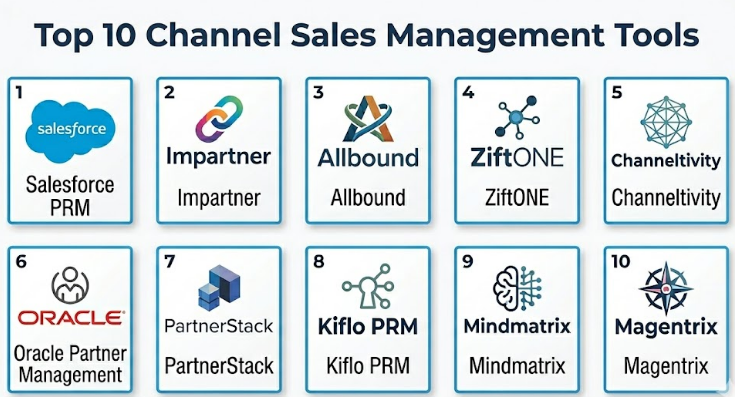
Channel Sales Management Tools
#1 — Salesforce PRM
Short description :
Salesforce PRM is one of the most widely recognized channel sales management platforms for enterprise organizations. Built within the Salesforce ecosystem, it enables businesses to manage partners, deal registration, sales collaboration, onboarding, and partner analytics from a centralized environment. The platform is especially suitable for organizations already using Salesforce CRM. It supports advanced automation, customizable workflows, and large-scale global partner ecosystems. Enterprises often choose Salesforce PRM for its scalability and integration depth.
Key Features
- Partner portals and onboarding
- Deal registration workflows
- AI-powered analytics
- Lead distribution automation
- Partner training management
- Workflow automation
- Sales forecasting dashboards
Pros
- Deep Salesforce ecosystem integration
- Highly scalable for enterprise operations
- Strong analytics and automation capabilities
Cons
- Higher implementation complexity
- Premium pricing for advanced features
- Customization may require specialist expertise
Platforms / Deployment
- Web / iOS / Android
- Cloud
Security & Compliance
- SSO/SAML
- MFA
- RBAC
- Audit logs
- GDPR support
- Enterprise compliance standards
Integrations & Ecosystem
Salesforce PRM integrates tightly with Salesforce products and enterprise business systems. It also supports APIs and marketplace extensions.
- Salesforce CRM
- Slack
- SAP
- HubSpot
- Microsoft Dynamics
- REST APIs
Support & Community
Salesforce provides extensive enterprise support, partner ecosystems, documentation, and implementation resources.
#2 — Impartner
Short description :
Impartner is a dedicated channel management and PRM platform designed to help organizations scale partner ecosystems efficiently. The platform focuses heavily on automation, partner engagement, onboarding, and analytics. It is widely used in technology, manufacturing, and B2B industries that depend on indirect sales networks. Impartner supports customizable workflows without requiring extensive development resources. It is suitable for both mid-market and enterprise organizations.
Key Features
- Automated partner onboarding
- Deal registration management
- Incentive management
- Partner training and certifications
- Workflow automation
- Channel analytics
- MDF management
Pros
- Purpose-built channel management platform
- Strong onboarding automation
- Good balance of flexibility and usability
Cons
- Pricing transparency is limited
- Advanced customization may require vendor assistance
- Some reporting features require setup effort
Platforms / Deployment
- Web
- Cloud
Security & Compliance
- SSO/SAML
- MFA
- RBAC
- Encryption
- GDPR support
- Audit capabilities
Integrations & Ecosystem
Impartner integrates with CRM and marketing platforms while supporting API-based custom workflows.
- Salesforce
- HubSpot
- Microsoft Dynamics
- Oracle
- Marketo
- APIs
Support & Community
Impartner provides onboarding support, implementation services, and enterprise customer success programs.
#3 — Allbound
Short description :
Allbound focuses on partner enablement, communication, and engagement. The platform combines channel sales management with partner training and collaboration tools. It is commonly used by SaaS companies and mid-sized organizations looking for user-friendly channel management capabilities. Allbound emphasizes usability while supporting deal registration, analytics, and content management workflows. Its modern interface is often considered a major advantage.
Key Features
- Partner onboarding and enablement
- Deal registration
- Training and certification tools
- Channel analytics
- Content sharing
- Lead distribution
- Gamification capabilities
Pros
- Easy-to-use interface
- Strong partner engagement functionality
- Faster deployment timelines
Cons
- Limited enterprise customization depth
- Advanced analytics may require higher plans
- Less suitable for highly complex enterprise ecosystems
Platforms / Deployment
- Web
- Cloud
Security & Compliance
- SSO
- MFA
- Encryption
- GDPR support
- Audit capabilities
- Not publicly stated for some certifications
Integrations & Ecosystem
Allbound supports CRM and marketing automation integrations alongside API connectivity.
- Salesforce
- HubSpot
- Marketo
- Microsoft Dynamics
- Zapier
- APIs
Support & Community
The platform provides onboarding assistance and customer support with a strong focus on usability.
#4 — ZiftONE
Short description :
ZiftONE combines channel sales management and channel marketing automation into one platform. It enables organizations to manage partner onboarding, lead distribution, marketing campaigns, and sales analytics from a centralized system. The platform is particularly strong for businesses that rely heavily on partner-driven marketing strategies. It is widely adopted in technology and cybersecurity sectors.
Key Features
- Channel marketing automation
- Partner onboarding workflows
- Deal registration
- MDF management
- Analytics dashboards
- Co-branded campaign tools
- Lead management
Pros
- Strong marketing automation functionality
- Unified partner engagement workflows
- Good analytics visibility
Cons
- Enterprise pricing may be high
- Learning curve for advanced features
- Reporting customization may require setup effort
Platforms / Deployment
- Web
- Cloud
Security & Compliance
- SSO/SAML
- MFA
- RBAC
- Audit logs
- Encryption
- GDPR support
Integrations & Ecosystem
ZiftONE integrates with CRM and marketing platforms while supporting APIs for extensibility.
- Salesforce
- HubSpot
- Oracle
- Microsoft Dynamics
- Marketo
- APIs
Support & Community
ZiftONE offers enterprise onboarding programs and implementation support services.
#5 — Channeltivity
Short description :
Channeltivity is designed for mid-market businesses seeking practical channel sales management functionality without excessive complexity. The platform includes partner onboarding, deal registration, partner directories, and reporting tools. It is often selected by organizations that want relatively quick deployment and simplified administration. Channeltivity balances usability with core PRM functionality.
Key Features
- Deal registration workflows
- Partner onboarding
- Learning management
- Lead distribution
- Partner locator tools
- Reporting dashboards
- Workflow automation
Pros
- Easier implementation process
- Strong usability
- Good fit for growing businesses
Cons
- Limited enterprise-level customization
- Smaller ecosystem compared to major vendors
- AI functionality is relatively limited
Platforms / Deployment
- Web
- Cloud
Security & Compliance
- SSO
- MFA
- Encryption
- RBAC
- GDPR support
- Not publicly stated for additional certifications
Integrations & Ecosystem
The platform integrates with common CRM systems and workflow automation tools.
- Salesforce
- HubSpot
- Microsoft Dynamics
- Zapier
- APIs
Support & Community
Channeltivity is known for responsive customer support and onboarding assistance.
#6 — Oracle Partner Management
Short description :
Oracle Partner Management is built for large enterprises managing global channel ecosystems. The platform integrates with Oracle CX and ERP systems to provide end-to-end partner sales visibility. It supports workflow automation, analytics, forecasting, and partner engagement across multinational operations. Organizations already invested in Oracle infrastructure often benefit from ecosystem alignment.
Key Features
- Enterprise partner management
- Deal registration
- Workflow automation
- Channel analytics
- Forecasting tools
- Partner segmentation
- ERP integrations
Pros
- Strong enterprise scalability
- Advanced analytics capabilities
- Broad Oracle ecosystem integration
Cons
- Complex implementation process
- Higher operational overhead
- Less suitable for SMBs
Platforms / Deployment
- Web
- Cloud / Hybrid
Security & Compliance
- SSO/SAML
- MFA
- RBAC
- Audit logs
- Encryption
- Enterprise governance capabilities
Integrations & Ecosystem
Oracle Partner Management integrates deeply with Oracle enterprise products and APIs.
- Oracle ERP
- Oracle CX
- SAP
- Salesforce
- APIs
- Middleware tools
Support & Community
Oracle offers enterprise support programs, implementation services, and technical documentation.
#7 — PartnerStack
Short description :
PartnerStack is widely used in the SaaS industry for managing affiliate, reseller, and referral partner programs. The platform emphasizes automation, partner recruitment, payouts, and partner ecosystem growth. It is especially useful for software companies building scalable indirect sales programs. PartnerStack simplifies recurring commission management and partner tracking.
Key Features
- Affiliate management
- Referral tracking
- Automated payouts
- Partner recruitment workflows
- Analytics dashboards
- Partner onboarding
- Marketplace visibility
Pros
- Strong SaaS-focused workflows
- Simplified commission management
- User-friendly experience
Cons
- Limited enterprise customization
- Governance features may be lighter than enterprise PRM suites
- Less suitable for highly regulated industries
Platforms / Deployment
- Web
- Cloud
Security & Compliance
- SSO
- MFA
- Encryption
- GDPR support
- Not publicly stated for enterprise certifications
Integrations & Ecosystem
PartnerStack supports integrations with SaaS-focused sales and marketing platforms.
- HubSpot
- Salesforce
- Stripe
- Zapier
- APIs
Support & Community
The platform offers onboarding assistance and customer success support tailored for SaaS businesses.
#8 — Kiflo PRM
Short description :
Kiflo PRM is designed for SMBs and growing businesses looking to establish structured partner programs. The platform emphasizes ease of use, partner communication, onboarding, and relationship visibility. It is commonly used by startups and mid-sized B2B organizations building their first formal channel ecosystems. Kiflo focuses on operational simplicity.
Key Features
- Partner onboarding
- Referral management
- Workflow automation
- Partner directories
- Analytics dashboards
- Communication management
- Partner segmentation
Pros
- Intuitive interface
- Good SMB-focused pricing and usability
- Faster deployment timelines
Cons
- Limited enterprise scalability
- Smaller integration ecosystem
- Basic analytics compared to enterprise platforms
Platforms / Deployment
- Web
- Cloud
Security & Compliance
- SSO
- MFA
- Encryption
- GDPR support
- Not publicly stated for additional certifications
Integrations & Ecosystem
Kiflo supports CRM integrations and automation workflows.
- Salesforce
- HubSpot
- Zapier
- APIs
Support & Community
Kiflo provides onboarding support and SMB-focused customer assistance.
#9 — Mindmatrix
Short description :
Mindmatrix combines channel sales management, sales enablement, and partner marketing automation into a unified platform. It supports distributed sales ecosystems through centralized training, content management, onboarding, and campaign workflows. The platform is commonly used in technology and telecom sectors requiring coordinated partner engagement strategies.
Key Features
- Sales enablement
- Partner portals
- Marketing automation
- Training and certifications
- Deal registration
- Content management
- Analytics dashboards
Pros
- Strong sales enablement capabilities
- Integrated marketing workflows
- Centralized content distribution
Cons
- Interface complexity for some users
- Advanced features require onboarding effort
- Reporting setup may take time
Platforms / Deployment
- Web
- Cloud
Security & Compliance
- SSO
- MFA
- RBAC
- Audit logs
- Encryption
- GDPR support
Integrations & Ecosystem
Mindmatrix integrates with CRM and marketing automation ecosystems.
- Salesforce
- HubSpot
- Microsoft Dynamics
- Marketo
- APIs
Support & Community
Mindmatrix provides onboarding assistance and implementation support for enterprise and mid-market customers.
#10 — Magentrix
Short description :
Magentrix focuses on partner collaboration, communication, and branded channel portals. The platform enables businesses to manage onboarding, document sharing, workflows, and sales collaboration across partner ecosystems. It is often chosen by organizations that prioritize partner engagement and collaborative workflows alongside core channel management functionality.
Key Features
- Partner portals
- Collaboration workflows
- Deal registration
- Document management
- Workflow automation
- Reporting dashboards
- Partner onboarding
Pros
- Strong portal customization
- Good collaboration functionality
- Flexible workflow management
Cons
- Smaller ecosystem compared to major vendors
- Advanced analytics capabilities are limited
- Some integrations require additional configuration
Platforms / Deployment
- Web
- Cloud
Security & Compliance
- SSO
- MFA
- RBAC
- Encryption
- GDPR support
- Not publicly stated for additional certifications
Integrations & Ecosystem
Magentrix supports CRM integrations and API-based customization.
- Salesforce
- Microsoft Dynamics
- SharePoint
- Zapier
- APIs
Support & Community
Magentrix offers onboarding assistance and enterprise customer support programs.
Comparison Table (Top 10)
| Tool Name | Best For | Platform(s) Supported | Deployment | Standout Feature | Public Rating |
|---|---|---|---|---|---|
| Salesforce PRM | Enterprise channel ecosystems | Web, iOS, Android | Cloud | Deep CRM integration | N/A |
| Impartner | Enterprise channel management | Web | Cloud | Automated onboarding | N/A |
| Allbound | Mid-market SaaS businesses | Web | Cloud | Partner engagement tools | N/A |
| ZiftONE | Channel marketing automation | Web | Cloud | Integrated marketing workflows | N/A |
| Channeltivity | Growing mid-market businesses | Web | Cloud | Simpler deployment | N/A |
| Oracle Partner Management | Large enterprises | Web | Cloud, Hybrid | Oracle ecosystem integration | N/A |
| PartnerStack | SaaS referral programs | Web | Cloud | Automated payouts | N/A |
| Kiflo PRM | SMB partner programs | Web | Cloud | Ease of use | N/A |
| Mindmatrix | Sales enablement ecosystems | Web | Cloud | Content and sales enablement | N/A |
| Magentrix | Partner collaboration | Web | Cloud | Custom partner portals | N/A |
Evaluation & Channel Sales Management Tools
| Tool Name | Core (25%) | Ease (15%) | Integrations (15%) | Security (10%) | Performance (10%) | Support (10%) | Value (15%) | Weighted Total (0–10) |
|---|---|---|---|---|---|---|---|---|
| Salesforce PRM | 9.5 | 7.5 | 10 | 9.5 | 9 | 9 | 7 | 8.8 |
| Impartner | 9 | 8 | 8.5 | 8.5 | 8.5 | 8.5 | 7.5 | 8.4 |
| Allbound | 8 | 9 | 8 | 8 | 8 | 8.5 | 8.5 | 8.2 |
| ZiftONE | 8.5 | 7.5 | 8.5 | 8.5 | 8.5 | 8 | 7.5 | 8.2 |
| Channeltivity | 7.5 | 8.5 | 7.5 | 7.5 | 8 | 8.5 | 8.5 | 8.0 |
| Oracle Partner Management | 9 | 6.5 | 9 | 9.5 | 9 | 8 | 6.5 | 8.2 |
| PartnerStack | 8 | 9 | 7.5 | 7.5 | 8 | 8 | 9 | 8.2 |
| Kiflo PRM | 7 | 9 | 7 | 7 | 7.5 | 8 | 9 | 7.9 |
| Mindmatrix | 8 | 7 | 8 | 8 | 8 | 7.5 | 7.5 | 7.8 |
| Magentrix | 7.5 | 8 | 7.5 | 7.5 | 7.5 | 8 | 8 | 7.8 |
These scores are comparative and intended to help buyers evaluate trade-offs between scalability, usability, integrations, security, and operational value. Enterprise organizations may prioritize integrations and governance, while SMBs may focus more heavily on ease of use and implementation speed. A lower score does not necessarily indicate a poor platform, but rather a different market focus or specialization.
Which Channel Sales Management Tools
Solo / Freelancer
Solo operators and small referral-driven businesses usually do not require complex enterprise channel management systems. Lightweight platforms like Kiflo PRM and PartnerStack are often sufficient for managing partner onboarding and referral workflows.
SMB
SMBs typically benefit from platforms that balance usability and functionality. Channeltivity, Allbound, and Kiflo PRM are strong choices for businesses seeking fast deployment and manageable operational complexity.
Mid-Market
Mid-market organizations often require better analytics, automation, and integration flexibility. Impartner, Mindmatrix, and Allbound provide strong balances between scalability and operational simplicity.
Enterprise
Large enterprises generally require advanced governance, workflow customization, and global scalability. Salesforce PRM and Oracle Partner Management are strong options for multinational channel ecosystems.
Budget vs Premium
- Budget-focused: Kiflo PRM, Channeltivity
- Mid-range value: Allbound, PartnerStack
- Premium enterprise solutions: Salesforce PRM, Oracle Partner Management, Impartner
Organizations should consider implementation and maintenance costs in addition to subscription pricing.
Feature Depth vs Ease of Use
- Feature-rich platforms: Salesforce PRM, Oracle Partner Management
- Easier-to-use platforms: Allbound, Kiflo PRM
- Balanced solutions: Impartner, Channeltivity
Complex enterprise platforms often require longer onboarding periods but provide greater customization.
Integrations & Scalability
Organizations already using Salesforce or Oracle ecosystems may benefit from native integrations. Businesses expecting rapid growth should prioritize API support and scalable workflow customization.
Security & Compliance Needs
Regulated industries should prioritize:
- MFA and SSO support
- RBAC controls
- Audit logging
- Encryption standards
- GDPR-focused governance capabilities
Enterprise-focused platforms generally provide stronger governance functionality.
Frequently Asked Questions (FAQs)
1. What are Channel Sales Management tools?
Channel Sales Management tools help businesses manage indirect sales ecosystems that include resellers, distributors, affiliates, and strategic partners. These platforms centralize onboarding, analytics, training, and sales workflows.
2. How are Channel Sales Management platforms different from CRM software?
CRM software focuses primarily on direct customer relationships, while channel sales platforms are designed to manage external partner ecosystems and indirect sales operations.
3. Which industries benefit most from these tools?
Technology, SaaS, manufacturing, telecom, cybersecurity, healthcare technology, and enterprise software companies commonly use channel sales management systems.
4. Are these platforms suitable for SMBs?
Yes. Many vendors now provide SMB-friendly platforms with simplified onboarding, lower operational complexity, and faster deployment timelines.
5. What integrations are most important?
CRM, ERP, marketing automation, analytics, collaboration, and finance system integrations are often critical for efficient channel operations.
6. What security capabilities should buyers prioritize?
Important capabilities include SSO, MFA, encryption, RBAC, audit logging, and compliance-focused governance controls.
7. Can these platforms automate partner onboarding?
Yes. Most modern platforms automate onboarding, deal approvals, certifications, content sharing, and lead distribution workflows.
8. How long does implementation usually take?
Implementation timelines vary significantly depending on integration complexity and customization requirements. SMB deployments may take weeks, while enterprise rollouts can take several months.
9. What are common mistakes during selection?
Common mistakes include underestimating integration requirements, over-customizing workflows too early, and choosing overly complex systems for small partner programs.
10. Do these platforms support AI functionality?
Many modern channel sales management tools now include AI-powered forecasting, analytics, partner scoring, workflow automation, and performance recommendations.
Conclusion
Channel Sales Management tools have become critical infrastructure for businesses that rely on indirect revenue channels and partner ecosystems. Modern platforms now extend far beyond simple partner portals by combining onboarding, analytics, automation, marketing, forecasting, and partner enablement into centralized systems designed for scalable growth.The best solution depends heavily on organizational size, integration requirements, channel complexity, and operational maturity. Enterprise organizations often prioritize governance, customization, and ecosystem depth, while SMBs may focus more on usability, deployment speed, and operational simplicity.
