Introduction
Business Phone Systems (VoIP) are cloud-based communication platforms that allow organizations to make and receive calls over the internet instead of traditional phone lines. These systems go beyond voice—offering messaging, video conferencing, call routing, analytics, and integrations with modern business tools.
In today’s distributed and hybrid work environment, VoIP systems are essential. They enable teams to stay connected across locations, reduce telecom costs, and integrate communication directly into workflows like CRM, support, and collaboration platforms.
Common use cases include:
- Customer support call centers
- Sales teams managing outbound/inbound calls
- Remote and hybrid team communication
- Multi-location business operations
- Unified communications (voice + video + chat)
What buyers should evaluate:
- Call quality and reliability
- Pricing structure and scalability
- Ease of setup and use
- Integration capabilities (CRM, helpdesk, etc.)
- Security and compliance features
- AI and automation capabilities
- Global coverage and number support
- Customer support quality
- Customization and extensibility
Best for: SMBs, startups, remote teams, customer support centers, and enterprises needing scalable communication solutions.
Not ideal for: Very small teams with minimal calling needs, or businesses requiring fully offline/on-prem-only telephony without internet dependency.
Key Trends in Business Phone Systems (VoIP)
- AI-powered call intelligence: Real-time transcription, sentiment analysis, and call summaries are becoming standard.
- Unified Communications (UCaaS): Voice, video, chat, and collaboration tools are merging into single platforms.
- Cloud-first adoption: Most new deployments are cloud-native with minimal hardware dependency.
- Global expansion: Easier provisioning of international numbers and localized compliance.
- Automation & workflows: IVR, call routing, and CRM triggers are increasingly automated.
- Security focus: End-to-end encryption, zero-trust access, and compliance certifications are more important.
- API-first platforms: Developer-friendly APIs for custom workflows and integrations.
- Mobile-first usage: Increased reliance on mobile apps for business communication.
- Flexible pricing models: Usage-based and tiered pricing structures are becoming common.
- AI voice agents: Early adoption of AI-driven virtual agents handling basic customer queries.
How We Selected These Tools (Methodology)
- Evaluated market adoption and brand recognition across SMB and enterprise segments
- Assessed feature completeness (voice, IVR, analytics, AI, integrations)
- Considered reliability and performance signals (uptime, call quality reputation)
- Reviewed security and compliance posture (where publicly known)
- Analyzed integration ecosystem and API availability
- Ensured coverage across business sizes (freelancers to enterprises)
- Compared ease of use and onboarding experience
- Looked at customer support reputation and documentation quality
- Included global availability and scalability
- Balanced cost vs value proposition
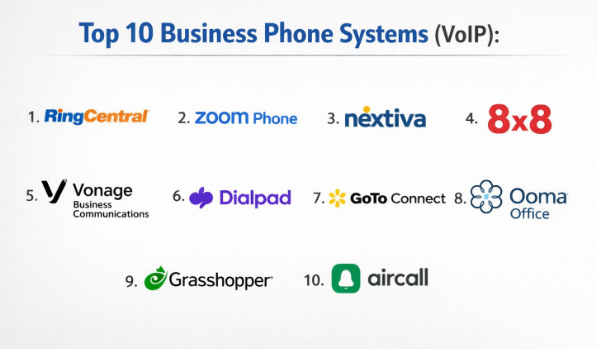
Top 10 Business Phone Systems (VoIP)
#1 — RingCentral
Short description: A leading UCaaS platform offering voice, video, messaging, and contact center capabilities for businesses of all sizes.
Key Features
- Cloud PBX with advanced call routing
- Video conferencing and team messaging
- AI-powered call insights and transcription
- Multi-level IVR and auto-attendant
- Global number support
- Analytics and reporting dashboard
Pros
- Comprehensive all-in-one solution
- Strong enterprise-grade reliability
Cons
- Can be expensive for small teams
- Interface may feel complex initially
Platforms / Deployment
Web / Windows / macOS / iOS / Android
Cloud
Security & Compliance
SSO, MFA, encryption, RBAC
SOC 2, GDPR (publicly known)
Integrations & Ecosystem
Strong ecosystem with CRM, helpdesk, and productivity tools.
- Salesforce
- HubSpot
- Microsoft 365
- Google Workspace
- APIs for custom integrations
Support & Community
Extensive documentation, enterprise support tiers, strong onboarding resources.
#2 — Zoom Phone
Short description: A VoIP extension of Zoom’s communication platform, designed for seamless voice integration with video meetings.
Key Features
- Native integration with Zoom Meetings
- Cloud PBX and call routing
- Voicemail transcription
- Call recording and analytics
- Global number availability
Pros
- Excellent for Zoom-heavy teams
- Easy to deploy and use
Cons
- Limited advanced telephony features
- Less robust than enterprise PBX systems
Platforms / Deployment
Web / Windows / macOS / iOS / Android
Cloud
Security & Compliance
Encryption, MFA
SOC 2 (publicly known)
Integrations & Ecosystem
- Zoom ecosystem
- Slack
- Salesforce
- Microsoft Teams (limited)
Support & Community
Strong documentation and widespread adoption, reliable support.
#3 — Nextiva
Short description: A business communication platform focused on reliability, customer experience, and unified communications.
Key Features
- VoIP calling and SMS
- Call analytics and reporting
- CRM-like customer interaction tools
- Auto-attendant and IVR
- Team collaboration features
Pros
- Strong customer support reputation
- Reliable call quality
Cons
- UI can feel dated
- Limited advanced AI features
Platforms / Deployment
Web / Windows / macOS / iOS / Android
Cloud
Security & Compliance
Not publicly stated in detail
Integrations & Ecosystem
- CRM integrations
- Helpdesk tools
- APIs available
Support & Community
Highly rated support and onboarding experience.
#4 — 8×8
Short description: Enterprise-grade VoIP and contact center platform with global communication capabilities.
Key Features
- Global cloud telephony
- Contact center integration
- Advanced analytics
- Video conferencing
- AI insights
Pros
- Strong global presence
- Enterprise-ready features
Cons
- Pricing complexity
- Learning curve for new users
Platforms / Deployment
Web / Windows / macOS / iOS / Android
Cloud
Security & Compliance
Encryption, compliance features (varies)
Integrations & Ecosystem
- CRM tools
- Microsoft Teams
- APIs
Support & Community
Enterprise-level support, strong documentation.
#5 — Vonage Business Communications
Short description: A flexible VoIP platform with strong APIs and communication tools for businesses and developers.
Key Features
- Cloud PBX
- Video meetings
- Messaging APIs
- Call recording
- Workflow automation
Pros
- Strong developer ecosystem
- Flexible customization
Cons
- UI can be inconsistent
- Pricing tiers can be confusing
Platforms / Deployment
Web / Mobile / Desktop
Cloud
Security & Compliance
Not publicly stated in detail
Integrations & Ecosystem
- CRM tools
- APIs and SDKs
- Communication APIs
Support & Community
Good developer community and documentation.
#6 — Dialpad
Short description: AI-powered VoIP platform focused on real-time insights and productivity.
Key Features
- Real-time transcription
- AI call summaries
- Voice intelligence
- Cloud PBX
- Messaging and video
Pros
- Strong AI capabilities
- Modern interface
Cons
- AI features may require higher tiers
- Limited traditional PBX depth
Platforms / Deployment
Web / Windows / macOS / iOS / Android
Cloud
Security & Compliance
Encryption, SSO
Integrations & Ecosystem
- Google Workspace
- Salesforce
- Slack
- APIs
Support & Community
Good documentation and growing user base.
#7 — GoTo Connect
Short description: Unified communication system combining VoIP, meetings, and messaging.
Key Features
- Cloud PBX
- Visual dial plan editor
- Video conferencing
- Call analytics
- Auto-attendant
Pros
- Easy setup
- Visual workflow builder
Cons
- Limited advanced AI features
- UI improvements needed
Platforms / Deployment
Web / Desktop / Mobile
Cloud
Security & Compliance
Not publicly stated
Integrations & Ecosystem
- CRM integrations
- Productivity tools
Support & Community
Reliable support and onboarding resources.
#8 — Ooma Office
Short description: Affordable VoIP solution tailored for small businesses.
Key Features
- Virtual receptionist
- Call forwarding
- Mobile app
- Voicemail transcription
- Basic analytics
Pros
- Cost-effective
- Easy to use
Cons
- Limited scalability
- Fewer enterprise features
Platforms / Deployment
Web / Mobile
Cloud
Security & Compliance
Not publicly stated
Integrations & Ecosystem
Limited integrations compared to competitors.
Support & Community
Basic support, suitable for small teams.
#9 — Grasshopper
Short description: Virtual phone system designed for entrepreneurs and small teams.
Key Features
- Call forwarding
- Voicemail transcription
- Business texting
- Custom greetings
- Extensions
Pros
- Very simple setup
- Ideal for freelancers
Cons
- Lacks advanced features
- No video or team collaboration
Platforms / Deployment
Mobile / Web
Cloud
Security & Compliance
Not publicly stated
Integrations & Ecosystem
Minimal integrations.
Support & Community
Basic support, easy onboarding.
#10 — Aircall
Short description: Cloud-based call center and phone system built for sales and support teams.
Key Features
- Call center features
- CRM integrations
- Call tagging and analytics
- IVR and routing
- Real-time monitoring
Pros
- Excellent CRM integrations
- Great for support teams
Cons
- Limited outside call center use
- Pricing can be high
Platforms / Deployment
Web / Desktop / Mobile
Cloud
Security & Compliance
Encryption, GDPR (publicly known)
Integrations & Ecosystem
- Salesforce
- HubSpot
- Zendesk
- APIs
Support & Community
Strong support and onboarding.
Comparison Table (Top 10)
| Tool Name | Best For | Platform(s) Supported | Deployment | Standout Feature | Public Rating |
|---|---|---|---|---|---|
| RingCentral | Enterprises | Web, Desktop, Mobile | Cloud | Full UCaaS suite | N/A |
| Zoom Phone | Zoom users | Web, Desktop, Mobile | Cloud | Native Zoom integration | N/A |
| Nextiva | SMBs | Web, Desktop, Mobile | Cloud | Customer experience focus | N/A |
| 8×8 | Global enterprises | Web, Desktop, Mobile | Cloud | Global telephony | N/A |
| Vonage | Developers | Web, Desktop, Mobile | Cloud | APIs & customization | N/A |
| Dialpad | AI-focused teams | Web, Desktop, Mobile | Cloud | AI transcription | N/A |
| GoTo Connect | SMBs | Web, Desktop, Mobile | Cloud | Visual dial plans | N/A |
| Ooma Office | Small businesses | Web, Mobile | Cloud | Affordability | N/A |
| Grasshopper | Freelancers | Mobile, Web | Cloud | Simplicity | N/A |
| Aircall | Support teams | Web, Desktop, Mobile | Cloud | CRM integrations | N/A |
Business Phone Systems (VoIP)
| Tool Name | Core (25%) | Ease (15%) | Integrations (15%) | Security (10%) | Performance (10%) | Support (10%) | Value (15%) | Weighted Total |
|---|---|---|---|---|---|---|---|---|
| RingCentral | 9 | 7 | 9 | 8 | 9 | 8 | 7 | 8.2 |
| Zoom Phone | 8 | 9 | 7 | 8 | 8 | 8 | 8 | 8.1 |
| Nextiva | 8 | 8 | 7 | 6 | 8 | 9 | 8 | 7.9 |
| 8×8 | 9 | 7 | 8 | 8 | 9 | 8 | 7 | 8.1 |
| Vonage | 8 | 7 | 9 | 6 | 8 | 7 | 7 | 7.7 |
| Dialpad | 8 | 9 | 8 | 7 | 8 | 8 | 8 | 8.2 |
| GoTo Connect | 7 | 8 | 7 | 6 | 7 | 8 | 8 | 7.5 |
| Ooma Office | 6 | 9 | 5 | 5 | 7 | 7 | 9 | 7.2 |
| Grasshopper | 5 | 10 | 4 | 5 | 6 | 7 | 9 | 6.8 |
| Aircall | 8 | 8 | 9 | 7 | 8 | 8 | 7 | 8.0 |
How to interpret:
- Scores are relative comparisons, not absolute benchmarks.
- Higher totals indicate balanced performance across categories.
- Some tools score higher due to specific strengths (e.g., AI, integrations).
- Choose based on your primary needs, not just total score.
Which Business Phone Systems (VoIP) Is Right for You?
Solo / Freelancer
- Best: Grasshopper, Ooma Office
- Focus on simplicity, low cost, and quick setup
SMB
- Best: Nextiva, GoTo Connect, Dialpad
- Balance between features, cost, and usability
Mid-Market
- Best: RingCentral, Aircall
- Need integrations, analytics, and scalability
Enterprise
- Best: 8×8, RingCentral
- Require global coverage, compliance, and reliability
Budget vs Premium
- Budget: Ooma, Grasshopper
- Premium: RingCentral, 8×8
Feature Depth vs Ease of Use
- Feature-rich: RingCentral, 8×8
- Easy: Zoom Phone, Grasshopper
Integrations & Scalability
- Best: Aircall, Vonage, RingCentral
Security & Compliance Needs
- Stronger: RingCentral, Zoom Phone, 8×8
Frequently Asked Questions (FAQs)
What is a VoIP business phone system?
A VoIP system uses the internet to make calls instead of traditional phone lines, offering more flexibility and features.
How much do VoIP systems cost?
Pricing varies widely based on features, users, and usage. Typically subscription-based.
Is VoIP reliable?
Yes, with a stable internet connection. Enterprise providers offer high uptime.
Can VoIP replace traditional PBX?
Yes, most businesses are transitioning to cloud-based PBX systems.
Do VoIP systems support mobile devices?
Yes, most offer iOS and Android apps.
Are VoIP systems secure?
Many include encryption, MFA, and compliance features, though levels vary.
How long does implementation take?
From a few hours (SMB) to several weeks (enterprise setups).
Can I keep my existing phone number?
Yes, number porting is commonly supported.
What integrations matter most?
CRM (Salesforce), helpdesk, and collaboration tools.
When should I switch providers?
When costs, features, or reliability no longer meet your needs.
Conclusion
Business Phone Systems (VoIP) have evolved into full-fledged communication platforms that power modern organizations. From AI-driven insights to global scalability, these tools are critical for staying competitive in a distributed world
