Introduction
Seismic Interpretation Software helps geoscientists, exploration teams, reservoir engineers, and subsurface specialists convert seismic survey data into useful geological understanding. In plain English, it helps teams “see” underground structures by interpreting 2D, 3D, and sometimes 4D seismic data. These tools are used to identify faults, horizons, reservoirs, stratigraphic features, drilling risks, and subsurface opportunities.
In the 2026+ environment, seismic interpretation matters because exploration teams are under pressure to make faster, safer, and more cost-aware subsurface decisions. AI-assisted interpretation, cloud collaboration, high-performance visualization, and integrated subsurface modeling are now becoming important buying factors.
Common use cases include:
- Oil and gas exploration and field development
- Carbon capture and storage site evaluation
- Geothermal resource assessment
- Basin analysis and regional subsurface studies
- Reservoir characterization and drilling planning
Buyers should evaluate:
- 2D, 3D, and 4D seismic interpretation capability
- Horizon and fault interpretation tools
- AI-assisted interpretation and automation
- Seismic attribute analysis
- Integration with geological and reservoir modeling
- Data format support and interoperability
- Visualization performance on large seismic volumes
- Collaboration and project governance
- Security and access control
- Licensing cost and deployment flexibility
Best for: geoscientists, geophysicists, exploration teams, reservoir engineers, oil and gas companies, energy consultants, research institutions, and organizations working with large subsurface datasets.
Not ideal for: teams that only need simple map viewing, basic GIS work, or lightweight geological documentation. In those cases, GIS software, data viewers, or simpler geological modeling tools may be more practical.
Key Seismic Interpretation Software
- AI-assisted interpretation is becoming more practical, especially for fault detection, horizon picking, facies classification, and seismic attribute analysis.
- Large-volume visualization performance matters more than ever, because modern seismic surveys can be extremely heavy and require fast rendering.
- Cloud and hybrid workflows are growing, but many enterprise users still depend on workstation-based or private infrastructure due to data size and security needs.
- Interoperability is a major buying factor, especially support for SEG-Y, interpretation objects, well logs, geological models, and reservoir simulation workflows.
- Integrated subsurface platforms are preferred by large enterprises, because they connect geophysics, geology, petrophysics, reservoir engineering, and drilling planning.
- Specialist interpretation tools remain important, especially for seismic geomorphology, stratigraphic interpretation, frequency decomposition, and automated pattern recognition.
- Collaboration and version control are becoming critical, especially when multiple interpreters, asset teams, and contractors work on the same field.
- Security and data governance are now board-level concerns, because seismic data is highly sensitive and commercially valuable.
- Pricing is often enterprise-driven, with licensing models varying by module, user type, deployment, and support level.
- Open-source and academic-friendly tools still have value, especially for research, training, smaller teams, and early-stage interpretation projects.
How We Selected These Tools
The tools in this list were selected using a practical evaluation approach focused on real-world subsurface workflows.
- Market recognition and adoption in seismic interpretation and subsurface teams
- Breadth of interpretation features across 2D, 3D, and advanced seismic workflows
- Suitability for exploration, development, reservoir characterization, and research
- Ability to handle large seismic volumes and complex subsurface datasets
- Support for interpretation objects such as horizons, faults, attributes, and well ties
- Integration with broader geoscience, modeling, or reservoir workflows
- Ecosystem strength, including training, documentation, partner tools, and industry usage
- Deployment flexibility across desktop, enterprise, cloud, or hybrid environments
- Practical fit for different buyer types, from research users to global energy companies
- Cautious treatment of ratings, certifications, and security claims where public details are uncertain
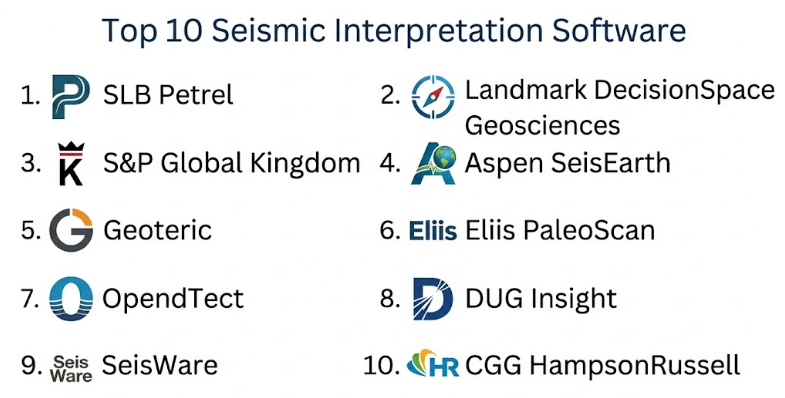
Top 10 Seismic Interpretation Software
#1 — SLB Petrel
Short description :
Petrel is one of the most widely recognized subsurface software platforms for seismic interpretation, geological modeling, and reservoir workflows.It is commonly used by large oil and gas companies, exploration teams, and integrated subsurface departments.The platform supports 2D and 3D interpretation, seismic visualization, well data integration, and model-building workflows.
Petrel is especially useful when teams need a shared environment for geophysicists, geologists, petrophysicists, and reservoir engineers.It is a strong option for enterprise users managing complex fields, multiple surveys, and multidisciplinary subsurface projects.
Key Features
- 2D and 3D seismic interpretation workflows
- Horizon and fault interpretation tools
- Seismic attribute generation and visualization
- Well-to-seismic integration and correlation
- Geological and reservoir modeling workflows
- Large seismic volume handling
- Multi-discipline subsurface project environment
Pros
- Strong enterprise adoption and broad subsurface workflow coverage
- Useful for teams that need seismic interpretation connected with geological modeling
- Mature ecosystem with training, services, and industry familiarity
Cons
- Can be expensive for smaller teams
- May require experienced users and structured onboarding
- Advanced workflows can feel complex for new interpreters
Platforms / Deployment
Windows / Linux: Varies by version and enterprise setup
Cloud / Self-hosted / Hybrid: Varies / N/A
Security & Compliance
Not publicly stated for all deployment models. Enterprise environments may support role-based access and controlled data management depending on configuration, but specific SOC 2, ISO 27001, GDPR, or HIPAA claims should be verified directly.
Integrations & Ecosystem
Petrel has a strong ecosystem because it is commonly used as part of larger subsurface and digital energy workflows. It fits well where interpretation must connect with well data, geological models, reservoir simulation, and field development planning.
- Well log and seismic data workflows
- Geological modeling integration
- Reservoir engineering workflows
- Data management platforms
- Partner and extension ecosystem
- Enterprise subsurface workflows
Support & Community
Support is generally enterprise-oriented, with vendor documentation, training, implementation services, and account-based support. Community strength is high in the professional geoscience industry, although access often depends on licensing and enterprise agreements.
#2 — Landmark DecisionSpace Geosciences
Short description :
DecisionSpace Geosciences is an enterprise geoscience platform used for seismic interpretation, geological analysis, and subsurface decision-making.It is designed for teams that need integrated exploration and development workflows across large asset portfolios.The software supports interpretation, visualization, structural analysis, and collaboration across geoscience teams.It is often considered by companies that already use broader Landmark or Halliburton digital subsurface solutions.
DecisionSpace is best suited for mid-market to enterprise energy organizations with mature geoscience operations.
Key Features
- 2D and 3D seismic interpretation
- Structural and stratigraphic interpretation workflows
- Horizon, fault, and attribute analysis
- Integrated geoscience data environment
- Well and seismic correlation
- Collaboration across asset teams
- Support for complex exploration workflows
Pros
- Strong fit for enterprise-scale exploration and development teams
- Good option for organizations using broader Landmark ecosystem tools
- Supports integrated geoscience workflows beyond simple interpretation
Cons
- May be too advanced for small teams or basic interpretation needs
- Licensing and implementation can require planning
- Learning curve may be high for new users
Platforms / Deployment
Windows / Linux: Varies / N/A
Cloud / Self-hosted / Hybrid: Varies / N/A
Security & Compliance
Not publicly stated. Security features and compliance controls should be verified based on deployment model, enterprise agreement, and data environment.
Integrations & Ecosystem
DecisionSpace fits into broader geoscience and reservoir workflows. It is useful where seismic interpretation must connect with asset-level decision-making, data management, and technical collaboration.
- Landmark ecosystem tools
- Well and seismic data workflows
- Geological interpretation workflows
- Reservoir and field development workflows
- Enterprise data management systems
- Subsurface collaboration environments
Support & Community
Support is typically enterprise-focused, with vendor services, technical documentation, onboarding, and professional support options. Community is strongest among enterprise geoscience users and Landmark ecosystem customers.
#3 — S&P Global Kingdom
Short description :
Kingdom is a well-known seismic interpretation and geoscience platform used by exploration teams, independents, consultants, and energy companies.It is often valued for practical interpretation workflows, mapping, well correlation, and project-based subsurface analysis.
Kingdom is suitable for teams that need a capable seismic interpretation tool without always requiring a very large integrated enterprise platform.It supports common interpretation tasks such as horizon picking, fault mapping, well ties, and seismic attribute review.It is a strong choice for small to mid-sized teams as well as enterprise groups that need focused interpretation workflows.
Key Features
- Seismic interpretation and mapping
- Horizon and fault interpretation
- Well data integration
- Attribute analysis and visualization
- Geological mapping workflows
- Project-based data management
- Practical subsurface evaluation tools
Pros
- Familiar and practical interface for many interpreters
- Good fit for independent operators and consulting teams
- Strong balance between capability and usability
Cons
- May not provide the same full enterprise ecosystem depth as larger platforms
- Advanced automation may depend on modules or workflows
- Deployment and pricing details vary by agreement
Platforms / Deployment
Windows: Commonly associated with desktop geoscience workflows
Cloud / Self-hosted / Hybrid: Varies / N/A
Security & Compliance
Not publicly stated. Buyers should verify access control, encryption, audit logging, and compliance details directly with the vendor.
Integrations & Ecosystem
Kingdom is commonly used in practical interpretation workflows where teams need to combine seismic, wells, mapping, and geological understanding. It is often part of a broader technical environment rather than the only system in use.
- Well log data workflows
- Seismic interpretation projects
- Mapping and contouring workflows
- Common geoscience data formats
- Export workflows for modeling tools
- Asset evaluation processes
Support & Community
Support is generally vendor-backed, with documentation, training resources, and professional services depending on license type. Community awareness is strong among geoscientists, consultants, and independent operators.
#4 — Aspen SeisEarth
Short description :
Aspen SeisEarth is an advanced seismic interpretation platform focused on modern interpretation, visualization, and AI-assisted workflows.It is designed for teams working with complex stratigraphy, structural interpretation, and large seismic datasets.The tool is suitable for energy companies that need faster interpretation cycles and stronger collaboration around seismic volumes.It can be useful where interpreters want advanced automation while still keeping expert control over geological decisions.
SeisEarth is best for enterprise and technical teams that require depth, performance, and scalable subsurface workflows.
Key Features
- Advanced seismic interpretation
- AI-assisted seismic analysis workflows
- Large seismic volume visualization
- Structural and stratigraphic interpretation
- Multi-user collaboration support
- Integration with broader AspenTech subsurface ecosystem
- Interpretation workflows for complex reservoirs
Pros
- Strong focus on advanced interpretation and productivity
- Useful for complex geology and large seismic datasets
- Fits teams already using AspenTech subsurface solutions
Cons
- May require skilled users and structured training
- Best value is likely in enterprise or specialist environments
- Pricing and deployment details may vary significantly
Platforms / Deployment
Windows / Linux: Varies / N/A
Cloud / Self-hosted / Hybrid: Varies / N/A
Security & Compliance
Not publicly stated. Enterprise security and compliance controls should be confirmed directly with the vendor.
Integrations & Ecosystem
SeisEarth is part of the AspenTech subsurface environment, making it suitable for organizations that want interpretation connected to broader geoscience and reservoir workflows.
- AspenTech subsurface ecosystem
- Seismic interpretation workflows
- Geological modeling workflows
- Reservoir characterization workflows
- Multi-user project environments
- Enterprise subsurface data workflows
Support & Community
Support is typically enterprise-focused, with vendor documentation, onboarding, and professional services. Community is more specialized compared with broader desktop tools, but strong in advanced technical environments.
#5 — Geoteric
Short description :
Geoteric is a specialist seismic interpretation platform known for seismic geomorphology, AI-assisted interpretation, and visual interpretation workflows.It is especially useful for teams that want to interpret complex seismic features faster and with more visual clarity.The software is often used for fault interpretation, stratigraphic analysis, geobody extraction, and understanding subtle geological patterns.
Geoteric is suitable for energy companies and specialist geoscience teams that need advanced seismic analysis beyond basic horizon picking.It works well as a specialist tool alongside larger subsurface platforms.
Key Features
- AI-assisted seismic interpretation
- Fault and horizon interpretation support
- Seismic geomorphology workflows
- Geobody and stratigraphic feature detection
- Advanced seismic attribute visualization
- Frequency and volume interpretation workflows
- Specialist interpretation productivity tools
Pros
- Strong for visual and AI-supported seismic interpretation
- Helpful for reducing manual interpretation effort
- Good specialist tool for complex geological features
Cons
- May not replace a full enterprise subsurface platform
- Best results require quality seismic data and expert review
- Specialist workflows may need training
Platforms / Deployment
Windows: Commonly used in technical workstation environments
Cloud / Self-hosted / Hybrid: Varies / N/A
Security & Compliance
Not publicly stated. Buyers should verify enterprise security features, user access controls, and compliance requirements directly.
Integrations & Ecosystem
Geoteric is often used alongside other interpretation and subsurface modeling platforms. It adds value where teams need specialist seismic insight, AI-supported interpretation, and advanced visualization.
- Seismic volume workflows
- Interpretation export workflows
- Integration with broader subsurface environments
- AI-assisted interpretation workflows
- Attribute and geobody analysis
- Specialist geoscience workflows
Support & Community
Support generally includes vendor documentation, technical support, training, and onboarding services. Community is strongest among specialist geophysicists, seismic interpreters, and advanced subsurface teams.
#6 — Eliis PaleoScan
Short description :
PaleoScan is a seismic interpretation software platform known for data-driven, model-based, and semi-automated interpretation workflows.It is especially useful for horizon interpretation, seismic stratigraphy, and building detailed geological understanding from seismic volumes.The tool helps interpreters work more efficiently by extracting geological patterns and relationships from seismic data.
PaleoScan is commonly considered by teams working on stratigraphic interpretation, sequence analysis, and reservoir characterization.It is a strong specialist option for teams that need speed, consistency, and geological detail in interpretation.
Key Features
- Semi-automated horizon interpretation
- Seismic stratigraphy workflows
- Geological model-based interpretation
- Fault and structural interpretation support
- Volume-based interpretation tools
- Attribute and facies-related workflows
- Reservoir characterization support
Pros
- Strong for stratigraphic and horizon-focused interpretation
- Can improve consistency across large seismic volumes
- Useful specialist tool for detailed geological understanding
Cons
- May not cover every enterprise geoscience workflow
- Requires skilled interpreters to validate outputs
- Deployment and pricing details are not always public
Platforms / Deployment
Windows / Linux: Varies / N/A
Cloud / Self-hosted / Hybrid: Varies / N/A
Security & Compliance
Not publicly stated. Security, authentication, encryption, and compliance details should be confirmed directly with the vendor.
Integrations & Ecosystem
PaleoScan works well in environments where seismic interpretation outputs need to support reservoir understanding, stratigraphic modeling, and field evaluation.
- Seismic interpretation workflows
- Horizon and stratigraphic analysis
- Export to modeling environments
- Attribute interpretation workflows
- Geological model workflows
- Specialist geoscience analysis
Support & Community
Support is typically vendor-led, with documentation, training, and technical support. Community is more specialized and strongest among geoscientists focused on stratigraphic interpretation.
#7 — OpendTect
Short description :
OpendTect is a seismic interpretation system widely recognized for its open-source base and strong use in research, education, and practical geoscience workflows.
It supports visualization, analysis, and interpretation of 2D, 3D, and 4D seismic data.The platform is useful for universities, consultants, smaller teams, and users who want flexibility without immediately committing to a large enterprise license.OpendTect also has commercial extensions and plugin-based capabilities for advanced workflows.It is a strong choice for learning, experimentation, and cost-aware seismic interpretation projects.
Key Features
- 2D, 3D, and 4D seismic interpretation
- Open-source base platform
- Attribute analysis tools
- Visualization and interpretation workflows
- Plugin and extension ecosystem
- Research and academic use cases
- Flexible seismic analysis environment
Pros
- Accessible option for learning, research, and smaller projects
- Flexible ecosystem with open-source foundation
- Useful for experimentation and non-enterprise workflows
Cons
- Enterprise support and advanced features may depend on commercial options
- May require technical knowledge for setup and extensions
- Not always the best fit for large enterprise standardization
Platforms / Deployment
Windows / Linux / macOS: Varies by version and setup
Self-hosted / Desktop: Common usage pattern
Cloud / Hybrid: Varies / N/A
Security & Compliance
Not publicly stated. Security controls depend heavily on deployment, user environment, and any commercial or enterprise configuration.
Integrations & Ecosystem
OpendTect has a flexible ecosystem because of its open-source foundation and plugin approach. It is useful for users who want to customize workflows or explore seismic interpretation methods.
- Seismic data visualization
- Attribute analysis plugins
- Research workflows
- Academic geoscience environments
- Custom extensions
- Common seismic data formats
Support & Community
Community strength is good for research and technical users. Vendor-backed support may be available depending on commercial offerings, while open-source users may rely more on documentation and community resources.
#8 — DUG Insight
Short description :
DUG Insight is a seismic interpretation and visualization platform designed for modern geoscience teams working with seismic data.It supports interactive interpretation, data visualization, processing-related workflows, and subsurface analysis.The platform is suitable for geoscientists who need a responsive environment for seismic review and interpretation.DUG Insight is often relevant for teams that value performance, visualization, and integrated seismic workflows.
It can be a practical option for technical teams working across exploration, development, and research-style interpretation projects.
Key Features
- Seismic interpretation and visualization
- Interactive seismic data analysis
- Processing and interpretation support
- Large-volume seismic review workflows
- Subsurface structure interpretation
- Integrated geoscience workflow support
- Modern user experience for interpreters
Pros
- Strong focus on visualization and interactivity
- Useful for technical seismic teams
- Can support both interpretation and analysis workflows
Cons
- May not be as broadly standardized as larger enterprise platforms
- Advanced enterprise capabilities should be verified
- Public security and compliance details are limited
Platforms / Deployment
Windows / Linux: Varies / N/A
Cloud / Self-hosted / Hybrid: Varies / N/A
Security & Compliance
Not publicly stated. Buyers should verify authentication, encryption, audit logging, RBAC, and compliance details directly.
Integrations & Ecosystem
DUG Insight fits technical geoscience workflows where seismic visualization, interpretation, and analysis need to happen in one environment.
- Seismic visualization workflows
- Interpretation workflows
- Processing-related data workflows
- Subsurface analysis
- Data export and review workflows
- Technical geoscience environments
Support & Community
Support is vendor-led and may include documentation, technical onboarding, and professional services. Community strength is more specialized compared with broad enterprise platforms.
#9 — SeisWare
Short description :
SeisWare is a seismic interpretation platform used by exploration and production teams for practical interpretation, mapping, and subsurface evaluation.It is often considered by independent operators, consultants, and teams that need strong geoscience functionality without unnecessary complexity.
The software supports seismic interpretation, well data workflows, mapping, and geological analysis.
SeisWare is useful for teams that want a practical, project-focused interpretation environment.
It is a good fit for users who value usability, workflow speed, and focused subsurface decision-making.
Key Features
- Seismic interpretation workflows
- Well and seismic integration
- Mapping and geological analysis
- Horizon and fault interpretation
- Attribute review and visualization
- Project-based subsurface workflows
- Exploration and development support
Pros
- Practical for independent operators and consulting teams
- Good balance of interpretation capability and usability
- Useful for focused subsurface projects
Cons
- May not provide the same enterprise ecosystem depth as larger platforms
- Advanced AI features may be limited or vary by version
- Security and compliance details are not broadly public
Platforms / Deployment
Windows: Commonly associated with desktop geoscience workflows
Cloud / Self-hosted / Hybrid: Varies / N/A
Security & Compliance
Not publicly stated. Buyers should confirm access control, encryption, audit features, and compliance requirements directly.
Integrations & Ecosystem
SeisWare supports practical geoscience workflows where seismic, wells, and maps need to be interpreted together for exploration or development decisions.
- Well data workflows
- Seismic interpretation projects
- Mapping workflows
- Attribute review
- Data import and export workflows
- Asset evaluation workflows
Support & Community
Support is generally vendor-led, with documentation, onboarding, and technical help depending on licensing. Community is strongest among practical interpretation teams and independent operators.
#10 — CGG HampsonRussell
Short description :
HampsonRussell is a recognized geoscience software suite often associated with seismic reservoir characterization, AVO analysis, inversion, and quantitative interpretation.
While it is not only a general seismic interpretation tool, it plays an important role in advanced seismic analysis workflows.It is especially useful for teams that need to connect seismic interpretation with rock physics, inversion, and reservoir property prediction.HampsonRussell is best suited for geophysicists, reservoir characterization specialists, and technical interpretation teams.It works well as a specialist tool alongside broader seismic interpretation platforms.
Key Features
- Seismic inversion workflows
- AVO analysis
- Reservoir characterization
- Rock physics integration
- Quantitative interpretation
- Attribute and seismic analysis
- Support for advanced geophysical workflows
Pros
- Strong specialist capability for quantitative interpretation
- Useful for reservoir characterization and inversion studies
- Good fit for technical geophysics teams
Cons
- Not a complete replacement for broad interpretation platforms
- Requires geophysical expertise
- May be too specialized for basic interpretation users
Platforms / Deployment
Windows / Linux: Varies / N/A
Cloud / Self-hosted / Hybrid: Varies / N/A
Security & Compliance
Not publicly stated. Security and compliance details should be confirmed directly with the vendor.
Integrations & Ecosystem
HampsonRussell is commonly used as part of advanced seismic analysis and reservoir characterization workflows. It is often paired with broader interpretation and modeling environments.
- Seismic inversion workflows
- AVO and rock physics workflows
- Reservoir characterization studies
- Attribute analysis
- Integration with interpretation outputs
- Specialist geophysics workflows
Support & Community
Support is vendor-led and often aimed at technical users. Community strength is strong among geophysicists and reservoir characterization specialists, but less broad than general interpretation platforms.
Comparison Table
| Tool Name | Best For | Platform(s) Supported | Deployment | Standout Feature | Public Rating |
|---|---|---|---|---|---|
| SLB Petrel | Enterprise subsurface teams | Windows / Linux varies | Varies / Hybrid | Integrated seismic, geology, and reservoir workflows | N/A |
| Landmark DecisionSpace Geosciences | Large exploration and development teams | Varies / N/A | Varies / Hybrid | Enterprise geoscience collaboration | N/A |
| S&P Global Kingdom | Independent operators and practical interpreters | Windows commonly used | Varies / N/A | Practical seismic interpretation and mapping | N/A |
| Aspen SeisEarth | Advanced enterprise interpretation teams | Varies / N/A | Varies / Hybrid | Advanced AI-assisted seismic interpretation | N/A |
| Geoteric | Specialist seismic geomorphology teams | Windows commonly used | Varies / N/A | AI-assisted visual seismic interpretation | N/A |
| Eliis PaleoScan | Stratigraphic and horizon interpretation | Varies / N/A | Varies / N/A | Semi-automated geological interpretation | N/A |
| OpendTect | Research, education, and cost-aware teams | Windows / Linux / macOS varies | Desktop / Self-hosted | Open-source seismic interpretation foundation | N/A |
| DUG Insight | Interactive seismic visualization teams | Varies / N/A | Varies / N/A | Modern seismic interpretation and visualization | N/A |
| SeisWare | SMBs, consultants, and independent operators | Windows commonly used | Varies / N/A | Practical project-based interpretation | N/A |
| CGG HampsonRussell | Quantitative interpretation specialists | Varies / N/A | Varies / N/A | Seismic inversion and reservoir characterization | N/A |
Evaluation & Seismic Interpretation Software
The scoring below is comparative and based on category fit, known workflow strength, ecosystem maturity, usability, and practical buyer value. It is not a universal ranking for every organization. A lower score does not mean a tool is weak; it may simply be more specialized, less public in security details, or better suited to a narrower workflow.
| Tool Name | Core (25%) | Ease (15%) | Integrations (15%) | Security (10%) | Performance (10%) | Support (10%) | Value (15%) | Weighted Total (0–10) |
|---|---|---|---|---|---|---|---|---|
| SLB Petrel | 10 | 7 | 9 | 7 | 9 | 9 | 7 | 8.45 |
| Landmark DecisionSpace Geosciences | 9 | 7 | 9 | 7 | 8 | 8 | 7 | 8.05 |
| S&P Global Kingdom | 8 | 8 | 8 | 6 | 8 | 8 | 8 | 7.75 |
| Aspen SeisEarth | 9 | 7 | 8 | 6 | 9 | 8 | 7 | 7.85 |
| Geoteric | 8 | 8 | 7 | 6 | 8 | 8 | 7 | 7.45 |
| Eliis PaleoScan | 8 | 7 | 7 | 6 | 8 | 7 | 7 | 7.20 |
| OpendTect | 7 | 7 | 7 | 5 | 7 | 7 | 9 | 7.10 |
| DUG Insight | 7 | 8 | 7 | 5 | 8 | 7 | 7 | 7.05 |
| SeisWare | 7 | 8 | 7 | 5 | 7 | 7 | 8 | 7.05 |
| CGG HampsonRussell | 8 | 6 | 7 | 5 | 8 | 7 | 7 | 7.05 |
Use these scores as a starting point, not a final buying decision. Enterprise buyers should give more weight to integration, support, security, and performance. Smaller teams may care more about usability, licensing flexibility, and time-to-value. Specialist teams should focus on workflow depth rather than the highest overall score.
Which Seismic Interpretation Software
Solo / Freelancer
Solo consultants and freelance geoscientists usually need practical tools that are usable, cost-aware, and not overly heavy. OpendTect, SeisWare, and Kingdom are strong options to consider, depending on licensing, project type, and client expectations.
For advanced inversion or quantitative work, HampsonRussell can be valuable, but it may be too specialized if the work is mostly horizon picking and mapping.
SMB
Small and mid-sized exploration companies often need a balance between capability and budget. Kingdom, SeisWare, OpendTect, and Geoteric can be practical choices.
If the company needs strong visual interpretation or AI-assisted seismic analysis, Geoteric may be worth evaluating. If the team needs general interpretation, mapping, and well integration, Kingdom or SeisWare may be easier to adopt.
Mid-Market
Mid-market energy companies usually need broader workflows, stronger governance, and better team collaboration. Petrel, DecisionSpace Geosciences, Kingdom, Geoteric, and PaleoScan are all relevant depending on the team’s workflow.
A common approach is to use one core platform for interpretation and modeling, then add specialist tools for stratigraphy, AI-assisted interpretation, or quantitative analysis.
Enterprise
Enterprise teams should prioritize scalability, security, support, integration, and standardization. Petrel, DecisionSpace Geosciences, and Aspen SeisEarth are strong enterprise candidates.
Large organizations may also use Geoteric, PaleoScan, or HampsonRussell as specialist tools alongside a primary enterprise interpretation platform.
Budget vs Premium
For budget-aware teams, OpendTect is often attractive because of its open-source foundation. SeisWare and Kingdom may also be practical depending on commercial terms.
Premium buyers should evaluate Petrel, DecisionSpace Geosciences, and Aspen SeisEarth because they offer broader enterprise workflows, mature ecosystems, and stronger fit for large subsurface teams.
Feature Depth vs Ease of Use
For feature depth, Petrel, DecisionSpace Geosciences, Aspen SeisEarth, and HampsonRussell stand out. These tools are powerful but may require experienced users.
For easier practical workflows, Kingdom, SeisWare, and OpendTect may feel more approachable depending on the user’s background.
Integrations & Scalability
If integration with geology, reservoir modeling, well data, and enterprise data systems is critical, shortlist Petrel, DecisionSpace Geosciences, and Aspen SeisEarth.
If the goal is to extend a workflow with specialist interpretation, consider Geoteric, PaleoScan, or HampsonRussell as complementary tools.
Security & Compliance Needs
Security-sensitive organizations should not rely only on marketing pages. Ask vendors directly about:
- SSO and SAML
- MFA
- Role-based access control
- Audit logs
- Encryption at rest and in transit
- Data residency
- Private cloud or on-premise deployment
- Backup and disaster recovery
- Compliance documentation
For highly sensitive seismic assets, enterprise platforms with controlled deployment options may be better than lightweight tools.
Frequently Asked Questions
1. What is Seismic Interpretation Software?
Seismic Interpretation Software helps geoscientists analyze seismic survey data to understand underground structures. It is used to identify faults, horizons, reservoirs, stratigraphic features, and drilling risks.
2. How much does Seismic Interpretation Software cost?
Pricing is usually not publicly simple because many tools use enterprise licensing, modules, user seats, support plans, or custom contracts. Smaller teams should ask for module-level pricing and avoid paying for features they will not use.
3. Is cloud deployment common for seismic interpretation?
Cloud and hybrid workflows are growing, but many teams still use desktop or private infrastructure because seismic files are large and sensitive. The right model depends on data size, security rules, collaboration needs, and IT maturity.
4. What are the most important features to evaluate?
Key features include 2D and 3D interpretation, horizon picking, fault mapping, attribute analysis, well integration, visualization performance, data format support, collaboration, and export workflows.
5. Can AI replace seismic interpreters?
No, AI should be treated as an assistant, not a replacement. It can speed up repetitive tasks like fault detection or horizon tracking, but expert geological judgment is still needed to validate results.
6. What are common mistakes buyers make?
Common mistakes include buying a tool without testing real project data, ignoring training needs, underestimating hardware requirements, and choosing a platform that does not fit existing data workflows.
7. How long does implementation usually take?
Implementation varies widely. A small team may start quickly with a focused desktop workflow, while an enterprise rollout may require data migration, templates, security review, user training, and governance planning.
8. Which tool is best for small teams?
Small teams may prefer OpendTect, SeisWare, or Kingdom depending on budget, workflow needs, and licensing availability. The best choice depends on whether the team needs basic interpretation, mapping, or advanced specialist workflows.
9. Which tool is best for enterprise teams?
Enterprise teams often evaluate Petrel, DecisionSpace Geosciences, and Aspen SeisEarth because they support broader subsurface workflows. Specialist tools like Geoteric, PaleoScan, and HampsonRussell may be added for deeper analysis.
10. How important are integrations?
Integrations are very important because seismic interpretation rarely happens in isolation. Teams often need to connect seismic interpretation with well data, geological modeling, reservoir simulation, GIS, data management, and reporting workflows.
11. What security features should buyers ask about?
Buyers should ask about SSO, SAML, MFA, RBAC, encryption, audit logs, data residency, backup, disaster recovery, and compliance documentation. If these details are not public, request them during vendor evaluation.
12. Can teams switch from one seismic interpretation tool to another?
Yes, but switching can be difficult if projects contain many interpretation objects, custom workflows, naming standards, and proprietary formats. Teams should test data export, import, and validation before committing to migration.
Conclusion
Choosing the best Seismic Interpretation Software depends on the size of your team, the complexity of your seismic data, your budget, and the type of decisions you need to make. Large enterprises often need integrated platforms such as Petrel, DecisionSpace Geosciences, or Aspen SeisEarth because they support broader subsurface workflows and team collaboration. Smaller teams may prefer Kingdom, SeisWare, or OpendTect for practical interpretation and cost control. Specialist teams may get more value from Geoteric, PaleoScan, DUG Insight, or HampsonRussell when the focus is AI-assisted interpretation, stratigraphy, visualization, inversion, or reservoir characterization.
