Introduction
Social Commerce Platforms help businesses sell products directly through social media, creator content, live shopping, messaging apps, shoppable posts, influencer campaigns, and community-driven product discovery. In simple words, these platforms connect social engagement with online shopping, so customers can discover, evaluate, and buy products where they already spend time.
Social commerce matters because customers no longer move in a straight line from search to website to checkout. Many buyers discover products through short videos, creator recommendations, livestreams, social posts, comments, reviews, groups, and direct messages. A good social commerce platform helps brands create shoppable content, manage product catalogs, track sales, work with creators, run live selling campaigns, and connect social activity with ecommerce results.
Real-world use cases include:
- Selling products through shoppable posts and videos
- Running live shopping events with hosts or creators
- Turning influencer content into sales campaigns
- Managing product catalogs across social channels
- Selling through messaging and chat-based journeys
- Tracking social-driven revenue and conversions
- Building creator storefronts or affiliate product pages
- Promoting limited product drops through social audiences
Buyers should evaluate:
- Supported social selling channels
- Product catalog management
- Shoppable post and video support
- Live commerce features
- Creator and influencer collaboration tools
- Checkout and payment workflow
- Ecommerce platform integrations
- Analytics and attribution reporting
- Inventory and order sync
- Messaging and customer engagement tools
- Content moderation and brand safety controls
- Pricing, fees, scalability, and support quality
Best for: ecommerce brands, DTC companies, fashion brands, beauty brands, lifestyle businesses, creators, influencers, small retailers, marketplaces, subscription brands, and businesses that depend on social discovery and community-driven sales.
Not ideal for: businesses with no social audience, weak product visuals, poor fulfillment operations, or complex B2B buying journeys that require long sales cycles. Social commerce works best when the product is easy to understand, visually appealing, and simple to buy.
Key Trends in Social Commerce Platforms
- Shoppable video is becoming a major growth channel: Short-form videos, product demos, creator reviews, and tutorials are increasingly connected with direct purchase options.
- Live shopping is expanding: Brands are using livestreams for product launches, limited drops, demonstrations, Q&A, and influencer-led selling.
- Creator-led commerce is growing: Influencers and creators are becoming sales partners through affiliate links, storefronts, product tagging, and performance-based campaigns.
- Social proof drives purchase decisions: Reviews, comments, user-generated content, creator trust, and community recommendations influence buying behavior.
- Messaging-based commerce is becoming common: Customers increasingly ask product questions, receive recommendations, and complete purchases through chat or messaging tools.
- Product catalog synchronization matters: Brands need accurate inventory, pricing, variants, and product details across social channels and ecommerce stores.
- Attribution is becoming harder but more important: Buyers may see a product on social, search later, use a coupon, or buy from another device, so brands need better tracking models.
- User-generated content is becoming a sales asset: Customer photos, creator videos, testimonials, and community posts are being reused as shoppable content.
- Mobile-first checkout is critical: Social commerce customers expect fast, simple, mobile-friendly buying experiences with minimal friction.
- Brand safety and trust are important: Businesses must manage fake reviews, misleading creator claims, counterfeit sellers, comment spam, and customer privacy risks.
How We Selected These Tools Methodology
The tools below were selected based on social commerce relevance, market recognition, selling capabilities, ecommerce integrations, creator support, analytics, and practical fit for different business models.
- Social selling capability: Tools were reviewed for shoppable posts, product tagging, creator selling, live commerce, and social storefronts.
- Ecommerce integration: Shopify, WooCommerce, BigCommerce, marketplace, product catalog, inventory, and order sync were considered.
- Creator and influencer fit: Platforms that support creators, affiliates, product seeding, UGC, or influencer-led sales were valued.
- Live commerce support: Livestream shopping, host tools, event campaigns, and real-time engagement features were considered.
- Customer journey support: Discovery, engagement, checkout, messaging, retargeting, and post-purchase flows were reviewed.
- Analytics quality: Revenue attribution, campaign reporting, creator performance, content performance, and conversion metrics were evaluated.
- Ease of use: Store setup, catalog sync, content publishing, campaign creation, and dashboard clarity were considered.
- Scalability: Tools for small sellers, creator brands, growing ecommerce companies, and enterprise brands were included.
- Security and compliance expectations: Payment handling, customer data, permissions, and brand safety controls were considered.
- Practical buyer fit: The goal is not one universal winner, but a useful comparison based on social selling strategy.
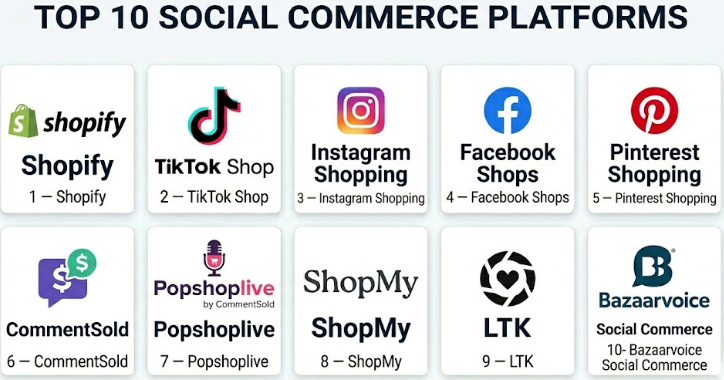
Top 10 Social Commerce Platforms
#1 — Shopify
Short description :
Shopify is a leading ecommerce platform that supports social commerce through integrations with social selling channels, product catalogs, creator tools, shopping feeds, and marketing apps. It helps brands manage products, inventory, checkout, payments, orders, and customer data from one ecommerce backend while selling across multiple social channels. Shopify is especially useful for DTC brands and small businesses that want social commerce connected to a serious online store. It can support shoppable posts, social ads, creator campaigns, and product feeds depending on setup. Shopify is a strong choice for brands that want owned ecommerce plus social selling.
Key Features
- Ecommerce storefront and checkout
- Product catalog and inventory management
- Social channel integrations
- App ecosystem for social commerce and UGC
- Order and customer management
- Discount codes and promotions
- Analytics and sales reporting
Pros
- Strong ecommerce foundation for social selling
- Large integration and app ecosystem
- Scales from small stores to larger brands
Cons
- Requires setup and app selection
- Social commerce features depend on integrations
- App costs and transaction costs can add up
Platforms / Deployment
Web / iOS / Android
Cloud deployment
Security & Compliance
Shopify handles customer data, payments, orders, storefront access, and merchant operations. Specific certifications such as SOC 2, ISO 27001, PCI, GDPR, or other compliance details should be verified directly.
Not publicly stated here for every merchant setup.
Integrations & Ecosystem
Shopify works well as a central ecommerce system for social commerce operations.
- Social selling channels
- Product feed tools
- Creator and affiliate apps
- Email and SMS marketing tools
- Analytics platforms
- Fulfillment and shipping systems
Support & Community
Shopify has a large merchant ecosystem, broad documentation, and strong third-party app support. It is best for brands that want long-term ecommerce control with social channel expansion.
#2 — TikTok Shop
Short description :
TikTok Shop is a social commerce platform that allows brands, sellers, and creators to sell products through short-form video, livestreams, product showcases, and creator-led recommendations. It is especially useful for visually engaging products that perform well in video-driven discovery. TikTok Shop helps shorten the path from content discovery to purchase because users can discover products inside the social experience. It is highly relevant for beauty, fashion, gadgets, lifestyle, home, fitness, and creator-led products. TikTok Shop is a strong option for brands that understand content-driven selling.
Key Features
- Shoppable short-form video
- Livestream shopping
- Product showcase pages
- Creator affiliate selling options
- In-app shopping experience
- Seller dashboard and product management
- Campaign and performance reporting
Pros
- Strong discovery engine for viral products
- Good fit for creator-led commerce
- Useful for live shopping and product demos
Cons
- Success depends heavily on content quality
- Platform policies and eligibility rules matter
- Not ideal for products requiring long sales consultation
Platforms / Deployment
Web / iOS / Android
Cloud deployment
Security & Compliance
TikTok Shop handles seller data, product details, customer transactions, creator performance data, and platform policy workflows. Specific certifications and compliance details should be verified directly.
Not publicly stated here for every seller use case.
Integrations & Ecosystem
TikTok Shop fits video-first product discovery and creator commerce workflows.
- Product showcases
- Creator affiliate programs
- Livestream shopping
- Social content campaigns
- Ecommerce integrations
- Seller analytics
Support & Community
Support depends on seller region, eligibility, and marketplace operations. It is best for brands that can produce engaging short-form and live commerce content.
#3 — Instagram Shopping
Short description :
Instagram Shopping helps brands and creators showcase products through product tags, shoppable posts, stories, reels, and storefront-style product discovery. It is especially useful for visual brands in fashion, beauty, home decor, lifestyle, fitness, art, accessories, and creator merchandise. Instagram Shopping works well when a brand already has an engaged audience and strong visual content. It helps users move from inspiration to product discovery more easily. Instagram Shopping is a strong option for brands that rely on visual storytelling and creator partnerships.
Key Features
- Product tags in posts and reels
- Shoppable content experiences
- Product catalog connection
- Brand storefront-style product discovery
- Creator collaboration support depending on setup
- Social engagement and product discovery
- Analytics through connected business tools
Pros
- Strong for visual product discovery
- Good fit for lifestyle and creator-led brands
- Works naturally with content and community engagement
Cons
- Requires strong visual content and audience engagement
- Checkout and catalog features vary by region and setup
- Attribution may require additional analytics tools
Platforms / Deployment
Web / iOS / Android
Cloud deployment
Security & Compliance
Instagram Shopping may process product catalog data, customer engagement signals, business account data, and commerce activity. Specific certifications and compliance details should be verified directly.
Not publicly stated here for every seller setup.
Integrations & Ecosystem
Instagram Shopping fits brands using social storytelling and visual product discovery.
- Product catalogs
- Ecommerce platforms
- Creator collaboration workflows
- Reels and story-based selling
- Social ads
- Analytics and business tools
Support & Community
Support depends on business account eligibility and commerce setup. It is best for brands with strong visuals and an active social audience.
#4 — Facebook Shops
Short description :
Facebook Shops helps businesses create a social storefront across Facebook and connected commerce experiences. It allows brands to display products, connect catalogs, promote items, and support discovery through social engagement, pages, ads, and messaging. Facebook Shops is especially useful for small businesses, local sellers, ecommerce brands, and social-first retailers with existing Facebook audiences. It can work well when paired with ads, groups, messenger communication, and product catalogs. Facebook Shops is a practical option for businesses that want social selling inside a familiar social ecosystem.
Key Features
- Social storefront setup
- Product catalog management
- Product discovery through pages and posts
- Messaging and customer interaction support
- Social ad integration
- Ecommerce platform connections
- Business reporting tools
Pros
- Useful for businesses with Facebook audiences
- Good catalog and social ad connection
- Works with messaging-based commerce
Cons
- Younger audiences may be stronger on other platforms
- Setup and feature availability vary by region
- Catalog and policy compliance can require maintenance
Platforms / Deployment
Web / iOS / Android
Cloud deployment
Security & Compliance
Facebook Shops handles product catalog data, business account information, customer interactions, and commerce-related activity. Specific certifications and compliance details should be verified directly.
Not publicly stated here for every seller use case.
Integrations & Ecosystem
Facebook Shops fits brands using social ads, pages, groups, and messaging.
- Product catalogs
- Ecommerce integrations
- Messenger workflows
- Social advertising
- Business pages
- Analytics and reporting
Support & Community
Support depends on business tools and commerce eligibility. It is best for businesses with existing Facebook communities or paid social campaigns.
#5 — Pinterest Shopping
Short description :
Pinterest Shopping helps brands turn visual inspiration into product discovery and purchase intent. It is useful for ecommerce businesses selling home decor, fashion, beauty, crafts, wedding products, DIY items, food, lifestyle products, and design-led goods. Pinterest users often search with purchase planning in mind, which makes the platform valuable for product discovery. Brands can use product catalogs, shopping pins, visual search, and paid campaigns to reach intent-driven audiences. Pinterest Shopping is a strong option for brands that sell visually searchable products with long consideration journeys.
Key Features
- Product catalog connection
- Shopping pins and product discovery
- Visual search and inspiration-led shopping
- Paid shopping campaign support
- Product feed management
- Analytics and performance reporting
- Ecommerce integration options
Pros
- Strong for visual discovery and purchase planning
- Good fit for home, fashion, beauty, and lifestyle products
- Content can have longer shelf life than fast-moving social posts
Cons
- Not ideal for every product category
- Results may take time to build
- Product feed quality is important
Platforms / Deployment
Web / iOS / Android
Cloud deployment
Security & Compliance
Pinterest Shopping handles product catalog data, business account data, audience engagement signals, and campaign performance information. Specific certifications and compliance details should be verified directly.
Not publicly stated here for every seller setup.
Integrations & Ecosystem
Pinterest Shopping fits visual ecommerce and inspiration-led buying journeys.
- Product catalogs
- Ecommerce platforms
- Shopping ads
- Product pins
- Visual discovery workflows
- Analytics and campaign reporting
Support & Community
Pinterest provides business resources and shopping campaign tools. It is best for brands with visually appealing products and search-friendly content.
#6 — CommentSold
Short description :
CommentSold is a social commerce and live selling platform designed for retailers, boutiques, brands, and sellers that use livestreams, social comments, and mobile shopping to drive sales. It helps businesses manage live shopping events, social selling, product claims, invoices, mobile apps, and ecommerce operations. CommentSold is especially useful for fashion boutiques, lifestyle sellers, and community-driven retail brands. It supports interactive selling where customers can claim items during live sessions or social posts. CommentSold is a strong option for sellers that want live commerce and community-based shopping workflows.
Key Features
- Live selling tools
- Comment-based product claiming
- Mobile shopping app support
- Inventory and order management
- Social selling workflows
- Customer notifications
- Sales and performance reporting
Pros
- Strong for live selling and boutique commerce
- Useful for community-driven shopping
- Helps convert social engagement into orders
Cons
- Best fit is retail and product-based selling
- Requires active live selling strategy
- May not fit brands that do not want live commerce
Platforms / Deployment
Web / mobile app availability
Cloud deployment
Security & Compliance
CommentSold handles customer orders, product data, payment workflows, live selling records, and customer communication. Specific certifications and compliance details should be verified directly.
Not publicly stated.
Integrations & Ecosystem
CommentSold fits social sellers that depend on live and interactive buying.
- Live shopping events
- Social selling channels
- Mobile commerce apps
- Inventory systems
- Customer messaging
- Order fulfillment workflows
Support & Community
CommentSold provides support for sellers running live commerce and social selling programs. It is best for retailers with active community engagement.
#7 — CommentSold Popshoplive
Short description :
Popshoplive is a live shopping platform focused on interactive livestream commerce for creators, brands, sellers, and communities. It helps hosts showcase products, engage viewers, and sell items during live video experiences. It is especially useful for collectibles, fashion, lifestyle products, beauty, handmade goods, and creator-led product drops. Popshoplive supports the idea that shopping can be social, entertaining, and community-led. It is a good choice for sellers that want livestream engagement and product storytelling in one experience.
Key Features
- Livestream shopping
- Real-time audience engagement
- Product showcase during live events
- Creator and seller storefronts
- Interactive buying experience
- Community-driven selling
- Sales and order workflows
Pros
- Strong for live, personality-led selling
- Good for product drops and community shopping
- Useful for creators and niche sellers
Cons
- Requires live hosting skills
- Not ideal for passive catalog-only selling
- Audience building is still the seller’s responsibility
Platforms / Deployment
Web / mobile app availability
Cloud deployment
Security & Compliance
Live shopping platforms handle customer data, product orders, payment-related workflows, seller accounts, and live content. Specific compliance details should be verified directly.
Not publicly stated.
Integrations & Ecosystem
Popshoplive fits creator-led and live event commerce.
- Livestream product shows
- Creator storefronts
- Product drops
- Real-time chat engagement
- Community selling
- Order and checkout workflows
Support & Community
Support depends on seller program and platform participation. It is best for sellers comfortable with live presentation and community engagement.
#8 — ShopMy
Short description :
ShopMy is a creator commerce and affiliate-style platform that helps influencers, stylists, creators, and experts share recommended products through curated shops and links. It is especially useful for fashion, beauty, lifestyle, home, wellness, and creator recommendation businesses. Brands can work with creators, track product recommendations, and drive commerce through trusted voices. ShopMy is more creator-curation focused than traditional ecommerce storefront software. It is a strong option for brands and creators that want social commerce built around recommendations and affiliate-style product discovery.
Key Features
- Creator storefronts and curated product pages
- Affiliate-style product recommendations
- Brand and creator collaboration workflows
- Product link tracking
- Performance reporting
- Creator discovery and relationship support depending on setup
- Social content commerce workflows
Pros
- Strong for creator-led product recommendations
- Good fit for fashion, beauty, and lifestyle categories
- Useful for affiliate-style social commerce
Cons
- Not a full ecommerce backend replacement
- Best results require trusted creators and strong content
- Product coverage and brand relationships should be validated
Platforms / Deployment
Web
Cloud deployment
Security & Compliance
ShopMy handles creator data, product recommendation data, tracking activity, and commerce performance information. Specific certifications and compliance details should be verified directly.
Not publicly stated.
Integrations & Ecosystem
ShopMy fits creator commerce and recommendation-led selling.
- Creator shops
- Affiliate product links
- Brand partnerships
- Social content workflows
- Product discovery
- Sales performance reporting
Support & Community
ShopMy is useful for creators and brands focused on recommendation-driven commerce. It is best where trusted creators influence purchase decisions.
#9 — LTK
Short description :
LTK is a creator commerce platform that helps influencers and creators monetize product recommendations through shoppable content and affiliate-style links. It is widely associated with fashion, beauty, home, lifestyle, family, and creator-led shopping recommendations. Creators can share product picks, build shoppable content, and earn commissions where eligible. Brands can work with creators to drive product discovery and measurable commerce. LTK is a strong option for brands and influencers focused on lifestyle-driven social commerce.
Key Features
- Creator-driven shoppable content
- Affiliate-style product recommendations
- Creator storefront and product collections
- Brand collaboration opportunities
- Performance tracking
- Mobile shopping experience
- Lifestyle commerce discovery
Pros
- Strong creator commerce ecosystem
- Good fit for fashion, beauty, home, and lifestyle
- Useful for trusted product recommendations
Cons
- Not a full ecommerce store replacement
- Creator eligibility and brand access may vary
- Best results depend on creator trust and content quality
Platforms / Deployment
Web / mobile app availability
Cloud deployment
Security & Compliance
LTK handles creator data, brand campaign data, product recommendation activity, and commerce tracking. Specific security and compliance details should be verified directly.
Not publicly stated.
Integrations & Ecosystem
LTK works well for influencer-led product discovery and affiliate commerce.
- Creator storefronts
- Shoppable posts
- Affiliate recommendations
- Brand collaborations
- Product collections
- Performance reporting
Support & Community
LTK has strong recognition in influencer commerce. It is best for creators and brands in lifestyle categories where recommendations drive sales.
#10 — Bazaarvoice Social Commerce
Short description :
Bazaarvoice Social Commerce helps brands collect, manage, and use user-generated content, reviews, ratings, visual content, and social proof to improve product discovery and conversion. It is especially useful for ecommerce brands that want to turn customer content and social proof into shoppable experiences. While it is not a pure social storefront platform, it supports social commerce by helping brands activate authentic customer and creator content across shopping journeys. Bazaarvoice is strong for brands that care about reviews, UGC, product trust, and conversion optimization. It is a good choice for larger ecommerce businesses needing social proof at scale.
Key Features
- User-generated content collection
- Ratings and reviews workflows
- Visual content management
- Social proof activation
- Product page content support
- Content moderation workflows
- Ecommerce conversion reporting
Pros
- Strong for UGC and review-driven commerce
- Useful for product trust and conversion
- Good fit for established ecommerce brands
Cons
- Not a simple creator storefront platform
- May be too advanced for small sellers
- Best value depends on content volume and ecommerce scale
Platforms / Deployment
Web
Cloud deployment
Security & Compliance
Bazaarvoice handles customer content, reviews, media, moderation data, brand account data, and ecommerce-related content workflows. Specific certifications and compliance details should be verified directly.
Not publicly stated.
Integrations & Ecosystem
Bazaarvoice fits social proof and UGC-driven commerce workflows.
- Ecommerce product pages
- Review platforms
- UGC collection
- Visual content galleries
- Moderation systems
- Analytics and conversion reporting
Support & Community
Bazaarvoice provides business and enterprise-focused support resources. It is best for brands that need to manage customer content, reviews, and UGC at scale.
Comparison Table Top 10
| Tool Name | Best For | Platform(s) Supported | Deployment | Standout Feature | Public Rating |
|---|---|---|---|---|---|
| Shopify | Social commerce connected to owned ecommerce | Web, iOS, Android | Cloud | Ecommerce backend with social integrations | N/A |
| TikTok Shop | Video-first product discovery and live selling | Web, iOS, Android | Cloud | Shoppable short videos and creator selling | N/A |
| Instagram Shopping | Visual product discovery and shoppable content | Web, iOS, Android | Cloud | Product tags in social content | N/A |
| Facebook Shops | Social storefronts and messaging commerce | Web, iOS, Android | Cloud | Catalog-based selling inside social ecosystem | N/A |
| Pinterest Shopping | Inspiration-led product discovery | Web, iOS, Android | Cloud | Shopping pins and visual discovery | N/A |
| CommentSold | Live selling and boutique social commerce | Web, mobile app availability | Cloud | Comment-based and live shopping workflows | N/A |
| Popshoplive | Creator-led livestream commerce | Web, mobile app availability | Cloud | Interactive live shopping events | N/A |
| ShopMy | Creator recommendations and curated shops | Web | Cloud | Creator-led product curation | N/A |
| LTK | Influencer-driven lifestyle shopping | Web, mobile app availability | Cloud | Shoppable creator recommendations | N/A |
| Bazaarvoice Social Commerce | UGC and review-driven social proof | Web | Cloud | Customer content and review activation | N/A |
Evaluation & Social Commerce Platforms
| Tool Name | Core 25% | Ease 15% | Integrations 15% | Security 10% | Performance 10% | Support 10% | Value 15% | Weighted Total 0–10 |
|---|---|---|---|---|---|---|---|---|
| Shopify | 9.2 | 8.2 | 9.3 | 8.8 | 8.8 | 8.5 | 8.2 | 8.73 |
| TikTok Shop | 8.8 | 8.0 | 8.2 | 8.2 | 8.8 | 8.0 | 8.5 | 8.44 |
| Instagram Shopping | 8.4 | 8.5 | 8.3 | 8.2 | 8.5 | 8.0 | 8.4 | 8.34 |
| Facebook Shops | 8.3 | 8.3 | 8.4 | 8.2 | 8.4 | 8.0 | 8.3 | 8.31 |
| Pinterest Shopping | 8.2 | 8.2 | 8.3 | 8.0 | 8.3 | 8.0 | 8.4 | 8.24 |
| CommentSold | 8.5 | 8.0 | 8.0 | 8.0 | 8.4 | 8.2 | 8.0 | 8.24 |
| Popshoplive | 8.2 | 8.2 | 7.6 | 7.8 | 8.2 | 7.8 | 8.0 | 7.98 |
| ShopMy | 8.2 | 8.5 | 7.8 | 8.0 | 8.3 | 8.0 | 8.2 | 8.17 |
| LTK | 8.4 | 8.4 | 8.0 | 8.0 | 8.4 | 8.0 | 8.2 | 8.23 |
| Bazaarvoice Social Commerce | 8.6 | 7.8 | 8.5 | 8.5 | 8.6 | 8.5 | 7.8 | 8.39 |
These scores are comparative and should be used as a starting point. A brand that wants owned ecommerce control may rate Shopify highest. A video-first brand may prefer TikTok Shop. A visual lifestyle brand may prefer Instagram Shopping, Pinterest Shopping, LTK, or ShopMy. A boutique retailer focused on live selling may prefer CommentSold or Popshoplive. An enterprise ecommerce brand focused on UGC and social proof may prefer Bazaarvoice.
Which Social Commerce Platform Should You Choose?
Solo / Small Seller
A small seller should begin with the platform where their audience is already active. If the audience watches short videos, TikTok Shop may be useful. If the audience follows visual posts, Instagram Shopping can help. If the seller wants more control, Shopify can act as the main store while social channels drive traffic.
Small sellers should avoid trying to sell everywhere at once. Start with one main social channel and one reliable ecommerce backend.
Ecommerce Brand
Ecommerce brands should compare Shopify, TikTok Shop, Instagram Shopping, Facebook Shops, and Pinterest Shopping. These tools help connect product catalogs with social discovery.
The brand should focus on product feed accuracy, mobile checkout quality, creator content, customer reviews, and fast fulfillment.
Creator-Led Brand
Creator-led brands should compare TikTok Shop, ShopMy, LTK, Instagram Shopping, and Shopify. These platforms help creators turn trust, recommendations, and audience attention into product sales.
The key is authenticity. Creator commerce works best when product recommendations feel natural and useful, not forced.
Boutique / Live Seller
Boutiques and sellers that depend on live engagement should compare CommentSold, Popshoplive, and TikTok Shop. These platforms support interactive selling, product demos, live Q&A, and limited product drops.
Live selling requires preparation. Sellers need scripts, product order, clear pricing, inventory readiness, and fast follow-up.
Enterprise Brand
Enterprise brands should evaluate Shopify Plus-style ecommerce setups, Bazaarvoice Social Commerce, TikTok Shop, Instagram Shopping, Pinterest Shopping, and creator commerce platforms such as LTK or ShopMy depending on goals.
Enterprise buyers should involve ecommerce, social media, legal, brand, analytics, product, customer support, and fulfillment teams.
Budget vs Premium
Budget-focused sellers can start with native social commerce features and a simple ecommerce store. This can work well for testing product demand.
Premium tools become useful when the brand needs advanced UGC management, creator programs, live commerce workflows, product feed automation, analytics, and multi-channel operations.
Feature Depth vs Ease of Use
TikTok Shop, Instagram Shopping, Facebook Shops, and Pinterest Shopping are strong for native social discovery. Shopify is stronger for ecommerce control. CommentSold and Popshoplive are stronger for live commerce. ShopMy and LTK are stronger for creator recommendations. Bazaarvoice is stronger for UGC and review-driven conversion.
The best platform depends on whether the business sells through content, live video, creator recommendations, reviews, or an owned online store.
Integrations & Scalability
Social commerce platforms may need to connect with ecommerce systems, product catalogs, inventory, payment processors, fulfillment tools, analytics, customer support, email marketing, affiliate tools, and creator management platforms.
Scalability means handling more products, more channels, more creators, more orders, more returns, more customer messages, and better attribution reporting.
Security & Compliance Needs
Social commerce platforms may process customer data, payment data, product catalog data, creator content, order details, reviews, and social engagement signals. Businesses should review account permissions, data sharing, payment handling, privacy settings, moderation controls, and fraud prevention.
Brands should also create clear policies for influencer disclosures, product claims, returns, customer support, and content usage rights.
Frequently Asked Questions FAQs
1. What is a Social Commerce Platform?
A Social Commerce Platform helps businesses sell products through social media, creator content, live shopping, shoppable posts, social storefronts, and community-driven product discovery.
2. How is social commerce different from ecommerce?
Ecommerce usually happens through an online store. Social commerce brings product discovery and buying closer to social content, creator recommendations, livestreams, posts, comments, and messaging.
3. Which platform is best for small businesses?
Small businesses may start with Shopify, Instagram Shopping, Facebook Shops, TikTok Shop, or Pinterest Shopping depending on where their audience is most active.
4. Which platform is best for video-based selling?
TikTok Shop, Popshoplive, CommentSold, and live shopping tools are strong options for video-based selling. The best choice depends on product type and audience behavior.
5. Which platform is best for fashion and beauty brands?
Instagram Shopping, TikTok Shop, LTK, ShopMy, Pinterest Shopping, and Shopify are strong options for fashion and beauty brands because visual content and creator recommendations influence buying decisions.
6. Which platform is best for live shopping?
CommentSold, Popshoplive, and TikTok Shop are useful for live shopping. Sellers should evaluate livestream tools, product tagging, audience engagement, checkout flow, and inventory handling.
7. Do social commerce platforms replace ecommerce websites?
Not always. Many brands use social commerce for discovery and keep Shopify or another ecommerce platform as the main store backend. This gives more control over customer data, branding, and operations.
8. What are common mistakes in social commerce?
Common mistakes include weak product content, poor mobile checkout, inaccurate inventory, ignoring customer comments, not tracking creator performance, using low-quality visuals, and failing to manage fulfillment properly.
9. Can creators earn through social commerce?
Yes. Creators can earn through affiliate links, product tagging, creator storefronts, brand partnerships, live selling, and commission-based recommendations depending on platform and eligibility.
10. How important is user-generated content?
User-generated content is very important because customers trust real experiences, reviews, photos, and videos. It can improve product confidence and support conversion when used responsibly.
Conclusion
Social Commerce Platforms help brands turn social attention into measurable sales through shoppable posts, creator recommendations, livestreams, product catalogs, social storefronts, and user-generated content. The best platform depends on the business model, product type, audience behavior, and operational readiness. Shopify is strong for owned ecommerce connected with social channels. TikTok Shop is powerful for video-first discovery and creator selling. Instagram Shopping and Facebook Shops support social storefronts and visual product discovery. Pinterest Shopping is strong for inspiration-led buying. CommentSold and Popshoplive are useful for live selling. ShopMy and LTK support creator-led recommendations. Bazaarvoice Social Commerce helps larger brands activate UGC, reviews, and social proof.
