Introduction
Pricing Intelligence Tools help businesses monitor competitor prices, track market changes, analyze product pricing, optimize margins, and make better pricing decisions. In simple words, these tools help companies understand how their prices compare with competitors and when they should adjust pricing to stay competitive, profitable, or strategically positioned.
Pricing is no longer a one-time decision. Ecommerce brands, retailers, marketplaces, distributors, manufacturers, and SaaS businesses face fast-changing customer expectations, competitor discounts, marketplace price shifts, seasonal demand, stock changes, and promotional pressure. Manual price checking is slow, incomplete, and difficult to scale. A pricing intelligence platform gives teams structured data, competitor tracking, alerts, dashboards, product matching, price history, and sometimes automated repricing recommendations.
Real-world use cases include:
- Tracking competitor prices across ecommerce sites and marketplaces
- Monitoring price changes for the same or similar products
- Identifying underpricing, overpricing, and margin risks
- Supporting dynamic pricing or repricing decisions
- Watching marketplace sellers and unauthorized discounting
- Measuring promotional pricing and seasonal pricing patterns
- Improving pricing strategy by category, region, or channel
- Protecting brand price positioning and profitability
Buyers should evaluate:
- Competitor price monitoring coverage
- Product matching accuracy
- Marketplace and ecommerce tracking support
- Price history and trend analysis
- Dynamic pricing or repricing support
- Alerting and reporting features
- Margin and profitability analysis
- MAP monitoring support if relevant
- Data refresh frequency
- API and export options
- Ecommerce, ERP, PIM, and analytics integrations
- Pricing, scalability, and support quality
Best for: ecommerce brands, retailers, marketplaces, manufacturers, distributors, consumer brands, pricing teams, category managers, revenue managers, marketplace sellers, and businesses that compete in price-sensitive categories.
Not ideal for: very small businesses with fixed prices, brands that never compare against competitors, or companies without clear margin rules. Pricing intelligence can show market movement, but businesses still need a pricing strategy, cost data, inventory visibility, and commercial judgment.
Key Trends in Pricing Intelligence Tools
- Dynamic pricing is becoming more common: Businesses increasingly adjust prices based on competitor movement, demand, inventory, seasonality, and margin targets.
- Product matching accuracy is critical: Pricing intelligence is only useful when tools correctly match equivalent products, bundles, sizes, variants, and comparable alternatives.
- Marketplace monitoring is growing: Brands need visibility into marketplace sellers, unauthorized discounting, third-party sellers, and price inconsistencies across channels.
- AI-assisted pricing recommendations are expanding: Some platforms use machine learning to suggest price changes, detect patterns, and improve pricing decisions.
- Margin-aware pricing is becoming essential: Teams want pricing recommendations that consider cost, margin, inventory, shipping, fees, and profitability, not only competitor prices.
- MAP and brand compliance monitoring matter: Manufacturers and brands often need to monitor whether resellers follow minimum advertised price policies where applicable.
- Real-time alerts are more important: Pricing teams need alerts when competitors change prices, launch discounts, go out of stock, or undercut key products.
- Promotion intelligence is becoming deeper: Businesses want to monitor coupons, bundles, sale prices, flash deals, and promotional patterns.
- Pricing intelligence is connecting with revenue operations: Pricing data is increasingly shared with ecommerce, merchandising, sales, finance, product, and marketing teams.
- Global pricing complexity is increasing: Multi-region businesses need support for currencies, local competitors, regional marketplaces, tax differences, and localized product catalogs.
How We Selected These Tools Methodology
The tools below were selected based on pricing intelligence relevance, market recognition, feature depth, competitor monitoring capability, product matching strength, analytics quality, and practical fit across different business sizes.
- Competitor monitoring capability: Tools were reviewed for ecommerce site monitoring, marketplace tracking, reseller visibility, and competitor price updates.
- Product matching: Matching accuracy across SKUs, product titles, images, GTINs, variants, bundles, and comparable products was considered.
- Pricing analytics: Price history, trend reporting, category insights, margin visibility, and pricing alerts were evaluated.
- Automation and repricing support: Dynamic pricing, rules, recommendations, and repricing workflows were considered where relevant.
- Brand and MAP monitoring: Tools that support reseller and price policy monitoring were included for brand protection needs.
- Integration ecosystem: Ecommerce platforms, ERP, PIM, BI tools, APIs, data exports, and marketplace systems were reviewed.
- Scalability: Tools for small ecommerce sellers, growing brands, agencies, retailers, and enterprise pricing teams were included.
- Ease of use: Dashboard clarity, report setup, alert configuration, and pricing workflow usability were considered.
- Support and onboarding: Pricing intelligence often requires setup, competitor mapping, and data validation, so support quality was considered.
- Practical buyer fit: The goal is not one universal winner, but a useful comparison based on pricing strategy and business model.
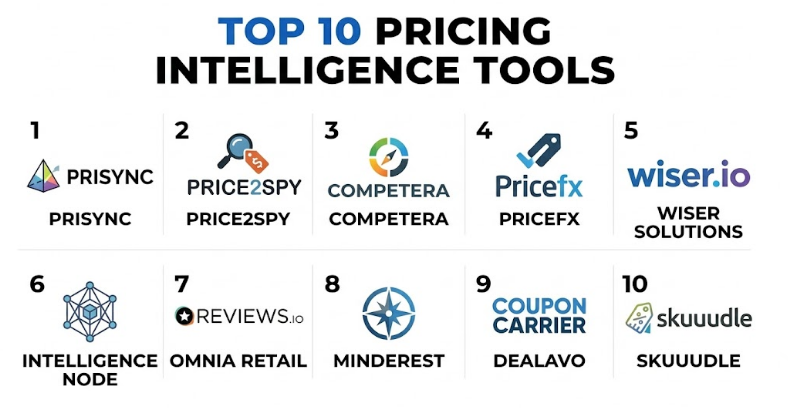
Top 10 Pricing Intelligence Tools
#1 — Prisync
Short description :
Prisync is a competitor price tracking and dynamic pricing tool designed mainly for ecommerce businesses, retailers, and online sellers. It helps teams monitor competitor prices, stock availability, price history, and market movement across selected products and competitors. Prisync is useful for businesses that want a practical way to track competitor pricing without building custom scraping or reporting systems. It can support pricing rules and dynamic price recommendations depending on setup. Prisync is a strong option for small and mid-sized ecommerce teams that need clear competitor price visibility.
Key Features
- Competitor price tracking
- Stock availability monitoring
- Price history and trend analysis
- Dynamic pricing rule support
- Product and competitor matching
- Alerts and reporting
- Data export and integration options
Pros
- Practical for ecommerce competitor price monitoring
- Easy to understand for pricing and merchandising teams
- Useful for small and mid-sized retailers
Cons
- Matching quality depends on product setup and competitor selection
- Not as enterprise-heavy as advanced pricing platforms
- Dynamic pricing still needs clear margin rules
Platforms / Deployment
Web
Cloud deployment
Security & Compliance
Prisync may process product catalogs, competitor pricing data, account data, and pricing rule information. Specific certifications such as SOC 2, ISO 27001, GDPR, or other compliance details should be verified directly.
Not publicly stated.
Integrations & Ecosystem
Prisync fits ecommerce pricing workflows where competitor price data needs to support pricing decisions.
- Ecommerce platforms
- Product catalog imports
- API workflows
- Data exports
- Pricing reports
- Dynamic pricing workflows
Support & Community
Prisync provides ecommerce-focused support and pricing monitoring resources. It is best for teams that want competitor tracking without complex enterprise implementation.
#2 — Price2Spy
Short description :
Price2Spy is a pricing intelligence and competitor price monitoring tool used by retailers, brands, distributors, and ecommerce sellers. It helps businesses track competitor prices, detect price changes, receive alerts, monitor stock, and analyze pricing history. Price2Spy is especially useful for businesses that need broad competitor monitoring and simple reporting across online stores and marketplaces. It can support product matching, alerts, repricing workflows, and price comparison dashboards depending on configuration. Price2Spy is a strong option for businesses that need flexible price monitoring across many competitors.
Key Features
- Competitor price monitoring
- Product price change alerts
- Stock availability tracking
- Price history dashboards
- Product matching support
- Repricing support depending on setup
- Reports and exports
Pros
- Strong competitor price tracking capability
- Useful for retailers, distributors, and ecommerce sellers
- Flexible reporting and alerting workflows
Cons
- Setup quality affects data accuracy
- Advanced pricing strategy still requires internal planning
- Large catalogs may require careful product mapping
Platforms / Deployment
Web
Cloud deployment
Security & Compliance
Price2Spy may process product information, competitor price data, user access, and pricing reports. Specific security and compliance details should be verified directly.
Not publicly stated.
Integrations & Ecosystem
Price2Spy fits pricing teams that need competitor tracking and price movement alerts.
- Ecommerce platforms
- Marketplace monitoring
- Product catalog imports
- Data exports
- API options
- Repricing workflows
Support & Community
Price2Spy provides pricing intelligence support resources. It is best for businesses needing regular competitor price tracking and alerting.
#3 — Competera
Short description :
Competera is a pricing platform focused on competitive pricing, price optimization, and AI-assisted pricing decisions for retailers and ecommerce businesses. It helps teams monitor competitor prices, analyze pricing opportunities, and make pricing decisions based on market data and business objectives. Competera is especially useful for larger retailers and brands that need more than basic price tracking. It can support intelligent pricing recommendations, dynamic pricing workflows, and pricing strategy optimization. Competera is a strong option for businesses that want pricing intelligence connected with decision automation.
Key Features
- Competitor price monitoring
- AI-assisted price optimization
- Dynamic pricing support
- Product matching and market tracking
- Pricing recommendations
- Price elasticity and strategy insights depending on setup
- Reporting and analytics
Pros
- Strong for advanced pricing optimization
- Useful for large ecommerce and retail teams
- Supports data-driven pricing decisions
Cons
- May be too advanced for small sellers
- Requires clean product, cost, and business data
- Implementation should involve pricing and analytics teams
Platforms / Deployment
Web / API options may vary
Cloud deployment
Security & Compliance
Competera may process product data, competitor pricing, pricing rules, business performance data, and decision models. Specific certifications and compliance details should be verified directly.
Not publicly stated.
Integrations & Ecosystem
Competera fits businesses that want pricing intelligence connected with optimization workflows.
- Ecommerce platforms
- ERP systems
- BI tools
- Product catalogs
- Pricing engines
- APIs and data exports
Support & Community
Competera provides pricing-focused business support and implementation resources. It is best for teams ready to use pricing intelligence strategically.
#4 — Pricefx
Short description :
Pricefx is a pricing software platform that supports price management, price optimization, quoting, rebates, analytics, and pricing operations. While broader than competitor price tracking alone, it is useful for companies that need structured pricing intelligence connected with enterprise pricing processes. Pricefx is especially relevant for B2B companies, manufacturers, distributors, and enterprises with complex pricing rules. It helps teams manage pricing strategies, analyze pricing performance, and improve pricing governance. Pricefx is a strong option when pricing intelligence must connect with enterprise pricing execution.
Key Features
- Price management workflows
- Price optimization support
- Pricing analytics
- Quoting and deal pricing support
- Rebate and margin workflows depending on setup
- Enterprise pricing governance
- Integration with business systems
Pros
- Strong for enterprise pricing operations
- Useful for B2B and complex pricing environments
- Connects pricing strategy with execution workflows
Cons
- Not a simple competitor price tracker
- Implementation requires pricing process maturity
- May be too advanced for small ecommerce teams
Platforms / Deployment
Web / API options may vary
Cloud deployment
Security & Compliance
Pricefx may process pricing data, customer data, commercial rules, margin information, quote data, and enterprise workflow records. Specific certifications and compliance details should be verified directly.
Not publicly stated.
Integrations & Ecosystem
Pricefx fits enterprise pricing environments where pricing intelligence connects with pricing execution.
- ERP systems
- CRM platforms
- CPQ systems
- BI tools
- Product catalogs
- Finance and sales workflows
Support & Community
Pricefx provides enterprise pricing support and implementation resources. It is best for organizations with complex pricing processes and governance needs.
#5 — Wiser Solutions
Short description :
Wiser Solutions provides pricing intelligence, retail analytics, marketplace monitoring, and commerce data solutions for brands and retailers. It helps businesses monitor competitor prices, online availability, marketplace activity, and retail execution signals. Wiser is especially useful for consumer brands, retailers, and ecommerce teams that need visibility into pricing, assortment, and digital shelf performance. It can support pricing intelligence alongside broader retail and market insights. Wiser Solutions is a strong option for brands that want pricing data connected with marketplace and retail monitoring.
Key Features
- Competitor price monitoring
- Marketplace and retail intelligence
- Product availability tracking
- Digital shelf visibility
- MAP and reseller monitoring support depending on setup
- Reporting and analytics
- Data services and insights
Pros
- Strong for brands and retailers
- Useful for pricing plus market visibility
- Supports broader digital shelf intelligence
Cons
- May be more than basic ecommerce sellers need
- Data setup and coverage should be validated
- Pricing and service scope may vary by use case
Platforms / Deployment
Web
Cloud deployment
Security & Compliance
Wiser Solutions may process product data, competitor prices, marketplace data, retail intelligence, and customer account information. Specific security and compliance details should be verified directly.
Not publicly stated.
Integrations & Ecosystem
Wiser fits brands that need pricing intelligence across retail and ecommerce environments.
- Ecommerce monitoring
- Marketplace tracking
- Digital shelf analytics
- Brand protection workflows
- Retail intelligence
- Reporting and data exports
Support & Community
Wiser provides business-focused support for retail and ecommerce intelligence. It is best for brands and retailers needing pricing data as part of broader market visibility.
#6 — Intelligence Node
Short description :
Intelligence Node is a retail analytics and pricing intelligence platform that helps businesses monitor competitor prices, product assortments, availability, promotions, and market positioning. It is useful for retailers, brands, and ecommerce businesses that want to understand competitive pricing and product performance at scale. Intelligence Node supports price benchmarking, product matching, competitive insights, and dynamic pricing workflows depending on setup. It is especially relevant for teams that need visibility across categories and competitive markets. Intelligence Node is a strong option for data-driven retail pricing teams.
Key Features
- Competitive price intelligence
- Product matching and benchmarking
- Assortment and availability monitoring
- Promotion tracking
- Dynamic pricing insights
- Retail analytics dashboards
- Reporting and market intelligence
Pros
- Strong competitive retail intelligence
- Useful for category and pricing teams
- Supports broader market positioning insights
Cons
- May require structured catalog setup
- Best suited for teams with pricing analytics maturity
- Pricing and data coverage should be verified
Platforms / Deployment
Web
Cloud deployment
Security & Compliance
Intelligence Node may process product catalogs, competitor prices, market data, and pricing analytics. Specific certifications and compliance details should be verified directly.
Not publicly stated.
Integrations & Ecosystem
Intelligence Node fits retail and ecommerce pricing intelligence workflows.
- Ecommerce platforms
- Product catalogs
- BI tools
- Competitive intelligence dashboards
- Pricing systems
- Data exports
Support & Community
Intelligence Node provides retail intelligence and pricing support resources. It is best for businesses that need competitive pricing and assortment analytics.
#7 — Omnia Retail
Short description :
Omnia Retail is a pricing automation and pricing intelligence platform designed for retailers and brands that need competitor price monitoring, dynamic pricing, and pricing rule automation. It helps teams set pricing strategies, monitor competition, and automate price updates based on rules and objectives. Omnia Retail is especially useful for ecommerce retailers that want to balance competitiveness with margin protection. It supports pricing automation workflows where teams can define strategy and let rules guide price changes. Omnia Retail is a strong option for retailers ready to move from manual pricing to structured automation.
Key Features
- Competitor price monitoring
- Dynamic pricing automation
- Pricing strategy rules
- Margin and competitiveness controls
- Product matching support
- Pricing dashboards
- Integration with ecommerce systems
Pros
- Strong for retail pricing automation
- Useful for balancing margin and competitiveness
- Helps reduce manual price updates
Cons
- Requires clear pricing strategy and guardrails
- Not ideal for businesses without cost and margin data
- Implementation should be carefully tested
Platforms / Deployment
Web
Cloud deployment
Security & Compliance
Omnia Retail may process product catalogs, competitor prices, pricing rules, margin data, and automated price updates. Specific security and compliance details should be verified directly.
Not publicly stated.
Integrations & Ecosystem
Omnia Retail fits ecommerce pricing automation workflows.
- Ecommerce platforms
- Product catalogs
- Competitor monitoring
- Pricing engines
- ERP systems
- Reporting dashboards
Support & Community
Omnia Retail provides pricing automation support and business resources. It is best for retailers that want controlled dynamic pricing workflows.
#8 — Minderest
Short description :
Minderest is a price intelligence and competitor monitoring platform used by retailers, brands, and ecommerce businesses to track prices, promotions, stock availability, and marketplace activity. It helps teams compare prices across competitors and channels, detect market changes, and support pricing decisions. Minderest is especially useful for businesses operating across different regions or marketplaces. It can also support brand monitoring and price compliance use cases depending on setup. Minderest is a good option for teams that need broad competitive price visibility.
Key Features
- Competitor price monitoring
- Product matching
- Promotion tracking
- Stock availability monitoring
- Marketplace price intelligence
- Alerts and reporting
- Brand and reseller monitoring support depending on setup
Pros
- Useful for competitor and marketplace monitoring
- Good for regional and multi-channel price visibility
- Supports promotion and availability tracking
Cons
- Product matching setup requires attention
- Advanced automation may require integrations
- Data coverage should be validated by market and category
Platforms / Deployment
Web
Cloud deployment
Security & Compliance
Minderest may process product catalogs, competitor data, pricing history, marketplace information, and reporting data. Specific certifications and compliance details should be verified directly.
Not publicly stated.
Integrations & Ecosystem
Minderest fits businesses needing competitive pricing and market monitoring.
- Ecommerce monitoring
- Marketplace tracking
- Product catalogs
- Alerts and dashboards
- Data exports
- Brand price monitoring workflows
Support & Community
Minderest provides pricing intelligence support resources. It is best for brands and retailers needing structured competitor price visibility.
#9 — Dealavo
Short description :
Dealavo is a pricing intelligence, price monitoring, and dynamic pricing platform for ecommerce businesses, manufacturers, retailers, and brands. It helps users monitor competitor prices, track market changes, analyze pricing trends, and support dynamic pricing decisions. Dealavo can be useful for brands monitoring reseller pricing as well as retailers competing in price-sensitive categories. It supports price tracking, product matching, reporting, and repricing workflows depending on setup. Dealavo is a practical option for businesses that need competitor price visibility and pricing automation support.
Key Features
- Competitor price monitoring
- Product matching
- Dynamic pricing support
- Marketplace and ecommerce tracking
- Price history reporting
- Alerts and dashboards
- Brand and reseller monitoring support
Pros
- Useful for both brands and retailers
- Supports monitoring and pricing automation workflows
- Good for tracking market price changes
Cons
- Requires clean product matching for best results
- Dynamic pricing should be guided by margin rules
- Data coverage should be checked by region and category
Platforms / Deployment
Web
Cloud deployment
Security & Compliance
Dealavo may process product data, competitor pricing, marketplace data, reseller price information, and pricing rules. Specific security and compliance details should be verified directly.
Not publicly stated.
Integrations & Ecosystem
Dealavo fits price monitoring and dynamic pricing workflows.
- Ecommerce platforms
- Marketplace tracking
- Product catalog imports
- Pricing reports
- Data exports
- Dynamic pricing workflows
Support & Community
Dealavo provides pricing intelligence and monitoring support. It is best for teams needing a mix of competitor tracking and pricing automation.
#10 — Skuuudle
Short description :
Skuuudle is a pricing intelligence platform focused on competitor price monitoring, product matching, and pricing data for retailers and businesses that need competitive price visibility. It helps teams track prices across competitor sites, monitor product changes, and support data-driven pricing decisions. Skuuudle is especially useful for retailers and pricing teams that want reliable market data and structured competitor analysis. It can support price benchmarking, reporting, and product matching workflows. Skuuudle is a strong option for businesses needing competitive pricing data as part of category management or revenue strategy.
Key Features
- Competitor price monitoring
- Product matching and benchmarking
- Market price tracking
- Price change reporting
- Category-level pricing insights
- Data exports and dashboards
- Pricing intelligence support
Pros
- Strong focus on competitive pricing data
- Useful for pricing and category teams
- Supports structured benchmarking workflows
Cons
- Less focused on simple plug-and-play ecommerce repricing
- Implementation may require product matching setup
- Data coverage should be validated before purchase
Platforms / Deployment
Web
Cloud deployment
Security & Compliance
Skuuudle may process product catalogs, competitor prices, pricing reports, category data, and user account information. Specific certifications and compliance details should be verified directly.
Not publicly stated.
Integrations & Ecosystem
Skuuudle fits competitive pricing and benchmarking workflows.
- Product catalogs
- Competitor monitoring
- Pricing dashboards
- Data exports
- BI tools
- Category management workflows
Support & Community
Skuuudle provides pricing intelligence support and data services. It is best for teams that need competitor benchmarking and market price visibility.
Comparison Table Top 10
| Tool Name | Best For | Platform(s) Supported | Deployment | Standout Feature | Public Rating |
|---|---|---|---|---|---|
| Prisync | Small and mid-sized ecommerce price monitoring | Web | Cloud | Competitor price tracking and dynamic pricing rules | N/A |
| Price2Spy | Flexible competitor price monitoring | Web | Cloud | Price alerts, stock tracking, and price history | N/A |
| Competera | AI-assisted retail price optimization | Web, API availability varies | Cloud | Advanced pricing recommendations | N/A |
| Pricefx | Enterprise pricing operations | Web, API availability varies | Cloud | Price management, optimization, and governance | N/A |
| Wiser Solutions | Retail and marketplace pricing intelligence | Web | Cloud | Pricing data plus digital shelf visibility | N/A |
| Intelligence Node | Retail competitive intelligence | Web | Cloud | Price, assortment, and market benchmarking | N/A |
| Omnia Retail | Retail dynamic pricing automation | Web | Cloud | Pricing rules and automated price updates | N/A |
| Minderest | Multi-channel competitor price monitoring | Web | Cloud | Price, promotion, and stock monitoring | N/A |
| Dealavo | Price monitoring and dynamic pricing | Web | Cloud | Competitor tracking plus repricing support | N/A |
| Skuuudle | Competitive price benchmarking | Web | Cloud | Product matching and market price intelligence | N/A |
Evaluation & Pricing Intelligence Tools
| Tool Name | Core 25% | Ease 15% | Integrations 15% | Security 10% | Performance 10% | Support 10% | Value 15% | Weighted Total 0–10 |
|---|---|---|---|---|---|---|---|---|
| Prisync | 8.4 | 8.7 | 8.0 | 8.0 | 8.4 | 8.2 | 8.5 | 8.34 |
| Price2Spy | 8.5 | 8.4 | 8.0 | 8.0 | 8.4 | 8.2 | 8.4 | 8.32 |
| Competera | 9.2 | 7.6 | 8.8 | 8.4 | 8.8 | 8.5 | 7.8 | 8.47 |
| Pricefx | 9.2 | 7.2 | 9.0 | 8.6 | 8.8 | 8.6 | 7.6 | 8.43 |
| Wiser Solutions | 8.8 | 7.8 | 8.5 | 8.3 | 8.6 | 8.4 | 8.0 | 8.39 |
| Intelligence Node | 8.8 | 7.8 | 8.4 | 8.2 | 8.6 | 8.2 | 8.0 | 8.34 |
| Omnia Retail | 8.7 | 8.0 | 8.5 | 8.2 | 8.6 | 8.3 | 8.0 | 8.36 |
| Minderest | 8.5 | 8.2 | 8.2 | 8.0 | 8.4 | 8.2 | 8.2 | 8.27 |
| Dealavo | 8.4 | 8.2 | 8.2 | 8.0 | 8.4 | 8.1 | 8.3 | 8.26 |
| Skuuudle | 8.3 | 8.0 | 8.0 | 8.0 | 8.3 | 8.0 | 8.1 | 8.12 |
These scores are comparative and should be used as a starting point. Small ecommerce teams may rate Prisync, Price2Spy, Dealavo, or Minderest higher because they are practical for competitor monitoring. Large retailers may prefer Competera, Omnia Retail, Intelligence Node, or Wiser Solutions. Enterprise B2B pricing teams may value Pricefx because it supports broader pricing operations and governance.
Which Pricing Intelligence Tool Should You Choose?
Solo / Small Seller
A solo seller or small ecommerce business should start with basic competitor price monitoring before investing in advanced pricing automation. Prisync, Price2Spy, Dealavo, and Minderest are practical options to compare.
At this stage, the goal should be simple: know competitor prices, avoid selling below profitable margins, and identify products where pricing needs attention.
Small Ecommerce Brand
Small ecommerce brands should focus on competitor price tracking, stock monitoring, price alerts, and simple dynamic pricing rules. Prisync, Price2Spy, Dealavo, and Minderest are strong options.
The brand should also define minimum margin, maximum discount, and product-level price boundaries before using automation.
Mid-Market Retailer
Mid-market retailers often need more advanced product matching, category pricing, competitive benchmarking, promotional tracking, and pricing analytics. Omnia Retail, Intelligence Node, Wiser Solutions, Competera, and Skuuudle are good tools to evaluate.
At this stage, pricing decisions should involve ecommerce, merchandising, category management, finance, and marketing teams.
Enterprise
Enterprise companies need pricing governance, price optimization, market intelligence, approval workflows, integration with business systems, and strategy-level reporting. Pricefx, Competera, Wiser Solutions, Intelligence Node, and Omnia Retail are strong options.
Enterprise buyers should involve pricing, finance, sales, ecommerce, product, legal, IT, and revenue management teams before selecting a platform.
Manufacturer or Brand
Manufacturers and brands often need to monitor reseller pricing, marketplace prices, unauthorized discounting, and MAP-related price behavior where applicable. Wiser Solutions, Minderest, Dealavo, Price2Spy, and Skuuudle can be useful.
Brands should focus on price visibility, reseller consistency, stock signals, and channel conflict management.
Marketplace Seller
Marketplace sellers competing for visibility, buy box placement, or high-volume sales should prioritize competitor monitoring and repricing workflows. Prisync, Price2Spy, Dealavo, and dynamic repricing tools can be useful depending on marketplace support.
Sellers should avoid race-to-the-bottom pricing. Automation should always include minimum margin protection.
Budget vs Premium
Budget-focused businesses should start with competitor tracking and alerts. This is usually enough to understand market movement before building complex automation.
Premium pricing platforms become valuable when the business has large catalogs, multiple markets, many competitors, complex pricing rules, dynamic price updates, and pricing governance needs.
Feature Depth vs Ease of Use
Prisync and Price2Spy are easier for straightforward competitor monitoring. Dealavo and Minderest are practical for broader price monitoring and dynamic pricing support. Omnia Retail is strong for pricing automation. Competera supports advanced pricing optimization. Pricefx is broader for enterprise pricing operations. Wiser Solutions and Intelligence Node are strong for retail pricing intelligence. Skuuudle is useful for benchmarking and competitive pricing data.
The best tool depends on whether the main need is price tracking, competitor benchmarking, MAP monitoring, dynamic pricing, enterprise pricing governance, or market intelligence.
Integrations & Scalability
Pricing intelligence tools may need to connect with ecommerce platforms, marketplaces, ERP systems, product catalogs, PIM systems, BI tools, CPQ tools, CRM systems, data warehouses, and pricing engines.
Scalability means handling more SKUs, more competitors, more price changes, more markets, more currencies, more rules, and more pricing decisions without manual overload.
Security & Compliance Needs
Pricing intelligence tools may process product catalogs, cost data, margin rules, competitor intelligence, customer pricing, marketplace information, and business strategy data. Buyers should review access controls, user permissions, data retention, API security, audit logs, and integration security.
Businesses should also define who can view pricing data, approve price changes, modify rules, and trigger automated repricing.
Frequently Asked Questions FAQs
1. What is a Pricing Intelligence Tool?
A Pricing Intelligence Tool helps businesses monitor competitor prices, track price changes, analyze market pricing, compare products, and support smarter pricing decisions.
2. Why is pricing intelligence important?
Pricing intelligence helps businesses stay competitive, protect margins, identify market shifts, and avoid pricing decisions based only on guesswork or manual checks.
3. What is competitor price monitoring?
Competitor price monitoring tracks how competitors price similar or identical products across websites, marketplaces, and selling channels. It helps businesses understand price gaps and market movement.
4. What is dynamic pricing?
Dynamic pricing means adjusting prices based on rules or data such as competitor prices, demand, inventory, seasonality, cost, and margin targets. It should always include clear pricing guardrails.
5. Which tool is best for small ecommerce stores?
Prisync, Price2Spy, Dealavo, and Minderest are useful options for small ecommerce teams that need competitor price tracking and alerts without heavy enterprise setup.
6. Which tool is best for enterprise pricing?
Pricefx, Competera, Wiser Solutions, Omnia Retail, and Intelligence Node are strong options for enterprise pricing, depending on whether the need is pricing governance, optimization, or competitive intelligence.
7. Can pricing intelligence tools automatically change prices?
Some tools support dynamic pricing or repricing automation. Businesses should test automation carefully and use minimum price, maximum price, margin, and approval rules.
8. What is product matching in pricing intelligence?
Product matching is the process of identifying the same or comparable products across competitor websites or marketplaces. Accurate matching is essential for reliable pricing analysis.
9. What are common pricing intelligence mistakes?
Common mistakes include tracking the wrong competitors, ignoring margins, trusting poor product matches, overreacting to every price change, and using automation without guardrails.
10. Can pricing intelligence tools help with MAP monitoring?
Some tools support MAP or reseller price monitoring workflows. Brands should verify whether the tool supports their markets, reseller channels, and compliance reporting needs.
Conclusion
Pricing Intelligence Tools help businesses make better pricing decisions by tracking competitor prices, monitoring market movement, analyzing product pricing, and supporting dynamic pricing strategies. The right platform depends on business size, catalog complexity, pricing maturity, and competitive pressure. Prisync and Price2Spy are practical for ecommerce competitor monitoring. Competera and Omnia Retail are strong for advanced retail pricing optimization and automation. Pricefx is useful for enterprise pricing operations and governance. Wiser Solutions and Intelligence Node support broader retail and digital shelf intelligence. Minderest, Dealavo, and Skuuudle are strong options for competitive price monitoring and benchmarking.
