Introduction
Nutrition Practice Management Tools are software platforms that help dietitians, nutritionists, wellness coaches, and nutrition clinics manage clients, meal plans, appointments, intake forms, progress tracking, billing, communication, and reports from one place. In simple terms, these tools reduce manual work and help nutrition professionals deliver better client care.
These tools matter because nutrition care is becoming more digital, personalized, and data-driven. Clients now expect online booking, digital food logs, mobile apps, progress dashboards, secure messaging, and easy payment options. Nutrition professionals also need better systems for managing client history, goals, allergies, supplements, diet preferences, and long-term progress.
Common use cases include:
- Managing client appointments and reminders
- Creating personalized meal plans
- Tracking food, weight, habits, and health goals
- Collecting intake forms and medical history
- Sending secure messages and documents
- Managing invoices, payments, and packages
- Supporting virtual consultations
Buyers should evaluate:
- Meal planning features
- Client tracking and progress reports
- Ease of use
- Mobile app experience
- Billing and payments
- Scheduling and reminders
- Client portal quality
- Integrations
- Security and privacy
- Pricing and scalability
Best for: dietitians, nutritionists, wellness coaches, health coaches, weight management clinics, fitness-nutrition teams, corporate wellness teams, and private nutrition practices.
Not ideal for: professionals who only need basic note-taking, clinics already using a full healthcare EHR, or teams that do not require nutrition-specific planning, tracking, or client engagement features.
Key Trends in Nutrition Practice Management Tools
- AI-assisted meal planning is becoming more common for faster diet plan creation and recipe suggestions.
- Mobile-first client tracking is now important because clients prefer logging meals, weight, water, and habits from their phones.
- Personalized nutrition workflows are growing, including support for allergies, lifestyle choices, medical goals, and fitness plans.
- Telehealth and virtual coaching are now standard expectations for many nutrition professionals.
- Wearable and fitness app integrations are becoming useful for activity, calorie, sleep, and progress tracking.
- Client engagement automation is improving through reminders, habit nudges, check-ins, and progress messages.
- Data privacy expectations are higher, especially for health records, food habits, and personal wellness data.
- Package-based billing is becoming common for nutrition coaching programs.
- Visual progress dashboards help clients stay motivated and help coaches measure outcomes.
- Hybrid nutrition practices are growing, combining in-person sessions, online coaching, and digital follow-ups.
How We Selected These Tools
The following tools were selected based on practical buyer-focused criteria:
- Market recognition among dietitians, nutritionists, and health coaches
- Nutrition-specific feature depth
- Meal planning and recipe management capabilities
- Client tracking and progress monitoring
- Ease of use for non-technical users
- Client portal and mobile experience
- Scheduling, billing, and admin workflows
- Security and privacy posture where publicly clear
- Fit for solo providers, small teams, and growing clinics
- Overall value for nutrition-focused practices
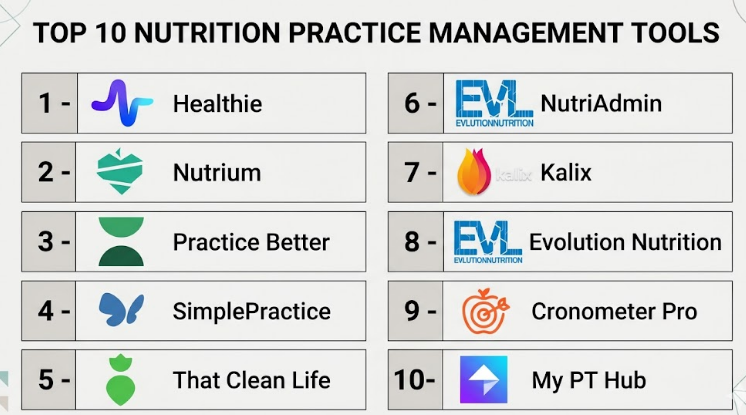
Top 10 Nutrition Practice Management Tools
#1 — Healthie
Short description : Healthie is a practice management and client engagement platform designed for dietitians, nutritionists, health coaches, and wellness organizations. It supports scheduling, telehealth, charting, billing, client messaging, forms, and progress tracking. The platform is suitable for solo practitioners, group practices, and growing digital health teams. Healthie is often used by providers who need both admin tools and client engagement features. It is a strong option for nutrition businesses that want an all-in-one care delivery system.
Key Features
- Appointment scheduling and calendar management
- Telehealth support
- Client portal and mobile app
- Food logging and progress tracking
- Billing and package management
- Intake forms and charting
- Secure messaging
Pros
- Strong fit for nutrition and wellness practices
- Good client engagement features
- Useful for both solo and growing teams
Cons
- Advanced features may require higher plans
- Setup may take time for larger programs
- Some integrations may vary by plan
Platforms / Deployment
Web / iOS / Android
Cloud
Security & Compliance
HIPAA-focused use case is publicly associated with the platform. Details such as SOC 2 or ISO 27001 are Not publicly stated.
Integrations & Ecosystem
Healthie supports nutrition practice workflows across scheduling, payments, client communication, forms, and virtual care.
- Telehealth
- Payments
- Client portal
- Forms
- Calendar workflows
- Progress tracking
Support & Community
Healthie offers documentation, onboarding resources, and customer support. Community strength is solid among dietitians, nutrition professionals, and wellness providers.
#2 — Nutrium
Short description : Nutrium is a nutrition software platform for dietitians and nutritionists who need meal planning, client tracking, appointment management, and client communication. It focuses strongly on professional nutrition care and personalized diet plans. The platform is useful for individual nutrition professionals and clinics. Nutrium helps providers create structured nutrition plans and monitor client progress. It is especially strong for nutrition-specific workflows rather than general practice management.
Key Features
- Personalized meal planning
- Nutrition analysis
- Client app
- Appointment management
- Progress tracking
- Client messaging
- Food diary support
Pros
- Strong nutrition-specific feature set
- Good for meal planning and progress monitoring
- Client app improves engagement
Cons
- May not be ideal for non-nutrition healthcare practices
- Billing depth may vary by region
- Some advanced workflows may need setup
Platforms / Deployment
Web / iOS / Android
Cloud
Security & Compliance
Privacy and secure client data handling are part of the platform’s healthcare positioning. HIPAA, SOC 2, and ISO 27001 details are Not publicly stated.
Integrations & Ecosystem
Nutrium focuses on the nutrition care ecosystem, especially food plans, client tracking, and nutrition analysis.
- Client mobile app
- Meal planning
- Food diary
- Appointment workflows
- Progress tracking
- Nutrition database
Support & Community
Nutrium provides help resources and support. Community strength is good among dietitians and nutrition professionals using digital meal planning tools.
#3 — Practice Better
Short description: Practice Better is a practice management platform for wellness professionals, nutritionists, dietitians, and health coaches. It supports scheduling, billing, packages, forms, programs, client communication, and telehealth. The platform is useful for professionals who sell coaching packages, group programs, and one-on-one services. Practice Better is especially popular among wellness businesses that need client management and business operations in one platform. It works well for nutrition practices with coaching-focused workflows.
Key Features
- Scheduling and booking
- Client portal
- Billing and payment tools
- Packages and programs
- Forms and waivers
- Telehealth support
- Client messaging
Pros
- Strong for coaching and wellness programs
- Good package and program management
- Easy to use for small practices
Cons
- Nutrition analysis may not be as deep as dedicated meal planning tools
- Advanced customization may require higher plans
- May not fit complex clinical nutrition teams
Platforms / Deployment
Web / iOS / Android
Cloud
Security & Compliance
Security features are positioned for wellness and health-related client management. HIPAA, SOC 2, and ISO 27001 details are Not publicly stated.
Integrations & Ecosystem
Practice Better supports business operations for wellness and nutrition providers.
- Payments
- Scheduling
- Client portal
- Forms
- Programs
- Telehealth
Support & Community
Practice Better has helpful documentation, training resources, and an active wellness professional user base. Support availability may vary by plan.
#4 — SimplePractice
Short descriptio : SimplePractice is a widely used practice management platform for health and wellness professionals, including dietitians and nutritionists. It supports scheduling, client records, documentation, telehealth, billing, intake forms, reminders, and payments. While it is not only nutrition-focused, it can work well for nutrition practices that need strong admin tools. It is especially useful for solo and small practices. SimplePractice is a good option when scheduling, documentation, and client communication matter more than deep meal planning.
Key Features
- Online scheduling
- Client portal
- Intake forms
- Telehealth
- Billing and payments
- Documentation tools
- Appointment reminders
Pros
- Easy to use and widely recognized
- Strong admin and client management features
- Good fit for solo providers and small practices
Cons
- Meal planning features are limited compared with nutrition-specific tools
- Advanced nutrition tracking may require another app
- Pricing may increase with added features
Platforms / Deployment
Web / iOS / Android
Cloud
Security & Compliance
HIPAA support is publicly positioned. Detailed SOC 2 and ISO 27001 information is Not publicly stated.
Integrations & Ecosystem
SimplePractice supports broad practice management needs across scheduling, billing, forms, and communication.
- Payments
- Telehealth
- Client portal
- Forms
- Scheduling
- Billing workflows
Support & Community
SimplePractice has strong documentation, onboarding resources, and a large user community across health and wellness practices.
#5 — That Clean Life
Short descriptio :That Clean Life is a nutrition planning platform designed for health professionals who create meal plans, recipes, grocery lists, and nutrition resources for clients. It is especially useful for nutritionists, dietitians, and wellness coaches focused on meal planning. The platform helps save time when building client-friendly plans. It is not a full practice management system like some competitors, but it is strong in meal plan creation. It works best when nutrition content and planning are the main requirement.
Key Features
- Meal planning
- Recipe database
- Grocery list generation
- Client-friendly nutrition resources
- Customizable plans
- Branded documents
- Nutrition-focused templates
Pros
- Strong meal planning experience
- Saves time creating client plans
- Easy for nutrition professionals to use
Cons
- Not a complete practice management system
- Limited billing and scheduling features
- May need to be paired with another platform
Platforms / Deployment
Web
Cloud
Security & Compliance
Not publicly stated.
Integrations & Ecosystem
That Clean Life is focused mainly on meal planning and nutrition content creation.
- Meal plans
- Recipe collections
- Grocery lists
- Branded exports
- Nutrition templates
- Client resources
Support & Community
Support resources and educational materials are available. Community strength is good among nutrition professionals who need practical meal planning tools.
#6 — NutriAdmin
Short description : NutriAdmin is a nutrition practice management platform built for dietitians, nutritionists, and health coaches. It supports client records, questionnaires, meal plans, reports, appointment management, and admin workflows. The platform is suitable for solo professionals and small nutrition practices. It is useful for providers who want nutrition-specific tools without heavy complexity. NutriAdmin combines practice administration with nutrition planning support.
Key Features
- Client records
- Meal planning
- Questionnaires and forms
- Report generation
- Appointment management
- Nutrition analysis
- Admin workflow tools
Pros
- Built specifically for nutrition professionals
- Good balance of admin and nutrition features
- Useful for structured client documentation
Cons
- Interface may feel less modern than some competitors
- Integration ecosystem may be limited
- May not fit large enterprise wellness programs
Platforms / Deployment
Web
Cloud
Security & Compliance
Not publicly stated.
Integrations & Ecosystem
NutriAdmin supports nutrition practice workflows from intake to meal planning and reporting.
- Questionnaires
- Meal planning
- Client records
- Reports
- Appointment workflows
- Nutrition analysis
Support & Community
Support is available through vendor resources. Community strength is moderate and focused on nutrition professionals.
#7 — Kalix
Short descriptio : Kalix is a practice management and nutrition care platform for dietitians and nutrition professionals. It supports scheduling, charting, billing, telehealth, forms, and client engagement. The platform is designed to support nutrition-specific documentation and practice workflows. It is suitable for solo dietitians and group practices. Kalix is useful for professionals who want nutrition care tools combined with practice administration.
Key Features
- Client records and charting
- Scheduling
- Billing and payments
- Telehealth
- Forms and documents
- Client portal
- Nutrition-focused workflows
Pros
- Designed for dietitians and nutrition practices
- Combines admin and nutrition documentation
- Useful for virtual and in-person practices
Cons
- Learning curve may exist for full setup
- Advanced integrations may be limited
- Public security details may be limited
Platforms / Deployment
Web
Cloud
Security & Compliance
HIPAA-oriented use case is publicly associated with healthcare practice management. SOC 2 and ISO 27001 details are Not publicly stated.
Integrations & Ecosystem
Kalix supports nutrition practice operations with scheduling, billing, client records, and virtual care tools.
- Telehealth
- Billing
- Forms
- Client portal
- Scheduling
- Documentation
Support & Community
Support and help resources are available. Community strength is moderate within the dietitian and nutrition professional market.
#8 — Evolution Nutrition
Short description : Evolution Nutrition is a nutrition software platform used by fitness professionals, wellness coaches, and nutrition providers to create meal plans and nutrition programs. It focuses on meal planning, client nutrition guidance, and program delivery. The platform is helpful for professionals working with weight loss, fitness, and wellness goals. It may not replace a full practice management system for clinical nutrition teams. It works best when nutrition planning is the main priority.
Key Features
- Meal planning
- Nutrition program creation
- Client nutrition guidance
- Recipe and food database
- Custom plans
- Fitness and wellness use cases
- Progress support
Pros
- Useful for fitness and wellness nutrition
- Strong meal plan creation focus
- Practical for coaching-style programs
Cons
- Not a full EHR or practice management platform
- May require another system for billing or scheduling
- Clinical documentation depth may be limited
Platforms / Deployment
Web
Cloud
Security & Compliance
Not publicly stated.
Integrations & Ecosystem
Evolution Nutrition is mainly focused on meal plan delivery and nutrition coaching.
- Meal plans
- Food database
- Nutrition programs
- Client resources
- Fitness nutrition workflows
- Progress support
Support & Community
Support details may vary. Community strength is stronger among fitness, wellness, and coaching professionals.
#9 — Cronometer Pro
Short descriptio : Cronometer Pro is a professional nutrition tracking platform used by dietitians, nutritionists, coaches, and health professionals. It is known for detailed nutrient tracking and food diary analysis. The platform helps professionals monitor client food intake, micronutrients, macronutrients, and progress. It is especially useful when detailed nutrition data is important. Cronometer Pro is more focused on tracking and analysis than full practice management.
Key Features
- Detailed food tracking
- Macro and micronutrient analysis
- Client sharing and monitoring
- Reports
- Goal tracking
- Nutrition data insights
- Mobile app support
Pros
- Strong nutrition tracking depth
- Useful for detailed nutrient analysis
- Good for evidence-informed nutrition coaching
Cons
- Not a complete practice management system
- Scheduling and billing are not the main strengths
- May need pairing with another platform
Platforms / Deployment
Web / iOS / Android
Cloud
Security & Compliance
Not publicly stated.
Integrations & Ecosystem
Cronometer Pro is strong for nutrition data tracking and client food diary review.
- Food diary
- Nutrient reports
- Client monitoring
- Mobile tracking
- Progress data
- Health and wellness workflows
Support & Community
Cronometer has strong user recognition in nutrition tracking. Support resources are available, and community awareness is strong among nutrition-focused users.
#10 — My PT Hub
Short description : My PT Hub is a coaching and client management platform used by personal trainers, fitness coaches, and nutrition professionals. It supports workout plans, nutrition guidance, client management, progress tracking, payments, and app-based coaching. While it is not only for nutrition practices, it can be useful for professionals who combine fitness and nutrition services. It works well for coaching businesses that need client engagement and program delivery. It is best for nutrition providers connected to fitness or lifestyle coaching.
Key Features
- Client management
- Nutrition guidance
- Progress tracking
- Workout and program delivery
- Payments
- Mobile app experience
- Coaching dashboards
Pros
- Good for fitness-nutrition coaching
- Strong client engagement tools
- Useful for hybrid coaching programs
Cons
- Not designed for clinical nutrition practices
- Meal planning depth may vary
- May not fit dietitians needing formal documentation
Platforms / Deployment
Web / iOS / Android
Cloud
Security & Compliance
Not publicly stated.
Integrations & Ecosystem
My PT Hub supports coaching workflows across fitness, nutrition, payments, and client progress.
- Payments
- Client app
- Nutrition tracking
- Progress dashboards
- Program delivery
- Fitness coaching workflows
Support & Community
Support and help resources are available. Community strength is stronger in fitness coaching and wellness coaching markets.
Comparison Table
| Tool Name | Best For | Platform(s) Supported | Deployment | Standout Feature | Public Rating |
|---|---|---|---|---|---|
| Healthie | Nutrition practices and wellness clinics | Web, iOS, Android | Cloud | All-in-one client engagement and practice management | N/A |
| Nutrium | Dietitians and nutritionists | Web, iOS, Android | Cloud | Personalized meal planning and client tracking | N/A |
| Practice Better | Wellness coaches and nutrition programs | Web, iOS, Android | Cloud | Packages, programs, and client portal | N/A |
| SimplePractice | Solo and small nutrition practices | Web, iOS, Android | Cloud | Scheduling, billing, forms, and telehealth | N/A |
| That Clean Life | Meal planning-focused professionals | Web | Cloud | Recipe-based meal plan creation | N/A |
| NutriAdmin | Solo nutritionists and small practices | Web | Cloud | Nutrition admin and meal planning workflows | N/A |
| Kalix | Dietitians and nutrition clinics | Web | Cloud | Nutrition documentation and practice tools | N/A |
| Evolution Nutrition | Fitness and wellness nutrition coaching | Web | Cloud | Meal planning for coaching programs | N/A |
| Cronometer Pro | Detailed nutrition tracking | Web, iOS, Android | Cloud | Macro and micronutrient analysis | N/A |
| My PT Hub | Fitness-nutrition coaches | Web, iOS, Android | Cloud | Coaching and progress tracking | N/A |
Evaluation & Nutrition Practice Management Tools
| Tool Name | Core (25%) | Ease (15%) | Integrations (15%) | Security (10%) | Performance (10%) | Support (10%) | Value (15%) | Weighted Total (0–10) |
|---|---|---|---|---|---|---|---|---|
| Healthie | 9 | 8 | 8 | 8 | 8 | 8 | 8 | 8.25 |
| Nutrium | 9 | 8 | 7 | 7 | 8 | 8 | 8 | 8.00 |
| Practice Better | 8 | 9 | 8 | 7 | 8 | 8 | 8 | 8.10 |
| SimplePractice | 8 | 9 | 8 | 8 | 8 | 8 | 7 | 8.10 |
| That Clean Life | 8 | 9 | 6 | 6 | 8 | 7 | 8 | 7.50 |
| NutriAdmin | 8 | 7 | 6 | 6 | 7 | 7 | 8 | 7.10 |
| Kalix | 8 | 7 | 7 | 7 | 8 | 7 | 7 | 7.45 |
| Evolution Nutrition | 7 | 8 | 6 | 6 | 7 | 7 | 8 | 7.05 |
| Cronometer Pro | 8 | 8 | 7 | 6 | 8 | 7 | 8 | 7.55 |
| My PT Hub | 7 | 8 | 7 | 6 | 8 | 7 | 8 | 7.35 |
These scores are comparative and should not be treated as fixed rankings for every practice. A nutrition clinic may value charting and privacy more, while a wellness coach may value meal plans and client engagement. Always test the platform with your real workflow before choosing. Shortlist tools based on your client type, service model, budget, and required integrations.
Which Nutrition Practice Management Tools
Solo / Freelancer
Solo nutritionists and dietitians should choose tools that are simple, affordable, and quick to launch. Healthie, Nutrium, Practice Better, SimplePractice, NutriAdmin, and That Clean Life are strong options depending on the workflow.
If the main need is meal planning, That Clean Life, Nutrium, or NutriAdmin may work well. If the main need is appointment management, payments, and client communication, Healthie, Practice Better, or SimplePractice may be better.
SMB
Small and growing nutrition practices need stronger workflows for scheduling, forms, billing, client tracking, and team coordination. Healthie, Practice Better, Kalix, Nutrium, and SimplePractice are practical options.
SMBs should evaluate user limits, staff access, package management, group programs, reporting, and how easy it is to onboard new providers.
Mid-Market
Mid-market nutrition clinics need more scalable workflows, better reporting, consistent documentation, billing support, and client engagement automation. Healthie, Practice Better, Kalix, and SimplePractice may fit this segment well.
These teams should run a pilot before migration. Testing should include client onboarding, note-taking, payments, plan creation, progress review, and reporting.
Enterprise
Enterprise nutrition programs may include corporate wellness providers, digital health companies, hospitals, or large coaching teams. Healthie is often worth reviewing for this segment because of its stronger platform orientation.
Enterprise buyers should ask about SSO, permissions, API access, audit logs, data export, security documentation, implementation support, and custom workflows.
Budget vs Premium
Budget-focused professionals should look at tools that cover the core workflow without unnecessary extras. That Clean Life, NutriAdmin, Evolution Nutrition, and Cronometer Pro may be useful depending on the need.
Premium buyers should focus on client portals, automation, telehealth, billing, reporting, integrations, and scalability. Healthie, Practice Better, Nutrium, Kalix, and SimplePractice may offer stronger value for broader operations.
Feature Depth vs Ease of Use
If feature depth is the priority, Healthie, Nutrium, Kalix, and Practice Better are strong options. If ease of use is more important, SimplePractice, That Clean Life, Practice Better, and Cronometer Pro may feel easier to adopt.
The best test is simple: create a client, build a plan, send forms, schedule a session, track progress, send a message, and collect payment.
Integrations & Scalability
Nutrition practices should check integrations for calendars, payments, telehealth, wearable apps, food tracking, accounting, forms, and reporting. Integration depth can vary by tool and plan.
Scalability also means user permissions, multiple providers, client volume, templates, automation, reporting, and export options.
Security & Compliance Needs
Nutrition data can include sensitive health, lifestyle, and medical details. Buyers should ask about encryption, secure messaging, access controls, MFA, data backup, audit logs, and privacy policies.
For clinical nutrition or healthcare-connected practices, HIPAA and regional privacy requirements should be reviewed carefully before purchase.
Frequently Asked Questions
1. What is nutrition practice management software?
Nutrition practice management software helps nutritionists, dietitians, and coaches manage clients, appointments, meal plans, progress tracking, billing, forms, and communication in one system.
2. Who should use nutrition practice management tools?
These tools are useful for dietitians, nutritionists, wellness coaches, weight-loss clinics, sports nutrition professionals, corporate wellness teams, and online coaching businesses.
3. How much do these tools usually cost?
Most tools use subscription pricing. Pricing may depend on features, number of clients, number of providers, billing tools, telehealth, or advanced reporting.
4. Are nutrition tools different from general practice management tools?
Yes. Nutrition tools often include meal planning, food tracking, nutrition analysis, recipes, grocery lists, and progress tracking. General tools may focus more on scheduling, billing, and notes.
5. Can these tools support telehealth?
Many nutrition practice tools include telehealth or virtual consultation support. However, video quality, consent workflows, reminders, and billing integration should be tested before purchase.
6. What common mistakes should buyers avoid?
Common mistakes include choosing only by price, ignoring client app experience, not checking privacy features, skipping trial testing, and selecting a tool without proper meal planning support.
7. Are these tools secure?
Many tools provide basic security features, but buyers should verify encryption, access controls, MFA, backups, audit logs, and privacy compliance before using them with client health data.
8. Can nutrition practice tools integrate with fitness apps?
Some tools support integrations with fitness or tracking platforms, but availability varies. Buyers should confirm integrations during the demo instead of assuming they are included.
9. How hard is it to switch from one nutrition tool to another?
Switching can take time if you have client records, meal plans, notes, payment history, and forms in an old system. Always check export options and migration support.
10. What is the best tool for meal planning?
Nutrium, That Clean Life, NutriAdmin, Evolution Nutrition, and Cronometer Pro are strong options for meal planning or nutrition tracking. The best choice depends on whether you need clinical plans, coaching plans, or detailed nutrient analysis.
Conclusion
Nutrition Practice Management Tools help modern nutrition professionals manage clients, reduce admin work, create better plans, track progress, and deliver a smoother client experience. The right platform depends on the type of practice. A solo dietitian may need simple scheduling, forms, and meal planning. A wellness coach may need programs, payments, and mobile engagement. A larger clinic may need reporting, provider permissions, secure documentation, and scalable workflows. There is no single best tool for everyone. The smart approach is to shortlist two or three platforms, test them with real client workflows, compare pricing and support, verify privacy and security details, and choose the tool that fits your service model today while supporting future growth.
