Introduction
Mental Health Therapy Apps are digital platforms that help people access emotional support, therapy, coaching, self-care tools, guided exercises, mood tracking, meditation, and sometimes psychiatry services through web or mobile apps. In simple words, these apps make mental health support easier to access without always visiting a clinic in person.
They matter now because more people want flexible, private, and affordable ways to manage stress, anxiety, depression, burnout, sleep issues, relationship concerns, and workplace mental wellness. Companies, healthcare teams, schools, and individuals are also looking for tools that combine human support, digital programs, reminders, and secure communication.
Common use cases include online therapy sessions, text-based counseling, anxiety management, employee wellness, meditation, sleep support, crisis guidance, mood tracking, and ongoing self-care.
Buyers should evaluate:
- Therapist availability and qualifications
- Therapy, psychiatry, or self-help scope
- Pricing and insurance support
- Privacy and data protection
- Ease of use
- Mobile experience
- Crisis support limitations
- Matching process
- Integrations and reporting
- Support quality
Best for: individuals, employers, healthcare teams, wellness programs, students, remote workers, and organizations that want accessible mental health support.
Not ideal for: emergency mental health situations, severe crisis care, users needing in-person diagnosis, or organizations that require fully customized clinical systems.
Key Trends in Mental Health Therapy Apps
- AI-assisted support: More apps are adding AI-based journaling, check-ins, emotional pattern detection, and personalized recommendations.
- Hybrid care models: Many platforms combine live therapy, psychiatry, coaching, and self-guided programs.
- Workplace mental wellness: Employers are adopting mental health apps as part of employee benefits.
- Privacy-first buying: Users and companies are paying more attention to encryption, data sharing, consent, and compliance.
- Insurance-led access: Therapy apps are increasingly trying to work with insurance plans and employer benefit programs.
- Personalized care journeys: Apps now focus on matching users with the right therapist, care path, or wellness content.
- Mobile-first experience: iOS and Android apps remain central because users want support anytime.
- Outcome tracking: Mood logs, assessments, progress reports, and care goals are becoming common.
- Integrated wellness: Mental health apps are connecting with sleep, meditation, fitness, and chronic care programs.
- Responsible AI expectations: Buyers expect transparency when AI is used in sensitive mental health workflows.
How We Selected These Tools
The tools below were selected using a practical SaaS/product evaluation lens:
- Market recognition and user mindshare
- Relevance to therapy, counseling, psychiatry, or mental wellness
- Feature depth across live care and self-guided support
- Availability across web and mobile platforms
- Security and privacy signals where publicly clear
- Suitability for individuals, employers, and care programs
- Ease of onboarding and day-to-day usage
- Breadth of support options
- Fit across budget, premium, and clinical-use scenarios
- Long-term product ecosystem and brand visibility
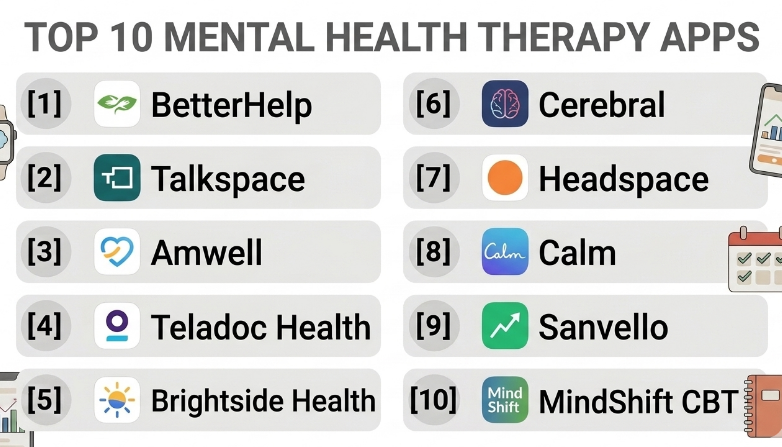
Top 10 Mental Health Therapy Apps
#1 — BetterHelp
Short description :
BetterHelp is one of the most widely recognized online therapy platforms for individuals seeking access to licensed therapists through digital channels. It is built mainly for people who want flexible therapy from home using messaging, live chat, phone, or video sessions. The platform is useful for users dealing with stress, anxiety, relationship concerns, grief, burnout, and everyday emotional challenges. It focuses on convenience and therapist matching rather than traditional clinic-based care. BetterHelp is best suited for users who want ongoing talk therapy without scheduling in-person visits.
Key Features
- Therapist matching based on user needs
- Messaging with assigned therapist
- Live video, phone, and chat sessions
- Individual therapy support
- Mobile and web access
- Ability to switch therapists
- Self-reflection tools and worksheets
Pros
- Easy to start compared with traditional therapy routes
- Flexible communication options for users with busy schedules
- Large therapist network improves matching chances
Cons
- Not designed for emergency or crisis support
- Therapist fit may vary by user experience
- Insurance coverage may be limited depending on region and plan
Platforms / Deployment
Web / iOS / Android
Cloud
Security & Compliance
Encryption: publicly stated by platform
HIPAA: Not publicly stated
SOC 2: Not publicly stated
ISO 27001: Not publicly stated
GDPR: Not publicly stated
Integrations & Ecosystem
BetterHelp is mainly a direct-to-consumer therapy platform. Its ecosystem focuses more on therapist matching, communication, and digital care delivery than enterprise integrations.
- Web and mobile app access
- Therapist communication tools
- Payment and subscription workflows
- Scheduling and session management
- Internal care matching system
Support & Community
Support includes account help, therapist switching, platform guidance, and user help resources. Community strength is mostly brand-driven rather than open community-based.
#2 — Talkspace
Short description :
Talkspace is an online therapy and psychiatry platform designed for individuals, employers, and health plans. It offers access to licensed therapists and, in some cases, psychiatric care through digital sessions. Talkspace is suitable for users who want structured virtual therapy with insurance or employer benefit possibilities. The platform supports messaging and live sessions depending on the plan. It is a strong option for users who want a more healthcare-connected therapy app experience.
Key Features
- Online therapy with licensed professionals
- Psychiatry services in selected cases
- Text, audio, and video messaging options
- Live video sessions
- Insurance and employer benefit support
- Couples therapy options
- Care matching workflow
Pros
- Strong fit for users seeking insurance-supported therapy
- Offers therapy and psychiatry in one ecosystem
- Useful for individuals and organizations
Cons
- Availability and coverage depend on location and plan
- Pricing can vary widely
- Therapist experience may differ by provider
Platforms / Deployment
Web / iOS / Android
Cloud
Security & Compliance
HIPAA: publicly positioned as healthcare-oriented
Encryption: Not publicly stated in detail
SOC 2: Not publicly stated
ISO 27001: Not publicly stated
GDPR: Not publicly stated
Integrations & Ecosystem
Talkspace has a broader ecosystem compared with many consumer-only apps because it serves individuals, employers, and health plans.
- Insurance workflows
- Employer benefit programs
- Mobile therapy access
- Psychiatry service coordination
- Session scheduling and messaging
- Care navigation support
Support & Community
Support is available through platform help channels, onboarding resources, and care navigation. Enterprise and employer support may vary by contract.
#3 — Amwell
Short description :
Amwell is a telehealth platform that includes behavioral health and therapy-related services as part of its broader virtual care offering. It is more enterprise and healthcare-system oriented than many consumer therapy apps. Amwell is often relevant for hospitals, health plans, employers, and care providers that want virtual care infrastructure. For mental health, it can support therapy-style visits, behavioral health programs, and provider-led care. It is best for organizations needing a scalable telehealth ecosystem.
Key Features
- Virtual care platform
- Behavioral health support
- Provider network options
- Video-based consultations
- Healthcare organization workflows
- Enterprise telehealth infrastructure
- Care delivery and patient access tools
Pros
- Strong fit for healthcare organizations
- Broader virtual care ecosystem beyond mental health
- Useful for structured clinical programs
Cons
- May be more complex than consumer therapy apps
- Not ideal for users who only need simple meditation or self-care
- Pricing and deployment details may require sales discussion
Platforms / Deployment
Web / iOS / Android
Cloud / Hybrid options may vary
Security & Compliance
HIPAA: commonly expected for healthcare telehealth workflows
SOC 2: Not publicly stated
ISO 27001: Not publicly stated
GDPR: Not publicly stated
RBAC / audit logs: Varies / N/A
Integrations & Ecosystem
Amwell is built for healthcare ecosystems, so integrations are more important for care delivery and enterprise operations.
- EHR-related workflows
- Provider scheduling
- Patient access tools
- Video consultation infrastructure
- Health plan and employer programs
- Care coordination systems
Support & Community
Support is more enterprise-focused, with onboarding, implementation, account management, and technical support depending on the customer agreement.
#4 — Teladoc Health
Short description :
Teladoc Health is a broad virtual healthcare platform that includes mental health and therapy services in many markets. It is suitable for individuals, employers, health plans, and large organizations seeking virtual medical and behavioral care. The platform is not only a therapy app; it is part of a larger digital health ecosystem. This makes it useful when mental health support must sit beside general medical care, chronic care, and wellness services. It is best for large-scale care access.
Key Features
- Virtual healthcare services
- Mental health support options
- Therapist and provider access
- Employer and health plan programs
- Mobile and web-based care
- Broader healthcare ecosystem
- Appointment-based care delivery
Pros
- Strong fit for enterprise and health plan use cases
- Broader care coverage beyond therapy
- Recognized virtual healthcare brand
Cons
- May feel less specialized than therapy-only apps
- Availability depends on region and plan
- Pricing and access can vary
Platforms / Deployment
Web / iOS / Android
Cloud
Security & Compliance
HIPAA: commonly expected in healthcare workflows
SOC 2: Not publicly stated
ISO 27001: Not publicly stated
GDPR: Not publicly stated
SSO / RBAC: Varies / N/A
Integrations & Ecosystem
Teladoc Health is part of a wider virtual healthcare ecosystem and is useful when mental health is one component of digital care.
- Employer benefit systems
- Health plan workflows
- Virtual visit scheduling
- Medical and behavioral care coordination
- Mobile health access
- Care program reporting
Support & Community
Support varies by user type. Individual users receive app and care support, while enterprise customers may receive account and implementation support.
#5 — Brightside Health
Short description :
Brightside Health focuses on mental health care for anxiety, depression, and related conditions through online therapy and medication management in selected cases. It is designed for users who need structured clinical care rather than only meditation or wellness content. The platform emphasizes assessment, care planning, provider support, and progress monitoring. Brightside is suitable for people who want a more condition-focused mental health app. It can be a good fit when users need therapy plus medication evaluation options.
Key Features
- Online therapy options
- Medication management in eligible cases
- Anxiety and depression support
- Care plan structure
- Progress tracking
- Provider-based support
- Digital assessments
Pros
- Stronger clinical focus than general wellness apps
- Good fit for anxiety and depression care pathways
- Combines care planning with digital access
Cons
- Availability may vary by location
- Not ideal for general meditation-only users
- Pricing and insurance details may differ by user
Platforms / Deployment
Web / iOS / Android
Cloud
Security & Compliance
HIPAA: healthcare-oriented platform
SOC 2: Not publicly stated
ISO 27001: Not publicly stated
GDPR: Not publicly stated
MFA / SSO: Not publicly stated
Integrations & Ecosystem
Brightside’s ecosystem is built around mental health care delivery, provider interaction, and progress tracking.
- Digital assessments
- Provider communication
- Medication management workflows
- Progress monitoring
- Care plan tools
- Insurance or payment workflows
Support & Community
Support is care-focused and platform-based. Documentation and onboarding are designed for patients starting online mental health treatment.
#6 — Cerebral
Short description :
Cerebral is a mental health platform focused on online care access for conditions such as anxiety, depression, insomnia, and related concerns. It has offered therapy, coaching, and medication-related care models depending on service availability. The platform is built for users who prefer digital-first mental health support with structured care options. Cerebral is best evaluated carefully because service availability, care model, and coverage may vary. It is suitable for users looking for guided online support rather than only self-help exercises.
Key Features
- Online mental health care access
- Therapy or coaching options depending on availability
- Medication management where applicable
- Digital intake and care matching
- Mobile-first care experience
- Condition-focused support
- Ongoing care communication
Pros
- Convenient digital-first care access
- Useful for users who want structured support
- Offers broader care pathways than simple wellness apps
Cons
- Service model may vary by location and plan
- Users should review care scope carefully
- Not a replacement for emergency mental health care
Platforms / Deployment
Web / iOS / Android
Cloud
Security & Compliance
HIPAA: Not publicly stated with enough detail here
SOC 2: Not publicly stated
ISO 27001: Not publicly stated
GDPR: Not publicly stated
Encryption / MFA: Not publicly stated
Integrations & Ecosystem
Cerebral’s ecosystem is centered on digital intake, care access, and ongoing support.
- Intake and assessment workflows
- Provider or coach communication
- Care plan management
- Payment and subscription workflows
- Mobile app access
- Progress-related features
Support & Community
Support and onboarding vary by plan and service type. Users should review available care options before subscribing.
#7 — Headspace
Short description :
Headspace is a mental wellness app focused on meditation, mindfulness, sleep, stress reduction, and emotional resilience. It is not a traditional therapy app in the same way as BetterHelp or Talkspace, but it is widely used for preventive mental wellness. Headspace is valuable for individuals and employers that want easy, guided mental health routines. It works well for stress management, sleep improvement, breathing exercises, and beginner-friendly mindfulness. It is best for users who want daily mental wellness support rather than clinical therapy.
Key Features
- Guided meditation
- Sleep content
- Stress management exercises
- Breathing and mindfulness tools
- Workplace wellness options
- Beginner-friendly programs
- Mobile-first user experience
Pros
- Very easy for beginners
- Strong fit for daily self-care routines
- Useful for employer wellness programs
Cons
- Not a replacement for licensed therapy
- Limited clinical care depth
- Users needing diagnosis or medication support need alternatives
Platforms / Deployment
Web / iOS / Android
Cloud
Security & Compliance
SOC 2: Not publicly stated
ISO 27001: Not publicly stated
HIPAA: Not publicly stated
GDPR: Not publicly stated
Encryption: Not publicly stated
Integrations & Ecosystem
Headspace works well as a wellness layer rather than a clinical therapy system.
- Mobile wellness app
- Employer wellness programs
- Meditation content library
- Sleep and relaxation content
- Progress tracking
- Possible benefit platform connections
Support & Community
Support includes help resources, app guidance, and customer support. Community strength comes from broad consumer adoption and workplace wellness usage.
#8 — Calm
Short description :
Calm is a mental wellness app known for sleep support, meditation, relaxation, breathing, and stress management content. It is designed for individuals who want simple, guided tools to improve emotional balance and daily wellbeing. Calm is not mainly a therapy marketplace, but it supports mental health through self-guided wellness routines. It is useful for users dealing with everyday stress, poor sleep, and burnout. Calm is best for personal wellness, relaxation, and employer wellbeing programs.
Key Features
- Guided meditation
- Sleep stories and sleep support
- Breathing exercises
- Stress and relaxation content
- Audio-based wellness library
- Mobile app experience
- Daily practice tools
Pros
- Strong sleep and relaxation experience
- Easy for non-technical users
- Good option for light mental wellness support
Cons
- Not suitable for clinical therapy needs
- Limited therapist-led care
- May not meet healthcare compliance needs for organizations
Platforms / Deployment
Web / iOS / Android
Cloud
Security & Compliance
SOC 2: Not publicly stated
ISO 27001: Not publicly stated
HIPAA: Not publicly stated
GDPR: Not publicly stated
RBAC / SSO: Varies / N/A
Integrations & Ecosystem
Calm’s ecosystem is centered on wellness content and guided daily routines.
- Mobile app access
- Sleep and meditation library
- Employer wellness offerings
- Progress tracking
- Audio content
- Subscription-based access
Support & Community
Support includes app help, billing support, and user guidance. Community is broad because Calm is widely recognized in the wellness market.
#9 — Sanvello
Short description :
Sanvello is a mental health and self-care app focused on stress, anxiety, depression, mood tracking, and CBT-based techniques. It is designed for users who want structured self-guided support with practical coping tools. Sanvello can be useful for individuals who want daily check-ins, guided journeys, and emotional health exercises. It is not always a full replacement for therapy, but it can support therapy between sessions. Sanvello is best for people who prefer CBT-style tools and mood-based self-management.
Key Features
- Mood tracking
- CBT-based exercises
- Guided journeys
- Coping tools
- Stress and anxiety support
- Progress insights
- Self-care routines
Pros
- Good for structured self-guided mental health support
- Useful mood tracking and coping tools
- Can complement therapy programs
Cons
- Not ideal for urgent or severe mental health needs
- Therapist access may vary by plan or region
- Some advanced features may require paid access
Platforms / Deployment
iOS / Android
Cloud
Security & Compliance
HIPAA: Not publicly stated
SOC 2: Not publicly stated
ISO 27001: Not publicly stated
GDPR: Not publicly stated
Encryption: Not publicly stated
Integrations & Ecosystem
Sanvello focuses on self-care workflows and guided mental health exercises.
- Mood tracking
- CBT-based journeys
- Guided audio tools
- Progress dashboards
- Mobile app experience
- Wellness program fit
Support & Community
Support is mainly app-based. Community features and availability may vary, so users should verify current options before choosing it.
#10 — MindShift CBT
Short description :
MindShift CBT is a mental health app focused on anxiety relief using cognitive behavioral therapy principles. It is designed for people who want practical tools to manage worry, panic, perfectionism, social anxiety, and stress. MindShift CBT is more self-help oriented than therapist-led therapy apps. It can be a good option for students, young adults, and users who want free or low-cost anxiety tools. It is best used as a self-guided support app or as a companion to professional care.
Key Features
- CBT-based anxiety tools
- Thought reframing exercises
- Panic and worry support
- Goal setting
- Coping cards
- Relaxation tools
- Self-guided mental health exercises
Pros
- Practical CBT-based approach
- Good for anxiety self-management
- Useful for users who want low-friction support
Cons
- Not a full therapy replacement
- Limited provider-led support
- May not be enough for complex clinical needs
Platforms / Deployment
iOS / Android
Cloud
Security & Compliance
HIPAA: Not publicly stated
SOC 2: Not publicly stated
ISO 27001: Not publicly stated
GDPR: Not publicly stated
Encryption: Not publicly stated
Integrations & Ecosystem
MindShift CBT is mainly a self-guided app, so integrations are limited compared with enterprise platforms.
- CBT exercises
- Anxiety tracking
- Goal tools
- Coping resources
- Mobile app access
- Self-help workflows
Support & Community
Support is mostly app and resource-based. It is not a large therapy marketplace, so community and support depth may be limited.
Comparison Table
| Tool Name | Best For | Platform(s) Supported | Deployment | Standout Feature | Public Rating |
|---|---|---|---|---|---|
| BetterHelp | Flexible online therapy | Web, iOS, Android | Cloud | Large therapist network | N/A |
| Talkspace | Therapy with insurance/employer fit | Web, iOS, Android | Cloud | Therapy plus psychiatry options | N/A |
| Amwell | Healthcare organizations | Web, iOS, Android | Cloud / Hybrid varies | Enterprise telehealth platform | N/A |
| Teladoc Health | Large-scale virtual care | Web, iOS, Android | Cloud | Broad virtual healthcare ecosystem | N/A |
| Brightside Health | Anxiety and depression care | Web, iOS, Android | Cloud | Therapy plus medication management options | N/A |
| Cerebral | Digital-first mental health care | Web, iOS, Android | Cloud | Structured online care pathways | N/A |
| Headspace | Meditation and workplace wellness | Web, iOS, Android | Cloud | Beginner-friendly mindfulness | N/A |
| Calm | Sleep and relaxation | Web, iOS, Android | Cloud | Sleep stories and calming content | N/A |
| Sanvello | CBT-style self-care | iOS, Android | Cloud | Mood tracking and guided journeys | N/A |
| MindShift CBT | Anxiety self-management | iOS, Android | Cloud | CBT-based anxiety tools | N/A |
Evaluation & Mental Health Therapy Apps
| Tool Name | Core (25%) | Ease (15%) | Integrations (15%) | Security (10%) | Performance (10%) | Support (10%) | Value (15%) | Weighted Total (0–10) |
|---|---|---|---|---|---|---|---|---|
| BetterHelp | 8.5 | 8.5 | 6.5 | 6.5 | 8.0 | 7.5 | 7.5 | 7.65 |
| Talkspace | 8.5 | 8.0 | 7.5 | 7.0 | 8.0 | 7.5 | 7.5 | 7.85 |
| Amwell | 8.0 | 7.0 | 8.5 | 8.0 | 8.0 | 8.0 | 7.0 | 7.85 |
| Teladoc Health | 8.0 | 7.5 | 8.0 | 8.0 | 8.0 | 8.0 | 7.0 | 7.85 |
| Brightside Health | 8.0 | 8.0 | 6.5 | 7.0 | 7.5 | 7.5 | 7.5 | 7.45 |
| Cerebral | 7.5 | 7.5 | 6.5 | 6.5 | 7.5 | 7.0 | 7.0 | 7.15 |
| Headspace | 7.0 | 9.0 | 7.0 | 6.5 | 8.5 | 8.0 | 8.0 | 7.65 |
| Calm | 7.0 | 9.0 | 6.5 | 6.5 | 8.5 | 7.5 | 8.0 | 7.55 |
| Sanvello | 7.0 | 8.0 | 6.0 | 6.0 | 7.5 | 6.5 | 8.0 | 7.00 |
| MindShift CBT | 6.5 | 8.0 | 5.5 | 5.5 | 7.0 | 6.0 | 8.5 | 6.75 |
These scores are comparative, not absolute. A higher score does not always mean the tool is best for every user. Therapy-first platforms score better on clinical access, while wellness apps score better on ease of use and daily engagement. Buyers should use the table to shortlist tools, then validate pricing, provider availability, compliance needs, and user fit.
Which Mental Health Therapy Apps
Solo / Freelancer
Solo users should focus on ease of access, pricing, therapist fit, and flexibility. BetterHelp and Talkspace are strong options for online therapy, while Headspace, Calm, Sanvello, and MindShift CBT are better for daily self-care.
For users who need therapy, choose a platform with licensed professionals. For stress, sleep, and mindfulness, a wellness app may be enough.
SMB
Small businesses should consider Headspace, Calm, Talkspace, or Teladoc Health depending on whether they need wellness-only support or therapy access. SMBs should look for simple onboarding, employee privacy, predictable pricing, and low admin effort.
A wellness app is easier to roll out, but therapy platforms provide deeper support.
Mid-Market
Mid-market companies should evaluate Talkspace, Teladoc Health, Amwell, Headspace, and Calm. The decision should depend on workforce size, benefits strategy, reporting needs, and privacy expectations.
At this level, admin dashboards, utilization reporting, support quality, and integration with HR benefits become more important.
Enterprise
Enterprises should prioritize Teladoc Health, Amwell, Talkspace, and Headspace for Work-style wellness programs. Large organizations need stronger vendor review, legal approval, compliance review, and support agreements.
Enterprises should also check data handling, employee anonymity, contract terms, reporting limits, and regional availability.
Budget vs Premium
Budget users may prefer MindShift CBT, Sanvello, Calm, or Headspace depending on the need. Premium users who need therapist access should compare BetterHelp, Talkspace, Brightside Health, and Cerebral.
The main difference is whether the user needs professional care or self-guided support.
Feature Depth vs Ease of Use
For deeper care, Talkspace, BetterHelp, Brightside Health, Teladoc Health, and Amwell are stronger. For simplicity, Calm, Headspace, MindShift CBT, and Sanvello are easier to start.
Do not choose a complex clinical platform if the main goal is daily meditation or stress relief.
Integrations & Scalability
Enterprises and healthcare buyers should look at Amwell, Teladoc Health, and Talkspace. These platforms are more relevant when care delivery must connect with benefits, healthcare workflows, or organizational programs.
Consumer apps may be easier to use but less flexible for integration-heavy environments.
Security & Compliance Needs
Mental health data is sensitive, so buyers should ask direct questions about encryption, consent, data sharing, retention, breach response, HIPAA, GDPR, SOC 2, audit logs, MFA, and role-based access.
If compliance is critical, avoid relying only on marketing claims. Request formal documentation before purchase.
Frequently Asked Questions
1. What are Mental Health Therapy Apps?
Mental Health Therapy Apps are digital tools that support therapy, counseling, mindfulness, mood tracking, stress relief, or emotional wellness. Some connect users with licensed therapists, while others focus on self-guided exercises.
2. Are these apps a replacement for in-person therapy?
Not always. They can be helpful for flexible support, mild to moderate concerns, and ongoing care, but serious or urgent mental health needs may require in-person clinical support or emergency services.
3. How much do Mental Health Therapy Apps cost?
Pricing varies widely. Some apps use monthly subscriptions, some charge per session, some work with insurance, and some offer free self-help tools. If pricing is unclear, treat it as Varies / N/A.
4. Which app is best for online therapy?
BetterHelp and Talkspace are popular choices for online therapy. Brightside Health and Cerebral may be useful for more structured care needs, depending on availability and service scope.
5. Which app is best for meditation and stress relief?
Headspace and Calm are strong choices for meditation, sleep, breathing, and relaxation. They are better for daily wellness than for professional therapy.
6. Are Mental Health Therapy Apps secure?
Security varies by vendor. Buyers should check encryption, data sharing, HIPAA or GDPR claims, consent settings, and retention policies before using any app for sensitive mental health data.
7. Can companies use these apps for employee wellness?
Yes, many companies use mental health and wellness apps as part of employee benefits. For business use, employers should check privacy, reporting limits, onboarding, and employee confidentiality.
8. What is the biggest mistake when choosing a therapy app?
The biggest mistake is choosing based only on brand name or price. Users should first define whether they need licensed therapy, psychiatry, meditation, mood tracking, or workplace wellness.
9. Can I switch from one mental health app to another?
Yes, but users should review cancellation rules, data export options, care continuity, and therapist transition needs. Switching is easier for wellness apps than for therapy or medication-related care.
10. Do these apps support integrations?
Some enterprise-focused platforms support healthcare, employer, or benefits integrations. Consumer-focused apps usually have fewer integrations and focus more on mobile experience and content access.
Conclusion
Mental Health Therapy Apps are becoming an important part of modern mental wellness because they make support more accessible, flexible, and easier to use. However, the best app depends on the real need. A person looking for licensed therapy may choose BetterHelp, Talkspace, Brightside Health, or Cerebral. A company building an employee wellness program may compare Headspace, Calm, Talkspace, Teladoc Health, or Amwell. A user looking for simple anxiety tools may prefer Sanvello or MindShift CBT.
