Introduction
Age Verification Tools help businesses confirm whether a user, customer, viewer, buyer, or account holder meets a required age limit before accessing age-restricted products, services, content, or digital experiences. In simple words, these tools help companies check whether someone is old enough to buy, view, register, play, transact, or participate.
Age verification is becoming more important because many industries now face stricter rules around minors, online safety, privacy, restricted goods, gaming, social platforms, adult content, gambling, alcohol, tobacco, vaping, financial products, and digital communities. At the same time, businesses must balance compliance with user privacy and smooth customer experience. A strong age verification tool should verify age accurately without creating unnecessary friction or collecting more personal data than needed.
Real-world use cases include:
- Verifying age before purchasing restricted products
- Restricting access to age-sensitive websites or content
- Supporting online safety requirements for minors
- Checking age for gaming, gambling, or entertainment platforms
- Managing youth safety and parental consent workflows
- Reducing risk for ecommerce and marketplace sellers
Buyers should evaluate:
- Verification methods supported
- Age estimation capability
- Government ID verification
- Facial matching and liveness checks
- Privacy-first data handling
- User experience and completion rate
- API and integration options
- Ecommerce platform compatibility
- Regional compliance coverage
- Fraud prevention and duplicate checks
- Reporting and audit logs
- Pricing and support quality
Best for: ecommerce businesses, gaming platforms, social apps, marketplaces, adult-content platforms, alcohol and tobacco sellers, vaping stores, online gambling platforms, dating apps, fintech products, and digital platforms with age-restricted access requirements.
Not ideal for: websites with no legal or policy-based age restriction, low-risk content platforms, or businesses that only need a basic age-gate popup without real verification. A simple age confirmation popup is not the same as actual age verification.
Key Trends in Age Verification Tools
- Privacy-first verification is becoming important: Businesses increasingly want tools that verify age without exposing unnecessary identity details.
- Age assurance is broader than age verification: Modern platforms may combine age verification, age estimation, parental consent, and age-appropriate experience controls.
- Facial age estimation is growing: Some tools estimate a user’s age from a selfie without requiring a government ID, which can reduce friction in some use cases.
- Government ID verification remains important: High-risk or regulated industries often need stronger checks using official ID documents and face match.
- Parental consent workflows are rising: Platforms serving children or teens may need parent approval, guardian verification, or age-based feature controls.
- Ecommerce integration is a major need: Sellers of restricted products need checkout-friendly age verification that does not hurt conversion.
- Reusable identity and age checks are gaining interest: Users do not want to scan IDs repeatedly across every website, so reusable age proof models are becoming more attractive.
- Regional compliance is becoming complex: Rules vary by country, state, industry, and product type, so businesses need flexible tools for different markets.
- AI and automation are improving review speed: Automated document reading, liveness checks, fraud detection, and age estimation help reduce manual review.
- Auditability matters more: Businesses need proof that age checks happened, while still protecting user privacy and minimizing stored sensitive data.
How We Selected These Tools Methodology
The tools below were selected based on relevance to age verification, market recognition, product capability, industry coverage, privacy approach, integration flexibility, and practical business fit.
- Verification capability: Tools were evaluated for age checks, ID verification, age estimation, face match, liveness, and consent workflows.
- Industry fit: We considered ecommerce, gaming, social platforms, marketplaces, adult content, regulated goods, and digital youth safety.
- Privacy and user experience: Tools with privacy-preserving age checks and smoother user flows were valued.
- Integration options: API, ecommerce plugins, checkout integrations, SDKs, and developer experience were considered.
- Compliance support: Platforms that support multiple regions or age-restricted industries were rated higher.
- Fraud prevention: Document checks, duplicate detection, face match, and anti-spoofing features were considered.
- Scalability: Tools suitable for both growing businesses and enterprise platforms were included.
- Support and onboarding: Documentation, customer support, and implementation guidance were considered.
- Reporting and auditability: Admin dashboards, verification status, and compliance records were evaluated.
- Practical buyer value: The goal is not one universal winner, but a useful comparison based on different age verification needs.
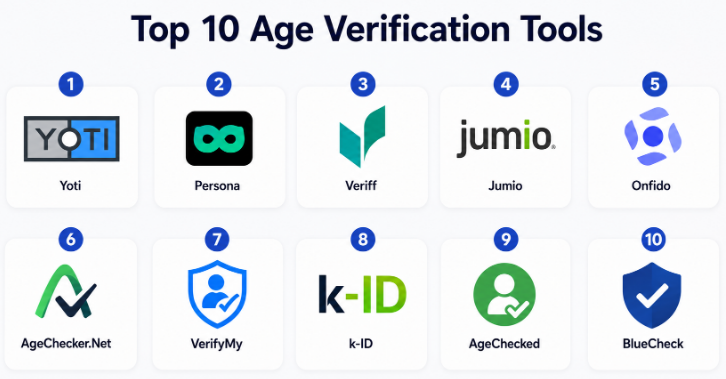
Top 10 Age Verification Tools
#1 — Yoti
Short description :
Yoti is an identity and age assurance platform used by businesses that need privacy-focused age checks, digital identity verification, facial age estimation, and document verification. It is suitable for online platforms, retail, gaming, social media, age-restricted products, and organizations that want flexible age assurance methods. Yoti supports different approaches, including age estimation from a selfie, digital ID, and document-based checks. It is especially useful for businesses that want to reduce unnecessary data sharing while still meeting age requirements. Yoti is a strong option for companies that care about privacy, user trust, and modern age assurance.
Key Features
- Age verification and age estimation options
- Facial age estimation support
- Digital ID-based verification
- Government ID document verification
- Liveness and anti-spoofing capabilities
- Business API and platform integration
- Privacy-focused age result sharing
Pros
- Strong privacy-first positioning
- Good range of age assurance methods
- Useful for platforms that want alternatives to ID-only verification
Cons
- Implementation depends on use case and region
- Some regulated industries may still require stronger ID checks
- Buyers should validate exact compliance requirements by market
Platforms / Deployment
Web / API / mobile app availability
Cloud deployment
Security & Compliance
Identity and age assurance workflows may include secure document processing, biometric checks, and privacy controls. Specific certifications such as SOC 2, ISO 27001, GDPR, or other compliance coverage should be verified directly.
Not publicly stated here for every use case.
Integrations & Ecosystem
Yoti can fit into digital platforms that need age checks, identity checks, and privacy-preserving verification.
- Website and app age checks
- Digital identity workflows
- Ecommerce and restricted-access flows
- Gaming and social platform workflows
- API-based integrations
- Age estimation and document verification systems
Support & Community
Yoti provides business-focused documentation and support resources. It is useful for organizations that need age assurance, identity verification, and privacy-aware user journeys.
#2 — Persona
Short description :
Persona is an identity verification platform that can support age verification through ID checks, document verification, face match, liveness checks, database checks, and workflow automation. It is suitable for fintech, marketplaces, online communities, ecommerce, gaming, social platforms, and regulated digital products. Persona is especially useful for companies that need customizable verification flows rather than a one-size-fits-all age gate. It can help businesses design risk-based checks for different user groups, regions, and compliance needs. Persona is a strong option when age verification is part of a broader identity and fraud prevention program.
Key Features
- Government ID verification
- Selfie and face match workflows
- Liveness detection support
- Custom verification flows
- Risk-based decisioning
- API and SDK integration
- Identity and fraud prevention workflows
Pros
- Highly flexible verification workflows
- Good for businesses needing age plus identity checks
- Suitable for risk-based compliance programs
Cons
- May be more advanced than simple age-gate needs
- Requires workflow planning and technical implementation
- Pricing and feature availability should be validated directly
Platforms / Deployment
Web / API / SDK
Cloud deployment
Security & Compliance
Identity verification platforms typically include access controls, secure data handling, and audit workflows. Specific certifications such as SOC 2, ISO 27001, GDPR, HIPAA, or other compliance claims should be verified directly.
Not publicly stated here for every use case.
Integrations & Ecosystem
Persona works well where age verification must connect with identity, risk, and compliance workflows.
- User onboarding
- KYC and identity checks
- Fraud prevention workflows
- Marketplace verification
- Fintech and regulated product onboarding
- API-based custom flows
Support & Community
Persona provides business and developer support resources. It is best for teams with technical resources and more complex verification requirements.
#3 — Veriff
Short description :
Veriff is an identity verification platform that supports document verification, biometric checks, liveness detection, fraud prevention, and age verification use cases. It is suitable for businesses that need to verify users remotely and reduce identity fraud. Veriff can be used by marketplaces, gaming platforms, fintech products, mobility platforms, ecommerce businesses, and regulated digital services. It is especially relevant when age verification requires stronger proof through official documents and identity matching. Veriff is a good fit for organizations that want identity verification and age confirmation in one process.
Key Features
- Government ID document verification
- Face match and selfie checks
- Liveness detection
- Fraud prevention signals
- Age verification through identity documents
- API and SDK integration
- Admin review and decision workflows
Pros
- Strong identity verification capability
- Useful for regulated or fraud-sensitive platforms
- Good fit when age verification must be tied to real identity
Cons
- ID-based verification can add user friction
- May be more than simple ecommerce age checks need
- Buyers should review regional document coverage
Platforms / Deployment
Web / API / SDK
Cloud deployment
Security & Compliance
Identity verification involves sensitive documents and biometric-related data. Buyers should verify encryption, data retention, privacy controls, certifications, and regional compliance directly.
Not publicly stated here for every use case.
Integrations & Ecosystem
Veriff can support platforms where verification must be built into onboarding or transaction flows.
- Marketplace onboarding
- Gaming and gambling checks
- Fintech identity workflows
- Ecommerce restricted access
- Mobile app verification
- Fraud prevention systems
Support & Community
Veriff provides business and developer support resources. It is best suited for companies with identity verification and fraud prevention needs beyond a simple age gate.
#4 — Jumio
Short description :
Jumio is an identity verification platform that supports age verification through document verification, biometric identity checks, liveness detection, and AI-assisted review. It is suitable for regulated industries, online gaming, gambling, financial services, ecommerce, social platforms, and age-restricted digital services. Jumio is especially relevant when businesses must confirm both identity and age with stronger assurance. It can help reduce fraud and support compliance programs. Jumio is a strong option for larger organizations that need mature identity verification workflows and global document support.
Key Features
- Identity document verification
- Biometric face matching
- Liveness detection
- AI-assisted verification workflows
- Age verification through ID documents
- Fraud detection support
- API and SDK integration
Pros
- Strong fit for regulated and high-risk industries
- Mature identity verification capabilities
- Useful for global onboarding and compliance workflows
Cons
- May be too heavy for simple website age gates
- ID verification can create user friction
- Implementation and pricing should be reviewed carefully
Platforms / Deployment
Web / API / SDK
Cloud deployment
Security & Compliance
Jumio handles sensitive identity and biometric-related workflows. Buyers should verify security certifications, privacy commitments, retention policies, and compliance coverage directly.
Not publicly stated here for every use case.
Integrations & Ecosystem
Jumio can be integrated into digital onboarding, restricted access, and compliance workflows.
- Online gaming and gambling verification
- Financial services onboarding
- Age-restricted ecommerce
- Marketplace user verification
- Mobile app onboarding
- Compliance and fraud systems
Support & Community
Jumio generally serves businesses with identity and compliance needs. Support availability may depend on plan, region, and implementation scope.
#5 — Onfido
Short description :
Onfido is an identity verification platform that supports document verification, biometric checks, liveness detection, fraud signals, and age verification through official documents. It is useful for businesses that need to verify users remotely and reduce fraud risk. Onfido is suitable for fintech, gaming, marketplaces, sharing economy platforms, online services, and regulated digital products. It is especially relevant when age verification is part of a broader onboarding and identity verification journey. Onfido is a strong option for teams that need document-based confidence rather than simple self-declared age checks.
Key Features
- Government ID verification
- Face match and biometric checks
- Liveness detection
- Fraud risk signals
- Age verification through ID data
- API and SDK workflows
- User onboarding and compliance support
Pros
- Strong identity verification foundation
- Good for age verification tied to onboarding
- Useful in fraud-sensitive or regulated industries
Cons
- May be more than low-risk websites need
- Requires user document submission in many flows
- Buyers should validate regional coverage and compliance fit
Platforms / Deployment
Web / API / SDK
Cloud deployment
Security & Compliance
Identity verification workflows involve sensitive personal data. Buyers should verify data protection, retention, security certifications, and compliance details directly.
Not publicly stated here for every use case.
Integrations & Ecosystem
Onfido fits platforms that need remote identity, age, and fraud checks during onboarding.
- Fintech onboarding
- Gaming and gambling verification
- Marketplace trust workflows
- App-based identity checks
- Compliance workflows
- Fraud prevention systems
Support & Community
Onfido provides business and developer resources. It is best for organizations with structured onboarding, verification, and compliance needs.
#6 — AgeChecker.Net
Short description :
AgeChecker.Net is an age verification tool designed mainly for ecommerce stores selling age-restricted products such as vaping products, tobacco-related goods, alcohol-related goods, and other restricted items. It supports real-time age verification during checkout and can verify customers through public records or photo ID upload when needed. AgeChecker.Net is especially useful for online merchants that need a checkout-friendly age verification flow. It is a strong option for businesses that want ecommerce integration and age compliance without building a custom system. It is more focused on ecommerce age checks than broad identity verification.
Key Features
- Real-time ecommerce age verification
- Public record-based checks
- Photo ID upload fallback
- Checkout integration support
- Age gate options
- Verification network reuse
- Restricted product compliance workflows
Pros
- Strong fit for age-restricted ecommerce
- Designed for checkout workflows
- Useful for merchants needing simple age compliance
Cons
- Less suitable for social platforms or gaming use cases
- Geographic coverage and match rates should be validated
- Not a full identity verification suite for all industries
Platforms / Deployment
Web / API / ecommerce integrations
Cloud deployment
Security & Compliance
Age verification involves personal and identity-related data. Buyers should review privacy, data retention, security practices, and compliance coverage directly.
Not publicly stated here for every use case.
Integrations & Ecosystem
AgeChecker.Net is focused on ecommerce and restricted product checkout flows.
- Ecommerce platforms
- Checkout workflows
- API-based custom integrations
- Age gate popups
- Restricted product stores
- Retail ID scanner workflows
Support & Community
AgeChecker.Net provides support resources for merchants and customer verification workflows. It is especially relevant for ecommerce sellers of restricted products.
#7 — VerifyMy
Short description :
VerifyMy provides age verification and identity verification tools for businesses that need to protect minors and comply with age-restricted access requirements. It supports age checks using methods such as government ID, face match, and other verification routes depending on use case. VerifyMy is suitable for online safety, adult-content compliance, gaming, ecommerce, marketplaces, and digital platforms requiring age assurance. It is especially useful for organizations that need a focused age verification provider rather than a general-purpose identity platform only. VerifyMy is a strong fit where age-gating and age assurance are central business requirements.
Key Features
- Age verification workflows
- Government ID checks
- Face match support
- Identity verification options
- Online access control for age-restricted services
- Business integration options
- Compliance-focused age assurance
Pros
- Strong focus on age verification use cases
- Useful for age-restricted digital platforms
- Supports ID and face match methods
Cons
- Exact method availability may vary by use case
- Buyers should validate country and industry coverage
- Integration planning may be required
Platforms / Deployment
Web / API
Cloud deployment
Security & Compliance
Age and identity verification involves sensitive personal data. Buyers should verify security controls, privacy practices, data retention, and compliance coverage directly.
Not publicly stated here for every use case.
Integrations & Ecosystem
VerifyMy can support digital platforms that need age-gated access and verification.
- Age-restricted websites
- Adult content platforms
- Gaming and entertainment
- Ecommerce workflows
- Identity verification flows
- Compliance reporting workflows
Support & Community
VerifyMy provides business-focused support resources. It is useful for companies where age assurance is a core compliance and safety requirement.
#8 — k-ID
Short description :
k-ID is an age assurance and youth safety platform designed to help digital products provide age-appropriate experiences across different markets. It is especially relevant for gaming platforms, social apps, youth-focused products, and online services that need to adapt features, permissions, notices, and parental consent based on a user’s age and jurisdiction. k-ID is broader than simple age verification because it supports age classification, parental consent, compliance guidance, and age-appropriate experience controls. It is a strong option for platforms serving children, teens, and families across multiple regions.
Key Features
- Age assurance workflows
- Age classification by jurisdiction
- Parental consent support
- Age-appropriate feature controls
- Compliance development support
- Global market configuration
- Youth safety and family workflow support
Pros
- Strong fit for youth-focused digital products
- Supports age-appropriate experience design
- Useful for global platforms with regional rules
Cons
- Not mainly an ecommerce checkout age verifier
- Best fit is digital product compliance and youth safety
- Buyers should validate implementation complexity
Platforms / Deployment
Web / API / developer tools
Cloud deployment
Security & Compliance
Age assurance and parental consent workflows may involve sensitive child and family data. Buyers should carefully review data protection, privacy, consent records, and compliance coverage directly.
Not publicly stated here for every use case.
Integrations & Ecosystem
k-ID fits digital products that need age-aware and region-aware experiences.
- Gaming platforms
- Social apps
- Youth communities
- Parental consent workflows
- Regional compliance logic
- Feature access control
Support & Community
k-ID provides developer and business resources for age assurance and youth safety. It is best for organizations that need more than a simple age check.
#9 — AgeChecked
Short description :
AgeChecked is an age verification provider focused on helping businesses verify whether users meet age requirements for restricted goods, services, or content. It is suitable for ecommerce, regulated products, gaming, gambling, and online age-restricted access flows. AgeChecked can support businesses that need a dedicated age verification process with different verification methods depending on user and market requirements. It is especially relevant when companies need proof of age without building their own verification workflow. It is a practical option for organizations that need focused age checks and compliance support.
Key Features
- Online age verification workflows
- Age-restricted product support
- Identity and age check methods
- Business integration options
- Ecommerce and digital access use cases
- Compliance-focused verification
- User verification status workflows
Pros
- Focused age verification capability
- Useful for restricted goods and digital services
- Can support compliance-led access control
Cons
- Exact verification methods should be validated directly
- May not be as broad as full identity verification platforms
- Buyer should confirm regional and industry coverage
Platforms / Deployment
Web / API
Cloud deployment
Security & Compliance
Age verification involves personal and identity-related data. Buyers should verify data retention, security controls, privacy policy, and compliance support directly.
Not publicly stated here for every use case.
Integrations & Ecosystem
AgeChecked can support businesses that need age checks within access, registration, or checkout flows.
- Restricted product ecommerce
- Online gambling and gaming workflows
- Age-gated websites
- API-based integration
- Compliance reporting
- User access controls
Support & Community
Support availability should be validated during evaluation. It is best for organizations that need a focused age verification solution.
#10 — BlueCheck
Short description :
BlueCheck is an age and identity verification tool focused on helping businesses verify customers for age-restricted products and services. It is commonly relevant for ecommerce and regulated-product sellers that need to confirm customer age before purchase or access. BlueCheck can support workflows where merchants need age checks without building custom verification infrastructure. It is especially practical for businesses selling restricted goods online. BlueCheck is best suited for companies that need age verification at checkout or account creation rather than broad identity orchestration.
Key Features
- Online age verification
- Identity verification support
- Checkout and restricted access use cases
- Ecommerce-focused workflows
- Verification status handling
- Customer age check support
- Compliance-oriented verification
Pros
- Useful for restricted product sellers
- Practical for ecommerce age verification
- Helps reduce manual verification work
Cons
- May not fit complex youth safety platforms
- Method coverage should be validated directly
- Not as broad as enterprise identity platforms
Platforms / Deployment
Web / API / ecommerce integration availability may vary
Cloud deployment
Security & Compliance
Age and identity verification involves sensitive user data. Buyers should validate data protection, retention, security controls, and compliance support directly.
Not publicly stated here for every use case.
Integrations & Ecosystem
BlueCheck fits businesses needing age verification in purchase or access flows.
- Ecommerce checkout
- Restricted product stores
- Account verification
- API-based verification
- Compliance record workflows
- Customer verification support
Support & Community
Support availability should be evaluated directly. BlueCheck is most relevant for businesses with age-restricted products or access requirements.
Comparison Table Top 10
| Tool Name | Best For | Platform(s) Supported | Deployment | Standout Feature | Public Rating |
|---|---|---|---|---|---|
| Yoti | Privacy-first age assurance and age estimation | Web, API, mobile app availability | Cloud | Facial age estimation and digital ID options | N/A |
| Persona | Custom identity and age verification workflows | Web, API, SDK | Cloud | Flexible risk-based verification flows | N/A |
| Veriff | ID-based identity and age verification | Web, API, SDK | Cloud | Document verification and face match | N/A |
| Jumio | Regulated identity and age verification | Web, API, SDK | Cloud | ID, biometric, and liveness verification | N/A |
| Onfido | Remote identity checks and age verification | Web, API, SDK | Cloud | Identity verification with fraud risk signals | N/A |
| AgeChecker.Net | Age-restricted ecommerce checkout | Web, API, ecommerce integrations | Cloud | Real-time checkout age verification | N/A |
| VerifyMy | Age verification for restricted digital access | Web, API | Cloud | Age verification with ID and face match options | N/A |
| k-ID | Youth safety and age-appropriate digital experiences | Web, API, developer tools | Cloud | Age assurance plus parental consent workflows | N/A |
| AgeChecked | Focused age verification for restricted services | Web, API | Cloud | Compliance-focused age checks | N/A |
| BlueCheck | Ecommerce and restricted product age checks | Web, API, ecommerce availability varies | Cloud | Age verification for restricted goods | N/A |
Evaluation & Age Verification Tools
| Tool Name | Core 25% | Ease 15% | Integrations 15% | Security 10% | Performance 10% | Support 10% | Value 15% | Weighted Total 0–10 |
|---|---|---|---|---|---|---|---|---|
| Yoti | 9.0 | 8.2 | 8.5 | 8.8 | 8.7 | 8.3 | 8.2 | 8.56 |
| Persona | 9.0 | 7.8 | 9.0 | 8.8 | 8.8 | 8.2 | 7.8 | 8.49 |
| Veriff | 8.8 | 8.0 | 8.7 | 8.7 | 8.7 | 8.2 | 7.8 | 8.41 |
| Jumio | 9.0 | 7.6 | 8.8 | 8.8 | 8.8 | 8.2 | 7.5 | 8.39 |
| Onfido | 8.8 | 7.8 | 8.7 | 8.7 | 8.7 | 8.2 | 7.7 | 8.37 |
| AgeChecker.Net | 8.2 | 8.7 | 8.2 | 8.0 | 8.4 | 8.0 | 8.5 | 8.29 |
| VerifyMy | 8.5 | 8.0 | 8.2 | 8.3 | 8.4 | 8.0 | 8.0 | 8.23 |
| k-ID | 8.8 | 7.8 | 8.5 | 8.5 | 8.4 | 8.0 | 7.8 | 8.31 |
| AgeChecked | 8.0 | 8.0 | 7.8 | 8.0 | 8.2 | 7.8 | 8.0 | 7.98 |
| BlueCheck | 7.8 | 8.0 | 7.6 | 7.8 | 8.0 | 7.6 | 8.0 | 7.82 |
These scores are comparative and should be used as a starting point. A social or gaming platform may rate k-ID or Yoti higher because age assurance and age-appropriate experiences matter. An ecommerce seller may prefer AgeChecker.Net, BlueCheck, or AgeChecked because checkout integration is more important. A fintech, gambling, or regulated product may prefer Persona, Veriff, Jumio, or Onfido because stronger identity verification is required.
Which Age Verification Tool Should You Choose?
Solo / Small Website
A small website should first decide whether it needs real age verification or just a basic age gate. If the requirement is low-risk, a simple age confirmation may be enough. If the business sells restricted products, real verification is safer.
For small ecommerce sellers, AgeChecker.Net, BlueCheck, or AgeChecked may be practical starting points. These tools are more focused on restricted-product workflows than broad identity platforms.
Small Business
Small businesses selling age-restricted products should prioritize ease of integration, checkout experience, verification success rate, customer support, and compliance fit. AgeChecker.Net, VerifyMy, AgeChecked, and BlueCheck are good tools to compare.
Small businesses should avoid overcomplicated identity workflows unless their industry requires stronger checks. A smooth user experience matters because too much friction can reduce completed purchases.
Mid-Market Platform
Mid-market companies often need stronger API control, multiple verification methods, fraud prevention, user dashboards, and regional policy support. Yoti, Persona, Veriff, Onfido, VerifyMy, and Jumio are strong options depending on risk level.
At this stage, teams should test ID checks, age estimation, face match, liveness, error handling, reporting, and user drop-off before full rollout.
Enterprise / Regulated Platform
Large platforms, gaming companies, gambling operators, fintech products, social platforms, and global marketplaces may need advanced workflows, multiple verification routes, audit logs, fraud controls, and regional compliance coverage. Persona, Jumio, Veriff, Onfido, Yoti, and k-ID are strong enterprise-level options to evaluate.
Enterprise teams should involve legal, privacy, security, product, compliance, engineering, customer support, and trust and safety teams before selecting a vendor.
Budget vs Premium
Budget-focused teams should avoid buying more than they need. A simple ecommerce store may only need checkout-based age verification. A youth-facing social platform may need deeper age assurance, parental consent, and region-specific controls.
Premium tools are worth considering when the business faces legal risk, fraud risk, high user volume, multiple regions, or strict compliance expectations.
Feature Depth vs Ease of Use
AgeChecker.Net, BlueCheck, and AgeChecked are more practical for ecommerce age verification. Yoti and k-ID are stronger for privacy-first age assurance and youth safety. Persona, Veriff, Jumio, and Onfido are deeper identity verification platforms that work well when age must be tied to real identity.
The best tool depends on whether the main requirement is checkout age verification, age estimation, parental consent, identity verification, or regulatory compliance.
Integrations & Scalability
Age verification tools may need to integrate with ecommerce platforms, websites, mobile apps, user onboarding, checkout flows, payment systems, identity systems, compliance dashboards, and fraud prevention tools. Integration quality directly affects user experience.
Scalability also includes verification volume, supported countries, document coverage, retry flows, manual review, support response time, and reporting.
Security & Compliance Needs
Age verification tools may process sensitive data such as IDs, selfies, biometric-related signals, dates of birth, addresses, and account information. Buyers should review encryption, data retention, privacy controls, consent, regional compliance, audit logs, and data minimization.
Platforms involving minors must be especially careful with privacy, parental consent, and age-appropriate data handling.
Frequently Asked Questions FAQs
1. What are Age Verification Tools?
Age Verification Tools help businesses confirm whether a user meets a required age threshold before accessing a product, service, website, app, or transaction. They may use ID documents, selfies, public records, age estimation, or digital identity methods.
2. How is age verification different from an age gate?
An age gate usually asks users to confirm their age manually, often by entering a date of birth. Real age verification checks the user’s age through stronger methods such as ID documents, public records, digital ID, facial age estimation, or verified consent.
3. What features should I look for first?
Start with verification methods, user experience, privacy controls, API integration, regional coverage, reporting, fraud checks, manual review options, and compliance fit. The right features depend on your industry and risk level.
4. Can age verification tools protect user privacy?
Yes, some tools are designed to verify age without sharing full identity details with the business. Buyers should look for data minimization, limited retention, secure processing, and clear privacy controls.
5. What is facial age estimation?
Facial age estimation uses a selfie to estimate whether a user is above or below a required age threshold. It can reduce the need for ID scans in some situations, but accuracy and suitability depend on the use case and legal requirements.
6. Do age verification tools require government ID?
Not always. Some tools support alternatives such as facial age estimation, digital ID, public record checks, parental consent, or payment-based verification. High-risk or regulated industries may still require government ID checks.
7. Which tool is best for ecommerce age verification?
AgeChecker.Net, BlueCheck, AgeChecked, and VerifyMy are practical options for ecommerce and restricted-product workflows. The best choice depends on platform compatibility, checkout experience, region, and product category.
8. Which tool is best for youth safety and parental consent?
k-ID and Yoti are strong options to evaluate when the goal is age assurance, youth safety, age-appropriate experiences, and parental consent workflows. The right choice depends on platform type and market requirements.
9. Which tool is best for regulated identity verification?
Persona, Veriff, Jumio, and Onfido are strong options when age verification must be tied to identity verification, fraud prevention, liveness checks, and document review. These are useful for higher-risk industries.
10. What are common mistakes when choosing age verification tools?
Common mistakes include using a simple age gate when real verification is required, collecting too much user data, ignoring privacy impact, not testing checkout friction, failing to check regional laws, and choosing a tool without clear audit records.
Conclusion
Age Verification Tools are becoming important for businesses that sell restricted products, run age-sensitive platforms, protect minors, or operate in regulated digital environments. The best tool depends on your business model, risk level, user experience goals, compliance requirements, and privacy expectations. Yoti is strong for privacy-first age assurance and age estimation. Persona, Veriff, Jumio, and Onfido are better suited for identity-heavy and regulated use cases. AgeChecker.Net, AgeChecked, BlueCheck, and VerifyMy are practical for age-restricted ecommerce and digital access. k-ID is useful for platforms that need youth safety, parental consent, and age-appropriate experiences.
