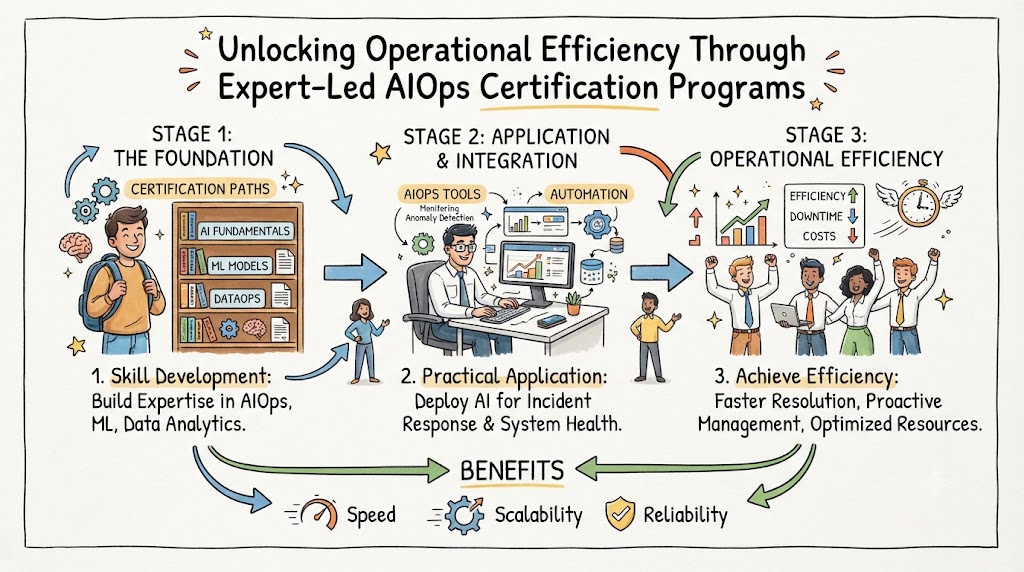
Introduction
In the current era of distributed systems, hyper-scale cloud environments, and rapid microservices deployment, IT complexity has reached unprecedented levels. IT teams are frequently overwhelmed by a deluge of telemetry data, making it nearly impossible to distinguish critical signals from background noise. This operational fatigue not only delays incident resolution but also increases the risk of prolonged downtime that impacts business revenue.
The industry solution is clear: the transition toward Artificial Intelligence for IT Operations (AIOps). By leveraging machine learning to automate event correlation, anomaly detection, and predictive diagnostics, organizations can shift their focus from reactive firefighting to proactive, intelligent operations. For professionals eager to stay ahead of this paradigm shift, formalizing your expertise is a critical career move. Whether you are looking to refine your observability skills or lead enterprise-wide automation initiatives, AIOpsSchool provides the specialized training, certification, and consulting expertise required to excel in the evolving landscape of intelligent operations.
Featured Snippet
What Is AIOps?
AIOps (Artificial Intelligence for IT Operations) integrates machine learning, data analytics, and automation to streamline IT management. It processes massive volumes of logs, metrics, and traces to detect anomalies, correlate related events into single incidents, and automate root cause identification, significantly improving system reliability and reducing MTTR (Mean Time to Repair).
Understanding AIOps
What Is Artificial Intelligence for IT Operations?
At its core, AIOps uses algorithmic intelligence to process data that humans cannot analyze at scale. It acts as an abstraction layer that contextualizes raw operational data.
Why Traditional IT Operations Are No Longer Enough
Traditional monitoring relies on static, manual configuration. In a modern, elastic Kubernetes environment, hard-coded thresholds become obsolete the moment they are set.
How AI and Machine Learning Improve Operations
ML models analyze historical data to establish dynamic baselines for “normal” system behavior, enabling the system to surface genuine anomalies while filtering out routine operational chatter.
Evolution from Monitoring to Intelligent Operations
| Traditional Operations | AIOps-Driven Operations |
| Reactive threshold-based alerts | Proactive anomaly-based insights |
| Manual, siloed data analysis | Unified, AI-correlated intelligence |
| High MTTR (Mean Time to Repair) | Accelerated incident resolution |
| Static, manual maintenance | Continuous, automated improvement |
Why AIOps Skills Are Becoming Essential
Growth of Cloud-Native Infrastructure
The modular nature of cloud-native systems makes them difficult to track via legacy tools, requiring intelligent observability.
Rise of Distributed Systems
Distributed tracing is now vital; AIOps provides the capability to map complex interdependencies across microservices.
Demand for Reliability Engineering
As organizations demand higher uptime, the ability to predict failures via AIOps has become a core competency for modern engineers.
AIOps Certification Explained
What Is an AIOps Certification?
A professional certification validates that an engineer possesses the theoretical and practical proficiency to design, build, and maintain AI-powered operational frameworks.
Benefits of Professional Certification
- Skill Validation: Demonstrates mastery over complex observability stacks.
- Industry Recognition: Positions you as a leader in SRE and DevOps transformation.
- Career Growth: Opens doors to senior-level architectural and consulting roles.
Who Should Pursue AIOps Certification?
- DevOps Engineers: To integrate intelligence into deployment pipelines.
- SRE Engineers: To reduce toil and improve reliability.
- Cloud/Platform Engineers: To manage large-scale multi-cloud infrastructure.
- IT Managers: To guide organizational strategy and tool adoption.
AIOps Training and Courses
Key Learning Modules
- Machine Learning Fundamentals: Applying algorithms to operational datasets.
- Event Correlation: Turning a flood of alerts into a single, actionable ticket.
- Intelligent Alerting: Reducing false positives to prevent “alert fatigue.”
- Root Cause Analysis (RCA): Automated diagnostic paths.
- Observability Strategy: Deep dives into logs, metrics, and traces.
- OpenTelemetry Standards: Implementing vendor-neutral data ingestion.
AIOps Engineer Certification Path
| Level | Skills | Outcome |
| Beginner | Monitoring Basics, Linux, Python | Observability Foundations |
| Intermediate | Kubernetes, OpenTelemetry, ML Basics | Alert Reduction Expertise |
| Advanced | Predictive Analytics, Self-Healing Ops | Architecture & Strategy |
AIOps Engineer Career Roadmap
Required Technical Skills
A successful AIOps journey begins with mastering Linux, Networking, Cloud Platforms, Kubernetes, Python, and Monitoring Tooling.
Learning Sequence
- Observability Mastery: Build a strong foundation in data collection.
- Data Architecture: Learn how to structure and store operational data efficiently.
- Algorithmic Literacy: Understand how models detect anomalies.
- Automation Logic: Develop scripts and workflows that act upon AI insights.
AI Observability Training
What Is AI Observability?
It is the marriage of traditional monitoring with deep analysis, providing the “why” behind system performance.
Comparison: Monitoring vs. Observability
| Feature | Monitoring | Observability |
| Focus | System Health | System Understanding |
| Nature | Pre-defined | Exploratory |
| Scope | Known Failure Modes | Unknown Failure Modes |
AIOps for SRE and DevOps Engineers
Reducing Alert Fatigue
AIOps tools group related alerts from different services, ensuring SREs only address meaningful incidents rather than fragmented symptoms.
Improving Incident Response
By automating initial diagnostics, AIOps provides developers with the specific service or code path causing an issue, drastically reducing MTTR.
Enterprise AIOps Consulting
Organizations require AIOps consulting to navigate the maturity transition. Consulting helps define the AIOps Roadmap, ensuring that technology adoption is supported by cultural and process shifts.
The Implementation Lifecycle
- Assessment: Evaluating existing telemetry maturity.
- Design: Architecting the observability pipeline.
- Tool Selection: Aligning tools with business-specific requirements.
- Integration: Unifying logs, metrics, and traces.
- Optimization: Continuous feedback loops for model accuracy.
Frequently Asked Questions
- What is AIOps Certification?It is a professional qualification validating your ability to implement and manage AI-driven operational tools, ensuring you can design systems that automate anomaly detection and incident resolution.
- Who should learn AIOps?DevOps engineers, SREs, platform engineers, and IT managers aiming to modernize their operations and improve system reliability.
- What skills are required for AIOps Engineers?A combination of infrastructure management (Cloud/Kubernetes), data handling, basic machine learning concepts, and proficiency in modern observability tools like OpenTelemetry.
- How does AIOps help DevOps teams?It minimizes manual toil by automating event correlation, which allows DevOps teams to spend less time investigating noise and more time focused on feature delivery.
- What is AI Observability?It is an advanced approach to monitoring that uses AI to analyze complex, high-cardinality telemetry data, providing deeper visibility into the root causes of performance issues.
- What is OpenTelemetry?A standardized, open-source framework for collecting and transmitting telemetry data, ensuring consistency and vendor-neutral observability across your entire tech stack.
- How long does it take to learn AIOps?For experienced IT professionals, grasping the core theory takes a few weeks, while gaining practical implementation expertise typically develops through several months of structured, hands-on learning.
- What are AIOps Implementation Services?These are expert-led services that help organizations assess, plan, and deploy AIOps tools to ensure they are properly configured to deliver business value.
- Is AIOps a good career choice?Yes. As enterprises digitize and automate, the demand for professionals who can manage AI-powered operations is rapidly outpacing the current supply of talent.
- What is the future of AIOps?The industry is trending toward “Autonomous Operations,” where AI systems will proactively identify, diagnose, and resolve infrastructure issues without human intervention.
FINAL SUMMARY
AIOps represents the next frontier in operational excellence. By moving from manual monitoring to intelligent, automated systems, enterprises can achieve higher reliability, lower costs, and better user experiences. Whether you are an SRE seeking to reduce alert fatigue or a manager driving digital transformation, the investment in AIOps training is a strategic step toward professional growth. We encourage you to explore the certification, consulting, and implementation frameworks available at AIOpsSchool to master these critical skills.
