Introduction
Telecom OSS/BSS systems are the foundational software platforms that power how telecom operators run their networks and manage customers. OSS (Operations Support Systems) handles the technical side—network monitoring, service provisioning, fault management, and inventory—while BSS (Business Support Systems) handles the commercial side—billing, CRM, product catalog, order management, and revenue processing. Together, they form the “brain” of telecom operations, connecting network infrastructure with customer-facing services.
In OSS/BSS platforms are undergoing major transformation due to 5G, cloud-native networks, IoT growth, and AI-driven automation. Telecom operators are moving away from monolithic legacy stacks toward modular, API-first, and cloud-native architectures that enable faster service launches and real-time network intelligence.
Modern OSS/BSS systems are no longer just back-office tools—they are real-time orchestration engines that directly impact customer experience, service agility, and revenue growth.
Common use cases include:
- End-to-end service provisioning (order → activation → billing)
- Real-time network monitoring and fault detection
- Customer lifecycle management and CRM
- Billing, charging, and revenue assurance
- 5G service orchestration and slicing management
- IoT device lifecycle management
- Wholesale and MVNO operations
- Network inventory and resource allocation
When evaluating OSS/BSS systems, buyers should consider:
- Modular vs monolithic architecture
- Cloud-native readiness (Kubernetes, microservices)
- API-first integration capability
- Real-time vs batch processing performance
- Billing accuracy and revenue assurance
- Service orchestration speed
- Scalability for 5G and IoT workloads
- Multi-vendor interoperability
- Data model flexibility
- AI/automation capabilities (AIOps, closed-loop control)
Best for: Telecom operators (MNOs, MVNOs), ISPs, satellite providers, IoT service providers, and large digital service providers managing complex networks and billing systems.
Not ideal for: Small IT environments or organizations without telecom-grade billing, provisioning, or network operations complexity.
Key Trends in Telecom OSS/BSS Systems
- Shift from monolithic OSS/BSS to cloud-native, microservices-based platforms
- Adoption of AI-driven AIOps for predictive network management
- Real-time charging and billing for 5G and IoT services
- Increased API standardization via TM Forum Open APIs
- Convergence of OSS, BSS, and orchestration layers
- Use of digital twins for network simulation and optimization
- Rise of “composable telecom stacks” (plug-and-play components)
- Strong focus on closed-loop automation (detect → decide → act)
- Integration with data lakes and analytics platforms
- Expansion of self-service digital customer journeys
How We Selected These Tools (Methodology)
The platforms below were selected based on telecom industry adoption, architectural maturity, and functional coverage across OSS and BSS domains.
Selection criteria included:
- End-to-end OSS + BSS capability coverage
- Telecom-grade scalability and reliability
- Support for 5G, IoT, and cloud-native networks
- API maturity and integration ecosystem
- Billing, charging, and revenue assurance strength
- Network orchestration and automation capabilities
- Real-time analytics and monitoring support
- Deployment flexibility (cloud, hybrid, on-prem)
- Vendor adoption in telecom operators
- Ability to support multi-domain services (mobile, broadband, IoT)
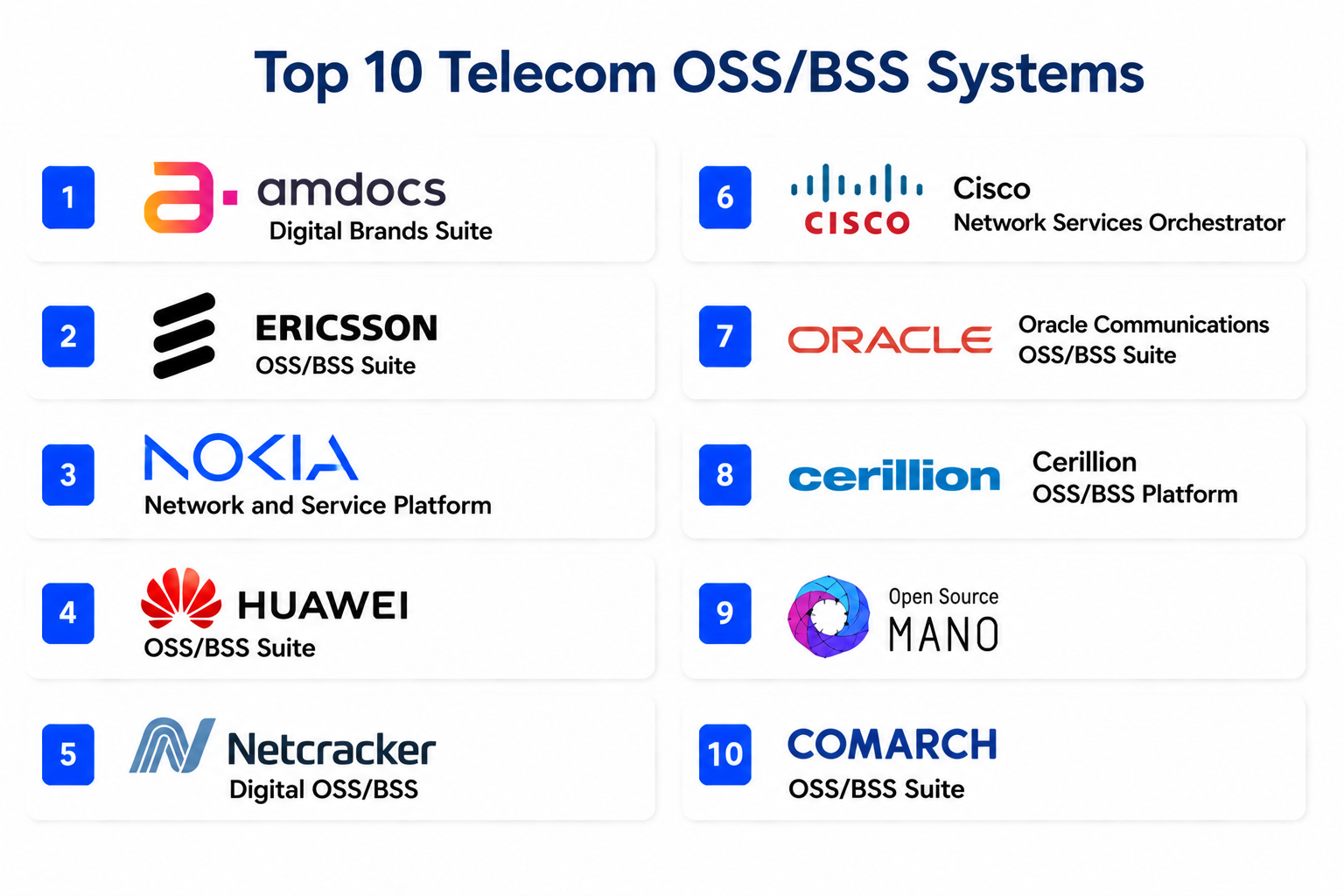
Top 10 Telecom OSS/BSS Systems
#1 — Amdocs Digital Brands Suite
Short description :
Amdocs is one of the most widely used OSS/BSS providers in global telecom environments, offering a full-stack suite for digital services, billing, CRM, and service orchestration. It is designed for large telecom operators managing millions of subscribers and complex service portfolios across mobile, broadband, and digital services.
Key Features
- End-to-end BSS (billing, CRM, order management)
- OSS service orchestration and fulfillment
- Real-time charging and rating engine
- Product catalog and lifecycle management
- Revenue assurance and analytics
- Digital customer experience tools
- Multi-service and multi-play support
Pros
- Extremely mature telecom-grade platform
- Strong global operator adoption
- Deep billing and revenue capabilities
Cons
- High implementation complexity
- Expensive licensing and operations
- Long deployment cycles
Platforms / Deployment
- Cloud / Hybrid / On-prem
Security & Compliance
- RBAC
- MFA
- Audit logging
- Encryption support
Integrations & Ecosystem
- Network equipment vendors
- Cloud platforms
- CRM systems
- Analytics tools
- Third-party billing systems
Support & Community
Strong enterprise telecom support with global operator ecosystem.
#2 — Ericsson OSS/BSS Suite
Short description :
Ericsson provides a comprehensive OSS/BSS ecosystem focused on network-centric operations, service orchestration, and 5G readiness. It is widely used by mobile operators for network automation and lifecycle management.
Key Features
- Network service orchestration
- OSS fault and performance management
- BSS billing and customer management
- 5G service lifecycle management
- Network inventory and topology management
- Policy and charging control integration
- AI-assisted network optimization
Pros
- Strong 5G and network focus
- Excellent OSS capabilities
- Deep telecom infrastructure integration
Cons
- Complex system integration
- Requires telecom engineering expertise
- Less flexible for non-telco use cases
Platforms / Deployment
- Cloud / Hybrid / On-prem
Security & Compliance
- RBAC
- Encryption support
- Audit logs
- Telecom-grade compliance support
Integrations & Ecosystem
- Network function vendors
- Cloud-native 5G cores
- Charging systems
- Analytics platforms
- OSS orchestration tools
Support & Community
Strong telecom operator support and global deployment footprint.
#3 — Nokia Network and Service Platform (NSP)
Short description :
Nokia NSP provides OSS capabilities for service orchestration, network automation, and lifecycle management across multi-vendor telecom environments. It is widely used in large-scale broadband, mobile, and enterprise networks.
Key Features
- Service orchestration and automation
- Network inventory management
- Fault and performance monitoring
- Multi-vendor network support
- 5G service provisioning
- Closed-loop automation
- API-driven architecture
Pros
- Strong multi-vendor interoperability
- Excellent network automation features
- Scalable telecom architecture
Cons
- Requires integration with external BSS
- Complex configuration
- Steep operational learning curve
Platforms / Deployment
- Cloud / Hybrid
Security & Compliance
- RBAC
- Audit logging
- Encryption support
- Role-based network access
Integrations & Ecosystem
- 5G network functions
- OSS orchestration systems
- Cloud platforms
- Analytics engines
- Third-party BSS tools
Support & Community
Strong enterprise telecom support and global adoption.
#4 — Huawei OSS/BSS Suite
Short description :
Huawei OSS/BSS suite supports end-to-end telecom operations including network management, billing, and service orchestration. It is widely used in large mobile and broadband operator environments.
Key Features
- Integrated OSS and BSS stack
- Network provisioning and monitoring
- Billing and charging systems
- Service catalog management
- 5G and IoT support
- AI-driven network optimization
- Fault management systems
Pros
- Strong integrated telecom suite
- High scalability for large networks
- Deep 5G capabilities
Cons
- Complex deployment structure
- Vendor lock-in concerns
- Requires specialized expertise
Platforms / Deployment
- Cloud / Hybrid / On-prem
Security & Compliance
- RBAC
- Encryption support
- Audit logs
- Telecom security frameworks
Integrations & Ecosystem
- Network infrastructure
- Cloud environments
- OSS orchestration systems
- Billing engines
- Analytics tools
Support & Community
Strong global telecom deployment base.
#5 — Netcracker Digital OSS/BSS
Short description :
Netcracker provides a full-stack digital OSS/BSS platform focused on revenue management, service orchestration, and digital transformation for telecom operators.
Key Features
- Digital BSS suite (CRM, billing, catalog)
- OSS service orchestration
- Revenue management and analytics
- Product lifecycle management
- Real-time charging engine
- Partner and wholesale management
- AI-driven automation
Pros
- Strong end-to-end telecom suite
- Good digital transformation capabilities
- Scalable architecture
Cons
- Complex implementation cycles
- High cost for enterprise deployment
- Requires heavy customization
Platforms / Deployment
- Cloud / Hybrid / On-prem
Security & Compliance
- RBAC
- MFA
- Audit logging
- Encryption support
Integrations & Ecosystem
- Network systems
- Cloud platforms
- CRM tools
- Analytics engines
- Third-party telecom systems
Support & Community
Strong enterprise telecom support.
#6 — Cisco Network Services Orchestrator (NSO)
Short description :
Cisco NSO focuses on service orchestration and automation for telecom and enterprise networks. It is widely used for provisioning and lifecycle management in multi-vendor environments.
Key Features
- Service orchestration engine
- Multi-vendor network provisioning
- API-first automation
- Configuration management
- Network service modeling
- Closed-loop automation support
- Real-time provisioning
Pros
- Excellent orchestration capabilities
- Strong multi-vendor support
- Highly flexible API-driven design
Cons
- Requires strong engineering expertise
- Not a full BSS system
- Needs integration with external OSS/BSS
Platforms / Deployment
- Cloud / On-prem / Hybrid
Security & Compliance
- RBAC
- Audit logging
- Encryption support
Integrations & Ecosystem
- Network devices
- OSS/BSS platforms
- Cloud orchestration systems
- Monitoring tools
- Automation frameworks
Support & Community
Strong enterprise networking ecosystem support.
#7 — Oracle Communications OSS/BSS Suite
Short description :
Oracle provides a comprehensive telecom OSS/BSS suite for billing, revenue management, service orchestration, and customer experience management.
Key Features
- Billing and revenue management
- Service orchestration
- Customer experience management
- Product catalog and order management
- Network resource management
- Policy and charging systems
- Analytics and reporting
Pros
- Strong enterprise billing capabilities
- Scalable telecom architecture
- Good integration ecosystem
Cons
- Complex implementation
- High cost
- Requires specialized expertise
Platforms / Deployment
- Cloud / Hybrid / On-prem
Security & Compliance
- RBAC
- MFA
- Encryption support
- Audit logging
Integrations & Ecosystem
- Telecom networks
- Cloud platforms
- CRM systems
- Analytics tools
- Partner systems
Support & Community
Strong enterprise telecom support.
#8 — Cerillion OSS/BSS Platform
Short description :
Cerillion offers a modular OSS/BSS platform designed for telecom operators and MVNOs, focusing on billing, CRM, and service provisioning.
Key Features
- BSS billing and CRM
- Product catalog management
- Service provisioning
- Order management workflows
- Revenue assurance tools
- Wholesale and MVNO support
- Self-service portals
Pros
- Flexible modular architecture
- Strong MVNO support
- Faster deployment than legacy stacks
Cons
- Smaller ecosystem than major vendors
- Limited ultra-large-scale deployments
- Requires integration for advanced OSS
Platforms / Deployment
- Cloud / Hybrid
Security & Compliance
- RBAC
- MFA
- Audit logs
- Encryption support
Integrations & Ecosystem
- Telecom operators
- Billing systems
- Cloud platforms
- CRM tools
- Payment gateways
Support & Community
Strong telecom-focused vendor support.
#9 — Open Source MANO (ETSI OSM)
Short description :
ETSI Open Source MANO (OSM) is an open-source orchestration framework used for automating telecom network services, especially in NFV and cloud-native environments.
Key Features
- Network function virtualization orchestration
- Service lifecycle management
- Cloud-native automation
- API-driven architecture
- Multi-vendor NFV support
- SDN integration
- Service modeling tools
Pros
- Open-source flexibility
- Strong NFV/5G alignment
- No vendor lock-in
Cons
- Requires high engineering effort
- Limited enterprise support
- Needs integration with full OSS/BSS stack
Platforms / Deployment
- Cloud / On-prem
Security & Compliance
- RBAC
- Audit logging
- Encryption support (varies by deployment)
Integrations & Ecosystem
- NFV platforms
- SDN controllers
- Telecom orchestration tools
- Cloud systems
- OSS/BSS stacks
Support & Community
Strong open-source telecom community support.
#10 — Comarch OSS/BSS Suite
Short description :
Comarch provides a full OSS/BSS suite covering billing, CRM, network management, and service assurance for telecom operators and digital service providers.
Key Features
- Billing and charging systems
- CRM and customer management
- Service assurance tools
- Network inventory management
- Product catalog and order management
- Revenue management
- Analytics and reporting
Pros
- Strong end-to-end telecom coverage
- Good modular flexibility
- Reliable enterprise performance
Cons
- Less known than top-tier vendors
- Requires integration effort
- Complex deployments for large operators
Platforms / Deployment
- Cloud / Hybrid / On-prem
Security & Compliance
- RBAC
- MFA
- Audit logs
- Encryption support
Integrations & Ecosystem
- Telecom infrastructure
- Cloud platforms
- CRM systems
- Billing engines
- Analytics tools
Support & Community
Solid enterprise telecom support.
Comparison Table (Top 10)
| Tool Name | Best For | Platform(s) Supported | Deployment | Standout Feature | Public Rating |
|---|---|---|---|---|---|
| Amdocs | Tier-1 operators | Multi-platform | Hybrid | End-to-end OSS/BSS | N/A |
| Ericsson | 5G networks | Multi-platform | Hybrid | Network orchestration | N/A |
| Nokia NSP | Multi-vendor OSS | Multi-platform | Cloud/Hybrid | Service automation | N/A |
| Huawei OSS/BSS | Large carriers | Multi-platform | Hybrid | Integrated suite | N/A |
| Netcracker | Digital telcos | Multi-platform | Hybrid | Revenue management | N/A |
| Cisco NSO | Orchestration | Multi-platform | Hybrid | Service automation | N/A |
| Oracle | Billing-heavy ops | Multi-platform | Hybrid | Revenue systems | N/A |
| Cerillion | MVNOs | Multi-platform | Cloud/Hybrid | Modular BSS | N/A |
| ETSI OSM | NFV orchestration | Multi-platform | Cloud | Open-source MANO | N/A |
| Comarch | Mid-to-large telcos | Multi-platform | Hybrid | Full OSS/BSS suite | N/A |
Evaluation & Telecom OSS/BSS Systems
| Tool Name | Core (25%) | Ease (15%) | Integrations (15%) | Security (10%) | Performance (10%) | Support (10%) | Value (15%) | Weighted Total (0–10) |
|---|---|---|---|---|---|---|---|---|
| Amdocs | 10 | 7 | 10 | 10 | 9 | 9 | 6 | 8.6 |
| Ericsson | 9 | 7 | 9 | 10 | 9 | 9 | 7 | 8.4 |
| Nokia NSP | 9 | 7 | 9 | 9 | 9 | 8 | 8 | 8.3 |
| Huawei | 9 | 6 | 9 | 9 | 9 | 8 | 7 | 8.0 |
| Netcracker | 9 | 7 | 9 | 9 | 9 | 8 | 7 | 8.2 |
| Cisco NSO | 8 | 8 | 9 | 9 | 9 | 8 | 9 | 8.4 |
| Oracle | 9 | 7 | 9 | 10 | 9 | 9 | 6 | 8.3 |
| Cerillion | 8 | 8 | 8 | 8 | 8 | 8 | 8 | 8.0 |
| ETSI OSM | 7 | 6 | 8 | 8 | 8 | 7 | 10 | 7.8 |
| Comarch | 8 | 7 | 8 | 8 | 8 | 8 | 8 | 8.0 |
Which Telecom OSS/BSS System Should You Choose?
Small operators / MVNOs
Cerillion or Comarch for faster deployment and modular billing systems.
Mid-market telecom providers
Netcracker, Nokia NSP, or Ericsson OSS for balanced OSS/BSS capabilities.
Tier-1 telecom operators
Amdocs, Huawei, Oracle, and Ericsson for full-stack scalability and reliability.
Network-first organizations
Cisco NSO or Nokia NSP for strong orchestration and automation.
Cloud-native / NFV environments
ETSI OSM for open-source orchestration flexibility.
Budget vs Enterprise
Open-source and modular vendors reduce cost but require engineering effort, while enterprise platforms offer full lifecycle management with higher investment.
OSS vs BSS focus
- OSS-heavy: Ericsson, Nokia, Cisco
- BSS-heavy: Amdocs, Oracle, Netcracker
- Balanced suites: Huawei, Comarch, Cerillion
Frequently Asked Questions (FAQs)
1. What is OSS in telecom?
OSS (Operations Support Systems) manages network operations like provisioning, monitoring, fault management, and service assurance.
2. What is BSS in telecom?
BSS (Business Support Systems) handles billing, CRM, customer management, and revenue processes.
3. Why are OSS/BSS systems important?
They ensure telecom networks run efficiently while enabling accurate billing and customer service.
4. Are OSS and BSS separate systems?
They can be separate, but modern telecom stacks integrate them for end-to-end automation.
5. What is service orchestration?
It is the automated process of activating and managing telecom services across network components.
6. What is revenue assurance?
It ensures that all services used by customers are correctly billed and accounted for.
7. Are OSS/BSS systems cloud-based?
Modern systems are increasingly cloud-native, but many enterprises still use hybrid deployments.
8. What is 5G’s impact on OSS/BSS?
5G increases complexity, requiring real-time orchestration, slicing, and automation.
9. What is MVNO in telecom?
A Mobile Virtual Network Operator that uses another operator’s infrastructure and relies heavily on BSS platforms.
10. What is the biggest OSS/BSS challenge?
Legacy system integration and modernization without disrupting live telecom services.
Conclusion
Telecom OSS/BSS systems remain the backbone of global communication networks, enabling operators to manage both the technical and commercial sides of massive, complex infrastructures. As telecom evolves toward 5G, IoT, and cloud-native architectures, OSS/BSS platforms are also shifting toward modular, API-first, and AI-driven systems that support real-time automation and service agility. The best solution depends heavily on operator scale and architecture maturity. Tier-1 carriers often rely on enterprise-grade platforms like Amdocs, Ericsson, and Huawei, while mid-market and MVNOs prefer more modular and agile systems like Cerillion or Comarch.
