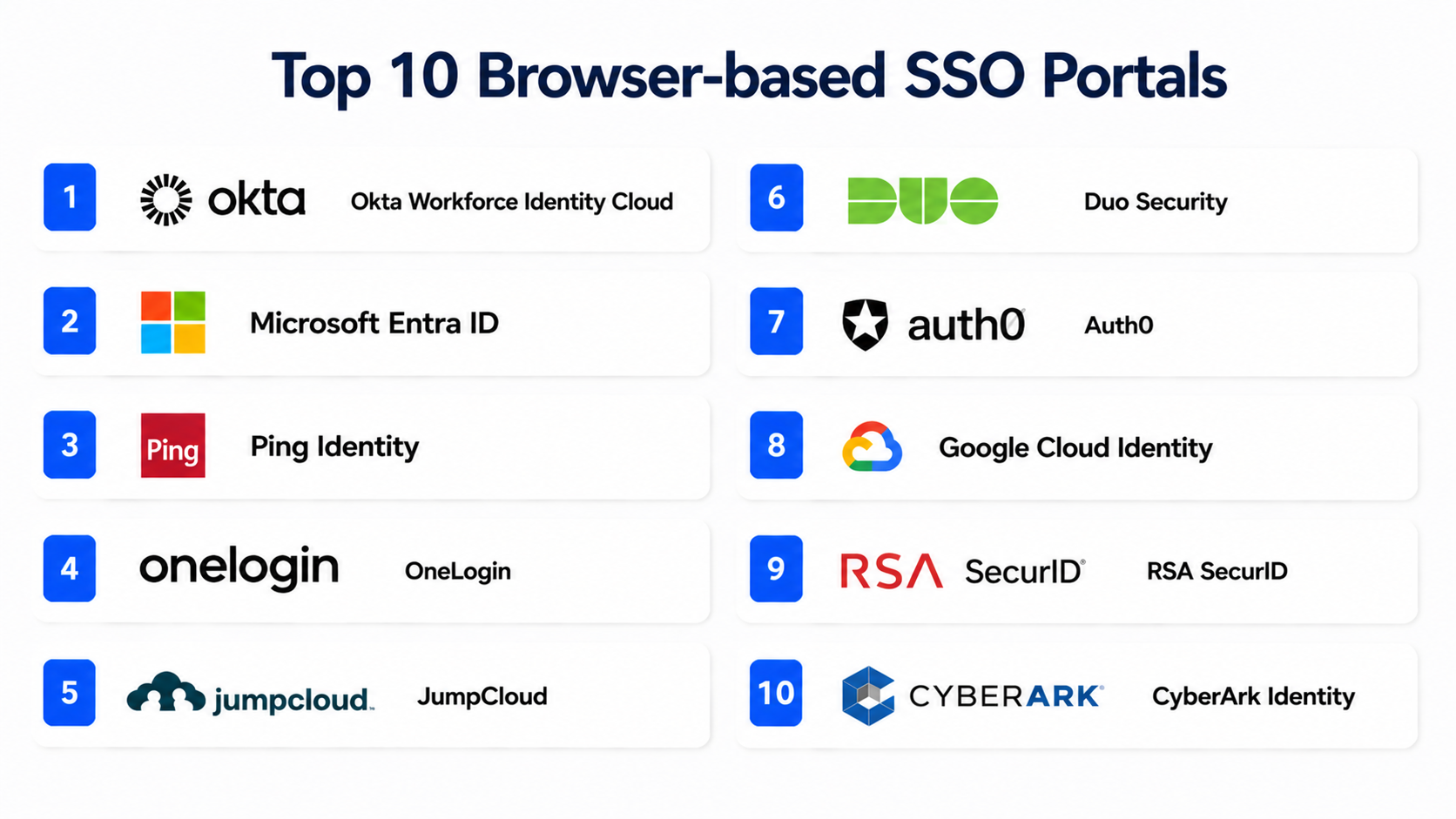
Introduction
Browser-based SSO (Single Sign-On) Portals are centralized authentication platforms that allow users to securely access multiple applications using a single login through a web browser. Instead of remembering separate usernames and passwords for dozens of cloud services, employees authenticate once through a unified portal and gain streamlined access to approved applications.
In browser-based SSO portals have become essential infrastructure for cloud-first organizations managing hybrid workforces, SaaS sprawl, remote contractors, AI-powered applications, and Zero Trust security models. Modern SSO platforms now go far beyond basic authentication by offering adaptive access controls, passwordless authentication, identity governance, conditional access policies, AI-driven threat detection, device trust validation, and automated lifecycle management.
Common real-world use cases include:
- Centralizing employee login access across SaaS applications
- Simplifying onboarding and offboarding workflows
- Enforcing MFA and passwordless authentication
- Managing remote workforce access security
- Reducing credential-related phishing risks
When evaluating Browser-based SSO Portals, buyers should consider:
- SSO protocol support (SAML, OAuth, OpenID Connect)
- MFA and passwordless authentication capabilities
- Identity lifecycle management
- Adaptive and conditional access policies
- Directory and HR integrations
- Device trust and endpoint visibility
- Security analytics and threat detection
- Scalability across enterprise environments
- API ecosystem and automation support
- Compliance and audit logging capabilities
Best for: Enterprises, SMBs, remote-first organizations, SaaS-heavy businesses, regulated industries, IT operations teams, and security teams managing distributed identities and cloud applications.
Not ideal for: Very small organizations with minimal SaaS usage, offline-only environments, or businesses without centralized identity management requirements.
Key Trends in Browser-based SSO Portals
- Passwordless authentication adoption is accelerating rapidly.
- Identity security and Zero Trust architectures are converging.
- Browser-native authentication experiences are becoming standard.
- AI-driven risk analysis and adaptive authentication are expanding.
- Device posture validation is increasingly integrated into SSO workflows.
- Identity governance and lifecycle automation are becoming core capabilities.
- Shadow SaaS discovery is being integrated into identity platforms.
- Decentralized workforce management is driving cloud-first identity models.
- Passkeys and phishing-resistant authentication are gaining adoption.
- Identity analytics and UEBA capabilities are becoming more advanced.
How We Selected These Tools (Methodology)
The tools in this list were selected using a balanced evaluation framework focused on authentication capabilities, ecosystem maturity, operational scalability, and enterprise adoption.
Selection criteria included:
- Market adoption and identity platform maturity
- SSO protocol and federation support
- MFA and passwordless authentication capabilities
- Identity governance functionality
- Security analytics and adaptive access controls
- Integration ecosystem breadth
- Ease of deployment and administration
- API and automation support
- Compliance and audit visibility
- Customer support and onboarding quality
Browser-based SSO Portals
#1 — Okta Workforce Identity Cloud
Short description :
Okta Workforce Identity Cloud is one of the most widely adopted browser-based SSO and identity management platforms for enterprise and cloud-first organizations. The platform provides centralized authentication, adaptive MFA, lifecycle management, and secure application access across thousands of SaaS applications. Okta is commonly used by enterprises requiring scalable identity governance and strong integration ecosystems.
Key Features
- Browser-based SSO
- Adaptive MFA
- Passwordless authentication
- Lifecycle management
- Universal directory services
- Conditional access policies
- Extensive SaaS integrations
Pros
- Large SaaS integration ecosystem
- Strong usability and deployment flexibility
- Mature identity governance capabilities
Cons
- Premium enterprise pricing
- Advanced policy tuning may require expertise
- Large deployments can become complex
Platforms / Deployment
- Web / Windows / macOS / Linux / iOS / Android
- Cloud
Security & Compliance
- SSO/SAML
- MFA
- RBAC
- Audit logs
- Adaptive authentication
- Compliance support
Integrations & Ecosystem
Okta integrates into enterprise identity, cloud, and security ecosystems.
- Microsoft 365
- Google Workspace
- Salesforce
- Slack
- AWS
- HR systems
Support & Community
Okta provides enterprise onboarding, technical documentation, developer resources, certification programs, and premium support tiers.
#2 — Microsoft Entra ID
Short description :
Microsoft Entra ID, formerly Azure Active Directory, is a browser-based identity and SSO platform integrated deeply into Microsoft ecosystems. The platform provides centralized authentication, conditional access, passwordless login capabilities, and identity governance for hybrid and cloud-first environments.
Key Features
- Browser-based SSO
- Conditional access policies
- Passwordless authentication
- Identity governance
- Device trust validation
- Risk-based authentication
- Hybrid identity support
Pros
- Strong Microsoft ecosystem integration
- Mature enterprise security controls
- Broad hybrid infrastructure support
Cons
- Best experience within Microsoft-centric environments
- Advanced configurations may require expertise
- Licensing complexity for some features
Platforms / Deployment
- Web / Windows / macOS / Linux / iOS / Android
- Cloud / Hybrid
Security & Compliance
- MFA
- SSO/SAML
- RBAC
- Audit logs
- Compliance support
- Risk-based access controls
Integrations & Ecosystem
Microsoft Entra integrates deeply into enterprise productivity and security ecosystems.
- Microsoft 365
- Defender XDR
- Endpoint Manager
- SaaS applications
- SIEM platforms
- HR systems
Support & Community
Microsoft provides extensive enterprise documentation, community forums, onboarding resources, and technical support programs.
#3 — Ping Identity
Short description :
Ping Identity is an enterprise-focused identity and browser-based SSO platform designed for organizations requiring advanced federation, adaptive authentication, and hybrid identity architectures. The platform supports large-scale workforce and customer identity environments.
Key Features
- Browser-based SSO
- Identity federation
- Adaptive authentication
- Passwordless authentication
- API security integration
- Hybrid identity support
- Risk-based access controls
Pros
- Strong enterprise federation capabilities
- Flexible deployment models
- Advanced authentication controls
Cons
- Enterprise-focused complexity
- Smaller SMB focus
- Advanced deployments may require consulting
Platforms / Deployment
- Web / Windows / Linux / macOS
- Cloud / Self-hosted / Hybrid
Security & Compliance
- MFA
- SSO/SAML
- Audit logs
- RBAC
- Compliance support
- Adaptive authentication
Integrations & Ecosystem
Ping Identity integrates into enterprise authentication ecosystems.
- SIEM platforms
- Cloud providers
- API gateways
- HR systems
- Endpoint security tools
- SaaS applications
Support & Community
Ping Identity offers enterprise onboarding, identity consulting, technical training, and support services.
#4 — OneLogin
Short description :
OneLogin is a cloud identity and browser-based SSO platform focused on secure workforce authentication, application access management, and identity governance. The platform emphasizes usability and simplified SaaS authentication management.
Key Features
- Browser-based SSO
- MFA and smart authentication
- Directory integration
- User provisioning
- Passwordless access
- Identity governance
- Cloud directory services
Pros
- User-friendly administration
- Good SaaS application support
- Strong cloud-native experience
Cons
- Enterprise customization varies
- Advanced governance lighter than some competitors
- Reporting depth differs by plan
Platforms / Deployment
- Web / Windows / macOS / Linux / iOS / Android
- Cloud
Security & Compliance
- MFA
- SSO/SAML
- RBAC
- Audit logs
- Compliance visibility
Integrations & Ecosystem
OneLogin integrates into SaaS and cloud ecosystems.
- Google Workspace
- Microsoft 365
- Salesforce
- Slack
- AWS
- HR platforms
Support & Community
OneLogin provides onboarding resources, documentation, and enterprise support programs.
#5 — JumpCloud
Short description :
JumpCloud is a cloud-based identity, device management, and browser-based SSO platform designed for SMBs and mid-market organizations. The platform combines identity management with endpoint visibility and directory services.
Key Features
- Browser-based SSO
- Cloud directory services
- Device management
- Passwordless authentication
- Conditional access
- Cross-platform identity support
- Endpoint trust policies
Pros
- Strong SMB and mid-market focus
- Good device management integration
- Cross-platform operating system support
Cons
- Enterprise governance depth varies
- Advanced analytics lighter than enterprise competitors
- Large-scale deployments may require tuning
Platforms / Deployment
- Web / Windows / macOS / Linux / iOS / Android
- Cloud
Security & Compliance
- MFA
- SSO/SAML
- RBAC
- Audit logs
- Device trust controls
Integrations & Ecosystem
JumpCloud integrates into identity and endpoint ecosystems.
- Google Workspace
- Microsoft 365
- AWS
- Slack
- HR systems
- Endpoint management tools
Support & Community
JumpCloud offers documentation, onboarding assistance, community resources, and support programs.
#6 — Duo Security
Short description :
Duo Security, owned by Cisco, is a browser-based authentication and SSO platform focused on secure access, MFA, and Zero Trust identity verification. The platform is widely used for workforce authentication and secure application access.
Key Features
- Browser-based SSO
- MFA and passwordless authentication
- Device trust verification
- Adaptive access policies
- Endpoint visibility
- Secure remote access
- Risk-based authentication
Pros
- Strong MFA capabilities
- Good Zero Trust alignment
- Easy deployment experience
Cons
- Broader identity governance lighter than some competitors
- Advanced IAM workflows vary
- Enterprise customization may require integration work
Platforms / Deployment
- Web / Windows / macOS / Linux / iOS / Android
- Cloud
Security & Compliance
- MFA
- SSO/SAML
- Audit logging
- RBAC
- Device trust validation
Integrations & Ecosystem
Duo integrates into security and authentication ecosystems.
- Cisco security products
- VPN platforms
- Cloud providers
- SaaS applications
- Endpoint security systems
- Identity providers
Support & Community
Duo provides technical documentation, onboarding resources, and enterprise support services.
#7 — Auth0
Short description :
Auth0 is a developer-focused identity platform that supports browser-based SSO, authentication workflows, and customer identity management. The platform is widely used by SaaS companies and developers building custom authentication experiences.
Key Features
- Browser-based SSO
- Identity federation
- Passwordless authentication
- Social login support
- API authentication
- Developer SDKs
- Adaptive MFA
Pros
- Strong developer ecosystem
- Flexible authentication workflows
- Broad API support
Cons
- Developer-focused learning curve
- Enterprise governance differs from workforce IAM platforms
- Pricing complexity for scale usage
Platforms / Deployment
- Web
- Cloud
Security & Compliance
- MFA
- SSO/SAML
- RBAC
- Audit logs
- Compliance support
Integrations & Ecosystem
Auth0 integrates into developer and SaaS ecosystems.
- Cloud providers
- API gateways
- CI/CD platforms
- SaaS applications
- Identity providers
- Developer frameworks
Support & Community
Auth0 offers extensive developer documentation, SDKs, tutorials, and enterprise support.
#8 — Google Cloud Identity
Short description :
Google Cloud Identity is a browser-based identity and SSO platform designed for organizations operating within Google Workspace and cloud-centric environments. The platform provides centralized authentication, access management, and endpoint-aware access controls.
Key Features
- Browser-based SSO
- MFA and passkey support
- Endpoint-aware access
- Device management integration
- User lifecycle management
- Cloud directory services
- Security insights
Pros
- Strong Google ecosystem integration
- Simple cloud-native deployment
- Good usability for Google-centric organizations
Cons
- Best suited for Google environments
- Advanced enterprise governance lighter than some competitors
- Hybrid infrastructure support varies
Platforms / Deployment
- Web / Windows / macOS / Linux / iOS / Android
- Cloud
Security & Compliance
- MFA
- SSO/SAML
- Audit logs
- RBAC
- Endpoint-aware access controls
Integrations & Ecosystem
Google Cloud Identity integrates into Google and SaaS ecosystems.
- Google Workspace
- Chrome Enterprise
- Cloud providers
- SaaS applications
- Endpoint management systems
- Identity services
Support & Community
Google provides documentation, onboarding resources, technical support, and cloud training materials.
#9 — RSA SecurID
Short description :
RSA SecurID is an enterprise authentication and browser-based SSO platform focused on secure workforce access, MFA, and identity governance. The platform is commonly used in regulated industries and large enterprise environments.
Key Features
- Browser-based SSO
- MFA and token authentication
- Risk-based access policies
- Identity governance
- Hybrid authentication support
- Compliance-focused controls
- Access monitoring
Pros
- Strong enterprise security heritage
- Good compliance-oriented workflows
- Mature authentication controls
Cons
- Legacy complexity for some environments
- Interface modernization varies
- Smaller SMB focus
Platforms / Deployment
- Web / Windows / Linux
- Cloud / Hybrid
Security & Compliance
- MFA
- RBAC
- Audit logs
- SSO/SAML
- Compliance support
Integrations & Ecosystem
RSA integrates into enterprise authentication ecosystems.
- SIEM platforms
- VPN systems
- Identity providers
- Endpoint security platforms
- HR systems
- SaaS applications
Support & Community
RSA provides enterprise onboarding, authentication consulting, and technical support services.
#10 — CyberArk Identity
Short description :
CyberArk Identity is a browser-based SSO and identity security platform focused on workforce authentication, privileged access security, and Zero Trust identity management. The platform combines SSO capabilities with broader identity security controls.
Key Features
- Browser-based SSO
- Adaptive MFA
- Privileged access integration
- Identity governance
- Passwordless authentication
- Risk analytics
- Endpoint-aware access
Pros
- Strong privileged access security integration
- Mature identity security capabilities
- Good Zero Trust alignment
Cons
- Enterprise-focused deployment complexity
- Premium pricing structure
- Smaller SMB focus
Platforms / Deployment
- Web / Windows / macOS / Linux / iOS / Android
- Cloud / Hybrid
Security & Compliance
- MFA
- SSO/SAML
- RBAC
- Audit logs
- Compliance support
- Risk analytics
Integrations & Ecosystem
CyberArk integrates into enterprise identity and privileged access ecosystems.
- SIEM platforms
- Endpoint security tools
- Cloud providers
- HR systems
- SaaS applications
- Privileged access management systems
Support & Community
CyberArk provides enterprise onboarding, security guidance, training resources, and support programs.
Comparison Table (Top 10)
| Tool Name | Best For | Platform(s) Supported | Deployment | Standout Feature | Public Rating |
|---|---|---|---|---|---|
| Okta Workforce Identity Cloud | Enterprise SaaS identity | Multi-platform | Cloud | Extensive SaaS integrations | N/A |
| Microsoft Entra ID | Microsoft-centric organizations | Multi-platform | Hybrid | Conditional access policies | N/A |
| Ping Identity | Enterprise federation | Multi-platform | Hybrid | Advanced identity federation | N/A |
| OneLogin | Cloud-first organizations | Multi-platform | Cloud | User-friendly SSO management | N/A |
| JumpCloud | SMB identity management | Multi-platform | Cloud | Identity plus device management | N/A |
| Duo Security | MFA-focused environments | Multi-platform | Cloud | Strong Zero Trust authentication | N/A |
| Auth0 | Developer authentication workflows | Web | Cloud | Flexible API authentication | N/A |
| Google Cloud Identity | Google Workspace environments | Multi-platform | Cloud | Google-native authentication | N/A |
| RSA SecurID | Regulated enterprise environments | Web, Windows, Linux | Hybrid | Compliance-oriented MFA | N/A |
| CyberArk Identity | Privileged identity security | Multi-platform | Hybrid | PAM integration | N/A |
Evaluation & Browser-based SSO Portals
| Tool Name | Core (25%) | Ease (15%) | Integrations (15%) | Security (10%) | Performance (10%) | Support (10%) | Value (15%) | Weighted Total (0–10) |
|---|---|---|---|---|---|---|---|---|
| Okta Workforce Identity Cloud | 9 | 8 | 10 | 9 | 8 | 8 | 7 | 8.5 |
| Microsoft Entra ID | 9 | 8 | 9 | 9 | 8 | 8 | 8 | 8.6 |
| Ping Identity | 9 | 6 | 8 | 9 | 8 | 8 | 6 | 7.8 |
| OneLogin | 8 | 8 | 8 | 8 | 8 | 7 | 8 | 8.0 |
| JumpCloud | 8 | 8 | 7 | 8 | 8 | 7 | 8 | 7.9 |
| Duo Security | 8 | 9 | 8 | 9 | 8 | 8 | 8 | 8.3 |
| Auth0 | 8 | 7 | 9 | 8 | 8 | 8 | 7 | 7.9 |
| Google Cloud Identity | 8 | 8 | 8 | 8 | 8 | 7 | 8 | 7.9 |
| RSA SecurID | 8 | 6 | 7 | 9 | 8 | 7 | 6 | 7.3 |
| CyberArk Identity | 9 | 7 | 8 | 9 | 8 | 8 | 6 | 7.9 |
These scores are comparative and intended to help organizations evaluate trade-offs between authentication depth, ease of deployment, ecosystem compatibility, and enterprise security capabilities. Enterprise-focused platforms generally provide stronger governance and adaptive security controls, while cloud-native SSO providers often emphasize usability and faster deployment. Buyers should prioritize platforms aligned with their identity architecture, compliance requirements, and workforce environment.
Which Browser-based SSO Portals
Solo / Freelancer
Freelancers and small independent teams may benefit from lightweight cloud-native SSO platforms if managing multiple SaaS applications and remote collaboration tools.
SMB
SMBs commonly benefit from JumpCloud, OneLogin, or Google Cloud Identity because of simplified administration and easier deployment models.
Mid-Market
Mid-market organizations should evaluate Okta, Duo Security, and Microsoft Entra ID for balanced identity governance, security, and scalability.
Enterprise
Large enterprises often require advanced federation, adaptive access controls, hybrid identity support, and governance capabilities. Ping Identity, CyberArk Identity, and Microsoft Entra ID are strong enterprise-focused choices.
Budget vs Premium
Organizations focused on basic SSO and MFA may prioritize ease of use and operational simplicity, while regulated enterprises often justify premium pricing for adaptive authentication and governance depth.
Feature Depth vs Ease of Use
Ping Identity and CyberArk provide deeper enterprise identity functionality, while JumpCloud and OneLogin emphasize faster deployment and simpler administration.
Integrations & Scalability
Organizations with large SaaS ecosystems should prioritize platforms with broad application integration catalogs, API support, lifecycle automation, and hybrid identity compatibility.
Security & Compliance Needs
Highly regulated industries should prioritize audit logging, adaptive authentication, privileged access integration, risk analytics, and compliance-oriented access controls.
Frequently Asked Questions (FAQs)
1. What are Browser-based SSO Portals?
Browser-based SSO Portals allow users to securely access multiple applications through a single authentication process using a centralized web portal.
2. Why are SSO platforms important in 2026?
Modern organizations rely on hundreds of SaaS applications and remote work environments, making centralized identity management and secure authentication critical operational requirements.
3. What is passwordless authentication?
Passwordless authentication replaces traditional passwords with passkeys, biometrics, hardware tokens, or secure device-based authentication methods.
4. How do SSO platforms improve security?
SSO platforms reduce password reuse, centralize access control policies, enforce MFA, and provide visibility into authentication risks and user behavior.
5. What protocols do modern SSO platforms support?
Most platforms support SAML, OAuth 2.0, OpenID Connect, SCIM provisioning, and federation protocols.
6. Are Browser-based SSO Portals suitable for SMBs?
Yes. Many vendors now offer simplified cloud-native deployment models specifically designed for SMB and mid-market organizations.
7. Can these platforms integrate with HR systems?
Yes. Most modern identity platforms integrate with HR systems to automate onboarding, offboarding, and user lifecycle management workflows.
8. What is adaptive authentication?
Adaptive authentication dynamically evaluates login risks using factors like device posture, location, behavior patterns, and network trust.
9. Do SSO platforms support Zero Trust security models?
Yes. Many modern platforms are built around Zero Trust principles that continuously validate user identity, device trust, and contextual access risks.
10. How difficult is implementation?
Implementation complexity depends on organizational size, legacy infrastructure, SaaS integrations, and governance requirements. Cloud-native deployments are generally easier than hybrid enterprise architectures.
Conclusion
Browser-based SSO Portals have become foundational identity infrastructure for modern organizations managing distributed workforces, cloud-first operations, SaaS sprawl, and increasingly complex security requirements. What began as a convenience technology for reducing password fatigue has evolved into a strategic security and governance layer supporting Zero Trust architectures, passwordless authentication, adaptive access policies, and identity lifecycle automation. As organizations continue adopting AI-powered applications, remote collaboration platforms, and hybrid infrastructure models, centralized identity visibility and secure authentication workflows are becoming even more critical.
