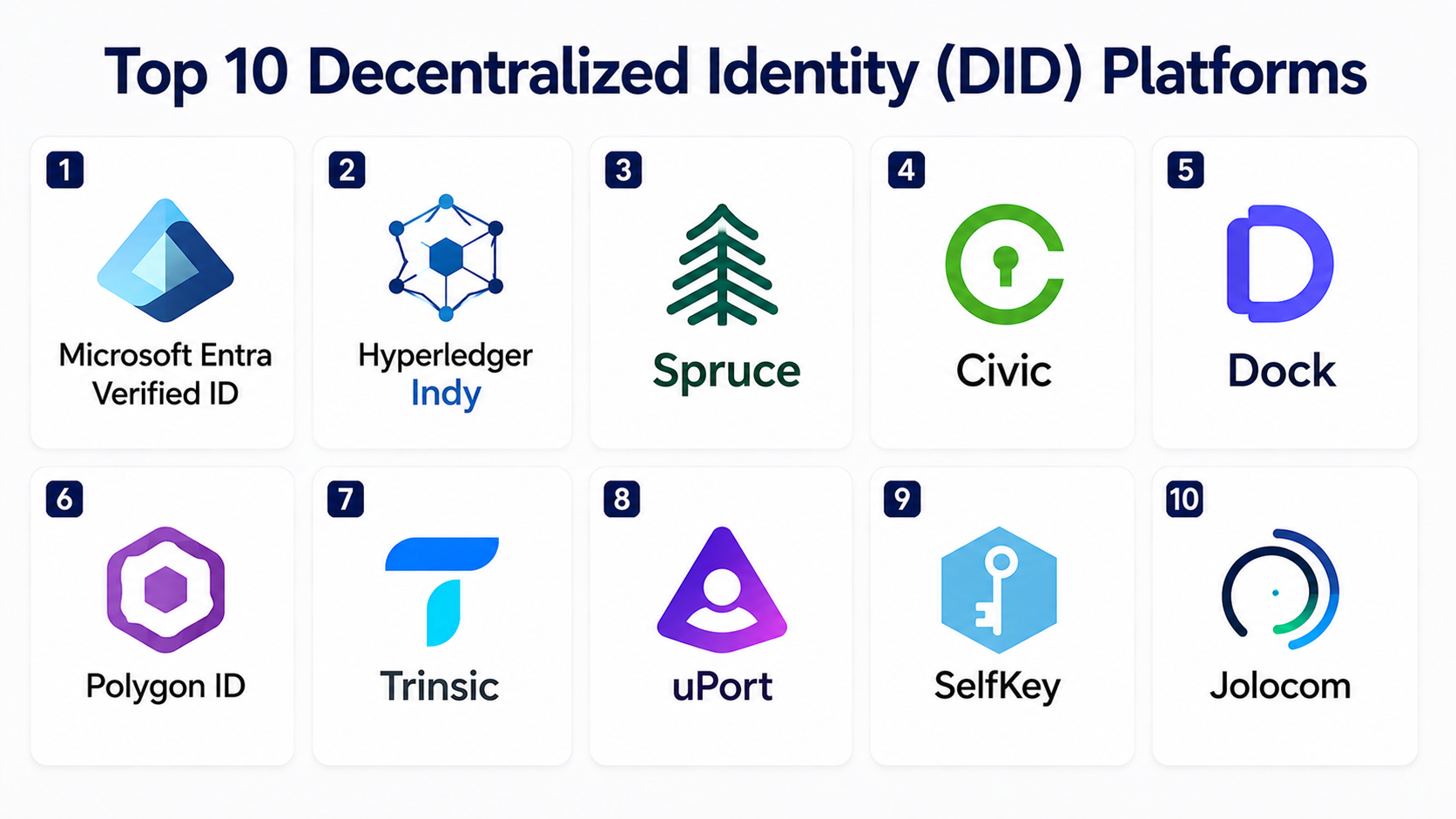
Introduction
Decentralized Identity (DID) Platforms are systems that allow individuals, organizations, devices, and applications to create, manage, and verify digital identities without relying entirely on centralized identity providers. These platforms use blockchain technology, cryptographic verification, verifiable credentials, and decentralized identifiers (DIDs) to enable secure, privacy-preserving digital identity management.
In decentralized identity is becoming increasingly important as organizations face growing concerns around data privacy, AI-driven identity fraud, regulatory compliance, and digital trust. DID platforms are now supporting passwordless authentication, self-sovereign identity (SSI), AI agent verification, cross-border identity systems, enterprise access management, and secure credential sharing across digital ecosystems.
Common real-world use cases include:
- Self-sovereign identity management
- Verifiable credential issuance
- Decentralized authentication
- Digital identity verification
- Secure enterprise access control
- Cross-border digital identity systems
- AI and device identity verification
When evaluating Decentralized Identity Platforms, buyers should consider:
- Standards compliance
- Verifiable credential support
- Blockchain interoperability
- Privacy and encryption architecture
- Identity recovery mechanisms
- Enterprise integration capabilities
- Governance controls
- Scalability and performance
- Developer tooling
- Regulatory alignment
Best for: Enterprises, governments, financial institutions, healthcare providers, Web3 applications, educational institutions, and organizations implementing privacy-preserving identity systems.
Not ideal for: Small applications with minimal identity requirements or organizations unwilling to adopt decentralized trust models.
Key Trends in Decentralized Identity (DID) Platforms
- Passwordless authentication adoption is increasing rapidly.
- Verifiable credentials are becoming enterprise-ready.
- AI-driven identity verification is expanding.
- Self-sovereign identity models are gaining regulatory attention.
- Blockchain interoperability for identity systems is improving.
- Privacy-preserving authentication methods are evolving.
- Digital identity wallets are becoming more common.
- Enterprise DID governance tooling is maturing.
- Decentralized identity for IoT and AI agents is growing.
- Compliance-focused DID infrastructure is becoming a priority.
How We Selected These Tools (Methodology)
The DID platforms in this list were selected based on standards alignment, ecosystem maturity, enterprise readiness, interoperability, security architecture, and adoption within digital identity ecosystems.
Selection criteria included:
- W3C DID and verifiable credential support
- Identity management capabilities
- Blockchain interoperability
- Enterprise adoption
- Security and privacy architecture
- Developer tooling quality
- Ecosystem integrations
- Governance and compliance features
- Scalability and performance
- Community and standards participation
The final list includes enterprise identity platforms, blockchain-based DID systems, self-sovereign identity frameworks, and decentralized credential management ecosystems.
Decentralized Identity (DID) Platforms
#1 — Microsoft Entra Verified ID
Short description :
Microsoft Entra Verified ID is an enterprise decentralized identity platform enabling organizations to issue, verify, and manage verifiable credentials using decentralized identity standards.
Key Features
- Verifiable credential issuance
- Decentralized identity support
- Enterprise identity integration
- Passwordless authentication workflows
- W3C DID standards support
- Secure identity verification
- Governance and compliance controls
Pros
- Strong enterprise ecosystem integration
- Broad Microsoft security compatibility
- Enterprise-ready governance tooling
Cons
- Enterprise-focused complexity
- Microsoft ecosystem dependency
- Advanced workflows may require specialized expertise
Platforms / Deployment
- Web / Windows / Linux
- Cloud / Hybrid
Security & Compliance
- SSO/SAML
- MFA
- Encryption
- RBAC
- Audit logs
Integrations & Ecosystem
Microsoft Entra Verified ID integrates deeply with enterprise identity ecosystems.
- Microsoft Entra ID
- Azure
- APIs
- Enterprise IAM systems
- Security platforms
Support & Community
Microsoft provides enterprise onboarding, documentation, and global support services.
#2 — Hyperledger Indy
Short description :
Hyperledger Indy is an open-source decentralized identity ledger platform designed for self-sovereign identity and verifiable credential management.
Key Features
- Decentralized identity infrastructure
- Verifiable credential support
- Self-sovereign identity architecture
- Permissioned distributed ledger
- DID standards support
- Privacy-preserving authentication
- Open-source governance
Pros
- Strong SSI architecture
- Open-source flexibility
- Good standards alignment
Cons
- Complex deployment requirements
- Enterprise onboarding may require expertise
- Smaller ecosystem than large enterprise vendors
Platforms / Deployment
- Linux
- Self-hosted / Hybrid
Security & Compliance
- Encryption
- Cryptographic verification
- Privacy-preserving identity workflows
Integrations & Ecosystem
Hyperledger Indy integrates with decentralized identity ecosystems.
- Hyperledger Aries
- APIs
- Identity wallets
- Enterprise identity systems
- Blockchain infrastructure
Support & Community
Hyperledger Indy has active open-source and decentralized identity communities.
#3 — Spruce
Short description :
Spruce is a decentralized identity infrastructure platform focused on verifiable credentials, Web3 authentication, and self-sovereign identity systems.
Key Features
- Verifiable credentials
- Decentralized authentication
- DID wallet support
- Web3 identity integration
- Identity interoperability
- Secure credential verification
- Developer APIs
Pros
- Strong Web3 identity focus
- Modern developer tooling
- Good interoperability support
Cons
- Enterprise ecosystem still evolving
- Web3-focused adoption
- Governance tooling maturity varies
Platforms / Deployment
- Web / Linux
- Cloud / Hybrid
Security & Compliance
- Encryption
- DID authentication
- Credential verification workflows
Integrations & Ecosystem
Spruce integrates with decentralized identity and blockchain ecosystems.
- Ethereum
- Wallet systems
- APIs
- Web3 applications
- Credential frameworks
Support & Community
Spruce has growing Web3 and decentralized identity community adoption.
#4 — Civic
Short description :
Civic is a blockchain-based identity verification platform focused on decentralized authentication, secure login workflows, and privacy-preserving credential management.
Key Features
- Decentralized identity verification
- Credential authentication
- Secure login workflows
- Blockchain identity support
- User-controlled credentials
- Fraud prevention workflows
- Mobile identity verification
Pros
- User-friendly authentication workflows
- Strong identity verification focus
- Good blockchain ecosystem integration
Cons
- Consumer-focused architecture
- Enterprise customization may vary
- Ecosystem maturity evolving
Platforms / Deployment
- Web / iOS / Android
- Cloud
Security & Compliance
- Encryption
- MFA support
- Credential verification controls
Integrations & Ecosystem
Civic integrates with digital identity and Web3 ecosystems.
- APIs
- Wallet systems
- Web3 applications
- Identity verification workflows
- Authentication systems
Support & Community
Civic has growing adoption in blockchain identity ecosystems.
#5 — Dock
Short description :
Dock is a decentralized identity and verifiable credential platform enabling organizations to issue and verify trusted digital credentials.
Key Features
- Verifiable credential issuance
- Decentralized identity support
- Credential verification workflows
- Blockchain-backed trust infrastructure
- Privacy-preserving architecture
- Developer APIs
- Governance tooling
Pros
- Strong credential verification workflows
- Good standards compatibility
- Flexible organizational identity support
Cons
- Smaller enterprise footprint
- Ecosystem maturity still developing
- Advanced governance setup complexity
Platforms / Deployment
- Web / Linux
- Cloud / Hybrid
Security & Compliance
- Encryption
- Credential integrity verification
- Privacy-focused identity workflows
Integrations & Ecosystem
Dock integrates with decentralized identity ecosystems and enterprise workflows.
- APIs
- Identity wallets
- Blockchain infrastructure
- Enterprise systems
- Credential management platforms
Support & Community
Dock has an active decentralized identity community.
#6 — Polygon ID
Short description :
Polygon ID is a decentralized identity platform focused on privacy-preserving authentication and zero-knowledge proof-based identity verification.
Key Features
- Zero-knowledge proof authentication
- Decentralized identity management
- Privacy-preserving credential verification
- Blockchain interoperability
- Web3 identity support
- Verifiable credentials
- Developer SDKs
Pros
- Strong privacy architecture
- Advanced cryptographic identity workflows
- Good blockchain scalability support
Cons
- Advanced cryptographic complexity
- Ecosystem maturity evolving
- Enterprise adoption still growing
Platforms / Deployment
- Web / Linux
- Cloud / Hybrid
Security & Compliance
- Zero-knowledge cryptography
- Encryption
- Credential privacy controls
Integrations & Ecosystem
Polygon ID integrates with blockchain and Web3 identity ecosystems.
- Polygon
- Ethereum
- APIs
- Wallet systems
- Decentralized applications
Support & Community
Polygon ID benefits from growing Web3 ecosystem support.
#7 — Trinsic
Short description :
Trinsic is a decentralized identity platform providing verifiable credential infrastructure and developer-friendly identity APIs for enterprises and applications.
Key Features
- Verifiable credential APIs
- Identity wallet infrastructure
- Decentralized authentication
- Credential issuance workflows
- Enterprise integration support
- Identity verification tools
- Developer SDKs
Pros
- Developer-friendly architecture
- Strong API ecosystem
- Good enterprise onboarding support
Cons
- Ecosystem still maturing
- Advanced governance workflows may vary
- Enterprise scaling complexity
Platforms / Deployment
- Web / Linux
- Cloud / Hybrid
Security & Compliance
- Encryption
- Credential verification
- Identity authentication workflows
Integrations & Ecosystem
Trinsic integrates with enterprise and decentralized identity ecosystems.
- APIs
- Identity wallets
- Enterprise IAM systems
- Web3 applications
- Credential platforms
Support & Community
Trinsic provides developer-focused onboarding and support resources.
#8 — uPort
Short description :
uPort is a decentralized identity platform enabling self-sovereign identity management and secure credential verification for Web3 applications.
Key Features
- Self-sovereign identity support
- Credential management
- Blockchain identity verification
- Mobile identity wallet
- Decentralized authentication
- Secure credential sharing
- Web3 integration support
Pros
- Early decentralized identity innovation
- Mobile-first identity workflows
- Good blockchain interoperability
Cons
- Ecosystem visibility lower than newer platforms
- Enterprise tooling maturity varies
- Governance features evolving
Platforms / Deployment
- Web / iOS / Android
- Cloud
Security & Compliance
- Encryption
- Credential verification
- Identity authentication protections
Integrations & Ecosystem
uPort integrates with decentralized identity and blockchain applications.
- Ethereum
- Wallet systems
- APIs
- Credential frameworks
- Web3 applications
Support & Community
uPort maintains an active decentralized identity community presence.
#9 — SelfKey
Short description :
SelfKey is a blockchain identity platform focused on self-sovereign identity, credential management, and privacy-preserving onboarding workflows.
Key Features
- Self-sovereign identity management
- Credential verification
- Blockchain-based authentication
- Identity wallet support
- Privacy-focused onboarding
- Digital identity ownership
- Secure credential storage
Pros
- Strong identity ownership model
- Privacy-focused architecture
- User-controlled credential workflows
Cons
- Smaller enterprise adoption
- Ecosystem scale still limited
- Advanced integrations may require customization
Platforms / Deployment
- Windows / macOS / Linux
- Cloud / Self-hosted
Security & Compliance
- Encryption
- Secure credential storage
- Identity verification protections
Integrations & Ecosystem
SelfKey integrates with blockchain identity ecosystems.
- Wallet systems
- APIs
- Identity verification services
- Blockchain applications
- Credential workflows
Support & Community
SelfKey has active decentralized identity community participation.
#10 — Jolocom
Short description :
Jolocom is a decentralized identity infrastructure platform focused on secure credential exchange, self-sovereign identity, and enterprise identity interoperability.
Key Features
- Self-sovereign identity architecture
- Credential exchange workflows
- Verifiable credential support
- DID interoperability
- Secure identity verification
- Enterprise integration support
- Developer SDKs
Pros
- Strong standards-based identity design
- Good interoperability support
- Flexible credential exchange workflows
Cons
- Enterprise ecosystem still growing
- Deployment complexity for advanced use cases
- Limited mainstream adoption compared to large vendors
Platforms / Deployment
- Web / Linux
- Cloud / Hybrid
Security & Compliance
- Encryption
- DID authentication
- Credential verification controls
Integrations & Ecosystem
Jolocom integrates with decentralized identity and enterprise systems.
- APIs
- Identity wallets
- Enterprise IAM systems
- Blockchain infrastructure
- Credential platforms
Support & Community
Jolocom has an active standards-focused decentralized identity community.
Comparison Table (Top 10)
| Tool Name | Best For | Platform(s) Supported | Deployment | Standout Feature | Public Rating |
|---|---|---|---|---|---|
| Microsoft Entra Verified ID | Enterprise decentralized identity | Web, Windows, Linux | Hybrid | Enterprise verifiable credentials | N/A |
| Hyperledger Indy | Self-sovereign identity infrastructure | Linux | Hybrid | Open-source DID ledger | N/A |
| Spruce | Web3 identity systems | Web, Linux | Hybrid | Decentralized Web3 authentication | N/A |
| Civic | Consumer identity verification | Web, iOS, Android | Cloud | Blockchain-based authentication | N/A |
| Dock | Verifiable credential management | Web, Linux | Hybrid | Trusted digital credential issuance | N/A |
| Polygon ID | Privacy-preserving identity verification | Web, Linux | Hybrid | Zero-knowledge proof identity | N/A |
| Trinsic | Developer identity APIs | Web, Linux | Hybrid | API-first credential infrastructure | N/A |
| uPort | Mobile decentralized identity | Web, iOS, Android | Cloud | Self-sovereign mobile identity | N/A |
| SelfKey | Identity ownership workflows | Windows, macOS, Linux | Hybrid | User-controlled identity management | N/A |
| Jolocom | Interoperable decentralized identity | Web, Linux | Hybrid | Credential interoperability workflows | N/A |
Evaluation & Decentralized Identity (DID) Platforms
| Tool Name | Core (25%) | Ease (15%) | Integrations (15%) | Security (10%) | Performance (10%) | Support (10%) | Value (15%) | Weighted Total |
|---|---|---|---|---|---|---|---|---|
| Microsoft Entra Verified ID | 10 | 8 | 10 | 10 | 9 | 10 | 7 | 9.1 |
| Hyperledger Indy | 9 | 6 | 8 | 9 | 8 | 8 | 8 | 8.1 |
| Spruce | 8 | 8 | 8 | 8 | 8 | 7 | 8 | 7.9 |
| Civic | 8 | 9 | 7 | 8 | 8 | 8 | 8 | 8.0 |
| Dock | 8 | 7 | 7 | 8 | 8 | 7 | 8 | 7.7 |
| Polygon ID | 9 | 7 | 8 | 10 | 8 | 7 | 8 | 8.2 |
| Trinsic | 8 | 8 | 8 | 8 | 8 | 8 | 8 | 8.0 |
| uPort | 7 | 8 | 7 | 8 | 7 | 7 | 8 | 7.5 |
| SelfKey | 7 | 8 | 7 | 8 | 7 | 7 | 8 | 7.5 |
| Jolocom | 8 | 7 | 8 | 8 | 7 | 7 | 8 | 7.7 |
These scores are comparative rather than absolute. Some DID platforms focus heavily on enterprise identity governance and compliance, while others prioritize self-sovereign identity, Web3 interoperability, or privacy-preserving authentication. Buyers should evaluate platforms based on identity architecture, ecosystem compatibility, governance requirements, and long-term digital trust strategies.
Which Decentralized Identity (DID) Platforms
Solo / Freelancer
Independent developers and Web3 builders may prefer:
- Spruce
- Polygon ID
- uPort
These platforms provide flexible decentralized identity tooling and Web3 integration support.
SMB
Small and medium-sized organizations should prioritize usability and identity interoperability.
Recommended options:
- Civic
- Dock
- Trinsic
Mid-Market
Mid-sized organizations often require stronger governance and credential verification workflows.
Recommended options:
- Hyperledger Indy
- Polygon ID
- Trinsic
Enterprise
Large enterprises with compliance and identity governance requirements should prioritize enterprise-ready infrastructure.
Recommended options:
- Microsoft Entra Verified ID
- Hyperledger Indy
- Polygon ID
Budget vs Premium
- Budget-friendly: Hyperledger Indy, uPort
- Premium enterprise: Microsoft Entra Verified ID
- Balanced value: Trinsic, Dock
Feature Depth vs Ease of Use
- Deepest enterprise governance: Microsoft Entra Verified ID
- Best privacy architecture: Polygon ID
- Best developer accessibility: Trinsic
Integrations & Scalability
- Best enterprise integration: Microsoft Entra Verified ID
- Best Web3 interoperability: Spruce
- Best open-source flexibility: Hyperledger Indy
Security & Compliance Needs
Organizations with strong governance and privacy requirements should prioritize:
- Microsoft Entra Verified ID
- Polygon ID
- Hyperledger Indy
Frequently Asked Questions (FAQs)
1. What is decentralized identity (DID)?
Decentralized identity is a digital identity model where users control their own credentials and identifiers instead of relying entirely on centralized providers.
2. What are verifiable credentials?
Verifiable credentials are cryptographically signed digital credentials that can be securely issued and verified online.
3. Why are DID platforms important?
They improve privacy, reduce centralized identity risks, and enable trusted digital interactions across decentralized ecosystems.
4. What is self-sovereign identity (SSI)?
SSI is a model where users fully own and control their digital identity credentials and data.
5. Can DID platforms support enterprise identity systems?
Yes. Many modern DID platforms integrate with enterprise IAM, SSO, and governance systems.
6. Are DID platforms blockchain-based?
Many are blockchain-enabled, although some use hybrid or distributed trust architectures instead of fully public blockchains.
7. What industries use decentralized identity systems?
Finance, healthcare, government, education, cybersecurity, and Web3 ecosystems are major adopters.
8. Are decentralized identities more secure?
They can reduce centralized attack surfaces and improve privacy, but secure implementation and governance remain essential.
9. What should buyers prioritize when selecting a DID platform?
Buyers should evaluate interoperability, standards compliance, security architecture, governance controls, and integration flexibility.
10. Can DID platforms support AI and IoT systems?
Yes. DID systems are increasingly used for AI agent identity verification and secure IoT device authentication.
Conclusion
Decentralized Identity (DID) Platforms are becoming foundational infrastructure for digital trust, privacy-preserving authentication, self-sovereign identity, and secure credential management across enterprise and Web3 ecosystems. As organizations face increasing pressure around identity fraud, regulatory compliance, AI-driven verification, and cross-platform interoperability, decentralized identity systems are evolving into critical components of modern digital infrastructure. Microsoft Entra Verified ID currently leads enterprise-focused decentralized identity adoption, while Hyperledger Indy remains highly influential within self-sovereign identity ecosystems.
