Introduction
Smart City IoT Platforms are integrated solutions that connect, monitor, and manage devices and infrastructure across urban environments. They enable cities to improve transportation, energy management, public safety, waste management, environmental monitoring, and citizen services through connected devices and real-time data analytics.
In smart cities are increasingly leveraging IoT to optimize operations, reduce costs, and enhance citizens’ quality of life. Rapid urbanization and data-driven governance have made these platforms critical for city planners, municipal authorities, and service providers.
Real-world use cases:
- Intelligent traffic management and congestion reduction.
- Smart energy grids optimizing consumption and renewable energy.
- Waste collection systems with sensor-enabled bins.
- Environmental monitoring (air quality, noise, water quality).
- Public safety systems including connected cameras and emergency response.
Evaluation criteria for buyers:
- Device and sensor connectivity
- Real-time monitoring and analytics
- Scalability to city-wide deployments
- Integration with existing infrastructure and IT systems
- AI and automation features for predictive insights
- Security and compliance
- Open APIs and interoperability
- Data visualization and reporting capabilities
- Vendor support and ecosystem
- Cost-effectiveness
Best for: Municipal authorities, city planners, utility companies, transportation agencies, and large-scale urban projects.
Not ideal for: Small towns or rural areas with limited infrastructure and minimal IoT device requirements, where simpler monitoring systems suffice.
Key Trends in Smart City IoT Platforms
- AI-powered predictive analytics for urban planning and maintenance.
- Integrated platforms combining traffic, energy, environmental, and public safety data.
- Cloud-based management with edge computing for low-latency processing.
- Enhanced cybersecurity and data privacy measures for citizen data.
- Interoperable and open API-driven ecosystems for multi-vendor integration.
- Subscription and pay-per-use pricing models for scalability.
- Increased use of 5G connectivity for real-time IoT data transmission.
- Sustainability-focused IoT for energy efficiency and environmental monitoring.
- Automated alerts and smart policy enforcement.
- Citizen engagement features through mobile apps and dashboards.
How We Selected These Tools (Methodology)
- Market adoption and city-level deployments
- Feature completeness across transportation, energy, public safety, and environmental modules
- Performance and reliability in live urban environments
- Security posture and compliance capabilities
- Integration with legacy IT/OT infrastructure
- AI and predictive analytics capabilities
- Vendor ecosystem and partner support
- Scalability for multiple city zones and devices
- Ease of deployment and cloud/edge flexibility
- Practical cost-effectiveness for municipal budgets
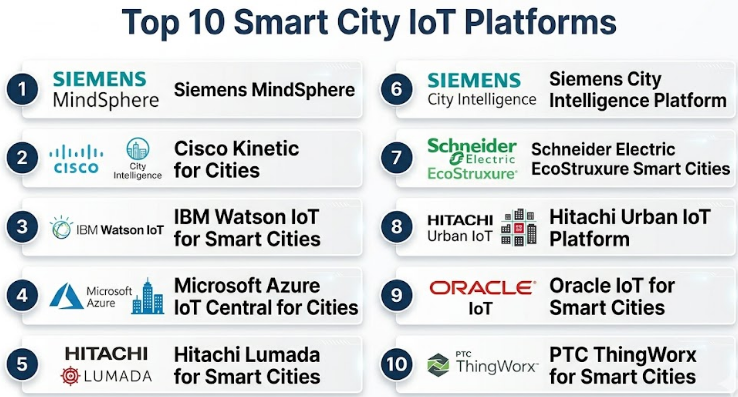
#1 — Siemens MindSphere
Short description:
MindSphere is an industrial IoT platform adapted for smart city applications, offering data analytics, device management, and predictive maintenance. It is ideal for large urban infrastructures and utility networks.
Key Features
- Real-time data analytics and dashboards
- Device and sensor management
- Predictive maintenance and alerts
- Open APIs for third-party integrations
- Energy and resource optimization
- Scalability for city-wide deployments
- Cloud-native architecture
Pros
- Strong industrial IoT pedigree
- Scalable for large, complex urban deployments
Cons
- Enterprise-level pricing
- May require specialized staff for deployment
Platforms / Deployment
- Web, Cloud
Security & Compliance
- ISO 27001, SOC 2
- MFA, RBAC, encryption
Integrations & Ecosystem
Supports energy, transportation, and environmental monitoring systems.
- Open APIs
- Third-party device integration
- Analytics connectors
Support & Community
- Dedicated enterprise support
- Extensive documentation and professional services
#2 — Cisco Kinetic for Cities
Short description:
Cisco Kinetic enables cities to securely connect, manage, and extract value from IoT devices. It focuses on traffic, public safety, utilities, and environment monitoring.
Key Features
- Device connectivity and lifecycle management
- Data ingestion and processing
- AI-driven insights and reporting
- Network segmentation and security
- Integration with Cisco IoT and IT infrastructure
- Policy-based automation
- Multi-domain analytics
Pros
- Strong integration with Cisco networking infrastructure
- Enterprise-grade security and visibility
Cons
- Complex configuration for non-Cisco networks
- Higher cost for small-scale deployments
Platforms / Deployment
- Web, Cloud / Hybrid
Security & Compliance
- ISO 27001, SOC 2
- MFA, SSO, RBAC
Integrations & Ecosystem
- Cisco networking and IoT devices
- API access for custom integrations
- Third-party SIEM and analytics support
Support & Community
- Cisco enterprise support and training
- Large partner ecosystem
#3 — IBM Watson IoT for Smart Cities
Short description:
IBM Watson IoT combines AI, data analytics, and device connectivity to improve city management. Applications include smart transportation, energy, and public safety systems.
Key Features
- AI-driven analytics and insights
- Device and sensor management
- Predictive maintenance for urban infrastructure
- Data visualization dashboards
- Integration with city IT systems
- Security and compliance monitoring
- Scalable cloud deployment
Pros
- Advanced AI for actionable insights
- Broad urban application coverage
Cons
- Can be complex for smaller cities
- Licensing costs may be high
Platforms / Deployment
- Web, Cloud
Security & Compliance
- ISO 27001, SOC 2, GDPR
- Encryption, RBAC, MFA
Integrations & Ecosystem
- APIs for city-specific applications
- Integration with transportation, utilities, and energy systems
- Analytics and reporting connectors
Support & Community
- IBM support tiers
- Extensive documentation and community forums
#4 — Microsoft Azure IoT Central for Cities
Short description:
Azure IoT Central simplifies city IoT management, offering pre-configured templates, cloud monitoring, and AI insights for urban operations.
Key Features
- Cloud-based device management
- Data analytics and visualization
- AI-powered anomaly detection
- Pre-built smart city templates
- Policy-driven access control
- Integration with Microsoft cloud ecosystem
Pros
- Quick deployment with templates
- Strong cloud scalability
Cons
- Primarily Azure-focused
- May require additional integration for OT systems
Platforms / Deployment
- Web, Cloud
Security & Compliance
- ISO 27001, SOC 2
- MFA, SSO, RBAC
Integrations & Ecosystem
- Microsoft Power BI and Azure services
- APIs for third-party device integration
- Cloud analytics and reporting connectors
Support & Community
- Microsoft enterprise support
- Active developer community
#5 — Hitachi Lumada for Smart Cities
Short description:
Lumada provides smart city platforms focusing on predictive analytics, mobility, and energy optimization for urban environments.
Key Features
- Device connectivity and data ingestion
- Predictive analytics for infrastructure
- Smart mobility and energy management
- Centralized dashboard and reporting
- Integration with OT and IT systems
- Security and compliance features
- Scalable cloud deployment
Pros
- Strong AI and predictive capabilities
- Integrated infrastructure management
Cons
- Primarily enterprise-level deployments
- Specialized setup may be needed
Platforms / Deployment
- Web, Cloud / Hybrid
Security & Compliance
- ISO 27001, SOC 2
- MFA, encryption, RBAC
Integrations & Ecosystem
- APIs for mobility, energy, and utilities integration
- Analytics connectors
- Third-party device compatibility
Support & Community
- Enterprise support plans
- Professional services and documentation
#6 — Siemens City Intelligence Platform
Short description:
Siemens City Intelligence Platform integrates urban infrastructure and IoT sensors to improve city planning, transportation, and energy efficiency.
Key Features
- Real-time city dashboards
- Predictive traffic and congestion analytics
- Energy and resource monitoring
- Device and sensor management
- AI-driven insights
- Data visualization tools
Pros
- Strong analytics for urban planning
- Scalable for multi-city projects
Cons
- Primarily for large-scale municipalities
- High initial setup cost
Platforms / Deployment
- Web, Cloud
Security & Compliance
- ISO 27001, SOC 2
- Encryption, RBAC, MFA
Integrations & Ecosystem
- Transportation, energy, and environmental systems
- APIs for city dashboards
- Reporting connectors
Support & Community
- Enterprise support and consulting
- Documentation and professional services
#7 — Schneider Electric EcoStruxure Smart Cities
Short description:
EcoStruxure provides integrated solutions for energy, building, and city infrastructure monitoring, enabling smart grid and sustainable city initiatives.
Key Features
- Real-time energy and building monitoring
- Predictive maintenance and alerts
- Smart grid and resource optimization
- Device management and data collection
- Integration with IT/OT systems
- Security and compliance features
Pros
- Energy and sustainability-focused analytics
- Strong IoT integration for utilities
Cons
- Focused primarily on energy and buildings
- May need additional modules for transport or safety
Platforms / Deployment
- Web, Cloud / Hybrid
Security & Compliance
- ISO 27001, SOC 2
- MFA, encryption, RBAC
Integrations & Ecosystem
- Utility and building systems
- Open APIs
- Energy and grid analytics
Support & Community
- Professional services
- Vendor support and documentation
#8 — Hitachi Urban IoT Platform
Short description:
Urban IoT Platform offers modular IoT solutions for mobility, waste, and environmental monitoring in cities with integrated AI analytics.
Key Features
- Modular smart city applications
- AI-powered analytics
- Real-time monitoring dashboards
- Predictive maintenance alerts
- Device and sensor management
Pros
- Flexible, modular solutions
- AI-driven decision support
Cons
- Enterprise-focused
- Smaller cities may find deployment complex
Platforms / Deployment
- Web, Cloud
Security & Compliance
- ISO 27001, SOC 2
- Encryption, RBAC
Integrations & Ecosystem
- APIs for mobility, environmental sensors, and waste management
- Dashboard integrations
- Reporting tools
Support & Community
- Enterprise support
- Documentation and professional services
#9 — Oracle IoT for Smart Cities
Short description:
Oracle IoT Cloud enables urban monitoring and predictive analytics for transportation, utilities, and infrastructure management.
Key Features
- Device connectivity and management
- Real-time analytics and dashboards
- Predictive maintenance and anomaly detection
- Policy-based alerts and automation
- Cloud-native architecture
Pros
- Broad IoT coverage for smart city needs
- Cloud scalability
Cons
- Primarily enterprise deployment
- Licensing may be complex
Platforms / Deployment
- Web, Cloud
Security & Compliance
- ISO 27001, SOC 2
- MFA, encryption, RBAC
Integrations & Ecosystem
- Cloud APIs
- Integration with IT/OT systems
- Analytics connectors
Support & Community
- Oracle enterprise support
- Knowledge base and professional services
#10 — PTC ThingWorx for Smart Cities
Short description:
ThingWorx provides IoT applications and analytics for city infrastructure, transportation, and environmental monitoring with rapid application development.
Key Features
- Device and sensor management
- Rapid IoT application development
- Real-time analytics and dashboards
- Predictive insights for city infrastructure
- Integration with OT/IT systems
Pros
- Rapid deployment and application creation
- Strong analytics and visualization
Cons
- Enterprise-focused pricing
- Customization may require technical expertise
Platforms / Deployment
- Web, Cloud / Hybrid
Security & Compliance
- ISO 27001, SOC 2
- MFA, RBAC, encryption
Integrations & Ecosystem
- APIs for third-party devices
- Analytics connectors
- OT/IT system integration
Support & Community
- Enterprise support tiers
- Documentation and developer community
Comparison Table (Top 10)
| Tool Name | Best For | Platform(s) Supported | Deployment | Standout Feature | Public Rating |
|---|---|---|---|---|---|
| Siemens MindSphere | Large urban infrastructures | Web | Cloud | Predictive maintenance | N/A |
| Cisco Kinetic for Cities | Networked city devices | Web | Cloud / Hybrid | Device lifecycle management | N/A |
| IBM Watson IoT for Smart Cities | AI analytics | Web | Cloud | AI-powered insights | N/A |
| Microsoft Azure IoT Central | Rapid city deployments | Web | Cloud | Pre-built templates | N/A |
| Hitachi Lumada | Mobility & energy optimization | Web | Cloud / Hybrid | Predictive analytics | N/A |
| Siemens City Intelligence Platform | Urban planning & traffic | Web | Cloud | City dashboards | N/A |
| Schneider EcoStruxure | Energy & sustainability | Web | Cloud / Hybrid | Smart grid optimization | N/A |
| Hitachi Urban IoT Platform | Modular city applications | Web | Cloud | AI-driven modularity | N/A |
| Oracle IoT for Smart Cities | Infrastructure & utilities | Web | Cloud | Cloud-native IoT | N/A |
| PTC ThingWorx | Rapid IoT app development | Web | Cloud / Hybrid | Application development | N/A |
Evaluation & Scoring
| Tool Name | Core (25%) | Ease (15%) | Integrations (15%) | Security (10%) | Performance (10%) | Support (10%) | Value (15%) | Weighted Total |
|---|---|---|---|---|---|---|---|---|
| Siemens MindSphere | 9 | 7 | 8 | 9 | 8 | 8 | 7 | 8.2 |
| Cisco Kinetic for Cities | 9 | 7 | 8 | 9 | 8 | 8 | 7 | 8.2 |
| IBM Watson IoT | 9 | 8 | 8 | 9 | 8 | 8 | 7 | 8.3 |
| Microsoft Azure IoT Central | 8 | 8 | 8 | 8 | 8 | 8 | 8 | 8.0 |
| Hitachi Lumada | 9 | 7 | 8 | 8 | 8 | 8 | 7 | 8.1 |
| Siemens City Intelligence | 8 | 8 | 7 | 8 | 8 | 8 | 7 | 7.9 |
| Schneider EcoStruxure | 8 | 8 | 7 | 8 | 8 | 8 | 7 | 7.9 |
| Hitachi Urban IoT | 8 | 7 | 7 | 8 | 8 | 7 | 7 | 7.6 |
| Oracle IoT | 8 | 7 | 7 | 8 | 8 | 7 | 7 | 7.6 |
| PTC ThingWorx | 8 | 7 | 7 | 8 | 8 | 7 | 7 | 7.6 |
Interpretation: Weighted totals indicate comparative performance. Higher scores reflect stronger feature coverage, integrations, security, and overall usability.
Which Smart City IoT Platform
Solo / Freelancer
- Azure IoT Central for quick pilot projects or smaller city initiatives.
SMB
- IBM Watson IoT or Siemens MindSphere for moderate-scale deployments and analytics.
Mid-Market
- Cisco Kinetic, Hitachi Lumada for integrated transportation, energy, and environmental management.
Enterprise
- Siemens City Intelligence, Schneider EcoStruxure, or PTC ThingWorx for city-wide infrastructure with advanced AI analytics.
Budget vs Premium
- Cloud-native solutions (Azure, IBM) are cost-effective; enterprise platforms (Siemens, Schneider) deliver high-end features at higher cost.
Feature Depth vs Ease of Use
- ThingWorx allows rapid app development; MindSphere provides deeper industrial analytics.
Integrations & Scalability
- Cisco, IBM, and Siemens excel in multi-vendor integration and scaling to city-wide deployments.
Security & Compliance Needs
- Siemens, IBM, and Microsoft provide ISO and SOC compliance; other platforms vary.
Frequently Asked Questions (FAQs)
1. What pricing models do smart city IoT platforms offer?
Most platforms use subscription-based or per-device pricing, with enterprise contracts for city-wide deployments. Costs depend on deployment scale and modules used.
2. How long does it take to implement a platform city-wide?
Implementation may range from weeks for pilot projects to several months for full city deployments.
3. Can legacy infrastructure integrate with these platforms?
Yes, many platforms provide APIs and adapters for existing traffic, energy, and utility systems.
4. Are AI-based predictions reliable?
AI enhances insights but should complement human oversight to avoid misinterpretation.
5. How is citizen data protected?
Platforms provide encryption, access controls, and compliance with standards like ISO 27001 and GDPR.
6. Do these platforms support real-time monitoring?
Yes, real-time dashboards, alerts, and predictive analytics are core features.
7. Are cloud and on-premises options available?
Most platforms offer cloud, hybrid, and sometimes on-premises deployments for flexibility.
8. Can platforms automate maintenance and alerts?
Yes, AI and policy-driven automation can trigger maintenance, alerts, and predictive actions.
9. How scalable are these platforms?
Cloud-native and hybrid platforms can scale from pilot zones to full city coverage.
10. What alternatives exist for small towns?
Smaller communities may opt for specialized monitoring solutions focusing on traffic, energy, or environmental sensors instead of a full smart city platform.
Conclusion
Smart City IoT Platforms enable cities to leverage connected devices, AI analytics, and data-driven decision-making to optimize operations and improve citizen services. Selection depends on city size, infrastructure complexity, budget, and specific objectives. Enterprise platforms like Siemens MindSphere and Schneider EcoStruxure offer full-scale capabilities, while cloud-native options like Microsoft Azure IoT Central and IBM Watson IoT provide flexibility and faster deployment. Evaluating connectivity, AI analytics, integration, scalability, and compliance is critical.
