Introduction
Edge Device Management Tools help organizations provision, monitor, secure, update, and maintain distributed edge computing devices across remote and decentralized environments. In simple terms, these platforms allow IT, operations, and engineering teams to centrally manage devices operating closer to data sources such as IoT gateways, industrial controllers, retail systems, smart sensors, edge servers, and AI inference devices.
In edge computing has become increasingly critical due to real-time processing demands, AI at the edge, industrial automation, smart city deployments, autonomous systems, remote operations, and bandwidth optimization requirements. Organizations now require scalable edge management platforms capable of handling distributed infrastructure with strong security, remote diagnostics, OTA (Over-the-Air) updates, telemetry visibility, and edge orchestration.
Modern Edge Device Management Tools combine fleet provisioning, device lifecycle management, container orchestration, policy enforcement, remote access, telemetry analytics, AI-assisted monitoring, and cybersecurity controls into centralized operational ecosystems.
Common real-world use cases include:
- Remote edge device provisioning
- Industrial edge infrastructure management
- AI inference device administration
- Edge firmware and software updates
- Retail and smart infrastructure operations
When evaluating Edge Device Management tools, buyers should consider:
- Scalability across distributed edge fleets
- Remote administration capabilities
- OTA update management
- Security and Zero Trust controls
- Edge orchestration support
- Container and Kubernetes compatibility
- Telemetry and analytics visibility
- Hybrid and offline operation support
- API and integration ecosystem
- Device provisioning automation
Best for: Manufacturing companies, telecom providers, logistics firms, smart city operators, retailers, healthcare organizations, industrial IoT teams, AI infrastructure operators, and enterprises managing distributed edge infrastructure.
Not ideal for: Organizations managing only centralized cloud infrastructure without distributed edge devices or remote operational requirements.
Key Trends in Edge Device Management Tools
- AI inference at the edge is driving new management requirements.
- Kubernetes and containerized edge orchestration adoption is increasing.
- Zero Trust edge security frameworks are becoming standard.
- OTA update automation is improving significantly.
- Hybrid cloud-edge operational models are expanding rapidly.
- Real-time telemetry analytics are becoming more advanced.
- Edge AI acceleration hardware management is growing.
- Offline-first edge operational support is improving.
- Industrial IoT and edge convergence are accelerating.
- Edge observability and fleet analytics are becoming critical capabilities.
How We Selected These Tools (Methodology)
The tools in this list were selected based on edge infrastructure scalability, operational reliability, ecosystem maturity, and enterprise adoption.
Our evaluation process included:
- Market adoption and operational credibility
- Edge fleet management functionality
- Device provisioning and OTA update capabilities
- Security and compliance controls
- Container and Kubernetes integration
- Hybrid cloud-edge operational support
- Telemetry and analytics visibility
- API and ecosystem maturity
- Scalability across distributed infrastructure
- Vendor support and developer ecosystem strength
The final selection includes cloud-native edge platforms, industrial edge management solutions, IoT operational ecosystems, and container-focused edge orchestration platforms.
Edge Device Management Tools
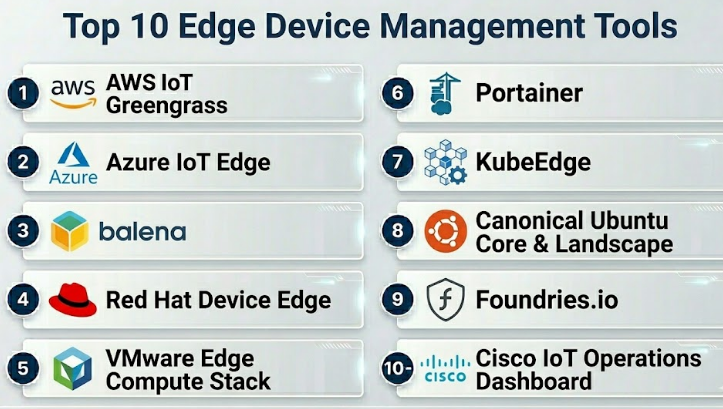
#1 — AWS IoT Greengrass
Short description :
AWS IoT Greengrass is an edge runtime and device management platform that extends AWS cloud capabilities to local edge devices. It enables organizations to run IoT workloads, machine learning inference, local messaging, and edge automation directly on distributed devices while maintaining centralized operational control.
Key Features
- Edge runtime orchestration
- Local ML inference support
- OTA software deployment
- Device shadow synchronization
- Secure edge messaging
- Edge telemetry visibility
- Lambda function execution at the edge
Pros
- Excellent AWS ecosystem integration
- Strong scalability for edge operations
- Good AI and ML edge support
Cons
- Requires AWS operational expertise
- Pricing complexity at scale
- Advanced deployments can become complex
Platforms / Deployment
- Linux / ARM devices / Edge gateways
- Cloud / Hybrid / Edge
Security & Compliance
- Encryption
- RBAC
- IAM integration
- Audit logging
- MFA integration
- Secure device identity controls
Integrations & Ecosystem
Greengrass integrates deeply with AWS cloud and IoT ecosystems.
- AWS IoT Core
- Lambda
- SageMaker
- APIs
- Edge hardware vendors
- Security tools
Support & Community
Large enterprise cloud ecosystem with extensive documentation and developer support.
#2 — Azure IoT Edge
Short description :
Azure IoT Edge is Microsoft’s edge computing platform that allows cloud workloads, AI models, analytics, and business logic to run directly on edge devices while remaining centrally managed through Azure infrastructure.
Key Features
- Containerized edge workloads
- AI and analytics deployment
- Remote device management
- Edge telemetry monitoring
- Offline operational support
- Kubernetes compatibility
- OTA deployment management
Pros
- Strong hybrid cloud-edge support
- Good AI and analytics integration
- Deep Microsoft ecosystem compatibility
Cons
- Complex large-scale deployments
- Requires Azure operational knowledge
- Some advanced workflows require tuning
Platforms / Deployment
- Linux / Windows / ARM devices
- Cloud / Hybrid / Edge
Security & Compliance
- MFA
- Encryption
- RBAC
- Audit logs
- Secure device authentication
- GDPR support
Integrations & Ecosystem
Azure IoT Edge integrates broadly across Microsoft ecosystems.
- Azure IoT Hub
- Azure AI
- Kubernetes
- APIs
- Microsoft Defender for IoT
Support & Community
Strong enterprise cloud ecosystem with extensive operational documentation.
#3 — Balena
Short description :
Balena is a container-focused edge device management platform designed for remote fleet administration, application deployment, and distributed Linux edge infrastructure management. It is widely used in industrial IoT, smart infrastructure, and embedded device operations.
Key Features
- Containerized edge deployment
- Remote fleet updates
- Device health monitoring
- Secure edge orchestration
- Cloud-based administration
- Remote diagnostics
- GitOps deployment workflows
Pros
- Excellent container management support
- Strong developer-friendly workflows
- Good remote edge visibility
Cons
- Primarily Linux-focused
- Enterprise governance depth varies
- Specialized edge focus
Platforms / Deployment
- Linux / Embedded devices
- Cloud / Hybrid / Edge
Security & Compliance
- Encryption
- RBAC
- MFA integration
- Audit logs
- Secure communication channels
Integrations & Ecosystem
Balena integrates with DevOps and edge ecosystems.
- Docker
- APIs
- CI/CD platforms
- Cloud services
- IoT gateways
Support & Community
Strong edge computing community with growing industrial adoption.
#4 — Red Hat Device Edge
Short description :
Red Hat Device Edge is an enterprise edge computing and device management platform designed for containerized edge workloads, distributed Linux systems, and hybrid cloud-edge infrastructure operations.
Key Features
- Kubernetes edge orchestration
- Linux edge management
- Container deployment automation
- Remote device administration
- OTA updates
- Edge observability
- Policy-based management
Pros
- Strong enterprise Linux integration
- Excellent Kubernetes ecosystem support
- Good hybrid cloud-edge scalability
Cons
- Enterprise deployment complexity
- Premium enterprise pricing
- Requires Linux and Kubernetes expertise
Platforms / Deployment
- Linux / Edge servers
- Cloud / Hybrid / Edge
Security & Compliance
- RBAC
- Encryption
- Audit logs
- MFA integration
- Policy enforcement controls
Integrations & Ecosystem
Red Hat Device Edge integrates deeply with Red Hat ecosystems.
- OpenShift
- Ansible
- Kubernetes
- APIs
- Hybrid cloud infrastructure
Support & Community
Large enterprise open-source ecosystem with strong operational support.
#5 — VMware Edge Compute Stack
Short description :
VMware Edge Compute Stack is a distributed edge infrastructure platform providing virtualization, Kubernetes orchestration, edge lifecycle management, and centralized operational visibility for enterprise edge deployments.
Key Features
- Edge virtualization
- Kubernetes orchestration
- Edge application lifecycle management
- Remote fleet administration
- Telemetry and observability
- Policy-based automation
- Edge analytics visibility
Pros
- Strong virtualization ecosystem integration
- Good enterprise scalability
- Centralized edge operational control
Cons
- Premium infrastructure costs
- Complex deployment architecture
- Best optimized for VMware ecosystems
Platforms / Deployment
- Linux / Edge servers / Virtualized infrastructure
- Cloud / Hybrid / Edge
Security & Compliance
- MFA
- RBAC
- Encryption
- Audit logs
- SSO/SAML integration
Integrations & Ecosystem
VMware integrates broadly across virtualization and hybrid cloud ecosystems.
- VMware Tanzu
- VMware vSphere
- Kubernetes
- APIs
- Security platforms
Support & Community
Large enterprise virtualization ecosystem with strong global support.
#6 — Portainer
Short description :
Portainer is a lightweight container and Kubernetes management platform increasingly used for edge infrastructure management, remote container orchestration, and distributed edge application deployment.
Key Features
- Kubernetes management
- Docker container administration
- Remote edge deployment
- GitOps workflows
- Edge endpoint monitoring
- Multi-cluster visibility
- Lightweight operational model
Pros
- Simple operational experience
- Good container management usability
- Flexible deployment options
Cons
- Advanced enterprise governance varies
- Limited deep industrial tooling
- Some large-scale features require enterprise editions
Platforms / Deployment
- Linux / Windows / Kubernetes
- Cloud / Self-hosted / Edge
Security & Compliance
- RBAC
- MFA integration
- Encryption
- Audit logs
- Access management controls
Integrations & Ecosystem
Portainer integrates with cloud-native and DevOps ecosystems.
- Docker
- Kubernetes
- APIs
- CI/CD tools
- Cloud infrastructure
Support & Community
Strong open-source and developer community with growing enterprise adoption.
#7 — KubeEdge
Short description :
KubeEdge is an open-source Kubernetes-native edge computing platform that extends container orchestration capabilities to distributed edge devices and offline edge environments.
Key Features
- Kubernetes-native edge orchestration
- Offline edge support
- Device synchronization
- Edge application deployment
- Telemetry collection
- Cloud-edge communication
- Open-source architecture
Pros
- Strong Kubernetes compatibility
- Good offline edge operation support
- Flexible open-source ecosystem
Cons
- Requires Kubernetes expertise
- Enterprise support varies
- Operational complexity for beginners
Platforms / Deployment
- Linux / Kubernetes environments
- Cloud / Self-hosted / Edge
Security & Compliance
- RBAC
- Encryption
- Audit logs
- Secure edge communication
- Policy controls
Integrations & Ecosystem
KubeEdge integrates with cloud-native and Kubernetes ecosystems.
- Kubernetes
- CNCF tools
- APIs
- Edge hardware
- DevOps platforms
Support & Community
Growing CNCF and edge computing community adoption.
#8 — Canonical Ubuntu Core & Landscape
Short description :
Canonical Ubuntu Core and Landscape provide secure Linux-based edge device management, OTA updates, remote administration, and centralized fleet visibility for Ubuntu-powered edge environments.
Key Features
- Secure Linux edge OS
- OTA update automation
- Device inventory management
- Remote administration
- Policy enforcement
- Snap package management
- Edge telemetry visibility
Pros
- Strong Ubuntu ecosystem integration
- Good Linux security model
- Reliable OTA update workflows
Cons
- Primarily Ubuntu-focused
- Limited broader edge orchestration depth
- Enterprise analytics vary
Platforms / Deployment
- Linux / Ubuntu devices
- Cloud / Hybrid / Edge
Security & Compliance
- Encryption
- RBAC
- Audit logs
- MFA integration
- Secure boot support
Integrations & Ecosystem
Canonical integrates with Linux and cloud-native ecosystems.
- Ubuntu Pro
- OpenStack
- APIs
- Kubernetes
- Edge hardware platforms
Support & Community
Large Linux administrator ecosystem with strong enterprise support.
#9 — Foundries.io
Short description :
Foundries.io is an edge and IoT device management platform focused on secure Linux edge deployments, OTA updates, DevSecOps workflows, and lifecycle management for connected edge infrastructure.
Key Features
- Secure OTA updates
- Linux edge lifecycle management
- DevSecOps automation
- Device provisioning
- Containerized workloads
- Remote diagnostics
- CI/CD integration
Pros
- Strong security-focused architecture
- Good DevSecOps workflows
- Useful OTA management functionality
Cons
- Smaller ecosystem maturity
- Advanced enterprise integrations vary
- Specialized Linux focus
Platforms / Deployment
- Linux / Embedded systems
- Cloud / Hybrid / Edge
Security & Compliance
- Secure boot
- Encryption
- RBAC
- Audit logs
- MFA integration
Integrations & Ecosystem
Foundries.io integrates with embedded Linux and DevOps ecosystems.
- Docker
- CI/CD tools
- APIs
- Cloud services
- Edge hardware vendors
Support & Community
Growing edge Linux ecosystem with developer-focused operational support.
#10 — Cisco IoT Operations Dashboard
Short description :
Cisco IoT Operations Dashboard provides centralized operational visibility, edge device administration, secure remote access, and lifecycle management for industrial and enterprise edge deployments.
Key Features
- Secure edge device onboarding
- Remote troubleshooting
- Edge telemetry visibility
- Policy-based management
- Device inventory administration
- Network-aware edge monitoring
- Secure remote access
Pros
- Strong networking ecosystem integration
- Good operational visibility
- Enterprise-grade security controls
Cons
- Best optimized for Cisco environments
- Premium enterprise pricing
- Complex enterprise deployment models
Platforms / Deployment
- Edge gateways / Linux / Industrial devices
- Cloud / Hybrid / Edge
Security & Compliance
- MFA
- RBAC
- Encryption
- Audit logs
- Secure device identity management
Integrations & Ecosystem
Cisco integrates broadly with networking and industrial ecosystems.
- Cisco networking infrastructure
- APIs
- Security platforms
- Industrial gateways
- Cloud services
Support & Community
Large enterprise networking ecosystem with strong global support infrastructure.
Comparison Table (Top 10)
| Tool Name | Best For | Platform(s) Supported | Deployment | Standout Feature | Public Rating |
|---|---|---|---|---|---|
| AWS IoT Greengrass | Cloud-connected edge fleets | Linux, ARM | Hybrid, Edge | Local ML inference | N/A |
| Azure IoT Edge | Microsoft-centric edge operations | Linux, Windows | Hybrid, Edge | Containerized edge workloads | N/A |
| Balena | Linux edge fleet management | Linux | Cloud, Edge | Remote container orchestration | N/A |
| Red Hat Device Edge | Enterprise Kubernetes edge | Linux | Hybrid, Edge | OpenShift integration | N/A |
| VMware Edge Compute Stack | Virtualized edge infrastructure | Linux, Virtualized | Hybrid, Edge | Enterprise edge virtualization | N/A |
| Portainer | Lightweight edge container management | Linux, Kubernetes | Self-hosted, Edge | Simple Kubernetes management | N/A |
| KubeEdge | Open-source Kubernetes edge | Linux | Self-hosted, Edge | Offline edge support | N/A |
| Ubuntu Core & Landscape | Secure Ubuntu edge operations | Linux | Hybrid, Edge | Secure OTA updates | N/A |
| Foundries.io | Secure Linux edge lifecycle management | Linux | Hybrid, Edge | DevSecOps automation | N/A |
| Cisco IoT Operations Dashboard | Industrial edge visibility | Industrial Devices | Hybrid, Edge | Network-aware edge monitoring | N/A |
Evaluation & Edge Device Management Tools
| Tool Name | Core (25%) | Ease (15%) | Integrations (15%) | Security (10%) | Performance (10%) | Support (10%) | Value (15%) | Weighted Total (0–10) |
|---|---|---|---|---|---|---|---|---|
| AWS IoT Greengrass | 10 | 7 | 10 | 9 | 10 | 9 | 7 | 8.85 |
| Azure IoT Edge | 9 | 8 | 10 | 9 | 9 | 9 | 8 | 8.85 |
| Balena | 8 | 9 | 7 | 8 | 8 | 8 | 8 | 8.00 |
| Red Hat Device Edge | 9 | 7 | 9 | 9 | 9 | 8 | 7 | 8.20 |
| VMware Edge Compute Stack | 9 | 7 | 9 | 9 | 8 | 8 | 7 | 8.05 |
| Portainer | 8 | 9 | 7 | 7 | 8 | 8 | 9 | 8.05 |
| KubeEdge | 8 | 6 | 8 | 8 | 8 | 7 | 9 | 7.80 |
| Ubuntu Core & Landscape | 8 | 8 | 7 | 9 | 8 | 8 | 8 | 8.00 |
| Foundries.io | 8 | 7 | 7 | 9 | 8 | 7 | 8 | 7.75 |
| Cisco IoT Operations Dashboard | 8 | 7 | 9 | 9 | 8 | 8 | 7 | 7.95 |
These scores are comparative evaluations designed to help organizations understand the relative strengths of edge device management platforms. Cloud hyperscalers generally score highly in scalability and integrations, while open-source and Linux-focused platforms provide stronger flexibility and operational customization. Buyers should prioritize categories aligned with edge deployment scale, Kubernetes adoption, security requirements, and operational complexity.
Which Edge Device Management Tools
Solo / Freelancer
Solo developers and makers often benefit most from lightweight platforms such as Portainer, Balena, or KubeEdge for experimentation and small edge deployments.
SMB
Portainer, Ubuntu Core & Landscape, and Balena provide manageable operational complexity, good scalability, and flexible deployment models for SMB environments.
Mid-Market
Azure IoT Edge, Red Hat Device Edge, and Cisco IoT Operations Dashboard work well for organizations balancing scalability, security, and operational visibility.
Enterprise
AWS IoT Greengrass, VMware Edge Compute Stack, and Red Hat Device Edge are ideal for enterprises requiring large-scale distributed edge orchestration and hybrid cloud-edge governance.
Budget vs Premium
Budget-conscious organizations may prefer Portainer or KubeEdge, while premium enterprise buyers often invest in AWS, VMware, or Red Hat ecosystems.
Feature Depth vs Ease of Use
Enterprise Kubernetes-focused platforms provide deep orchestration functionality but often require experienced DevOps or platform engineering teams. Portainer and Balena generally offer easier onboarding and operational simplicity.
Integrations & Scalability
Organizations heavily invested in Kubernetes, VMware, AWS, Microsoft Azure, or industrial networking ecosystems should prioritize tools with strong native integrations and API ecosystems.
Security & Compliance Needs
Highly regulated industries should prioritize edge management platforms offering secure boot, encryption, RBAC, audit logging, Zero Trust integration, and secure OTA deployment capabilities.
Frequently Asked Questions (FAQs)
1. What are Edge Device Management Tools?
Edge Device Management Tools help organizations provision, monitor, secure, update, and maintain distributed edge computing devices and infrastructure.
2. Why are edge management platforms important?
Modern edge deployments often involve geographically distributed infrastructure that requires centralized operational visibility, automation, and security enforcement.
3. What is edge computing?
Edge computing processes data closer to where it is generated rather than relying entirely on centralized cloud infrastructure.
4. What industries commonly use edge computing?
Manufacturing, healthcare, retail, telecom, logistics, smart cities, transportation, and energy sectors are major adopters.
5. Can edge management platforms improve security?
Yes. They help enforce device identity management, automate updates, monitor telemetry, and support Zero Trust operational models.
6. What features matter most in edge device management?
Important features include OTA updates, remote administration, edge orchestration, telemetry visibility, container support, and scalability.
7. What is OTA edge management?
OTA (Over-the-Air) management allows remote deployment of firmware, applications, and configurations to distributed edge devices.
8. Are Kubernetes-based edge platforms growing?
Yes. Kubernetes-native edge orchestration is becoming increasingly common for scalable containerized edge infrastructure management.
9. What are common edge management implementation mistakes?
Common mistakes include weak security governance, poor offline operational planning, insufficient telemetry monitoring, and limited scalability preparation.
10. Can SMBs benefit from edge management tools?
Yes. SMBs operating retail systems, industrial automation, or smart infrastructure can improve operational visibility and remote administration efficiency.
11. How do edge management platforms support AI workloads?
They help deploy, monitor, update, and orchestrate AI inference workloads directly on edge devices and local infrastructure.
12. What is the difference between IoT management and edge device management?
IoT management focuses broadly on connected devices and telemetry, while edge management emphasizes local compute infrastructure, edge orchestration, AI processing, and distributed application management.
Conclusion
Edge Device Management Tools have become essential operational platforms for organizations managing distributed infrastructure, industrial automation, AI inference systems, and hybrid cloud-edge environments. In businesses require centralized edge visibility, secure remote administration, scalable orchestration, and reliable OTA lifecycle management to support increasingly decentralized operational models.The ideal platform depends heavily on cloud strategy, edge computing maturity, Kubernetes adoption, operational scale, and security requirements.
