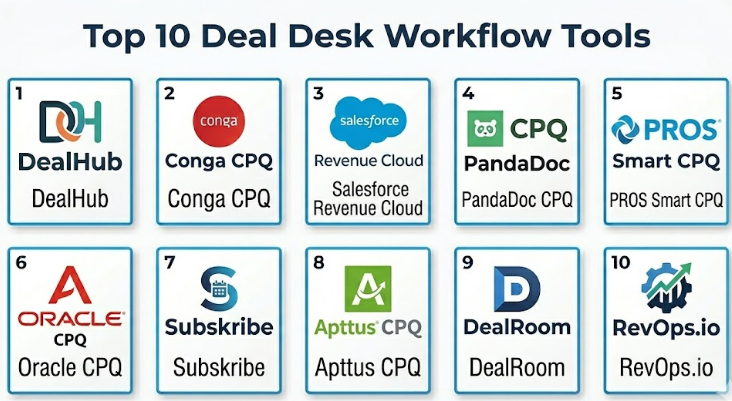
Introduction
Deal Desk Workflow tools help sales, finance, legal, procurement, and revenue operations teams streamline complex deal approval processes. These platforms centralize pricing approvals, quote reviews, contract workflows, discount governance, and cross-functional collaboration into one structured system. In simple terms, Deal Desk software helps organizations close deals faster while reducing pricing errors, compliance risks, and approval bottlenecks.
In 2026, modern revenue organizations are increasingly relying on Deal Desk platforms to support subscription pricing models, enterprise negotiations, CPQ workflows, usage-based billing, and AI-assisted approvals. As SaaS and enterprise sales cycles become more complex, businesses need tools that improve visibility, governance, and collaboration across distributed teams.
Common real-world use cases include:
- Managing quote and pricing approvals
- Automating discount governance workflows
- Coordinating legal and finance approvals
- Supporting enterprise contract negotiations
- Managing CPQ and proposal workflows
- Improving sales cycle visibility and forecasting
When evaluating Deal Desk Workflow tools, buyers should consider:
- Workflow automation flexibility
- CPQ and CRM integrations
- Approval routing capabilities
- Pricing and discount governance
- Contract lifecycle integrations
- AI-powered analytics and forecasting
- Security and audit logging
- Ease of deployment and usability
- Scalability for enterprise operations
- Reporting and collaboration features
Best for: Enterprise sales teams, SaaS companies, RevOps teams, finance departments, legal operations teams, and organizations with complex approval or pricing workflows.
Not ideal for: Small businesses with very short sales cycles or companies managing simple fixed-price transactions without multi-stage approval processes.
Key Trends in Deal Desk Workflow Tools
- AI-powered approval recommendations are reducing manual review times.
- Revenue operations teams are increasingly consolidating CPQ, contract management, and deal workflows into unified systems.
- Usage-based pricing and subscription billing support are becoming essential features.
- Embedded analytics and forecasting are improving sales pipeline visibility.
- Workflow automation engines are replacing spreadsheet-driven approvals.
- Integration-first architectures are enabling better interoperability with CRM and ERP ecosystems.
- Security expectations now commonly include RBAC, SSO, MFA, and audit trails.
- Low-code workflow builders are improving operational flexibility.
- Real-time collaboration tools are supporting distributed sales and legal teams.
- Enterprise organizations are prioritizing governance and pricing consistency across regions.
How We Selected These Tools (Methodology)
The tools in this list were selected using practical business and technical evaluation criteria relevant to modern revenue operations teams.
Selection factors included:
- Market adoption and enterprise visibility
- Workflow automation capabilities
- CRM, ERP, and CPQ integration depth
- Security and compliance functionality
- Ease of use for cross-functional teams
- Analytics and reporting capabilities
- Scalability for enterprise deployments
- Vendor reliability and ecosystem maturity
- Support quality and onboarding resources
- Flexibility across SaaS, manufacturing, and enterprise sales environments
The final list includes both enterprise-grade platforms and mid-market solutions designed for different operational requirements.
Deal Desk Workflow Tools
#1 — DealHub
Short description :
DealHub is a revenue operations platform focused on CPQ, deal desk workflows, contract management, and subscription billing. It is widely used by SaaS and enterprise organizations that require complex approval routing and pricing governance. The platform combines workflow automation with collaborative deal management capabilities. DealHub emphasizes no-code configuration and centralized deal visibility for sales, finance, and legal teams. Organizations with complex quoting environments often choose DealHub for operational flexibility.
Key Features
- CPQ and quote management
- Deal approval workflows
- Contract lifecycle management
- Subscription billing support
- Workflow automation engine
- Revenue analytics dashboards
- No-code configuration tools
Pros
- Strong CPQ and workflow automation
- Good fit for SaaS pricing models
- Flexible no-code customization
Cons
- Enterprise pricing may be expensive
- Advanced setup can require onboarding assistance
- Some analytics features may require configuration effort
Platforms / Deployment
- Web
- Cloud
Security & Compliance
- SSO/SAML
- MFA
- RBAC
- Audit logs
- GDPR support
- Enterprise-grade encryption
Integrations & Ecosystem
DealHub integrates with CRM, ERP, billing, and contract management ecosystems to support end-to-end revenue workflows.
- Salesforce
- HubSpot
- Microsoft Dynamics
- NetSuite
- Stripe
- APIs
Support & Community
DealHub provides onboarding assistance, implementation services, customer success programs, and enterprise support resources.
#2 — Conga CPQ
Short description :
Conga CPQ is designed for enterprises managing complex pricing, approvals, and contract workflows. The platform supports quote generation, approval routing, proposal automation, and contract lifecycle management within larger revenue operations environments. Conga is commonly used in industries with highly customized pricing structures and long enterprise sales cycles. Its strong Salesforce ecosystem alignment is a major advantage for existing Salesforce customers.
Key Features
- CPQ workflows
- Proposal generation
- Contract lifecycle management
- Approval routing automation
- Pricing governance
- Analytics dashboards
- Salesforce-native capabilities
Pros
- Strong enterprise workflow capabilities
- Deep Salesforce ecosystem integration
- Advanced document automation
Cons
- Higher implementation complexity
- Learning curve for advanced features
- Premium licensing costs
Platforms / Deployment
- Web
- Cloud
Security & Compliance
- SSO/SAML
- MFA
- Encryption
- RBAC
- Audit logging
- GDPR support
Integrations & Ecosystem
Conga integrates with CRM, ERP, and document management ecosystems.
- Salesforce
- SAP
- Oracle
- Microsoft Dynamics
- DocuSign
- APIs
Support & Community
Conga offers enterprise onboarding, implementation partners, training programs, and support tiers.
#3 — Salesforce Revenue Cloud
Short description :
Salesforce Revenue Cloud combines CPQ, billing, contract management, and deal workflow automation into one platform. It is designed for enterprise organizations managing large sales operations with complex approval structures. Revenue Cloud helps teams automate pricing governance, subscription billing, and quote approvals while maintaining centralized revenue visibility. Businesses already invested in Salesforce infrastructure often benefit from native ecosystem integration.
Key Features
- CPQ automation
- Deal approval workflows
- Subscription billing
- Revenue forecasting
- Contract management
- AI-powered analytics
- Workflow automation
Pros
- Unified Salesforce ecosystem
- Strong enterprise scalability
- Advanced automation capabilities
Cons
- Complex implementation requirements
- Premium enterprise pricing
- Customization may require specialist expertise
Platforms / Deployment
- Web / iOS / Android
- Cloud
Security & Compliance
- SSO/SAML
- MFA
- RBAC
- Audit logs
- Encryption
- Enterprise compliance capabilities
Integrations & Ecosystem
Salesforce Revenue Cloud integrates deeply with Salesforce products and enterprise business systems.
- Salesforce CRM
- Slack
- MuleSoft
- SAP
- NetSuite
- APIs
Support & Community
Salesforce offers extensive enterprise documentation, implementation ecosystems, and premium support programs.
#4 — PandaDoc CPQ
Short description :
PandaDoc CPQ combines quote generation, approvals, proposal management, and e-signature workflows into a collaborative platform. It is commonly used by SMB and mid-market sales organizations seeking simplified deal workflow automation. The platform emphasizes usability, fast deployment, and document collaboration while supporting pricing approvals and sales acceleration workflows.
Key Features
- Quote and proposal generation
- Approval workflows
- E-signature support
- Workflow automation
- Pricing configuration
- Document collaboration
- Analytics dashboards
Pros
- User-friendly interface
- Faster deployment process
- Strong document collaboration capabilities
Cons
- Enterprise customization depth is limited
- Advanced governance features may be basic
- Large-scale enterprise workflows may require additional tools
Platforms / Deployment
- Web / iOS / Android
- Cloud
Security & Compliance
- SSO
- MFA
- Encryption
- Audit logs
- GDPR support
- SOC compliance information varies
Integrations & Ecosystem
PandaDoc supports integrations across CRM, payment, and document management platforms.
- Salesforce
- HubSpot
- Stripe
- Zapier
- Microsoft Dynamics
- APIs
Support & Community
PandaDoc provides onboarding assistance, customer support, templates, and documentation resources.
#5 — PROS Smart CPQ
Short description :
PROS Smart CPQ is designed for enterprises managing complex pricing structures and advanced sales approval workflows. The platform uses AI-assisted pricing optimization and deal analytics to improve pricing governance and revenue performance. It is widely adopted in manufacturing, distribution, and enterprise sales environments with highly configurable pricing models.
Key Features
- AI-powered pricing optimization
- Quote configuration workflows
- Deal approvals
- Revenue analytics
- Workflow automation
- Guided selling capabilities
- Enterprise pricing governance
Pros
- Advanced pricing intelligence
- Strong enterprise scalability
- AI-driven revenue optimization
Cons
- Complex implementation process
- Requires specialized onboarding
- Premium enterprise pricing
Platforms / Deployment
- Web
- Cloud
Security & Compliance
- SSO/SAML
- MFA
- RBAC
- Encryption
- Audit trails
- Enterprise governance features
Integrations & Ecosystem
PROS integrates with enterprise CRM and ERP ecosystems.
- Salesforce
- SAP
- Oracle
- Microsoft Dynamics
- APIs
Support & Community
PROS provides enterprise onboarding, implementation consulting, and customer success programs.
#6 — Oracle CPQ
Short description :
Oracle CPQ helps enterprises automate pricing, approvals, quote generation, and contract workflows. The platform is designed for organizations managing high-volume enterprise sales operations with complex configuration requirements. Oracle CPQ supports advanced workflow customization and integrates closely with Oracle ERP and CX ecosystems.
Key Features
- Quote automation
- Approval workflows
- Product configuration
- Contract management
- Workflow customization
- Revenue analytics
- Enterprise integrations
Pros
- Strong enterprise scalability
- Broad Oracle ecosystem integration
- Advanced workflow customization
Cons
- Implementation complexity
- Longer deployment timelines
- Requires specialized expertise
Platforms / Deployment
- Web
- Cloud / Hybrid
Security & Compliance
- SSO/SAML
- MFA
- RBAC
- Audit logs
- Encryption
- Enterprise compliance support
Integrations & Ecosystem
Oracle CPQ integrates with Oracle enterprise systems and third-party business applications.
- Oracle ERP
- Oracle CX
- Salesforce
- SAP
- APIs
Support & Community
Oracle offers enterprise support programs, technical documentation, and implementation services.
#7 — Subskribe
Short description :
Subskribe is a modern quote-to-revenue platform designed primarily for SaaS companies. The platform combines CPQ, billing, deal desk workflows, and revenue analytics into one unified environment. Subskribe focuses on subscription-based sales operations and aims to simplify pricing approvals, quoting, and revenue management workflows for fast-growing SaaS organizations.
Key Features
- SaaS-focused CPQ
- Subscription billing
- Deal approval workflows
- Revenue analytics
- Contract workflows
- Pricing management
- Workflow automation
Pros
- Built for SaaS subscription models
- Modern interface and usability
- Unified revenue operations workflows
Cons
- Smaller ecosystem compared to enterprise vendors
- Limited enterprise customization depth
- May not fit highly regulated industries
Platforms / Deployment
- Web
- Cloud
Security & Compliance
- SSO
- MFA
- Encryption
- Audit logs
- GDPR support
- Not publicly stated for additional certifications
Integrations & Ecosystem
Subskribe supports CRM and billing integrations for SaaS workflows.
- Salesforce
- HubSpot
- Stripe
- NetSuite
- APIs
Support & Community
Subskribe provides onboarding assistance and SaaS-focused customer support programs.
#8 — Apttus CPQ (Conga)
Short description :
Apttus CPQ, now part of Conga, is a long-established enterprise CPQ and deal workflow platform. It supports pricing governance, approvals, quote generation, and contract automation for organizations with large enterprise sales operations. The platform is commonly used in industries with complex procurement and pricing requirements.
Key Features
- CPQ automation
- Deal desk workflows
- Contract lifecycle management
- Pricing governance
- Workflow approvals
- Proposal generation
- Revenue analytics
Pros
- Mature enterprise workflow capabilities
- Strong contract management functionality
- Scalable for large organizations
Cons
- Complex implementation process
- Requires dedicated administration
- Higher licensing costs
Platforms / Deployment
- Web
- Cloud
Security & Compliance
- SSO/SAML
- MFA
- RBAC
- Audit logging
- Encryption
- GDPR support
Integrations & Ecosystem
Apttus integrates with CRM and ERP ecosystems for enterprise sales operations.
- Salesforce
- SAP
- Oracle
- DocuSign
- APIs
Support & Community
The platform offers enterprise support, onboarding services, and implementation partner ecosystems.
#9 — DealRoom
Short description :
DealRoom focuses on collaboration-heavy deal workflows and revenue operations coordination. The platform helps organizations manage approvals, document workflows, stakeholder communication, and pipeline visibility across distributed teams. It is commonly used by sales, finance, and operations teams seeking better coordination around enterprise deals.
Key Features
- Deal collaboration tools
- Approval workflows
- Pipeline visibility
- Workflow automation
- Analytics dashboards
- Stakeholder coordination
- Document management
Pros
- Strong collaboration functionality
- Good workflow visibility
- Faster operational coordination
Cons
- Less mature CPQ depth compared to enterprise suites
- Smaller ecosystem
- Advanced pricing governance may be limited
Platforms / Deployment
- Web
- Cloud
Security & Compliance
- SSO
- MFA
- Encryption
- Audit logs
- GDPR support
- Not publicly stated for additional certifications
Integrations & Ecosystem
DealRoom integrates with CRM and productivity ecosystems.
- Salesforce
- HubSpot
- Slack
- Google Workspace
- APIs
Support & Community
DealRoom provides onboarding support and operational assistance for growing revenue teams.
#10 — RevOps.io
Short description :
RevOps.io is designed to streamline revenue operations workflows including approvals, pricing governance, sales coordination, and analytics. The platform emphasizes operational visibility and workflow standardization across sales and finance teams. It is suitable for organizations looking to improve quote governance and deal execution efficiency.
Key Features
- Workflow automation
- Pricing approvals
- Revenue analytics
- Sales coordination tools
- Reporting dashboards
- Governance workflows
- Operational visibility
Pros
- Strong workflow visibility
- Simplified operational coordination
- Useful for RevOps-focused organizations
Cons
- Smaller market presence
- Limited enterprise ecosystem depth
- Some advanced features may require customization
Platforms / Deployment
- Web
- Cloud
Security & Compliance
- SSO
- MFA
- Encryption
- RBAC
- Audit logs
- Not publicly stated for additional certifications
Integrations & Ecosystem
RevOps.io supports integrations across CRM and revenue operations platforms.
- Salesforce
- HubSpot
- Slack
- APIs
- Zapier
Support & Community
The platform offers onboarding support and operational guidance for RevOps teams.
Comparison Table (Top 10)
| Tool Name | Best For | Platform(s) Supported | Deployment | Standout Feature | Public Rating |
|---|---|---|---|---|---|
| DealHub | SaaS and enterprise RevOps | Web | Cloud | No-code deal workflows | N/A |
| Conga CPQ | Enterprise pricing workflows | Web | Cloud | Salesforce-native document automation | N/A |
| Salesforce Revenue Cloud | Enterprise revenue operations | Web, iOS, Android | Cloud | Unified revenue ecosystem | N/A |
| PandaDoc CPQ | SMB and mid-market sales teams | Web, iOS, Android | Cloud | Fast proposal automation | N/A |
| PROS Smart CPQ | AI-driven pricing optimization | Web | Cloud | AI pricing intelligence | N/A |
| Oracle CPQ | Large enterprise sales operations | Web | Cloud, Hybrid | Oracle ecosystem integration | N/A |
| Subskribe | SaaS subscription businesses | Web | Cloud | Unified quote-to-revenue workflows | N/A |
| Apttus CPQ (Conga) | Complex enterprise approvals | Web | Cloud | Mature contract automation | N/A |
| DealRoom | Collaborative enterprise deal workflows | Web | Cloud | Stakeholder collaboration | N/A |
| RevOps.io | Revenue operations governance | Web | Cloud | Operational workflow visibility | N/A |
Evaluation & Deal Desk Workflow Tools
| Tool Name | Core (25%) | Ease (15%) | Integrations (15%) | Security (10%) | Performance (10%) | Support (10%) | Value (15%) | Weighted Total (0–10) |
|---|---|---|---|---|---|---|---|---|
| DealHub | 9 | 8.5 | 8.5 | 8.5 | 8.5 | 8 | 8 | 8.5 |
| Conga CPQ | 9 | 7 | 9 | 8.5 | 8.5 | 8 | 7 | 8.2 |
| Salesforce Revenue Cloud | 9.5 | 7 | 10 | 9.5 | 9 | 9 | 6.5 | 8.7 |
| PandaDoc CPQ | 7.5 | 9 | 8 | 7.5 | 8 | 8.5 | 9 | 8.2 |
| PROS Smart CPQ | 9 | 6.5 | 8.5 | 9 | 9 | 8 | 6.5 | 8.1 |
| Oracle CPQ | 9 | 6.5 | 9 | 9 | 9 | 8 | 6.5 | 8.1 |
| Subskribe | 8 | 8.5 | 7.5 | 7.5 | 8 | 8 | 8.5 | 8.0 |
| Apttus CPQ (Conga) | 8.5 | 6.5 | 8.5 | 8.5 | 8.5 | 8 | 6.5 | 7.9 |
| DealRoom | 7.5 | 8.5 | 7 | 7.5 | 7.5 | 8 | 8 | 7.7 |
| RevOps.io | 7 | 8 | 7 | 7.5 | 7.5 | 7.5 | 8 | 7.4 |
These scores are comparative and designed to help organizations evaluate trade-offs between workflow depth, usability, governance, integrations, and operational scalability. Enterprise-focused platforms generally score higher in customization and compliance, while SMB-focused solutions often prioritize usability and deployment speed. Businesses should align scoring priorities with their operational maturity and sales complexity.
Which Deal Desk Workflow Tools
Solo / Freelancer
Solo consultants and small businesses with simple pricing structures may not require advanced deal desk platforms. Lightweight quoting and proposal tools may be more practical than enterprise workflow systems.
SMB
SMBs often benefit from platforms that balance usability and automation. PandaDoc CPQ and Subskribe are strong options for organizations seeking faster implementation and simplified workflows.
Mid-Market
Mid-market businesses usually require stronger integrations and pricing governance while maintaining operational flexibility. DealHub and Conga CPQ provide balanced functionality for scaling revenue teams.
Enterprise
Large enterprises typically prioritize governance, scalability, workflow customization, and ecosystem integrations. Salesforce Revenue Cloud, Oracle CPQ, and PROS Smart CPQ are strong enterprise-focused choices.
Budget vs Premium
- Budget-friendly options: PandaDoc CPQ, Subskribe
- Mid-range enterprise value: DealHub, Conga CPQ
- Premium enterprise platforms: Salesforce Revenue Cloud, Oracle CPQ, PROS Smart CPQ
Organizations should evaluate operational and implementation costs alongside licensing fees.
Feature Depth vs Ease of Use
- Feature-rich enterprise tools: Salesforce Revenue Cloud, Oracle CPQ
- Easier-to-use platforms: PandaDoc CPQ, Subskribe
- Balanced workflow flexibility: DealHub, Conga CPQ
Highly customizable platforms often require longer deployment timelines and specialized onboarding.
Integrations & Scalability
Organizations already invested in Salesforce or Oracle ecosystems may benefit from native integration advantages. Businesses expecting operational growth should prioritize API support and workflow extensibility.
Security & Compliance Needs
Organizations in regulated industries should prioritize:
- MFA and SSO support
- Audit trails
- RBAC controls
- Encryption standards
- Governance and compliance capabilities
Enterprise-focused platforms generally provide stronger governance and compliance tooling.
Frequently Asked Questions (FAQs)
1. What is a Deal Desk Workflow tool?
A Deal Desk Workflow tool helps organizations manage pricing approvals, contract coordination, quote reviews, and enterprise deal collaboration across sales, finance, legal, and operations teams.
2. Why are Deal Desk platforms important in 2026?
Modern enterprise sales processes involve subscription pricing, complex approvals, global compliance requirements, and multi-team collaboration. Deal Desk platforms help standardize and accelerate these workflows.
3. How do Deal Desk tools differ from CRM systems?
CRM systems primarily manage customer relationships and pipeline tracking, while Deal Desk platforms focus on pricing governance, approvals, contracts, and revenue workflow coordination.
4. Which industries benefit most from Deal Desk software?
SaaS, enterprise software, manufacturing, telecom, healthcare technology, and large B2B sales organizations commonly use Deal Desk Workflow tools.
5. Are these tools suitable for SMBs?
Yes. Some platforms offer simplified deployment and SMB-focused workflows designed for growing sales organizations with moderate approval complexity.
6. What integrations are most important?
CRM, ERP, CPQ, billing, contract lifecycle management, and collaboration platform integrations are often essential for efficient operations.
7. What security features should buyers prioritize?
Key security capabilities include SSO, MFA, RBAC, audit logging, encryption, and governance-focused workflow controls.
8. Can Deal Desk platforms automate approvals?
Yes. Most modern solutions automate approval routing, discount governance, legal review coordination, and workflow notifications.
9. How long does implementation usually take?
Implementation timelines vary significantly depending on workflow complexity and integration requirements. SMB deployments may take weeks, while enterprise rollouts can take several months.
10. What are common mistakes when selecting a Deal Desk tool?
Common mistakes include over-customizing workflows too early, underestimating integration requirements, and selecting enterprise-grade systems for relatively simple sales processes.
Conclusion
Deal Desk Workflow tools have become increasingly important for organizations managing complex pricing, contract approvals, subscription billing, and enterprise sales coordination. Modern platforms now extend beyond basic quoting by combining workflow automation, analytics, governance, collaboration, and revenue operations into centralized operational systems.The best platform depends heavily on organizational size, sales complexity, pricing models, integration requirements, and governance priorities
