Introduction
Obligation Tracking Tools help organizations monitor contractual, compliance, procurement, regulatory, and operational obligations from a centralized platform. These tools automate reminders, track deadlines, monitor milestones, and reduce the risk of missed commitments, compliance failures, or supplier disputes.
In 2026, obligation management has become increasingly important as businesses manage larger supplier ecosystems, stricter compliance requirements, ESG reporting mandates, and more complex contracts. Modern platforms now combine AI-powered extraction, workflow automation, analytics dashboards, and enterprise integrations to improve operational visibility and governance.
Common use cases include:
- Contract obligation management
- Supplier SLA tracking
- Procurement milestone monitoring
- Compliance reporting
- Audit preparation
- Vendor governance
- Financial covenant tracking
When evaluating Obligation Tracking Tools, buyers should consider:
- AI-powered obligation extraction
- Workflow automation
- Notification systems
- Audit and compliance reporting
- Integration ecosystem
- Dashboard usability
- Security controls
- Scalability
- User experience
- Reporting depth
Best for: legal teams, procurement departments, compliance officers, finance teams, vendor management teams, and enterprises handling large volumes of contracts and compliance obligations.
Not ideal for: small businesses managing only a few contracts manually or teams that can track obligations using basic project management software.
Key Trends in Obligation Tracking Tools
- AI-driven obligation extraction is reducing manual contract reviews.
- Automated workflow orchestration is improving compliance efficiency.
- Predictive analytics are helping organizations identify risks earlier.
- Cloud-native governance platforms are replacing spreadsheets and legacy systems.
- Generative AI search assistants are improving obligation visibility.
- API-first integrations are becoming critical for enterprise workflows.
- Procurement and supplier governance integrations are expanding.
- Cross-functional collaboration tools are improving operational transparency.
- Audit-ready reporting is becoming essential for regulated industries.
- No-code workflow builders are increasing business user adoption.
How We Selected These Tools (Methodology)
The tools in this list were selected based on:
- Market adoption and credibility
- Obligation management functionality
- AI and automation capabilities
- Enterprise scalability
- Workflow flexibility
- Integration ecosystem strength
- Security and governance features
- Reporting and audit support
- Customer fit across business sizes
- Overall usability and operational value
Obligation Tracking Tools
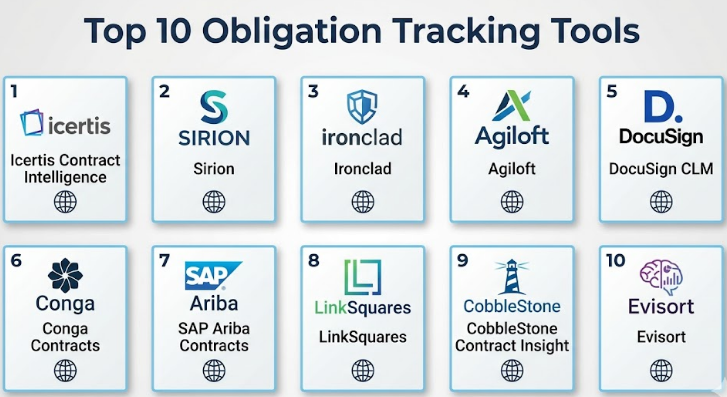
#1 — Icertis Contract Intelligence
Short description :
Icertis Contract Intelligence is an enterprise-grade obligation management and contract governance platform that helps organizations monitor contractual commitments, compliance requirements, and operational risks from a centralized system. The platform uses AI to identify obligations, deadlines, and contract risks while providing advanced analytics, reporting, and workflow automation capabilities for legal, procurement, and supplier management teams.
Key Features
- AI-powered obligation extraction
- Compliance workflow automation
- Contract milestone tracking
- Risk monitoring dashboards
- Audit-ready reporting
- Advanced analytics
- Governance workflows
Pros
- Strong enterprise scalability
- Advanced AI-driven analytics
- Comprehensive governance capabilities
Cons
- Complex implementation process
- Premium pricing
- Requires mature workflows
Platforms / Deployment
- Web
- Cloud
Security & Compliance
- MFA
- SSO/SAML
- RBAC
- Audit logs
- GDPR support
Integrations & Ecosystem
Icertis integrates with enterprise procurement, ERP, CRM, and legal ecosystems.
- SAP
- Salesforce
- APIs
- Microsoft ecosystem
- ERP systems
Support & Community
Provides onboarding, implementation consulting, customer success programs, and enterprise support services.
#2 — Sirion
Short description :
Sirion is an AI-powered obligation and supplier performance management platform designed for enterprises handling complex procurement and vendor relationships. The platform helps organizations track SLAs, supplier obligations, compliance milestones, and operational performance while improving visibility into procurement governance and contractual accountability.
Key Features
- SLA monitoring
- Supplier obligation tracking
- AI-driven analytics
- Workflow automation
- Compliance dashboards
- Risk alerts
- Performance tracking
Pros
- Strong supplier governance capabilities
- Useful operational analytics
- Good enterprise scalability
Cons
- Enterprise-focused complexity
- Higher implementation costs
- Requires process standardization
Platforms / Deployment
- Web
- Cloud
Security & Compliance
- SSO/SAML
- MFA
- Encryption
- Audit logs
- GDPR support
Integrations & Ecosystem
Sirion integrates with procurement and supplier management ecosystems.
- SAP
- Salesforce
- APIs
- Procurement systems
- ERP platforms
Support & Community
Offers onboarding support, enterprise consulting, implementation services, and customer success programs.
#3 — Ironclad
Short description :
Ironclad is a modern obligation tracking and contract workflow platform that helps legal and procurement teams automate approvals, manage agreements, and monitor contractual responsibilities. The platform centralizes contracts and improves operational collaboration through workflow automation, reminders, and AI-powered search capabilities.
Key Features
- Obligation tracking workflows
- AI-powered contract search
- Workflow automation
- Approval management
- Automated reminders
- Reporting dashboards
- Audit tracking
Pros
- Modern user interface
- Strong collaboration features
- Useful workflow automation
Cons
- Premium enterprise pricing
- Advanced customization may require onboarding
- Best for structured legal operations
Platforms / Deployment
- Web
- Cloud
Security & Compliance
- MFA
- SSO/SAML
- RBAC
- Audit logs
- GDPR support
Integrations & Ecosystem
Ironclad integrates with legal and business productivity ecosystems.
- Salesforce
- DocuSign
- Slack
- APIs
- ERP systems
Support & Community
Provides onboarding resources, implementation support, documentation, and customer success programs.
#4 — Agiloft
Short description :
Agiloft is a highly configurable obligation tracking and contract management platform built for enterprises requiring customizable workflows and compliance controls. It supports automated alerts, audit reporting, obligation monitoring, and no-code workflow customization across legal, procurement, and governance operations.
Key Features
- Workflow automation
- Obligation lifecycle tracking
- Audit reporting
- Compliance monitoring
- AI metadata extraction
- No-code customization
- Reminder systems
Pros
- Highly configurable
- Strong compliance support
- Good enterprise flexibility
Cons
- Learning curve for advanced features
- Complex enterprise setup
- Interface may feel technical
Platforms / Deployment
- Web
- Cloud / Hybrid
Security & Compliance
- MFA
- SSO
- RBAC
- Audit logs
- GDPR support
Integrations & Ecosystem
Agiloft supports integrations across procurement and legal ecosystems.
- Salesforce
- APIs
- ERP systems
- E-signature platforms
Support & Community
Offers onboarding, implementation consulting, documentation, and enterprise customer support.
#5 — DocuSign CLM
Short description :
DocuSign CLM combines obligation tracking, contract lifecycle management, workflow automation, and e-signature capabilities within a centralized enterprise platform. Organizations use it to manage contractual commitments, automate approvals, and improve visibility into legal and compliance processes across departments.
Key Features
- Obligation tracking
- Workflow automation
- Approval routing
- Contract repository
- Reminder notifications
- Compliance reporting
- E-signature integration
Pros
- Strong e-signature ecosystem
- Broad enterprise adoption
- Good workflow orchestration
Cons
- Advanced modules increase costs
- Complex deployment for large organizations
- Interface consistency varies
Platforms / Deployment
- Web
- Cloud
Security & Compliance
- MFA
- SSO/SAML
- Encryption
- Audit logs
- GDPR support
Integrations & Ecosystem
DocuSign CLM integrates broadly with enterprise business systems.
- Salesforce
- SAP
- APIs
- Microsoft ecosystem
- ERP platforms
Support & Community
Provides enterprise onboarding, training resources, implementation support, and customer services.
#6 — Conga Contracts
Short description :
Conga Contracts is a contract and obligation management platform with strong Salesforce integration that helps businesses track commitments, automate reminders, and manage approval workflows. The platform is commonly used by procurement, sales, and legal teams seeking better visibility into agreements and compliance obligations.
Key Features
- Obligation monitoring
- Automated alerts
- Workflow automation
- Salesforce-native workflows
- Approval routing
- Reporting dashboards
- Contract analytics
Pros
- Strong Salesforce integration
- Useful workflow automation
- Good sales contract visibility
Cons
- Best suited for Salesforce environments
- Complex customization may require consulting
- Enterprise deployments can take time
Platforms / Deployment
- Web
- Cloud
Security & Compliance
- MFA
- SSO
- Encryption
- Audit logs
- GDPR support
Integrations & Ecosystem
Conga integrates with CRM and enterprise business systems.
- Salesforce
- APIs
- Microsoft ecosystem
- E-signature tools
Support & Community
Offers onboarding support, implementation consulting, customer assistance, and training materials.
#7 — SAP Ariba Contracts
Short description :
SAP Ariba Contracts is an enterprise procurement contract management platform that helps organizations track supplier obligations, sourcing milestones, procurement compliance, and vendor governance activities. Businesses using SAP ecosystems benefit from centralized visibility, workflow automation, and strong procurement integration capabilities.
Key Features
- Supplier obligation tracking
- Procurement milestone monitoring
- Workflow automation
- Audit-ready reporting
- Contract repository management
- Procurement analytics
- Reminder systems
Pros
- Deep SAP integration
- Strong procurement governance
- Enterprise scalability
Cons
- Complex implementation
- Best suited for SAP ecosystems
- Requires procurement maturity
Platforms / Deployment
- Web
- Cloud
Security & Compliance
- MFA
- SSO/SAML
- Encryption
- Audit logs
- GDPR support
Integrations & Ecosystem
SAP Ariba integrates deeply with procurement and ERP ecosystems.
- SAP ERP
- SAP S/4HANA
- APIs
- Supplier systems
Support & Community
Provides onboarding, consulting services, enterprise documentation, and implementation support.
#8 — LinkSquares
Short description :
LinkSquares is an AI-driven obligation tracking and contract analytics platform focused on helping legal teams identify commitments, deadlines, and compliance risks more efficiently. The platform combines AI-powered extraction, contract search, and workflow automation to improve operational visibility and legal productivity.
Key Features
- AI-powered obligation extraction
- Contract analytics
- Automated reminders
- Workflow automation
- Metadata tracking
- Search tools
- Repository management
Pros
- Strong AI capabilities
- Modern user experience
- Good search functionality
Cons
- Smaller ecosystem footprint
- AI outputs may require review
- Enterprise customization may require support
Platforms / Deployment
- Web
- Cloud
Security & Compliance
- MFA
- SSO
- Encryption
- Audit logs
- GDPR support
Integrations & Ecosystem
LinkSquares integrates with legal and productivity systems.
- Salesforce
- DocuSign
- APIs
- Microsoft ecosystem
Support & Community
Provides onboarding assistance, implementation guidance, documentation, and customer support.
#9 — CobbleStone Contract Insight
Short description :
CobbleStone Contract Insight is a governance-focused obligation tracking and contract management platform designed to help organizations automate compliance workflows, monitor contractual milestones, and improve audit readiness. It is commonly used in regulated industries requiring strong reporting and workflow configurability.
Key Features
- Obligation management workflows
- Compliance monitoring
- Automated alerts
- Audit trail tracking
- Workflow configurability
- Reporting dashboards
- Clause library support
Pros
- Strong compliance reporting
- Good workflow customization
- Useful for regulated industries
Cons
- User interface may feel outdated
- Smaller ecosystem
- Advanced setup may require support
Platforms / Deployment
- Web / Windows
- Cloud / Self-hosted
Security & Compliance
- MFA
- SSO
- RBAC
- Audit logs
- Encryption
Integrations & Ecosystem
CobbleStone integrates with procurement and business governance systems.
- APIs
- ERP systems
- Microsoft ecosystem
- E-signature tools
Support & Community
Offers onboarding, enterprise support services, implementation assistance, and documentation.
#10 — Evisort
Short description :
Evisort is an AI-native contract intelligence and obligation tracking platform that automates metadata extraction, compliance monitoring, and obligation identification across large contract repositories. Organizations use the platform to reduce manual legal review work and improve operational visibility through AI-powered automation.
Key Features
- AI-powered obligation extraction
- Smart contract search
- Workflow automation
- Metadata tracking
- Compliance monitoring
- Reminder systems
- Reporting dashboards
Pros
- Strong AI automation
- Good metadata extraction
- Modern interface
Cons
- AI-generated outputs may require review
- Enterprise adoption still evolving
- Advanced customization may require support
Platforms / Deployment
- Web
- Cloud
Security & Compliance
- MFA
- SSO
- Encryption
- Audit logs
- GDPR support
Integrations & Ecosystem
Evisort integrates with enterprise legal and business ecosystems.
- Salesforce
- APIs
- Microsoft ecosystem
- E-signature tools
Support & Community
Provides onboarding programs, implementation support, training resources, and customer services.
Comparison Table (Top 10)
| Tool Name | Best For | Platform(s) Supported | Deployment | Standout Feature | Public Rating |
|---|---|---|---|---|---|
| Icertis Contract Intelligence | Enterprise governance | Web | Cloud | AI-powered obligation intelligence | N/A |
| Sirion | Supplier governance | Web | Cloud | SLA monitoring | N/A |
| Ironclad | Modern legal operations | Web | Cloud | Workflow collaboration | N/A |
| Agiloft | Configurable governance workflows | Web | Cloud / Hybrid | No-code customization | N/A |
| DocuSign CLM | E-signature workflows | Web | Cloud | Integrated contract execution | N/A |
| Conga Contracts | Salesforce-centric operations | Web | Cloud | CRM-integrated workflows | N/A |
| SAP Ariba Contracts | Procurement governance | Web | Cloud | SAP procurement integration | N/A |
| LinkSquares | AI legal analytics | Web | Cloud | AI-powered extraction | N/A |
| CobbleStone Contract Insight | Compliance-heavy industries | Web / Windows | Cloud / Self-hosted | Workflow configurability | N/A |
| Evisort | AI-native obligation management | Web | Cloud | Automated metadata extraction | N/A |
Evaluation & Obligation Tracking Tools
| Tool Name | Core (25%) | Ease (15%) | Integrations (15%) | Security (10%) | Performance (10%) | Support (10%) | Value (15%) | Weighted Total (0–10) |
|---|---|---|---|---|---|---|---|---|
| Icertis Contract Intelligence | 10 | 7 | 9 | 9 | 9 | 8 | 6 | 8.40 |
| Sirion | 9 | 7 | 8 | 9 | 8 | 8 | 7 | 8.00 |
| Ironclad | 9 | 8 | 8 | 9 | 8 | 8 | 7 | 8.15 |
| Agiloft | 9 | 7 | 8 | 8 | 8 | 8 | 8 | 8.05 |
| DocuSign CLM | 9 | 8 | 9 | 9 | 8 | 8 | 7 | 8.30 |
| Conga Contracts | 8 | 8 | 9 | 8 | 8 | 8 | 7 | 8.00 |
| SAP Ariba Contracts | 9 | 7 | 10 | 9 | 9 | 9 | 6 | 8.45 |
| LinkSquares | 8 | 8 | 7 | 8 | 8 | 8 | 7 | 7.75 |
| CobbleStone Contract Insight | 8 | 7 | 7 | 8 | 8 | 7 | 8 | 7.65 |
| Evisort | 8 | 8 | 7 | 8 | 8 | 7 | 7 | 7.65 |
These scores are comparative and intended to help buyers evaluate overall platform balance. Enterprise-focused tools typically score higher in governance, integrations, and scalability, while simpler platforms may offer faster adoption and easier workflows.
Which Obligation Tracking Tools
Solo / Freelancer
Freelancers and independent professionals generally only need lightweight contract reminders or task management systems instead of enterprise obligation platforms.
SMB
SMBs should prioritize affordability, usability, and quick deployment. LinkSquares and workflow-focused tools may provide enough functionality without excessive complexity.
Mid-Market
Mid-market organizations benefit from configurable workflows, compliance reporting, and scalable integrations. Agiloft, Ironclad, and Conga Contracts provide balanced functionality for growing teams.
Enterprise
Large enterprises usually require advanced governance, procurement integrations, supplier visibility, and audit readiness. Icertis, SAP Ariba Contracts, Sirion, and DocuSign CLM are strong enterprise-focused options.
Budget vs Premium
Budget-conscious businesses should avoid highly complex enterprise governance suites unless advanced compliance capabilities are necessary. Premium platforms provide deeper AI, analytics, and automation features.
Feature Depth vs Ease of Use
Highly configurable enterprise systems often require more onboarding and process maturity, while usability-focused platforms can accelerate adoption for smaller teams.
Integrations & Scalability
Organizations using SAP, Salesforce, Oracle, or Microsoft ecosystems should prioritize strong API support and native integrations.
Security & Compliance Needs
Businesses handling sensitive legal, procurement, or regulatory data should prioritize MFA, RBAC, encryption, audit logs, and governance reporting.
Frequently Asked Questions (FAQs)
1. What are Obligation Tracking Tools?
Obligation Tracking Tools help organizations manage contractual, compliance, procurement, and operational commitments through centralized workflows and automated tracking.
2. Why are these platforms important in 2026?
Organizations now manage more contracts, suppliers, and compliance requirements than ever before, making automated obligation tracking essential for reducing operational risk.
3. How do AI-powered obligation systems work?
These platforms use AI and natural language processing to extract obligations, deadlines, clauses, and milestones from contracts automatically.
4. Which departments typically use these tools?
Legal, procurement, compliance, finance, vendor management, and operations teams commonly use obligation tracking platforms.
5. Can these platforms integrate with ERP systems?
Yes. Most enterprise-grade platforms support integrations with ERP, CRM, procurement, and document management systems.
6. What are common implementation challenges?
Common challenges include contract migration, metadata cleanup, workflow standardization, integration complexity, and user adoption.
7. How long does implementation usually take?
Implementation timelines vary depending on workflow complexity, integrations, and organizational scale. Enterprise deployments can take several months.
8. Are cloud-based obligation tracking systems secure?
Most enterprise vendors provide encryption, MFA, RBAC, audit logs, and SSO capabilities. Organizations should still validate compliance requirements carefully.
9. Can these tools help with audits?
Yes. Many platforms provide audit trails, centralized reporting, evidence tracking, and compliance dashboards that simplify audit preparation.
10. How are Obligation Tracking Tools priced?
Pricing varies based on users, contract volume, AI functionality, integrations, and workflow complexity. Public pricing is often limited.
Conclusion
Obligation Tracking Tools have become essential governance platforms for organizations managing complex contractual, procurement, and compliance responsibilities. businesses increasingly rely on AI-powered extraction, workflow automation, and centralized reporting to reduce operational risks and improve accountability. workflow maturity, compliance requirements, and integration needs. Enterprises seeking advanced procurement governance may prefer SAP Ariba Contracts or Icertis, while legal operations teams may favor Ironclad, LinkSquares, or Evisort. Organizations heavily invested in Salesforce ecosystems may benefit from Conga Contracts, while businesses requiring extensive workflow customization may prefer Agiloft.
