Introduction
Operating Room Scheduling Software helps hospitals, ambulatory surgery centers, surgical departments, and perioperative teams plan, manage, and optimize operating room time. In simple words, these tools help teams decide which surgery happens in which room, at what time, with which surgeon, staff, equipment, anesthesia team, and recovery resources.
These systems matter because operating rooms are among the most expensive and resource-sensitive areas in healthcare. Poor scheduling can cause delays, cancellations, overtime, surgeon frustration, underused rooms, patient wait times, and staff burnout. A good OR scheduling system improves visibility, coordination, block utilization, case planning, equipment readiness, and communication across surgical teams.
Common use cases include surgical case scheduling, block time management, surgeon availability, anesthesia coordination, room utilization tracking, preference card management, equipment planning, case duration prediction, pre-op readiness, and cancellation reduction.
Buyers should evaluate EHR integration, real-time schedule visibility, block management, predictive analytics, mobile access, staff coordination, preference card support, reporting, security, ease of use, implementation effort, and scalability.
Best for: Hospitals, ambulatory surgery centers, perioperative leaders, OR managers, surgical coordinators, anesthesia teams, surgeons, nursing teams, and healthcare operations leaders.
Not ideal for: Very small clinics with limited surgical volume, facilities that only need a basic calendar, or organizations whose EHR already fully supports their OR scheduling and perioperative workflow needs.
Key Trends in Operating Room Scheduling Software
- AI-assisted case duration prediction is becoming more useful for reducing delays and improving schedule accuracy.
- Block time optimization is a major priority, especially for hospitals trying to improve OR utilization and reduce unused surgical capacity.
- Real-time perioperative visibility is growing, helping teams track pre-op, intra-op, post-op, delays, cancellations, and room turnover.
- EHR integration is now essential, because surgical scheduling must connect with patient records, orders, anesthesia, billing, and clinical documentation.
- Mobile access is becoming more important, allowing surgeons, coordinators, and perioperative teams to view schedules and updates quickly.
- Preference card accuracy is becoming a cost-control priority, because wrong supplies or equipment can delay cases and increase waste.
- Surgical command center dashboards are gaining attention, especially in large hospitals with many ORs and complex schedules.
- Automated alerts and workflow reminders are improving coordination, especially for missing consents, incomplete pre-op tasks, equipment conflicts, and staffing issues.
- Analytics-driven OR management is replacing manual spreadsheets, helping leaders measure utilization, turnover time, cancellation reasons, overtime, and surgeon performance trends.
- Cloud and hybrid deployment models are growing, but many hospitals still require strong integration, security, and governance controls.
How We Selected These Tools
- We selected tools widely recognized for operating room scheduling, perioperative management, surgical coordination, hospital operations, or surgical optimization.
- We considered practical fit for hospitals, ambulatory surgery centers, academic medical centers, and multi-site health systems.
- We prioritized platforms that support surgical scheduling, block time management, OR utilization, case tracking, room coordination, and perioperative analytics.
- We included both EHR-native OR scheduling options and specialist perioperative optimization tools.
- We considered integration potential with EHR, anesthesia systems, billing systems, staffing systems, preference card tools, inventory systems, and analytics platforms.
- We looked at usability for OR managers, surgical schedulers, surgeons, anesthesia teams, nursing leaders, and operations teams.
- We avoided guessing public ratings, pricing, certifications, or unsupported compliance claims.
- We used N/A, Varies / N/A, and Not publicly stated wherever information is uncertain.
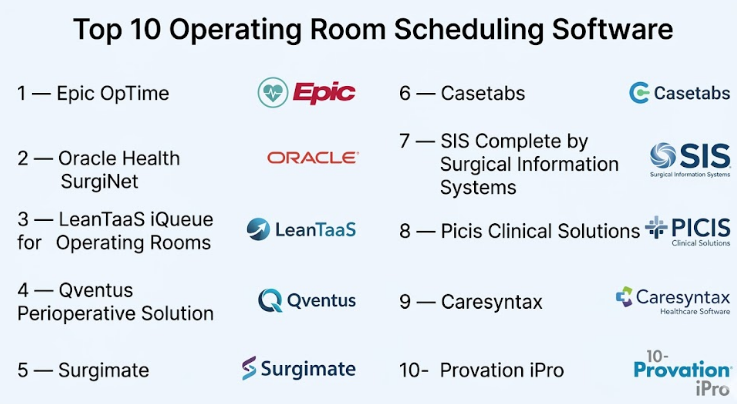
#1 — Epic OpTime
Short description: Epic OpTime is an operating room and perioperative management solution within the Epic ecosystem. It helps hospitals manage surgical scheduling, preference cards, perioperative documentation, case tracking, anesthesia workflows, and OR utilization. It is best suited for hospitals and health systems already using Epic as their core EHR. The platform is a strong fit for organizations that want OR scheduling tightly connected with patient records, orders, clinical workflows, billing, and perioperative documentation.
Key Features
- Surgical case scheduling.
- Operating room calendar management.
- Preference card support.
- Perioperative documentation.
- Case tracking.
- OR utilization reporting.
- Integration with Epic clinical workflows.
Pros
- Strong fit for Epic-based hospitals.
- Connects OR scheduling with patient records and perioperative workflows.
- Useful for large hospitals with complex surgical operations.
Cons
- Best suited for organizations already using Epic.
- Implementation can be complex and resource-intensive.
- May be less practical for non-Epic environments.
Platforms / Deployment
Web / Mobile / Varies / N/A
Cloud / Self-hosted / Hybrid / Varies / N/A
Security & Compliance
Epic environments commonly support role-based access, audit controls, identity management, and healthcare security workflows. Specific certifications: Not publicly stated.
Integrations & Ecosystem
Epic OpTime works strongest within Epic-based hospital environments where perioperative workflows must connect with clinical and administrative systems.
- Epic EHR workflows.
- Anesthesia documentation.
- Billing workflows.
- Orders and patient records.
- Surgical preference cards.
- Reporting and analytics.
Support & Community
Epic provides enterprise support, implementation resources, training, documentation, and a strong customer network. Support quality depends on the hospital’s Epic contract, internal governance, and implementation maturity.
#2 — Oracle Health SurgiNet
Short description: Oracle Health SurgiNet is a perioperative management solution used by hospitals to manage surgical scheduling, operating room documentation, case tracking, and perioperative workflows. It is useful for organizations already using Oracle Health clinical systems and seeking connected surgical operations. The platform supports OR scheduling and coordination across surgical teams, anesthesia, nursing, and hospital operations. It is best for hospitals that want perioperative workflows aligned with their broader Oracle Health environment.
Key Features
- Operating room scheduling.
- Surgical case management.
- Perioperative documentation.
- Case tracking.
- Anesthesia workflow support.
- Surgical resource coordination.
- Reporting and operational visibility.
Pros
- Strong fit for Oracle Health environments.
- Supports connected surgical and clinical workflows.
- Useful for hospitals needing structured perioperative management.
Cons
- Best value comes in Oracle Health-based organizations.
- Implementation and configuration can require planning.
- Non-Oracle environments may need additional integration effort.
Platforms / Deployment
Web / Mobile / Varies / N/A
Cloud / Self-hosted / Hybrid / Varies / N/A
Security & Compliance
Security details vary by deployment and customer environment. Capabilities may include access control, audit logging, identity management, and healthcare data protection workflows. Specific certifications: Not publicly stated.
Integrations & Ecosystem
Oracle Health SurgiNet is strongest when connected with Oracle Health clinical, administrative, and operational workflows.
- EHR integration.
- Patient record workflows.
- Anesthesia documentation.
- Surgical scheduling.
- Billing and charge workflows.
- Reporting dashboards.
Support & Community
Oracle Health provides enterprise support, implementation services, documentation, and partner resources. Support quality depends on customer agreement, deployment model, and internal readiness.
#3 — LeanTaaS iQueue for Operating Rooms
Short description: LeanTaaS iQueue for Operating Rooms is a data-driven OR optimization platform focused on improving block utilization, access to OR time, surgical volume, and schedule performance. It helps perioperative leaders identify unused block time, release time earlier, improve surgeon access, and reduce scheduling inefficiencies. The tool is especially useful for hospitals that need analytics and recommendations beyond a basic OR schedule. It is a strong fit for organizations focused on improving OR capacity and utilization.
Key Features
- OR block utilization analytics.
- Open time management.
- Surgeon access insights.
- Predictive scheduling support.
- Case volume and utilization dashboards.
- Release time recommendations.
- Perioperative performance reporting.
Pros
- Strong analytics for OR utilization improvement.
- Useful for reducing unused block time.
- Helps leaders make data-driven scheduling decisions.
Cons
- Not a full EHR or complete perioperative documentation system.
- Requires good data integration for best results.
- Adoption depends on leadership and surgeon engagement.
Platforms / Deployment
Web / Varies / N/A
Cloud
Security & Compliance
Security and compliance details vary by contract and implementation. Specific certifications: Not publicly stated.
Integrations & Ecosystem
LeanTaaS iQueue can connect with hospital surgical data sources to improve OR utilization and operational planning.
- EHR data integration.
- OR schedule feeds.
- Case volume data.
- Block utilization dashboards.
- Operational analytics.
- Reporting workflows.
Support & Community
LeanTaaS provides vendor-led onboarding, analytics support, implementation guidance, and customer success resources. Community strength is strongest among healthcare operations and perioperative leaders.
#4 — Qventus Perioperative Solution
Short description: Qventus Perioperative Solution uses automation and AI-assisted workflows to improve OR utilization, case scheduling, surgical access, and operational coordination. It helps teams identify schedule gaps, improve block time usage, reduce avoidable delays, and support perioperative decision-making. The platform is useful for hospitals that need proactive operational recommendations rather than only static reports. It is a strong option for organizations focused on OR efficiency and surgical growth.
Key Features
- AI-assisted OR scheduling workflows.
- Block utilization support.
- Case volume optimization.
- Schedule gap detection.
- Operational alerts.
- Perioperative dashboards.
- Workflow automation.
Pros
- Strong for proactive OR optimization.
- Useful for improving surgical access and utilization.
- Helps teams act on scheduling opportunities faster.
Cons
- Requires strong change management.
- Best value depends on data quality and workflow adoption.
- Not a replacement for full perioperative documentation.
Platforms / Deployment
Web / Varies / N/A
Cloud
Security & Compliance
Security details vary by deployment and agreement. Specific certifications: Not publicly stated.
Integrations & Ecosystem
Qventus can connect with hospital data systems and operational workflows to support perioperative optimization.
- EHR data feeds.
- OR schedule data.
- Case management workflows.
- Capacity analytics.
- Operational alerts.
- Reporting dashboards.
Support & Community
Qventus provides implementation support, operational guidance, customer success services, and workflow optimization help. Public community strength is limited, but healthcare operations focus is strong.
#5 — Surgimate
Short description: Surgimate is a surgical scheduling platform designed to help surgical practices, hospitals, and ambulatory surgery centers manage cases, forms, approvals, communication, and scheduling workflows. It is useful for surgical coordinators and practices that need a better way to organize surgery requests, patient information, documents, and facility coordination. The platform is especially practical for teams moving away from paper-heavy or spreadsheet-based surgical scheduling. It is a good fit for specialty practices and surgical groups managing high case volume.
Key Features
- Surgical case scheduling.
- Digital forms and workflow tracking.
- Patient and procedure coordination.
- Communication tools.
- Document and task management.
- Facility coordination.
- Reporting and schedule visibility.
Pros
- Strong fit for surgical practices and coordinators.
- Helps reduce manual paperwork and scheduling confusion.
- Useful for improving communication around surgical cases.
Cons
- May not replace enterprise hospital OR management systems.
- Integration needs should be validated.
- Best suited for surgical scheduling workflows, not full hospital operations.
Platforms / Deployment
Web / Varies / N/A
Cloud
Security & Compliance
Security details vary by agreement and deployment. Specific certifications: Not publicly stated.
Integrations & Ecosystem
Surgimate supports scheduling and workflow coordination around surgical cases.
- Practice management workflows.
- EHR integration options.
- Facility communication.
- Digital form workflows.
- Scheduling dashboards.
- Reporting and exports.
Support & Community
Surgimate provides vendor-led onboarding, documentation, support, and implementation assistance. Community strength is strongest among surgical practices and scheduling teams.
#6 — Casetabs
Short description: Casetabs is a surgery coordination and perioperative communication platform designed to help surgical teams manage case status, documentation, readiness, and communication. It is especially useful for ambulatory surgery centers and perioperative teams that need better visibility into case progress and coordination. The platform helps improve communication between surgeons, nurses, anesthesia teams, and administrative staff. It is a practical option for facilities that want real-time case coordination and workflow clarity.
Key Features
- Surgery case coordination.
- Real-time case status visibility.
- Team communication.
- Pre-op readiness support.
- Task and checklist workflows.
- Patient and procedure tracking.
- ASC-focused workflow support.
Pros
- Strong fit for ambulatory surgery centers.
- Improves communication across perioperative teams.
- Helps reduce case coordination gaps.
Cons
- May not be a full enterprise OR scheduling platform.
- Hospital-wide integration needs should be validated.
- Best fit depends on perioperative workflow design.
Platforms / Deployment
Web / iOS / Android / Varies / N/A
Cloud
Security & Compliance
Security details vary by contract and deployment. Specific certifications: Not publicly stated.
Integrations & Ecosystem
Casetabs can support perioperative communication and case coordination workflows.
- EHR integration options.
- Surgery center workflows.
- Case status updates.
- Team communication.
- Checklist and readiness tracking.
- Reporting and operational visibility.
Support & Community
Support is vendor-led with onboarding, customer support, training, and implementation help. Community strength is strongest among ambulatory surgery and perioperative operations users.
#7 — SIS Complete by Surgical Information Systems
Short description: SIS Complete is a perioperative and anesthesia information management solution designed for hospitals and surgery centers. It supports surgical scheduling, clinical documentation, anesthesia workflows, billing-related processes, and perioperative analytics. The platform is useful for organizations that need a dedicated surgery-focused system rather than a general scheduling calendar. It is a strong fit for facilities that require operating room coordination, anesthesia documentation, and perioperative workflow support.
Key Features
- Surgical scheduling.
- Perioperative documentation.
- Anesthesia information management.
- Case tracking.
- Charge capture support.
- Reporting and analytics.
- Surgery center workflow support.
Pros
- Strong perioperative and anesthesia workflow focus.
- Useful for hospitals and surgery centers.
- Supports clinical and operational OR needs.
Cons
- May require implementation planning.
- Integration with existing EHR and billing systems should be reviewed.
- Product fit depends on facility size and workflow needs.
Platforms / Deployment
Web / Windows / Varies / N/A
Cloud / Self-hosted / Hybrid / Varies / N/A
Security & Compliance
Security details vary by deployment and customer environment. Specific certifications: Not publicly stated.
Integrations & Ecosystem
SIS Complete can connect perioperative, anesthesia, billing, and reporting workflows.
- EHR integration options.
- Anesthesia system workflows.
- Billing and charge capture.
- OR schedule management.
- Clinical documentation.
- Reporting and analytics.
Support & Community
Surgical Information Systems provides vendor-led implementation, customer support, training, and documentation. Community strength is focused on perioperative and surgical operations users.
#8 — Picis Clinical Solutions
Short description: Picis Clinical Solutions supports perioperative, anesthesia, and critical care workflows for hospitals and surgical departments. Its perioperative capabilities can support OR scheduling, case documentation, anesthesia workflows, and clinical operational visibility. It is useful for organizations needing a surgery-focused system that connects clinical documentation with operational coordination. The platform is best suited for hospitals with complex perioperative environments and specialized surgical workflow needs.
Key Features
- Perioperative workflow support.
- OR scheduling capabilities.
- Anesthesia documentation.
- Case tracking.
- Clinical documentation.
- Reporting and analytics.
- Department-level operational visibility.
Pros
- Strong focus on perioperative clinical workflows.
- Useful for complex hospital surgical departments.
- Supports anesthesia and OR documentation needs.
Cons
- Implementation can require specialized planning.
- Integration needs should be validated.
- May be more system than smaller surgery centers need.
Platforms / Deployment
Web / Windows / Varies / N/A
Cloud / Self-hosted / Hybrid / Varies / N/A
Security & Compliance
Security details vary by deployment and customer environment. Specific certifications: Not publicly stated.
Integrations & Ecosystem
Picis can support perioperative and clinical workflow integrations across hospital systems.
- EHR integration options.
- Anesthesia workflows.
- OR scheduling data.
- Clinical documentation systems.
- Reporting tools.
- Operational dashboards.
Support & Community
Picis provides vendor-led implementation, documentation, training, and customer support. Community strength is focused on perioperative and hospital clinical operations teams.
#9 — Caresyntax
Short description: Caresyntax is a surgical intelligence and OR integration platform that helps hospitals improve surgical performance, data visibility, operating room efficiency, and perioperative insights. While it is not only a scheduling tool, it can support OR operations through data capture, analytics, workflow visibility, and surgical performance improvement. It is useful for hospitals looking to connect surgical data, video, devices, and operational insights. It is best for organizations interested in surgical intelligence and OR optimization beyond basic scheduling.
Key Features
- Surgical data integration.
- OR analytics.
- Surgical performance insights.
- Workflow visibility.
- Video and device data support.
- Operational dashboards.
- Quality and efficiency insights.
Pros
- Strong surgical intelligence focus.
- Useful for advanced OR analytics and performance improvement.
- Helps hospitals understand surgical workflow patterns.
Cons
- Not a simple OR scheduling calendar.
- May require significant integration and infrastructure planning.
- Best for organizations ready for advanced surgical analytics.
Platforms / Deployment
Web / Varies / N/A
Cloud / Hybrid / Varies / N/A
Security & Compliance
Security details vary by deployment and customer agreement. Specific certifications: Not publicly stated.
Integrations & Ecosystem
Caresyntax can connect OR data, devices, surgical workflows, and analytics systems.
- OR device integration options.
- Surgical video workflows.
- EHR integration options.
- Analytics dashboards.
- Performance reporting.
- Quality improvement workflows.
Support & Community
Caresyntax provides vendor-led implementation, support, training, and surgical workflow guidance. Public community strength is limited, but surgical intelligence focus is strong.
#10 — Provation iPro
Short description: Provation iPro supports perioperative documentation, surgical workflows, and procedure-related clinical documentation. It can help healthcare organizations manage procedure documentation, case information, and operational visibility in surgical and procedural environments. While it may not be a complete OR scheduling platform for every hospital, it is relevant for facilities that need procedure documentation and workflow support connected to surgical operations. It is a practical option where documentation quality and procedural workflow control are important.
Key Features
- Procedure documentation.
- Surgical workflow support.
- Case information management.
- Clinical documentation templates.
- Reporting support.
- Procedure data capture.
- Perioperative workflow visibility.
Pros
- Useful for procedure documentation and workflow control.
- Supports structured clinical records.
- Good fit for procedural departments.
Cons
- Not always a full OR scheduling replacement.
- Scheduling depth should be validated.
- Integration needs depend on the hospital environment.
Platforms / Deployment
Web / Windows / Varies / N/A
Cloud / Self-hosted / Hybrid / Varies / N/A
Security & Compliance
Security details vary by deployment and customer environment. Specific certifications: Not publicly stated.
Integrations & Ecosystem
Provation iPro can connect procedure documentation with clinical and operational workflows.
- EHR integration options.
- Procedure documentation workflows.
- Reporting tools.
- Clinical data capture.
- Department workflow support.
- Billing or coding workflow options may vary.
Support & Community
Provation provides vendor-led support, documentation, onboarding, and training. Community strength is focused on procedural documentation and healthcare clinical workflow users.
Comparison Table
| Tool Name | Best For | Platform(s) Supported | Deployment | Standout Feature | Public Rating |
|---|---|---|---|---|---|
| Epic OpTime | Epic-based hospitals and health systems | Web / Mobile / Varies | Cloud / Self-hosted / Hybrid / Varies | EHR-connected perioperative scheduling | N/A |
| Oracle Health SurgiNet | Oracle Health hospital environments | Web / Mobile / Varies | Cloud / Self-hosted / Hybrid / Varies | Surgical scheduling and perioperative documentation | N/A |
| LeanTaaS iQueue for Operating Rooms | OR utilization optimization | Web / Varies | Cloud | Block time and access optimization | N/A |
| Qventus Perioperative Solution | AI-assisted OR operations | Web / Varies | Cloud | Proactive scheduling and utilization recommendations | N/A |
| Surgimate | Surgical practices and case coordinators | Web / Varies | Cloud | Case scheduling and digital workflow coordination | N/A |
| Casetabs | Ambulatory surgery centers | Web / iOS / Android / Varies | Cloud | Real-time surgery coordination | N/A |
| SIS Complete | Hospitals and surgery centers | Web / Windows / Varies | Cloud / Self-hosted / Hybrid / Varies | Perioperative and anesthesia workflow support | N/A |
| Picis Clinical Solutions | Complex perioperative departments | Web / Windows / Varies | Cloud / Self-hosted / Hybrid / Varies | Perioperative and anesthesia documentation | N/A |
| Caresyntax | Surgical intelligence and OR analytics | Web / Varies | Cloud / Hybrid / Varies | Surgical data integration and analytics | N/A |
| Provation iPro | Procedure documentation and workflow support | Web / Windows / Varies | Cloud / Self-hosted / Hybrid / Varies | Structured procedure documentation | N/A |
Evaluation & Operating Room Scheduling Software
| Tool Name | Core (25%) | Ease (15%) | Integrations (15%) | Security (10%) | Performance (10%) | Support (10%) | Value (15%) | Weighted Total |
|---|---|---|---|---|---|---|---|---|
| Epic OpTime | 9 | 7 | 9 | 8 | 8 | 8 | 7 | 8.15 |
| Oracle Health SurgiNet | 8 | 7 | 8 | 8 | 8 | 8 | 7 | 7.80 |
| LeanTaaS iQueue for Operating Rooms | 8 | 8 | 8 | 7 | 8 | 8 | 8 | 7.95 |
| Qventus Perioperative Solution | 8 | 8 | 8 | 7 | 8 | 8 | 8 | 7.95 |
| Surgimate | 8 | 8 | 7 | 7 | 7 | 8 | 8 | 7.65 |
| Casetabs | 7 | 8 | 7 | 7 | 7 | 8 | 8 | 7.45 |
| SIS Complete | 8 | 7 | 8 | 7 | 8 | 8 | 7 | 7.65 |
| Picis Clinical Solutions | 8 | 7 | 8 | 7 | 8 | 7 | 7 | 7.55 |
| Caresyntax | 7 | 7 | 8 | 7 | 8 | 8 | 7 | 7.40 |
| Provation iPro | 7 | 7 | 7 | 7 | 7 | 8 | 7 | 7.20 |
These scores are comparative and should be used as a starting point, not a final ranking. EHR-native tools often score higher for integration when the hospital already uses that EHR, while specialist tools may score higher for analytics, optimization, or surgical coordination. A tool that scores lower overall may still be the best fit for a specific use case, such as ambulatory surgery coordination, block utilization, or procedure documentation. Buyers should validate workflows, integrations, security, reporting, and user adoption before selection.
Which Operating Room Scheduling Software Should You Choose?
Solo / Freelancer
Independent healthcare consultants or perioperative advisors usually do not need a full OR scheduling platform. They may use analytics, workflow assessments, or scheduling templates to help hospitals identify bottlenecks. If advising clients, they should evaluate tools based on OR utilization, block management, data availability, and integration readiness.
SMB
Small surgery centers and specialty practices should focus on ease of use, fast adoption, case coordination, communication, and practical scheduling workflows. Surgimate and Casetabs may be useful for smaller or specialty-focused surgical teams. Provation iPro may be relevant where procedure documentation is a key requirement.
Mid-Market
Mid-sized hospitals and ambulatory surgery centers usually need stronger scheduling visibility, case tracking, block management, staff coordination, and reporting. LeanTaaS iQueue, Qventus, SIS Complete, Surgimate, and Casetabs can be strong options depending on whether the priority is utilization, coordination, documentation, or workflow automation.
Enterprise
Large hospitals and health systems need deep integration, perioperative documentation, block management, anesthesia workflows, capacity dashboards, reporting, and security controls. Epic OpTime and Oracle Health SurgiNet are strong options for organizations already using those EHR ecosystems. LeanTaaS, Qventus, SIS Complete, Picis, and Caresyntax can add value where advanced optimization, analytics, or specialized perioperative workflows are needed.
Budget vs Premium
Budget-focused surgical practices should avoid buying enterprise perioperative platforms if they only need scheduling coordination and case tracking. Premium buyers should focus on EHR integration, block utilization analytics, anesthesia workflows, real-time case visibility, preference cards, operational dashboards, and long-term scalability.
Feature Depth vs Ease of Use
A simple scheduling tool is easier to adopt but may not handle complex OR workflows, block utilization, anesthesia coordination, preference cards, staff readiness, or reporting. Enterprise platforms offer deeper functionality but require more implementation planning, training, and governance. The right choice depends on surgical volume, case complexity, and operational maturity.
Integrations & Scalability
Operating room scheduling software should integrate with EHR, ADT, anesthesia systems, billing, inventory, preference card tools, staffing systems, pre-op workflows, and reporting platforms. Scalability matters because OR operations become more complex as facilities add more rooms, surgeons, specialties, locations, and procedural volume.
Security & Compliance Needs
Hospitals and surgery centers should review role-based access, audit logs, authentication, encryption, user activity tracking, data retention, and integration security. OR scheduling data may include patient identifiers, procedure details, surgeon information, and operational records, so security and privacy review should happen before implementation.
Frequently Asked Questions
1. What is Operating Room Scheduling Software?
Operating Room Scheduling Software helps hospitals and surgery centers plan and manage surgical cases, rooms, surgeons, staff, equipment, anesthesia, and case timing. It improves visibility and coordination across perioperative teams.
2. Why do hospitals need OR scheduling software?
Hospitals need OR scheduling software because manual scheduling can cause delays, unused block time, conflicts, cancellations, and poor communication. A good system helps improve utilization, reduce confusion, and support better surgical operations.
3. What is block time management?
Block time management is the process of assigning operating room time to surgeons, specialties, or service lines. Good block management helps hospitals use OR capacity efficiently and reduce unused surgical time.
4. Can OR scheduling software reduce cancellations?
Yes, it can help reduce avoidable cancellations by improving pre-op readiness, equipment planning, communication, and schedule visibility. However, cancellation reduction also depends on staffing, patient readiness, surgeon availability, and hospital workflows.
5. How much does OR scheduling software cost?
Pricing varies based on hospital size, number of ORs, users, modules, integrations, deployment model, and support level. Many enterprise vendors use custom pricing rather than public pricing.
6. How long does implementation take?
Implementation depends on surgical volume, number of rooms, integration needs, workflow complexity, data migration, reporting requirements, and staff training. Simple scheduling tools may be faster, while enterprise perioperative systems require more planning.
7. Can OR scheduling software integrate with EHR systems?
Yes, many OR scheduling tools integrate with EHR systems, but integration depth varies. Buyers should validate patient data flows, orders, anesthesia documentation, billing, preference cards, and schedule updates before purchase.
8. What common mistakes should buyers avoid?
Common mistakes include choosing a tool without mapping OR workflows, ignoring surgeon adoption, underestimating integration effort, failing to clean preference card data, and not involving anesthesia, nursing, schedulers, and IT early.
9. Does OR scheduling software support anesthesia workflows?
Some systems include anesthesia documentation or anesthesia workflow support, while others focus only on scheduling or analytics. Buyers should confirm whether anesthesia needs are included or require a separate system.
10. Can these tools improve OR utilization?
Yes, tools with analytics and block management features can help improve OR utilization by showing unused time, schedule gaps, late starts, turnover delays, cancellations, and block release opportunities.
Conclusion
Operating Room Scheduling Software helps healthcare organizations improve surgical coordination, room utilization, case visibility, staff planning, and perioperative communication. The best choice depends on the organization’s EHR environment, surgical volume, OR complexity, analytics needs, budget, and workflow maturity. Epic OpTime and Oracle Health SurgiNet are strong options for hospitals already using those ecosystems. LeanTaaS iQueue and Qventus are strong for OR optimization, block utilization, and data-driven surgical growth.
