Introduction
Materials Informatics Platforms are software tools that help research, engineering, and product development teams use data, AI, machine learning, simulations, and structured materials databases to discover, design, compare, and improve materials faster. In simple words, these platforms help scientists and engineers understand which materials may work best for a product before spending too much time and money on trial-and-error experiments.
Materials development is often slow because teams deal with complex relationships between composition, processing methods, structure, properties, performance, cost, and sustainability. A materials informatics platform helps connect these data points so teams can make better decisions about polymers, alloys, batteries, coatings, chemicals, semiconductors, composites, ceramics, and other advanced materials.
Real-world use cases include predicting material properties, designing new formulations, reducing failed experiments, comparing material alternatives, managing experimental data, connecting simulation results, supporting sustainability goals, and improving collaboration between R&D, product, quality, and manufacturing teams.
Buyers should evaluate:
- Materials data management depth
- AI and machine learning capabilities
- Simulation and modeling support
- Experiment planning and recommendation features
- Ease of use for scientists and engineers
- Collaboration and workflow management
- Integration with ELN, LIMS, PLM, CAD, CAE, and ERP systems
- Security, access control, and auditability
- Support for proprietary and public datasets
- Fit for industry-specific materials use cases
Best for: R&D teams, materials scientists, chemical engineers, product engineers, formulation scientists, data science teams, universities, manufacturing companies, battery developers, pharma material teams, polymer companies, aerospace firms, electronics companies, and industrial innovation teams.
Not ideal for: Very small teams that only need basic material datasheets or manual comparison tables. If the work is simple, low-volume, and does not involve prediction, simulation, formulation, or structured research data, a standard spreadsheet or basic materials database may be enough.
Key Materials Informatics Platform Trends
- AI-assisted materials discovery is becoming more practical. Teams are using machine learning to predict properties, screen candidates, and reduce the number of physical experiments.
- Formulation intelligence is growing fast. Polymer, chemical, coating, battery, and additive teams increasingly need tools that can recommend new formulations based on desired performance targets.
- Data quality is now a major priority. Materials informatics depends heavily on clean, structured, and reusable experimental data. Poor data quality reduces model accuracy and slows progress.
- Simulation and AI are becoming more connected. Modern platforms increasingly combine physics-based modeling, computational chemistry, and machine learning workflows.
- Sustainability is influencing materials selection. Buyers now consider recyclability, carbon impact, restricted substances, supply risk, and safer alternatives when evaluating materials.
- Enterprise material intelligence is becoming important. Large companies want one trusted source for material data across engineering, R&D, quality, compliance, and product teams.
- Cloud collaboration is becoming common. Distributed R&D teams need shared workspaces where scientists, engineers, and data teams can collaborate securely.
- Integration with PLM, CAD, CAE, ELN, and LIMS is becoming essential. Materials data becomes more valuable when it connects with design, simulation, testing, manufacturing, and quality systems.
- Explainable AI is becoming more important. Scientists need to understand why a model recommends a material or formulation, not just receive a black-box prediction.
- Open materials databases continue to support research. Public platforms remain useful for education, early research, computational screening, and benchmarking.
How We Selected These Tools
The platforms in this list were selected using a practical buyer-focused evaluation approach.
- Market recognition in materials informatics, materials data, computational materials science, or materials R&D
- Support for materials data management, prediction, simulation, or discovery workflows
- Usefulness for industrial, academic, or research-focused materials teams
- Ability to support structured data, collaboration, and repeatable workflows
- Fit for different use cases such as polymers, chemicals, alloys, batteries, semiconductors, and composites
- Integration potential with lab, engineering, simulation, and enterprise systems
- Practical value for R&D teams, product teams, and data science teams
- Breadth of platform capabilities beyond simple material lookup
- Support for AI, machine learning, modeling, or materials intelligence where relevant
- Suitability across small research teams, mid-sized innovators, and enterprise organizations
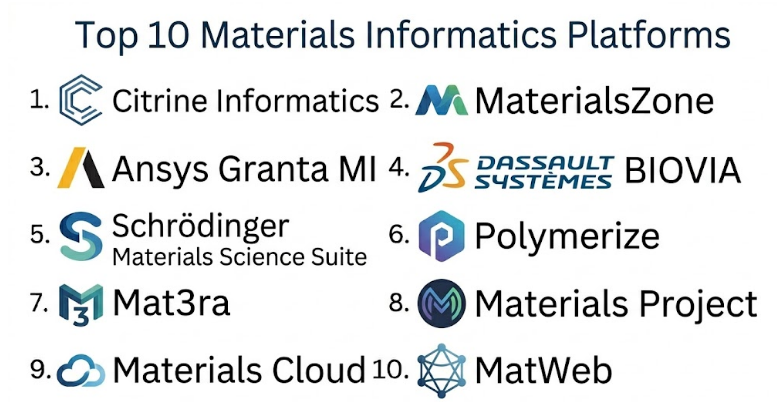
Top 10 Materials Informatics Platforms
#1 — Citrine Informatics
Short description :
Citrine Informatics is a materials and chemicals development platform focused on using data and AI to accelerate R&D decisions. It helps teams organize materials data, build predictive models, and identify promising material candidates or formulations. The platform is mainly useful for industrial R&D teams working in chemicals, polymers, coatings, advanced materials, and product innovation. Citrine is designed for organizations that want to move from manual experiment cycles toward data-driven material discovery. It is especially valuable when teams have historical data but need better ways to reuse it for future development.
Key Features
- Materials data management and structuring
- AI and machine learning model support
- Property prediction and candidate screening
- Formulation and material development workflows
- Data-driven experiment planning
- Collaboration across R&D teams
- Support for industrial materials innovation
Pros
- Strong focus on industrial materials and chemical R&D
- Useful for reducing trial-and-error development cycles
- Good fit for teams with valuable historical experiment data
Cons
- May require clean and structured data for best results
- Enterprise-level adoption may need strong change management
- Pricing and implementation details are not simple for public comparison
Platforms / Deployment
Web-based platform.
Cloud deployment is commonly expected.
Self-hosted / Hybrid: Varies / N/A.
Security & Compliance
SSO/SAML, MFA, encryption, audit logs, RBAC: Not publicly stated in detail.
SOC 2, ISO 27001, GDPR, HIPAA: Not publicly stated.
Integrations & Ecosystem
Citrine can fit into R&D environments where materials data needs to connect with lab systems, data science workflows, and enterprise innovation processes. Integration depth may depend on the customer’s systems and implementation scope.
- Materials data import and structuring
- Experiment and property datasets
- Possible connection with lab and enterprise systems
- AI/ML workflow support
- API availability: Not publicly stated
Support & Community
Support is generally vendor-led and enterprise-focused. Onboarding, data preparation, and implementation support may vary by project size, customer needs, and contract scope.
#2 — MaterialsZone
Short description :
MaterialsZone is a materials informatics platform designed to help R&D teams centralize experimental data, connect research workflows, and apply analytics or AI to materials development. It is useful for materials scientists, formulation teams, and research organizations that want to bring scattered data into one searchable and reusable environment. The platform supports the idea that better materials discovery starts with better data organization. MaterialsZone is especially helpful for teams that work across experiments, measurements, properties, and formulation parameters. It is a practical option for organizations trying to modernize their materials R&D process.
Key Features
- Centralized materials data management
- Experiment and property data organization
- AI and analytics support
- Collaboration for research teams
- Workflow visibility for R&D projects
- Data search and comparison features
- Support for materials discovery processes
Pros
- Strong fit for data-driven materials research
- Helps reduce scattered and disconnected R&D data
- Useful for teams moving from spreadsheets to structured systems
Cons
- Value depends heavily on data quality and data discipline
- Advanced use cases may need onboarding and configuration
- Public details on security and integrations may be limited
Platforms / Deployment
Web-based platform.
Cloud deployment is commonly expected.
Self-hosted / Hybrid: Varies / N/A.
Security & Compliance
SSO/SAML, MFA, encryption, audit logs, RBAC: Not publicly stated in detail.
SOC 2, ISO 27001, GDPR, HIPAA: Not publicly stated.
Integrations & Ecosystem
MaterialsZone is useful where materials research teams want to connect experiments, measurements, and analytics in a structured way. It can support data reuse across different projects and research groups.
- Experiment data management
- Materials property data organization
- Analytics and AI workflows
- Collaboration across R&D teams
- Integration availability: Varies / Not publicly stated
Support & Community
Support is generally vendor-led. Documentation, onboarding, and implementation assistance may depend on customer requirements and deployment scope.
#3 — Ansys Granta MI
Short description :
Ansys Granta MI is a materials information management platform designed for companies that need to create, control, manage, and share trusted materials information across engineering and product development teams. It is especially useful for manufacturers, aerospace companies, automotive teams, electronics firms, and industrial organizations where material data must support design, simulation, compliance, and product decisions. Granta MI focuses strongly on enterprise material intelligence rather than only experimental discovery. It helps organizations maintain consistent material data across CAD, CAE, PLM, and engineering workflows. It is a strong choice for enterprises where material selection and engineering consistency are critical.
Key Features
- Enterprise materials information management
- Material property database control
- Support for engineering and product development
- Integration potential with CAD, CAE, and PLM workflows
- Material selection and comparison support
- Data governance and controlled access
- Support for internal material knowledge management
Pros
- Strong enterprise material data governance
- Useful for engineering-heavy organizations
- Good fit for design, simulation, and product teams
Cons
- May be too advanced for small research-only teams
- Implementation can require planning and data migration
- Best value comes when connected to engineering workflows
Platforms / Deployment
Web-based / enterprise software environment.
Cloud / Self-hosted / Hybrid: Varies / N/A.
Security & Compliance
Enterprise access controls may be available depending on deployment.
SSO/SAML, MFA, encryption, audit logs, RBAC: Not publicly stated in detail.
SOC 2, ISO 27001, GDPR, HIPAA: Not publicly stated.
Integrations & Ecosystem
Ansys Granta MI is designed to work within engineering and simulation ecosystems. It is especially relevant when material information must support CAD, CAE, PLM, simulation, and design decisions.
- CAD and CAE workflow support
- PLM-related materials data use
- Engineering material databases
- Material selection and simulation support
- Enterprise reporting and governance workflows
Support & Community
Support is typically enterprise-focused, with documentation, implementation assistance, and professional support options. Community strength is connected to the wider engineering and simulation ecosystem.
#4 — Dassault Systèmes BIOVIA
Short description :
Dassault Systèmes BIOVIA provides scientific software for modeling, simulation, data science, lab informatics, and research collaboration. In materials informatics, it is useful for organizations working on molecular modeling, chemistry, polymers, formulations, materials simulation, and scientific data management. BIOVIA is suitable for pharma, chemicals, consumer goods, materials science, and advanced research teams. It helps teams connect scientific knowledge, computational modeling, and laboratory workflows. It is a strong option for organizations that want materials informatics as part of a broader scientific innovation platform.
Key Features
- Molecular modeling and simulation support
- Scientific data management
- Materials and chemistry research workflows
- Collaboration across research teams
- Lab informatics ecosystem support
- Modeling for formulations and materials
- Enterprise scientific workflow capabilities
Pros
- Strong scientific and modeling ecosystem
- Useful for chemistry, materials, and life science R&D
- Good fit for large research organizations
Cons
- May be complex for small teams
- Best results may require scientific software expertise
- Pricing and module selection can vary widely
Platforms / Deployment
Windows / Web / Enterprise environments: Varies by product module.
Cloud / Self-hosted / Hybrid: Varies / N/A.
Security & Compliance
Enterprise security options may be available depending on product and deployment.
SSO/SAML, MFA, encryption, audit logs, RBAC: Not publicly stated in detail.
SOC 2, ISO 27001, GDPR, HIPAA: Not publicly stated.
Integrations & Ecosystem
BIOVIA is part of a broader scientific software ecosystem and can be relevant for organizations that need to connect modeling, lab data, informatics, and collaboration.
- Scientific modeling workflows
- Lab informatics connections
- Data science and research collaboration
- Chemistry and materials data management
- Integration availability: Varies by product and deployment
Support & Community
Support is generally enterprise-led, with documentation, training, account support, and professional services depending on product package and customer size.
#5 — Schrödinger Materials Science Suite
Short description :
Schrödinger Materials Science Suite is a computational platform focused on molecular modeling, simulations, and materials design. It is useful for teams working on polymers, catalysts, electronic materials, batteries, chemicals, and advanced materials. The platform helps scientists model structure-property relationships and evaluate material behavior before or alongside lab experiments. It is especially useful where computational chemistry and physics-based modeling are central to materials research. Schrödinger is a strong choice for expert teams that need scientific depth and predictive modeling rather than only data management.
Key Features
- Molecular modeling and simulation
- Materials property prediction support
- Polymer and chemical modeling workflows
- Battery and electronic material research support
- Visualization and analysis tools
- Computational chemistry capabilities
- Support for expert scientific users
Pros
- Strong modeling and simulation depth
- Useful for advanced materials discovery
- Good fit for expert computational science teams
Cons
- May require specialized technical knowledge
- Not a simple no-code platform for all users
- May need integration with separate data management systems
Platforms / Deployment
Windows / Linux / Web or enterprise access: Varies by product and setup.
Cloud / Self-hosted / Hybrid: Varies / N/A.
Security & Compliance
SSO/SAML, MFA, encryption, audit logs, RBAC: Not publicly stated in detail.
SOC 2, ISO 27001, GDPR, HIPAA: Not publicly stated.
Integrations & Ecosystem
Schrödinger fits into computational R&D workflows where simulations, models, and scientific analysis must support materials decisions.
- Computational chemistry workflows
- Molecular and materials modeling
- Scientific data export and analysis
- Possible integration with internal research systems
- API / automation availability: Varies / Not publicly stated
Support & Community
Support is usually strong for scientific and enterprise customers. Documentation, training, technical support, and expert services may be available depending on licensing and customer needs.
#6 — Polymerize
Short description :
Polymerize is a materials informatics platform focused on helping materials and chemical R&D teams manage experimental data, build AI-driven insights, and improve formulation development. It is especially relevant for polymer, chemical, coating, and formulation-focused organizations. The platform helps teams capture experiment data, understand relationships between inputs and outcomes, and recommend better formulation directions. Polymerize is useful for teams that want to reduce repeated experiments and make better use of past R&D knowledge. It is a strong fit for companies that need practical AI support for product formulation and materials development.
Key Features
- Materials R&D data management
- Formulation intelligence
- AI-assisted experiment recommendations
- Experimental data organization
- Property and performance analysis
- Collaboration for R&D teams
- Visualization and insight generation
Pros
- Strong fit for formulation and polymer R&D
- Helpful for teams with scattered experimental data
- Focused on practical materials development workflows
Cons
- May be less suitable for pure engineering material databases
- Best results depend on data quality and domain setup
- Security and compliance details are not fully public
Platforms / Deployment
Web-based platform.
Cloud deployment is commonly expected.
Self-hosted / Hybrid: Varies / N/A.
Security & Compliance
SSO/SAML, MFA, encryption, audit logs, RBAC: Not publicly stated in detail.
SOC 2, ISO 27001, GDPR, HIPAA: Not publicly stated.
Integrations & Ecosystem
Polymerize fits well into R&D environments where formulation data, experiments, properties, and AI recommendations need to work together.
- Formulation and experiment datasets
- Materials property analysis
- AI model workflows
- Collaboration between scientists and data teams
- Integration availability: Varies / Not publicly stated
Support & Community
Support is generally vendor-led and focused on R&D adoption. Onboarding, data setup, and workflow configuration may be important parts of implementation.
#7 — Mat3ra
Short description :
Mat3ra is a materials R&D cloud platform designed for computational materials science, simulations, structure design, and AI-assisted materials workflows. It helps researchers and teams design material structures, run simulations, manage computational workflows, and collaborate online. Mat3ra is useful for academic researchers, computational scientists, startups, and industrial teams working on advanced materials. The platform is especially relevant where simulation and cloud-based collaboration are important. It is a good fit for teams that want to combine computational experiments, data, and AI models in one environment.
Key Features
- Cloud-based materials R&D workflows
- Materials structure design
- Simulation workflow support
- AI and data workflow capabilities
- Collaboration for research teams
- Computational experiment management
- Open and team-based research support
Pros
- Strong fit for computational materials teams
- Useful for cloud-based collaboration
- Supports simulation-driven research workflows
Cons
- May require computational materials knowledge
- Less focused on enterprise material governance
- May not replace broader PLM or lab informatics systems
Platforms / Deployment
Web-based cloud platform.
Cloud deployment.
Self-hosted / Hybrid: Varies / N/A.
Security & Compliance
SSO/SAML, MFA, encryption, audit logs, RBAC: Not publicly stated in detail.
SOC 2, ISO 27001, GDPR, HIPAA: Not publicly stated.
Integrations & Ecosystem
Mat3ra works well for computational materials teams that need to connect structure design, simulation workflows, and data analysis.
- Simulation workflow support
- Materials structure data
- Computational research collaboration
- AI and data modeling workflows
- API availability: Varies / Not publicly stated
Support & Community
Support includes platform documentation and user assistance. Community strength is more relevant to computational materials researchers and technical users.
#8 — Materials Project
Short description :
Materials Project is an open materials data platform that provides access to computed information on known and predicted materials. It is widely useful for researchers, students, scientists, and engineers who need materials property data for early screening, comparison, and computational research. While it is not an enterprise materials informatics suite in the same way as commercial platforms, it is very valuable for discovery, education, and research workflows. Materials Project helps users explore material structures, computed properties, and candidate materials. It is best for teams that need open scientific data as part of their materials research process.
Key Features
- Open materials data access
- Computed materials properties
- Materials search and exploration
- Structure and property information
- Research and education support
- Data for screening and comparison
- Useful for computational materials science
Pros
- Valuable open resource for materials research
- Useful for early-stage screening and learning
- Strong fit for academic and computational users
Cons
- Not a full enterprise R&D management platform
- Does not replace proprietary experiment data systems
- Commercial security and workflow controls may be limited
Platforms / Deployment
Web-based platform.
Cloud / Open web access.
Self-hosted / Hybrid: Varies / N/A.
Security & Compliance
SSO/SAML, MFA, encryption, audit logs, RBAC: Not publicly stated.
SOC 2, ISO 27001, GDPR, HIPAA: Not publicly stated.
Integrations & Ecosystem
Materials Project is often used as a data source for computational research, screening, education, and early materials discovery.
- Open materials datasets
- Computational property data
- Research data access
- API-based usage may be available
- Integration with custom research workflows may depend on user setup
Support & Community
Materials Project has strong academic and research relevance. Community strength is higher among computational materials scientists, students, and researchers than among enterprise software buyers.
#9 — Materials Cloud
Short description :
Materials Cloud is an open science platform for computational materials science. It supports sharing, discovering, and exploring materials data, workflows, and research outputs. The platform is useful for researchers who need open access to computational materials datasets and reproducible workflows. It is not a commercial enterprise materials R&D system, but it plays an important role in open materials informatics and scientific collaboration. Materials Cloud is especially valuable for academic teams, computational researchers, and organizations exploring open data-driven materials science.
Key Features
- Open computational materials data
- Research workflow sharing
- Materials data discovery
- Support for reproducible research
- Scientific collaboration
- Data publishing and exploration
- Useful for academic materials informatics
Pros
- Strong open science orientation
- Useful for computational materials research
- Supports transparency and reproducibility
Cons
- Not designed as a full enterprise materials platform
- May not support private industrial workflow needs
- Requires research and technical knowledge for best use
Platforms / Deployment
Web-based platform.
Open cloud access.
Self-hosted / Hybrid: Varies / N/A.
Security & Compliance
SSO/SAML, MFA, encryption, audit logs, RBAC: Not publicly stated.
SOC 2, ISO 27001, GDPR, HIPAA: Not publicly stated.
Integrations & Ecosystem
Materials Cloud fits into academic and computational research workflows where open datasets, published workflows, and reproducibility matter.
- Open materials data access
- Computational research workflows
- Data sharing and publishing
- Research collaboration
- Integration availability: Varies / Not publicly stated
Support & Community
Community strength is mainly academic and research-focused. Support may come through documentation, research community usage, and platform guidance rather than enterprise support tiers.
#10 — MatWeb
Short description :
MatWeb is an online materials information resource that provides searchable material property data for plastics, metals, ceramics, composites, fibers, and other engineering materials. It is not a modern AI-first materials informatics platform, but it remains useful for engineers and product teams who need quick access to material datasheets and property comparisons. MatWeb is helpful during early material selection, product design review, supplier comparison, and engineering reference work. It is best for teams that need a practical materials database rather than advanced AI, simulation, or workflow automation. It can be a useful starting point before moving to more advanced materials intelligence platforms.
Key Features
- Searchable material property database
- Datasheets for many engineering materials
- Support for plastics, metals, ceramics, and composites
- Material comparison support
- Engineering reference data
- Useful for early material selection
- Simple browser-based access
Pros
- Easy to use for material lookup
- Useful for engineers and product teams
- Good starting point for basic material comparison
Cons
- Not an AI-driven materials discovery platform
- Limited workflow, collaboration, and enterprise governance
- Not a replacement for internal material data management
Platforms / Deployment
Web-based platform.
Cloud / Web access.
Self-hosted / Hybrid: Varies / N/A.
Security & Compliance
SSO/SAML, MFA, encryption, audit logs, RBAC: Not publicly stated.
SOC 2, ISO 27001, GDPR, HIPAA: Not publicly stated.
Integrations & Ecosystem
MatWeb is mainly used as a searchable materials reference database. It can support early research and material comparison, but integration depth is limited compared with enterprise platforms.
- Material property lookup
- Engineering datasheet reference
- Material comparison workflows
- Manual use in product design research
- API availability: Not publicly stated
Support & Community
Support and community activity are more reference-resource oriented than enterprise software focused. It is useful for engineers who need quick material information but not full R&D workflow support.
Comparison Table
| Tool Name | Best For | Platform(s) Supported | Deployment | Standout Feature | Public Rating |
|---|---|---|---|---|---|
| Citrine Informatics | Industrial materials and chemicals R&D | Web | Cloud / Varies | AI-driven materials development | N/A |
| MaterialsZone | Centralized materials R&D data management | Web | Cloud / Varies | Structured experimental data and analytics | N/A |
| Ansys Granta MI | Enterprise material information management | Web / Enterprise environment | Cloud / Hybrid / Varies | Engineering-grade material data governance | N/A |
| Dassault Systèmes BIOVIA | Scientific modeling and research workflows | Windows / Web / Varies | Cloud / Hybrid / Varies | Scientific modeling and lab informatics ecosystem | N/A |
| Schrödinger Materials Science Suite | Computational materials modeling | Windows / Linux / Web / Varies | Cloud / Hybrid / Varies | Molecular modeling and simulation depth | N/A |
| Polymerize | Formulation and polymer R&D | Web | Cloud / Varies | AI-assisted formulation intelligence | N/A |
| Mat3ra | Cloud computational materials research | Web | Cloud | Simulation and AI materials R&D workflows | N/A |
| Materials Project | Open materials data and research | Web | Open web access | Computed materials data access | N/A |
| Materials Cloud | Open computational materials science | Web | Open web access | Reproducible research and data sharing | N/A |
| MatWeb | Engineering material property lookup | Web | Web access | Searchable materials datasheets | N/A |
Evaluation & Materials Informatics Platforms
The scoring below is comparative. It is based on practical buyer needs such as core materials informatics capabilities, ease of use, integrations, security signals, performance expectations, support, and overall value. Scores are not universal rankings. A tool with a lower enterprise score may still be the best choice for a research team, while a high-scoring enterprise platform may be too complex for a small lab.
| Tool Name | Core (25%) | Ease (15%) | Integrations (15%) | Security (10%) | Performance (10%) | Support (10%) | Value (15%) | Weighted Total (0–10) |
|---|---|---|---|---|---|---|---|---|
| Citrine Informatics | 9 | 8 | 8 | 7 | 8 | 8 | 8 | 8.15 |
| MaterialsZone | 8 | 8 | 7 | 7 | 8 | 7 | 8 | 7.65 |
| Ansys Granta MI | 9 | 7 | 9 | 8 | 9 | 8 | 7 | 8.20 |
| Dassault Systèmes BIOVIA | 9 | 7 | 8 | 8 | 9 | 8 | 7 | 8.05 |
| Schrödinger Materials Science Suite | 9 | 7 | 8 | 7 | 9 | 8 | 7 | 7.95 |
| Polymerize | 8 | 8 | 7 | 7 | 8 | 8 | 8 | 7.75 |
| Mat3ra | 8 | 8 | 7 | 6 | 8 | 7 | 8 | 7.50 |
| Materials Project | 7 | 8 | 8 | 5 | 8 | 7 | 9 | 7.35 |
| Materials Cloud | 7 | 7 | 7 | 5 | 8 | 7 | 9 | 7.15 |
| MatWeb | 6 | 9 | 5 | 5 | 8 | 6 | 8 | 6.75 |
A high weighted total usually means the platform has strong overall fit across multiple buyer needs. However, buyers should not choose by score alone. For example, MatWeb may be excellent for simple material lookup, while Citrine, Polymerize, or MaterialsZone may be better for AI-driven R&D. Enterprises that need controlled engineering material data may prefer Ansys Granta MI, while computational teams may prefer Schrödinger or Mat3ra.
Which Materials Informatics Platform Should You Choose?
Solo / Freelancer
Solo researchers, consultants, and independent engineers should avoid overcomplicated platforms unless they have advanced modeling or data needs. A simple materials database or open research platform may be enough for early exploration.
Good options:
- MatWeb for material property lookup
- Materials Project for open computed materials data
- Materials Cloud for open research workflows
- Mat3ra for cloud-based computational research
The focus should be on low-friction access, easy learning, and useful data rather than enterprise governance.
SMB
Small and mid-sized materials R&D teams need practical tools that improve experiment tracking, formulation learning, and data reuse. They may not need full enterprise PLM integration, but they do need better structure than spreadsheets.
Good options:
- Polymerize for formulation and polymer R&D
- MaterialsZone for centralized R&D data
- Citrine Informatics for AI-driven materials development
- Mat3ra for computational materials workflows
SMBs should focus on adoption, data cleanup, and clear use cases. The best platform is the one scientists will actually use every day.
Mid-Market
Mid-market organizations often have more data, more teams, and more pressure to reduce experiment cycles. They may need AI, data governance, integration, and collaboration features together.
Good options:
- Citrine Informatics for predictive materials development
- MaterialsZone for structured R&D data management
- Polymerize for formulation intelligence
- Schrödinger for computational modeling
- Ansys Granta MI for engineering materials governance
Mid-market buyers should evaluate whether their biggest challenge is data structure, prediction accuracy, simulation depth, formulation speed, or enterprise material consistency.
Enterprise
Large enterprises need secure, scalable, governed platforms that connect R&D, engineering, simulation, product development, compliance, and manufacturing teams. They also need clear ownership of proprietary data and strong workflow control.
Good options:
- Ansys Granta MI for enterprise material information management
- Dassault Systèmes BIOVIA for scientific modeling and research workflows
- Citrine Informatics for AI-driven industrial materials development
- Schrödinger Materials Science Suite for advanced computational science
- MaterialsZone or Polymerize for specialized R&D data and formulation workflows
Enterprise buyers should involve R&D, IT, security, engineering, compliance, and business stakeholders before final selection.
Budget vs Premium
Budget-focused users should start with open platforms or lightweight material databases if their needs are mostly research, learning, or reference-based.
Budget-friendly starting points:
- Materials Project
- Materials Cloud
- MatWeb
Premium platforms make more sense when teams need:
- Proprietary data management
- AI prediction models
- Simulation workflows
- Enterprise integrations
- Role-based access
- Support and onboarding
- Multi-site collaboration
The premium choice should be justified by measurable R&D value, not only by advanced features.
Feature Depth vs Ease of Use
Feature-rich platforms provide deeper capability, but they may require training, setup, data preparation, and expert users. Easy platforms help teams start quickly but may not solve complex enterprise problems.
Choose feature depth when:
- You work with complex material systems
- You need AI or simulation workflows
- You manage large proprietary datasets
- You need integration with engineering systems
- You need enterprise governance
Choose ease of use when:
- Your team is new to materials informatics
- You mainly need lookup, data organization, or simple analysis
- You do not have dedicated data scientists
- Adoption is more important than advanced modeling
Integrations & Scalability
Materials data becomes more valuable when it connects to the wider technology ecosystem. Buyers should think beyond the platform itself and ask how it will fit with current and future systems.
Important integration areas include:
- ELN and LIMS
- PLM and product development systems
- CAD and CAE tools
- Simulation environments
- Data lakes and analytics tools
- HR and identity systems
- ERP and procurement systems
- Internal AI/ML pipelines
Scalability matters when multiple sites, teams, product lines, or research groups need to use the same trusted materials data.
Security & Compliance Needs
Materials data can be highly sensitive because it may include proprietary formulations, experimental results, product designs, supplier information, and competitive research knowledge. Security should be reviewed early, not after the tool is selected.
Buyers should ask about:
- Role-based access control
- SSO and MFA
- Encryption
- Audit logs
- Data backup and retention
- User activity tracking
- Data export rights
- Compliance documentation
- Tenant isolation for cloud systems
- Support for internal security review
Do not assume a vendor has a security certification unless it is clearly confirmed in writing.
Frequently Asked Questions
1. What is a Materials Informatics Platform?
A Materials Informatics Platform helps teams use data, AI, machine learning, simulations, and structured databases to discover, compare, design, and improve materials. It supports faster and more informed decisions in materials research and product development.
2. How is materials informatics different from a normal materials database?
A normal materials database mainly stores and displays material properties. A materials informatics platform goes further by helping analyze data, predict properties, recommend candidates, manage experiments, and connect research workflows.
3. Who should use Materials Informatics Platforms?
These platforms are useful for materials scientists, chemical engineers, formulation scientists, R&D teams, data scientists, product engineers, universities, manufacturers, and companies working with advanced materials, polymers, coatings, batteries, alloys, or semiconductors.
4. Are these platforms only for large enterprises?
No. Some platforms are built for enterprises, but others are useful for startups, research labs, universities, and small R&D teams. Smaller teams should choose tools that match their data volume, budget, and technical skill level.
5. What is the biggest mistake when adopting materials informatics?
The biggest mistake is expecting AI to work well on poor-quality data. Materials informatics needs clean, structured, consistent, and meaningful data. Without good data preparation, even advanced platforms may produce weak results.
6. Can these platforms reduce physical experiments?
Yes, they can help reduce unnecessary experiments by predicting promising candidates, identifying patterns in past data, and recommending better experiment directions. However, physical validation is still important in most materials development workflows.
7. Do these tools replace materials scientists?
No. These tools support scientists by helping them analyze data faster and make better decisions. Human expertise is still needed to interpret results, design experiments, validate findings, and understand real-world material behavior.
8. What pricing model do Materials Informatics Platforms use?
Pricing varies widely. Some open platforms are free to access, while enterprise tools may use custom pricing based on users, modules, data volume, deployment, support, and integration needs. If pricing is not clear, buyers should request a detailed quote.
9. How long does implementation take?
Implementation depends on data quality, team size, use case complexity, integrations, and platform scope. A simple database setup may be quick, while an enterprise AI-driven materials platform may require data migration, workflow design, training, and phased rollout.
10. Can Materials Informatics Platforms integrate with ELN, LIMS, PLM, or CAD systems?
Some platforms can integrate with lab, engineering, simulation, and enterprise systems, but integration depth varies. Buyers should ask about APIs, supported connectors, data import/export, identity management, and custom integration options.
Conclusion
Materials Informatics Platforms are becoming important for organizations that want to make materials research faster, smarter, and more data-driven. These tools help teams organize experimental data, predict material properties, design better formulations, run simulations, compare alternatives, and connect research knowledge across departments. However, the best platform depends on the buyer’s real situation. A small research team may only need an open materials database or a lightweight cloud platform, while an enterprise manufacturer may need governed material data, CAD and CAE integration, security controls, and advanced AI workflows.
