Introduction
Oil & Gas Field Service Tools help energy companies manage field crews, work orders, inspections, maintenance, equipment, compliance tasks, service tickets, safety workflows, and asset operations across upstream, midstream, and downstream environments. In simple English, these tools help oil and gas teams plan field work, dispatch technicians, track jobs, capture field data, manage assets, and improve service execution.
Oil and gas field operations are complex because teams often work across remote wells, pipelines, compressor stations, refineries, terminals, rigs, plants, and service locations. Field teams need accurate job details, equipment history, safety checklists, parts availability, offline access, compliance records, and real-time communication.
Common use cases include:
- Work order and field crew management
- Preventive and corrective maintenance
- Well site and pipeline inspections
- Asset and equipment service tracking
- HSE and compliance checklist management
- Mobile field data collection
- Dispatching and scheduling
- Inventory, spare parts, and tool tracking
- Contractor and service provider coordination
- Reporting for operations, maintenance, and compliance teams
Buyers should evaluate:
- Mobile and offline field access
- Work order and dispatch capabilities
- Asset and equipment management
- Inspection and checklist workflows
- Integration with ERP, EAM, CMMS, GIS, SCADA, and IoT systems
- Safety, compliance, and audit trail support
- Scheduling and crew optimization
- Inventory and parts management
- User permissions and security controls
- Reporting and analytics
- Vendor experience in oil and gas operations
- Ease of use for field technicians and supervisors
Best for: Oil and gas operators, field service companies, drilling contractors, pipeline operators, equipment service providers, refineries, maintenance teams, HSE teams, asset managers, dispatch teams, and operations leaders managing distributed field work.
Not ideal for: Very small service teams that only need basic task lists, companies without field crews or assets, or organizations that only need simple invoicing without maintenance, inspections, dispatch, or compliance workflows.
Key Oil & Gas Field Service Tool Trends
- Mobile-first field operations are becoming essential because technicians need job details, forms, equipment records, and photos directly in the field.
- Offline access is a major requirement because many oil and gas locations have limited or unstable connectivity.
- Predictive maintenance is growing as companies use sensor and equipment data to reduce failures and unplanned downtime.
- HSE and compliance workflows are becoming more important because field operations must document safety steps, inspections, permits, and audit evidence.
- GIS and location-based workflows are valuable for pipeline, well site, and distributed asset operations.
- Integration with ERP and EAM systems is important because field work affects finance, procurement, inventory, labor, and asset lifecycle records.
- IoT and SCADA integration is becoming useful for triggering maintenance based on real equipment conditions.
- Contractor and vendor management is increasingly important because oil and gas field work often involves third-party service providers.
- AI-assisted scheduling and work prioritization can help teams optimize crew deployment, reduce travel time, and improve response time.
- Digital forms and inspection automation are replacing paper checklists, reducing errors and improving compliance visibility.
How We Selected These Tools
The tools below were selected using practical oil and gas field operations evaluation logic:
- Recognized presence in field service, enterprise asset management, oil and gas operations, maintenance, or inspection workflows.
- Ability to support mobile work orders, dispatch, field data capture, inspections, and asset service management.
- Suitability for upstream, midstream, downstream, industrial service, utilities, and energy field operations.
- Strength in mobile usability, offline access, work execution, scheduling, and field reporting.
- Integration capability with ERP, EAM, CMMS, GIS, SCADA, IoT, inventory, finance, and reporting systems.
- Support for safety, compliance, documentation, and audit trails.
- Scalability for small service teams, mid-market operators, and large enterprise energy organizations.
- Vendor maturity, implementation ecosystem, documentation, and support quality.
- Flexibility for contractors, internal field teams, and multi-site operations.
- Balanced inclusion of enterprise platforms, field-service-focused tools, mobile inspection tools, and asset-heavy maintenance platforms.
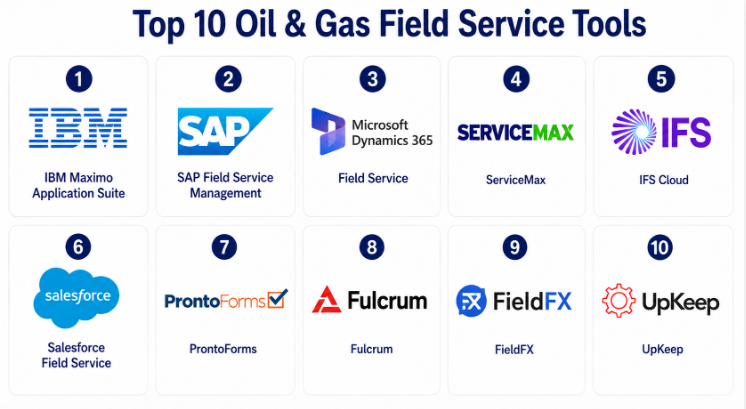
Top 10 Oil & Gas Field Service Tools
#1 — IBM Maximo Application Suite
Short description :
IBM Maximo Application Suite is an enterprise asset management platform used by asset-heavy industries, including oil and gas, utilities, manufacturing, and energy. It helps companies manage work orders, preventive maintenance, inspections, asset lifecycle, spare parts, reliability, and field execution. For oil and gas teams, Maximo is useful for maintaining wells, pipelines, rotating equipment, compressors, pumps, valves, terminals, plants, and production assets. It is especially strong where maintenance governance, asset history, reliability, and compliance are important. IBM Maximo is best for large operators and asset-heavy organizations that need enterprise-grade maintenance and field service control.
Key Features
- Enterprise asset and maintenance management
- Work order planning and execution
- Preventive and predictive maintenance support
- Asset lifecycle and reliability management
- Mobile field work support depending on setup
- Inventory and spare parts workflows
- Reporting, dashboards, and enterprise integration
Pros
- Strong fit for asset-heavy oil and gas operations.
- Useful for maintenance, inspections, reliability, and asset lifecycle tracking.
- Scalable for large and complex field environments.
Cons
- Implementation can be complex for smaller teams.
- Requires configuration for specific oil and gas workflows.
- May need strong internal ownership and partner support.
Platforms / Deployment
Web / Mobile options may vary
Cloud / On-premise / Hybrid options may vary
Security & Compliance
IBM enterprise security capabilities may apply depending on deployment and configuration. Specific certifications should be verified directly in the customer’s environment.
Integrations & Ecosystem
IBM Maximo is useful when oil and gas field service must connect with enterprise maintenance, inventory, procurement, finance, and operational systems.
- ERP and finance systems
- Inventory and procurement workflows
- SCADA and IoT systems where configured
- Mobile field work tools
- Reliability and asset health analytics
- Enterprise reporting systems
Support & Community
IBM provides enterprise support, documentation, implementation partners, training, and a strong asset management ecosystem. Community strength is strong among enterprise maintenance, reliability, utility, and oil and gas teams.
#2 — SAP Field Service Management
Short description :
SAP Field Service Management helps organizations schedule, dispatch, manage, and complete field service work. It is useful for oil and gas companies that need field crews, contractors, technicians, and service teams connected with enterprise processes. The platform supports work orders, technician scheduling, mobile execution, service reporting, and customer or asset-related workflows. It is especially useful for companies already using SAP ERP, SAP S/4HANA, or SAP asset management solutions. SAP Field Service Management is best for enterprise oil and gas teams that want field service connected with finance, procurement, inventory, and asset systems.
Key Features
- Field service scheduling and dispatch
- Mobile technician workflows
- Work order execution and reporting
- Service task and job tracking
- Integration with SAP enterprise systems
- Contractor and technician coordination
- Service history and operational visibility
Pros
- Strong fit for SAP-based oil and gas companies.
- Good for connecting field service with enterprise business processes.
- Useful for dispatch, work execution, and mobile service workflows.
Cons
- Best value depends on SAP ecosystem fit.
- Implementation may require SAP expertise.
- May need configuration for complex oilfield-specific workflows.
Platforms / Deployment
Web / Mobile options may vary
Cloud
Security & Compliance
SAP enterprise security controls may apply depending on licensing and configuration. Specific certifications and compliance details should be verified directly.
Integrations & Ecosystem
SAP Field Service Management works well when field work must connect with ERP, asset management, procurement, and finance.
- SAP ERP and S/4HANA workflows
- Asset and equipment records
- Inventory and spare parts systems
- Finance and billing workflows
- Mobile technician apps
- Reporting and analytics tools
Support & Community
SAP provides documentation, enterprise support, partner services, training, and a large ecosystem. Community strength is strong among SAP enterprise and energy industry users.
#3 — Microsoft Dynamics 365 Field Service
Short description :
Microsoft Dynamics 365 Field Service is a field service management platform for work orders, scheduling, technician dispatch, mobile execution, asset service, and customer service workflows. Oil and gas teams can use it for equipment service, contractor coordination, preventive maintenance, inspections, and field technician management. It is especially useful for organizations already using Microsoft tools such as Dynamics, Power Platform, Teams, and Azure. The platform can be configured for asset-heavy and service-oriented field operations. Microsoft Dynamics 365 Field Service is best for companies that want flexible field service workflows inside a Microsoft ecosystem.
Key Features
- Work order and service management
- Scheduling and dispatch optimization
- Mobile technician workflows
- Asset and equipment service history
- Preventive maintenance scheduling
- Integration with Microsoft ecosystem
- Reporting and dashboard support
Pros
- Strong fit for Microsoft-centric organizations.
- Flexible platform for field service workflows.
- Good integration potential with productivity and analytics tools.
Cons
- Requires configuration for oil and gas-specific workflows.
- Advanced enterprise asset management may need additional tools.
- Offline and complex remote-field scenarios should be validated.
Platforms / Deployment
Web / iOS / Android
Cloud
Security & Compliance
Microsoft enterprise security controls may apply depending on licensing and configuration. Specific compliance coverage should be verified in the customer’s own environment.
Integrations & Ecosystem
Dynamics 365 Field Service is useful when oil and gas field service needs to connect with customer, asset, reporting, and productivity workflows.
- Microsoft Power Platform
- Microsoft Teams
- Azure services
- ERP and finance systems
- IoT and sensor data where configured
- Reporting and analytics dashboards
Support & Community
Microsoft documentation, partner ecosystem, enterprise support, and community resources are available. Community strength is strong due to the wider Microsoft ecosystem.
#4 — ServiceMax
Short description :
ServiceMax is a field service management platform designed for asset-centric service organizations. It helps companies manage technicians, work orders, installed assets, service contracts, preventive maintenance, dispatching, and field execution. For oil and gas service companies, it can support equipment maintenance, field service jobs, inspections, and service history tracking. It is especially useful where uptime, asset history, and technician productivity are important. ServiceMax is best for oilfield service providers and industrial equipment service teams that need structured field service execution.
Key Features
- Asset-centric field service management
- Work order and technician scheduling
- Installed asset and service history tracking
- Preventive maintenance workflows
- Mobile field technician support
- Service contract and entitlement workflows
- Reporting and performance dashboards
Pros
- Strong fit for asset-centric service operations.
- Useful for equipment service providers and field technicians.
- Helps improve service visibility and job execution control.
Cons
- May require configuration for oil and gas operational context.
- Integration with ERP and inventory systems should be validated.
- Pricing and package details may not be publicly simple.
Platforms / Deployment
Web / Mobile options may vary
Cloud
Security & Compliance
Enterprise controls such as role-based access and audit-related features may be available. Specific certifications are Not publicly stated here.
Integrations & Ecosystem
ServiceMax works well when field service must connect with asset records, service contracts, parts, and enterprise reporting.
- ERP and inventory systems
- CRM and customer service systems
- Mobile technician workflows
- Asset and equipment history
- Reporting and analytics tools
- Service contract workflows
Support & Community
Vendor support, implementation services, documentation, and field service expertise are available. Community strength is strongest among industrial service and asset-centric field service teams.
#5 — IFS Cloud
Short description :
IFS Cloud is an enterprise platform that supports field service management, enterprise asset management, project management, supply chain, and service operations. It is relevant for oil and gas companies that need asset maintenance, technician scheduling, complex projects, inventory, and operational workflows in one system. The platform is suitable for upstream, midstream, downstream, and energy service organizations with complex assets and distributed teams. IFS Cloud is especially useful when field service must connect with maintenance, projects, finance, and supply chain. It is best for asset-heavy energy companies that need broad operational capability.
Key Features
- Field service and workforce scheduling
- Enterprise asset management
- Work order and maintenance workflows
- Project and service management
- Inventory and supply chain support
- Mobile field execution
- Enterprise reporting and analytics
Pros
- Strong fit for asset-heavy and project-heavy operations.
- Combines field service, EAM, and enterprise workflows.
- Useful for complex energy and industrial service environments.
Cons
- May be more platform than small teams need.
- Implementation requires strong process planning.
- Exact oil and gas workflow fit should be validated.
Platforms / Deployment
Web / Mobile options may vary
Cloud / Hybrid options may vary
Security & Compliance
Enterprise security controls may be available depending on deployment. Specific certifications should be verified directly with the vendor.
Integrations & Ecosystem
IFS Cloud is useful when oil and gas field service must connect with assets, projects, supply chain, finance, and operations.
- ERP and finance systems
- Asset and maintenance workflows
- Inventory and procurement
- Mobile workforce tools
- Project management workflows
- Reporting and analytics platforms
Support & Community
Vendor support, implementation partners, documentation, and training resources are available. Community strength is strong among asset-heavy industries, service organizations, and industrial operations teams.
#6 — Salesforce Field Service
Short description :
Salesforce Field Service helps organizations manage field technicians, work orders, scheduling, dispatch, mobile workflows, customer communication, and service operations. In oil and gas, it can support service companies, equipment providers, contractors, and distributed maintenance teams that need to coordinate field jobs and customer-facing work. The platform is especially useful for companies already using Salesforce for CRM or service management. It helps align customer service, dispatch, field execution, and reporting. Salesforce Field Service is best for oil and gas service organizations that need strong service coordination and customer visibility.
Key Features
- Work order and field service management
- Scheduling and dispatch optimization
- Mobile technician workflows
- Customer and account visibility
- Service appointment tracking
- Reporting and dashboards
- Integration with Salesforce ecosystem
Pros
- Strong fit for Salesforce-based organizations.
- Useful for customer-facing field service teams.
- Flexible scheduling and mobile service workflows.
Cons
- Requires configuration for oil and gas assets and compliance workflows.
- Advanced asset maintenance may need integration with EAM or CMMS.
- Best value depends on Salesforce ecosystem adoption.
Platforms / Deployment
Web / iOS / Android
Cloud
Security & Compliance
Salesforce enterprise security controls may apply depending on plan and configuration. Specific certifications and compliance scope should be verified directly.
Integrations & Ecosystem
Salesforce Field Service works well when field jobs must connect with customers, contracts, service history, and sales or support workflows.
- Salesforce CRM and Service Cloud
- ERP and billing systems
- Mobile technician apps
- Inventory and parts systems
- Analytics dashboards
- Customer communication workflows
Support & Community
Salesforce documentation, partner ecosystem, admin community, and enterprise support options are available. Community strength is strong due to the wider Salesforce ecosystem.
#7 — ProntoForms
Short description :
ProntoForms is a mobile forms and field data collection platform used by field teams to capture inspections, checklists, photos, signatures, safety records, and service reports. For oil and gas companies, it is useful for digitizing field inspections, HSE forms, maintenance checklists, equipment reports, and compliance documentation. It is especially valuable when teams need flexible mobile forms with offline support and fast deployment. ProntoForms is not a full EAM or field service platform, but it is strong for field data capture. It is best for teams replacing paper forms and manual inspection processes.
Key Features
- Mobile forms and checklists
- Offline field data collection
- Photos, signatures, and evidence capture
- Inspection and safety workflows
- Conditional logic and form automation
- Reporting and data exports
- Integration with business systems
Pros
- Strong for replacing paper field forms.
- Useful for inspections, HSE, and service documentation.
- Faster to deploy than heavy enterprise platforms.
Cons
- Not a full field service or asset management system.
- Scheduling and dispatch features may be limited.
- Complex maintenance workflows may require integration with other systems.
Platforms / Deployment
Web / iOS / Android
Cloud
Security & Compliance
Enterprise controls may be available depending on plan. Specific certifications are Not publicly stated here.
Integrations & Ecosystem
ProntoForms is useful when oil and gas field data must be captured accurately and sent into enterprise systems.
- ERP and CRM systems
- Cloud storage and reporting tools
- Work order systems
- Safety and compliance workflows
- Mobile device workflows
- Data export and API workflows
Support & Community
Vendor support, documentation, onboarding resources, and form-building guidance are available. Community strength is strongest among field operations and inspection teams.
#8 — Fulcrum
Short description :
Fulcrum is a field data collection and inspection platform used for mobile forms, location-based data, photos, surveys, checklists, and field reporting. It is useful in oil and gas for pipeline inspections, well site inspections, environmental checks, equipment audits, HSE documentation, and field surveys. The platform supports mobile field teams that need structured data capture with maps and offline access. Fulcrum is especially useful where GIS-style field data and inspection workflows are important. It is best for teams needing flexible mobile data collection rather than a full field service suite.
Key Features
- Mobile field data collection
- Offline forms and inspections
- Location-based data capture
- Photos, signatures, and attachments
- Map-based field workflows
- Reporting and data exports
- Integration with GIS and business tools
Pros
- Strong for field inspections and location-based data.
- Useful for pipeline, site, and environmental field workflows.
- Flexible and practical for remote teams.
Cons
- Not a full EAM, CMMS, or dispatch platform.
- Advanced crew scheduling may require another system.
- Asset lifecycle management depth may be limited.
Platforms / Deployment
Web / iOS / Android
Cloud
Security & Compliance
Enterprise security controls may be available depending on plan. Specific certifications are Not publicly stated here.
Integrations & Ecosystem
Fulcrum works well when oil and gas teams need field data connected with maps, inspections, reporting, and analytics.
- GIS systems
- Business intelligence tools
- Cloud storage systems
- Work order systems
- Environmental and inspection workflows
- API and data export workflows
Support & Community
Vendor support, documentation, onboarding, and field data collection resources are available. Community strength is strong among inspection, GIS, infrastructure, and field operations teams.
#9 — FieldFX
Short description :
FieldFX is field service software designed for energy and industrial service companies, with strong relevance for oilfield service operations. It helps manage field tickets, jobs, quotes, dispatch, equipment, billing data, and service execution. The platform is especially useful for oilfield service providers that need field tickets and job data connected with billing and operations. It helps reduce paperwork and improve visibility between field crews and back-office teams. FieldFX is best for oilfield service companies needing digital field ticketing and operational service workflows.
Key Features
- Field ticket management
- Job and service order tracking
- Dispatch and crew coordination
- Equipment and service item tracking
- Quote and pricing workflows
- Billing data capture
- Mobile field execution
Pros
- Strong fit for oilfield service companies.
- Useful for field tickets, job data, and billing workflows.
- Helps connect field crews with back-office operations.
Cons
- May be less suitable for internal utility-style maintenance teams.
- Advanced enterprise EAM may require integration.
- Exact deployment and package details should be validated.
Platforms / Deployment
Web / Mobile options may vary
Cloud
Security & Compliance
Role-based access and enterprise controls may be available. Specific certifications are Not publicly stated here.
Integrations & Ecosystem
FieldFX is useful when field service jobs must connect with quoting, ticketing, billing, and operational reporting.
- ERP and accounting systems
- Mobile field ticketing
- Dispatch workflows
- Equipment and job records
- Billing and invoicing processes
- Reporting dashboards
Support & Community
Vendor support, implementation assistance, documentation, and oilfield service workflow expertise are available. Community strength is strongest among energy service companies and oilfield operations teams.
#10 — UpKeep
Short description :
UpKeep is a modern CMMS and maintenance management platform used for work orders, preventive maintenance, asset tracking, inspections, inventory, and mobile maintenance workflows. For smaller oil and gas service teams or facilities, it can help organize maintenance tasks, equipment records, field work, and technician activity. It is easier to adopt than many enterprise EAM platforms and can be practical for smaller operations. UpKeep is not a full oilfield operations suite, but it is useful for maintenance-focused teams that need a simple and mobile-friendly CMMS. It is best for small to mid-sized teams needing practical maintenance execution.
Key Features
- Work order management
- Preventive maintenance scheduling
- Asset and equipment tracking
- Mobile maintenance workflows
- Inventory and parts tracking
- Inspection checklists
- Reporting and maintenance dashboards
Pros
- Easy to adopt for maintenance teams.
- Mobile-friendly work order execution.
- Good value for small and mid-sized teams.
Cons
- Not specialized for complex oilfield operations.
- Advanced dispatch, compliance, and field ticketing may be limited.
- Enterprise integration depth should be validated.
Platforms / Deployment
Web / iOS / Android
Cloud
Security & Compliance
Role-based access and standard cloud controls may be available depending on plan. Specific certifications are Not publicly stated here.
Integrations & Ecosystem
UpKeep is useful when maintenance teams need simple work orders, asset records, and mobile execution.
- Maintenance and work order workflows
- Inventory tracking
- Reporting dashboards
- Mobile technician workflows
- ERP or accounting exports where configured
- Inspection checklists
Support & Community
Vendor support, documentation, onboarding resources, and maintenance management guidance are available. Community strength is strong among maintenance and facilities teams.
Comparison Table
| Tool Name | Best For | Platform(s) Supported | Deployment | Standout Feature | Public Rating |
|---|---|---|---|---|---|
| IBM Maximo Application Suite | Enterprise asset-heavy oil and gas operations | Web / Mobile options vary | Cloud / On-premise / Hybrid | Enterprise asset lifecycle and maintenance management | N/A |
| SAP Field Service Management | SAP-based enterprise field operations | Web / Mobile options vary | Cloud | Field service connected with SAP business workflows | N/A |
| Microsoft Dynamics 365 Field Service | Microsoft-centric field service teams | Web / iOS / Android | Cloud | Flexible field service with Microsoft ecosystem integration | N/A |
| ServiceMax | Asset-centric industrial field service | Web / Mobile options vary | Cloud | Installed asset and service history tracking | N/A |
| IFS Cloud | Asset-heavy and project-heavy energy operations | Web / Mobile options vary | Cloud / Hybrid options vary | Field service, EAM, projects, and supply chain together | N/A |
| Salesforce Field Service | Customer-facing oil and gas service teams | Web / iOS / Android | Cloud | Field service connected with Salesforce CRM | N/A |
| ProntoForms | Mobile inspections and digital forms | Web / iOS / Android | Cloud | Flexible mobile forms and offline field data capture | N/A |
| Fulcrum | Location-based inspections and field surveys | Web / iOS / Android | Cloud | GIS-friendly field data collection | N/A |
| FieldFX | Oilfield service companies | Web / Mobile options vary | Cloud | Digital field ticketing and job-to-billing workflows | N/A |
| UpKeep | Small and mid-sized maintenance teams | Web / iOS / Android | Cloud | Simple mobile CMMS and work order management | N/A |
Evaluation & Oil & Gas Field Service Tools
| Tool Name | Core (25%) | Ease (15%) | Integrations (15%) | Security (10%) | Performance (10%) | Support (10%) | Value (15%) | Weighted Total (0–10) |
|---|---|---|---|---|---|---|---|---|
| IBM Maximo Application Suite | 10 | 6 | 9 | 9 | 9 | 9 | 7 | 8.50 |
| SAP Field Service Management | 8 | 7 | 9 | 9 | 8 | 8 | 7 | 8.00 |
| Microsoft Dynamics 365 Field Service | 8 | 8 | 9 | 9 | 8 | 8 | 8 | 8.25 |
| ServiceMax | 9 | 8 | 8 | 8 | 8 | 8 | 7 | 8.10 |
| IFS Cloud | 9 | 7 | 9 | 8 | 8 | 8 | 7 | 8.05 |
| Salesforce Field Service | 8 | 8 | 9 | 9 | 8 | 8 | 7 | 8.10 |
| ProntoForms | 7 | 9 | 8 | 7 | 8 | 8 | 9 | 8.00 |
| Fulcrum | 7 | 9 | 8 | 7 | 8 | 8 | 9 | 8.00 |
| FieldFX | 8 | 8 | 7 | 7 | 8 | 8 | 8 | 7.75 |
| UpKeep | 7 | 9 | 7 | 7 | 8 | 8 | 9 | 7.85 |
These scores are comparative and should be used for shortlisting, not as final purchasing advice. Enterprise platforms score higher for depth, integrations, and governance, but they may be too complex for smaller teams. Mobile form and inspection tools score strongly for field usability but may not replace a full EAM or field service platform. Buyers should test real field workflows, offline usage, work orders, inspections, reporting, security controls, and integrations before choosing.
Which Oil & Gas Field Service Tool Should You Choose?
Solo / Freelancer
Solo consultants and independent oil and gas service advisors usually do not need a large enterprise platform unless they are supporting a client implementation. For inspection work, field audits, or site surveys, Fulcrum or ProntoForms may be practical because they support mobile field data collection.
Consultants working with enterprise clients should understand platforms like IBM Maximo, SAP Field Service Management, Microsoft Dynamics 365 Field Service, IFS Cloud, and ServiceMax, because many larger energy companies use these systems internally.
SMB
Small and mid-sized oilfield service companies should focus on ease of use, mobile access, job tracking, field tickets, and billing visibility. FieldFX, UpKeep, ProntoForms, and Fulcrum may be practical depending on the main workflow.
If the company mainly manages maintenance, UpKeep may be enough. If field tickets and service billing are central, FieldFX may be a better fit. If inspections and safety checklists are the priority, ProntoForms or Fulcrum may be easier to deploy.
Mid-Market
Mid-market oil and gas organizations often need stronger scheduling, asset records, technician management, inventory, inspections, and reporting. ServiceMax, Microsoft Dynamics 365 Field Service, Salesforce Field Service, IFS Cloud, and FieldFX can be strong candidates.
A mid-market service provider may prefer FieldFX or ServiceMax. A Microsoft-based company may prefer Dynamics 365 Field Service. A Salesforce-based company may prefer Salesforce Field Service.
Enterprise
Large oil and gas operators should prioritize enterprise asset management, work control, safety workflows, integration depth, audit trails, mobile execution, and reliability. IBM Maximo, SAP Field Service Management, IFS Cloud, Microsoft Dynamics 365 Field Service, and ServiceMax are strong enterprise candidates.
Enterprise buyers should test integration with ERP, CMMS, EAM, GIS, SCADA, IoT, inventory, procurement, finance, and reporting systems. They should also validate offline field workflows and security controls.
Budget vs Premium
Budget-conscious teams should choose based on the most urgent field pain. UpKeep, ProntoForms, and Fulcrum can be practical for smaller maintenance, inspection, and field data collection needs.
Premium buyers with complex assets, contractors, compliance requirements, and enterprise integrations should evaluate IBM Maximo, SAP Field Service Management, IFS Cloud, ServiceMax, or Microsoft Dynamics 365 Field Service.
Feature Depth vs Ease of Use
For feature depth, IBM Maximo, IFS Cloud, SAP Field Service Management, ServiceMax, and Microsoft Dynamics 365 Field Service are stronger because they support complex enterprise field and asset workflows.
For ease of use, ProntoForms, Fulcrum, UpKeep, and FieldFX may be more approachable depending on the field team’s needs.
Integrations & Scalability
Oil and gas field service tools often need to connect with ERP, EAM, CMMS, inventory, procurement, GIS, SCADA, IoT, accounting, document management, and reporting systems.
Large integration-heavy organizations may prefer IBM Maximo, SAP Field Service Management, IFS Cloud, or Microsoft Dynamics 365 Field Service. Field-focused service companies may prefer FieldFX, ProntoForms, or Fulcrum depending on workflow.
Security & Compliance Needs
Oil and gas field service data can include asset records, site locations, safety records, work permits, job tickets, operational data, customer information, and financial details. Buyers should ask vendors about SSO, MFA, RBAC, encryption, audit logs, data residency, backups, access reviews, and incident response.
For high-risk field environments, security should be reviewed together with offline access, device management, data sync, contractor permissions, and safety documentation controls.
Frequently Asked Questions
1. What are Oil & Gas Field Service Tools?
Oil & Gas Field Service Tools help companies manage field crews, work orders, inspections, equipment maintenance, service tickets, dispatching, safety forms, and field reporting. They help connect office teams, supervisors, technicians, and contractors.
2. How are field service tools different from CMMS tools?
Field service tools focus on dispatch, technician scheduling, mobile job execution, customer or site service, and field reporting. CMMS tools focus more on maintenance planning, work orders, preventive maintenance, equipment records, and spare parts.
3. Can these tools work offline?
Many field tools offer offline functionality, but depth varies. Offline access is important for remote oilfields, pipelines, rigs, and plants where network coverage may be poor. Buyers should test offline forms, work orders, photos, and sync behavior.
4. Which tools are best for oilfield service companies?
Oilfield service companies may evaluate FieldFX, ServiceMax, Salesforce Field Service, Microsoft Dynamics 365 Field Service, or ProntoForms depending on job tracking, field ticketing, billing, and technician workflow needs.
5. Which tools are best for large oil and gas operators?
Large operators may evaluate IBM Maximo, SAP Field Service Management, IFS Cloud, Microsoft Dynamics 365 Field Service, or ServiceMax. The best choice depends on existing enterprise systems, asset complexity, compliance needs, and field workflows.
6. Can these tools support HSE inspections?
Yes, many tools can support HSE inspections, safety checklists, forms, photos, signatures, and compliance evidence. ProntoForms and Fulcrum are especially useful for flexible mobile inspections and field data capture.
7. Can field service tools integrate with ERP systems?
Yes, many enterprise field service tools integrate with ERP, finance, procurement, inventory, and asset systems. Buyers should validate integration depth during a pilot because actual setup depends on data quality and system architecture.
8. What is the biggest mistake buyers make?
The biggest mistake is choosing software before mapping field workflows. Companies should define work orders, approvals, crew roles, safety forms, parts usage, offline needs, reports, and integration points before selecting a tool.
9. Can these tools help reduce downtime?
Yes, field service and asset management tools can reduce downtime by improving preventive maintenance, faster dispatch, better equipment history, spare parts planning, and quicker issue resolution. Results depend on adoption and workflow discipline.
10. Are these tools useful for pipeline inspections?
Yes. Fulcrum, ProntoForms, IBM Maximo, IFS Cloud, and Microsoft Dynamics 365 Field Service can support pipeline inspections depending on configuration. GIS integration, offline access, photos, forms, and audit trails are important for this use case.
Conclusion
Oil & Gas Field Service Tools are important for companies that manage distributed assets, remote crews, maintenance tasks, inspections, service tickets, safety documentation, and operational reporting. The right platform can improve field visibility, reduce paperwork, support compliance, speed up work execution, and help teams make better maintenance and service decisions.
