Introduction
Solar Asset Monitoring Software helps solar asset owners, operators, EPCs, O&M providers, and investors monitor solar plant performance, detect faults, analyze production, manage alarms, and improve energy generation. In simple English, it gives teams one place to track how solar panels, inverters, meters, transformers, weather stations, and site equipment are performing.
Solar assets generate continuous data from inverters, SCADA systems, meters, sensors, weather devices, and data loggers. Without proper monitoring software, teams may miss problems such as inverter failures, string-level losses, soiling, shading, underperformance, communication gaps, grid curtailment, or weather-related production drops.
Common use cases include:
- Solar plant performance monitoring
- Inverter and string-level fault detection
- Energy generation and loss analysis
- Alarm management and issue tracking
- O&M planning and work order support
- Portfolio-level reporting for owners and investors
- Weather-adjusted performance analysis
- Revenue, availability, and downtime tracking
Buyers should evaluate:
- Inverter, meter, SCADA, and data logger compatibility
- Real-time dashboards and alarm workflows
- Performance ratio and loss analysis
- Weather and irradiance data integration
- Portfolio reporting and benchmarking
- Work order and O&M workflow support
- Mobile access for field teams
- Data quality and validation
- Security, permissions, and audit trails
- Vendor support and solar industry experience
Best for: Solar asset owners, O&M companies, EPC firms, independent power producers, utilities, commercial solar operators, rooftop solar portfolio managers, renewable energy investors, performance engineers, and asset managers handling single-site or multi-site solar portfolios.
Not ideal for: Very small residential users who only need a basic inverter app, teams without access to reliable site data, or organizations that only need financial asset tracking without technical performance monitoring.
Key Solar Asset Monitoring Software Trends
- Portfolio-level monitoring is becoming essential as owners manage rooftop, commercial, industrial, and utility-scale solar assets together.
- AI-assisted anomaly detection is helping teams identify inverter faults, underperformance, soiling, shading, string failures, and abnormal production patterns.
- Weather-normalized analytics are becoming important because solar production depends heavily on irradiance, temperature, and site conditions.
- Battery storage integration is growing as solar-plus-storage projects become more common.
- O&M workflow integration is becoming a key need because monitoring insights must turn into field action.
- Investor-grade reporting is increasingly important for asset owners, infrastructure funds, lenders, and portfolio managers.
- SCADA and data logger compatibility is critical because solar sites often use mixed hardware from different vendors.
- Cybersecurity and access control matter more as solar assets connect with operational systems and grid infrastructure.
- Predictive maintenance is gaining value as owners try to prevent major failures and reduce downtime.
- Mobile field access is useful for technicians who need site alarms, work orders, equipment history, and performance context.
How We Selected These Tools
The tools below were selected using a practical buyer-focused evaluation approach:
- Recognized presence in solar asset monitoring, renewable asset management, O&M software, or energy performance analytics.
- Ability to support solar plant data, inverter data, meter data, SCADA data, alarms, and performance reporting.
- Suitability for solar owners, operators, O&M providers, EPCs, utilities, and investors.
- Strength in solar performance analytics, issue detection, availability tracking, and portfolio dashboards.
- Integration potential with inverters, meters, weather stations, SCADA, CMMS, ERP, and reporting tools.
- Usability for performance engineers, asset managers, field teams, and control room teams.
- Support for distributed solar, commercial solar, utility-scale solar, or mixed renewable portfolios.
- Vendor maturity, onboarding quality, documentation, and renewable energy expertise.
- Security and user permission capabilities where confidently known.
- Balanced inclusion of solar-focused tools, renewable portfolio platforms, and enterprise asset management systems.
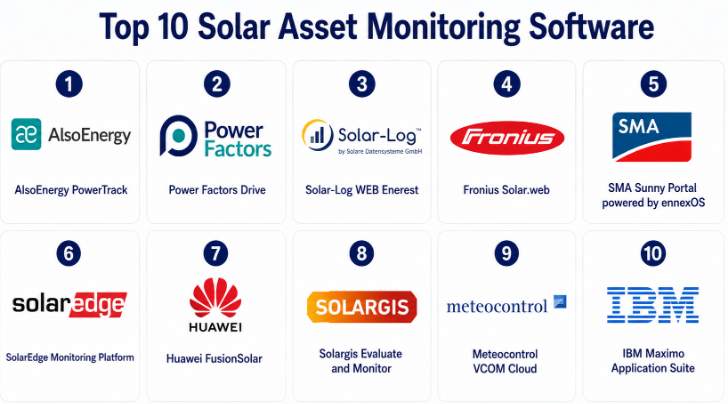
Top 10 Solar Asset Monitoring Software
#1 — AlsoEnergy PowerTrack
Short description :
AlsoEnergy PowerTrack is a solar and storage monitoring platform used by solar asset owners, EPCs, O&M teams, and renewable operators. It helps teams monitor production, manage alarms, analyze site-level performance, and report across distributed or utility-scale portfolios. The platform is especially useful for solar-heavy portfolios that need reliable operational dashboards and issue tracking. It can support commercial, industrial, and utility-scale solar monitoring workflows. AlsoEnergy PowerTrack is best for teams that need strong solar monitoring and portfolio visibility.
Key Features
- Solar and storage performance monitoring
- Real-time dashboards and site visibility
- Inverter, meter, and data acquisition integration
- Alarm management and issue tracking
- Portfolio-level reporting
- Performance analytics and trend analysis
- Support for distributed and utility-scale assets
Pros
- Strong fit for solar monitoring and O&M teams.
- Useful for multi-site solar portfolio visibility.
- Good for alarm workflows and production reporting.
Cons
- Broader commercial asset management depth should be validated.
- Best value depends on clean site data and hardware integration.
- Wind or non-solar support may be limited compared with broader renewable platforms.
Platforms / Deployment
Web
Cloud
Security & Compliance
Role-based access and cloud security controls may be available. Specific certifications are Not publicly stated here.
Integrations & Ecosystem
AlsoEnergy PowerTrack is useful when solar site data needs to be collected, visualized, and reported across many assets.
- Solar inverters
- Revenue meters
- Data acquisition systems
- Weather stations
- Storage monitoring systems
- O&M reporting workflows
Support & Community
Vendor support, onboarding, monitoring expertise, and documentation are available. Community strength is strongest among solar owners, EPCs, O&M providers, and distributed energy operators.
#2 — Power Factors Drive
Short description :
Power Factors Drive is a renewable asset management and operations platform that supports solar, wind, storage, and hybrid portfolios. For solar assets, it helps teams monitor performance, detect losses, manage alarms, coordinate maintenance, and report portfolio health. The platform is suitable for owners, operators, and O&M providers managing many assets across regions. It is especially useful for companies that need both technical performance monitoring and operational workflows in one system. Power Factors Drive is best for larger solar and renewable portfolios that require strong asset operations management.
Key Features
- Solar, wind, storage, and hybrid asset support
- Solar performance monitoring and loss analysis
- Alarm and issue management
- Work order and maintenance workflows
- Portfolio dashboards and reporting
- Availability and downtime tracking
- Integration with SCADA, meters, and operational systems
Pros
- Strong fit for large renewable portfolios.
- Combines monitoring, reporting, and operations management.
- Useful for solar owners, operators, and O&M teams.
Cons
- May be more advanced than small solar owners need.
- Implementation depends on clean data and integration quality.
- Pricing and package details are usually not publicly simple.
Platforms / Deployment
Web
Cloud
Security & Compliance
Enterprise security controls such as role-based access, audit trails, and data protection may be available. Specific certifications are Not publicly stated here.
Integrations & Ecosystem
Power Factors Drive works well when solar performance data must connect with operations, maintenance, reporting, and commercial workflows.
- SCADA and plant monitoring systems
- Inverters, meters, and sensors
- CMMS and work order systems
- ERP and financial systems
- Weather and forecasting data
- Portfolio reporting tools
Support & Community
Vendor support, onboarding, implementation services, documentation, and renewable energy expertise are available. Community strength is strongest among renewable asset owners, operators, and O&M providers.
#3 — Solar-Log WEB Enerest
Short description :
Solar-Log WEB Enerest is a solar monitoring platform used for photovoltaic system monitoring, performance tracking, and fault detection. It is useful for residential, commercial, industrial, and distributed solar portfolios depending on configuration. The platform helps users monitor energy generation, detect system issues, compare performance, and manage solar site visibility. It is especially relevant for installers, O&M providers, and owners managing many PV systems. Solar-Log WEB Enerest is best for teams that need practical solar monitoring with hardware ecosystem support.
Key Features
- PV system monitoring and dashboards
- Inverter and data logger integration
- Fault detection and alerts
- Energy generation tracking
- Portfolio monitoring for multiple systems
- Performance comparison and reporting
- Useful for installers and O&M providers
Pros
- Strong solar-specific monitoring focus.
- Useful for distributed PV system portfolios.
- Good fit for installers and service providers.
Cons
- Advanced enterprise asset management may require other tools.
- Best value may depend on Solar-Log hardware and ecosystem fit.
- Complex utility-scale analytics should be validated.
Platforms / Deployment
Web
Cloud
Security & Compliance
Not publicly stated.
Integrations & Ecosystem
Solar-Log WEB Enerest is useful when PV system data needs to be collected and monitored across multiple sites.
- Solar-Log data loggers
- Inverters
- Meters and sensors
- PV monitoring hardware
- Alert and reporting workflows
- Installer and O&M workflows
Support & Community
Vendor support, documentation, and technical resources are available. Community strength is strongest among solar installers, PV system owners, and monitoring service providers.
#4 — Fronius Solar.web
Short description :
Fronius Solar.web is a solar monitoring platform designed for users of Fronius inverters and related solar systems. It helps system owners, installers, and service providers track solar production, energy consumption, system performance, and alerts. The platform is especially useful for residential, commercial, and small-to-mid-sized solar installations using Fronius hardware. It provides clear monitoring for system health and energy performance. Fronius Solar.web is best for solar owners and installers already using the Fronius inverter ecosystem.
Key Features
- Solar production monitoring
- Fronius inverter integration
- Energy consumption and generation visibility
- System status and alerting
- Dashboard and performance history
- Installer and service provider access
- Useful for residential and commercial PV systems
Pros
- Good fit for Fronius inverter users.
- Easy solar performance visibility for owners and installers.
- Useful for basic-to-moderate solar monitoring needs.
Cons
- Best suited to Fronius ecosystem.
- Not a broad multi-vendor enterprise asset management platform.
- Advanced portfolio and financial reporting may be limited.
Platforms / Deployment
Web / iOS / Android
Cloud
Security & Compliance
Account security controls are expected. Specific certifications are Not publicly stated.
Integrations & Ecosystem
Fronius Solar.web works best when solar monitoring is tied to Fronius inverter and energy management hardware.
- Fronius inverters
- Smart meters and energy devices
- Installer workflows
- Energy consumption dashboards
- System alerts
- Mobile monitoring
Support & Community
Vendor support, documentation, installer resources, and product guidance are available. Community strength is strongest among Fronius installers, owners, and service partners.
#5 — SMA Sunny Portal powered by ennexOS
Short description :
SMA Sunny Portal powered by ennexOS is a solar monitoring and energy management platform for systems using SMA technology. It helps users monitor PV generation, energy consumption, device status, alarms, and system performance. The platform is suitable for residential, commercial, and larger solar installations depending on system design. It is especially useful for installers and asset operators managing SMA-based solar systems. SMA Sunny Portal is best for teams that want solar monitoring closely connected with SMA inverter and energy management devices.
Key Features
- PV system monitoring and visualization
- SMA inverter and device integration
- Energy generation and consumption tracking
- System alerts and status monitoring
- Performance history and reporting
- Installer and operator access
- Support for energy management workflows
Pros
- Strong fit for SMA ecosystem users.
- Useful for monitoring PV production and device status.
- Good for installers and operators managing SMA systems.
Cons
- Best suited to SMA-based systems.
- May not replace enterprise multi-vendor portfolio platforms.
- Advanced O&M workflow depth should be validated.
Platforms / Deployment
Web / Mobile access may vary
Cloud
Security & Compliance
Not publicly stated.
Integrations & Ecosystem
SMA Sunny Portal works well when solar monitoring needs to connect with SMA devices and energy management workflows.
- SMA inverters
- SMA energy management devices
- Smart meters and PV components
- Installer workflows
- Alerts and monitoring dashboards
- Energy reporting tools
Support & Community
Vendor support, documentation, installer resources, and product training are available. Community strength is strong among SMA installers and PV system owners.
#6 — SolarEdge Monitoring Platform
Short description :
SolarEdge Monitoring Platform is used to monitor solar systems built with SolarEdge inverters, optimizers, and energy devices. It provides visibility into system production, consumption, inverter status, module-level performance where supported, and alerts. The platform is useful for residential, commercial, and industrial solar systems using SolarEdge technology. It is especially valuable for installers and asset owners who need detailed performance visibility across SolarEdge sites. SolarEdge Monitoring Platform is best for SolarEdge ecosystem users who want strong device-level and site-level monitoring.
Key Features
- SolarEdge inverter and optimizer monitoring
- System production and consumption tracking
- Site-level and module-level visibility where supported
- Alerts and device status monitoring
- Installer and fleet management workflows
- Historical performance reports
- Mobile and web access
Pros
- Strong monitoring for SolarEdge-based systems.
- Useful for installers managing multiple customer sites.
- Module-level visibility can help identify performance issues where supported.
Cons
- Best suited to SolarEdge hardware ecosystem.
- Not ideal as a neutral multi-vendor monitoring platform.
- Enterprise asset management and financial workflows may require other tools.
Platforms / Deployment
Web / iOS / Android
Cloud
Security & Compliance
Account and role-based access controls may be available. Specific certifications are Not publicly stated.
Integrations & Ecosystem
SolarEdge Monitoring Platform is useful when solar assets use SolarEdge inverters, optimizers, and energy devices.
- SolarEdge inverters
- Power optimizers
- Energy meters
- Battery and EV charging devices where applicable
- Installer fleet dashboards
- Mobile monitoring workflows
Support & Community
Vendor support, installer documentation, product resources, and partner guidance are available. Community strength is strong among SolarEdge installers, owners, and service providers.
#7 — Huawei FusionSolar
Short description :
Huawei FusionSolar is a smart PV and energy management platform connected with Huawei solar inverters, optimizers, storage, and digital energy devices. It helps users monitor solar generation, system performance, device status, alerts, and energy flows. The platform is relevant for residential, commercial, industrial, and utility-scale PV systems depending on deployment. It is especially useful for projects using Huawei smart PV ecosystem. Huawei FusionSolar is best for users who want solar monitoring integrated with Huawei inverter and storage technologies.
Key Features
- Solar generation and system monitoring
- Huawei inverter and smart PV device integration
- Energy flow and storage visibility
- Alerts and device status monitoring
- Portfolio and plant-level dashboards depending on setup
- Mobile and web access
- Smart PV and energy management workflows
Pros
- Strong fit for Huawei solar ecosystem users.
- Useful for PV and storage visibility.
- Supports different solar project sizes depending on setup.
Cons
- Best value depends on Huawei hardware ecosystem fit.
- Multi-vendor neutrality should be validated.
- Regional availability and support may vary.
Platforms / Deployment
Web / iOS / Android
Cloud
Security & Compliance
Not publicly stated.
Integrations & Ecosystem
Huawei FusionSolar works best when solar monitoring is connected with Huawei smart PV and energy devices.
- Huawei inverters
- Smart PV optimizers
- Energy storage systems
- Smart meters
- Mobile monitoring workflows
- Plant and portfolio dashboards
Support & Community
Vendor support, documentation, installer resources, and partner ecosystem support are available. Community strength is strongest among Huawei solar users, installers, and project operators.
#8 — Solargis Evaluate and Monitor
Short description :
Solargis provides solar resource data, performance assessment, and monitoring-related analytics for solar projects. Its tools are useful for solar developers, asset owners, operators, and analysts who need high-quality solar resource information and performance comparison. For monitoring workflows, Solargis can help teams compare actual generation with expected solar resource conditions and identify performance gaps. It is especially relevant for technical teams focused on yield assessment and solar performance validation. Solargis is best for organizations that need strong solar resource and performance analytics rather than basic inverter monitoring.
Key Features
- Solar resource data and analytics
- Performance assessment and benchmarking
- Weather and irradiance-based analysis
- Expected vs actual production comparison
- Solar project evaluation workflows
- Portfolio performance support
- Useful for asset owners, developers, and analysts
Pros
- Strong solar resource and performance analytics.
- Useful for technical performance validation.
- Good fit for developers, investors, and asset analysts.
Cons
- Not a complete O&M work order platform.
- Not primarily an inverter-level monitoring tool.
- May need integration with operational monitoring systems.
Platforms / Deployment
Web
Cloud
Security & Compliance
Not publicly stated.
Integrations & Ecosystem
Solargis is useful when solar monitoring decisions require accurate resource data, benchmarking, and performance validation.
- Solar resource datasets
- Production and performance data
- Weather and irradiance data
- Asset analysis workflows
- Portfolio reporting
- Technical due diligence processes
Support & Community
Vendor support, documentation, solar resource expertise, and technical guidance are available. Community strength is strong among solar developers, analysts, investors, and technical asset managers.
#9 — Meteocontrol VCOM Cloud
Short description :
Meteocontrol VCOM Cloud is a solar monitoring and asset management platform for PV plants and renewable portfolios. It helps users monitor solar performance, manage alarms, analyze plant data, and support O&M workflows. The platform is especially useful for commercial, industrial, and utility-scale solar operators who need centralized monitoring across many sites. It can support technical asset management, reporting, and operational issue tracking. Meteocontrol VCOM Cloud is best for professional solar monitoring and O&M teams managing distributed PV portfolios.
Key Features
- PV plant monitoring and dashboards
- Alarm and ticket management
- Performance analysis and reporting
- Portfolio-level visibility
- Data logger, meter, inverter, and sensor integration
- O&M workflow support
- Commercial and utility-scale solar support
Pros
- Strong solar monitoring and O&M focus.
- Useful for professional PV portfolio management.
- Good fit for distributed and utility-scale solar operations.
Cons
- Broader wind or multi-technology support should be validated.
- Implementation depends on data quality and site integration.
- Commercial contract management depth may require other tools.
Platforms / Deployment
Web
Cloud
Security & Compliance
Role-based access and cloud security controls may be available. Specific certifications are Not publicly stated here.
Integrations & Ecosystem
Meteocontrol VCOM Cloud is useful when solar data needs to connect with operational monitoring, alarms, and O&M workflows.
- Inverters and meters
- Data loggers and sensors
- Weather stations
- Alarm and ticket workflows
- Reporting systems
- PV plant monitoring infrastructure
Support & Community
Vendor support, onboarding, documentation, and solar monitoring expertise are available. Community strength is strongest among PV operators, asset managers, and O&M providers.
#10 — IBM Maximo Application Suite
Short description :
IBM Maximo Application Suite is an enterprise asset management platform that can support solar asset maintenance, inspections, work orders, spare parts, and lifecycle management. It is not a solar-only monitoring platform, but it is highly relevant for large solar owners, utilities, and asset-heavy organizations that need structured maintenance governance. Solar teams can use Maximo to manage preventive maintenance, corrective work, field tasks, inventory, asset records, and reliability workflows. It is best for organizations that need enterprise maintenance management alongside solar monitoring tools.
Key Features
- Enterprise asset management
- Work order and maintenance planning
- Preventive and predictive maintenance support
- Asset lifecycle and reliability management
- Inventory and spare parts workflows
- Mobile field work support depending on setup
- Enterprise reporting and integration support
Pros
- Strong for maintenance and asset lifecycle management.
- Useful for large solar owners and utilities.
- Can support solar assets as part of wider enterprise asset operations.
Cons
- Not a solar-specific performance monitoring platform.
- Requires configuration for renewable workflows.
- May be too broad for smaller solar operators.
Platforms / Deployment
Web / Mobile options may vary
Cloud / On-premise / Hybrid options may vary
Security & Compliance
IBM enterprise security capabilities may apply depending on deployment and configuration. Specific certifications should be verified directly in the customer’s environment.
Integrations & Ecosystem
IBM Maximo is useful when solar maintenance must connect with enterprise operations, inventory, finance, and field service workflows.
- SCADA and operational systems where configured
- ERP and finance systems
- Inventory and procurement workflows
- Mobile field tools
- Reliability and asset health analytics
- Enterprise reporting systems
Support & Community
IBM provides enterprise support, documentation, implementation partners, training, and a broad asset management ecosystem. Community strength is strong among enterprise asset management and utility maintenance teams.
Comparison Table
| Tool Name | Best For | Platform(s) Supported | Deployment | Standout Feature | Public Rating |
|---|---|---|---|---|---|
| AlsoEnergy PowerTrack | Solar and storage monitoring teams | Web | Cloud | Strong solar portfolio monitoring and alarms | N/A |
| Power Factors Drive | Large renewable owners and operators | Web | Cloud | Integrated solar operations and asset management | N/A |
| Solar-Log WEB Enerest | Distributed PV monitoring and installers | Web | Cloud | Practical PV monitoring with Solar-Log ecosystem | N/A |
| Fronius Solar.web | Fronius inverter system owners | Web / iOS / Android | Cloud | Solar monitoring for Fronius-based systems | N/A |
| SMA Sunny Portal powered by ennexOS | SMA-based solar systems | Web / Mobile access varies | Cloud | PV monitoring connected with SMA devices | N/A |
| SolarEdge Monitoring Platform | SolarEdge ecosystem users | Web / iOS / Android | Cloud | Site and module-level visibility where supported | N/A |
| Huawei FusionSolar | Huawei smart PV and storage users | Web / iOS / Android | Cloud | Smart PV monitoring with Huawei ecosystem | N/A |
| Solargis Evaluate and Monitor | Solar resource and performance analysts | Web | Cloud | Solar resource and performance benchmarking | N/A |
| Meteocontrol VCOM Cloud | Professional PV O&M teams | Web | Cloud | PV monitoring, alarms, and ticket workflows | N/A |
| IBM Maximo Application Suite | Enterprise maintenance and lifecycle teams | Web / Mobile options vary | Cloud / On-premise / Hybrid | Work orders and asset lifecycle management | N/A |
Evaluation & Solar Asset Monitoring Software
| Tool Name | Core (25%) | Ease (15%) | Integrations (15%) | Security (10%) | Performance (10%) | Support (10%) | Value (15%) | Weighted Total (0–10) |
|---|---|---|---|---|---|---|---|---|
| AlsoEnergy PowerTrack | 9 | 8 | 8 | 7 | 9 | 8 | 8 | 8.25 |
| Power Factors Drive | 9 | 8 | 9 | 8 | 9 | 8 | 7 | 8.35 |
| Solar-Log WEB Enerest | 8 | 8 | 7 | 6 | 8 | 7 | 8 | 7.55 |
| Fronius Solar.web | 7 | 9 | 6 | 6 | 8 | 8 | 9 | 7.55 |
| SMA Sunny Portal powered by ennexOS | 7 | 9 | 6 | 6 | 8 | 8 | 9 | 7.55 |
| SolarEdge Monitoring Platform | 8 | 9 | 7 | 7 | 8 | 8 | 9 | 8.05 |
| Huawei FusionSolar | 8 | 8 | 7 | 6 | 8 | 8 | 8 | 7.65 |
| Solargis Evaluate and Monitor | 8 | 7 | 8 | 6 | 9 | 8 | 8 | 7.80 |
| Meteocontrol VCOM Cloud | 9 | 8 | 8 | 7 | 9 | 8 | 8 | 8.25 |
| IBM Maximo Application Suite | 8 | 7 | 9 | 9 | 8 | 9 | 7 | 8.10 |
These scores are comparative and should be used for shortlisting, not as final purchasing advice. Hardware ecosystem tools may be excellent for specific inverter brands but weaker for neutral multi-vendor portfolio management. Enterprise asset management tools may be strong for maintenance but may need integration with solar monitoring platforms. Buyers should test real site data, alarms, reports, integrations, field workflows, and security controls before choosing.
Which Solar Asset Monitoring Software Should You Choose?
Solo / Freelancer
Solo solar consultants and independent performance analysts usually need tools that help inspect production data, detect underperformance, and create clear client reports. Solargis, Solar-Log WEB Enerest, Meteocontrol VCOM Cloud, or ecosystem tools such as SolarEdge Monitoring Platform, Fronius Solar.web, and SMA Sunny Portal may be useful depending on the client’s hardware.
Freelancers working with larger solar owners should also understand Power Factors Drive, AlsoEnergy PowerTrack, and IBM Maximo, because enterprise clients may already use these tools internally.
SMB
Small and mid-sized solar operators should focus on ease of use, alarm handling, basic performance analytics, and clear reports. SolarEdge Monitoring Platform, Fronius Solar.web, SMA Sunny Portal, Solar-Log WEB Enerest, and Huawei FusionSolar can be practical depending on installed hardware.
If the SMB manages many sites or works as an O&M provider, Meteocontrol VCOM Cloud or AlsoEnergy PowerTrack may be stronger.
Mid-Market
Mid-market solar operators often need multi-site visibility, better alarm workflows, performance ratio reporting, ticketing, investor reports, and site benchmarking. AlsoEnergy PowerTrack, Meteocontrol VCOM Cloud, Power Factors Drive, Solar-Log WEB Enerest, and Solargis are strong candidates depending on needs.
A hardware-specific portfolio may use the matching ecosystem platform, but a mixed-vendor portfolio usually benefits from a more neutral monitoring or asset management platform.
Enterprise
Large solar owners, utilities, IPPs, and O&M providers should prioritize scalability, multi-vendor data integration, cybersecurity, portfolio reporting, maintenance workflows, and investor-ready reporting. Power Factors Drive, AlsoEnergy PowerTrack, Meteocontrol VCOM Cloud, Solargis, and IBM Maximo are strong enterprise candidates depending on the workflow.
Enterprise teams often use multiple systems together. For example, they may use one platform for solar monitoring, another for enterprise maintenance, and another for resource analysis or investor reporting.
Budget vs Premium
Budget-conscious buyers should first use the platform connected to their inverter ecosystem if it meets basic needs. SolarEdge Monitoring Platform, Fronius Solar.web, SMA Sunny Portal, and Huawei FusionSolar may be practical for hardware-specific monitoring.
Premium buyers with large portfolios and mixed hardware should evaluate Power Factors Drive, AlsoEnergy PowerTrack, Meteocontrol VCOM Cloud, Solargis, or IBM Maximo depending on whether the main need is monitoring, analytics, O&M, or maintenance governance.
Feature Depth vs Ease of Use
For ease of use, hardware ecosystem platforms such as SolarEdge Monitoring Platform, Fronius Solar.web, SMA Sunny Portal, and Huawei FusionSolar are often easier for owners and installers.
For feature depth, Power Factors Drive, AlsoEnergy PowerTrack, Meteocontrol VCOM Cloud, Solargis, and IBM Maximo are stronger for professional and enterprise workflows.
Integrations & Scalability
Solar monitoring software must often connect with inverters, meters, SCADA systems, weather stations, storage systems, CMMS, ERP, finance tools, and reporting dashboards. Integration quality should be tested early.
Large portfolios should prioritize platforms with strong data ingestion, clean asset hierarchy, alarm workflows, report automation, and support for mixed hardware. Smaller operators may prioritize simple dashboards and reliable alerts.
Security & Compliance Needs
Solar asset data can include production, site location, device status, maintenance records, revenue-sensitive information, and grid-connected equipment data. Buyers should ask vendors about SSO, MFA, RBAC, encryption, audit logs, data residency, backups, access reviews, and incident response.
For utility-scale and grid-connected assets, security should also be reviewed around remote access, SCADA architecture, device connectivity, and user permission design.
Frequently Asked Questions
1. What is Solar Asset Monitoring Software?
Solar Asset Monitoring Software helps teams track solar energy generation, inverter performance, alarms, site health, weather impact, and portfolio performance. It turns raw system data into dashboards, alerts, reports, and operational insights.
2. How is it different from a basic inverter app?
A basic inverter app usually shows production and device status for one system or one brand. Solar asset monitoring software is broader and may support multi-site portfolios, multiple hardware brands, alarms, reports, analytics, O&M workflows, and investor reporting.
3. Can solar monitoring software detect underperformance?
Yes, many platforms can detect underperformance by comparing actual output with expected generation, irradiance, weather data, inverter performance, and historical patterns. Accuracy depends on data quality and analytics depth.
4. Can these tools support solar-plus-storage projects?
Some tools support storage monitoring and hybrid workflows. AlsoEnergy PowerTrack, Power Factors Drive, Huawei FusionSolar, and SolarEdge Monitoring Platform may support storage depending on the system setup and hardware ecosystem.
5. How much does Solar Asset Monitoring Software cost?
Pricing varies by number of sites, installed capacity, data volume, users, hardware integrations, analytics modules, support level, and deployment type. Many professional and enterprise platforms use custom pricing.
6. What is the biggest mistake buyers make?
The biggest mistake is choosing software before checking data quality and hardware compatibility. Poor inverter data, missing meter data, weak weather data, or communication gaps can reduce the value of any monitoring platform.
7. Can this software integrate with SCADA systems?
Yes, many professional solar monitoring platforms can integrate with SCADA systems, meters, data loggers, and plant controllers. Buyers should test tag mapping, data latency, historical data import, and alarm workflows during evaluation.
8. Which software is best for small solar owners?
Small solar owners may use ecosystem platforms such as SolarEdge Monitoring Platform, Fronius Solar.web, SMA Sunny Portal, or Huawei FusionSolar depending on their hardware. These are often easier and more practical for smaller systems.
9. Which software is best for large solar portfolios?
Large portfolios may evaluate Power Factors Drive, AlsoEnergy PowerTrack, Meteocontrol VCOM Cloud, Solargis, or IBM Maximo depending on whether the priority is monitoring, analytics, O&M workflows, maintenance, or enterprise reporting.
10. Can Solar Asset Monitoring Software improve generation?
Yes, it can help identify inverter faults, string losses, soiling, shading, communication failures, downtime, and underperformance. Actual improvement depends on how quickly the team investigates and fixes the issues.
Conclusion
Solar Asset Monitoring Software is essential for organizations that need reliable visibility into solar production, inverter performance, site health, alarms, losses, and portfolio-level results. The right platform can help teams detect problems faster, reduce downtime, improve reporting, support O&M planning, and protect asset revenue. However, the best choice depends on site size, hardware ecosystem, data quality, portfolio complexity, maintenance needs, reporting expectations, and internal team maturity.
