Introduction
Renewable Asset Management Software helps owners, operators, and investors manage renewable energy assets such as solar farms, wind farms, battery storage systems, hydro assets, and hybrid energy portfolios. In simple English, it gives renewable teams one place to monitor asset performance, track maintenance, manage contracts, analyze production, control downtime, review financial performance, and report portfolio health.
Renewable energy assets need continuous monitoring because even small losses in generation, equipment availability, inverter performance, curtailment, weather impact, or maintenance delays can affect revenue. As renewable portfolios grow across multiple locations, manual spreadsheets and disconnected monitoring tools become difficult to manage.
Common use cases include:
- Solar and wind asset performance monitoring
- Battery storage and hybrid portfolio tracking
- Operations and maintenance planning
- Asset availability and downtime analysis
- Revenue, PPA, and contract performance tracking
- Work order and field service coordination
- Investor, owner, and operator reporting
- Forecasting, benchmarking, and performance analytics
Buyers should evaluate:
- Asset type support for solar, wind, storage, hydro, or hybrid portfolios
- SCADA, inverter, turbine, meter, and sensor data integrations
- Performance analytics and loss detection
- Work order and maintenance management
- Contract, PPA, and financial reporting support
- Portfolio dashboards and benchmarking
- Alerting and anomaly detection
- Mobile field team support
- Security, permissions, and audit trails
- Vendor support and implementation experience
Best for: Renewable asset owners, independent power producers, solar operators, wind operators, battery storage companies, O&M providers, infrastructure funds, energy investors, EPC firms, utilities, and portfolio managers managing multiple renewable assets.
Not ideal for: Very small owners with one basic rooftop system, teams that only need simple energy monitoring, or organizations without performance, maintenance, contract, or portfolio reporting needs.
Key Renewable Asset Management Software Trends
- Multi-technology portfolio management is becoming important as companies manage solar, wind, storage, and hybrid assets together.
- AI-assisted performance analytics is helping teams detect underperformance, inverter faults, turbine issues, curtailment losses, and abnormal production patterns.
- Battery energy storage integration is becoming more important as renewable portfolios include storage, grid services, and hybrid operations.
- Predictive maintenance is gaining value because operators want to reduce downtime and avoid expensive equipment failures.
- Revenue and contract analytics are becoming essential as asset owners track PPA terms, merchant exposure, curtailment, incentives, and settlement data.
- Centralized portfolio dashboards are needed because renewable owners often manage assets across many sites, countries, technologies, and counterparties.
- Weather-normalized performance analysis is becoming a key feature for fair comparison between sites.
- Cybersecurity and access control are more important because renewable assets are connected to grid systems, SCADA, and operational data networks.
- Integration with CMMS, ERP, SCADA, and market systems is now a major buying requirement.
- Investor-grade reporting is becoming common because renewable portfolios are often owned by funds, infrastructure investors, utilities, and lenders.
How We Selected These Tools
The tools below were selected using a practical buyer-focused evaluation approach:
- Recognized presence in renewable asset management, energy performance monitoring, O&M software, or renewable portfolio operations.
- Ability to support solar, wind, storage, or hybrid renewable assets.
- Strength in performance monitoring, analytics, maintenance workflows, reporting, and portfolio visibility.
- Suitability for asset owners, operators, O&M providers, utilities, and investors.
- Integration capability with SCADA, meters, inverters, turbines, sensors, CMMS, ERP, and financial systems.
- Support for operational decision-making, alerts, issue tracking, and downtime analysis.
- Reporting quality for owners, investors, operators, and management teams.
- Security and user permission capabilities where confidently known.
- Vendor maturity, onboarding support, documentation, and renewable energy domain knowledge.
- Balanced inclusion of enterprise platforms, solar-focused tools, wind-focused solutions, and broader asset management platforms.
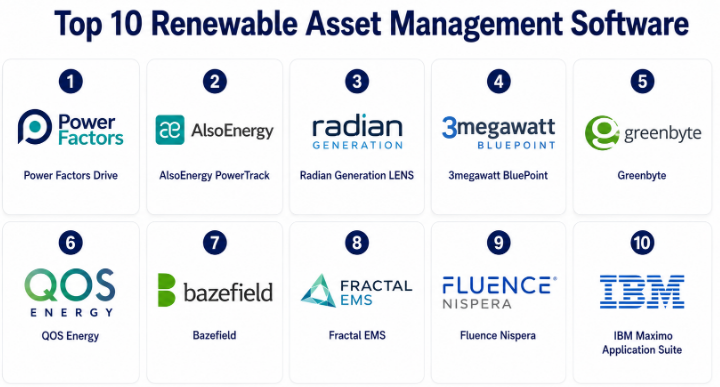
Top 10 Renewable Asset Management Software
#1 — Power Factors Drive
Short description :
Power Factors Drive is a renewable asset management platform designed for owners, operators, and O&M teams managing solar, wind, storage, and hybrid renewable portfolios. It helps teams monitor asset performance, analyze production, detect losses, manage work orders, and report portfolio health. The platform is especially useful for companies operating multiple renewable assets across regions and technologies. It supports technical, commercial, and operational workflows in one environment. Power Factors Drive is best for renewable businesses that need portfolio-level visibility and deep operational control.
Key Features
- Solar, wind, storage, and hybrid asset support
- Performance monitoring and loss analysis
- Work order and maintenance management
- Portfolio dashboards and reporting
- Alerting and issue tracking
- Revenue and contract-related insights depending on configuration
- Integration with SCADA, meters, and operational systems
Pros
- Strong fit for large renewable portfolios.
- Supports both technical performance and operational workflows.
- Useful for owners, operators, and O&M providers.
Cons
- May be more advanced than small asset owners need.
- Implementation depends on clean operational and SCADA data.
- Pricing and detailed package structure are usually not publicly simple.
Platforms / Deployment
Web
Cloud
Security & Compliance
Enterprise security controls such as role-based access, audit trails, and data protection may be available. Specific certifications are Not publicly stated here and should be verified directly.
Integrations & Ecosystem
Power Factors Drive works well when renewable asset data must connect with monitoring, maintenance, financial, and reporting workflows.
- SCADA and plant monitoring systems
- Inverters, meters, and turbine data
- CMMS and work order systems
- ERP and financial systems
- Weather and forecasting data
- Portfolio reporting tools
Support & Community
Vendor support, onboarding, implementation services, documentation, and renewable energy expertise are available. Community strength is strongest among renewable asset owners, operators, and O&M teams.
#2 — AlsoEnergy PowerTrack
Short description :
AlsoEnergy PowerTrack is a renewable energy monitoring and asset management platform widely used for solar and energy storage portfolios. It helps users monitor production, track performance, manage alarms, analyze site-level issues, and report asset performance. The platform is suitable for commercial, industrial, utility-scale solar, and storage operators. It is especially useful for teams that need reliable monitoring and operational dashboards across many distributed assets. AlsoEnergy PowerTrack is best for solar-heavy renewable portfolios that need strong monitoring and performance visibility.
Key Features
- Solar and storage performance monitoring
- Real-time dashboards and alerts
- Site and portfolio-level analytics
- Alarm management and issue tracking
- Reporting for owners and operators
- Integration with inverters, meters, and data acquisition systems
- Support for distributed and utility-scale assets
Pros
- Strong fit for solar monitoring and asset visibility.
- Useful for O&M teams managing many sites.
- Good for performance reporting and alarm workflows.
Cons
- Wind and broader multi-technology depth should be validated.
- Best value may depend on monitoring hardware and data setup.
- Advanced commercial asset management may require additional tools.
Platforms / Deployment
Web
Cloud
Security & Compliance
Role-based access and cloud security controls may be available. Specific certifications are Not publicly stated here.
Integrations & Ecosystem
AlsoEnergy PowerTrack is useful when solar and storage data must be collected, visualized, and reported across many assets.
- Solar inverters and meters
- Data acquisition systems
- Weather stations
- Storage monitoring systems
- Alarm and reporting workflows
- O&M dashboards
Support & Community
Vendor support, onboarding, monitoring expertise, and documentation are available. Community strength is strongest among solar owners, EPCs, O&M providers, and distributed energy operators.
#3 — Radian Generation LENS
Short description :
Radian Generation LENS is a renewable asset management platform designed for asset owners, investors, and operators who need technical, financial, and contract visibility across renewable portfolios. It helps teams manage documents, compliance obligations, contracts, project data, financial records, tasks, and performance-related information. The platform is especially useful for renewable asset managers who need more than production monitoring. It is best for teams managing portfolio administration, compliance, reporting, and commercial asset management workflows.
Key Features
- Renewable asset and portfolio data management
- Contract, document, and compliance tracking
- Task and obligation management
- Reporting for asset owners and investors
- Financial and operational data organization
- Portfolio-level dashboards
- Support for solar, wind, and storage assets depending on configuration
Pros
- Strong for commercial and administrative asset management.
- Useful for investors and asset managers.
- Helps reduce spreadsheet and document fragmentation.
Cons
- Not primarily a SCADA or real-time monitoring platform.
- Technical performance analytics may require integration with monitoring tools.
- Value depends on disciplined data and document management.
Platforms / Deployment
Web
Cloud
Security & Compliance
Enterprise controls such as permissions and document access controls may be available. Specific certifications are Not publicly stated here.
Integrations & Ecosystem
Radian Generation LENS is useful when asset management requires organized contracts, compliance data, reporting, and portfolio governance.
- Performance monitoring data sources
- Document management workflows
- Financial and accounting data
- Compliance tracking workflows
- Investor and owner reporting
- Task and obligation management
Support & Community
Vendor support, onboarding, asset management guidance, and documentation are available. Community strength is strongest among renewable asset managers, owners, and investors.
#4 — 3megawatt BluePoint
Short description :
3megawatt BluePoint is renewable asset management software focused on solar, wind, and storage portfolio management. It helps renewable energy teams manage contracts, tasks, documents, reporting, operations, and financial workflows. The platform is designed for asset managers who need visibility across projects and counterparties. It is especially useful for teams managing compliance obligations, maintenance coordination, revenue documents, and portfolio reporting. BluePoint is best for renewable asset management teams that need structured commercial and operational workflows.
Key Features
- Renewable portfolio management
- Contract and document tracking
- Task and workflow management
- Financial and operational reporting
- Compliance and obligation tracking
- Solar, wind, and storage asset support
- Centralized portfolio dashboards
Pros
- Good fit for renewable asset managers.
- Useful for contracts, tasks, documents, and reporting.
- Helps organize portfolio-level administration.
Cons
- Not a deep real-time SCADA monitoring platform.
- Advanced technical analytics may require integrations.
- Best suited for structured asset management teams.
Platforms / Deployment
Web
Cloud
Security & Compliance
Role-based access and cloud security controls may be available. Specific certifications are Not publicly stated here.
Integrations & Ecosystem
BluePoint works well when renewable asset teams need to organize commercial, operational, and reporting data.
- Financial and accounting workflows
- Monitoring data imports
- Document management
- Compliance workflows
- Task management
- Portfolio reporting
Support & Community
Vendor support, onboarding, documentation, and renewable asset management guidance are available. Community strength is strongest among solar, wind, and storage asset managers.
#5 — Greenbyte
Short description :
Greenbyte is a renewable energy monitoring and analytics platform focused on wind and solar asset performance. It helps operators collect operational data, analyze production, monitor availability, manage alarms, and report performance across renewable portfolios. The platform is especially useful for technical teams that need clean operational insights from turbines, inverters, meters, and SCADA systems. Greenbyte is best for renewable operators who need performance analytics across wind and solar assets. It is more technical and operational than document-focused asset management tools.
Key Features
- Wind and solar performance monitoring
- SCADA data integration and analytics
- Availability and production tracking
- Alarm and event management
- Portfolio-level dashboards
- Performance reporting
- Benchmarking and operational insights
Pros
- Strong fit for wind and solar performance analytics.
- Useful for technical operations teams.
- Helps identify underperformance and operational issues.
Cons
- Commercial contract management depth may be limited.
- Implementation depends on data quality from SCADA and monitoring systems.
- Not ideal for teams needing only document and compliance management.
Platforms / Deployment
Web
Cloud
Security & Compliance
Cloud access controls and role-based permissions may be available. Specific certifications are Not publicly stated here.
Integrations & Ecosystem
Greenbyte is useful when renewable operational data must be turned into performance insights and actionable reports.
- SCADA systems
- Wind turbine data
- Solar inverter and meter data
- Weather data
- Alarm systems
- Performance reporting workflows
Support & Community
Vendor support, onboarding, documentation, and renewable performance analytics expertise are available. Community strength is strongest among wind and solar operators.
#6 — QOS Energy
Short description :
QOS Energy provides renewable energy monitoring and analytics software for solar, wind, storage, and energy portfolios. It helps teams collect data from plants, monitor performance, detect issues, analyze losses, and generate reports. The platform is especially useful for technical asset managers and O&M teams managing distributed renewable assets. It supports operational analytics and portfolio performance visibility. QOS Energy is best for renewable teams focused on data-driven performance monitoring and operational efficiency.
Key Features
- Renewable energy monitoring and analytics
- Solar, wind, and storage asset support depending on setup
- Performance dashboards and loss analysis
- Alarm and event management
- Data acquisition and integration support
- Reporting and benchmarking
- Portfolio performance tracking
Pros
- Strong for renewable performance analytics.
- Useful for distributed and multi-site portfolios.
- Good fit for O&M and technical asset management teams.
Cons
- Commercial asset management features should be validated.
- Data quality depends on integrations and plant systems.
- May require setup effort for complex portfolios.
Platforms / Deployment
Web
Cloud
Security & Compliance
Role-based access and cloud controls may be available. Specific certifications are Not publicly stated here.
Integrations & Ecosystem
QOS Energy works well when renewable operations data must connect with dashboards, analytics, and O&M workflows.
- SCADA and monitoring systems
- Solar inverters and meters
- Wind turbine data
- Storage monitoring data
- Weather and forecast data
- Reporting tools
Support & Community
Vendor support, onboarding, technical services, and documentation are available. Community strength is strongest among renewable O&M and performance management teams.
#7 — Bazefield
Short description :
Bazefield is a renewable energy operations management platform used for wind, solar, hydro, storage, and other renewable assets. It helps operators monitor performance, manage alarms, analyze production, and coordinate operational activities. The platform is suitable for asset owners and operators managing diverse renewable portfolios. It is especially useful where teams need operational visibility across multiple technologies and sites. Bazefield is best for renewable operators that need a flexible operations platform for multi-technology portfolios.
Key Features
- Multi-technology renewable operations support
- Wind, solar, hydro, and storage monitoring
- Alarm and event management
- Performance dashboards and analytics
- Production and availability tracking
- Operational reporting
- Portfolio-level visibility
Pros
- Strong fit for multi-technology renewable portfolios.
- Useful for operations teams managing many assets.
- Good for monitoring and performance visibility.
Cons
- Commercial contract and finance workflows should be validated.
- Implementation depends on asset data integrations.
- May be more operational than investor-reporting focused.
Platforms / Deployment
Web
Cloud / Hosted options may vary
Security & Compliance
Enterprise access controls may be available. Specific certifications are Not publicly stated here.
Integrations & Ecosystem
Bazefield is useful when renewable operators need to connect operational data from different asset types and technologies.
- SCADA systems
- Wind, solar, hydro, and storage data
- Weather and forecast sources
- Alarm systems
- Reporting and analytics tools
- O&M workflows
Support & Community
Vendor support, implementation guidance, documentation, and renewable operations expertise are available. Community strength is strongest among renewable energy operators and portfolio teams.
#8 — Fractal EMS
Short description :
Fractal EMS is focused on energy storage and hybrid renewable asset control, monitoring, and optimization. It is especially relevant for battery energy storage systems, hybrid solar-plus-storage projects, and grid-connected storage portfolios. The platform helps teams manage battery performance, dispatch, operations, alarms, and system visibility. It is useful for asset owners, storage operators, and developers managing complex storage operations. Fractal EMS is best for organizations where battery storage is central to the renewable asset strategy.
Key Features
- Battery energy storage monitoring and control
- Hybrid renewable asset support
- Dispatch and operational visibility
- Alarm and event management
- Performance and availability tracking
- Grid services and storage operations support depending on setup
- Reporting and asset performance insights
Pros
- Strong focus on battery storage operations.
- Useful for hybrid renewable portfolios.
- Good fit for storage owners, operators, and developers.
Cons
- Not a general renewable document management platform.
- Solar or wind-only portfolios may not need storage-focused depth.
- Integration with market, SCADA, and controls should be validated carefully.
Platforms / Deployment
Web / Control environment options may vary
Cloud / On-premise / Hybrid options may vary
Security & Compliance
Operational security controls may be available depending on deployment. Specific certifications are Not publicly stated here.
Integrations & Ecosystem
Fractal EMS is useful when storage operations must connect with asset controls, market operations, and renewable plant systems.
- Battery management systems
- SCADA and plant controls
- Market and dispatch systems
- Solar and hybrid plant data
- Grid interconnection systems
- Reporting and analytics workflows
Support & Community
Vendor support, implementation guidance, technical documentation, and storage operations expertise are available. Community strength is strongest among battery energy storage and hybrid project teams.
#9 — Fluence Nispera
Short description :
Fluence Nispera is a renewable energy performance management platform focused on solar, wind, hydro, and storage assets. It helps operators monitor renewable portfolios, detect underperformance, analyze losses, and improve asset performance. The platform is useful for owners, operators, and asset managers who need advanced analytics across different renewable technologies. It is especially relevant for teams managing large operational portfolios with multiple asset types. Nispera is best for renewable operators focused on performance analytics and portfolio optimization.
Key Features
- Renewable performance monitoring and analytics
- Solar, wind, hydro, and storage support
- Loss detection and performance benchmarking
- Portfolio dashboards and reporting
- Anomaly detection and operational insights
- Asset availability and production analysis
- Multi-technology data integration
Pros
- Strong multi-technology performance analytics.
- Useful for portfolio-level optimization.
- Good fit for asset owners and operators.
Cons
- Commercial contract workflows should be validated.
- Data integration quality is critical for performance insights.
- May be more analytics-focused than maintenance-workflow focused.
Platforms / Deployment
Web
Cloud
Security & Compliance
Enterprise access controls may be available. Specific certifications are Not publicly stated here.
Integrations & Ecosystem
Fluence Nispera is useful when renewable performance data must be integrated, analyzed, and reported across a diverse portfolio.
- SCADA systems
- Solar, wind, hydro, and storage data
- Weather and forecasting data
- Portfolio reporting tools
- Alarm and event workflows
- Performance analytics systems
Support & Community
Vendor support, onboarding, documentation, and renewable analytics expertise are available. Community strength is strongest among renewable portfolio owners and operators.
#10 — IBM Maximo Application Suite
Short description :
IBM Maximo Application Suite is an enterprise asset management platform that can support renewable asset maintenance, reliability, inspections, work orders, and lifecycle management. While it is not only built for renewable energy, it is relevant for companies that need robust maintenance and asset management across renewable plants, substations, storage assets, and grid-connected equipment. The platform is useful for large utilities, energy companies, and asset-heavy organizations. It helps teams manage preventive maintenance, spare parts, inspections, reliability, and asset health. IBM Maximo is best for organizations that need enterprise asset management beyond renewable performance monitoring alone.
Key Features
- Enterprise asset management
- Work order and maintenance planning
- Preventive and predictive maintenance support
- Asset lifecycle and reliability management
- Inventory and spare parts workflows
- Mobile field work support depending on setup
- Integration with operational and enterprise systems
Pros
- Strong for maintenance and asset lifecycle management.
- Useful for large utilities and asset-heavy renewable operators.
- Can support renewable assets as part of a wider enterprise asset strategy.
Cons
- Not a renewable-only performance monitoring platform.
- Requires configuration for renewable-specific workflows.
- May be too broad for smaller renewable asset owners.
Platforms / Deployment
Web / Mobile options may vary
Cloud / On-premise / Hybrid options may vary
Security & Compliance
IBM enterprise security capabilities may apply depending on deployment and configuration. Specific certifications should be verified directly in the customer’s environment.
Integrations & Ecosystem
IBM Maximo is useful when renewable asset maintenance must connect with enterprise operations, inventory, finance, and field teams.
- SCADA and operational systems where configured
- ERP and finance systems
- Inventory and procurement workflows
- Mobile field work tools
- Reliability and asset health analytics
- Enterprise reporting systems
Support & Community
IBM provides enterprise support, documentation, implementation partners, training, and a broad asset management ecosystem. Community strength is strong among enterprise asset management and utility maintenance teams.
Comparison Table
| Tool Name | Best For | Platform(s) Supported | Deployment | Standout Feature | Public Rating |
|---|---|---|---|---|---|
| Power Factors Drive | Large renewable owners and operators | Web | Cloud | Multi-technology renewable asset operations | N/A |
| AlsoEnergy PowerTrack | Solar and storage monitoring teams | Web | Cloud | Strong solar portfolio monitoring | N/A |
| Radian Generation LENS | Renewable asset managers and investors | Web | Cloud | Commercial asset management and reporting | N/A |
| 3megawatt BluePoint | Solar, wind, and storage asset managers | Web | Cloud | Contract, task, and portfolio management | N/A |
| Greenbyte | Wind and solar performance teams | Web | Cloud | Renewable performance analytics | N/A |
| QOS Energy | Renewable O&M and performance teams | Web | Cloud | Multi-site monitoring and analytics | N/A |
| Bazefield | Multi-technology renewable operators | Web | Cloud / Hosted options vary | Operations management across renewable technologies | N/A |
| Fractal EMS | Battery storage and hybrid asset operators | Web / Control options vary | Cloud / On-premise / Hybrid options vary | Storage control and operational visibility | N/A |
| Fluence Nispera | Renewable portfolio performance optimization | Web | Cloud | Multi-technology performance intelligence | N/A |
| IBM Maximo Application Suite | Enterprise maintenance and asset lifecycle teams | Web / Mobile options vary | Cloud / On-premise / Hybrid options vary | Enterprise asset and maintenance management | N/A |
Evaluation & Renewable Asset Management Software
| Tool Name | Core (25%) | Ease (15%) | Integrations (15%) | Security (10%) | Performance (10%) | Support (10%) | Value (15%) | Weighted Total (0–10) |
|---|---|---|---|---|---|---|---|---|
| Power Factors Drive | 9 | 8 | 9 | 8 | 9 | 8 | 7 | 8.35 |
| AlsoEnergy PowerTrack | 8 | 8 | 8 | 7 | 8 | 8 | 8 | 7.95 |
| Radian Generation LENS | 8 | 8 | 7 | 7 | 8 | 8 | 8 | 7.75 |
| 3megawatt BluePoint | 8 | 8 | 7 | 7 | 8 | 8 | 8 | 7.75 |
| Greenbyte | 8 | 8 | 8 | 7 | 9 | 8 | 8 | 8.05 |
| QOS Energy | 8 | 8 | 8 | 7 | 8 | 8 | 8 | 7.95 |
| Bazefield | 8 | 8 | 8 | 7 | 8 | 8 | 8 | 7.95 |
| Fractal EMS | 8 | 7 | 8 | 7 | 9 | 8 | 7 | 7.80 |
| Fluence Nispera | 9 | 8 | 8 | 8 | 9 | 8 | 7 | 8.30 |
| IBM Maximo Application Suite | 8 | 7 | 9 | 9 | 8 | 9 | 7 | 8.10 |
These scores are comparative and should be used for shortlisting, not as final purchasing advice. A performance analytics platform may score highly for technical monitoring but may not replace a commercial asset management system. A maintenance platform may be strong for work orders but may need integration with SCADA or renewable monitoring tools. Buyers should validate asset type coverage, data integrations, reporting needs, security controls, and total cost before choosing.
Which Renewable Asset Management Software Should You Choose?
Solo / Freelancer
Solo renewable consultants and independent asset advisors usually need tools that help organize reports, analyze performance, and support client communication. Radian Generation LENS, 3megawatt BluePoint, Greenbyte, or QOS Energy may be relevant depending on the client’s asset type and data access.
Consultants working with large owners should also understand platforms such as Power Factors Drive, Fluence Nispera, and IBM Maximo, because enterprise clients may already use these systems internally.
SMB
Small and mid-sized renewable owners should focus on ease of use, cost, reporting, and operational clarity. AlsoEnergy PowerTrack, 3megawatt BluePoint, QOS Energy, and Radian Generation LENS can be practical depending on whether the priority is performance monitoring, asset administration, or reporting.
SMBs should avoid overbuying. A large enterprise system can be powerful, but it may create unnecessary complexity if the portfolio is still small.
Mid-Market
Mid-market renewable operators often need stronger portfolio dashboards, performance analytics, maintenance workflows, investor reporting, and data integrations. Power Factors Drive, Greenbyte, QOS Energy, Bazefield, Radian Generation LENS, and Fluence Nispera can all be strong candidates.
A solar-heavy company may prefer AlsoEnergy PowerTrack or Power Factors Drive. A wind and solar operator may evaluate Greenbyte, Bazefield, or Fluence Nispera. A commercial asset manager may prefer Radian Generation LENS or 3megawatt BluePoint.
Enterprise
Large renewable owners, utilities, infrastructure funds, and IPPs should prioritize scalability, multi-technology support, integrations, security, reporting, maintenance workflows, and portfolio benchmarking. Power Factors Drive, Fluence Nispera, Bazefield, IBM Maximo, and Greenbyte are strong enterprise candidates depending on use case.
Enterprise buyers should test SCADA integrations, data quality, maintenance workflows, asset hierarchy, user permissions, investor reports, financial reporting, and support for future storage and hybrid assets.
Budget vs Premium
Budget-conscious buyers should focus on the most urgent operational pain. If the need is solar monitoring, AlsoEnergy PowerTrack may be practical. If the need is commercial asset organization, 3megawatt BluePoint or Radian Generation LENS may be useful.
Premium buyers managing large, multi-technology portfolios may prefer Power Factors Drive, Fluence Nispera, Bazefield, or IBM Maximo depending on whether the main priority is performance, operations, maintenance, or enterprise asset lifecycle management.
Feature Depth vs Ease of Use
For feature depth, Power Factors Drive, Fluence Nispera, Bazefield, Greenbyte, and IBM Maximo are stronger because they support larger operational or enterprise asset environments.
For ease of use and focused asset management, Radian Generation LENS, 3megawatt BluePoint, AlsoEnergy PowerTrack, and QOS Energy may be more approachable depending on the team’s needs.
Integrations & Scalability
Renewable asset platforms must often integrate with SCADA, inverters, turbines, meters, weather systems, CMMS, ERP, finance tools, market systems, and investor reporting workflows. Integration quality should be tested early.
Large integration-heavy organizations may prefer Power Factors Drive, Fluence Nispera, IBM Maximo, or Bazefield. Solar-focused organizations may prioritize AlsoEnergy PowerTrack. Storage-heavy operators should evaluate Fractal EMS carefully.
Security & Compliance Needs
Renewable asset data can include operational performance, grid-connected equipment data, financial reports, contracts, and investor information. Buyers should ask vendors about SSO, MFA, RBAC, encryption, audit logs, data residency, backups, access reviews, and incident response.
For grid-connected and storage assets, security should be evaluated together with operational controls, remote access, SCADA architecture, control permissions, and vendor support practices.
Frequently Asked Questions
1. What is Renewable Asset Management Software?
Renewable Asset Management Software helps owners and operators manage renewable energy assets such as solar, wind, hydro, storage, and hybrid projects. It can support performance monitoring, maintenance, contracts, reporting, compliance, and portfolio management.
2. How is it different from solar monitoring software?
Solar monitoring software mainly tracks production, inverter performance, alarms, and site-level energy data. Renewable asset management software is broader because it may include contracts, maintenance, financial reporting, compliance, documents, and portfolio governance.
3. Can these platforms manage both solar and wind assets?
Yes, many platforms support both solar and wind, but depth varies. Tools like Power Factors Drive, Greenbyte, Bazefield, QOS Energy, and Fluence Nispera are more relevant for multi-technology renewable portfolios.
4. Can these tools support battery storage assets?
Some platforms support storage and hybrid projects. Fractal EMS is especially focused on battery storage operations, while Power Factors Drive, Fluence Nispera, Bazefield, and QOS Energy may support storage depending on configuration.
5. How much does Renewable Asset Management Software cost?
Pricing varies by asset count, installed capacity, users, modules, data volume, integrations, support level, and portfolio complexity. Many vendors use custom pricing for larger renewable portfolios.
6. What is the biggest mistake buyers make?
The biggest mistake is choosing software before defining the main use case. Performance monitoring, commercial asset management, maintenance management, and investor reporting are different needs and may require different platforms.
7. Can this software reduce energy losses?
Yes, performance-focused platforms can help detect underperformance, downtime, inverter issues, turbine faults, curtailment, and abnormal production patterns. However, actual improvement depends on data quality and how quickly teams act on insights.
8. Can Renewable Asset Management Software integrate with SCADA?
Many platforms can integrate with SCADA or plant monitoring systems. Buyers should test data quality, tag mapping, latency, availability calculations, alarm handling, and reporting outputs during evaluation.
9. Which platform is best for solar operators?
Solar-heavy operators may evaluate AlsoEnergy PowerTrack, Power Factors Drive, QOS Energy, Greenbyte, or Fluence Nispera. The best choice depends on portfolio size, monitoring needs, reporting requirements, and O&M workflows.
10. Which platform is best for wind operators?
Wind operators may evaluate Greenbyte, Bazefield, Power Factors Drive, QOS Energy, or Fluence Nispera. The best platform should support turbine data, availability analysis, alarm workflows, weather normalization, and portfolio benchmarking.
Conclusion
Renewable Asset Management Software is essential for organizations that manage solar, wind, storage, hydro, or hybrid renewable energy portfolios. The right platform can improve performance visibility, reduce downtime, support maintenance planning, organize contracts, strengthen reporting, and help asset owners make better operational and financial decisions. However, the best platform depends on portfolio size, asset technology, data quality, reporting needs, maintenance workflows, integration requirements, and team maturity.
