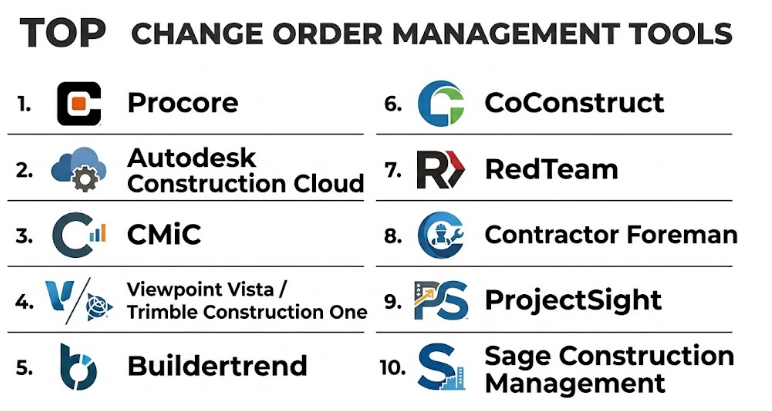
Introduction
Change Order Management Tools help construction teams create, review, approve, track, and document changes to the original project scope, cost, or schedule. In simple words, these tools help contractors, owners, project managers, subcontractors, and finance teams manage project changes in a controlled and transparent way.
Change orders are common in construction because project conditions often change after work begins. Design revisions, owner requests, material changes, site conditions, labor adjustments, missing scope, code requirements, delays, and subcontractor changes can all affect cost and timeline. Without a proper change order system, teams may lose track of approvals, miss cost impacts, delay billing, or face disputes later.
Common use cases include change request tracking, cost impact management, subcontractor change orders, owner change approvals, budget updates, scope changes, delay claims, contract revisions, field change documentation, and project financial control.
Buyers should evaluate approval workflows, budget integration, cost tracking, document attachments, subcontractor collaboration, audit history, version control, mobile access, permissions, notifications, reporting, contract management, accounting integration, and ease of use.
Best for: general contractors, subcontractors, construction project managers, owners, developers, commercial contractors, residential builders, infrastructure teams, construction finance teams, cost controllers, and companies that manage frequent scope or cost changes.
Not ideal for: very small projects with minimal change activity, teams that only need simple email approvals, or companies that already manage small change requests effectively through basic spreadsheets and signed documents.
Key Trends in Change Order Management Tools
- Digital approval workflows are becoming standard, helping teams avoid slow email chains and unclear approval status.
- Change orders are becoming more connected to project budgets, allowing teams to see how each approved change affects cost, margin, contingency, and forecast.
- Field-to-office change capture is becoming important, because many changes start on-site and must be documented quickly with photos, notes, and supporting evidence.
- Subcontractor collaboration is becoming more structured, helping general contractors receive, review, compare, and approve subcontractor change requests more efficiently.
- Real-time cost visibility is now expected, especially when owners and contractors need to understand budget impact before approving changes.
- Document control is becoming critical, because change orders often require drawings, RFIs, site instructions, photos, emails, specifications, and contract references.
- Mobile access is becoming more useful, allowing project managers and site teams to review or submit change information from the field.
- Integration with accounting and ERP systems is growing, so approved changes can flow into job cost, billing, commitments, and financial reporting.
- Audit trails are becoming more important, especially when disputes arise around who requested, reviewed, approved, or rejected a change.
- AI-assisted contract and change review is emerging, helping teams summarize change impacts, compare documents, and identify missing approval details.
How We Selected These Tools
The tools below were selected using practical construction-focused evaluation logic.
- Market recognition: Tools known in construction management, project financials, contract control, and change order workflows were prioritized.
- Feature completeness: Change requests, owner change orders, subcontractor changes, approval routing, budget updates, and documentation were reviewed.
- Financial control: Tools that connect change orders with budgets, commitments, cost codes, forecasts, and accounting workflows were given stronger consideration.
- Ease of use: Project managers, finance teams, and subcontractors should be able to use the system without unnecessary complexity.
- Collaboration: Owner, contractor, subcontractor, and consultant communication workflows were considered important.
- Document support: Attachments, drawings, RFIs, photos, contracts, and supporting documentation were reviewed.
- Security and governance: Role-based access, approval permissions, audit trails, and project-level controls were considered.
- Integration ecosystem: Accounting, ERP, estimating, document control, scheduling, and construction project management integrations were evaluated.
- Scalability: Tools suitable for residential builders, commercial contractors, large enterprises, and capital project owners were included.
Top 10 Change Order Management Tools
#1 — Procore
Short description :
Procore is a widely used construction management platform that includes strong change order management capabilities for contractors, owners, and project teams. It helps teams manage change events, potential change orders, prime contract change orders, commitment change orders, budget impacts, approvals, and supporting documents. Procore is useful for construction companies that need change orders connected with project financials, RFIs, documents, submittals, drawings, and field workflows. It supports structured collaboration between project teams, subcontractors, and owners. It is best for mid-market and enterprise construction teams that need change control inside a broad project management platform.
Key Features
- Change event tracking.
- Potential change order management.
- Prime contract change orders.
- Commitment change orders.
- Budget impact visibility.
- Approval workflows and status tracking.
- Attachments, documentation, and audit records.
Pros
- Strong construction-specific change order workflows.
- Connects change orders with budgets and project financials.
- Good for large teams and multi-project environments.
Cons
- May be more than small contractors need.
- Implementation requires proper cost code and workflow setup.
- Pricing may be higher than lightweight tools.
Platforms / Deployment
Web / iOS / Android
Cloud
Security & Compliance
Supports role-based permissions, project access controls, approval history, document controls, and administrative governance depending on plan. Specific compliance details should be validated directly with the vendor.
Integrations & Ecosystem
Procore connects change order workflows with broader construction operations.
- Project financials.
- Budget management.
- RFIs and submittals.
- Drawing and document control.
- Accounting integrations.
- Field reporting workflows.
Support & Community
Procore provides onboarding, documentation, training resources, customer support, and a large construction technology ecosystem. It is suitable for teams that need a mature platform for change order control.
#2 — Autodesk Construction Cloud
Short description :
Autodesk Construction Cloud supports change order and cost management workflows through its construction project management, document control, and cost modules. It helps teams manage change requests, budget impacts, contracts, cost items, approvals, and supporting documentation. Autodesk Construction Cloud is useful for contractors, owners, architects, engineers, and project teams that need change management connected with drawings, BIM, RFIs, issues, and project records. It is especially useful for teams already working in Autodesk design and construction workflows. It is best for organizations that want change control connected with design, documentation, and cost visibility.
Key Features
- Change request tracking.
- Cost impact management.
- Contract and budget workflow support.
- Issue and RFI connection.
- Document and drawing attachments.
- Approval workflow support.
- Project reporting and dashboards.
Pros
- Strong connection with drawings, design, and BIM workflows.
- Useful for cost and document-connected change management.
- Good for teams already using Autodesk construction tools.
Cons
- Some features depend on selected modules.
- May require setup planning for cost workflows.
- Teams not using Autodesk tools may face a learning curve.
Platforms / Deployment
Web / iOS / Android
Cloud
Security & Compliance
Supports project permissions, document access controls, activity tracking, and enterprise administration depending on plan. Specific compliance details should be validated directly with the vendor.
Integrations & Ecosystem
Autodesk Construction Cloud connects change orders with design and construction workflows.
- BIM coordination.
- Drawing management.
- Document control.
- Cost management.
- RFIs and issues.
- Project analytics.
Support & Community
Autodesk provides documentation, training resources, support, and a large architecture, engineering, and construction ecosystem.
#3 — CMiC
Short description :
CMiC is an enterprise construction ERP and project management platform that supports change order management, contract control, accounting, job cost, procurement, payroll, document management, and reporting. It helps construction companies manage changes from project initiation through financial posting and reporting. CMiC is especially useful for larger contractors that need change orders deeply connected with accounting, commitments, budgets, and enterprise workflows. It is best for construction companies that need change order control inside an integrated construction ERP environment.
Key Features
- Change order management.
- Contract and commitment workflows.
- Job cost integration.
- Budget updates and financial tracking.
- Document and workflow management.
- Project accounting connection.
- Enterprise reporting.
Pros
- Strong construction ERP and financial control.
- Useful for contractors needing project-to-accounting integration.
- Good for enterprise-level change governance.
Cons
- Implementation can be complex.
- May be too heavy for small contractors.
- Requires training and process discipline.
Platforms / Deployment
Web / Mobile options may vary
Cloud / Enterprise deployment options may vary
Security & Compliance
Supports enterprise permissions, financial controls, user roles, audit records, and administrative governance depending on deployment and configuration.
Integrations & Ecosystem
CMiC connects change orders with construction business operations.
- Construction accounting.
- Job costing.
- Procurement workflows.
- Contract management.
- Document control.
- Enterprise reporting.
Support & Community
CMiC provides implementation services, documentation, customer support, and enterprise construction workflow guidance.
#4 — Viewpoint Vista / Trimble Construction One
Short description :
Viewpoint Vista and Trimble Construction One support construction accounting, project management, document control, job cost, change orders, contracts, and field-to-office workflows. These tools are useful for contractors that need change order management connected with financial control and construction operations. They help teams track scope changes, update budgets, manage approvals, and connect project changes to accounting workflows. It is best for contractors that need construction ERP, job cost control, and change order management in one connected environment.
Key Features
- Change order tracking.
- Job cost and budget integration.
- Contract management.
- Project document control.
- Approval workflows.
- Field-to-office collaboration.
- Construction accounting connection.
Pros
- Strong construction accounting and ERP alignment.
- Useful for contractors needing job cost visibility.
- Helps connect project changes with financial workflows.
Cons
- Implementation may require planning and training.
- Module fit should be reviewed carefully.
- Smaller teams may prefer simpler tools.
Platforms / Deployment
Web / Mobile options may vary
Cloud / Enterprise deployment options vary
Security & Compliance
Supports user roles, financial controls, project permissions, audit records, and administrative governance depending on configuration. Specific compliance details should be validated directly with the vendor.
Integrations & Ecosystem
Trimble construction tools connect change orders with project and financial workflows.
- Job cost management.
- Construction accounting.
- Project management.
- Document control.
- Field workflows.
- Reporting systems.
Support & Community
Trimble provides documentation, implementation services, support resources, and construction industry guidance.
#5 — Buildertrend
Short description :
Buildertrend is construction management software designed mainly for residential builders, remodelers, and specialty contractors. It helps teams manage estimates, schedules, client communication, selections, invoices, payments, and change orders. Buildertrend is useful when owners or clients request changes during residential projects and builders need clear approvals, pricing, and documentation. It helps reduce misunderstandings by keeping change details and communication organized. It is best for home builders and remodelers that need change order management connected with client communication and job management.
Key Features
- Change order creation.
- Client approvals.
- Cost and price updates.
- Project scheduling support.
- Estimates and proposals.
- Client communication portal.
- Mobile project access.
Pros
- Strong fit for residential construction.
- Good client-facing approval workflows.
- Helps builders document scope and pricing changes clearly.
Cons
- Less suited for large commercial construction programs.
- Advanced enterprise financial controls may be limited.
- Best value depends on residential workflow needs.
Platforms / Deployment
Web / iOS / Android
Cloud
Security & Compliance
Supports project permissions, client access controls, document management, and administrative features depending on plan. Specific security details should be validated directly with the vendor.
Integrations & Ecosystem
Buildertrend connects change orders with residential construction workflows.
- Client communication.
- Estimates and proposals.
- Scheduling.
- Invoicing and payments.
- Selections.
- Job management.
Support & Community
Buildertrend provides onboarding, training resources, documentation, and customer support for residential construction teams.
#6 — CoConstruct
Short description :
CoConstruct is a construction management platform for custom home builders and remodelers that supports estimates, budgets, selections, schedules, client communication, and change orders. It helps residential builders manage client-requested changes, pricing updates, approvals, and project documentation. CoConstruct is especially useful where clients make selections or design changes that affect cost and schedule. It is best for custom builders that need change order management connected with selections, approvals, and client communication.
Key Features
- Change order tracking.
- Client approval workflows.
- Selection management.
- Budget and estimate support.
- Project communication.
- Scheduling.
- Cost visibility.
Pros
- Good for custom residential projects.
- Helps manage client-driven scope changes.
- Useful for selections and approval documentation.
Cons
- Not ideal for large commercial contractors.
- Advanced enterprise cost controls may be limited.
- May overlap with broader residential builder platforms.
Platforms / Deployment
Web / iOS / Android
Cloud
Security & Compliance
Supports client permissions, project access controls, communication records, and document management features depending on plan. Specific security details should be validated directly with the vendor.
Integrations & Ecosystem
CoConstruct connects change orders with residential construction workflows.
- Client communication.
- Selections.
- Estimates and budgets.
- Scheduling.
- Change approvals.
- Project documents.
Support & Community
CoConstruct provides support resources, onboarding, and guidance for residential builders and remodelers.
#7 — RedTeam
Short description :
RedTeam is construction project management software designed for commercial contractors that need to manage contracts, RFIs, submittals, change orders, documents, schedules, and project workflows. It helps teams organize change order requests, approvals, cost impacts, and project communication. RedTeam is useful for contractors that want structured project controls without the complexity of large enterprise ERP systems. It is best for commercial contractors that need practical change order management connected with project documentation and contract workflows.
Key Features
- Change order workflows.
- Contract management.
- RFIs and submittals.
- Document control.
- Project schedules.
- Budget and cost tracking support.
- Collaboration workflows.
Pros
- Practical fit for commercial contractors.
- Good balance of project management and contract workflows.
- Helps organize project change documentation.
Cons
- May not match the depth of enterprise ERP platforms.
- Advanced accounting integration needs should be validated.
- Best value depends on process maturity.
Platforms / Deployment
Web / Mobile options may vary
Cloud
Security & Compliance
Supports user permissions, project access controls, document records, and administrative controls depending on plan. Specific security details should be validated directly with the vendor.
Integrations & Ecosystem
RedTeam connects change orders with commercial construction project workflows.
- Contract workflows.
- RFIs and submittals.
- Project documents.
- Change order tracking.
- Scheduling.
- Reporting workflows.
Support & Community
RedTeam provides onboarding, documentation, support resources, and construction workflow guidance.
#8 — Contractor Foreman
Short description :
Contractor Foreman is construction management software designed for small and mid-sized contractors. It supports project management, estimates, invoices, change orders, schedules, time tracking, documents, daily logs, and customer communication. Contractor Foreman is useful for contractors who need a cost-conscious tool for managing project workflows, including changes and approvals. It helps teams document scope changes, update costs, and communicate with clients or project teams. It is best for smaller contractors that need affordable change order management inside a broader contractor management platform.
Key Features
- Change order management.
- Estimates and invoicing.
- Project scheduling.
- Daily logs and documents.
- Client communication.
- Cost tracking features.
- Mobile access.
Pros
- Good value for small and mid-sized contractors.
- Covers many construction management basics.
- Useful for documenting change requests and approvals.
Cons
- May not match enterprise construction platforms.
- Advanced financial controls may be limited.
- Feature depth should be tested for complex projects.
Platforms / Deployment
Web / iOS / Android
Cloud
Security & Compliance
Supports user access controls, project permissions, and document storage features depending on plan. Specific security details should be validated directly with the vendor.
Integrations & Ecosystem
Contractor Foreman connects change orders with contractor workflows.
- Estimates.
- Invoices.
- Scheduling.
- Daily logs.
- Project documents.
- Client communication.
Support & Community
Contractor Foreman provides documentation, support resources, onboarding help, and contractor-focused guidance.
#9 — ProjectSight
Short description :
ProjectSight is a construction project management platform designed to help teams manage budgets, contracts, change orders, RFIs, submittals, documents, and project collaboration. It is useful for owners, contractors, and project teams that need structured project controls with cost visibility. ProjectSight helps teams document changes, manage approvals, track financial impact, and coordinate project information. It is best for organizations that want change order management connected with budgets, contracts, and project documentation.
Key Features
- Change order management.
- Budget and cost tracking.
- Contract workflows.
- RFIs and submittals.
- Document management.
- Approval workflows.
- Project reporting.
Pros
- Strong project control focus.
- Useful for budgets and contract-connected change orders.
- Good fit for owners and contractors.
Cons
- Setup requires clear project cost structure.
- Some teams may need training for consistent use.
- Integration requirements should be validated carefully.
Platforms / Deployment
Web / Mobile options may vary
Cloud
Security & Compliance
Supports project permissions, document access controls, workflow records, and administrative governance depending on plan. Specific security details should be validated directly with the vendor.
Integrations & Ecosystem
ProjectSight connects change orders with construction project controls.
- Budget management.
- Contract workflows.
- Document control.
- RFIs and submittals.
- Reporting dashboards.
- Project collaboration.
Support & Community
ProjectSight provides support resources, onboarding guidance, documentation, and construction project management assistance.
#10 — Sage Construction Management
Short description :
Sage Construction Management supports project management, estimating, change orders, RFIs, submittals, documents, budgets, and project collaboration for contractors. It is useful for construction teams that want change order workflows connected with construction financial and project management processes. Sage is especially relevant for teams already using Sage construction accounting or ERP products. It helps project teams manage changes, approvals, documentation, and budget impact in a more controlled way. It is best for contractors that need change order management aligned with construction finance workflows.
Key Features
- Change order tracking.
- Project management workflows.
- Budget and cost visibility.
- RFIs and submittals.
- Document management.
- Estimating and project controls support.
- Sage ecosystem alignment.
Pros
- Good fit for Sage construction ecosystem users.
- Useful for connecting project changes with financial workflows.
- Supports structured construction project documentation.
Cons
- Best value depends on Sage product adoption.
- Implementation and setup may require planning.
- Smaller teams may prefer simpler tools.
Platforms / Deployment
Web / Mobile options may vary
Cloud / Deployment options may vary
Security & Compliance
Supports user access controls, project permissions, administrative settings, and construction financial governance depending on configuration. Specific compliance details should be validated directly with the vendor.
Integrations & Ecosystem
Sage Construction Management connects change orders with construction business systems.
- Sage accounting workflows.
- Project management.
- RFIs and submittals.
- Document control.
- Budget workflows.
- Reporting tools.
Support & Community
Sage provides documentation, training resources, partner support, and construction industry guidance.
Comparison Table
| Tool Name | Best For | Platform(s) Supported | Deployment | Standout Feature | Public Rating |
|---|---|---|---|---|---|
| Procore | Large and growing construction teams | Web / iOS / Android | Cloud | Change orders connected with project financials | N/A |
| Autodesk Construction Cloud | Design and cost-connected change workflows | Web / iOS / Android | Cloud | Change tracking tied to drawings, issues, and cost | N/A |
| CMiC | Enterprise construction ERP users | Web / Mobile varies | Cloud / Enterprise varies | Change orders connected with accounting and job cost | N/A |
| Viewpoint Vista / Trimble Construction One | Contractors needing construction ERP and job cost | Web / Mobile varies | Cloud / Enterprise varies | Financially connected change order workflows | N/A |
| Buildertrend | Residential builders and remodelers | Web / iOS / Android | Cloud | Client-facing change approvals | N/A |
| CoConstruct | Custom home builders | Web / iOS / Android | Cloud | Change orders connected with selections and budgets | N/A |
| RedTeam | Commercial contractors | Web / Mobile varies | Cloud | Practical contract and change order workflows | N/A |
| Contractor Foreman | Small and mid-sized contractors | Web / iOS / Android | Cloud | Affordable change order tracking for contractors | N/A |
| ProjectSight | Owners and contractors needing project controls | Web / Mobile varies | Cloud | Budget and contract-connected change management | N/A |
| Sage Construction Management | Sage construction ecosystem users | Web / Mobile varies | Cloud / Varies | Change orders aligned with construction finance | N/A |
Evaluation & Change Order Management Tools
| Tool Name | Core (25%) | Ease (15%) | Integrations (15%) | Security (10%) | Performance (10%) | Support (10%) | Value (15%) | Weighted Total (0–10) |
|---|---|---|---|---|---|---|---|---|
| Procore | 10 | 8 | 9 | 9 | 9 | 9 | 7 | 8.80 |
| Autodesk Construction Cloud | 9 | 7 | 10 | 9 | 9 | 9 | 7 | 8.65 |
| CMiC | 10 | 6 | 9 | 9 | 9 | 9 | 7 | 8.45 |
| Viewpoint Vista / Trimble Construction One | 9 | 7 | 9 | 9 | 8 | 9 | 7 | 8.25 |
| Buildertrend | 8 | 9 | 8 | 8 | 8 | 8 | 8 | 8.20 |
| CoConstruct | 8 | 8 | 8 | 8 | 8 | 8 | 8 | 8.00 |
| RedTeam | 8 | 8 | 8 | 8 | 8 | 8 | 8 | 8.00 |
| Contractor Foreman | 7 | 8 | 7 | 8 | 8 | 8 | 9 | 7.85 |
| ProjectSight | 8 | 8 | 8 | 8 | 8 | 8 | 8 | 8.00 |
| Sage Construction Management | 8 | 7 | 9 | 8 | 8 | 8 | 7 | 7.90 |
These scores are comparative and should be used as a practical guide, not a fixed ranking. Procore and Autodesk Construction Cloud are strong for broad construction project teams. CMiC, Viewpoint / Trimble, and Sage are stronger when change orders must connect deeply with accounting and job cost. Buildertrend and CoConstruct are practical for residential builders. Contractor Foreman is useful for smaller contractors that need affordability and basic change tracking.
Which Change Order Management Tools
Solo / Freelancer
Solo contractors, consultants, and small project managers usually need a simple tool to document scope changes, pricing, approvals, and client communication. Contractor Foreman, Buildertrend, CoConstruct, or basic project documentation tools may be enough.
A solo user should focus on clarity: what changed, why it changed, who approved it, what it costs, and whether it affects schedule. A heavy enterprise system may be unnecessary unless the project owner requires it.
SMB
Small and medium contractors should focus on easy change order creation, client approval, cost tracking, document attachments, and invoice connection. Contractor Foreman, Buildertrend, CoConstruct, RedTeam, and ProjectSight are practical options.
Residential builders may prefer Buildertrend or CoConstruct. Commercial contractors may prefer RedTeam, ProjectSight, or Contractor Foreman depending on project complexity.
Mid-Market
Mid-market contractors usually need stronger approval workflows, budget impact tracking, subcontractor change management, contract alignment, and project financial visibility. Procore, Autodesk Construction Cloud, RedTeam, ProjectSight, and Sage Construction Management are strong candidates.
At this stage, teams should define change categories, approval authority, cost code structure, documentation requirements, and owner approval workflow before rollout.
Enterprise
Enterprises should prioritize job cost integration, contract governance, audit trails, role-based permissions, owner approvals, subcontractor commitments, budget forecasting, ERP integration, and portfolio reporting. Procore, Autodesk Construction Cloud, CMiC, Viewpoint / Trimble, and Sage Construction Management are strong options.
Large organizations should involve project controls, finance, legal, procurement, accounting, operations, IT, and executive stakeholders before standardizing change order workflows.
Budget vs Premium
Budget-conscious teams may prefer Contractor Foreman, Buildertrend, CoConstruct, or RedTeam depending on project type and company size.
Premium platforms such as Procore, Autodesk Construction Cloud, CMiC, Viewpoint / Trimble, and Sage Construction Management are better when teams need advanced financial controls, ERP integration, workflow governance, and multi-project reporting.
Feature Depth vs Ease of Use
If ease of use matters most, Buildertrend, CoConstruct, Contractor Foreman, and RedTeam are practical choices. They are easier for smaller teams and client-facing workflows.
If feature depth matters more, Procore, Autodesk Construction Cloud, CMiC, Viewpoint / Trimble, and Sage Construction Management provide stronger controls for contracts, budgets, commitments, approvals, and accounting-connected workflows.
Integrations & Scalability
Change order management tools should integrate with accounting, ERP, estimating, scheduling, document control, RFIs, submittals, project management, procurement, and reporting systems.
For Procore-based teams, Procore change management is a natural fit. For Autodesk users, Autodesk Construction Cloud is relevant. For ERP-driven contractors, CMiC, Viewpoint / Trimble, and Sage should be reviewed. For residential builders, Buildertrend and CoConstruct are practical.
Security & Compliance Needs
Change order tools may store contract changes, pricing details, subcontractor quotes, owner approvals, project photos, RFIs, design revisions, budget impacts, and financial records.
Buyers should validate role-based access, approval permissions, audit trails, document version control, subcontractor access, owner visibility, encryption, retention policies, and admin governance before rollout.
Frequently Asked Questions
1. What is a Change Order Management Tool?
A Change Order Management Tool helps construction teams document, price, approve, track, and manage changes to project scope, cost, or schedule. It keeps change details organized and helps reduce disputes.
2. How is change order software different from general project management software?
General project management software tracks tasks and timelines. Change order software is built to manage construction-specific changes involving contracts, budgets, cost codes, approvals, subcontractor changes, owner approvals, and financial impact.
3. What pricing models are common for Change Order Management Tools?
Pricing may depend on users, projects, modules, annual construction volume, storage, integrations, or enterprise contracts. Some tools include change orders inside broader construction management platforms, while others offer them as part of project or financial modules.
4. What are common mistakes when managing change orders?
Common mistakes include starting work before approval, missing documentation, unclear scope descriptions, weak cost backup, delayed submission, poor owner communication, and not updating budgets after approval. Another common mistake is tracking changes in email without a formal audit trail.
5. Which tool is best for small contractors?
Contractor Foreman, Buildertrend, CoConstruct, RedTeam, and ProjectSight can be practical for small contractors. The best choice depends on whether the contractor works in residential, commercial, or mixed project environments.
6. Which tool is best for large construction companies?
Procore, Autodesk Construction Cloud, CMiC, Viewpoint / Trimble, and Sage Construction Management are strong options for larger construction companies. They are better suited for complex approvals, job cost integration, financial reporting, and project governance.
7. Which tool is best for residential builders?
Buildertrend and CoConstruct are strong options for residential builders because they support client-facing approvals, selections, estimates, schedules, and project communication. Contractor Foreman may also be useful for smaller builders.
8. Can Change Order Management Tools connect with accounting?
Yes, many tools connect change orders with accounting or construction ERP workflows. This helps approved changes update budgets, commitments, invoices, job costs, and financial reports. Integration depth should always be validated before purchase.
9. Can subcontractors submit change requests through these tools?
Many construction platforms allow subcontractors to submit or collaborate on change requests, depending on permissions and setup. This helps general contractors collect backup documents, pricing, and scope details in a structured way.
10. Why is approval history important in change order management?
Approval history shows who requested, reviewed, approved, rejected, or revised a change. This is important for accountability, billing, dispute prevention, audits, and contract compliance.
Conclusion
Change Order Management Tools help construction teams control scope changes, protect margins, reduce disputes, and maintain a clear record of approvals and cost impacts. The best tool depends on project type, company size, financial workflows, and existing systems. Procore and Autodesk Construction Cloud are strong for broader construction teams that need change orders connected with documents, drawings, budgets, and project records. CMiC, Viewpoint / Trimble, and Sage Construction Management are better when change orders must connect deeply with job cost and accounting. Buildertrend and CoConstruct are practical for residential builders managing client-facing approvals.
