Introduction
Pulse Survey Tools help organizations collect quick, regular employee feedback through short surveys. In simple words, these tools allow HR teams, managers, and leaders to understand how employees are feeling, what is working well, and where improvements are needed. Instead of waiting for one long annual survey, pulse surveys give companies frequent insights into employee experience, engagement, morale, workload, leadership trust, culture, wellbeing, and team health.
Pulse surveys matter because workplaces change quickly. Employees may face workload pressure, communication gaps, burnout, manager issues, unclear goals, or lack of recognition. A short survey sent at the right time can help leaders catch problems early and take action before they become bigger issues.
Real-world use cases include employee engagement tracking, manager feedback, remote work check-ins, onboarding feedback, wellbeing surveys, culture measurement, change management feedback, and exit or retention risk insights.
Buyers should evaluate survey design, ease of use, anonymity options, analytics, reporting dashboards, benchmarking, manager insights, integrations, action planning, privacy controls, mobile experience, and scalability.
Best for: HR teams, people operations teams, employee experience leaders, managers, internal communication teams, growing companies, enterprises, remote teams, and organizations that want regular employee feedback.
Not ideal for: very small teams where leaders can collect direct feedback personally, companies that are not ready to act on survey results, or organizations that only need one-time market research surveys instead of employee listening.
Key Trends in Pulse Survey Tools
- Employee listening is becoming continuous, with companies moving from annual surveys to shorter and more frequent feedback cycles.
- AI-assisted insights are becoming more useful, helping HR teams summarize comments, detect themes, and identify sentiment patterns faster.
- Manager-level dashboards are gaining importance, because employee experience often changes at the team level, not only at the company level.
- Action planning is now a core requirement, as companies want tools that help convert survey data into practical next steps.
- Anonymity and privacy are major buying factors, especially when employees share sensitive feedback about leadership, workload, stress, or culture.
- Wellbeing and burnout tracking are becoming common, with pulse surveys used to understand workload pressure, mental fatigue, and work-life balance.
- Integration with HRIS and collaboration tools matters more, because employee data, teams, and departments should stay updated automatically.
- Benchmarking is becoming more valuable, helping companies compare engagement scores across teams, departments, and industry-style norms.
- Mobile-friendly surveys are now expected, especially for frontline, remote, field, and deskless employees.
- Shorter surveys are performing better, because employees are more likely to respond when surveys are quick, clear, and relevant.
How We Selected These Tools
The tools below were selected using practical business-focused evaluation logic.
- Market recognition: Tools commonly known in employee engagement, employee listening, HR analytics, and pulse survey categories were prioritized.
- Feature completeness: Pulse surveys, templates, anonymity, analytics, dashboards, comments, reporting, and action planning were considered.
- Ease of use: Survey tools should be easy for HR teams to launch and easy for employees to answer.
- Analytics depth: Tools with strong dashboards, sentiment analysis, trend tracking, and manager-level insights were given stronger consideration.
- Employee experience fit: Platforms that help measure engagement, culture, wellbeing, retention risk, and team health were evaluated.
- Integrations and ecosystem: HRIS, Slack, Microsoft Teams, email, identity providers, and people analytics integrations were considered.
- Security and privacy: Access controls, anonymity thresholds, data privacy, role-based reporting, and admin governance were reviewed.
- Scalability: Tools suitable for SMBs, mid-market companies, global organizations, and enterprise HR teams were included.
- Actionability: Platforms that help move from feedback collection to improvement planning were prioritized.
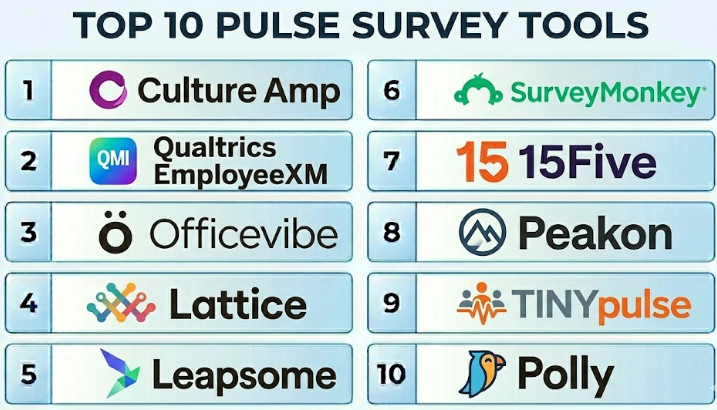
Top 10 Pulse Survey Tools
#1 — Culture Amp
Short description :
Culture Amp is an employee experience platform known for engagement surveys, pulse surveys, performance development, and people analytics. It helps organizations understand employee sentiment, identify engagement drivers, and support action planning. Culture Amp is useful for HR teams that want structured employee listening with strong analytics and practical insights. It works well for growing companies, mid-market organizations, and enterprises that want to measure engagement regularly. It is best for companies that want survey insights connected to people development and culture improvement.
Key Features
- Employee engagement pulse surveys.
- Survey templates and question libraries.
- Engagement drivers and heatmaps.
- Comment analysis and reporting.
- Manager dashboards.
- Action planning support.
- People analytics and trend tracking.
Pros
- Strong employee engagement analytics.
- Useful templates and research-backed survey structure.
- Good for companies that want feedback plus action planning.
Cons
- May be more advanced than very small teams need.
- Requires HR ownership to turn insights into action.
- Pricing may be better suited for growing and larger companies.
Platforms / Deployment
Web / iOS / Android
Cloud
Security & Compliance
Supports enterprise security controls, user permissions, and employee data privacy features. Specific security certifications and compliance details should be validated directly with the vendor.
Integrations & Ecosystem
Culture Amp connects employee feedback with HR and workplace systems.
- HRIS systems.
- Slack.
- Microsoft Teams.
- SSO providers.
- Employee directories.
- People analytics workflows.
Support & Community
Culture Amp provides onboarding, documentation, customer support, templates, and employee experience guidance. It is widely used by HR and people teams focused on engagement.
#2 — Qualtrics EmployeeXM
Short description :
Qualtrics EmployeeXM is an employee experience platform built for enterprise listening, engagement surveys, pulse surveys, lifecycle feedback, and advanced analytics. It is suitable for large organizations that need deep survey design, complex segmentation, benchmarking, and enterprise reporting. Qualtrics helps HR leaders measure employee experience across the entire employee journey. It is especially useful for organizations that need advanced analytics, governance, and scalable employee listening. It is best for enterprise teams with mature people analytics programs.
Key Features
- Employee pulse surveys.
- Engagement and lifecycle surveys.
- Advanced analytics and dashboards.
- Employee journey feedback.
- Text and sentiment analysis.
- Role-based reporting.
- Action planning and insights.
Pros
- Strong enterprise survey and analytics capabilities.
- Good for complex organizations and large employee populations.
- Useful for advanced segmentation and employee experience measurement.
Cons
- May be too complex for smaller teams.
- Implementation may require survey and analytics expertise.
- Advanced features can require careful configuration.
Platforms / Deployment
Web / iOS / Android
Cloud
Security & Compliance
Supports enterprise security, access control, and governance capabilities depending on plan and configuration. Specific certifications and compliance details should be validated directly with the vendor.
Integrations & Ecosystem
Qualtrics connects employee experience data with HR, analytics, and business systems.
- HRIS systems.
- SSO providers.
- Business intelligence tools.
- Employee lifecycle workflows.
- Collaboration platforms.
- People analytics systems.
Support & Community
Qualtrics provides enterprise support, documentation, onboarding resources, and customer success guidance. It is suitable for organizations with formal employee experience programs.
#3 — Officevibe
Short description :
Officevibe is an employee engagement and pulse survey tool designed to help managers understand team morale, engagement, and feedback. It is useful for small and mid-sized companies that want simple recurring surveys and clear insights without heavy analytics complexity. Officevibe supports anonymous feedback, engagement metrics, team reports, and manager-focused recommendations. It helps leaders detect employee concerns early and improve team communication. It is best for organizations that want an easy-to-use pulse survey tool for regular team check-ins.
Key Features
- Recurring pulse surveys.
- Anonymous employee feedback.
- Engagement score tracking.
- Team-level insights.
- Feedback conversations.
- Manager recommendations.
- Simple reports and dashboards.
Pros
- Easy to launch and use.
- Strong fit for managers and smaller teams.
- Good for regular employee check-ins.
Cons
- May not meet complex enterprise analytics needs.
- Advanced customization may be limited.
- Requires managers to act on feedback consistently.
Platforms / Deployment
Web / Cloud
Security & Compliance
Supports employee feedback privacy and business administration controls. Specific security and compliance details should be validated directly with the vendor.
Integrations & Ecosystem
Officevibe connects with common workplace and HR workflows.
- Slack.
- Microsoft Teams.
- HRIS systems.
- Email-based survey workflows.
- Employee directory tools.
- Team reporting workflows.
Support & Community
Officevibe provides documentation, onboarding help, templates, and support resources. It is popular with teams that want practical engagement insights without complex setup.
#4 — Lattice
Short description :
Lattice is a people management platform that includes employee engagement surveys, pulse surveys, performance reviews, goals, feedback, and career development features. It is useful for companies that want employee listening connected with performance and manager workflows. Lattice helps HR teams understand engagement while also supporting broader people operations. It is suitable for growing companies and mid-market organizations that want one platform for engagement, performance, and employee development. It is best for teams that want pulse survey insights connected to people management.
Key Features
- Engagement and pulse surveys.
- Performance management.
- Goals and OKRs.
- Feedback and one-on-ones.
- Analytics and reporting.
- Manager dashboards.
- Employee development workflows.
Pros
- Strong connection between engagement and performance.
- Useful for people teams wanting a broader HR platform.
- Good manager-facing workflows.
Cons
- May be more than needed for survey-only use cases.
- Requires strong process design across HR programs.
- Some advanced analytics may depend on package and setup.
Platforms / Deployment
Web / iOS / Android
Cloud
Security & Compliance
Supports business security features such as access controls, admin roles, and SSO options depending on plan. Specific compliance certifications should be validated directly with the vendor.
Integrations & Ecosystem
Lattice connects engagement feedback with people management systems.
- HRIS systems.
- Slack.
- Microsoft Teams.
- SSO providers.
- Calendar workflows.
- People analytics tools.
Support & Community
Lattice provides documentation, onboarding support, customer success resources, and HR best-practice guidance. It is useful for companies building structured people programs.
#5 — Leapsome
Short description :
Leapsome is a people enablement platform that includes engagement surveys, pulse surveys, performance reviews, goals, learning, feedback, and employee development tools. It helps organizations connect employee listening with growth, performance, and management practices. Leapsome is suitable for growing companies and mid-market organizations that want a broad people operations platform. It is useful for HR teams that want to measure engagement while also improving development and alignment. It is best for companies that want pulse surveys inside a wider people enablement system.
Key Features
- Pulse and engagement surveys.
- Survey templates and analytics.
- Performance reviews.
- Goals and OKRs.
- Learning and development features.
- Feedback and praise tools.
- Manager insights and reporting.
Pros
- Broad people enablement feature set.
- Good connection between surveys, goals, and performance.
- Useful for companies improving people processes together.
Cons
- May be more platform than a survey-only buyer needs.
- Requires configuration across multiple HR workflows.
- Best value comes when multiple modules are used.
Platforms / Deployment
Web / Cloud
Security & Compliance
Supports enterprise access controls, permissions, and admin settings depending on plan. Specific security certifications should be verified directly with the vendor.
Integrations & Ecosystem
Leapsome connects employee feedback with HR and productivity systems.
- HRIS platforms.
- Slack.
- Microsoft Teams.
- SSO providers.
- Calendar workflows.
- People analytics processes.
Support & Community
Leapsome provides onboarding, documentation, templates, and customer support. It is suitable for HR teams building engagement and performance programs together.
#6 — SurveyMonkey
Short description :
SurveyMonkey is a widely used online survey platform that can support employee pulse surveys, feedback forms, engagement check-ins, and internal research. While it is not only an HR tool, many businesses use it for simple employee feedback programs. It is suitable for teams that need flexible survey creation, quick deployment, and general-purpose survey functionality. SurveyMonkey is useful for small businesses, HR teams, operations teams, and managers who want a straightforward survey tool. It is best for organizations that need flexible surveys without a full employee experience platform.
Key Features
- Flexible survey builder.
- Employee feedback templates.
- Multiple question types.
- Survey sharing and response collection.
- Basic analytics and reporting.
- Custom branding options.
- Export and reporting features.
Pros
- Easy to use and widely understood.
- Good for general-purpose surveys.
- Flexible for many feedback use cases.
Cons
- Not as specialized for employee engagement as dedicated HR platforms.
- Advanced people analytics may be limited.
- Action planning and manager dashboards may require manual work.
Platforms / Deployment
Web / iOS / Android
Cloud
Security & Compliance
Supports business survey security controls depending on plan. Specific compliance and security certifications should be validated directly with the vendor.
Integrations & Ecosystem
SurveyMonkey connects with common productivity and business tools.
- Email workflows.
- CRM systems.
- Collaboration tools.
- Business intelligence tools.
- Automation platforms.
- Data export workflows.
Support & Community
SurveyMonkey provides documentation, templates, support resources, and a large user base. It is practical for teams that need quick survey creation and broad flexibility.
#7 — 15Five
Short description :
15Five is a performance management and employee engagement platform that includes pulse surveys, check-ins, manager tools, feedback, recognition, and goals. It helps organizations improve manager-employee communication and track engagement across teams. 15Five is suitable for companies that want regular feedback loops rather than only occasional surveys. It is useful for HR teams and managers focused on engagement, performance, and coaching. It is best for organizations that want pulse surveys connected with ongoing manager conversations.
Key Features
- Employee pulse surveys.
- Weekly check-ins.
- Engagement reporting.
- Manager feedback tools.
- Goals and performance workflows.
- Recognition features.
- Coaching and development support.
Pros
- Strong for manager-employee communication.
- Useful for regular feedback habits.
- Good connection between engagement and performance.
Cons
- May not fit companies needing only anonymous survey analytics.
- Requires manager participation to succeed.
- Advanced enterprise needs may depend on plan and setup.
Platforms / Deployment
Web / iOS / Android
Cloud
Security & Compliance
Supports business access controls, permissions, and admin settings depending on plan. Specific security certifications should be verified directly with the vendor.
Integrations & Ecosystem
15Five connects employee feedback with people and workplace systems.
- HRIS systems.
- Slack.
- Microsoft Teams.
- SSO providers.
- Calendar workflows.
- Performance management workflows.
Support & Community
15Five provides onboarding, documentation, templates, customer support, and manager enablement resources. It is useful for companies improving feedback culture.
#8 — Peakon
Short description :
Peakon, part of Workday, is an employee listening platform focused on engagement, sentiment, people analytics, and continuous feedback. It helps organizations collect regular employee feedback, identify engagement drivers, and support leadership decision-making. Peakon is suitable for mid-market and enterprise companies, especially those with mature HR and people analytics needs. It is useful for organizations that want frequent employee listening connected with workforce insights. It is best for companies that need structured engagement measurement and strong analytics.
Key Features
- Continuous employee listening.
- Pulse and engagement surveys.
- Engagement driver analysis.
- Comment and sentiment insights.
- Manager dashboards.
- Action planning support.
- Workforce analytics alignment.
Pros
- Strong employee listening and analytics capabilities.
- Good fit for larger organizations.
- Useful for identifying engagement drivers and trends.
Cons
- May be too advanced for small teams.
- Best value may depend on broader HR system alignment.
- Implementation requires clear ownership and action planning.
Platforms / Deployment
Web / Cloud
Security & Compliance
Supports enterprise security and access controls depending on configuration. Specific compliance and certification details should be validated directly with the vendor.
Integrations & Ecosystem
Peakon connects employee listening with HR and workforce systems.
- Workday ecosystem.
- HRIS systems.
- Identity providers.
- People analytics workflows.
- Employee directories.
- Reporting systems.
Support & Community
Peakon provides enterprise support, onboarding, documentation, and customer success resources. It is suitable for HR teams focused on continuous employee listening.
#9 — TINYpulse
Short description :
TINYpulse is an employee engagement and pulse survey tool designed to collect quick feedback, recognize employees, and improve workplace culture. It is useful for organizations that want lightweight pulse surveys, anonymous feedback, and simple engagement reporting. TINYpulse helps HR teams and managers understand employee sentiment without requiring long survey cycles. It is suitable for small and mid-sized companies that want fast employee listening. It is best for teams that need simple pulse feedback and culture check-ins.
Key Features
- Pulse surveys.
- Anonymous employee feedback.
- Employee recognition features.
- Engagement reporting.
- Survey templates.
- Feedback trends.
- Manager insights.
Pros
- Simple and easy to use.
- Good for quick employee feedback.
- Useful for smaller teams and growing companies.
Cons
- May not support complex enterprise analytics.
- Requires regular follow-up to maintain trust.
- Advanced integrations may be limited compared with larger platforms.
Platforms / Deployment
Web / Cloud
Security & Compliance
Supports basic business security and feedback privacy features. Specific security and compliance details should be validated directly with the vendor.
Integrations & Ecosystem
TINYpulse supports lightweight employee listening and engagement workflows.
- HR systems.
- Slack-style communication workflows.
- Employee feedback processes.
- Recognition workflows.
- Reporting exports.
- Team dashboards.
Support & Community
TINYpulse provides documentation, support resources, and employee engagement guidance. It is practical for companies wanting a simple pulse survey approach.
#10 — Polly
Short description :
Polly is a survey and polling tool designed for quick feedback inside collaboration tools such as Slack and Microsoft Teams. It is useful for teams that want lightweight pulse surveys, polls, team check-ins, and quick sentiment collection where employees already work. Polly is not a full employee experience platform, but it is very practical for fast feedback and simple team-level surveys. It is suitable for remote teams, managers, and operations teams that need frequent feedback without complex setup. It is best for organizations that want surveys embedded directly into daily communication workflows.
Key Features
- Quick polls and pulse surveys.
- Slack and Microsoft Teams workflows.
- Anonymous response options.
- Scheduled surveys.
- Templates and recurring check-ins.
- Basic analytics and reporting.
- Team-level feedback collection.
Pros
- Very easy to use inside collaboration tools.
- Good for quick team feedback.
- Useful for remote and async teams.
Cons
- Not a full enterprise employee listening platform.
- Advanced HR analytics may be limited.
- Best suited for lightweight survey use cases.
Platforms / Deployment
Web / Cloud
Security & Compliance
Supports business access and admin controls depending on plan and configuration. Specific compliance details should be validated directly with the vendor.
Integrations & Ecosystem
Polly is strongest when used inside daily collaboration platforms.
- Slack.
- Microsoft Teams.
- Scheduled team check-ins.
- Quick polls.
- Feedback templates.
- Reporting exports.
Support & Community
Polly provides documentation, templates, and support resources. It is useful for teams that want fast feedback collection without launching a large HR survey platform.
Comparison Table
| Tool Name | Best For | Platform(s) Supported | Deployment | Standout Feature | Public Rating |
|---|---|---|---|---|---|
| Culture Amp | Employee engagement and people analytics | Web / iOS / Android | Cloud | Engagement drivers and action planning | N/A |
| Qualtrics EmployeeXM | Enterprise employee experience measurement | Web / iOS / Android | Cloud | Advanced survey analytics and segmentation | N/A |
| Officevibe | Simple team pulse surveys | Web | Cloud | Manager-friendly team engagement insights | N/A |
| Lattice | Engagement connected with performance | Web / iOS / Android | Cloud | Pulse surveys with performance workflows | N/A |
| Leapsome | People enablement and engagement | Web | Cloud | Surveys connected with goals and development | N/A |
| SurveyMonkey | Flexible general-purpose surveys | Web / iOS / Android | Cloud | Easy survey creation for many use cases | N/A |
| 15Five | Manager check-ins and engagement | Web / iOS / Android | Cloud | Pulse surveys with ongoing feedback habits | N/A |
| Peakon | Continuous employee listening | Web | Cloud | Engagement analytics and driver insights | N/A |
| TINYpulse | Lightweight engagement surveys | Web | Cloud | Simple anonymous pulse feedback | N/A |
| Polly | Quick polls in Slack and Teams | Web | Cloud | Fast feedback inside collaboration tools | N/A |
Evaluation & Pulse Survey Tools
| Tool Name | Core (25%) | Ease (15%) | Integrations (15%) | Security (10%) | Performance (10%) | Support (10%) | Value (15%) | Weighted Total (0–10) |
|---|---|---|---|---|---|---|---|---|
| Culture Amp | 9 | 8 | 8 | 8 | 8 | 9 | 8 | 8.35 |
| Qualtrics EmployeeXM | 10 | 7 | 9 | 9 | 9 | 9 | 7 | 8.65 |
| Officevibe | 8 | 9 | 7 | 7 | 8 | 8 | 8 | 7.95 |
| Lattice | 8 | 8 | 8 | 8 | 8 | 8 | 8 | 8.00 |
| Leapsome | 8 | 8 | 8 | 8 | 8 | 8 | 8 | 8.00 |
| SurveyMonkey | 7 | 9 | 8 | 8 | 8 | 8 | 9 | 8.00 |
| 15Five | 8 | 8 | 7 | 8 | 8 | 8 | 8 | 7.85 |
| Peakon | 9 | 8 | 8 | 9 | 8 | 9 | 7 | 8.35 |
| TINYpulse | 7 | 9 | 6 | 7 | 8 | 7 | 8 | 7.35 |
| Polly | 7 | 9 | 8 | 7 | 8 | 7 | 8 | 7.75 |
These scores are comparative and should be used as a practical guide, not a fixed ranking. Qualtrics EmployeeXM and Culture Amp are strong for advanced employee listening, Officevibe and TINYpulse are useful for simple pulse feedback, Polly is excellent for quick collaboration-based polls, and Lattice or Leapsome may be better when surveys need to connect with performance and people development.
Which Pulse Survey Tools
Solo / Freelancer
Solo professionals usually do not need a dedicated pulse survey tool. A simple feedback form, direct check-in, or short survey tool may be enough when working with contractors or clients.
However, consultants who support HR, employee engagement, or organizational development should understand platforms like Culture Amp, Qualtrics EmployeeXM, Lattice, Leapsome, and Officevibe because clients may use these tools for employee listening programs.
SMB
Small and medium businesses should focus on ease of use, quick launch, simple reporting, and employee trust. Officevibe, TINYpulse, Polly, SurveyMonkey, and 15Five are practical options for SMBs.
The main goal for SMBs should be creating a healthy feedback habit. A simple survey sent regularly and followed by visible action is better than a complex survey that employees do not trust.
Mid-Market
Mid-market companies usually need better analytics, segmentation, manager dashboards, HRIS integration, and action planning. Culture Amp, Lattice, Leapsome, 15Five, Officevibe, and Peakon are strong candidates.
At this stage, companies should track engagement by department, location, role, and manager while protecting employee anonymity. Survey results should lead to clear action plans.
Enterprise
Enterprises should prioritize scalability, privacy, advanced analytics, benchmarking, role-based reporting, integration with HR systems, and governance. Qualtrics EmployeeXM, Culture Amp, Peakon, Lattice, and Leapsome are strong options.
Large organizations should involve HR, legal, IT, privacy, works councils where relevant, and business leaders before launching employee surveys. Employee listening programs must be trusted and carefully governed.
Budget vs Premium
Budget-conscious teams may prefer Polly, SurveyMonkey, TINYpulse, or Officevibe for simple pulse surveys and quick feedback.
Premium platforms such as Qualtrics EmployeeXM, Culture Amp, Peakon, Lattice, and Leapsome are better when companies need analytics depth, lifecycle listening, manager dashboards, action planning, and enterprise governance.
Feature Depth vs Ease of Use
If ease of use matters most, Officevibe, Polly, TINYpulse, and SurveyMonkey are practical choices. They help teams collect feedback without heavy setup.
If feature depth matters more, Qualtrics EmployeeXM, Culture Amp, Peakon, Lattice, and Leapsome offer stronger analytics, segmentation, engagement models, and people program alignment.
Integrations & Scalability
For survey tools to scale, they should connect with HRIS, employee directories, collaboration tools, SSO, and reporting systems. This reduces manual work and improves data accuracy.
For collaboration-heavy teams, Polly is useful inside Slack and Microsoft Teams. For HR-led programs, Culture Amp, Qualtrics EmployeeXM, Lattice, Leapsome, and Peakon provide stronger workforce-level structure.
Security & Compliance Needs
Pulse surveys often include sensitive employee feedback about managers, workload, culture, burnout, and leadership trust. Buyers should validate anonymity thresholds, role-based reporting, SSO, MFA, data retention, audit logs, and privacy controls.
Employees will only share honest feedback if they trust the process. Clear communication about anonymity, data use, and follow-up actions is essential.
Frequently Asked Questions
1. What is a Pulse Survey Tool?
A Pulse Survey Tool helps organizations collect short and regular employee feedback. It is usually used to measure engagement, morale, wellbeing, manager support, workload, culture, and employee experience. Unlike long annual surveys, pulse surveys are faster and more frequent.
2. How often should companies run pulse surveys?
Many companies run pulse surveys monthly, quarterly, or after important events such as reorganizations, onboarding, leadership changes, or policy updates. The best frequency depends on company size, culture, and ability to act on feedback. Sending surveys too often without action can reduce trust.
3. What is the difference between a pulse survey and an annual engagement survey?
A pulse survey is shorter and sent more frequently. An annual engagement survey is usually longer and more detailed. Pulse surveys help track changes over time, while annual surveys provide a deeper snapshot of employee experience.
4. What pricing models are common for Pulse Survey Tools?
Most tools use per-user pricing, tiered plans, or custom enterprise pricing. Some platforms include pulse surveys inside broader HR or people management suites. Buyers should compare both software cost and the time needed to manage survey programs.
5. Are pulse surveys anonymous?
Many pulse survey tools support anonymous feedback, but anonymity depends on settings, team size, and reporting thresholds. Companies should clearly explain how anonymity works. If employees do not trust the process, response quality will suffer.
6. What are common mistakes when using pulse surveys?
Common mistakes include asking too many questions, surveying too often, ignoring results, failing to protect anonymity, and not training managers. Another major mistake is collecting feedback without communicating what actions will be taken.
7. Which Pulse Survey Tool is best for small businesses?
Officevibe, TINYpulse, Polly, SurveyMonkey, and 15Five can be practical for small businesses. The best choice depends on whether the team wants anonymous feedback, quick polls, manager check-ins, or flexible survey creation.
8. Which tool is best for enterprises?
Qualtrics EmployeeXM, Culture Amp, Peakon, Lattice, and Leapsome are strong options for enterprises. They provide deeper analytics, segmentation, role-based reporting, engagement drivers, and stronger governance capabilities.
9. Can pulse surveys improve employee engagement?
Yes, but only when leaders act on the results. Pulse surveys can reveal problems early, but they do not solve issues by themselves. Engagement improves when employees see that their feedback leads to meaningful change.
10. What integrations should buyers check?
Buyers should check HRIS, Slack, Microsoft Teams, SSO, employee directories, email, people analytics, and reporting integrations. Good integrations keep employee data updated and make surveys easier to deliver and manage.
Conclusion
Pulse Survey Tools help organizations listen to employees more regularly, understand team health, and act before small concerns become serious workplace problems. They are useful for measuring engagement, wellbeing, culture, manager effectiveness, workload, communication quality, and employee trust. The best tool depends on your company size, HR maturity, feedback culture, reporting needs, and budget. Officevibe, TINYpulse, and Polly are practical for simple and quick feedback. Culture Amp, Peakon, and Qualtrics EmployeeXM are stronger for advanced employee listening and analytics. Lattice, Leapsome, and 15Five are useful when surveys should connect with performance, goals, and manager workflows.
