Introduction
Multi-touch Attribution Tools help marketing and revenue teams understand how different customer touchpoints contribute to a conversion, sale, lead, opportunity, subscription, or revenue outcome. In simple terms, these tools do not give full credit to only the first click or last click. Instead, they help show how multiple interactions work together across the customer journey.
A buyer may first see a social ad, later read a blog, attend a webinar, click an email, compare pricing, visit a review site, speak with sales, and then finally convert. If a business only uses last-click attribution, many important touchpoints are ignored. Multi-touch attribution helps teams see the wider journey and understand which channels influence awareness, consideration, trust, and final decision-making.
Real-world use cases include B2B pipeline attribution, ecommerce journey analysis, paid media optimization, content performance tracking, campaign ROI reporting, sales and marketing alignment, partner attribution, and budget planning.
Buyers should evaluate attribution model flexibility, CRM integration, ad platform connections, journey visibility, reporting quality, data accuracy, privacy controls, implementation effort, support, and scalability.
Best for: B2B marketing teams, demand generation teams, ecommerce brands, growth marketers, marketing operations teams, revenue operations teams, agencies, and companies managing many campaigns across many channels.
Not ideal for: Very small businesses running only one or two simple campaigns, companies without clean tracking setup, or teams that only need basic website analytics instead of journey-level performance measurement.
Key Trends in Multi-touch Attribution Tools
- First-party data is becoming more important: Teams are relying more on CRM data, website events, email engagement, customer data platforms, app behavior, and owned channel signals.
- Privacy-friendly attribution is now a major requirement: Cookie limitations and consent rules are pushing teams to use cleaner, more transparent tracking methods.
- B2B attribution is becoming revenue-focused: Marketing teams no longer want only lead attribution. They want to connect campaigns with pipeline, opportunity value, deal movement, and closed revenue.
- Ecommerce attribution is becoming more blended: Brands are comparing multi-touch attribution with platform-reported ROAS, post-purchase surveys, contribution margin, and media mix modeling.
- Data quality matters more than dashboard design: Poor campaign naming, broken tracking, duplicate conversions, and missing CRM stages can make attribution reports misleading.
- AI-assisted reporting is becoming common: Some tools help identify journey patterns, channel influence, anomalies, and budget opportunities more quickly.
- Attribution is being combined with incrementality: Mature teams use attribution for journey analysis and incrementality testing for deeper validation.
- Data warehouse integration is becoming important: Larger teams want attribution data connected with BI, finance, product analytics, and customer data systems.
- Account-based attribution is growing: B2B companies want to understand how multiple people from the same company interact before a deal closes.
- Cross-channel visibility is now expected: Buyers want one view across paid search, paid social, email, organic search, direct traffic, referrals, events, webinars, affiliates, and sales activity.
How We Selected These Tools
The following tools were selected based on practical business use cases for modern attribution and marketing measurement.
- Market adoption and recognition: Preference was given to tools commonly discussed in B2B attribution, ecommerce attribution, revenue attribution, and performance marketing measurement.
- Multi-touch attribution capability: Tools were considered stronger when they supported multiple attribution models, journey tracking, and channel influence reporting.
- CRM and revenue connectivity: B2B attribution tools were evaluated based on their ability to connect marketing activity with leads, opportunities, pipeline, and revenue.
- Ecommerce and paid media fit: Ecommerce-focused tools were evaluated based on their ability to connect ad spend, customer journeys, sales, and revenue.
- Integration ecosystem: Stronger tools support CRM, ad platforms, analytics platforms, ecommerce systems, marketing automation, data warehouses, and BI tools.
- Reporting quality: Tools with clear dashboards, journey views, campaign reports, and executive-friendly insights were prioritized.
- Security and governance signals: Access controls, privacy handling, and enterprise-readiness were considered, but no certifications are assumed.
- Customer fit across segments: The list balances enterprise tools, B2B revenue attribution tools, ecommerce attribution platforms, and practical SMB-friendly options.
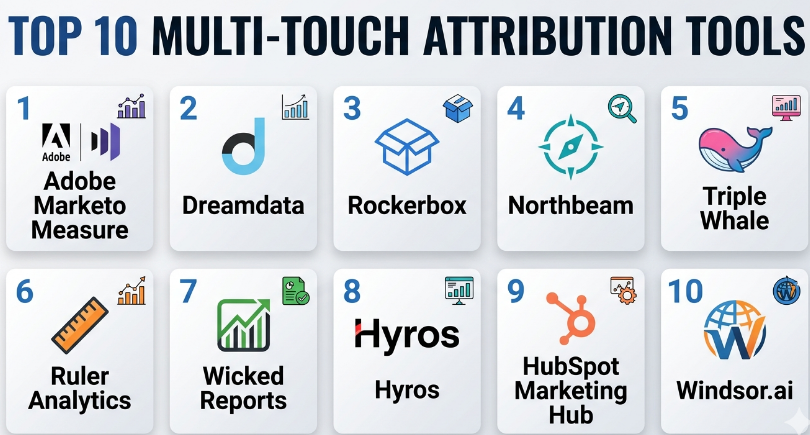
Top 10 Multi-touch Attribution Tools
#1 — Adobe Marketo Measure
Short description :
Adobe Marketo Measure is a B2B marketing attribution platform designed to connect marketing touchpoints with pipeline and revenue. It helps teams understand how campaigns, channels, content, ads, events, and sales activities influence opportunities and closed deals. It is best suited for B2B companies with structured CRM processes and mature marketing operations. The platform is useful for revenue leaders who want to move beyond lead-count reporting and understand real pipeline impact. It fits well for organizations already using Adobe or Marketo-related marketing workflows.
Key Features
- B2B multi-touch attribution
- Pipeline and revenue attribution
- Campaign and channel influence reporting
- Opportunity journey tracking
- CRM-connected measurement
- Marketing ROI dashboards
- Revenue operations reporting workflows
Pros
- Strong fit for B2B revenue attribution.
- Helps connect marketing activity with pipeline outcomes.
- Useful for enterprise teams with complex sales cycles.
Cons
- May be too complex for small teams.
- Requires clean CRM and campaign structure.
- Less suitable for ecommerce or mobile-first businesses.
Platforms / Deployment
Web-based platform.
Cloud deployment.
Security & Compliance
Enterprise security capabilities may vary by product and contract. Buyers should validate exact controls directly.
SOC 2, ISO 27001, HIPAA: Not publicly stated here.
Integrations & Ecosystem
Adobe Marketo Measure works best inside a structured B2B marketing and revenue operations environment. It can help connect marketing automation, CRM, campaign management, paid media, and sales pipeline data.
- CRM systems
- Marketing automation workflows
- Paid media reporting
- Campaign management tools
- Revenue dashboards
- Sales and pipeline reporting
Support & Community
Adobe provides documentation, customer support, partner ecosystem support, and enterprise onboarding options. Support depth may depend on contract and product environment.
#2 — Dreamdata
Short description :
Dreamdata is a B2B revenue attribution platform built for companies with long sales cycles, multiple stakeholders, and complex buyer journeys. It helps marketing and revenue teams see how accounts move from first touch to closed revenue. Dreamdata connects website activity, CRM data, campaign engagement, paid media, and sales touchpoints into a clearer customer journey. It is especially useful for SaaS companies, demand generation teams, and revenue operations teams. The platform is strong when marketing needs to prove influence on pipeline and revenue, not only leads.
Key Features
- B2B multi-touch attribution
- Account-based journey tracking
- Pipeline and revenue reporting
- Website and campaign tracking
- CRM integration
- Paid media performance visibility
- Customer journey visualization
Pros
- Strong for B2B SaaS and revenue attribution.
- Helps connect marketing, sales, and website activity.
- Useful for account-based and long-cycle buying journeys.
Cons
- Requires clean CRM and sales data.
- Less useful for simple ecommerce businesses.
- Setup may require marketing operations involvement.
Platforms / Deployment
Web-based platform.
Cloud deployment.
Security & Compliance
Security details should be verified directly with the vendor.
SOC 2, ISO 27001, HIPAA: Not publicly stated.
Integrations & Ecosystem
Dreamdata fits into B2B revenue stacks where campaign activity, CRM data, and website engagement need to be connected into one journey view.
- CRM systems
- Marketing automation tools
- Website tracking
- Paid media platforms
- Revenue dashboards
- Data warehouse workflows
Support & Community
Dreamdata offers documentation, onboarding, customer support, and educational resources for B2B revenue teams. It is most relevant for SaaS, demand generation, and revenue operations users.
#3 — Rockerbox
Short description :
Rockerbox is a marketing measurement and attribution platform focused on helping brands understand customer journeys, channel performance, and media influence. It is commonly used by ecommerce, DTC, and performance marketing teams that need a better view beyond platform-reported metrics. Rockerbox helps unify data across paid media, website activity, conversions, and customer touchpoints. It supports multi-touch attribution and broader marketing measurement workflows. The platform is useful for teams that want to compare channel impact and make better budget decisions.
Key Features
- Multi-touch attribution
- Customer journey analysis
- Channel and campaign reporting
- Ecommerce and DTC measurement support
- Marketing performance dashboards
- Media mix-style insights
- Data exports and integrations
Pros
- Strong fit for ecommerce and DTC teams.
- Helps reduce over-reliance on platform-reported ROAS.
- Useful for comparing multiple marketing channels.
Cons
- Requires clean tracking and conversion data.
- May not be ideal for very small advertisers.
- Advanced reporting may need marketing operations support.
Platforms / Deployment
Web-based platform.
Cloud deployment.
Security & Compliance
Security features should be validated directly with the vendor.
SOC 2, ISO 27001, HIPAA: Not publicly stated.
Integrations & Ecosystem
Rockerbox fits into ecommerce, paid media, and analytics workflows where teams need unified channel reporting and attribution insights.
- Paid media platforms
- Ecommerce systems
- Analytics tools
- Data warehouses
- BI dashboards
- Marketing reporting workflows
Support & Community
Rockerbox provides onboarding and support resources. It is well suited for DTC, ecommerce, agency, and performance marketing teams.
#4 — Northbeam
Short description :
Northbeam is an ecommerce attribution and marketing measurement platform designed for DTC brands and online sellers. It helps brands understand revenue contribution, customer journeys, paid media performance, and channel influence. Northbeam is especially useful for ecommerce teams that want a more balanced view than what individual ad platforms report. It helps marketing teams compare campaign performance, track customer paths, and make better spending decisions. The platform is best for brands with meaningful online sales and multi-channel advertising activity.
Key Features
- Ecommerce attribution
- Multi-channel journey tracking
- Paid media performance reporting
- Revenue and ROAS analysis
- Customer journey insights
- Dashboard-based reporting
- Budget decision support
Pros
- Strong fit for DTC and ecommerce brands.
- Helps compare channel performance more fairly.
- Useful for teams managing paid media across several platforms.
Cons
- Less useful for non-ecommerce companies.
- Value depends on sales volume and clean data.
- May not fit complex B2B revenue attribution needs.
Platforms / Deployment
Web-based platform.
Cloud deployment.
Security & Compliance
Security and compliance details should be verified with the vendor.
SOC 2, ISO 27001, HIPAA: Not publicly stated.
Integrations & Ecosystem
Northbeam works best in ecommerce growth stacks where store data, paid media data, and revenue data need to be analyzed together.
- Ecommerce platforms
- Paid media platforms
- Analytics tools
- Data exports
- Reporting dashboards
- Growth marketing workflows
Support & Community
Northbeam offers support and onboarding resources. It is commonly used by ecommerce operators, DTC brands, and performance marketing teams.
#5 — Triple Whale
Short description :
Triple Whale is an ecommerce analytics and attribution platform built mainly for DTC brands and Shopify-focused businesses. It helps teams track revenue, paid media, profitability, customer journeys, and marketing performance from one dashboard. Triple Whale is useful for founders, operators, media buyers, and ecommerce growth teams that want simplified reporting across marketing channels. It combines attribution with business metrics such as revenue and profitability. It is best for ecommerce teams that need fast daily visibility without a heavy enterprise analytics setup.
Key Features
- Ecommerce attribution and analytics
- Paid media performance reporting
- Revenue and profitability dashboards
- Customer journey insights
- Shopify-focused workflows
- Creative and campaign reporting
- Executive-friendly dashboards
Pros
- Strong fit for Shopify and DTC teams.
- Easier to use than many enterprise attribution systems.
- Combines marketing and ecommerce performance in one view.
Cons
- Less suitable for B2B or non-ecommerce businesses.
- Advanced enterprise governance may be limited.
- Best value depends on ecommerce platform compatibility.
Platforms / Deployment
Web-based platform.
Cloud deployment.
Security & Compliance
Security details should be confirmed directly with the vendor.
SOC 2, ISO 27001, HIPAA: Not publicly stated.
Integrations & Ecosystem
Triple Whale works best when store, advertising, and revenue data need to be visible together for ecommerce decision-making.
- Shopify ecosystem
- Paid media platforms
- Ecommerce analytics
- Customer data workflows
- Dashboard reporting
- Marketing operations workflows
Support & Community
Triple Whale has documentation, support resources, and a strong user presence among ecommerce founders, operators, and DTC marketers.
#6 — Ruler Analytics
Short description :
Ruler Analytics is a marketing attribution and call tracking platform that helps teams connect leads, calls, forms, website visits, and revenue. It is useful for companies that generate leads through multiple channels and need to understand which campaigns influence sales outcomes. Ruler Analytics is especially relevant for service businesses, agencies, B2B companies, and lead generation teams. It helps connect online journeys with offline conversations and CRM outcomes. The platform is practical for teams that need attribution beyond simple form submissions.
Key Features
- Multi-touch attribution
- Call tracking
- Form and website journey tracking
- CRM revenue attribution
- Campaign and channel reporting
- Lead source visibility
- Offline conversion tracking support
Pros
- Strong for lead generation and call-based businesses.
- Helps connect online activity with offline sales outcomes.
- Useful for agencies managing client attribution.
Cons
- Less suitable for pure ecommerce analytics.
- Requires proper call and CRM setup.
- Reporting depth may depend on integrations and data quality.
Platforms / Deployment
Web-based platform.
Cloud deployment.
Security & Compliance
Security details should be confirmed with the vendor.
SOC 2, ISO 27001, HIPAA: Not publicly stated.
Integrations & Ecosystem
Ruler Analytics fits into lead generation workflows where businesses need to connect website traffic, calls, forms, CRM records, and revenue.
- CRM systems
- Paid media platforms
- Call tracking workflows
- Website forms
- Analytics tools
- Reporting dashboards
Support & Community
Ruler Analytics provides support, documentation, and onboarding resources. It is particularly useful for agencies, service providers, and lead-focused businesses.
#7 — Wicked Reports
Short description :
Wicked Reports is a marketing attribution and customer journey reporting platform focused on ecommerce, online businesses, and paid media teams. It helps connect marketing clicks, leads, customers, purchases, and lifetime value. The platform is useful for teams that want to understand which campaigns create profitable customers over time. It can support multi-touch attribution, customer lifetime value reporting, and channel performance analysis. Wicked Reports is especially relevant for businesses that run paid traffic and need to understand long-term revenue impact.
Key Features
- Multi-touch attribution
- Customer journey tracking
- Ecommerce and online business reporting
- Lifetime value analysis
- Paid media ROI reporting
- Campaign performance dashboards
- Lead-to-sale tracking
Pros
- Useful for understanding long-term customer value.
- Strong fit for paid traffic and ecommerce-focused teams.
- Helps connect leads, purchases, and revenue.
Cons
- May require careful setup for accurate tracking.
- Less suitable for enterprise B2B attribution.
- Best value depends on clean customer and purchase data.
Platforms / Deployment
Web-based platform.
Cloud deployment.
Security & Compliance
Security details should be validated directly with the vendor.
SOC 2, ISO 27001, HIPAA: Not publicly stated.
Integrations & Ecosystem
Wicked Reports fits into online marketing stacks where paid media, ecommerce, CRM, and revenue data need to be connected.
- Paid media platforms
- Ecommerce systems
- CRM tools
- Email marketing platforms
- Revenue reporting
- Customer journey dashboards
Support & Community
Wicked Reports provides customer support and educational resources. It is commonly used by online marketers, ecommerce brands, and performance-focused businesses.
#8 — Hyros
Short description :
Hyros is an ad tracking and attribution platform used by ecommerce brands, info-product businesses, agencies, and online advertisers. It helps track customer journeys across ads, clicks, leads, calls, purchases, and repeat sales. Hyros is often used by businesses that rely heavily on paid media and need clearer attribution than ad platform dashboards alone. It can help teams understand which campaigns create revenue and customer value over time. It is especially useful for advertisers with complex funnels and high-volume paid traffic.
Key Features
- Ad tracking and attribution
- Multi-touch customer journey visibility
- Lead and purchase tracking
- Call and sales journey support
- Revenue attribution
- Paid media performance reporting
- Funnel tracking
Pros
- Strong fit for paid media-heavy businesses.
- Useful for complex funnels and online sales journeys.
- Helps reduce confusion from platform-reported attribution.
Cons
- May not fit every traditional enterprise environment.
- Requires proper tracking setup and funnel mapping.
- Best for teams with meaningful ad spend and conversion volume.
Platforms / Deployment
Web-based platform.
Cloud deployment.
Security & Compliance
Security and compliance details should be validated with the vendor.
SOC 2, ISO 27001, HIPAA: Not publicly stated.
Integrations & Ecosystem
Hyros fits into paid advertising and online sales workflows where lead, call, and revenue attribution are important.
- Paid media platforms
- Sales funnel tools
- CRM systems
- Ecommerce workflows
- Call tracking workflows
- Reporting dashboards
Support & Community
Hyros provides onboarding and support resources. It has strong visibility among paid media buyers, ecommerce operators, and online funnel-based businesses.
#9 — HubSpot Marketing Hub
Short description :
HubSpot Marketing Hub includes attribution reporting features that can help teams understand how marketing interactions influence contacts, deals, and revenue. It is especially useful for SMB and mid-market B2B teams already using HubSpot CRM, forms, email, landing pages, workflows, and sales pipelines. While it may not be a dedicated attribution-only platform, it provides practical multi-touch reporting inside a broader marketing and CRM system. It is suitable for teams that want attribution without adding a separate complex platform. HubSpot works best when customer data is already managed inside its ecosystem.
Key Features
- Attribution reporting
- CRM-connected campaign tracking
- Contact and deal journey visibility
- Email, form, landing page, and workflow tracking
- Revenue reporting
- Campaign dashboards
- Marketing automation integration
Pros
- Good fit for teams already using HubSpot.
- Combines CRM, marketing automation, and attribution.
- Easier to adopt than many standalone enterprise tools.
Cons
- Less specialized than dedicated attribution platforms.
- Advanced reporting may depend on plan level.
- Best value comes when the business uses the broader HubSpot ecosystem.
Platforms / Deployment
Web-based platform.
Cloud deployment.
Security & Compliance
Security features vary by plan and configuration. Buyers should validate SSO, permissions, audit logging, and compliance needs directly.
SOC 2, ISO 27001, HIPAA: Not publicly stated here.
Integrations & Ecosystem
HubSpot works best as a connected CRM and marketing platform where attribution reports are built from contact, campaign, and deal activity.
- CRM workflows
- Email marketing
- Landing pages
- Forms
- Sales pipelines
- Reporting dashboards
Support & Community
HubSpot has strong documentation, training resources, partner support, and a large user community. Support options vary by plan.
#10 — Windsor.ai
Short description :
Windsor.ai is a marketing attribution and data integration platform that helps teams connect campaign data, analytics data, CRM data, and BI dashboards. It is useful for businesses that want attribution insights alongside data pipeline and reporting capabilities. Windsor.ai can support multi-touch attribution use cases by combining marketing touchpoints and conversion data from different platforms. It is suitable for agencies, SMBs, analysts, and marketing teams that want flexible data movement and attribution reporting. The platform is especially helpful when teams need data connected into dashboards and reporting tools.
Key Features
- Multi-touch attribution support
- Marketing data integration
- Campaign performance reporting
- Data connectors
- BI dashboard support
- Cross-channel reporting
- Conversion and revenue analysis
Pros
- Useful for teams needing both attribution and data integration.
- Good fit for agencies and reporting-heavy teams.
- Flexible for connecting marketing data into dashboards.
Cons
- May require analytics knowledge for best use.
- Not as specialized for deep B2B revenue attribution as dedicated tools.
- Data quality depends on proper connector and tracking setup.
Platforms / Deployment
Web-based platform.
Cloud deployment.
Security & Compliance
Security details should be confirmed directly with the vendor.
SOC 2, ISO 27001, HIPAA: Not publicly stated.
Integrations & Ecosystem
Windsor.ai fits into marketing reporting stacks where teams need to move data into BI dashboards and analyze performance across channels.
- Ad platforms
- Analytics tools
- CRM systems
- BI dashboards
- Data warehouses
- Reporting workflows
Support & Community
Windsor.ai provides documentation and support resources. It is useful for analysts, agencies, and marketing teams building custom reporting workflows.
Comparison Table Top 10
| Tool Name | Best For | Platform Supported | Deployment | Standout Feature | Public Rating |
|---|---|---|---|---|---|
| Adobe Marketo Measure | Enterprise B2B revenue attribution | Web | Cloud | Pipeline and revenue attribution | N/A |
| Dreamdata | B2B SaaS and revenue teams | Web | Cloud | Account-based journey attribution | N/A |
| Rockerbox | Ecommerce and DTC attribution | Web | Cloud | Unified customer journey reporting | N/A |
| Northbeam | DTC ecommerce brands | Web | Cloud | Revenue-focused ecommerce attribution | N/A |
| Triple Whale | Shopify and ecommerce operators | Web | Cloud | Attribution with profit dashboards | N/A |
| Ruler Analytics | Lead generation and call tracking | Web | Cloud | Online-to-offline lead attribution | N/A |
| Wicked Reports | Paid traffic and customer value tracking | Web | Cloud | Lifetime value attribution | N/A |
| Hyros | Paid media-heavy online businesses | Web | Cloud | Funnel and ad tracking attribution | N/A |
| HubSpot Marketing Hub | SMB and mid-market CRM attribution | Web | Cloud | Attribution inside CRM and marketing automation | N/A |
| Windsor.ai | Attribution plus data integration | Web | Cloud | Marketing attribution with BI connectors | N/A |
Evaluation & Multi-touch Attribution Tools
| Tool Name | Core 25% | Ease 15% | Integrations 15% | Security 10% | Performance 10% | Support 10% | Value 15% | Weighted Total 0–10 |
|---|---|---|---|---|---|---|---|---|
| Adobe Marketo Measure | 9 | 7 | 9 | 8 | 8 | 8 | 7 | 8.10 |
| Dreamdata | 8 | 8 | 8 | 7 | 8 | 7 | 8 | 7.80 |
| Rockerbox | 8 | 8 | 8 | 7 | 8 | 7 | 8 | 7.80 |
| Northbeam | 8 | 8 | 7 | 7 | 8 | 7 | 8 | 7.65 |
| Triple Whale | 7 | 9 | 7 | 6 | 8 | 7 | 9 | 7.65 |
| Ruler Analytics | 7 | 8 | 7 | 6 | 7 | 7 | 8 | 7.20 |
| Wicked Reports | 7 | 7 | 7 | 6 | 7 | 7 | 8 | 7.05 |
| Hyros | 8 | 7 | 7 | 6 | 8 | 7 | 8 | 7.35 |
| HubSpot Marketing Hub | 7 | 9 | 8 | 7 | 8 | 8 | 8 | 7.85 |
| Windsor.ai | 7 | 7 | 9 | 6 | 7 | 7 | 8 | 7.35 |
These scores are comparative and should not be treated as universal rankings. A B2B enterprise team may value Adobe Marketo Measure or Dreamdata more highly. An ecommerce team may prefer Rockerbox, Northbeam, Triple Whale, Wicked Reports, or Hyros. A lead generation team may find Ruler Analytics more practical, while a reporting-heavy team may benefit from Windsor.ai. Always validate tracking accuracy, integrations, reporting needs, pricing, and security before choosing.
Which Multi-touch Attribution Tools
Solo / Freelancer
Solo marketers and freelancers usually do not need a complex enterprise attribution tool. If they manage small campaigns, basic analytics, platform dashboards, and spreadsheet reporting may be enough.
However, freelancers handling paid traffic, ecommerce, or lead generation clients may benefit from simpler attribution platforms. Triple Whale may work well for ecommerce clients, Ruler Analytics for lead generation, and Windsor.ai for custom reporting dashboards.
SMB
Small and mid-sized businesses should choose based on business model. Ecommerce SMBs may evaluate Triple Whale, Northbeam, Rockerbox, Wicked Reports, or Hyros. Lead generation businesses may consider Ruler Analytics.
For B2B SMBs, HubSpot Marketing Hub or Dreamdata may be practical if CRM data is clean. Before buying any tool, SMBs should fix tracking basics, campaign naming, conversion events, and CRM hygiene.
Mid-Market
Mid-market companies often need stronger attribution because they run multiple channels, larger campaigns, and more complex customer journeys. They may also need reporting for leadership, finance, sales, and marketing teams.
Dreamdata, Rockerbox, Northbeam, HubSpot Marketing Hub, Ruler Analytics, and Windsor.ai may fit depending on use case. Ecommerce teams should prioritize revenue clarity, while B2B teams should prioritize pipeline and account journey visibility.
Enterprise
Enterprise teams need governance, scalability, security review, user permissions, data quality, and integration depth. They often have multiple campaigns, regions, teams, products, and revenue streams.
Adobe Marketo Measure, Dreamdata, Rockerbox, HubSpot Marketing Hub, and Windsor.ai may be considered depending on the environment. Enterprise teams should also evaluate whether multi-touch attribution needs to work alongside media mix modeling and incrementality testing.
Budget vs Premium
Budget-focused teams should avoid buying advanced attribution before fixing basic measurement problems. If conversion tracking, CRM data, campaign names, and revenue data are messy, even an expensive tool will produce weak insights.
Premium tools are more useful when the company has meaningful ad spend, multiple channels, a complex buying journey, and leadership demand for trustworthy attribution. The right platform should improve budget confidence and decision-making, not just produce more dashboards.
Feature Depth vs Ease of Use
Adobe Marketo Measure and Dreamdata provide stronger B2B attribution depth, but they need cleaner revenue operations and CRM discipline. Rockerbox and Northbeam provide stronger ecommerce measurement depth, but they require reliable sales and campaign data.
Triple Whale and HubSpot Marketing Hub may be easier for teams already working inside those ecosystems. Windsor.ai may suit teams that want flexible reporting and data movement. Ruler Analytics is easier to understand for lead generation teams that depend on calls, forms, and offline sales conversations.
Integrations & Scalability
A good multi-touch attribution tool must connect with the systems where customer journeys happen. Important integrations include CRM, marketing automation, ad platforms, ecommerce platforms, analytics tools, call tracking systems, data warehouses, BI dashboards, and sales tools.
Scalability matters when companies expand across more channels, products, markets, and teams. Buyers should check whether the platform can support multiple attribution models, user roles, custom events, revenue objects, offline touchpoints, and reporting requirements.
Security & Compliance Needs
Attribution platforms may process customer data, marketing events, campaign data, revenue data, sales records, and behavioral information. This makes security and privacy review important.
Buyers should evaluate SSO, SAML, MFA, RBAC, audit logs, encryption, data retention, consent handling, data residency, and privacy controls. If a vendor does not clearly publish certifications, buyers should request formal documentation during procurement.
Frequently Asked Questions FAQs
1. What are Multi-touch Attribution Tools?
Multi-touch Attribution Tools help businesses understand how multiple marketing touchpoints contribute to conversions, leads, sales, pipeline, or revenue. Instead of giving all credit to one click, they distribute credit across the customer journey. This helps teams understand which channels influence buying decisions.
2. How is multi-touch attribution different from last-click attribution?
Last-click attribution gives full credit to the final touchpoint before conversion. Multi-touch attribution considers several touchpoints, such as ads, emails, webinars, search visits, content, social media, and sales interactions. This gives a more complete view of the journey.
3. What types of attribution models are commonly used?
Common models include first-touch, last-touch, linear, time-decay, U-shaped, W-shaped, position-based, and data-driven attribution. Each model gives credit differently. Teams should choose a model based on how their customers actually research, compare, and buy.
4. How much do Multi-touch Attribution Tools cost?
Pricing varies based on users, data volume, integrations, event tracking, revenue size, support level, and business type. Some platforms use custom pricing, while others offer package-based plans. Buyers should ask about setup fees, connector limits, data exports, and support costs.
5. How long does implementation usually take?
Implementation depends on data quality and system complexity. A simple ecommerce setup may be faster, while B2B revenue attribution may require CRM cleanup, tracking setup, campaign mapping, and stakeholder alignment. Clean data makes implementation much smoother.
6. What are common mistakes in multi-touch attribution?
Common mistakes include poor campaign naming, broken tracking, duplicate conversions, missing CRM stages, and over-trusting one attribution model. Another mistake is treating attribution as exact truth instead of directional decision support.
7. Can multi-touch attribution work for B2B companies?
Yes, multi-touch attribution can be very useful for B2B companies because B2B journeys are often long and involve many touchpoints. It helps connect marketing activity with leads, opportunities, pipeline, and revenue. CRM discipline is very important for accurate results.
8. Can multi-touch attribution work for ecommerce brands?
Yes, ecommerce brands can use multi-touch attribution to understand how ads, emails, organic search, social media, influencers, affiliates, and repeat visits contribute to sales. Ecommerce teams should also compare attribution with profit, margin, lifetime value, and blended revenue metrics.
9. Are Multi-touch Attribution Tools secure?
Many platforms offer security controls, but details vary by vendor and plan. Buyers should verify SSO, MFA, RBAC, encryption, audit logs, data retention, and privacy controls. Do not assume certifications unless the vendor confirms them directly.
10. Can attribution tools integrate with CRM and ad platforms?
Yes, most serious attribution tools integrate with CRM systems, ad platforms, marketing automation tools, analytics platforms, ecommerce systems, and BI dashboards. Integration quality is one of the most important buying criteria because attribution depends on connected data.
Conclusion
Multi-touch Attribution Tools are important because modern marketing journeys are rarely simple. Customers do not usually convert after one ad, one email, or one website visit. They compare, research, return, engage, speak with sales, read content, watch videos, click ads, and interact with multiple channels before making a decision. A good multi-touch attribution platform helps teams see this full journey more clearly and understand which touchpoints are helping move customers forward.
