Introduction
Concept Testing Platforms help businesses test ideas before investing heavily in product development, marketing, branding, packaging, pricing, or launch campaigns. In simple words, these platforms help teams ask the right audience whether a new idea is clear, useful, attractive, believable, and worth buying.
A concept can be many things. It may be a new product idea, app feature, service offer, advertisement, logo, brand name, packaging design, pricing plan, landing page message, course idea, subscription model, or campaign theme. Instead of guessing what customers will like, companies can show early versions of these concepts to target users and collect structured feedback.
Concept testing matters because many ideas fail not because the team is weak, but because the idea was never validated with the right audience. A good concept testing platform helps teams reduce risk, compare multiple ideas, understand customer reactions, identify confusion, and improve the final concept before launch.
Real-world use cases include:
- Testing a new product idea before development
- Comparing multiple ad concepts
- Validating brand names, taglines, or logos
- Testing packaging designs before production
- Measuring customer interest in a new feature
- Evaluating pricing and offer positioning
- Testing landing page messaging
- Understanding why people like or dislike a concept
- Prioritizing ideas based on customer feedback
Buyers should evaluate:
- Audience targeting and respondent quality
- Survey and test design flexibility
- Concept comparison features
- Image, video, text, and prototype testing support
- Quantitative and qualitative feedback options
- Reporting and dashboard quality
- AI-assisted analysis and summarization
- Segmentation and demographic breakdowns
- Speed of response collection
- Export and sharing options
- Research templates and guidance
- Pricing, scalability, and support quality
Best for: product managers, founders, marketers, UX researchers, brand teams, agencies, innovation teams, ecommerce brands, SaaS companies, consumer product teams, and businesses that want to validate ideas before spending heavily.
Not ideal for: teams that do not have a clear concept to test, businesses that expect research to guarantee success, or companies unwilling to revise ideas based on feedback. Concept testing reduces risk, but it does not replace strong execution, market timing, pricing strategy, and customer experience.
Key Trends in Concept Testing Platforms
- AI-assisted concept analysis is growing: Platforms increasingly help summarize responses, detect themes, compare concepts, and highlight customer objections faster.
- Faster research cycles are becoming normal: Teams want concept feedback in hours or days, not after long research cycles.
- Visual concept testing is more important: Brands now test images, packaging, ads, product mockups, landing pages, and video concepts because visual reaction strongly affects buying decisions.
- Audience quality matters more than sample size alone: Testing with the wrong audience can create misleading results, even if the response count is high.
- Mixed-method testing is increasing: Teams combine surveys, open-ended feedback, user interviews, heatmaps, preference tests, and usability tests to understand concepts better.
- Remote concept testing is now standard: Teams can test ideas globally without physical research rooms or local-only panels.
- Segmentation is becoming essential: Businesses want to understand how different customer groups react based on age, location, role, industry, buying behavior, or product experience.
- Message testing and product testing are merging: Teams test both the idea itself and the way it is explained to customers.
- Concept testing is becoming part of product discovery: Product teams use testing before roadmap decisions, prototype development, or feature prioritization.
- Decision-ready dashboards are replacing long reports: Stakeholders want clear charts, preference scores, customer quotes, and next-step recommendations.
How We Selected These Tools Methodology
The tools below were selected based on concept testing relevance, audience access, survey and research capabilities, ease of use, analytics quality, collaboration features, and fit across different business sizes.
- Concept testing capability: Tools were reviewed for idea testing, comparison testing, message testing, product testing, brand testing, and creative testing.
- Audience access: Platforms with panel access, recruitment features, or customer targeting options were considered.
- Research flexibility: Text, image, video, prototype, ad, packaging, and landing page testing support were evaluated.
- Analytics quality: Dashboards, cross-tabs, segmentation, sentiment analysis, open-text analysis, and AI summaries were considered.
- Ease of use: Setup speed, templates, question logic, report generation, and non-researcher usability were reviewed.
- Response quality: Screening, targeting, respondent validation, attention checks, and research quality controls were considered.
- Collaboration: Team sharing, stakeholder reports, comments, permissions, and export options were evaluated.
- Scalability: Tools for founders, small teams, agencies, research teams, and enterprise organizations were included.
- Use case fit: Product, marketing, brand, UX, packaging, advertising, and pricing concept testing were considered.
- Practical value: The goal is not one universal winner, but a useful comparison based on testing style and research maturity.
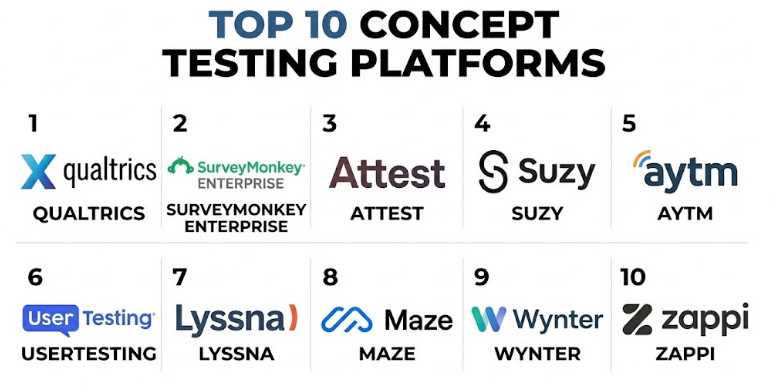
Top 10 Concept Testing Platforms
#1 — Qualtrics
Short description :
Qualtrics is an enterprise research and experience management platform that supports concept testing through advanced surveys, panels, segmentation, dashboards, and analytics. It is useful for businesses that need structured product, brand, customer, and market research at scale. Teams can test product ideas, messaging, ads, packaging, pricing, and customer experience concepts with detailed survey logic and reporting. Qualtrics is especially strong for organizations that require governance, research rigor, and enterprise-level reporting. It is a strong option for teams running complex concept testing programs across markets or customer segments.
Key Features
- Advanced survey design and logic
- Concept testing survey workflows
- Audience targeting and panel options depending on setup
- Segmentation and cross-tab analysis
- Text analytics and sentiment analysis
- Dashboards and stakeholder reporting
- Enterprise permissions and governance
Pros
- Strong for enterprise research programs
- Useful for complex concept testing and segmentation
- Powerful reporting and analytics options
Cons
- May be too complex for small teams
- Requires strong research design skills
- Pricing and implementation scope should be reviewed carefully
Platforms / Deployment
Web
Cloud deployment
Security & Compliance
Qualtrics may process survey responses, customer feedback, respondent data, research data, and personal information. Specific certifications such as SOC 2, ISO 27001, GDPR, HIPAA, or other compliance details should be verified directly by plan and use case.
Not publicly stated here for every setup.
Integrations & Ecosystem
Qualtrics fits enterprise concept testing and research workflows.
- CRM systems
- Customer experience platforms
- Data warehouses
- Analytics tools
- Survey panels
- Reporting dashboards
Support & Community
Qualtrics provides enterprise support, research resources, and implementation guidance depending on plan. It is best for organizations with mature research and insights teams.
#2 — SurveyMonkey
Short description :
SurveyMonkey is a popular survey and research platform that helps teams create concept testing surveys, collect responses, analyze results, and share reports. It is useful for marketers, founders, product teams, agencies, and small to mid-sized businesses that need accessible research tools. Teams can test names, ads, pricing ideas, product descriptions, feature ideas, and customer preferences. SurveyMonkey also offers audience access depending on setup, which can help teams reach respondents outside their own contact lists. It is a strong option for fast, practical, survey-based concept testing.
Key Features
- Survey builder and templates
- Concept testing survey questions
- Question logic and branching
- Audience panel options depending on setup
- Response analytics and charts
- Data export options
- Team collaboration features
Pros
- Easy to use for general concept testing
- Good for quick feedback and simple comparisons
- Suitable for small and mid-sized teams
Cons
- Advanced research design may require manual setup
- Deep analytics may need exports or higher plans
- Research quality depends heavily on question design
Platforms / Deployment
Web / mobile app availability
Cloud deployment
Security & Compliance
SurveyMonkey may process survey responses, respondent data, customer lists, research results, and team account data. Specific certifications and compliance details should be verified directly by plan and configuration.
Not publicly stated here for every setup.
Integrations & Ecosystem
SurveyMonkey fits accessible research and concept testing workflows.
- Email distribution
- CRM tools
- Collaboration platforms
- Audience panels
- Data exports
- Customer feedback workflows
Support & Community
SurveyMonkey has broad adoption and many templates. It is best for teams that need fast and simple survey-based testing.
#3 — Attest
Short description :
Attest is a consumer research platform designed to help brands test ideas, concepts, messaging, ads, brand perception, and market opportunities with target audiences. It is especially useful for agile consumer research where teams need feedback quickly. Attest helps businesses create surveys, reach relevant consumer groups, and analyze results in a structured way. It is practical for product launches, message testing, concept validation, and brand tracking. Attest is a strong option for marketing and product teams that need consumer feedback before making launch decisions.
Key Features
- Consumer survey research
- Audience targeting
- Concept and message testing
- Brand and market research workflows
- Survey templates and analysis
- Reporting dashboards
- Fast feedback collection
Pros
- Strong for agile consumer concept testing
- Useful for product and marketing validation
- Good audience targeting for consumer research
Cons
- B2B niche targeting should be validated
- Research quality depends on survey design
- Advanced custom research may require support
Platforms / Deployment
Web
Cloud deployment
Security & Compliance
Attest may process survey responses, respondent targeting data, research project data, and insight reports. Specific certifications and compliance details should be verified directly.
Not publicly stated.
Integrations & Ecosystem
Attest fits fast consumer concept testing and brand research.
- Survey research
- Audience panels
- Brand tracking
- Concept testing
- Message testing
- Insight reporting
Support & Community
Attest provides research support and platform guidance. It is best for teams that need quick consumer feedback with structured reporting.
#4 — Suzy
Short description :
Suzy is a consumer insights platform that helps brands collect real-time feedback from target audiences. It is useful for concept testing, product feedback, packaging research, ad testing, brand perception, and consumer sentiment studies. Suzy is especially relevant for consumer brands, marketing teams, innovation teams, and agencies that need fast market feedback. It helps teams ask questions, collect responses, and turn consumer input into usable insights. Suzy is a strong option for businesses that want quick consumer feedback to guide creative, product, and marketing decisions.
Key Features
- Consumer audience feedback
- Concept testing workflows
- Product and packaging research
- Brand and ad testing
- Real-time survey responses
- Reporting and insight dashboards
- Audience segmentation
Pros
- Good for fast consumer insights
- Useful for brands and agencies
- Practical for concept, ad, and product testing
Cons
- Not always ideal for complex B2B research
- Audience coverage should be validated by target market
- Research depth depends on project design
Platforms / Deployment
Web
Cloud deployment
Security & Compliance
Suzy may process survey responses, respondent data, consumer insights, research project data, and user account information. Specific security and compliance details should be verified directly.
Not publicly stated.
Integrations & Ecosystem
Suzy fits consumer insight and agile research workflows.
- Consumer surveys
- Concept testing
- Brand research
- Ad testing
- Product research
- Reporting dashboards
Support & Community
Suzy provides support for research and insight teams. It is best for consumer brands that need faster audience feedback.
#5 — aytm
Short description :
aytm is a consumer insights and research platform that supports concept testing, product testing, pricing research, packaging feedback, message testing, and market validation. It helps teams design surveys, reach target audiences, collect responses, and analyze results. aytm is useful for brands, agencies, product teams, and researchers that need structured consumer feedback. It supports both self-service and guided research depending on needs. aytm is a strong option for agile research teams that want consumer panel access and concept testing workflows in one place.
Key Features
- Survey design and fielding
- Consumer panel access
- Concept and product testing
- Pricing and packaging research
- Audience targeting
- Analytics and reporting
- Research support options depending on setup
Pros
- Strong for agile consumer concept research
- Useful for packaging, product, and pricing studies
- Good mix of platform and research support
Cons
- B2B targeting should be validated
- Complex studies may need research guidance
- Pricing depends on audience and sample needs
Platforms / Deployment
Web
Cloud deployment
Security & Compliance
aytm may process survey responses, respondent profiles, audience data, research data, and reports. Specific certifications and compliance details should be verified directly.
Not publicly stated.
Integrations & Ecosystem
aytm fits consumer concept testing and product validation workflows.
- Survey research
- Consumer panels
- Concept testing
- Packaging research
- Pricing research
- Insight reporting
Support & Community
aytm provides platform guidance and research support. It is best for teams that want structured consumer insights with flexible research options.
#6 — UserTesting
Short description :
UserTesting is a human insight platform that helps teams test concepts, prototypes, websites, apps, product experiences, messaging, and customer journeys with real users. It is especially useful when teams need qualitative feedback, video reactions, spoken thoughts, and usability insights. For concept testing, UserTesting can show early product ideas, ads, landing pages, wireframes, or prototypes to target participants and capture reactions. It is practical for product, UX, design, and marketing teams that want to understand why people respond in a certain way. UserTesting is a strong option for qualitative concept validation.
Key Features
- Video-based user feedback
- Concept and prototype testing
- Usability research
- Audience targeting depending on setup
- Task-based research workflows
- Research templates
- Insight sharing and collaboration
Pros
- Strong for qualitative concept feedback
- Useful for understanding user reactions and confusion
- Good for product, UX, and design teams
Cons
- Not mainly a large-scale survey platform
- Costs and participant access should be reviewed
- Research quality depends on task design
Platforms / Deployment
Web
Cloud deployment
Security & Compliance
UserTesting may process participant videos, research tasks, feedback, prototype data, and team insight records. Specific certifications and compliance details should be verified directly by use case.
Not publicly stated here for every setup.
Integrations & Ecosystem
UserTesting fits qualitative concept and experience testing workflows.
- UX research
- Prototype testing
- Message testing
- Customer journey research
- Product discovery
- Insight sharing
Support & Community
UserTesting provides research support and education resources. It is best for teams needing real human reactions to concepts and experiences.
#7 — Lyssna
Short description :
Lyssna is a user research platform that helps teams test concepts, designs, prototypes, preference choices, first impressions, and usability tasks with target audiences. It is useful for designers, product teams, marketers, startups, and UX researchers that need fast feedback on visuals, copy, layouts, and product ideas. Lyssna supports tests such as preference testing, five-second testing, prototype testing, and surveys depending on setup. It is especially practical for validating early design and message concepts before launch. Lyssna is a strong option for teams that need quick design-focused concept feedback.
Key Features
- Preference testing
- First impression testing
- Prototype and design testing
- Survey and question workflows
- Audience panel access depending on setup
- Results and reporting dashboards
- UX-focused research templates
Pros
- Strong for design and message concept testing
- Useful for fast UX and visual feedback
- Easy for product and design teams to use
Cons
- Not a full enterprise market research platform
- Deep segmentation may be limited compared with enterprise tools
- Best suited for design, UX, and creative testing
Platforms / Deployment
Web
Cloud deployment
Security & Compliance
Lyssna may process participant responses, design test materials, survey data, and user account data. Specific security and compliance details should be verified directly.
Not publicly stated.
Integrations & Ecosystem
Lyssna fits design-led concept testing and usability feedback workflows.
- Design tools
- Prototype testing
- Preference testing
- UX research
- Survey workflows
- Result exports
Support & Community
Lyssna provides resources for UX and design research teams. It is best for teams testing visual, product, and experience concepts.
#8 — Maze
Short description :
Maze is a product discovery and user research platform that helps teams test prototypes, product concepts, usability flows, copy, and user experience decisions. It is useful for product managers, designers, UX researchers, and startup teams that want feedback early in the product development process. Maze supports prototype testing, surveys, usability tasks, and research reports. For concept testing, teams can test early flows, product ideas, screens, messaging, and interaction concepts before full development. Maze is a strong option for product-led teams that want rapid validation inside design and product workflows.
Key Features
- Prototype testing
- Product concept validation
- Usability testing
- Survey and feedback questions
- Research templates
- Automated reports and dashboards
- Design tool integrations depending on setup
Pros
- Strong for product and prototype concept testing
- Useful for early validation before development
- Good fit for product and UX teams
Cons
- Not mainly a broad market panel platform
- Participant recruitment may require planning
- Best results require clear tasks and prototypes
Platforms / Deployment
Web
Cloud deployment
Security & Compliance
Maze may process prototype links, participant responses, test results, survey data, and team research data. Specific certifications and compliance details should be verified directly.
Not publicly stated.
Integrations & Ecosystem
Maze fits product discovery and design testing workflows.
- Design tools
- Prototype testing
- Product research
- UX workflows
- Survey feedback
- Research reporting
Support & Community
Maze provides resources for product and UX research teams. It is best for teams testing product concepts and user flows quickly.
#9 — Wynter
Short description :
Wynter is a message testing and B2B research platform that helps companies test website copy, landing pages, value propositions, ads, and positioning with target audiences. It is especially useful for B2B SaaS teams, marketers, founders, and product marketing teams that need feedback from business buyers. Wynter focuses on understanding whether messaging is clear, relevant, differentiated, and persuasive. For concept testing, it is useful when the concept is a value proposition, positioning statement, webpage, or campaign message. Wynter is a strong option for teams that want to validate messaging before launching campaigns.
Key Features
- Message testing
- Landing page and website copy testing
- B2B audience feedback
- Target audience panels depending on setup
- Qualitative response collection
- Clarity and relevance analysis
- Reporting and recommendations
Pros
- Strong for B2B message and positioning testing
- Useful for SaaS and product marketing teams
- Helps identify unclear or weak value propositions
Cons
- Not a general product concept testing platform
- Best fit is message and copy testing
- Audience availability should be checked for niche segments
Platforms / Deployment
Web
Cloud deployment
Security & Compliance
Wynter may process test materials, respondent feedback, audience targeting data, and research results. Specific security and compliance details should be verified directly.
Not publicly stated.
Integrations & Ecosystem
Wynter fits messaging and positioning research workflows.
- Landing page testing
- Website copy testing
- B2B audience panels
- Product marketing research
- Campaign message testing
- Report sharing
Support & Community
Wynter provides messaging-focused research support and resources. It is best for B2B teams that need clear feedback on positioning and copy.
#10 — Zappi
Short description :
Zappi is an insights automation platform used by brands to test ads, products, packaging, and innovation concepts. It helps teams run repeatable research studies and compare creative or product ideas with target consumers. Zappi is especially useful for consumer brands, innovation teams, and marketing teams that need faster concept feedback at scale. It supports testing workflows for advertising, product innovation, packaging, and brand development. Zappi is a strong option for companies that want structured concept testing as part of an ongoing insights process.
Key Features
- Concept testing workflows
- Ad and creative testing
- Product innovation research
- Packaging research support
- Consumer audience feedback
- Automated insights and reporting
- Benchmarking and repeatable study design depending on setup
Pros
- Strong for consumer brand concept testing
- Useful for repeatable innovation research
- Good fit for ads, packaging, and product ideas
Cons
- May be more suitable for established brands
- Research setup should match business decisions
- Pricing and methodology scope should be reviewed carefully
Platforms / Deployment
Web
Cloud deployment
Security & Compliance
Zappi may process concept materials, survey responses, consumer research data, creative assets, and insight reports. Specific certifications and compliance details should be verified directly.
Not publicly stated.
Integrations & Ecosystem
Zappi fits brand, creative, and product innovation testing workflows.
- Ad testing
- Product concept research
- Packaging feedback
- Consumer insights
- Innovation pipelines
- Reporting dashboards
Support & Community
Zappi provides insights automation support and research guidance. It is best for consumer brands and innovation teams running recurring concept tests.
Comparison Table Top 10
| Tool Name | Best For | Platform(s) Supported | Deployment | Standout Feature | Public Rating |
|---|---|---|---|---|---|
| Qualtrics | Enterprise concept testing and research governance | Web | Cloud | Advanced surveys, segmentation, and dashboards | N/A |
| SurveyMonkey | Fast survey-based concept testing | Web, mobile app availability | Cloud | Easy surveys and audience feedback | N/A |
| Attest | Agile consumer concept testing | Web | Cloud | Fast consumer feedback and insight reports | N/A |
| Suzy | Real-time consumer concept feedback | Web | Cloud | Quick brand, product, and ad feedback | N/A |
| aytm | Consumer product, pricing, and packaging tests | Web | Cloud | Structured consumer research workflows | N/A |
| UserTesting | Qualitative concept and prototype feedback | Web | Cloud | Video-based real user reactions | N/A |
| Lyssna | Design and UX concept testing | Web | Cloud | Preference and first-impression testing | N/A |
| Maze | Product concept and prototype validation | Web | Cloud | Rapid product and usability testing | N/A |
| Wynter | B2B message and positioning testing | Web | Cloud | Targeted feedback on copy and value proposition | N/A |
| Zappi | Consumer brand and innovation concept testing | Web | Cloud | Repeatable ad, product, and packaging research | N/A |
Evaluation & Concept Testing Platforms
| Tool Name | Core 25% | Ease 15% | Integrations 15% | Security 10% | Performance 10% | Support 10% | Value 15% | Weighted Total 0–10 |
|---|---|---|---|---|---|---|---|---|
| Qualtrics | 9.4 | 7.6 | 9.0 | 8.8 | 9.0 | 8.7 | 7.6 | 8.65 |
| SurveyMonkey | 8.3 | 9.0 | 8.3 | 8.2 | 8.5 | 8.2 | 8.5 | 8.41 |
| Attest | 8.8 | 8.4 | 8.0 | 8.2 | 8.5 | 8.3 | 8.0 | 8.34 |
| Suzy | 8.6 | 8.4 | 8.0 | 8.2 | 8.5 | 8.3 | 8.0 | 8.30 |
| aytm | 8.7 | 8.3 | 8.2 | 8.2 | 8.5 | 8.3 | 8.1 | 8.36 |
| UserTesting | 8.8 | 8.0 | 8.2 | 8.4 | 8.6 | 8.5 | 7.8 | 8.36 |
| Lyssna | 8.2 | 8.8 | 8.0 | 8.0 | 8.4 | 8.0 | 8.4 | 8.28 |
| Maze | 8.5 | 8.6 | 8.4 | 8.2 | 8.5 | 8.2 | 8.3 | 8.42 |
| Wynter | 8.3 | 8.5 | 7.8 | 8.0 | 8.3 | 8.2 | 8.2 | 8.20 |
| Zappi | 8.8 | 8.0 | 8.2 | 8.3 | 8.6 | 8.4 | 7.9 | 8.34 |
These scores are comparative and should be used as a starting point. Enterprise teams may rate Qualtrics higher because governance and reporting matter. Consumer brands may prefer Attest, Suzy, aytm, or Zappi. Product and UX teams may prefer Maze, Lyssna, or UserTesting. B2B SaaS and product marketing teams may prefer Wynter for message testing.
Which Concept Testing Platform Should You Choose?
Solo / Founder
A solo founder should start with a simple and affordable way to validate an idea before building too much. SurveyMonkey, Typeform-style survey tools, Lyssna, Maze, or Wynter can be useful depending on the concept.
The goal should be to answer basic questions: Do people understand the idea? Do they care? Would they choose it over alternatives? What feels unclear or weak?
Startup
Startups need fast concept feedback for product ideas, landing pages, pricing, positioning, and prototypes. Maze, Lyssna, UserTesting, SurveyMonkey, and Wynter are strong options.
Startups should test early and often. A simple concept test before building can save time, budget, and engineering effort.
SMB
Small and mid-sized businesses may need to test product ideas, new services, packaging, ad concepts, and customer messages. SurveyMonkey, Attest, aytm, UserTesting, and Lyssna are practical options.
SMBs should focus on clarity, customer relevance, purchase intent, and objections. These signals are often more useful than just asking whether people “like” the idea.
Mid-Market Business
Mid-market teams often need stronger segmentation, repeatable studies, stakeholder reporting, and audience testing. Attest, Suzy, aytm, Zappi, and Qualtrics are strong options.
At this stage, concept testing should become part of product, marketing, and innovation workflows, not just a one-time activity.
Enterprise
Enterprise organizations need governance, advanced analytics, global audience testing, permissions, repeatable methodologies, and executive reporting. Qualtrics, Zappi, aytm, UserTesting, and Attest are strong options to evaluate.
Enterprise buyers should involve research, marketing, product, legal, brand, analytics, and customer experience teams before selecting a platform.
Product Team
Product teams should prioritize prototype testing, usability feedback, feature validation, and product discovery. Maze, UserTesting, Lyssna, and Qualtrics are useful depending on research depth.
Product teams should test both the concept and the user experience. A good idea can still fail if the workflow is confusing.
Marketing Team
Marketing teams often need message testing, ad testing, campaign concept testing, landing page testing, and brand positioning research. Wynter, Attest, Suzy, SurveyMonkey, and Zappi are strong options.
Marketing tests should focus on clarity, relevance, differentiation, believability, and action intent.
Consumer Brand
Consumer brands should test product concepts, packaging, names, ads, claims, and purchase drivers. Zappi, aytm, Attest, Suzy, and Qualtrics are strong platforms.
Consumer concept testing should include visual assets whenever possible because packaging, imagery, and creative presentation strongly affect response.
B2B Company
B2B teams need feedback from the right roles, not just general consumers. Wynter, UserTesting, Qualtrics, and targeted survey panel workflows are useful options.
B2B concept testing should validate pain point strength, budget relevance, decision-maker clarity, and competitive differentiation.
Budget vs Premium
Budget-focused teams should start with simple survey or UX testing tools. A small test with clear questions is often better than a large expensive study with vague goals.
Premium platforms become valuable when teams need audience panels, advanced analytics, global research, brand benchmarks, repeatable methodologies, or enterprise governance.
Feature Depth vs Ease of Use
SurveyMonkey is easier for simple concept surveys. Attest, Suzy, aytm, and Zappi are stronger for consumer research. UserTesting is better for qualitative reactions. Lyssna and Maze are strong for design and prototype validation. Wynter is strong for B2B messaging. Qualtrics is strongest for enterprise research structure.
The best platform depends on whether the concept is a product idea, design, prototype, ad, message, packaging, pricing plan, or brand positioning.
Integrations & Scalability
Concept testing platforms may need to connect with survey tools, design tools, prototype tools, CRM systems, customer panels, data warehouses, research repositories, analytics platforms, and reporting dashboards.
Scalability means handling more concepts, more audiences, more markets, more stakeholders, more comparisons, more research templates, and more decision-ready reports.
Security & Compliance Needs
Concept testing platforms may store confidential product ideas, unreleased designs, customer feedback, respondent data, research videos, prototype links, and marketing concepts. Buyers should review data retention, access permissions, encryption, participant consent, and confidentiality controls.
Teams should also avoid sharing sensitive product concepts with the wrong audience or without proper internal approval.
Frequently Asked Questions FAQs
1. What is a Concept Testing Platform?
A Concept Testing Platform helps businesses test early ideas, products, features, ads, messages, packaging, or designs with target audiences before launching or investing heavily.
2. Why is concept testing important?
Concept testing helps reduce risk by showing whether people understand, like, trust, and want an idea. It also reveals objections, confusion, weak messaging, and improvement opportunities.
3. What can be tested with concept testing tools?
Teams can test product ideas, feature ideas, brand names, logos, packaging, ads, landing pages, pricing plans, value propositions, prototypes, and campaign messages.
4. Which platform is best for startups?
Maze, Lyssna, SurveyMonkey, UserTesting, and Wynter are useful for startups depending on whether the startup needs product feedback, design testing, survey validation, or message testing.
5. Which platform is best for consumer product testing?
Attest, Suzy, aytm, Zappi, and Qualtrics are strong options for consumer product concept testing. They are useful for testing ideas with target consumer audiences.
6. Which platform is best for B2B message testing?
Wynter is useful for B2B message and positioning testing. UserTesting and Qualtrics can also support B2B concept testing depending on audience access and research design.
7. Which platform is best for prototype testing?
Maze, UserTesting, and Lyssna are strong options for prototype and design concept testing. They help teams understand usability, clarity, first impressions, and user reactions.
8. What are common concept testing mistakes?
Common mistakes include testing with the wrong audience, asking leading questions, showing unclear concepts, only asking if people “like” the idea, and ignoring open-ended feedback.
9. How many concepts should be tested at once?
It depends on the study. Testing too many concepts can overwhelm respondents. Many teams compare a small number of strong concepts to understand preference and reasons behind choice.
10. Can concept testing predict market success?
Concept testing can reduce risk and reveal customer reactions, but it cannot guarantee success. Execution, pricing, timing, distribution, competition, and customer experience also matter.
Conclusion
Concept Testing Platforms help businesses validate ideas before spending heavily on development, production, advertising, or launch. The right platform depends on what type of concept you are testing and who needs to evaluate it. Qualtrics is strong for enterprise research and advanced segmentation. SurveyMonkey is practical for fast survey-based concept testing. Attest, Suzy, aytm, and Zappi are useful for consumer research, product testing, packaging, and creative validation. UserTesting helps teams capture qualitative reactions from real users. Lyssna and Maze are strong for design, UX, and prototype testing. Wynter is valuable for B2B messaging and positioning tests.
