Introduction
Market Research Platforms help businesses collect, analyze, and understand market data, customer behavior, audience needs, competitor activity, product demand, brand perception, and industry trends. In simple words, these platforms help companies make better decisions by using research instead of guessing.
Market research is useful before launching a product, entering a new market, changing pricing, testing brand messaging, improving customer experience, or understanding what buyers really want. These platforms can support surveys, audience panels, consumer insights, social listening, competitive analysis, usability testing, sentiment analysis, market sizing, and trend discovery.
Real-world use cases include:
- Understanding customer needs and buying behavior
- Testing product ideas before launch
- Measuring brand awareness and customer sentiment
- Running surveys with target audiences
- Studying competitors and market positioning
- Identifying market trends and category opportunities
- Collecting feedback on pricing, packaging, ads, or messaging
- Supporting strategic planning with research data
Buyers should evaluate:
- Survey and questionnaire capabilities
- Audience panel quality and targeting
- Data collection methods
- Research templates and methodology support
- Analytics and dashboard features
- AI-assisted insight generation
- Customer segmentation tools
- Competitor and market intelligence support
- Data export and reporting options
- Collaboration and team workflows
- Security, privacy, and compliance controls
- Pricing, scalability, and support quality
Best for: product teams, marketing teams, founders, agencies, researchers, strategy teams, customer experience teams, brand teams, ecommerce businesses, SaaS companies, enterprises, and consultants who need structured market and customer insights.
Not ideal for: teams that only need informal feedback from a few customers, businesses that are not ready to act on insights, or companies looking for guaranteed answers without research design. A market research platform can collect and analyze data, but good decisions still need human judgment and clear business questions.
Key Trends in Market Research Platforms
- AI-assisted research is becoming common: Platforms are using AI to summarize responses, identify themes, generate survey ideas, classify sentiment, and speed up insight discovery.
- Research is becoming faster and more agile: Teams want quick customer feedback before making product, marketing, or pricing decisions.
- Audience targeting is more important: Businesses need access to specific buyer groups, job roles, industries, demographics, regions, or customer segments.
- Mixed-method research is growing: Companies now combine surveys, interviews, usability tests, behavioral data, reviews, and social listening for a fuller picture.
- Self-service research is expanding: Non-research teams want easy tools to run surveys and analyze responses without always depending on external agencies.
- Brand tracking is becoming continuous: Instead of one-time studies, brands want ongoing visibility into awareness, perception, customer sentiment, and competitor movement.
- Customer feedback and market research are merging: Product teams use research platforms alongside customer support, product analytics, reviews, and NPS data.
- Privacy and consent matter more: Research platforms must handle respondent data responsibly, especially when collecting personal, behavioral, or demographic information.
- Visual dashboards are replacing static reports: Stakeholders want easy-to-read dashboards, charts, summaries, and shareable insights.
- Research quality is a major concern: Poor survey design, low-quality panels, biased samples, and weak questions can lead to misleading conclusions.
How We Selected These Tools Methodology
The tools below were selected based on market research relevance, market recognition, feature depth, audience access, analytics quality, ease of use, and practical value for different research teams.
- Research capability: Survey creation, audience panels, interviews, product testing, brand tracking, and customer feedback collection were considered.
- Audience access: Panel quality, targeting depth, respondent validation, and global reach were reviewed.
- Analytics depth: Dashboards, segmentation, cross-tabs, sentiment analysis, text analytics, and AI-assisted summaries were evaluated.
- Ease of use: Survey builder experience, templates, reporting, and non-technical usability were considered.
- Research quality controls: Sample management, response validation, fraud prevention, and bias-reduction support were reviewed.
- Business use cases: Product research, brand research, customer experience, pricing research, competitor research, and market sizing were considered.
- Collaboration: Team workspaces, sharing, stakeholder reports, permissions, and project management features were considered.
- Integration ecosystem: CRM, analytics tools, data warehouses, customer feedback systems, and reporting exports were reviewed.
- Scalability: Tools for startups, agencies, mid-market teams, enterprise research teams, and global organizations were included.
- Practical buyer fit: The goal is not one universal winner, but a useful comparison based on research maturity and business need.
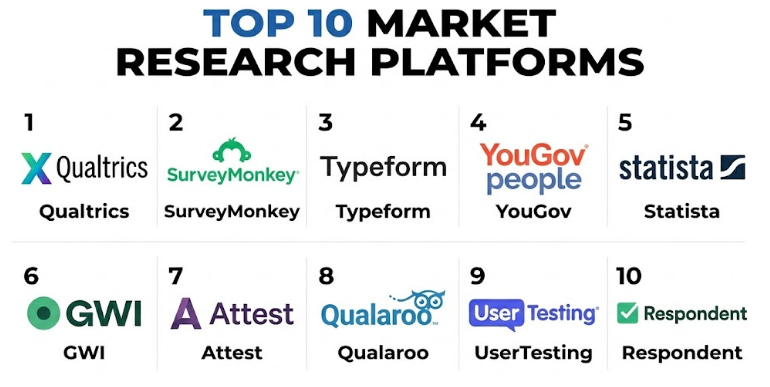
Top 10 Market Research Platforms
#1 — Qualtrics
Short description :
Qualtrics is an enterprise experience management and research platform used for market research, customer experience, employee experience, product research, and brand tracking. It helps organizations create surveys, manage research programs, analyze feedback, and generate insights across different audiences. Qualtrics is especially useful for larger companies that need advanced research workflows, governance, segmentation, and reporting. It supports complex survey logic, dashboards, text analytics, and enterprise collaboration. Qualtrics is a strong option for organizations that treat research and experience data as strategic business assets.
Key Features
- Advanced survey creation
- Customer and market research workflows
- Brand and experience tracking
- Text analytics and sentiment analysis
- Dashboards and reporting
- Audience and panel options depending on setup
- Enterprise permissions and governance
Pros
- Strong enterprise research and experience management capability
- Useful for complex surveys and advanced reporting
- Good fit for large teams and structured research programs
Cons
- May be too complex for small teams
- Requires thoughtful research design and setup
- Pricing and implementation scope should be reviewed carefully
Platforms / Deployment
Web
Cloud deployment
Security & Compliance
Qualtrics may process survey responses, customer feedback, employee feedback, research data, and personal information. Specific certifications such as SOC 2, ISO 27001, GDPR, HIPAA, or other compliance details should be verified directly.
Not publicly stated here for every plan and use case.
Integrations & Ecosystem
Qualtrics fits enterprise research and experience management workflows.
- CRM systems
- Customer experience platforms
- HR systems
- Analytics tools
- Data warehouses
- Reporting dashboards
Support & Community
Qualtrics provides enterprise support, training resources, and research guidance depending on plan. It is best for organizations with mature research, CX, or strategy teams.
#2 — SurveyMonkey
Short description :
SurveyMonkey is a widely used survey and market research platform that helps teams create surveys, collect responses, analyze results, and share reports. It is useful for businesses of many sizes, from small teams running simple surveys to larger teams conducting customer, employee, product, and market research. SurveyMonkey is especially practical for quick feedback, customer research, concept testing, and simple brand studies. It offers survey templates, question logic, analytics, and audience options depending on plan. SurveyMonkey is a strong option for teams that need an easy, flexible survey platform.
Key Features
- Survey creation and templates
- Question logic and branching
- Audience panel options depending on setup
- Response collection and analysis
- Charts and reporting
- Team collaboration features
- Data export options
Pros
- Easy to use for many survey types
- Good for quick feedback and simple research
- Flexible enough for small and mid-sized teams
Cons
- Advanced research workflows may need higher plans
- Complex analytics may require exports or integrations
- Research quality still depends on question design
Platforms / Deployment
Web / mobile app availability
Cloud deployment
Security & Compliance
SurveyMonkey may process survey responses, respondent data, team data, and research results. Specific certifications and compliance details should be verified directly by plan and use case.
Not publicly stated here for every setup.
Integrations & Ecosystem
SurveyMonkey fits general survey and feedback workflows.
- CRM tools
- Email tools
- Collaboration platforms
- Analytics exports
- Customer feedback workflows
- Audience panels
Support & Community
SurveyMonkey has broad user adoption and helpful support resources. It is best for teams that need survey speed and simplicity.
#3 — Typeform
Short description :
Typeform is a form, survey, and research data collection platform known for its conversational design and user-friendly response experience. It helps businesses create surveys, quizzes, feedback forms, lead forms, product research forms, and customer questionnaires. Typeform is especially useful when response experience matters and teams want forms that feel engaging rather than traditional. It works well for customer discovery, product feedback, concept testing, brand research, and audience segmentation. Typeform is a strong option for teams that want visually clean and interactive research forms.
Key Features
- Conversational survey builder
- Custom forms and questionnaires
- Conditional logic
- Templates for research and feedback
- Response analytics
- Integrations and automation support
- Brand customization options
Pros
- Strong user experience for respondents
- Good for customer discovery and feedback forms
- Easy to create polished surveys
Cons
- Not as deep as enterprise research platforms
- Large-scale research may require added analytics tools
- Response quality still depends on audience and question design
Platforms / Deployment
Web
Cloud deployment
Security & Compliance
Typeform may process survey responses, customer data, form submissions, and lead information. Specific certifications and compliance details should be verified directly.
Not publicly stated here for every plan.
Integrations & Ecosystem
Typeform fits research workflows that need clean data collection and good response experience.
- CRM systems
- Email marketing tools
- Automation platforms
- Analytics tools
- Product feedback workflows
- Lead capture systems
Support & Community
Typeform has a strong user community and many templates. It is best for teams that want engaging forms and simple research collection.
#4 — YouGov
Short description :
YouGov is a research and data platform known for audience insights, public opinion research, brand tracking, consumer behavior data, and panel-based research. It is useful for brands, agencies, media companies, governments, and strategy teams that need survey data and consumer opinion insights. YouGov is especially relevant for understanding market perception, audience attitudes, brand health, and demographic trends. It can support custom research and syndicated data depending on needs. YouGov is a strong option for teams needing access to broad consumer opinion and audience intelligence.
Key Features
- Audience and consumer research
- Public opinion insights
- Brand tracking
- Panel-based survey research
- Demographic and behavioral segmentation
- Market and category insights
- Reporting and analysis support
Pros
- Strong consumer opinion and audience insight capability
- Useful for brand and market perception studies
- Good fit for agencies and strategy teams
Cons
- May be more research-service oriented than self-service tools
- Pricing and access depend on research needs
- Not ideal for simple internal surveys
Platforms / Deployment
Web / service-supported research workflows
Cloud deployment
Security & Compliance
YouGov may process respondent data, survey responses, demographic information, and research datasets. Specific privacy, security, and compliance details should be verified directly.
Not publicly stated here for every research use case.
Integrations & Ecosystem
YouGov fits market research and audience insight programs.
- Consumer panels
- Brand tracking
- Opinion research
- Agency reporting
- Audience segmentation
- Market studies
Support & Community
YouGov provides research support and data products. It is best for organizations that need consumer intelligence and opinion-based market research.
#5 — Statista
Short description :
Statista is a market and business data platform that provides statistics, reports, forecasts, industry data, consumer insights, and market research summaries. It is useful for strategy teams, marketers, analysts, researchers, students, consultants, and business leaders who need quick access to market data. Statista helps teams understand industry size, market trends, consumer behavior, and category-level insights. It is not mainly a primary research survey platform, but it is strong for secondary research and market data discovery. Statista is a practical option for teams that need reliable market context and data points.
Key Features
- Market statistics and datasets
- Industry reports
- Consumer and business insights
- Market forecasts
- Downloadable charts and reports
- Category and country-level data
- Research library access
Pros
- Good for fast secondary market research
- Useful for reports, planning, and presentations
- Broad industry and category coverage
Cons
- Not a primary survey collection platform
- Data depth varies by topic and region
- Users should validate critical decisions with multiple inputs
Platforms / Deployment
Web
Cloud deployment
Security & Compliance
Statista may process user account data, research activity, downloads, and subscription access information. Specific compliance details should be verified directly.
Not publicly stated.
Integrations & Ecosystem
Statista fits secondary research and market data workflows.
- Market reports
- Industry research
- Business planning
- Strategy presentations
- Analyst workflows
- Research libraries
Support & Community
Statista provides research access and business data resources. It is best for teams that need market context, statistics, and industry data.
#6 — GWI
Short description :
GWI is a consumer research and audience insights platform that helps businesses understand audience behavior, attitudes, media habits, purchase drivers, and consumer trends. It is useful for marketers, agencies, media teams, brand strategists, and research teams that need deep consumer profiling. GWI is especially helpful for audience segmentation, campaign planning, brand positioning, and market analysis. It provides access to structured consumer data across markets and segments depending on product coverage. GWI is a strong option for teams that need audience intelligence for marketing and strategy.
Key Features
- Consumer audience insights
- Behavioral and attitudinal data
- Audience segmentation
- Media consumption insights
- Brand and purchase behavior analysis
- Trend tracking
- Reporting and visualization tools
Pros
- Strong consumer audience profiling
- Useful for marketing and media strategy
- Good for understanding buyer behavior and motivations
Cons
- Not mainly a custom survey builder
- Best value depends on target markets and audience needs
- Requires research skills to interpret insights properly
Platforms / Deployment
Web
Cloud deployment
Security & Compliance
GWI may process research datasets, audience insights, user queries, and reporting workflows. Specific privacy and compliance details should be verified directly.
Not publicly stated.
Integrations & Ecosystem
GWI fits consumer research and audience planning workflows.
- Audience segmentation
- Brand strategy
- Media planning
- Consumer trend research
- Campaign planning
- Market analysis
Support & Community
GWI provides support and research resources for audience insight teams. It is best for marketers and strategists needing consumer intelligence.
#7 — Attest
Short description :
Attest is a consumer research platform that helps businesses run surveys, access target audiences, test ideas, measure brand health, and understand customer preferences. It is designed for teams that want faster access to consumer insights without relying only on traditional research agencies. Attest is useful for brand research, concept testing, messaging tests, market validation, and customer understanding. It offers audience targeting and survey workflows to help teams collect structured feedback. Attest is a strong option for brands that need agile consumer research.
Key Features
- Consumer survey research
- Audience targeting
- Concept and message testing
- Brand tracking support
- Market validation workflows
- Survey templates and analysis
- Insight reporting
Pros
- Good for agile consumer research
- Useful for validating product and marketing ideas
- Helpful for brand and market questions
Cons
- Not a general-purpose business intelligence platform
- Research quality depends on survey design
- Audience coverage should be checked for target markets
Platforms / Deployment
Web
Cloud deployment
Security & Compliance
Attest may process survey responses, audience targeting data, respondent information, and research results. Specific certifications and compliance details should be verified directly.
Not publicly stated.
Integrations & Ecosystem
Attest fits consumer research and brand insight workflows.
- Survey research
- Audience panels
- Brand tracking
- Concept testing
- Messaging research
- Reporting dashboards
Support & Community
Attest provides research support and platform guidance. It is best for teams that want fast, structured consumer insight.
#8 — Qualaroo
Short description :
Qualaroo is a customer research and feedback platform that helps businesses collect in-context feedback through website surveys, product surveys, and targeted questions. It is useful for product teams, UX teams, marketers, and customer experience teams that want to understand visitor intent, objections, product friction, and customer needs. Qualaroo is especially practical for website feedback, conversion research, and user experience research. It can help teams ask the right question at the right moment inside a digital experience. Qualaroo is a strong option for businesses that want qualitative customer insights from real users.
Key Features
- Website and product feedback surveys
- Targeted in-context questions
- Customer intent research
- UX and conversion feedback
- Survey logic and segmentation
- Response analysis
- Reporting and exports
Pros
- Good for collecting feedback from real users
- Useful for UX and conversion research
- Helps identify customer objections and friction points
Cons
- Not a full market panel research platform
- Best results require careful question placement
- Too many prompts can hurt user experience
Platforms / Deployment
Web
Cloud deployment
Security & Compliance
Qualaroo may process website visitor responses, customer feedback, user segments, and behavioral targeting data. Specific security and compliance details should be verified directly.
Not publicly stated.
Integrations & Ecosystem
Qualaroo fits website and product feedback research workflows.
- Website surveys
- Product feedback
- UX research
- Conversion optimization
- Customer experience tools
- Analytics exports
Support & Community
Qualaroo provides support resources for customer feedback and UX research. It is best for teams that need in-context customer insights.
#9 — UserTesting
Short description :
UserTesting is a human insight and user research platform that helps teams test products, websites, prototypes, concepts, messaging, and customer experiences with real users. It is useful for product teams, UX researchers, designers, marketers, and customer experience teams. UserTesting helps teams capture video feedback, usability observations, spoken reactions, and user behavior insights. It is especially strong for understanding why users behave a certain way, not just what they clicked. UserTesting is a strong option for teams that need qualitative market and user research.
Key Features
- User testing and usability research
- Video feedback from participants
- Prototype and concept testing
- Customer experience research
- Audience targeting depending on setup
- Research templates
- Insight sharing and collaboration
Pros
- Strong for qualitative user insights
- Useful for product, UX, and message testing
- Helps teams see real user reactions
Cons
- Not mainly a large-scale survey platform
- Costs and participant access should be reviewed
- Research quality depends on test design
Platforms / Deployment
Web
Cloud deployment
Security & Compliance
UserTesting may process participant videos, research tasks, user feedback, prototype data, and customer experience insights. Specific certifications and compliance details should be verified directly.
Not publicly stated here for every use case.
Integrations & Ecosystem
UserTesting fits user research and customer experience workflows.
- UX research
- Product testing
- Prototype validation
- Message testing
- Customer journey research
- Team insight sharing
Support & Community
UserTesting provides research support and user testing resources. It is best for teams that need real human feedback on experiences and concepts.
#10 — Respondent
Short description :
Respondent is a research participant recruitment platform that helps teams find people for interviews, surveys, user research, and professional research studies. It is useful for product teams, UX researchers, marketers, founders, consultants, and agencies that need access to specific audience segments. Respondent is especially helpful for B2B research because teams can recruit professionals by role, industry, skills, or experience depending on availability. It is not a complete research analytics platform by itself, but it is strong for finding qualified participants. Respondent is a practical option when participant quality is the main research challenge.
Key Features
- Research participant recruitment
- Professional audience targeting
- Interview and survey recruitment support
- Screener questions
- Participant scheduling workflows
- Incentive management support depending on setup
- Research project management basics
Pros
- Strong for recruiting specific research participants
- Useful for B2B and professional research
- Helps teams find people outside their existing customer base
Cons
- Not a full survey or analytics platform
- Research design must be handled separately
- Participant quality depends on screening and targeting
Platforms / Deployment
Web
Cloud deployment
Security & Compliance
Respondent may process participant profiles, screener responses, research invitations, scheduling data, and incentive-related information. Specific compliance and privacy details should be verified directly.
Not publicly stated.
Integrations & Ecosystem
Respondent fits research workflows that need participant recruitment.
- User interviews
- B2B research
- Product discovery
- Survey recruitment
- UX research
- Professional audience studies
Support & Community
Respondent provides participant recruitment workflows and research support resources. It is best for teams that need access to specific research audiences.
Comparison Table Top 10
| Tool Name | Best For | Platform(s) Supported | Deployment | Standout Feature | Public Rating |
|---|---|---|---|---|---|
| Qualtrics | Enterprise research and experience management | Web | Cloud | Advanced surveys, dashboards, and governance | N/A |
| SurveyMonkey | General surveys and quick feedback | Web, mobile app availability | Cloud | Easy survey creation and response analysis | N/A |
| Typeform | Engaging surveys and customer discovery forms | Web | Cloud | Conversational survey experience | N/A |
| YouGov | Consumer opinion and audience research | Web | Cloud | Panel-based consumer and public opinion insights | N/A |
| Statista | Secondary market research and industry data | Web | Cloud | Market statistics and industry reports | N/A |
| GWI | Consumer audience intelligence | Web | Cloud | Audience behavior and attitude insights | N/A |
| Attest | Agile consumer research | Web | Cloud | Fast audience surveys and concept testing | N/A |
| Qualaroo | Website and product feedback research | Web | Cloud | In-context customer feedback prompts | N/A |
| UserTesting | Qualitative user and concept testing | Web | Cloud | Video-based real user feedback | N/A |
| Respondent | Research participant recruitment | Web | Cloud | Qualified participant sourcing for research | N/A |
Evaluation & Market Research Platforms
| Tool Name | Core 25% | Ease 15% | Integrations 15% | Security 10% | Performance 10% | Support 10% | Value 15% | Weighted Total 0–10 |
|---|---|---|---|---|---|---|---|---|
| Qualtrics | 9.5 | 7.6 | 9.0 | 8.8 | 9.0 | 8.7 | 7.6 | 8.68 |
| SurveyMonkey | 8.5 | 9.0 | 8.3 | 8.2 | 8.5 | 8.2 | 8.4 | 8.47 |
| Typeform | 8.0 | 9.2 | 8.4 | 8.0 | 8.4 | 8.0 | 8.3 | 8.33 |
| YouGov | 8.8 | 7.8 | 8.0 | 8.4 | 8.7 | 8.5 | 7.8 | 8.31 |
| Statista | 8.2 | 8.8 | 7.5 | 8.2 | 8.5 | 8.0 | 8.4 | 8.21 |
| GWI | 8.8 | 8.0 | 8.0 | 8.3 | 8.7 | 8.4 | 7.8 | 8.34 |
| Attest | 8.6 | 8.4 | 8.0 | 8.2 | 8.5 | 8.3 | 8.0 | 8.31 |
| Qualaroo | 8.0 | 8.7 | 8.2 | 8.0 | 8.3 | 8.0 | 8.4 | 8.24 |
| UserTesting | 8.8 | 8.0 | 8.2 | 8.4 | 8.6 | 8.5 | 7.8 | 8.36 |
| Respondent | 8.0 | 8.5 | 7.6 | 8.0 | 8.2 | 8.0 | 8.2 | 8.07 |
These scores are comparative and should be used as a starting point. Enterprise teams may rate Qualtrics higher because governance, scale, and reporting matter. Small teams may prefer SurveyMonkey or Typeform because ease of use matters. Marketing and strategy teams may prefer YouGov, Statista, GWI, or Attest. Product and UX teams may prefer UserTesting, Qualaroo, or Respondent.
Which Market Research Platform Should You Choose?
Solo / Founder
A solo founder should start with simple, fast research tools. Typeform, SurveyMonkey, Qualaroo, and Respondent can be useful depending on whether the founder needs surveys, website feedback, or interview participants.
At this stage, the goal is not perfect research. The goal is to reduce uncertainty before building, pricing, or launching something.
Startup
Startups need fast customer discovery, concept validation, pricing feedback, and message testing. SurveyMonkey, Typeform, Attest, UserTesting, and Respondent are good platforms to compare.
Startups should focus on clear questions: who has the problem, how painful it is, what alternatives customers use, and what would make them switch.
SMB
Small and mid-sized businesses should choose tools based on research maturity. SurveyMonkey and Typeform work well for general surveys. Qualaroo is useful for website feedback. UserTesting helps with product and usability research. Statista helps with market context.
SMBs should avoid running surveys without a clear decision to make. Research should support product, marketing, pricing, or customer experience decisions.
Mid-Market Business
Mid-market teams may need brand tracking, customer research, audience studies, product validation, and customer experience insights. Attest, GWI, SurveyMonkey, UserTesting, and Qualtrics are strong options.
At this stage, research should become more repeatable. Teams should document audience segments, research questions, survey templates, and reporting standards.
Enterprise
Enterprise organizations need governance, permissions, advanced reporting, global research programs, data privacy controls, and stakeholder dashboards. Qualtrics, YouGov, GWI, UserTesting, and Statista are strong options to evaluate.
Enterprise buyers should involve research, product, marketing, customer experience, legal, data, and strategy teams before choosing a platform.
Agency or Consultant
Agencies need tools that help them run surveys, analyze audiences, present insights, recruit participants, and support client strategy. SurveyMonkey, Typeform, Statista, GWI, Attest, and Respondent are useful depending on client needs.
Agencies should prioritize repeatable research workflows, clean reporting, and credible audience sources.
Product Team
Product teams need customer discovery, usability feedback, concept testing, feature validation, and in-product feedback. UserTesting, Qualaroo, Respondent, Typeform, and SurveyMonkey are strong options.
Product research should combine what customers say with what customers do. Survey data is useful, but it should be compared with product usage and customer behavior.
Marketing Team
Marketing teams often need audience insights, brand perception, message testing, campaign feedback, and competitive context. GWI, Attest, YouGov, Statista, and SurveyMonkey are strong options.
Marketing teams should use research to improve targeting, positioning, copy, creative direction, and campaign planning.
Budget vs Premium
Budget-focused teams should start with simple survey and feedback tools before investing in enterprise research systems. A well-designed small survey can be more useful than a large but unclear research project.
Premium platforms become valuable when teams need global audience access, advanced analytics, governance, brand tracking, panel research, or ongoing research programs.
Feature Depth vs Ease of Use
SurveyMonkey and Typeform are easier for general surveys. Qualtrics is stronger for enterprise research. YouGov, GWI, and Attest are stronger for consumer audience insight. Statista is strong for secondary research. UserTesting is better for qualitative user feedback. Respondent is useful for participant recruitment. Qualaroo is best for in-context website and product feedback.
The best platform depends on whether the main need is surveys, consumer panels, market data, user testing, participant recruitment, or website feedback.
Integrations & Scalability
Market research platforms may need to connect with CRM systems, analytics tools, customer feedback platforms, email tools, data warehouses, product analytics tools, BI dashboards, and collaboration tools.
Scalability means handling more research projects, more respondents, more markets, more teams, more reports, more permissions, and more data governance needs.
Security & Compliance Needs
Market research platforms may process personal data, survey responses, demographics, customer opinions, video recordings, product feedback, and confidential business questions. Buyers should review consent workflows, data retention, access controls, encryption, respondent privacy, and compliance requirements.
Teams should also avoid collecting unnecessary sensitive information unless there is a clear research reason and proper consent.
Frequently Asked Questions FAQs
1. What is a Market Research Platform?
A Market Research Platform helps businesses collect and analyze data about customers, markets, competitors, products, brands, and trends. It supports better decisions through structured research.
2. Why is market research important?
Market research helps businesses understand customer needs, reduce risk, test ideas, improve messaging, identify market opportunities, and avoid decisions based only on assumptions.
3. Which platform is best for surveys?
SurveyMonkey, Typeform, and Qualtrics are strong survey platforms. SurveyMonkey is practical for general surveys, Typeform is strong for engaging forms, and Qualtrics is better for enterprise research.
4. Which platform is best for consumer insights?
YouGov, GWI, Attest, and Qualtrics are useful for consumer insights. The best option depends on audience targeting, region, sample size, and research goals.
5. Which platform is best for product research?
UserTesting, Qualaroo, Respondent, Typeform, and SurveyMonkey are useful for product research. They help teams test ideas, gather user feedback, and understand product friction.
6. Which platform is best for secondary market data?
Statista is useful for secondary market data, industry statistics, charts, and reports. Teams should combine secondary research with primary research when making important decisions.
7. What is the difference between primary and secondary research?
Primary research collects new data directly from respondents, customers, or users. Secondary research uses existing reports, statistics, studies, and market data that have already been collected.
8. What are common market research mistakes?
Common mistakes include asking biased questions, surveying the wrong audience, using too small a sample, ignoring qualitative feedback, overtrusting one data source, and running research without a clear decision goal.
9. Can AI replace market researchers?
No. AI can summarize responses, detect themes, and speed up analysis, but humans are still needed to design research, interpret context, identify bias, and make business decisions.
10. How many respondents are enough for market research?
It depends on the research goal. Qualitative interviews may need fewer participants to find patterns, while quantitative surveys need larger samples for more reliable measurement.
Conclusion
Market Research Platforms help businesses make smarter decisions by turning customer opinions, audience behavior, market data, and user feedback into practical insights. The right platform depends on the research goal, audience, team size, and research maturity. Qualtrics is strong for enterprise research and experience management. SurveyMonkey and Typeform are practical for general surveys and fast feedback. YouGov, GWI, and Attest are useful for consumer insights and audience research. Statista is strong for secondary market data. Qualaroo helps capture in-context website and product feedback. UserTesting is valuable for qualitative user research. Respondent is useful for recruiting specific research participants.
