Introduction
Print-on-Demand Platforms help creators, ecommerce sellers, artists, designers, influencers, small brands, and businesses sell custom products without buying inventory upfront. In simple words, these platforms print products only after a customer places an order. This means sellers can offer t-shirts, hoodies, mugs, posters, phone cases, tote bags, hats, wall art, books, stickers, and other personalized products without storing stock.
Print-on-demand is useful because it lowers risk. A seller can test many designs, launch products quickly, and avoid warehouse costs. The platform or print partner usually handles production, packaging, and shipping. This makes it easier for creators and small businesses to focus on design, branding, marketing, and customer experience.
Real-world use cases include:
- Selling custom t-shirts, hoodies, and apparel
- Launching a creator merchandise store
- Selling wall art, posters, and photography prints
- Creating branded products for small businesses
- Testing niche ecommerce product ideas
- Selling personalized gifts and accessories
- Running seasonal or limited-edition product campaigns
Buyers should evaluate:
- Product catalog size and quality
- Printing methods and production locations
- Ecommerce platform integrations
- Shipping speed and global fulfillment coverage
- Product base cost and profit margins
- Branding and packaging options
- Mockup and design tools
- Order automation
- Customer support quality
- Return and replacement policies
- Sample ordering process
- Scalability for higher order volume
Best for: creators, artists, designers, ecommerce sellers, YouTubers, influencers, small brands, startups, agencies, nonprofits, and entrepreneurs who want to sell custom products without managing inventory.
Not ideal for: sellers who need full control over manufacturing, luxury packaging, bulk wholesale pricing, complex supply chains, or guaranteed same-day fulfillment. In those cases, traditional manufacturing or custom fulfillment may be better.
Key Trends in Print-on-Demand Platforms
- Local fulfillment is becoming more important: Sellers want products printed closer to customers to reduce shipping time and delivery costs.
- Product variety is expanding: Print-on-demand is no longer limited to t-shirts and mugs. Sellers can now offer home decor, wall art, stationery, accessories, sportswear, embroidery, and premium apparel.
- Creator commerce is growing: Influencers, YouTubers, podcasters, musicians, and online educators are using print-on-demand to launch branded merchandise quickly.
- Ecommerce integrations are critical: Sellers want smooth connections with Shopify, Etsy, WooCommerce, Wix, Squarespace, Amazon, eBay, and other selling channels.
- Branding options matter more: Custom labels, packing slips, inserts, embroidery, and premium packaging help sellers look more professional.
- AI and design tools are improving: Platforms are adding design makers, mockup generators, layout tools, and product preview features to help sellers create products faster.
- Quality control is a major differentiator: Poor print quality, wrong sizing, or slow fulfillment can damage customer trust, so sample testing is essential.
- Sustainable production is gaining attention: Many sellers prefer local printing, reduced waste, eco-friendly products, and responsible production practices.
- Multi-supplier routing is becoming useful: Some platforms let sellers choose or switch print providers based on price, location, quality, or delivery speed.
- Analytics and margin control are becoming important: Sellers need clear visibility into product cost, shipping cost, selling price, profit margin, and store performance.
How We Selected These Tools Methodology
The tools below were selected based on their relevance to print-on-demand selling, product catalog strength, ecommerce integrations, fulfillment capability, ease of use, seller adoption, and practical business value.
- Product catalog depth: Platforms with strong apparel, accessories, home goods, wall art, and specialty product options were prioritized.
- Fulfillment network: Local production, global coverage, and supplier reliability were considered.
- Ecommerce integrations: Shopify, Etsy, WooCommerce, Wix, Squarespace, Amazon, and marketplace integrations were evaluated.
- Ease of use: Product creation, mockup tools, order automation, and dashboard clarity were considered.
- Quality control: Printing methods, sample ordering, product consistency, and seller feedback patterns were considered.
- Branding options: Custom labels, inserts, packing slips, packaging, and white-label features were reviewed.
- Pricing and margins: Base product cost, shipping fees, subscription options, and margin flexibility were considered.
- Scalability: Tools for beginners, growing stores, and enterprise-level sellers were included.
- Support and documentation: Seller support, help centers, onboarding guides, and issue handling were considered.
- Practical buyer fit: The goal is not one universal winner, but a useful comparison based on business model and product strategy.
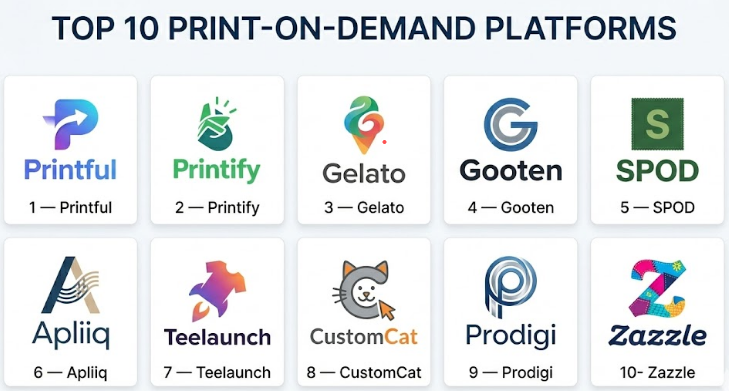
Top 10 Print-on-Demand Platforms
#1 — Printful
Short description :
Printful is one of the most recognized print-on-demand platforms for ecommerce sellers, creators, artists, and small brands. It offers custom apparel, accessories, home goods, wall art, embroidery, and branding options. Printful is often used by sellers who want reliable fulfillment, strong product quality, and smooth ecommerce integrations. It connects with major ecommerce platforms and marketplaces, making it practical for sellers who want to automate orders. Printful is a strong option for businesses that care about brand experience, product quality, and scalable fulfillment.
Key Features
- Large product catalog for apparel, accessories, and home goods
- Print-on-demand fulfillment and dropshipping
- Ecommerce integrations with major platforms
- Product mockup generator and design tools
- Custom branding options
- Embroidery, direct-to-garment, and other print options
- Order tracking and fulfillment dashboard
Pros
- Strong product quality and fulfillment reputation
- Good ecommerce integration ecosystem
- Useful for serious creator and brand stores
Cons
- Product base costs can be higher than some competitors
- Profit margins may be tighter on low-priced items
- Sellers should order samples before scaling
Platforms / Deployment
Web
Cloud deployment
Security & Compliance
Printful handles store data, order details, customer shipping information, payment-related workflows, and product files. Specific certifications such as SOC 2, ISO 27001, PCI, GDPR, or other compliance details should be verified directly.
Not publicly stated.
Integrations & Ecosystem
Printful works well as a fulfillment engine connected with online stores and marketplaces.
- Shopify
- Etsy
- WooCommerce
- Wix
- Squarespace
- Amazon and marketplace workflows
- Custom API workflows
Support & Community
Printful has broad seller adoption, strong documentation, and helpful onboarding resources. It is best for sellers who want a professional print-on-demand setup with reliable fulfillment support.
#2 — Printify
Short description :
Printify is a print-on-demand platform that connects sellers with a large network of print providers. It helps creators and ecommerce sellers design products, choose suppliers, set pricing, and sell across different sales channels. Printify is especially useful for sellers who want supplier flexibility, competitive base costs, and a wide product catalog. Instead of relying on one production network only, sellers can choose providers based on location, pricing, ratings, and product options. Printify is a strong choice for sellers who want control over cost and supplier selection.
Key Features
- Large print provider network
- Wide product catalog
- Product creator and mockup tools
- Ecommerce and marketplace integrations
- Supplier selection by location and product
- Order routing and fulfillment support
- Pricing and profit margin controls
Pros
- Strong product variety and supplier flexibility
- Good for testing products and comparing providers
- Competitive base pricing options
Cons
- Quality can vary by print provider
- Sellers must test samples carefully
- Support experience may depend on provider and order issue
Platforms / Deployment
Web
Cloud deployment
Security & Compliance
Printify handles store data, order information, customer shipping details, design files, and fulfillment records. Specific certifications and compliance practices should be verified directly.
Not publicly stated.
Integrations & Ecosystem
Printify fits sellers who want marketplace and ecommerce flexibility.
- Shopify
- Etsy
- WooCommerce
- Wix
- Squarespace
- eBay and marketplace workflows
- API-based integrations
Support & Community
Printify has a large seller community and broad print-on-demand usage. It is best for sellers who want product variety and supplier choice.
#3 — Gelato
Short description :
Gelato is a global print-on-demand platform focused on local production, faster delivery, and reduced shipping distance. It supports custom products such as apparel, wall art, stationery, photo products, and business merchandise. Gelato is especially useful for sellers with international customers because it works through a distributed print network. The platform aims to produce orders closer to buyers where possible, which can improve delivery time and reduce logistics complexity. Gelato is a strong option for brands that want global reach and local fulfillment.
Key Features
- Global print-on-demand network
- Local production model where available
- Apparel, wall art, stationery, and merchandise products
- Ecommerce platform integrations
- Design and product creation tools
- Order automation and tracking
- Business and enterprise print workflows
Pros
- Strong international fulfillment approach
- Useful for sellers with global customers
- Good fit for wall art, stationery, and branded products
Cons
- Product availability can vary by region
- Sellers should test quality in key markets
- Some advanced features may depend on plan or setup
Platforms / Deployment
Web
Cloud deployment
Security & Compliance
Gelato handles order data, customer shipping information, product files, and fulfillment records. Specific certifications and compliance details should be verified directly.
Not publicly stated.
Integrations & Ecosystem
Gelato works well for sellers that want international order automation.
- Shopify
- Etsy
- WooCommerce
- Wix
- Squarespace
- API-based workflows
- Global print partner network
Support & Community
Gelato provides seller resources and global fulfillment support. It is best for sellers who want local production capabilities and international customer reach.
#4 — Gooten
Short description :
Gooten is a print-on-demand and order fulfillment platform designed for ecommerce businesses, brands, and sellers that need scalable production workflows. It offers a product catalog across apparel, home goods, accessories, wall art, and lifestyle products. Gooten is especially useful for sellers who want automated order management and access to a production partner network. It can support growing stores that need more operational structure than basic beginner tools. Gooten is a good fit for brands looking for reliable backend fulfillment and order routing.
Key Features
- Print-on-demand fulfillment network
- Apparel, home goods, and lifestyle product catalog
- Ecommerce integrations
- Automated order routing
- Order management dashboard
- Production partner network
- Reporting and operational visibility
Pros
- Good for scalable ecommerce operations
- Useful product range beyond basic apparel
- Helps automate order fulfillment workflows
Cons
- May be less beginner-friendly than simple POD tools
- Product and print quality should be tested by category
- Integration and setup should be planned carefully
Platforms / Deployment
Web
Cloud deployment
Security & Compliance
Gooten handles order details, customer shipping data, product files, and seller account information. Specific compliance and security details should be verified directly.
Not publicly stated.
Integrations & Ecosystem
Gooten fits ecommerce sellers who need order fulfillment automation.
- Shopify
- WooCommerce
- Etsy workflows
- API integrations
- Order routing systems
- Product fulfillment workflows
Support & Community
Gooten is useful for sellers who need operational fulfillment support. It is best for brands that want scalable order routing and supplier-backed production.
#5 — SPOD
Short description :
SPOD is a print-on-demand platform known for fast production workflows and custom merchandise fulfillment. It supports apparel, accessories, and personalized products for ecommerce sellers. SPOD is useful for sellers who want a simple POD setup with fast turnaround as a key priority. It integrates with ecommerce platforms and allows sellers to create custom products for online stores. SPOD is a practical choice for stores focused on apparel, gifts, and fast-moving merchandise campaigns.
Key Features
- Print-on-demand product creation
- Apparel and accessory catalog
- Ecommerce integrations
- Design and product customization tools
- Fast production-focused workflow
- Order fulfillment and shipping support
- Product mockup tools
Pros
- Good for fast merchandise production workflows
- Useful for apparel and gift products
- Simple setup for ecommerce sellers
Cons
- Product catalog may be narrower than some competitors
- Branding options may be limited compared with premium platforms
- Sellers should test samples before launch
Platforms / Deployment
Web
Cloud deployment
Security & Compliance
SPOD handles customer order data, shipping details, seller account data, and product designs. Specific security and compliance details should be verified directly.
Not publicly stated.
Integrations & Ecosystem
SPOD fits ecommerce sellers who need simple POD product fulfillment.
- Shopify
- WooCommerce
- Marketplace workflows depending on setup
- Product customization
- Apparel fulfillment
- Order tracking
Support & Community
SPOD provides seller support and product creation resources. It is best for sellers focused on quick product launches and apparel-based merchandise.
#6 — Apliiq
Short description :
Apliiq is a print-on-demand and apparel customization platform focused on fashion-style products, private labeling, embroidery, patches, woven labels, and custom apparel branding. It is especially useful for clothing brands and creators who want more unique apparel customization than standard t-shirt printing. Apliiq helps sellers create products that feel closer to streetwear or boutique fashion merchandise. It is a strong option for apparel-focused businesses that care about labels, branding, and design detail. Apliiq is best suited for sellers building a clothing brand rather than only selling basic merch.
Key Features
- Custom apparel print-on-demand
- Private label options
- Embroidery and applique-style customization
- Woven labels and branding details
- Apparel-focused product catalog
- Ecommerce integration support
- Dropshipping and fulfillment workflows
Pros
- Strong fit for apparel and clothing brands
- Better branding options than many basic POD tools
- Useful for streetwear and boutique-style products
Cons
- Not ideal for broad non-apparel product catalogs
- More specialized than general POD platforms
- Sellers should carefully test product quality and sizing
Platforms / Deployment
Web
Cloud deployment
Security & Compliance
Apliiq handles product designs, order details, customer shipping data, and branding assets. Specific security and compliance practices should be verified directly.
Not publicly stated.
Integrations & Ecosystem
Apliiq works well for apparel-focused ecommerce sellers.
- Shopify-style ecommerce workflows
- Apparel fulfillment
- Private label branding
- Embroidery workflows
- Custom label production
- Dropshipping operations
Support & Community
Apliiq is useful for creators and brands focused on clothing and branded apparel. It is best for sellers who want more fashion-oriented merchandise.
#7 — Teelaunch
Short description :
Teelaunch is a print-on-demand platform that helps ecommerce sellers create and sell custom products through online stores. It supports apparel, drinkware, home goods, accessories, and gift products. Teelaunch is especially useful for sellers who want a practical POD partner with a mix of standard and niche products. It has been used by Shopify sellers and ecommerce entrepreneurs looking to test product ideas without inventory. Teelaunch is a good option for sellers who want product variety and straightforward fulfillment.
Key Features
- Print-on-demand product fulfillment
- Apparel, accessories, drinkware, and home products
- Ecommerce integration support
- Product mockup generation
- Order fulfillment automation
- Custom product creation
- Seller dashboard
Pros
- Good mix of product categories
- Useful for testing niche merchandise ideas
- Practical for ecommerce sellers
Cons
- Product availability may vary
- Branding options may be limited compared with more advanced setups
- Sellers should test fulfillment and print quality
Platforms / Deployment
Web
Cloud deployment
Security & Compliance
Teelaunch handles seller accounts, order details, customer shipping information, and product files. Specific security and compliance details should be verified directly.
Not publicly stated.
Integrations & Ecosystem
Teelaunch fits ecommerce sellers using POD for custom products.
- Shopify workflows
- Product fulfillment
- Custom merchandise
- Order automation
- Mockup tools
- Shipping workflows
Support & Community
Teelaunch is practical for sellers who want custom products and ecommerce-based POD fulfillment. It is best for stores testing different products and niches.
#8 — CustomCat
Short description :
CustomCat is a print-on-demand fulfillment platform offering apparel, accessories, and custom products for ecommerce sellers. It is useful for sellers who want competitive production costs, fast fulfillment workflows, and a practical product catalog. CustomCat is often considered by sellers focused on apparel and high-volume product testing. It can connect with ecommerce platforms and automate order fulfillment. CustomCat is a strong option for sellers who care about margin control and efficient POD operations.
Key Features
- Print-on-demand fulfillment
- Apparel and merchandise catalog
- Ecommerce platform integrations
- Order automation
- Product personalization options
- Seller dashboard and reporting
- Fulfillment and shipping workflows
Pros
- Useful for apparel-focused ecommerce sellers
- Can support margin-focused product strategies
- Good for sellers testing multiple designs
Cons
- Product and print quality should be tested by item
- Storefront must usually be managed separately
- Branding depth may be limited compared with premium apparel tools
Platforms / Deployment
Web
Cloud deployment
Security & Compliance
CustomCat handles order data, customer shipping information, seller account details, and product design files. Specific security and compliance details should be verified directly.
Not publicly stated.
Integrations & Ecosystem
CustomCat fits ecommerce sellers who need automated POD fulfillment.
- Shopify
- WooCommerce
- API workflows
- Apparel fulfillment
- Product personalization
- Order tracking
Support & Community
CustomCat is useful for ecommerce sellers who want print-on-demand fulfillment with practical product and pricing options.
#9 — Prodigi
Short description :
Prodigi is a print-on-demand platform focused on high-quality printing, global fulfillment, wall art, photo products, stationery, apparel, and custom merchandise. It is especially useful for artists, photographers, designers, and businesses that care about print quality and international delivery. Prodigi supports integrations and API workflows, making it practical for ecommerce sellers and developers building print products into their stores or apps. It is a strong option for wall art, fine art prints, and photo-based products. Prodigi works well when product quality and print detail are important.
Key Features
- Global print-on-demand fulfillment
- Wall art, photo products, stationery, and apparel
- API-based workflows
- Ecommerce integration options
- High-quality print product focus
- Order routing and fulfillment
- Product catalog and production network
Pros
- Strong for art, photography, and print products
- Useful global fulfillment model
- Good fit for API-driven print workflows
Cons
- May be more specialized than beginner POD platforms
- Sellers should test samples for each product category
- Setup may require more planning for API use cases
Platforms / Deployment
Web / API
Cloud deployment
Security & Compliance
Prodigi handles order data, customer shipping details, artwork files, and fulfillment records. Specific security and compliance details should be verified directly.
Not publicly stated.
Integrations & Ecosystem
Prodigi fits sellers and businesses that need quality print fulfillment.
- Ecommerce integrations
- API-based print workflows
- Wall art stores
- Photography stores
- Custom merchandise apps
- Global fulfillment systems
Support & Community
Prodigi is useful for artists, photographers, and businesses needing print quality and international fulfillment support.
#10 — Zazzle
Short description :
Zazzle is a marketplace and print-on-demand platform where designers, artists, and creators can upload designs and sell them on a large range of customizable products. It supports apparel, accessories, stationery, invitations, home goods, gifts, and personalized products. Zazzle is especially useful for creators who want marketplace exposure instead of building their own ecommerce store. The platform handles production, checkout, customer service, and fulfillment. Zazzle is a practical option for designers who want to monetize artwork through a large product marketplace.
Key Features
- Print-on-demand marketplace
- Large customizable product catalog
- Artist and designer storefronts
- Product personalization options
- Marketplace discovery
- Fulfillment handled by platform
- Earnings and product management tools
Pros
- Huge variety of customizable products
- No inventory or fulfillment management required
- Marketplace exposure can help product discovery
Cons
- Less control over branding and customer relationships
- Marketplace competition can be high
- Profit margins depend on product pricing and platform structure
Platforms / Deployment
Web / mobile app availability
Cloud deployment
Security & Compliance
Zazzle handles marketplace payments, customer data, creator accounts, product files, and fulfillment workflows. Specific certifications and compliance details should be verified directly.
Not publicly stated.
Integrations & Ecosystem
Zazzle works best as a marketplace-based POD platform.
- Designer storefronts
- Personalized products
- Marketplace search
- Product customization
- Fulfillment workflows
- Creator earnings dashboard
Support & Community
Zazzle has a large marketplace ecosystem for creators and customers. It is best for designers who want broad product variety and marketplace-based selling.
Comparison Table Top 10
| Tool Name | Best For | Platform(s) Supported | Deployment | Standout Feature | Public Rating |
|---|---|---|---|---|---|
| Printful | Professional POD stores and creator brands | Web | Cloud | Strong fulfillment, quality, and integrations | N/A |
| Printify | Product variety and supplier flexibility | Web | Cloud | Large print provider network | N/A |
| Gelato | Global sellers needing local production | Web | Cloud | Local fulfillment network for international orders | N/A |
| Gooten | Scalable ecommerce fulfillment workflows | Web | Cloud | Order routing and production partner network | N/A |
| SPOD | Fast apparel and gift fulfillment | Web | Cloud | Fast production-focused POD workflow | N/A |
| Apliiq | Apparel brands and streetwear-style merch | Web | Cloud | Private labels, embroidery, and apparel branding | N/A |
| Teelaunch | Niche product testing and ecommerce POD | Web | Cloud | Practical product variety for online stores | N/A |
| CustomCat | Margin-focused apparel POD sellers | Web | Cloud | Apparel fulfillment and order automation | N/A |
| Prodigi | Art, photography, and quality print products | Web, API | Cloud | Global print network and wall art focus | N/A |
| Zazzle | Marketplace-based customizable product selling | Web, mobile app availability | Cloud | Large product marketplace and personalization | N/A |
Evaluation & Print-on-Demand Platforms
| Tool Name | Core 25% | Ease 15% | Integrations 15% | Security 10% | Performance 10% | Support 10% | Value 15% | Weighted Total 0–10 |
|---|---|---|---|---|---|---|---|---|
| Printful | 9.2 | 8.4 | 9.2 | 8.5 | 8.8 | 8.5 | 8.0 | 8.68 |
| Printify | 9.0 | 8.5 | 9.0 | 8.2 | 8.5 | 8.2 | 8.6 | 8.65 |
| Gelato | 8.8 | 8.3 | 8.7 | 8.3 | 8.7 | 8.3 | 8.2 | 8.55 |
| Gooten | 8.5 | 8.0 | 8.3 | 8.0 | 8.5 | 8.0 | 8.1 | 8.25 |
| SPOD | 8.0 | 8.5 | 8.0 | 7.8 | 8.4 | 8.0 | 8.2 | 8.14 |
| Apliiq | 8.3 | 7.8 | 7.8 | 7.8 | 8.2 | 8.0 | 8.0 | 8.01 |
| Teelaunch | 8.0 | 8.2 | 7.8 | 7.8 | 8.1 | 7.8 | 8.1 | 7.99 |
| CustomCat | 8.2 | 8.0 | 8.0 | 7.8 | 8.2 | 7.8 | 8.5 | 8.10 |
| Prodigi | 8.5 | 7.8 | 8.2 | 8.0 | 8.5 | 8.0 | 8.0 | 8.21 |
| Zazzle | 7.8 | 8.8 | 7.2 | 7.8 | 8.0 | 7.8 | 8.0 | 7.91 |
These scores are comparative and should be used as a starting point. A seller building a serious ecommerce brand may rate Printful, Printify, or Gelato higher because integrations, fulfillment, and product range matter. An apparel-focused brand may prefer Apliiq. A photographer or artist may prefer Prodigi. A creator who wants marketplace exposure may prefer Zazzle. The best choice depends on product type, audience, region, margin goals, and brand expectations.
Which Print-on-Demand Platform Should You Choose?
Solo / Beginner Seller
A beginner seller should start with a platform that is easy to set up and does not require inventory. Printful, Printify, Gelato, and Zazzle are good platforms to compare.
If the beginner already has a Shopify or Etsy store, Printful, Printify, or Gelato may be better. If the beginner wants marketplace exposure without building a store, Zazzle may be easier.
Artist or Designer
Artists and designers should focus on product quality, wall art options, color accuracy, product variety, and marketplace visibility. Prodigi, Printful, Gelato, and Zazzle are strong options.
Artists should always order samples before promoting products. Print quality and packaging can directly affect reputation.
Creator / Influencer
Creators and influencers usually need fast merch launches, simple product setup, social promotion, and reliable fulfillment. Printful, Printify, Gelato, and SPOD can be useful depending on store setup.
Creators should start with a small collection, such as one hoodie, one t-shirt, one mug, and one sticker. Too many products can confuse fans.
Apparel Brand
Apparel brands should evaluate fabric quality, fit, print durability, embroidery, labels, packaging, and brand presentation. Apliiq, Printful, Printify, and CustomCat are good options to compare.
If the goal is to build a serious clothing brand, branding details matter more than simply choosing the cheapest base product.
Ecommerce Store
Ecommerce sellers need product variety, order automation, integrations, reliable shipping, tracking, and margin control. Printful, Printify, Gelato, Gooten, and CustomCat are strong options.
Sellers should test multiple products, compare base costs, and check fulfillment times for target markets before scaling ads.
Budget vs Premium
Budget-focused sellers may prefer Printify or CustomCat because supplier choice and base pricing can help manage margins. Marketplace sellers may use Zazzle to avoid storefront costs.
Premium sellers may prefer Printful, Gelato, Prodigi, or Apliiq when quality, branding, local production, or product experience matters more than lowest price.
Feature Depth vs Ease of Use
Printful is strong for quality and integrations. Printify is strong for provider choice and product variety. Gelato is strong for global local fulfillment. Apliiq is strong for apparel branding. Prodigi is strong for art and print products. Zazzle is strong for marketplace-based selling.
The best platform is the one that matches your product strategy, customer location, and brand promise.
Integrations & Scalability
Print-on-demand platforms may need to connect with Shopify, Etsy, WooCommerce, Wix, Squarespace, Amazon, eBay, TikTok Shop, social platforms, payment systems, analytics tools, and email marketing tools.
Scalability also means handling more orders, more SKUs, more regions, more customer support issues, more returns, and more product quality checks.
Security & Compliance Needs
Print-on-demand platforms handle customer names, addresses, order details, product files, payments, tax-related information, and seller account data. Sellers should review account security, data export options, privacy practices, and payment settings.
Creators should also make sure their designs do not violate copyright, trademark, personality rights, or brand usage rules.
Frequently Asked Questions FAQs
1. What is a Print-on-Demand Platform?
A Print-on-Demand Platform lets sellers create custom products that are printed only after a customer orders them. The platform or print partner usually handles production, packing, and shipping.
2. How is print-on-demand different from traditional inventory?
Traditional inventory requires buying products in advance and storing them. Print-on-demand produces items only after a sale, which reduces upfront cost and inventory risk.
3. Which print-on-demand platform is best for beginners?
Printful, Printify, Gelato, and Zazzle are good options for beginners. Printful is strong for quality and integrations, Printify is strong for supplier choice, Gelato is strong for global fulfillment, and Zazzle is useful for marketplace selling.
4. Which platform is best for Shopify stores?
Printful, Printify, Gelato, Gooten, SPOD, Apliiq, Teelaunch, and CustomCat can work well for Shopify-based POD stores. The best choice depends on product type, region, price, and quality expectations.
5. Which platform is best for Etsy sellers?
Printful, Printify, and Gelato are common options for Etsy sellers. Sellers should compare production time, product quality, mockup quality, shipping price, and personalization features.
6. Which platform is best for apparel brands?
Apliiq, Printful, Printify, and CustomCat are good platforms to compare for apparel brands. Apliiq is especially useful when private labels, embroidery, and apparel branding matter.
7. Which platform is best for artists and photographers?
Prodigi, Printful, Gelato, and Zazzle are useful for artists and photographers. Prodigi is especially relevant for wall art and print-quality-focused products.
8. Do print-on-demand platforms handle shipping?
Yes, most print-on-demand platforms handle production and shipping after an order is placed. However, delivery time, shipping cost, and tracking quality vary by platform, product, and customer region.
9. What are common mistakes in print-on-demand?
Common mistakes include not ordering samples, using weak designs, choosing poor product mockups, ignoring shipping costs, pricing too low, copying copyrighted designs, and launching too many products too early.
10. Is print-on-demand profitable?
Print-on-demand can be profitable, but margins depend on product cost, selling price, shipping, platform fees, ad costs, and return rates. Sellers need strong designs, clear positioning, and good marketing.
Conclusion
Print-on-Demand Platforms make it easier for creators, artists, ecommerce sellers, and small brands to sell custom products without buying inventory upfront. The right platform depends on your product strategy and business goals. Printful is strong for quality, branding, and integrations. Printify is strong for supplier choice and product variety. Gelato is useful for global sellers who value local production. Gooten is practical for scalable ecommerce fulfillment. SPOD is useful for fast apparel and gift workflows. Apliiq is strong for apparel branding. Teelaunch and CustomCat are useful for ecommerce product testing and margin control. Prodigi is strong for art and print products. Zazzle is useful for marketplace-based customizable product selling.
