Introduction
Merchandise Storefront Platforms help creators, brands, influencers, musicians, podcasters, YouTubers, streamers, artists, nonprofits, and small businesses sell branded products online. In simple words, these platforms let users create an online shop for items like t-shirts, hoodies, mugs, stickers, posters, hats, tote bags, phone cases, digital products, and fan merchandise.
These platforms are useful because creators and brands often want to sell merchandise without building a full ecommerce operation from scratch. Many storefront tools handle product creation, checkout, printing, inventory, fulfillment, shipping, taxes, and customer support depending on the platform. This makes it easier for creators to focus on audience building, branding, and promotion.
Real-world use cases include:
- Selling fan merchandise for YouTube, podcast, or livestream audiences
- Launching branded apparel for creators and influencers
- Creating print-on-demand products for artists and designers
- Selling nonprofit campaign merchandise
- Building a simple ecommerce store for digital and physical goods
- Testing product ideas without holding inventory
- Selling event, music, gaming, or community merchandise
Buyers should evaluate:
- Product catalog and merchandise options
- Print-on-demand support
- Storefront customization
- Branding and domain options
- Payment processing and payout workflow
- Fulfillment and shipping support
- Product quality and supplier network
- Integration with social platforms and websites
- Inventory and order management
- Analytics and sales reporting
- Platform fees and product margins
- Customer support and refund handling
Best for: creators, artists, YouTubers, streamers, musicians, podcasters, influencers, nonprofits, small brands, online communities, event organizers, and businesses that want to sell branded merchandise without managing a complex ecommerce backend.
Not ideal for: businesses needing highly customized enterprise ecommerce, large warehouse-based retail operations, or brands that require complete control over manufacturing, packaging, logistics, and fulfillment. In those cases, a dedicated ecommerce platform plus custom supply chain may be better.
Key Trends in Merchandise Storefront Platforms
- Print-on-demand is becoming the default: Creators can sell products without buying inventory upfront, which reduces financial risk.
- Creator-led commerce is growing: YouTubers, streamers, musicians, podcasters, and educators are using merchandise to build deeper audience relationships.
- Social commerce matters more: Merchandise storefronts increasingly connect with social platforms, link-in-bio pages, video channels, and creator profiles.
- Small-batch product testing is easier: Creators can launch limited designs, test demand, and remove products quickly if they do not sell.
- Brand experience is becoming important: Creators want storefronts that feel professional, branded, and aligned with their audience identity.
- Global shipping expectations are rising: Customers expect faster delivery, clear shipping costs, tracking, and reliable fulfillment.
- Merchandise plus memberships are merging: Some creators combine merch, fan clubs, subscriptions, and exclusive drops in one monetization strategy.
- Sustainable merchandise is gaining interest: Many buyers prefer ethical sourcing, eco-friendly products, and transparent production practices.
- Product quality is a major differentiator: Poor print quality, sizing issues, or slow shipping can hurt a creator’s brand reputation.
- Analytics are becoming more useful: Creators need to know which products, designs, regions, and campaigns generate the most sales.
How We Selected These Tools Methodology
The tools below were selected based on merchandise storefront relevance, creator adoption, ecommerce capability, product catalog depth, fulfillment support, ease of use, and practical value for different creator and brand needs.
- Storefront capability: Platforms were reviewed for product pages, checkout, branding, custom domains, and shop management.
- Merchandise catalog: Apparel, accessories, print products, digital goods, and custom product support were considered.
- Print-on-demand and fulfillment: Tools that reduce inventory and shipping workload were prioritized.
- Creator fit: Platforms commonly used by creators, artists, streamers, musicians, and online communities were included.
- Ease of use: Simple setup, product creation, design upload, and order management were evaluated.
- Integration ecosystem: Social media, YouTube, TikTok, Shopify, websites, email, and marketplace integrations were considered.
- Payment and payout workflow: Creator earnings, fees, payment processing, and payout clarity were reviewed.
- Scalability: Tools for beginners, growing creator brands, and larger ecommerce businesses were included.
- Support and operations: Customer support, fulfillment support, documentation, and seller guidance were considered.
- Practical buyer fit: The goal is not one universal winner, but a useful comparison based on creator goals and merchandise strategy.
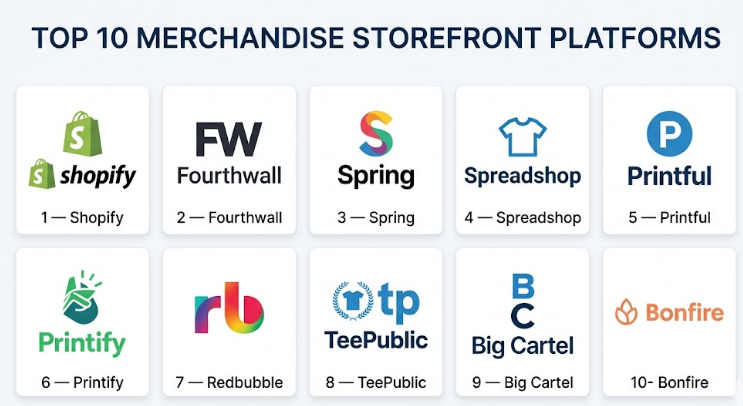
Top 10 Merchandise Storefront Platforms
#1 — Shopify
Short description :
Shopify is a full ecommerce platform that can be used to build a professional merchandise storefront for creators, brands, artists, and businesses. It supports product pages, checkout, payment processing, shipping settings, discount codes, analytics, themes, and many integrations. Shopify is especially useful for creators who want more control over branding, customer experience, and long-term store growth. It can be connected with print-on-demand providers, fulfillment tools, email marketing, and social selling channels. Shopify is a strong option for creators or brands who want a serious merchandise business rather than a simple merch page only.
Key Features
- Custom ecommerce storefront
- Product catalog and inventory management
- Payment processing and checkout
- Themes and branding customization
- Discount codes and promotions
- App ecosystem for print-on-demand and marketing
- Analytics and sales reporting
Pros
- Strong control over branding and store experience
- Scales well from small stores to larger businesses
- Large integration ecosystem
Cons
- More setup work than simple creator merch platforms
- Monthly costs and app costs can add up
- Fulfillment usually requires additional setup or partners
Platforms / Deployment
Web / iOS / Android
Cloud deployment
Security & Compliance
Shopify handles ecommerce payments, customer data, storefront security, and account access. Specific certifications such as SOC 2, ISO 27001, PCI, GDPR, or other compliance details should be verified directly.
Not publicly stated here for every merchant setup.
Integrations & Ecosystem
Shopify works well as a central ecommerce hub for merchandise businesses.
- Print-on-demand apps
- Payment gateways
- Email marketing tools
- Social selling channels
- Analytics platforms
- Shipping and fulfillment tools
Support & Community
Shopify has a large merchant ecosystem, extensive documentation, and broad support resources. It is best for creators and brands that want a scalable ecommerce foundation.
#2 — Fourthwall
Short description :
Fourthwall is a creator-focused merchandise storefront platform designed for YouTubers, streamers, podcasters, artists, and internet creators who want to sell fan products. It supports merch stores, product fulfillment, memberships, digital products, and fan engagement tools. Fourthwall is especially useful for creators who want branded storefronts without managing the full complexity of ecommerce logistics. It can help creators launch apparel, accessories, and fan products quickly. Fourthwall is a strong choice for creators whose audience wants branded merchandise and community-driven products.
Key Features
- Creator merchandise storefronts
- Product creation and fulfillment support
- Apparel, accessories, and fan products
- Membership and digital product options
- Branded shop pages
- Checkout and payment workflow
- Creator analytics
Pros
- Strong fit for creator-led merchandise
- Reduces fulfillment and operational burden
- Useful for creators with loyal fan communities
Cons
- Best value depends on audience demand for merch
- Product margins should be reviewed carefully
- Not as flexible as a fully custom ecommerce stack
Platforms / Deployment
Web
Cloud deployment
Security & Compliance
Fourthwall handles payments, customer data, order details, creator storefront data, and membership records. Specific security and compliance details should be verified directly.
Not publicly stated.
Integrations & Ecosystem
Fourthwall fits creators who want merchandise, memberships, and fan products in one place.
- Creator storefronts
- Product fulfillment workflows
- Membership access
- Digital product sales
- Fan engagement tools
- Sales analytics
Support & Community
Fourthwall provides creator-focused support and product fulfillment workflows. It is especially useful for creators who want to monetize audience loyalty through merchandise.
#3 — Spring
Short description :
Spring is a creator commerce platform that helps creators design, sell, and fulfill merchandise without holding inventory. It is commonly used by creators, influencers, YouTubers, streamers, artists, and online communities. Spring supports print-on-demand products such as apparel, accessories, home goods, and fan merchandise. It is especially useful for creators who want a quick merch launch without building a full ecommerce store. Spring is a strong option for audience-driven merchandise drops and simple creator storefronts.
Key Features
- Print-on-demand merchandise
- Creator storefront pages
- Apparel and accessory products
- Product design tools
- Fulfillment and shipping support
- Social platform integration options
- Sales and campaign reporting
Pros
- Easy for creators to launch merch quickly
- No inventory required
- Useful for simple fan merchandise campaigns
Cons
- Storefront customization may be limited
- Product margins depend on base costs and pricing
- Product quality and fulfillment experience should be tested
Platforms / Deployment
Web
Cloud deployment
Security & Compliance
Spring handles customer orders, payment workflows, creator accounts, and fulfillment data. Specific certifications and compliance practices should be verified directly.
Not publicly stated.
Integrations & Ecosystem
Spring works well for creators who drive traffic from social and content platforms.
- Social media creator profiles
- YouTube-style creator workflows
- Print-on-demand fulfillment
- Fan merchandise campaigns
- Creator storefronts
- Sales reporting
Support & Community
Spring is widely known in the creator merchandise space. It is best for creators who want fast setup and minimal operational complexity.
#4 — Spreadshop
Short description :
Spreadshop is a print-on-demand storefront platform that helps creators, designers, organizations, and small brands sell custom merchandise online. It allows users to create a shop, upload designs, choose products, and sell items without managing inventory or fulfillment. Spreadshop is useful for artists, communities, teams, nonprofits, and creators who want a simple merchandise store. It is especially strong for custom apparel and branded products. Spreadshop is a practical option for creators who want print-on-demand selling with a hosted storefront.
Key Features
- Print-on-demand storefront
- Custom apparel and merchandise products
- Design upload tools
- Hosted shop pages
- Fulfillment and shipping support
- Pricing and margin controls
- Sales reporting
Pros
- Good for custom apparel and simple merch stores
- No inventory management required
- Useful for artists, clubs, and small communities
Cons
- Store customization may be less flexible than Shopify
- Product catalog depends on available print-on-demand options
- Seller should test product quality before scaling
Platforms / Deployment
Web
Cloud deployment
Security & Compliance
Spreadshop handles customer orders, payments, storefront data, and fulfillment information. Specific security and compliance details should be verified directly.
Not publicly stated.
Integrations & Ecosystem
Spreadshop supports simple merchandise storefront workflows.
- Print-on-demand product catalog
- Creator and organization shops
- Apparel and accessories
- Fulfillment workflows
- Sales tracking
- Design-based product selling
Support & Community
Spreadshop provides seller support and resources for merchandise creators. It is best for users who want a simple hosted merch shop.
#5 — Printful
Short description :
Printful is a print-on-demand and fulfillment platform used by creators, ecommerce sellers, artists, and brands to create and ship custom products. Unlike simple hosted creator storefronts, Printful is often connected to ecommerce platforms such as Shopify, WooCommerce, Etsy, or other storefront tools. It supports apparel, accessories, posters, home goods, embroidery, and custom branding options. Printful is especially useful for sellers who want product quality, fulfillment control, and ecommerce flexibility. It is a strong choice for creators who want a more professional print-on-demand operation.
Key Features
- Print-on-demand fulfillment
- Apparel, accessories, and home products
- Ecommerce platform integrations
- Custom branding options
- Product mockup generator
- Warehousing and fulfillment options may vary
- Order tracking and fulfillment reporting
Pros
- Strong product and fulfillment ecosystem
- Works well with major ecommerce platforms
- Good for creators building a serious merch brand
Cons
- Requires a separate storefront in many cases
- Base product costs can affect margins
- Setup is more involved than simple creator merch pages
Platforms / Deployment
Web
Cloud deployment
Security & Compliance
Printful processes order data, customer shipping details, product files, and fulfillment records. Specific certifications and compliance details should be verified directly.
Not publicly stated.
Integrations & Ecosystem
Printful works as a fulfillment engine connected to storefronts.
- Shopify and ecommerce platforms
- Marketplace integrations
- Product design workflows
- Fulfillment and shipping
- Branding and packaging options
- Sales channel integrations
Support & Community
Printful has broad adoption among print-on-demand sellers and ecommerce creators. It is best for creators who want more control and are comfortable managing a storefront.
#6 — Printify
Short description :
Printify is a print-on-demand platform that connects creators and sellers with a network of print providers. It allows users to create custom products and sell them through ecommerce platforms and marketplaces. Printify is useful for creators, designers, entrepreneurs, and small brands that want product variety and supplier choice. It supports apparel, accessories, home goods, wall art, and other custom merchandise. Printify is a strong option for sellers who want flexibility in production partners, pricing, and product selection.
Key Features
- Print-on-demand product creation
- Network of print providers
- Apparel, accessories, and home goods
- Ecommerce and marketplace integrations
- Product mockup tools
- Supplier selection options
- Order routing and fulfillment support
Pros
- Large product and supplier selection
- Flexible pricing and provider choice
- Good for testing different products
Cons
- Product quality can vary by provider
- Requires storefront setup through another platform
- Sellers should test samples before selling at scale
Platforms / Deployment
Web
Cloud deployment
Security & Compliance
Printify handles order data, customer shipping details, product designs, and fulfillment information. Specific certifications and compliance details should be verified directly.
Not publicly stated.
Integrations & Ecosystem
Printify fits creators and ecommerce sellers who want print-on-demand flexibility.
- Shopify and ecommerce integrations
- Marketplace selling
- Print provider network
- Product testing workflows
- Merchandise fulfillment
- Sales channel management
Support & Community
Printify has a large seller community and broad print-on-demand usage. It is best for creators who want supplier flexibility and product variety.
#7 — Redbubble
Short description :
Redbubble is an artist marketplace where creators can upload designs and sell them on products such as stickers, apparel, wall art, phone cases, home decor, and accessories. It is especially useful for artists and designers who want marketplace exposure without building their own store. Redbubble handles production, shipping, customer service, and marketplace transactions. Creators earn based on product sales and markup settings. Redbubble is a practical option for artists who want passive-style merchandise sales from uploaded designs.
Key Features
- Artist marketplace storefront
- Print-on-demand product catalog
- Design upload and product placement
- Marketplace search and discovery
- Fulfillment and customer service handled by platform
- Artist profile pages
- Sales and earnings dashboard
Pros
- Easy for artists to start selling designs
- No inventory or fulfillment management
- Marketplace discovery can help new buyers find designs
Cons
- Less control over branding and customer relationship
- Marketplace competition is high
- Margins and visibility depend on platform rules and demand
Platforms / Deployment
Web / mobile app availability
Cloud deployment
Security & Compliance
Redbubble handles marketplace payments, customer data, order fulfillment, and artist account information. Specific security and compliance details should be verified directly.
Not publicly stated.
Integrations & Ecosystem
Redbubble works best for artists who want marketplace-based print-on-demand selling.
- Artist design uploads
- Marketplace discovery
- Print-on-demand products
- Customer service workflows
- Sales reporting
- Product listing pages
Support & Community
Redbubble has a large artist and buyer marketplace. It is best for designers who want to sell artwork without managing a standalone shop.
#8 — TeePublic
Short description :
TeePublic is a print-on-demand marketplace focused on artist-designed apparel, t-shirts, stickers, posters, and fan-style merchandise. It allows artists and designers to upload artwork and sell products through marketplace listings. TeePublic handles production, shipping, and customer service, making it easy for creators to start selling without operational overhead. It is especially useful for graphic designers, illustrators, fan-art style creators, and artists focused on apparel and sticker products. TeePublic is a good option for marketplace-based merchandise sales.
Key Features
- Artist marketplace storefront
- T-shirts, stickers, posters, and apparel products
- Design upload workflow
- Product listing pages
- Marketplace discovery
- Fulfillment handled by platform
- Earnings dashboard
Pros
- Easy for designers and artists to start
- Good for t-shirt and sticker-style merch
- No fulfillment management required
Cons
- Limited customer relationship ownership
- Marketplace competition can be high
- Less storefront customization than owned ecommerce stores
Platforms / Deployment
Web
Cloud deployment
Security & Compliance
TeePublic handles marketplace transactions, artist accounts, customer order data, and fulfillment workflows. Specific certifications and compliance practices should be verified directly.
Not publicly stated.
Integrations & Ecosystem
TeePublic fits artists who want marketplace-based merch distribution.
- Design uploads
- Apparel and sticker products
- Marketplace search
- Print-on-demand fulfillment
- Artist profiles
- Earnings tracking
Support & Community
TeePublic provides marketplace support and artist resources. It is best for creators who want simple product selling without building their own store.
#9 — Big Cartel
Short description :
Big Cartel is an ecommerce platform designed for artists, makers, bands, designers, and small creative brands that want a simple online store. It is useful for creators who sell physical products, art, prints, apparel, handmade items, or limited merchandise drops. Big Cartel offers storefront creation, product listings, checkout, order management, and basic customization. It is simpler than large ecommerce platforms, which can make it attractive for independent creators. Big Cartel is a strong option for small merchandise stores with a creative brand identity.
Key Features
- Simple ecommerce storefront
- Product listings and inventory management
- Customizable shop themes
- Payment checkout support
- Order management
- Discount and promotion tools
- Basic sales reporting
Pros
- Simple and creator-friendly storefront setup
- Good for artists, makers, and small brands
- Less complex than large ecommerce systems
Cons
- Not as scalable as advanced ecommerce platforms
- Fulfillment must be managed separately
- Advanced marketing and automation may be limited
Platforms / Deployment
Web
Cloud deployment
Security & Compliance
Big Cartel handles storefront data, orders, checkout workflows, and seller account information. Payment security depends partly on connected payment providers and configuration. Specific compliance details should be verified directly.
Not publicly stated.
Integrations & Ecosystem
Big Cartel fits small creator stores and independent brands.
- Product storefronts
- Payment processing
- Inventory tracking
- Limited-edition drops
- Shipping workflows
- Artist merchandise stores
Support & Community
Big Cartel is popular among independent artists and small creative sellers. It is best for simple storefronts and limited product catalogs.
#10 — Bonfire
Short description :
Bonfire is a merchandise and fundraising platform focused on custom apparel campaigns, t-shirts, and group merchandise. It is especially useful for nonprofits, schools, communities, creators, events, and fundraising campaigns. Bonfire allows users to design apparel, launch campaigns, collect orders, and handle fulfillment without managing inventory. It is a practical option for cause-based merchandise, limited campaigns, and group shirts. Bonfire is a strong fit when merchandise is connected to fundraising, awareness, community identity, or event promotion.
Key Features
- Custom apparel campaigns
- T-shirt and merchandise design tools
- Fundraising campaign support
- No inventory requirement
- Order collection and fulfillment
- Campaign pages
- Sales and campaign reporting
Pros
- Strong fit for fundraising and group apparel
- Easy campaign-based merch setup
- No inventory or shipping management for sellers
Cons
- Less suitable for full ecommerce stores
- Product catalog may be narrower than large POD tools
- Best fit is campaign-based merch rather than broad retail
Platforms / Deployment
Web
Cloud deployment
Security & Compliance
Bonfire handles campaign data, payments, customer orders, fundraising information, and fulfillment records. Specific certifications and compliance details should be verified directly.
Not publicly stated.
Integrations & Ecosystem
Bonfire works well for fundraising and campaign-based merchandise.
- Nonprofit campaigns
- Community merchandise
- Event shirts
- Creator apparel drops
- Fundraising pages
- Order fulfillment
Support & Community
Bonfire provides support for campaign creators and fundraising sellers. It is best for groups and creators using merchandise for causes, events, or limited campaigns.
Comparison Table Top 10
| Tool Name | Best For | Platform(s) Supported | Deployment | Standout Feature | Public Rating |
|---|---|---|---|---|---|
| Shopify | Scalable creator and brand ecommerce stores | Web, iOS, Android | Cloud | Full ecommerce control and app ecosystem | N/A |
| Fourthwall | Creator merchandise and fan products | Web | Cloud | Merch, memberships, and fan engagement tools | N/A |
| Spring | Quick creator merch launches | Web | Cloud | Simple print-on-demand creator storefronts | N/A |
| Spreadshop | Simple hosted print-on-demand stores | Web | Cloud | Custom apparel storefronts with fulfillment | N/A |
| Printful | Professional print-on-demand fulfillment | Web | Cloud | Strong fulfillment and ecommerce integrations | N/A |
| Printify | Product variety and supplier flexibility | Web | Cloud | Print provider network and product choice | N/A |
| Redbubble | Artist marketplace merchandise | Web, mobile app availability | Cloud | Marketplace discovery for uploaded designs | N/A |
| TeePublic | T-shirt and sticker marketplace selling | Web | Cloud | Artist-designed apparel marketplace | N/A |
| Big Cartel | Small artist-owned storefronts | Web | Cloud | Simple ecommerce for creative sellers | N/A |
| Bonfire | Fundraising and campaign apparel | Web | Cloud | Custom apparel campaigns for causes and groups | N/A |
Evaluation & Merchandise Storefront Platforms
| Tool Name | Core 25% | Ease 15% | Integrations 15% | Security 10% | Performance 10% | Support 10% | Value 15% | Weighted Total (0–10) |
|---|---|---|---|---|---|---|---|---|
| Shopify | 9.2 | 8.0 | 9.2 | 8.8 | 8.8 | 8.5 | 8.0 | 8.65 |
| Fourthwall | 8.7 | 8.8 | 8.0 | 8.0 | 8.5 | 8.2 | 8.2 | 8.39 |
| Spring | 8.2 | 9.0 | 7.8 | 7.8 | 8.2 | 8.0 | 8.2 | 8.20 |
| Spreadshop | 8.0 | 8.7 | 7.5 | 7.8 | 8.0 | 8.0 | 8.3 | 8.04 |
| Printful | 8.8 | 8.0 | 9.0 | 8.2 | 8.7 | 8.3 | 8.0 | 8.47 |
| Printify | 8.7 | 8.2 | 8.8 | 8.0 | 8.5 | 8.0 | 8.5 | 8.44 |
| Redbubble | 7.8 | 9.0 | 7.2 | 7.8 | 8.0 | 7.8 | 8.0 | 7.91 |
| TeePublic | 7.6 | 9.0 | 7.0 | 7.8 | 8.0 | 7.8 | 8.0 | 7.84 |
| Big Cartel | 7.8 | 8.6 | 7.5 | 7.8 | 8.0 | 7.8 | 8.3 | 7.99 |
| Bonfire | 7.8 | 8.8 | 7.2 | 7.8 | 8.0 | 8.0 | 8.4 | 7.99 |
These scores are comparative and should be used as a starting point. A serious merchandise brand may rate Shopify, Printful, or Printify higher because control and scalability matter. A creator who wants fast merch launch may prefer Fourthwall or Spring. An artist who wants marketplace discovery may prefer Redbubble or TeePublic. A nonprofit or community campaign may prefer Bonfire.
Which Merchandise Storefront Platform Should You Choose?
Solo / Beginner Creator
A beginner creator should start with a simple platform that does not require inventory or complex setup. Spring, Fourthwall, Spreadshop, Redbubble, or TeePublic can be practical starting points.
At this stage, the goal is to test whether the audience wants merchandise. Start with a few strong designs instead of launching too many products at once.
Artist or Designer
Artists and designers may prefer marketplace platforms such as Redbubble and TeePublic if they want to upload designs and let the platform handle production and customer service. Spreadshop is also useful for a dedicated print-on-demand shop.
If the artist wants more control over branding and customer relationships, Shopify with Printful or Printify may be better.
YouTuber / Streamer / Influencer
Creators with loyal fan communities should compare Fourthwall, Spring, Shopify, and Bonfire. Fourthwall is useful for creator-focused merchandise and fan products, while Spring is simple for fast launches.
If the creator wants a long-term merch brand with full control, Shopify plus a print-on-demand provider may be the stronger choice.
Small Brand
Small brands usually need better storefront control, product testing, marketing tools, and customer experience. Shopify, Printful, Printify, and Big Cartel are good platforms to compare.
Shopify is better for growth and integrations. Big Cartel is better for smaller creative stores that want simplicity. Printful and Printify are fulfillment partners rather than complete storefront replacements.
Nonprofit or Community Campaign
Nonprofits, schools, local groups, and community organizers should consider Bonfire, Spring, or Spreadshop. These tools make it easier to run campaign-style merchandise without managing inventory.
For fundraising campaigns, keep the product catalog simple, explain the cause clearly, and promote the campaign through email and social media.
Budget vs Premium
Budget-focused creators should start with print-on-demand or marketplace tools that do not require upfront inventory costs. This reduces risk while testing product demand.
Premium setups are better when the creator wants custom branding, higher margins, advanced marketing, email capture, analytics, custom packaging, or long-term store growth.
Feature Depth vs Ease of Use
Spring, Bonfire, Redbubble, TeePublic, and Spreadshop are easier for beginners. Shopify, Printful, and Printify offer more control and scalability but require more setup. Fourthwall balances creator ease with fan-focused merch tools.
The best tool depends on whether the creator wants a quick merch page, marketplace exposure, a serious ecommerce store, or a campaign-based fundraising shop.
Integrations & Scalability
Merchandise storefront platforms may need to connect with social media, YouTube, TikTok, Instagram, email marketing, analytics, print-on-demand providers, payment processors, shipping tools, and customer support systems.
Scalability also means handling more products, more orders, more regions, more customer questions, more returns, and stronger brand control.
Security & Compliance Needs
Merchandise platforms handle customer names, addresses, payment details, order history, tax settings, product files, and creator payout information. Sellers should review account security, payment settings, data exports, refund rules, and customer privacy policies.
Creators should also protect original designs, avoid copyrighted artwork they do not own, and keep clear rights documentation for logos, fonts, images, and fan-related designs.
Frequently Asked Questions FAQs
1. What is a Merchandise Storefront Platform?
A Merchandise Storefront Platform helps creators and brands sell products like t-shirts, hoodies, mugs, stickers, posters, hats, accessories, and fan merchandise through an online shop.
2. What is print-on-demand?
Print-on-demand means products are only printed after a customer places an order. This helps creators sell merchandise without buying inventory upfront or managing stock.
3. Which platform is best for beginners?
Spring, Fourthwall, Spreadshop, Redbubble, TeePublic, and Bonfire are beginner-friendly because they reduce setup work and often handle fulfillment.
4. Which platform is best for serious ecommerce growth?
Shopify is one of the strongest options for serious ecommerce growth because it provides more control, app integrations, branding, analytics, and store customization.
5. Which platform is best for artists?
Redbubble and TeePublic are useful for artists who want marketplace-based product sales. Artists who want more control may use Shopify with Printful or Printify.
6. Which platform is best for YouTubers and creators?
Fourthwall, Spring, Shopify, and Bonfire are strong options for YouTubers, streamers, podcasters, and fan-based creators. The best choice depends on audience size and branding needs.
7. Do I need inventory to sell merchandise?
No, not always. Print-on-demand platforms like Printful, Printify, Spring, Spreadshop, Redbubble, TeePublic, and Bonfire allow sellers to launch products without holding inventory.
8. What are common mistakes when launching merch?
Common mistakes include launching too many products, using weak designs, ignoring product quality, pricing too high, not testing samples, using copyrighted artwork, and failing to promote the store properly.
9. How do creators make profit from merchandise?
Creators make profit by setting a selling price above the base product cost, production cost, platform fee, and shipping-related costs. Profit margins vary by product, platform, and pricing strategy.
10. Can merchandise platforms handle shipping?
Yes, many print-on-demand and marketplace platforms handle production and shipping. Shopify sellers may need to connect fulfillment providers such as Printful or Printify.
Conclusion
Merchandise Storefront Platforms help creators, artists, nonprofits, communities, and brands turn audience identity into physical products. The right platform depends on the seller’s goal, audience size, product type, and operational capacity. Shopify is strong for scalable ecommerce and brand control. Fourthwall and Spring are useful for creator-led merchandise. Spreadshop is practical for simple print-on-demand stores. Printful and Printify are strong fulfillment partners for sellers who want more control. Redbubble and TeePublic are useful for artist marketplace exposure. Big Cartel is simple for small creative shops. Bonfire is strong for fundraising and campaign-based apparel.
