Introduction
Reputation Management Tools help businesses monitor, manage, improve, and protect their public image across review sites, search results, social media, local listings, customer feedback channels, and online conversations. In simple words, these tools help companies understand what customers are saying, respond to reviews, collect feedback, improve ratings, and reduce reputation risk.
Reputation matters because customers often check reviews, ratings, social proof, and brand mentions before making a purchase decision. A strong reputation can build trust, while unanswered negative reviews or poor visibility can hurt sales, hiring, partnerships, and customer loyalty.
Best for: local businesses, multi-location brands, agencies, healthcare providers, hospitality businesses, restaurants, SaaS companies, ecommerce brands, customer experience teams, marketing teams, and PR teams.
Not ideal for: businesses with no public customer reviews, teams that only need basic social scheduling, or companies that already manage reputation manually with low review volume.
Key Trends in Reputation Management Tools
- AI-assisted review replies are becoming common, helping teams respond faster while keeping tone professional.
- Multi-location reputation management is growing because chains, clinics, franchises, and service brands need location-level review control.
- Customer feedback and reputation tools are merging so teams can connect reviews with surveys, NPS, and customer experience data.
- Real-time alerts are now important for negative reviews, social complaints, and sudden reputation issues.
- Sentiment analysis is helping teams understand customer emotions across reviews and online mentions.
- Local SEO and reputation are becoming closely connected, especially for businesses that depend on map visibility and local search.
- Automated review generation workflows are helping businesses request reviews after transactions, visits, or support interactions.
- Compliance-aware review management is important for healthcare, finance, legal, and regulated industries.
- Executive dashboards are becoming more useful for leadership teams that want clear reputation health signals.
- Integration with CRM, support, and POS systems is becoming a key buying factor.
How We Selected These Tools
- Market recognition among reputation, review, customer experience, and local marketing teams.
- Strength of review monitoring and response workflows.
- Support for multi-location businesses and agencies.
- Ability to collect customer feedback and generate new reviews.
- Reporting quality, dashboards, sentiment analysis, and alerts.
- Integration with CRM, helpdesk, marketing, and local listing workflows.
- Ease of use for non-technical teams.
- Scalability for small businesses, mid-market companies, and enterprises.
- Security, user permissions, and workflow controls where known.
- Overall value based on practical daily use.
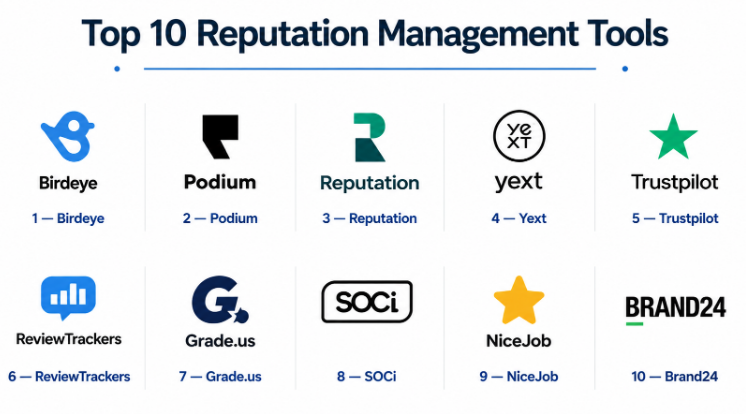
Top 10 Reputation Management Tools
#1 — Birdeye
Short description :
Birdeye is a widely used reputation management and customer experience platform for businesses that need review management, customer feedback, messaging, listings, and local SEO support. It is popular among multi-location businesses, healthcare providers, service companies, agencies, and local brands. The platform helps teams request reviews, monitor ratings, respond to feedback, and understand customer sentiment. Birdeye is especially useful for businesses that want reputation management connected with customer communication. It works well for teams that need both review growth and operational visibility.
Key Features
- Review monitoring and review generation.
- Automated review request workflows.
- Customer messaging and feedback collection.
- Local listing management.
- Sentiment analysis and reporting.
- Multi-location dashboard support.
- Customer experience insights.
Pros
- Strong fit for local and multi-location businesses.
- Good mix of reviews, messaging, and listings.
- Useful dashboards for customer experience teams.
Cons
- May be more than very small teams need.
- Pricing can vary by business size and package.
- Setup should be planned carefully for multi-location use.
Platforms / Deployment
Web / iOS / Android / Cloud
Security & Compliance
Security features may vary by plan. Specific certifications are Not publicly stated.
Integrations & Ecosystem
Birdeye connects reputation management with customer communication and local business workflows.
- CRM integrations may vary.
- Messaging and customer communication tools.
- Review site workflows.
- Local listing management.
- Survey and feedback tools.
- Reporting dashboards.
Support & Community
Birdeye provides onboarding, support, and documentation for business users. Support level may vary by package and customer size.
#2 — Podium
Short description :
Podium is a customer interaction and reputation management platform focused on reviews, messaging, payments, web chat, and customer communication. It is widely used by local businesses, service companies, automotive brands, healthcare offices, and retail teams. Podium helps teams request reviews through customer conversations and manage communication from one place. It is especially useful for businesses that want to improve reputation through faster customer engagement. The platform is strong for review generation and SMS-style customer workflows.
Key Features
- Review request automation.
- Customer messaging.
- Web chat and lead capture.
- Payment communication workflows.
- Review monitoring and response support.
- Team inbox features.
- Local business customer communication tools.
Pros
- Strong for local businesses and service teams.
- Easy customer messaging experience.
- Helps connect reviews with real customer conversations.
Cons
- Not ideal for teams needing deep media monitoring.
- Pricing may not suit very small businesses.
- Best value depends on messaging volume and workflow fit.
Platforms / Deployment
Web / iOS / Android / Cloud
Security & Compliance
Security and compliance details may vary by plan. Specific certifications are Not publicly stated.
Integrations & Ecosystem
Podium works well for businesses that want reputation, messaging, and customer communication together.
- CRM integrations may vary.
- Website chat workflows.
- Review site workflows.
- Payment communication workflows.
- Customer messaging.
- Team inbox workflows.
Support & Community
Podium offers business support, onboarding, and help resources. Support experience may vary by customer size and package.
#3 — Reputation
Short description :
Reputation is an enterprise-focused reputation management and customer experience platform built for large brands, multi-location businesses, healthcare organizations, automotive groups, property management companies, and enterprise service teams. It helps organizations monitor reviews, manage surveys, track sentiment, analyze customer feedback, and improve reputation across many locations. The platform is useful for companies that need reputation data connected with operational improvement. Reputation is especially strong for large-scale review management and experience analytics. It is best suited for organizations with complex location and reporting needs.
Key Features
- Review monitoring and response management.
- Multi-location reputation dashboards.
- Customer surveys and feedback collection.
- Sentiment and experience analytics.
- Local listing management.
- Competitive benchmarking.
- Executive reporting.
Pros
- Strong for enterprise and multi-location brands.
- Good for connecting reputation with customer experience.
- Useful analytics for leadership and operations teams.
Cons
- May be too complex for small businesses.
- Pricing and implementation may require planning.
- Best results require strong internal process ownership.
Platforms / Deployment
Web / Cloud
Security & Compliance
Enterprise security features may be available depending on contract. Specific certifications are Not publicly stated.
Integrations & Ecosystem
Reputation fits into enterprise customer experience, local marketing, and operational reporting workflows.
- Review platform workflows.
- Survey and feedback systems.
- Local listing tools.
- CRM and customer experience integrations may vary.
- Executive dashboards.
- Multi-location reporting.
Support & Community
Reputation generally supports enterprise customers with onboarding, account management, and customer success resources. Support levels may vary by contract.
#4 — Yext
Short description :
Yext is a digital presence and reputation management platform used by businesses that need local listings, reviews, search visibility, knowledge management, and brand information control. It is especially useful for multi-location companies that must keep business information accurate across many online directories and search experiences. Yext helps teams manage reviews, listings, local pages, and brand data from a centralized system. It is a strong fit for brands where reputation depends on accurate online presence and local discovery. It is widely used by retail, healthcare, financial services, restaurants, and service brands.
Key Features
- Local listing management.
- Review monitoring and response workflows.
- Business information management.
- Local search visibility support.
- Multi-location data control.
- Analytics and reporting.
- Local page and knowledge management capabilities.
Pros
- Strong for local SEO and listing accuracy.
- Good for multi-location businesses.
- Useful for controlling brand information across channels.
Cons
- Review management may not be as deep as dedicated feedback tools.
- Can be more complex than small teams need.
- Value depends heavily on local presence requirements.
Platforms / Deployment
Web / Cloud
Security & Compliance
Security features may vary by plan and contract. Specific certifications are Not publicly stated.
Integrations & Ecosystem
Yext is useful for businesses that need accurate location data, listings, and reputation workflows.
- Local listing directories.
- Search and map visibility workflows.
- Review monitoring.
- Local pages.
- Business data management.
- Analytics exports.
Support & Community
Yext provides documentation, onboarding, and customer support. Enterprise support may vary by agreement and business size.
#5 — Trustpilot
Short description :
Trustpilot is a customer review platform that helps businesses collect, manage, display, and respond to customer reviews. It is especially useful for ecommerce brands, SaaS companies, service providers, and businesses that want public social proof. Trustpilot helps companies build trust through verified customer feedback and review visibility. While it is not a complete reputation intelligence platform, it is strong for review collection and public review presence. It is a good fit for brands that want to improve credibility through customer reviews.
Key Features
- Customer review collection.
- Public review profiles.
- Review invitation workflows.
- Review response management.
- Review widgets and display options.
- Basic analytics and reporting.
- Customer trust and social proof support.
Pros
- Strong public review visibility.
- Useful for ecommerce and service brands.
- Helps build customer trust through reviews.
Cons
- Not a full brand monitoring platform.
- Advanced reputation workflows may require other tools.
- Pricing and features may vary by plan.
Platforms / Deployment
Web / Cloud
Security & Compliance
Security and compliance details are Not publicly stated.
Integrations & Ecosystem
Trustpilot fits into customer review, ecommerce, and trust-building workflows.
- Ecommerce platform integrations may vary.
- Review invitation workflows.
- Website review display.
- Customer feedback processes.
- Marketing proof points.
- Reporting exports.
Support & Community
Trustpilot provides business support and documentation. Support levels may vary by subscription and customer size.
#6 — ReviewTrackers
Short description :
ReviewTrackers is a reputation and review management tool focused on monitoring online reviews, analyzing customer feedback, and helping businesses respond to customer sentiment. It is commonly used by multi-location brands, agencies, healthcare providers, restaurants, and service businesses. The platform helps teams bring reviews from multiple sites into one dashboard. ReviewTrackers is especially useful for businesses that want to identify customer experience trends from reviews. It is a strong option for review-focused reputation management.
Key Features
- Review monitoring across multiple sites.
- Review response workflows.
- Sentiment and feedback analytics.
- Multi-location reporting.
- Review alerts.
- Customer experience insights.
- Competitor tracking capabilities may vary.
Pros
- Strong review monitoring focus.
- Good for multi-location reputation tracking.
- Useful for customer experience analysis.
Cons
- Less focused on broad social listening.
- May require other tools for full brand monitoring.
- Integration depth may vary by plan.
Platforms / Deployment
Web / Cloud
Security & Compliance
Security and compliance details are Not publicly stated.
Integrations & Ecosystem
ReviewTrackers works well for review-heavy industries and local reputation workflows.
- Review site monitoring.
- Customer feedback reporting.
- Location-level dashboards.
- Alerts and notifications.
- CRM integrations may vary.
- Agency reporting workflows.
Support & Community
ReviewTrackers provides support and documentation for business users. Support levels may vary depending on package and customer size.
#7 — Grade.us
Short description :
Grade.us is a reputation management platform often used by agencies, marketers, and businesses that need review generation, review monitoring, and white-label reputation services. It is especially useful for agencies managing reputation campaigns for multiple clients. The platform supports review funnels, review requests, monitoring, reporting, and client-facing dashboards. Grade.us is practical for teams that want structured review growth and reputation workflows. It is a strong choice for service providers that need repeatable client reputation programs.
Key Features
- Review generation campaigns.
- Review monitoring.
- White-label agency support.
- Review funnel workflows.
- Reporting dashboards.
- Multi-client management.
- Review response support.
Pros
- Strong fit for agencies.
- Useful white-label reputation workflows.
- Good for structured review generation.
Cons
- May not be ideal for enterprise brand monitoring.
- Social listening depth may be limited.
- Best suited for review-focused use cases.
Platforms / Deployment
Web / Cloud
Security & Compliance
Security and compliance details are Not publicly stated.
Integrations & Ecosystem
Grade.us fits well into agency-led reputation management programs.
- Review request workflows.
- White-label reporting.
- Client dashboards.
- Review monitoring.
- Marketing agency processes.
- Customer feedback workflows.
Support & Community
Grade.us provides resources and support for agencies and businesses. Community strength is strongest among reputation marketing and local SEO professionals.
#8 — SOCi
Short description :
SOCi is a localized marketing and reputation management platform designed for multi-location brands, franchises, and enterprises. It helps teams manage local social media, reviews, listings, and reputation across many locations. SOCi is useful for brands that need centralized control with local execution. It supports reputation management by helping teams monitor and respond to reviews at scale. The platform is a good fit for franchises, restaurants, retail chains, healthcare groups, and service brands.
Key Features
- Multi-location review management.
- Local social media workflows.
- Listing management.
- Brand and location-level reporting.
- Approval and workflow controls.
- Reputation monitoring.
- Localized marketing support.
Pros
- Strong for franchises and multi-location brands.
- Combines local social, listings, and reviews.
- Useful for centralized governance.
Cons
- May be too advanced for single-location businesses.
- Pricing may not fit small teams.
- Setup requires proper location data and workflows.
Platforms / Deployment
Web / Cloud
Security & Compliance
Security features may vary by plan. Specific certifications are Not publicly stated.
Integrations & Ecosystem
SOCi works well for brands that manage many locations and local marketing workflows.
- Review site workflows.
- Local listings.
- Social media management.
- Approval workflows.
- Location reporting.
- Enterprise marketing systems may vary.
Support & Community
SOCi typically supports multi-location businesses with onboarding, customer success, and support resources. Support levels may vary by contract.
#9 — NiceJob
Short description :
NiceJob is a reputation marketing platform focused on helping businesses collect more reviews, improve ratings, and turn customer feedback into social proof. It is commonly used by local service businesses, home service companies, small businesses, and growing teams that want a simple review generation workflow. NiceJob helps automate review requests and promote positive customer experiences. It is best suited for businesses that want more reviews without a complex enterprise system. The platform is practical, simple, and focused on reputation growth.
Key Features
- Automated review requests.
- Review monitoring.
- Customer feedback collection.
- Social proof and review display.
- Referral and reputation marketing workflows.
- Simple dashboards.
- Small business-friendly setup.
Pros
- Easy for small businesses to use.
- Strong focus on review growth.
- Good for service-based businesses.
Cons
- Not a deep enterprise reputation platform.
- Limited advanced analytics compared to larger tools.
- Best for review generation, not full brand monitoring.
Platforms / Deployment
Web / Cloud
Security & Compliance
Security and compliance details are Not publicly stated.
Integrations & Ecosystem
NiceJob fits into local business review generation and reputation marketing workflows.
- Review request automation.
- Website review display.
- Customer feedback workflows.
- Small business CRM integrations may vary.
- Social proof workflows.
- Local service business processes.
Support & Community
NiceJob provides support and resources for small businesses. It is generally approachable for teams without technical expertise.
#10 — Brand24
Short description :
Brand24 is a brand monitoring and social listening tool that can also support reputation management by tracking online mentions, sentiment, influencers, and customer conversations. It is useful for startups, SMBs, agencies, and marketing teams that need to know what people are saying online. Brand24 is stronger for monitoring public conversations than for review generation. It can help teams detect negative mentions, track campaigns, monitor competitors, and understand online reputation signals. It is a good fit when reputation management includes social and web monitoring.
Key Features
- Online mention monitoring.
- Sentiment analysis.
- Influencer and source tracking.
- Competitor monitoring.
- Alerts for brand mentions.
- Campaign tracking.
- Reporting dashboards.
Pros
- Good for online reputation monitoring.
- Easy to use for SMBs and agencies.
- Helpful for social and web conversation tracking.
Cons
- Not focused on review generation.
- May need another tool for local listings.
- Enterprise-level analytics may require deeper platforms.
Platforms / Deployment
Web / iOS / Android / Cloud
Security & Compliance
Security and compliance details are Not publicly stated.
Integrations & Ecosystem
Brand24 supports reputation tracking through online listening and mention analysis.
- Social listening workflows.
- Web mention tracking.
- Alert notifications.
- Reporting exports.
- Competitor tracking.
- Influencer monitoring.
Support & Community
Brand24 provides support resources and is widely used by marketers, agencies, and small business teams. Support may vary by plan.
Comparison Table (Top 10)
| Tool Name | Best For | Platform(s) Supported | Deployment | Standout Feature | Public Rating |
|---|---|---|---|---|---|
| Birdeye | Multi-location review and customer experience | Web, iOS, Android | Cloud | Reviews, messaging, listings, and feedback | N/A |
| Podium | Local business messaging and reviews | Web, iOS, Android | Cloud | Review generation through customer messaging | N/A |
| Reputation | Enterprise reputation and customer experience | Web | Cloud | Multi-location reputation analytics | N/A |
| Yext | Local listings and review management | Web | Cloud | Business information and local visibility control | N/A |
| Trustpilot | Public customer review collection | Web | Cloud | Review collection and trust-building | N/A |
| ReviewTrackers | Review monitoring and feedback analytics | Web | Cloud | Multi-site review tracking | N/A |
| Grade.us | Agencies and white-label reputation services | Web | Cloud | White-label review generation workflows | N/A |
| SOCi | Franchise and multi-location brands | Web | Cloud | Localized marketing and review workflows | N/A |
| NiceJob | Small business review growth | Web | Cloud | Automated review generation | N/A |
| Brand24 | Online reputation monitoring | Web, iOS, Android | Cloud | Social and web mention tracking | N/A |
Evaluation & Reputation Management Tools
| Tool Name | Core (25%) | Ease (15%) | Integrations (15%) | Security (10%) | Performance (10%) | Support (10%) | Value (15%) | Weighted Total (0–10) |
|---|---|---|---|---|---|---|---|---|
| Birdeye | 9 | 8 | 8 | 7 | 8 | 8 | 7 | 8.00 |
| Podium | 8 | 9 | 8 | 7 | 8 | 8 | 7 | 8.00 |
| Reputation | 9 | 7 | 8 | 7 | 8 | 8 | 7 | 7.85 |
| Yext | 8 | 7 | 8 | 7 | 8 | 8 | 7 | 7.60 |
| Trustpilot | 7 | 8 | 7 | 6 | 8 | 7 | 7 | 7.20 |
| ReviewTrackers | 8 | 8 | 7 | 6 | 8 | 7 | 8 | 7.55 |
| Grade.us | 7 | 8 | 7 | 6 | 7 | 7 | 8 | 7.20 |
| SOCi | 8 | 7 | 8 | 7 | 8 | 8 | 7 | 7.60 |
| NiceJob | 7 | 9 | 6 | 6 | 7 | 8 | 8 | 7.35 |
| Brand24 | 7 | 9 | 7 | 6 | 8 | 8 | 8 | 7.60 |
These scores are comparative and should be used as a shortlist guide, not a final buying decision. A tool with a higher total may not be the best fit for every business. For example, Trustpilot is strong for public review collection, while Brand24 is stronger for online mention monitoring. Multi-location companies may need Birdeye, Reputation, Yext, or SOCi, while small service businesses may prefer NiceJob or Podium.
Which Reputation Management Tools
Solo / Freelancer
Solo professionals usually need simple review collection, basic online monitoring, and easy customer feedback workflows. NiceJob, Trustpilot, Brand24, and Google-style manual monitoring alternatives may be enough for basic needs.
If the goal is to build public trust, Trustpilot or NiceJob can help. If the goal is to monitor online mentions, Brand24 may be more useful.
SMB
Small and mid-sized businesses should focus on review generation, review response, customer messaging, and simple reporting. Podium, Birdeye, NiceJob, Trustpilot, and ReviewTrackers are strong options to compare.
SMBs should choose tools that are easy to use and directly improve customer review volume, response speed, and local reputation.
Mid-Market
Mid-market companies often need better dashboards, integrations, multi-location support, and feedback analytics. Birdeye, Podium, ReviewTrackers, Yext, and SOCi are useful options.
These teams should check CRM integrations, user roles, reporting exports, response workflows, and review site coverage before purchasing.
Enterprise
Enterprises need advanced reporting, location-level control, review governance, sentiment analysis, customer experience insights, and strong support. Reputation, Birdeye, Yext, SOCi, and Podium are strong tools to evaluate.
Enterprise buyers should involve marketing, customer experience, compliance, operations, and IT teams before making a final decision.
Budget vs Premium
Budget-focused teams may prefer NiceJob, Trustpilot, Brand24, or Grade.us depending on their use case.
Premium buyers should evaluate Birdeye, Reputation, Podium, Yext, and SOCi when they need scale, support, automation, multi-location workflows, and deeper analytics.
Feature Depth vs Ease of Use
For deeper feature coverage, Birdeye, Reputation, Yext, SOCi, and Podium are stronger options.
For ease of use, NiceJob, Trustpilot, Grade.us, ReviewTrackers, and Brand24 may be easier for smaller teams to adopt.
Integrations & Scalability-
Teams should evaluate integrations with CRM, helpdesk, POS, scheduling tools, ecommerce systems, marketing automation, local listing platforms, and customer feedback tools.
Scalable reputation workflows also need user roles, approval workflows, location-level permissions, automated review requests, alerts, and executive dashboards.
Security & Compliance Needs
Security-focused buyers should ask vendors about SSO, MFA, RBAC, audit logs, encryption, data retention, review response permissions, and compliance documentation.
Healthcare, finance, legal, and enterprise teams should review vendor security carefully before connecting customer communication or review workflows.
Frequently Asked Questions (FAQs)
1. What is a reputation management tool?
A reputation management tool helps businesses track reviews, collect feedback, respond to customers, monitor brand mentions, and improve public trust. It gives teams one place to manage online reputation instead of checking many sites manually.
2. How is reputation management different from brand monitoring?
Brand monitoring focuses on tracking mentions and conversations across the web and social media. Reputation management is broader because it includes reviews, ratings, responses, feedback collection, listings, and customer trust improvement.
3. Do small businesses need reputation management tools?
Yes, especially if customers check reviews before buying. Local service businesses, clinics, restaurants, agencies, and ecommerce brands can benefit from review requests, faster responses, and better public ratings.
4. Can reputation management tools remove negative reviews?
Generally, these tools cannot remove genuine negative reviews. They can help teams respond professionally, report reviews that violate platform rules, and collect more positive feedback over time.
5. What is the biggest mistake in reputation management?
The biggest mistake is only asking for reviews but not responding to negative feedback. A strong reputation strategy includes listening, responding, fixing root causes, and learning from customer complaints.
6. How do reputation tools help with local SEO?
Reviews, ratings, location accuracy, and customer engagement can influence local visibility. Tools like Birdeye, Yext, SOCi, and ReviewTrackers can help businesses manage reviews and location data more consistently.
7. Are reputation management tools secure?
Security depends on the vendor and plan. Buyers should ask about user permissions, encryption, SSO, MFA, audit logs, and data handling before choosing a platform.
8. What integrations are important?
Important integrations include CRM, helpdesk, POS, ecommerce, appointment scheduling, marketing automation, messaging, customer feedback tools, and local listing platforms.
9. How long does implementation take?
Simple tools can be set up quickly, while enterprise or multi-location platforms may need more planning. Setup usually includes location data, review sources, templates, permissions, integrations, and reporting dashboards.
10. Which tool is best for multi-location businesses?
Birdeye, Reputation, Yext, SOCi, Podium, and ReviewTrackers are strong options for multi-location needs. The best choice depends on review volume, listing needs, customer communication, and reporting depth.
Conclusion
Reputation Management Tools help businesses protect trust, improve customer feedback workflows, respond faster to reviews, and understand public perception more clearly. The best tool depends on business size, review volume, industry, number of locations, customer communication style, and reporting needs. Local businesses may prefer Podium, NiceJob, Trustpilot, or Birdeye, while multi-location and enterprise teams may need Reputation, Yext, SOCi, or ReviewTrackers. Teams that care more about online mentions and sentiment may also consider Brand24.
