Introduction
Brand Monitoring Tools help businesses track what people are saying about their brand across online news, social media, blogs, forums, review sites, videos, podcasts, and other digital channels. In simple words, these tools help companies understand brand reputation, customer sentiment, competitor mentions, campaign impact, and early signs of public issues.
Brand monitoring matters because customers now discuss brands everywhere. A complaint can spread quickly, a positive campaign can create new demand, and a competitor’s move can change market perception overnight. Modern brand monitoring tools help marketing, PR, customer support, social media, and leadership teams stay informed and respond faster.
Best for: marketing teams, PR teams, social media managers, agencies, customer experience teams, founders, enterprise communications teams, and brands that need to track public conversations.
Not ideal for: very small teams that only need basic Google Alerts, businesses with no public-facing brand activity, or teams that only need internal customer support ticket tracking.
Key Trends in Brand Monitoring Tools
- AI-powered sentiment analysis is becoming more important for identifying positive, negative, and neutral brand conversations.
- Real-time crisis alerts are now a core requirement for teams that need fast response during reputation issues.
- Social listening and brand monitoring are merging into unified platforms for PR, marketing, and customer experience teams.
- Competitor intelligence is becoming a stronger use case, especially for tracking share of voice and market positioning.
- Multichannel monitoring is expanding beyond social media to include news, forums, podcasts, videos, review sites, and communities.
- Executive-ready reporting is becoming important because leadership teams want clear brand health insights, not only raw mention counts.
- Influencer and creator monitoring is growing as brands want to know who is shaping conversations in their market.
- More demand for regional and multilingual tracking is rising as brands expand across global markets.
- Integration with CRM and support tools is increasing so teams can connect brand mentions with customer action.
- Privacy and data governance expectations are rising, especially for enterprises and regulated industries.
How We Selected These Tools
- Market recognition and adoption among PR, marketing, social media, and communication teams.
- Strength of brand mention tracking across social, web, news, reviews, and online communities.
- Sentiment analysis and reputation intelligence capabilities.
- Reporting quality, dashboards, alerts, and executive visibility.
- Competitor tracking and share-of-voice measurement.
- Fit for different company sizes, including startups, SMBs, agencies, mid-market, and enterprise teams.
- Integration ecosystem with CRM, helpdesk, analytics, social media, and collaboration tools.
- Usability for non-technical teams.
- Security, access control, and enterprise readiness where clearly known.
- Overall value based on feature depth, reliability, and practical daily use.
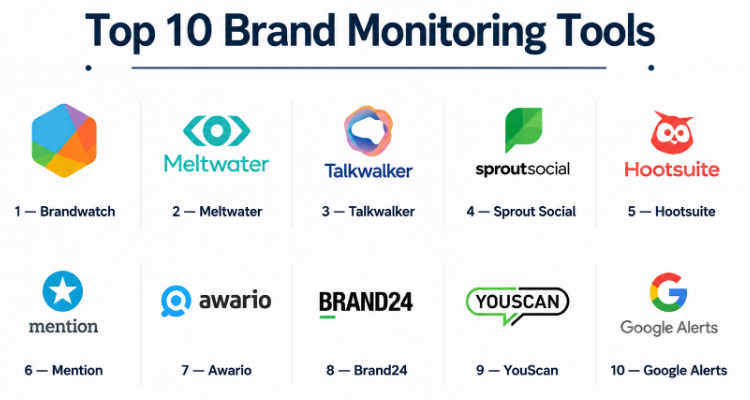
Top 10 Brand Monitoring Tools
#1 — Brandwatch
Short description :
Brandwatch is a well-known consumer intelligence and social listening platform used by enterprises, agencies, and large marketing teams. It helps brands monitor online conversations, understand sentiment, identify trends, and measure brand perception. The platform is useful for companies that need deep analytics and large-scale monitoring across social and digital channels. Brandwatch is especially strong for enterprise research, audience insights, competitive intelligence, and campaign measurement. It is best suited for teams that need advanced brand intelligence rather than simple mention alerts.
Key Features
- Social listening and online conversation tracking.
- Sentiment analysis and trend detection.
- Competitor and share-of-voice monitoring.
- Audience insights and consumer intelligence.
- Campaign reporting and dashboards.
- Influencer and topic discovery.
- Enterprise-level analytics workflows.
Pros
- Strong analytics and social listening depth.
- Good fit for enterprise and agency teams.
- Useful for competitive and consumer intelligence.
Cons
- Can be complex for small teams.
- Pricing may be high for basic monitoring needs.
- Requires setup and training to get full value.
Platforms / Deployment
Web / Cloud
Security & Compliance
Enterprise security features may vary by contract. Specific certifications are Not publicly stated.
Integrations & Ecosystem
Brandwatch fits into larger marketing, PR, and consumer intelligence workflows.
- Social media analytics workflows.
- Reporting and dashboard exports.
- Consumer research processes.
- Agency campaign reporting.
- Competitive intelligence workflows.
- Marketing and brand strategy use cases.
Support & Community
Brandwatch generally serves professional and enterprise users with documentation, onboarding, and support options. Support levels may vary by package and region.
#2 — Meltwater
Short description :
Meltwater is a media intelligence and brand monitoring platform used by PR, marketing, communications, and social media teams. It helps organizations track brand mentions across news, online media, social channels, and digital conversations. Meltwater is useful for reputation monitoring, campaign reporting, competitor tracking, and crisis alerts. It is especially valuable for teams that want media monitoring and social listening in one system. Mid-market and enterprise teams often evaluate Meltwater when they need both brand intelligence and PR reporting.
Key Features
- Media monitoring across news, social, and online sources.
- Brand mention alerts.
- Sentiment analysis and reputation tracking.
- Competitive monitoring.
- Campaign performance dashboards.
- Media database and PR workflow support.
- Social listening and reporting.
Pros
- Strong combination of media monitoring and social listening.
- Useful for PR and marketing teams together.
- Good fit for brand reputation tracking.
Cons
- Pricing may not suit small teams.
- Setup can take time for advanced reporting.
- Some workflows may require onboarding support.
Platforms / Deployment
Web / Cloud
Security & Compliance
Enterprise security capabilities may vary by plan. Specific certifications are Not publicly stated.
Integrations & Ecosystem
Meltwater connects brand monitoring with media intelligence and PR workflows.
- Social listening workflows.
- Media monitoring dashboards.
- PR reporting.
- Alert notifications.
- Campaign analytics.
- Competitive intelligence workflows.
Support & Community
Meltwater typically provides onboarding and customer support for business users. Support experience may vary by region, package, and customer size.
#3 — Talkwalker
Short description :
Talkwalker is a consumer intelligence and social listening platform used for brand monitoring, reputation management, competitive analysis, and campaign measurement. It helps teams track conversations across social media, online news, blogs, forums, and other digital sources. Talkwalker is useful for brands that need broad monitoring coverage and deeper analytics. It is commonly evaluated by enterprises and agencies that need sentiment insights, trend tracking, and share-of-voice reporting. The platform is a strong fit for data-driven brand and communication teams.
Key Features
- Social listening and brand mention monitoring.
- Sentiment analysis and trend discovery.
- Competitive benchmarking.
- Campaign tracking and reporting.
- Image and visual listening capabilities where available.
- Crisis detection and alerts.
- Consumer intelligence dashboards.
Pros
- Strong for social and digital intelligence.
- Good for enterprise-level brand monitoring.
- Useful for competitive and campaign analysis.
Cons
- May be too advanced for simple needs.
- Pricing may be high for smaller teams.
- Requires careful dashboard setup.
Platforms / Deployment
Web / Cloud
Security & Compliance
Enterprise security details may vary by agreement. Specific certifications are Not publicly stated.
Integrations & Ecosystem
Talkwalker works well for data-heavy brand monitoring and market intelligence workflows.
- Social analytics workflows.
- Reporting dashboards.
- Brand reputation tracking.
- Competitive intelligence.
- Campaign performance analysis.
- Alert and crisis monitoring workflows.
Support & Community
Talkwalker generally supports business and enterprise customers with onboarding, support resources, and customer success options. Exact support levels may vary.
#4 — Sprout Social
Short description :
Sprout Social is a social media management and listening platform used by marketing teams, agencies, and customer experience teams. While it is widely known for social publishing and engagement, it also supports brand monitoring through social listening, mentions, sentiment, and reporting. It is useful for teams that want brand monitoring connected with social media management. Sprout Social is a good fit for brands that need to track conversations, respond to customers, and measure social performance from one platform. It is especially practical for social-first brand monitoring.
Key Features
- Social media monitoring and listening.
- Brand mentions and keyword tracking.
- Social inbox and engagement workflows.
- Sentiment and conversation insights.
- Reporting dashboards.
- Competitor and campaign tracking.
- Team collaboration features.
Pros
- Strong social media workflow integration.
- Easy for marketing and social teams to use.
- Good for monitoring and engagement together.
Cons
- Broader web and news monitoring may be limited compared to media intelligence tools.
- Advanced listening may depend on plan.
- Not ideal as a full PR monitoring platform alone.
Platforms / Deployment
Web / iOS / Android / Cloud
Security & Compliance
Security features may vary by plan. Specific certifications are Not publicly stated.
Integrations & Ecosystem
Sprout Social fits well into social media marketing, customer engagement, and brand response workflows.
- Social media platform integrations.
- CRM and support workflow connections may vary.
- Reporting exports.
- Team collaboration.
- Customer engagement workflows.
- Campaign measurement.
Support & Community
Sprout Social has strong documentation, customer support options, and a broad user community among marketers and social media teams.
#5 — Hootsuite
Short description :
Hootsuite is a social media management platform that also supports brand monitoring through streams, keyword tracking, mentions, and social listening features. It is widely used by marketing teams, agencies, SMBs, and enterprises for managing social channels and tracking brand conversations. Hootsuite is practical for teams that want publishing, scheduling, engagement, and monitoring in one place. It is especially useful for brands that rely heavily on social media presence. For deeper media intelligence, teams may still need a specialized listening or monitoring platform.
Key Features
- Social media monitoring streams.
- Brand mention and keyword tracking.
- Social publishing and scheduling.
- Engagement and inbox workflows.
- Reporting and analytics.
- Team collaboration.
- App and integration ecosystem.
Pros
- Familiar and widely used social media platform.
- Good for social monitoring plus publishing.
- Useful for teams managing multiple channels.
Cons
- Deep brand intelligence may require add-ons or integrations.
- Not as strong for full web and news monitoring.
- Advanced analytics may vary by plan.
Platforms / Deployment
Web / iOS / Android / Cloud
Security & Compliance
Security features may vary by plan. Specific certifications are Not publicly stated.
Integrations & Ecosystem
Hootsuite works well for social-first monitoring and publishing workflows.
- Social platform integrations.
- Content scheduling workflows.
- Reporting and analytics.
- App marketplace integrations.
- Team collaboration.
- Customer engagement processes.
Support & Community
Hootsuite has documentation, learning resources, and support options. Its community is broad because many social media teams and agencies use it.
#6 — Mention
Short description :
Mention is a brand monitoring and social listening tool designed for tracking brand mentions, competitors, keywords, and online conversations. It is commonly used by startups, SMBs, agencies, and marketing teams that need a simpler monitoring solution. Mention helps users track web and social mentions, respond to conversations, and create reports. It is a practical choice for teams that do not need a heavy enterprise platform. Mention is especially useful for early reputation monitoring and competitive tracking.
Key Features
- Brand mention monitoring.
- Social listening and keyword alerts.
- Competitor tracking.
- Sentiment and conversation insights.
- Reporting dashboards.
- Team collaboration.
- Basic engagement workflows.
Pros
- Easier to use than many enterprise tools.
- Good for startups and SMBs.
- Useful for basic brand and competitor monitoring.
Cons
- May not match enterprise monitoring depth.
- Advanced analytics may be limited.
- Coverage quality should be tested for niche markets.
Platforms / Deployment
Web / Cloud
Security & Compliance
Security and compliance details are Not publicly stated.
Integrations & Ecosystem
Mention supports practical monitoring and alert workflows for growing teams.
- Social monitoring.
- Web mention tracking.
- Alerts and notifications.
- Reporting exports.
- Team collaboration.
- Competitor tracking workflows.
Support & Community
Mention provides help resources and support options. It is generally approachable for small and mid-sized teams.
#7 — Awario
Short description :
Awario is a brand monitoring and social listening tool focused on tracking mentions across social media, web sources, blogs, forums, and online conversations. It is useful for startups, small businesses, agencies, and marketers who need affordable monitoring with practical alerts. Awario helps teams track brand reputation, competitors, industry keywords, and potential leads. It can also support social selling and customer conversation discovery. The platform is a good fit for teams that want monitoring without enterprise complexity.
Key Features
- Brand and keyword monitoring.
- Social listening across multiple sources.
- Competitor tracking.
- Sentiment analysis.
- Lead discovery features.
- Real-time alerts.
- Reporting and analytics.
Pros
- Practical for smaller teams.
- Useful for brand and competitor tracking.
- More accessible than many enterprise tools.
Cons
- Not ideal for large enterprise monitoring needs.
- Data coverage may vary by source and region.
- Advanced reporting may be limited compared to premium tools.
Platforms / Deployment
Web / Cloud
Security & Compliance
Security and compliance details are Not publicly stated.
Integrations & Ecosystem
Awario supports brand monitoring, competitor listening, and social selling workflows.
- Social media monitoring.
- Web mention tracking.
- Alerts and notifications.
- Reporting dashboards.
- Competitor tracking.
- Lead discovery workflows.
Support & Community
Awario provides support resources for users, but community and enterprise support depth may be more limited than larger platforms.
#8 — Brand24
Short description :
Brand24 is a brand monitoring and social listening tool used by marketing teams, agencies, startups, and SMBs. It helps track online mentions, sentiment, reach, influencers, and competitor conversations. Brand24 is useful for teams that want simple monitoring, fast alerts, and easy-to-understand dashboards. It can support reputation tracking, campaign measurement, social listening, and customer feedback discovery. It is a strong option for teams that want a focused brand monitoring tool without a large enterprise setup.
Key Features
- Online brand mention monitoring.
- Sentiment analysis.
- Influencer and source tracking.
- Mention alerts.
- Competitor monitoring.
- Campaign analytics.
- Reporting dashboards.
Pros
- Easy to use for marketing teams.
- Good for quick alerts and brand tracking.
- Useful for SMBs and agencies.
Cons
- May not match enterprise intelligence platforms.
- Coverage depth should be tested for target markets.
- Advanced integrations may vary by plan.
Platforms / Deployment
Web / iOS / Android / Cloud
Security & Compliance
Security and compliance details are Not publicly stated.
Integrations & Ecosystem
Brand24 fits into practical brand reputation and campaign tracking workflows.
- Social listening.
- Web mention monitoring.
- Alert notifications.
- Reporting exports.
- Influencer tracking.
- Competitor monitoring.
Support & Community
Brand24 provides support resources and is known among marketers, agencies, and small business users. Support levels may vary by plan.
#9 — YouScan
Short description :
YouScan is a social listening and brand monitoring platform with a focus on consumer insights, sentiment, visual analysis, and online conversation tracking. It is useful for brands that want to understand how customers discuss products, services, and competitors across digital channels. YouScan can help teams track reputation, identify trends, and analyze social conversations. It is especially relevant for consumer brands, agencies, and teams that care about visual content monitoring. Buyers should evaluate regional coverage, source availability, and analytics needs.
Key Features
- Social listening and mention tracking.
- Sentiment analysis.
- Visual content analysis where available.
- Trend and topic discovery.
- Competitor monitoring.
- Reporting dashboards.
- Consumer insight workflows.
Pros
- Strong for consumer insight use cases.
- Useful visual monitoring capabilities.
- Good for brand and campaign analysis.
Cons
- May not be necessary for simple monitoring.
- Pricing and package details may vary.
- Regional coverage should be validated.
Platforms / Deployment
Web / Cloud
Security & Compliance
Security and compliance details are Not publicly stated.
Integrations & Ecosystem
YouScan fits into social listening, consumer intelligence, and reputation tracking workflows.
- Social media monitoring.
- Visual listening workflows.
- Sentiment tracking.
- Dashboard reporting.
- Competitive intelligence.
- Consumer insight analysis.
Support & Community
Support and onboarding may vary by plan and region. Teams should confirm training and customer success support before choosing it.
#10 — Google Alerts
Short description :
Google Alerts is a simple and free brand monitoring option for tracking web mentions based on selected keywords. It is not a full brand monitoring platform, but it can be useful for individuals, small businesses, founders, and early-stage teams that need basic web alerts. Users can monitor company names, product names, executive names, competitors, or industry keywords. It is best for lightweight awareness, not deep analytics. Teams that need sentiment, social monitoring, reporting, or crisis alerts will need a more advanced tool.
Key Features
- Keyword-based web alerts.
- Email notifications.
- Simple setup.
- Basic brand and competitor tracking.
- Useful for personal name monitoring.
- No complex dashboard required.
- Lightweight monitoring for small teams.
Pros
- Simple and free to use.
- Good for basic web mention awareness.
- Easy for anyone to set up.
Cons
- No advanced analytics or sentiment.
- Limited social media monitoring.
- Not suitable for serious brand reputation programs.
Platforms / Deployment
Web / Cloud
Security & Compliance
Security and compliance details are Not publicly stated.
Integrations & Ecosystem
Google Alerts is basic and does not offer a deep integration ecosystem.
- Email alerts.
- Keyword monitoring.
- Basic web mention tracking.
- Manual reporting workflows.
- Simple competitor monitoring.
- Lightweight reputation tracking.
Support & Community
Support is limited compared to paid platforms. It is best used as a basic starting point or backup alert system.
Comparison Table (Top 10)
| Tool Name | Best For | Platform(s) Supported | Deployment | Standout Feature | Public Rating |
|---|---|---|---|---|---|
| Brandwatch | Enterprise consumer intelligence | Web | Cloud | Advanced social listening and analytics | N/A |
| Meltwater | PR and media intelligence teams | Web | Cloud | Media monitoring plus social listening | N/A |
| Talkwalker | Enterprise social and consumer intelligence | Web | Cloud | Deep trend and sentiment analysis | N/A |
| Sprout Social | Social-first brand monitoring | Web, iOS, Android | Cloud | Monitoring plus engagement workflows | N/A |
| Hootsuite | Social media monitoring and publishing | Web, iOS, Android | Cloud | Social streams and publishing workflows | N/A |
| Mention | SMB brand monitoring | Web | Cloud | Simple mention tracking and alerts | N/A |
| Awario | Affordable social listening | Web | Cloud | Brand tracking and lead discovery | N/A |
| Brand24 | SMB and agency monitoring | Web, iOS, Android | Cloud | Fast alerts and influencer tracking | N/A |
| YouScan | Consumer insight and visual listening | Web | Cloud | Visual content monitoring | N/A |
| Google Alerts | Basic web alerts | Web | Cloud | Free keyword-based monitoring | N/A |
Evaluation & Brand Monitoring Tools
| Tool Name | Core (25%) | Ease (15%) | Integrations (15%) | Security (10%) | Performance (10%) | Support (10%) | Value (15%) | Weighted Total (0–10) |
|---|---|---|---|---|---|---|---|---|
| Brandwatch | 9 | 7 | 8 | 7 | 9 | 8 | 7 | 8.00 |
| Meltwater | 9 | 8 | 8 | 7 | 8 | 8 | 7 | 8.00 |
| Talkwalker | 9 | 7 | 8 | 7 | 8 | 8 | 7 | 7.85 |
| Sprout Social | 8 | 9 | 8 | 7 | 8 | 8 | 8 | 8.10 |
| Hootsuite | 7 | 9 | 8 | 7 | 8 | 8 | 8 | 7.85 |
| Mention | 7 | 9 | 7 | 6 | 7 | 7 | 8 | 7.35 |
| Awario | 7 | 8 | 6 | 6 | 7 | 7 | 8 | 7.05 |
| Brand24 | 8 | 9 | 7 | 6 | 8 | 8 | 8 | 7.75 |
| YouScan | 8 | 7 | 7 | 6 | 8 | 7 | 7 | 7.30 |
| Google Alerts | 4 | 10 | 4 | 5 | 6 | 4 | 10 | 5.95 |
The scores are comparative and based on practical brand monitoring use cases. Enterprise tools score higher for depth, analytics, and scale, while lightweight tools score better for ease and value. A small team may not need the highest-scoring platform if a simpler tool solves the job. Buyers should validate source coverage, alert speed, reporting quality, integrations, and pricing before making a final decision.
Which Brand Monitoring Tools
Solo / Freelancer
Solo professionals, consultants, and freelancers usually need simple alerts and low-cost monitoring. Google Alerts, Mention, Awario, and Brand24 are practical starting points.
If the goal is only to track a personal name, brand name, or small business mention, Google Alerts may be enough. If sentiment, social monitoring, and reporting matter, Brand24 or Mention can be better.
SMB
SMBs need tools that are affordable, easy to use, and useful for reputation tracking. Brand24, Mention, Awario, Hootsuite, and Sprout Social are good options to compare.
SMBs should focus on alert quality, dashboard simplicity, social media coverage, competitor tracking, and whether the tool helps teams respond quickly.
Mid-Market
Mid-market teams often need better reporting, competitor insights, social listening, and cross-team collaboration. Sprout Social, Hootsuite, Meltwater, Talkwalker, and Brandwatch are useful options to evaluate.
These companies should look for integrations, team permissions, reporting exports, sentiment analysis, campaign tracking, and scalable monitoring workflows.
Enterprise
Enterprise brands need advanced monitoring, global coverage, crisis alerts, dashboards, access controls, competitive intelligence, and strong support. Brandwatch, Meltwater, Talkwalker, and YouScan are strong enterprise-focused options.
Enterprises should validate data coverage, multilingual support, compliance needs, user roles, historical data access, and executive reporting quality.
Budget vs Premium
Budget-conscious users can start with Google Alerts, Awario, Mention, or Brand24. These tools can cover basic brand monitoring without a heavy budget.
Premium buyers should evaluate Brandwatch, Meltwater, Talkwalker, Sprout Social, and YouScan when they need advanced analytics, broader coverage, stronger reporting, and enterprise support.
Feature Depth vs Ease of Use
For deep brand intelligence, Brandwatch, Meltwater, Talkwalker, and YouScan are stronger choices. They are useful for advanced reporting, trend tracking, and competitive analysis.
For ease of use, Brand24, Mention, Sprout Social, Hootsuite, and Google Alerts may be easier for smaller teams and marketers to adopt.
Integrations & Scalability-
Teams should evaluate integrations with social media platforms, CRM, helpdesk tools, Slack-style notifications, analytics systems, reporting dashboards, and marketing tools.
Scalable teams should also review user roles, team workflows, multi-brand support, saved searches, export options, alert routing, and API availability where needed.
Security & Compliance Needs
Security-focused buyers should ask about SSO, MFA, RBAC, audit logs, encryption, data retention, and compliance documentation. This is especially important for enterprises, finance, healthcare, government-related teams, and regulated industries.
Do not assume that every brand monitoring tool has the same security level. Always confirm security details during vendor evaluation.
Frequently Asked Questions (FAQs)
1. What is a brand monitoring tool?
A brand monitoring tool tracks online mentions of a company, product, person, competitor, or keyword. It helps teams understand reputation, customer sentiment, campaign impact, and public conversations.
2. How is brand monitoring different from social listening?
Brand monitoring focuses on tracking mentions and reputation signals. Social listening goes deeper into audience behavior, sentiment, trends, themes, and market insights across social and digital channels.
3. Do small businesses need brand monitoring tools?
Yes, small businesses can benefit from monitoring reviews, customer complaints, competitor mentions, and social conversations. However, they may only need a simple or affordable tool at first.
4. Can Google Alerts replace a paid brand monitoring tool?
Google Alerts can help with basic web mentions, but it does not provide deep social listening, sentiment analysis, dashboards, competitor intelligence, or advanced reporting. It is useful as a starting point, not a full solution.
5. What should I monitor besides my brand name?
You should monitor product names, founder names, executive names, competitor names, campaign hashtags, industry keywords, common misspellings, and important customer pain points.
6. How accurate is sentiment analysis?
Sentiment analysis is useful but not perfect. It can misunderstand sarcasm, slang, regional language, and context. Human review is still important for sensitive or high-impact mentions.
7. What is the biggest mistake in brand monitoring?
The biggest mistake is tracking too many keywords without a clear response process. Monitoring only creates value when teams know who should respond, when to escalate, and how to report insights.
8. Can brand monitoring help during a crisis?
Yes. Real-time alerts and negative sentiment tracking can help teams detect issues early. During a crisis, fast awareness can help PR, legal, support, and leadership teams respond more effectively.
9. Do brand monitoring tools track competitors?
Many tools support competitor tracking, share-of-voice reporting, keyword comparison, and industry trend monitoring. This helps teams understand market positioning and competitor communication.
10. How do brand monitoring tools integrate with other systems?
Common integrations include social media platforms, CRM tools, helpdesk software, analytics tools, collaboration platforms, and reporting systems. Integration depth varies by vendor and plan.
Conclusion
Brand Monitoring Tools are essential for teams that want to understand how their brand is seen, discussed, questioned, praised, or criticized across digital channels. The best tool depends on company size, monitoring depth, budget, channel coverage, reporting needs, and response workflow. Enterprise teams may prefer Brandwatch, Meltwater, Talkwalker, or YouScan for advanced analytics and broad intelligence, while SMBs and agencies may find Brand24, Mention, Awario, Sprout Social, or Hootsuite more practical. Google Alerts can still be useful for basic tracking, but it is not enough for serious reputation management.
