Introduction
Account-Based Marketing platforms help B2B teams focus sales and marketing efforts on high-value target accounts instead of broad, generic lead generation. In plain English, ABM platforms help companies identify the right accounts, understand buyer intent, personalize campaigns, run targeted ads, coordinate sales outreach, and measure pipeline impact.
In environment, ABM matters because buying committees are larger, sales cycles are longer, and marketing budgets are under stronger pressure to prove revenue contribution. Instead of chasing every lead, ABM helps teams prioritize accounts that match their ideal customer profile.
Common use cases include enterprise account targeting, sales and marketing alignment, intent-based campaign planning, personalized website experiences, account-based advertising, pipeline acceleration, and customer expansion campaigns.
Buyers should evaluate account data quality, intent signals, CRM integrations, campaign orchestration, analytics, ease of use, security controls, pricing fit, implementation effort, and sales-team adoption.
Best for: B2B SaaS companies, enterprise sales teams, revenue operations teams, demand generation teams, and marketing leaders targeting high-value accounts.
Not ideal for: Very small businesses with simple lead generation needs, low-ticket products, or teams without enough CRM data and sales process maturity.
Key Trends in Account-Based Marketing (ABM) Platforms
- AI-powered account scoring is becoming standard, helping teams identify accounts most likely to engage or convert.
- Intent data is moving closer to revenue workflows, not just marketing dashboards.
- Sales and marketing alignment is now central, with shared account views, alerts, and engagement timelines.
- Personalization is expanding beyond email, including ads, landing pages, website content, chat, and direct outreach.
- Privacy and compliance expectations are increasing, especially around data handling, consent, and customer tracking.
- CRM and MAP integrations remain critical, especially with Salesforce, HubSpot, Marketo, and Microsoft Dynamics.
- Buying committee visibility is becoming more important, because B2B purchases involve multiple stakeholders.
- Pipeline attribution is replacing vanity metrics, with teams focusing less on clicks and more on opportunities and revenue.
- Modular ABM stacks are growing, where companies combine data, ad, enrichment, and orchestration tools instead of one platform.
- Mid-market ABM adoption is rising, driven by easier setup, packaged workflows, and more flexible pricing models.
How We Selected These Tools Methodology
The tools below were selected using practical evaluation logic based on:
- Market recognition and adoption across B2B sales and marketing teams.
- Strength of ABM-specific features such as targeting, intent, orchestration, and reporting.
- Fit for different company sizes including SMB, mid-market, and enterprise.
- Integration strength with CRM, marketing automation, advertising, and sales tools.
- Availability of analytics, engagement tracking, and account-level measurement.
- Security and compliance posture where publicly known.
- Ease of implementation and support ecosystem.
- Suitability for modern ABM workflows such as AI scoring, personalization, and multi-channel engagement.
- Balance between all-in-one ABM suites and focused ABM campaign platforms.
- Practical value for revenue teams, not only feature depth.
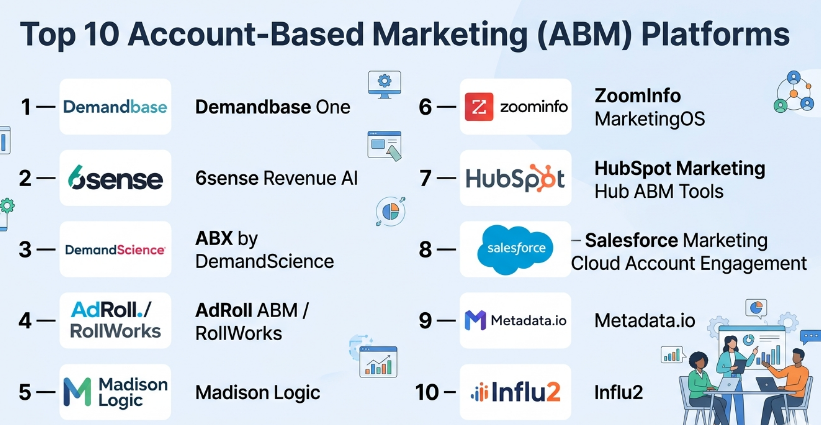
Top 10 Account-Based Marketing (ABM) Platforms
#1 — Demandbase One
Short description :
Demandbase One is a mature ABM and go-to-market platform designed for B2B companies that want account intelligence, intent data, advertising, orchestration, and measurement in one system. It is especially strong for enterprise and upper mid-market teams that manage large account lists and complex buying journeys. The platform helps revenue teams prioritize accounts, personalize engagement, and connect marketing activity with pipeline outcomes. It is a strong choice for organizations with established sales and marketing operations. It may feel heavy for very small teams that need only simple campaign execution.
Key Features
- Account identification and account-level intelligence.
- Intent data and buyer behavior signals.
- Account-based advertising and campaign orchestration.
- Sales intelligence and account engagement insights.
- Website personalization and journey analytics.
- Pipeline and revenue measurement.
- CRM and marketing automation integrations.
Pros
- Strong fit for mature B2B ABM programs.
- Deep account intelligence and orchestration capabilities.
- Useful for aligning sales, marketing, and revenue operations.
Cons
- Can require strong internal operations support.
- May be more complex than smaller teams need.
- Pricing and setup effort may be high for early-stage companies.
Platforms / Deployment
Web. Cloud.
Security & Compliance
SSO/SAML, role-based access, encryption, and enterprise security controls are commonly expected. Specific certifications should be verified directly. Some details are not publicly stated.
Integrations & Ecosystem
Demandbase is built to connect with core B2B revenue systems and campaign channels. It works best when integrated deeply into CRM, marketing automation, advertising, and sales workflows.
- Salesforce
- HubSpot
- Marketo
- Microsoft Dynamics
- Advertising networks
- Sales engagement tools
Support & Community
Demandbase generally supports enterprise onboarding, customer success, documentation, and strategic guidance. Community strength is strongest among mature B2B marketing and revenue teams.
#2 — 6sense Revenue AI
Short description :
6sense Revenue AI is an ABM and revenue intelligence platform focused on predictive insights, buyer intent, account prioritization, and pipeline generation. It helps teams identify hidden demand, prioritize in-market accounts, and coordinate sales and marketing actions. The platform is widely used by B2B teams that want AI-assisted account scoring and buyer journey visibility. It is especially useful for teams with large addressable markets and long sales cycles. Smaller teams may need time to fully adopt its data-driven workflows.
Key Features
- AI-based account scoring and prioritization.
- Intent and buying-stage signals.
- Predictive analytics for sales and marketing.
- Account-based advertising and segmentation.
- Sales alerts and engagement insights.
- CRM and marketing automation integrations.
- Revenue reporting and pipeline analytics.
Pros
- Strong predictive intelligence capabilities.
- Helps prioritize accounts based on buying signals.
- Useful for sales and marketing alignment.
Cons
- Requires clean CRM and account data for best results.
- May need training for teams new to predictive ABM.
- Can be more than small teams need.
Platforms / Deployment
Web. Cloud.
Security & Compliance
Enterprise security controls are expected, including access controls and data protection. Specific certifications should be verified directly. Some details are not publicly stated.
Integrations & Ecosystem
6sense connects with common revenue systems and helps turn account intelligence into campaign and sales actions.
- Salesforce
- HubSpot
- Marketo
- Sales engagement tools
- Advertising platforms
- Data enrichment tools
Support & Community
6sense provides onboarding, documentation, customer success, and enterprise support options. Its ecosystem is strong among B2B revenue teams using predictive ABM.
#3 — ABX by DemandScience
Short description :
ABX by DemandScience, formerly associated with Terminus, is an account-based experience platform focused on multi-channel ABM execution, account engagement, advertising, and revenue team alignment. It is useful for B2B companies that want to coordinate account-based campaigns across marketing and sales channels. The platform supports account targeting, campaign activation, analytics, and engagement insights. It is suitable for mid-market and enterprise teams looking for structured ABM execution. Buyers should confirm current product packaging and capabilities during evaluation.
Key Features
- Account targeting and segmentation.
- Multi-channel campaign activation.
- Account engagement tracking.
- Advertising and digital campaign support.
- Sales and marketing alignment workflows.
- Campaign reporting and attribution.
- CRM and marketing integrations.
Pros
- Strong focus on ABM campaign execution.
- Useful for teams running coordinated account programs.
- Good fit for sales and marketing collaboration.
Cons
- Product structure may require careful evaluation.
- Advanced use may need ABM process maturity.
- Some details depend on current packaging.
Platforms / Deployment
Web. Cloud.
Security & Compliance
Security controls are expected for enterprise use, but specific certifications and controls should be verified directly. Some details are not publicly stated.
Integrations & Ecosystem
The platform is designed to connect account data, campaigns, and revenue workflows.
- Salesforce
- HubSpot
- Marketing automation platforms
- Advertising channels
- Sales tools
- Reporting systems
Support & Community
Support is typically provided through onboarding, account teams, and documentation. Community strength is more enterprise and revenue-team oriented.
#4 — AdRoll ABM / RollWorks
Short description :
AdRoll ABM, formerly RollWorks, is an account-based advertising and marketing platform popular with mid-market B2B teams. It helps companies target account lists, run digital advertising, identify engaged accounts, and support sales outreach. It is often chosen by teams that want practical ABM execution without a heavy enterprise platform. The platform is especially helpful for account-based advertising, retargeting, and campaign measurement. It may not offer the same depth of predictive intelligence as some enterprise ABM suites.
Key Features
- Account-based advertising.
- Target account list activation.
- Engagement tracking and account scoring.
- Website visitor insights.
- CRM and marketing integrations.
- Retargeting and campaign reporting.
- Sales alerts and account engagement signals.
Pros
- Practical option for mid-market ABM.
- Strong advertising and retargeting workflows.
- Easier to adopt than some enterprise platforms.
Cons
- Less broad than full enterprise ABM suites.
- Deep orchestration may require additional tools.
- Advanced analytics may vary by package.
Platforms / Deployment
Web. Cloud.
Security & Compliance
Security and privacy controls are available, but specific certifications should be verified directly. Some details are not publicly stated.
Integrations & Ecosystem
AdRoll ABM / RollWorks works well in revenue stacks that need ad activation and account engagement visibility.
- Salesforce
- HubSpot
- Marketo
- Advertising networks
- Website tracking
- Sales workflows
Support & Community
Support includes documentation, help center resources, and customer support options. It is well known among mid-market demand generation teams.
#5 — Madison Logic
Short description :
Madison Logic is an ABM platform focused on intent-based demand generation, content syndication, display advertising, and multi-channel engagement. It is often used by B2B companies that want to reach buying committees with content and advertising across target accounts. The platform is suitable for enterprise and mid-market teams that rely on content-led ABM programs. It helps marketers activate campaigns based on account signals and measure engagement. It is especially strong where content syndication is a key part of the ABM strategy.
Key Features
- Intent data for account prioritization.
- ABM content syndication.
- Display advertising.
- Multi-channel campaign activation.
- Buying committee engagement.
- Campaign measurement and reporting.
- Pipeline-focused analytics.
Pros
- Strong for content-driven ABM programs.
- Useful for reaching buying groups across channels.
- Good fit for demand generation teams.
Cons
- Less ideal if content syndication is not a priority.
- May need strong campaign planning to get value.
- Pricing and packaging may vary.
Platforms / Deployment
Web. Cloud.
Security & Compliance
Enterprise security expectations apply, but specific certifications should be verified directly. Some details are not publicly stated.
Integrations & Ecosystem
Madison Logic connects ABM campaign activation with intent and marketing workflows.
- Salesforce
- Marketing automation platforms
- Intent data workflows
- Content syndication campaigns
- Advertising channels
- Reporting systems
Support & Community
Support generally includes customer success, campaign guidance, and managed support options. It is recognized in B2B demand generation and ABM circles.
#6 — ZoomInfo MarketingOS
Short description :
ZoomInfo MarketingOS is a go-to-market platform that combines company data, contact data, intent signals, audience building, and campaign activation. It is useful for teams that want ABM supported by strong B2B data and enrichment capabilities. The platform helps marketers build target account lists, identify contacts, activate audiences, and support sales outreach. It fits teams that need data quality and prospect intelligence alongside ABM execution. Companies should evaluate whether they need a data-first platform or a deeper ABM orchestration suite.
Key Features
- B2B company and contact data.
- Intent signals and account insights.
- Audience segmentation.
- Campaign activation support.
- Data enrichment.
- Sales and marketing alignment.
- CRM and workflow integrations.
Pros
- Strong B2B data foundation.
- Useful for account list building and enrichment.
- Good fit for sales and marketing teams sharing data.
Cons
- ABM depth may depend on use case and package.
- Data governance requires careful management.
- May need other tools for advanced personalization.
Platforms / Deployment
Web. Cloud.
Security & Compliance
Security controls and enterprise data handling are important parts of evaluation. Specific certifications and compliance details should be verified directly. Some details are not publicly stated.
Integrations & Ecosystem
ZoomInfo works well with sales, CRM, marketing, and data workflows.
- Salesforce
- HubSpot
- Marketo
- Outreach
- Salesloft
- Data enrichment workflows
Support & Community
ZoomInfo offers documentation, onboarding, training resources, and customer support. Its ecosystem is strong among B2B sales and marketing teams.
#7 — HubSpot Marketing Hub ABM Tools
Short description :
HubSpot Marketing Hub includes ABM features that help teams manage target accounts, personalize campaigns, track engagement, and align marketing with sales. It is a strong option for SMB and mid-market companies already using HubSpot CRM. The platform is easier to adopt than many enterprise ABM suites because CRM, marketing, forms, email, landing pages, and reporting are connected. It is best for teams that want practical ABM workflows inside an all-in-one customer platform. Large enterprises may need more advanced intent and orchestration capabilities.
Key Features
- Target account management.
- Company scoring and account views.
- Marketing automation.
- Email and landing page personalization.
- CRM-native sales and marketing alignment.
- Reporting dashboards.
- Workflow automation.
Pros
- Easy to use for HubSpot-based teams.
- Strong all-in-one CRM and marketing experience.
- Good for SMB and mid-market ABM adoption.
Cons
- Less advanced intent intelligence than specialist ABM platforms.
- Enterprise customization may be limited in some scenarios.
- Advanced ABM may require additional tools.
Platforms / Deployment
Web. Cloud. iOS and Android apps available for broader HubSpot use.
Security & Compliance
HubSpot offers enterprise security controls depending on plan, including access controls and security features. Specific certifications should be verified directly.
Integrations & Ecosystem
HubSpot has a large app ecosystem and works well for connected CRM and marketing workflows.
- HubSpot CRM
- Salesforce integration
- Email tools
- Ad platforms
- Website forms
- Reporting and analytics apps
Support & Community
HubSpot has strong documentation, academy-style learning resources, community forums, partner agencies, and support tiers.
#8 — Salesforce Marketing Cloud Account Engagement
Short description :
Salesforce Marketing Cloud Account Engagement, formerly Pardot, is a B2B marketing automation platform often used for account-based marketing when paired with Salesforce CRM. It helps teams nurture prospects, score leads, run campaigns, and support sales handoff. While it is not only an ABM platform, it can support ABM programs through segmentation, automation, account engagement, and CRM alignment. It is best for Salesforce-centered organizations that want marketing automation connected to sales workflows. Teams needing advanced standalone ABM advertising may need additional tools.
Key Features
- B2B marketing automation.
- Lead scoring and grading.
- Account-based segmentation.
- Email nurturing campaigns.
- Salesforce CRM alignment.
- Campaign reporting.
- Sales engagement visibility.
Pros
- Strong fit for Salesforce-based teams.
- Good for B2B nurture and account engagement.
- Useful for enterprise marketing operations.
Cons
- Not a pure ABM platform by itself.
- Setup may require Salesforce expertise.
- Advanced ABM advertising needs external tools.
Platforms / Deployment
Web. Cloud.
Security & Compliance
Salesforce provides enterprise security capabilities, access controls, audit features, and compliance programs. Specific plan-level details should be verified directly.
Integrations & Ecosystem
The strongest value comes from its connection with the Salesforce ecosystem.
- Salesforce CRM
- Salesforce Data Cloud
- Marketing Cloud tools
- Sales Cloud
- Analytics tools
- Partner applications
Support & Community
Salesforce has extensive documentation, training, partners, consultants, and enterprise support options. Community strength is very high.
#9 — Metadata.io
Short description :
Metadata.io is a B2B demand generation and campaign automation platform that supports account-based advertising, paid campaign optimization, audience targeting, and pipeline measurement. It is useful for marketing teams that want to automate paid campaign execution and reduce manual campaign operations. The platform helps teams build audiences, launch campaigns, test messaging, and measure performance. It fits growth and demand generation teams that want operational efficiency. It may be less suitable for teams looking for deep sales intelligence or full ABM suite functionality.
Key Features
- Paid campaign automation.
- Account-based audience targeting.
- Experimentation and campaign testing.
- Pipeline-focused reporting.
- CRM audience syncing.
- Multi-channel paid media support.
- Campaign performance optimization.
Pros
- Strong for automating paid demand generation.
- Useful for testing and scaling account-based campaigns.
- Helps reduce manual ad operations.
Cons
- Less focused on full ABM orchestration.
- Requires strong campaign strategy and data.
- May need other tools for sales intelligence.
Platforms / Deployment
Web. Cloud.
Security & Compliance
Security controls should be verified directly. Some details are not publicly stated.
Integrations & Ecosystem
Metadata.io connects campaign execution with CRM and marketing systems.
- Salesforce
- HubSpot
- LinkedIn Ads
- Google Ads
- Facebook Ads
- Marketing automation platforms
Support & Community
Support usually includes onboarding, customer success, documentation, and campaign guidance. Community visibility is strongest among B2B demand generation teams.
#10 — Influ2
Short description :
Influ2 is an account-based advertising platform focused on person-level and buying-committee targeting. It helps B2B teams run more precise advertising campaigns aimed at specific decision-makers and influencers within target accounts. The platform is useful when companies want to move beyond account-level advertising and understand which contacts are engaging. It works well for teams focused on sales-marketing coordination and contact-level campaign insights. It may not replace a full ABM suite for teams needing broad orchestration and data management.
Key Features
- Person-level advertising.
- Buying committee targeting.
- Contact-level engagement insights.
- Account-based campaign measurement.
- Sales visibility into ad engagement.
- CRM integration.
- Campaign performance reporting.
Pros
- Strong for precise contact-level ABM advertising.
- Useful for buying committee engagement.
- Helps sales teams understand individual engagement.
Cons
- Narrower than full ABM platforms.
- Best value depends on clean contact data.
- May need other tools for orchestration and intent data.
Platforms / Deployment
Web. Cloud.
Security & Compliance
Security and privacy controls should be verified directly. Some details are not publicly stated.
Integrations & Ecosystem
Influ2 fits into revenue stacks that need targeted advertising and engagement visibility.
- Salesforce
- HubSpot
- Marketing automation platforms
- Advertising workflows
- Sales engagement processes
- Reporting tools
Support & Community
Support typically includes onboarding, campaign guidance, documentation, and customer success. Community strength is growing among teams focused on account-based advertising.
Comparison Table Top 10
| Tool Name | Best For | Platform(s) Supported | Deployment | Standout Feature | Public Rating |
|---|---|---|---|---|---|
| Demandbase One | Enterprise ABM and account intelligence | Web | Cloud | Full ABM orchestration and account intelligence | N/A |
| 6sense Revenue AI | Predictive ABM and revenue intelligence | Web | Cloud | AI-based account scoring and intent signals | N/A |
| ABX by DemandScience | Multi-channel ABM execution | Web | Cloud | Account-based experience orchestration | N/A |
| AdRoll ABM / RollWorks | Mid-market ABM advertising | Web | Cloud | Practical account-based advertising workflows | N/A |
| Madison Logic | Content-led ABM and demand generation | Web | Cloud | Intent-driven content syndication | N/A |
| ZoomInfo MarketingOS | Data-first ABM and enrichment | Web | Cloud | B2B data and account intelligence | N/A |
| HubSpot Marketing Hub ABM Tools | SMB and mid-market ABM | Web, iOS, Android | Cloud | CRM-native ABM workflows | N/A |
| Salesforce Marketing Cloud Account Engagement | Salesforce-based B2B marketing teams | Web | Cloud | Salesforce CRM alignment | N/A |
| Metadata.io | Paid campaign automation | Web | Cloud | Automated B2B campaign execution | N/A |
| Influ2 | Contact-level ABM advertising | Web | Cloud | Person-level ad targeting | N/A |
Evaluation & Account-Based Marketing (ABM) Platforms
| Tool Name | Core (25%) | Ease (15%) | Integrations (15%) | Security (10%) | Performance (10%) | Support (10%) | Value (15%) | Weighted Total (0–10) |
|---|---|---|---|---|---|---|---|---|
| Demandbase One | 9 | 7 | 9 | 8 | 8 | 8 | 7 | 8.10 |
| 6sense Revenue AI | 9 | 7 | 9 | 8 | 8 | 8 | 7 | 8.10 |
| ABX by DemandScience | 8 | 7 | 8 | 7 | 8 | 7 | 7 | 7.50 |
| AdRoll ABM / RollWorks | 8 | 8 | 8 | 7 | 8 | 7 | 8 | 7.75 |
| Madison Logic | 8 | 7 | 7 | 7 | 8 | 8 | 7 | 7.45 |
| ZoomInfo MarketingOS | 8 | 7 | 8 | 8 | 8 | 8 | 7 | 7.75 |
| HubSpot Marketing Hub ABM Tools | 7 | 9 | 8 | 8 | 8 | 9 | 8 | 8.00 |
| Salesforce Marketing Cloud Account Engagement | 7 | 7 | 9 | 9 | 8 | 9 | 7 | 7.90 |
| Metadata.io | 7 | 8 | 8 | 7 | 8 | 7 | 8 | 7.55 |
| Influ2 | 7 | 8 | 7 | 7 | 8 | 7 | 8 | 7.40 |
These scores are comparative, not absolute. A higher score does not automatically mean the tool is the best choice for every company. Enterprise teams may value depth and governance more, while SMB teams may value ease of use and price fit. Always validate the score against your CRM, marketing automation stack, budget, data quality, and sales process.
Which Account-Based Marketing (ABM) Platform Is Right for You?
Solo / Freelancer
Solo consultants and freelancers usually do not need a heavy ABM platform. A CRM, email tool, LinkedIn workflow, and simple account tracking process may be enough. If you support B2B clients, HubSpot can be a practical choice because it is easier to manage and does not require a large operations team.
SMB
SMBs should prioritize ease of use, fast setup, CRM integration, and clear campaign reporting. HubSpot Marketing Hub, AdRoll ABM / RollWorks, Metadata.io, and Influ2 can be good options depending on whether the main need is CRM-based ABM, advertising, campaign automation, or contact-level targeting.
Mid-Market
Mid-market companies usually need stronger account scoring, better sales alerts, campaign analytics, and scalable integrations. AdRoll ABM / RollWorks, ZoomInfo MarketingOS, Metadata.io, Madison Logic, and 6sense can fit well depending on budget and maturity. The best choice depends on whether the team needs data, ads, content syndication, or predictive intelligence.
Enterprise
Enterprise companies should focus on governance, security, integration depth, multi-region support, reporting, and sales-marketing alignment. Demandbase One, 6sense Revenue AI, Salesforce Marketing Cloud Account Engagement, Madison Logic, and ZoomInfo MarketingOS are strong candidates for complex ABM environments.
Budget vs Premium
Budget-conscious teams should avoid buying a broad platform before defining their ABM process. Start with CRM hygiene, target account lists, basic segmentation, and campaign goals. Premium platforms make sense when the company has enough target accounts, sales capacity, content, and pipeline tracking to use the platform fully.
Feature Depth vs Ease of Use
Feature-rich tools like Demandbase and 6sense can support mature ABM programs, but they require stronger operations. Easier tools like HubSpot or RollWorks may be better when teams need adoption quickly. The right choice depends on whether your biggest problem is strategy, execution, data, or measurement.
Integrations & Scalability-
ABM platforms must connect cleanly with CRM, marketing automation, advertising, sales engagement, analytics, and data enrichment systems. Poor integration leads to duplicate records, weak reporting, and low sales adoption. Always test integrations before committing to a long-term contract.
Security & Compliance Needs
Enterprise and regulated industries should carefully review SSO, MFA, RBAC, audit logs, encryption, data processing terms, and compliance documentation. If your ABM program uses sensitive account, contact, or intent data, security review should happen before implementation, not after purchase.
Frequently Asked Questions FAQs
1. What is an Account-Based Marketing platform?
An ABM platform helps B2B teams target specific high-value accounts instead of marketing to a broad audience. It usually supports account selection, segmentation, campaign execution, personalization, sales alerts, and reporting.
2. How much do ABM platforms usually cost?
Pricing varies widely based on company size, account volume, features, data needs, and support level. Some platforms are built for enterprise budgets, while others offer more flexible options for mid-market teams.
3. How long does ABM implementation take?
Implementation can take a few weeks for simpler tools and several months for enterprise platforms. The timeline depends on CRM quality, integrations, account list readiness, campaign planning, and internal team alignment.
4. What is the biggest mistake companies make with ABM platforms?
The biggest mistake is buying software before defining the ABM strategy. Teams should first clarify target accounts, ideal customer profile, sales process, messaging, campaign goals, and success metrics.
5. Do ABM platforms replace CRM systems?
No. ABM platforms usually work alongside CRM systems. The CRM remains the main system of record, while the ABM platform adds account intelligence, campaign activation, engagement tracking, and revenue insights.
6. Are ABM platforms secure?
Many enterprise ABM platforms provide security controls, but buyers should verify the details directly. Important checks include SSO, MFA, RBAC, encryption, audit logs, data retention, and compliance documentation.
7. Which integrations matter most for ABM?
The most important integrations are CRM, marketing automation, advertising platforms, sales engagement tools, data enrichment systems, analytics tools, and customer data platforms. Integration quality directly affects reporting and adoption.
8. Can small businesses use ABM platforms?
Yes, but small businesses should start simple. A lightweight CRM-based ABM process may be better than a complex enterprise platform unless the company sells high-value B2B products with a clear target account list.
9. When should a company switch ABM tools?
A company should consider switching when the current tool cannot support required integrations, reporting, scale, security, or campaign workflows. Switching should be planned carefully because ABM platforms depend heavily on clean data and team adoption.
10. What are alternatives to ABM platforms?
Alternatives include CRM tools, marketing automation platforms, sales engagement tools, LinkedIn advertising, data enrichment tools, content syndication providers, and manual account planning. These can work well for early ABM maturity.
Conclusion
Account-Based Marketing platforms can help B2B teams focus on the right accounts, personalize engagement, align sales and marketing, and measure pipeline impact more clearly. However, the best ABM platform depends on company size, sales cycle, budget, data maturity, integrations, and internal process readiness. Demandbase and 6sense are strong for mature enterprise ABM, HubSpot is practical for CRM-native SMB and mid-market teams, RollWorks and Influ2 are useful for account-based advertising, Madison Logic fits content-led ABM, and ZoomInfo is strong when data is a major priority.
