Introduction
SSL/TLS Certificate Authorities Tooling helps organizations issue, manage, renew, validate, and monitor digital certificates used to secure websites, APIs, applications, cloud services, email systems, and enterprise infrastructure. These tools play a critical role in encrypted communication, identity verification, and internet trust.
As businesses move toward cloud-native infrastructure, Zero Trust security, hybrid environments, and automated DevOps workflows, certificate lifecycle management has become more important than ever. Expired certificates can cause downtime, security warnings, failed API connections, and customer trust issues. Modern certificate tooling now includes automation, certificate discovery, PKI management, compliance monitoring, API integrations, and large-scale certificate governance.
Best for: enterprises, DevOps teams, security teams, SaaS providers, cloud-native organizations, ecommerce companies, hosting providers, and infrastructure administrators.
Not ideal for: users running a simple personal blog with minimal security requirements or organizations fully outsourcing certificate management to managed hosting providers.
Key Trends in SSL/TLS Certificate Authorities Tooling
- Automated certificate lifecycle management is becoming essential for large environments.
- Shorter certificate validity periods are increasing the need for automation and monitoring.
- ACME protocol adoption continues growing for automated certificate issuance and renewal.
- Cloud-native integrations with Kubernetes, containers, and service meshes are now common requirements.
- Certificate discovery and visibility tools are becoming critical for compliance and risk management.
- Zero Trust security models are increasing the use of internal PKI and private certificate authorities.
- Multi-cloud certificate orchestration is becoming important for distributed infrastructure teams.
- API-first certificate tooling is now expected for DevOps and infrastructure automation.
- Quantum-resistant cryptography discussions are influencing long-term PKI planning.
- Centralized certificate governance is becoming important for enterprises managing thousands of certificates.
How We Selected These Tools
- We evaluated overall market adoption and enterprise visibility.
- We prioritized platforms with strong certificate lifecycle management capabilities.
- We included both public certificate authorities and enterprise PKI tooling vendors.
- We considered automation, ACME support, API availability, and cloud-native compatibility.
- We reviewed practical usability for SMB, mid-market, and enterprise organizations.
- We considered integration ecosystems across cloud, Kubernetes, DNS, and DevOps platforms.
- We evaluated security-focused capabilities such as auditability, access controls, and governance.
- We prioritized tools with strong operational reliability and certificate management workflows.
- We included a mix of commercial and open-source tooling where relevant.
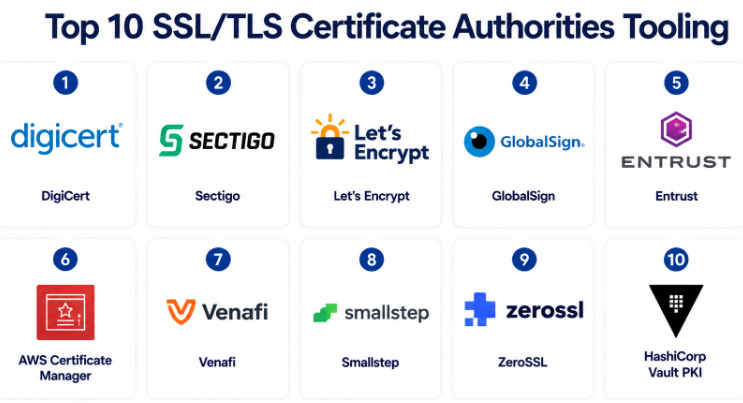
Top 10 SSL/TLS Certificate Authorities Tooling
#1 — DigiCert
Short description :
DigiCert is one of the most recognized certificate authority and PKI management providers for enterprises, financial organizations, ecommerce businesses, and infrastructure-heavy companies. The platform supports SSL/TLS certificates, enterprise PKI, certificate lifecycle management, IoT security, and digital trust services. DigiCert is widely used in regulated industries and large-scale infrastructure environments. It provides automation capabilities, centralized visibility, and enterprise governance controls. The platform is suitable for organizations managing large numbers of certificates across cloud and hybrid systems.
Key Features
- Public SSL/TLS certificate issuance.
- Enterprise PKI management.
- Certificate lifecycle automation.
- Certificate discovery and monitoring.
- ACME protocol support.
- API integrations and automation workflows.
- Multi-cloud and hybrid infrastructure support.
Pros
- Strong enterprise-grade certificate management capabilities.
- Good scalability for large certificate environments.
- Broad ecosystem for PKI and digital trust.
Cons
- Pricing may be higher than simpler certificate providers.
- Some advanced enterprise features require specialized expertise.
- Smaller organizations may not need the full feature set.
Platforms / Deployment
Web / Cloud / Hybrid
Security & Compliance
MFA, RBAC, audit logs, encryption, enterprise governance capabilities.
SOC 2, ISO 27001, GDPR support: Publicly associated with enterprise security programs.
HIPAA: Varies / N/A.
Integrations & Ecosystem
DigiCert integrates with enterprise infrastructure, DevOps tools, cloud platforms, and certificate automation workflows.
- Kubernetes
- Cloud platforms
- Enterprise PKI systems
- API integrations
- ACME automation
- DevOps pipelines
Support & Community
DigiCert provides enterprise support, onboarding assistance, technical documentation, and managed implementation guidance. Strong enterprise ecosystem presence.
#2 — Sectigo
Short description :
Sectigo is a widely used certificate authority platform focused on SSL/TLS certificates, enterprise PKI, and certificate lifecycle management. It supports businesses ranging from SMBs to large enterprises. Sectigo is known for certificate automation, ACME support, public certificates, and enterprise certificate management workflows. The platform supports DevOps integration and cloud-based certificate operations. It is commonly used by hosting providers, SaaS companies, and infrastructure teams.
Key Features
- SSL/TLS certificate issuance.
- Enterprise PKI services.
- Automated certificate lifecycle management.
- ACME support.
- Certificate discovery tools.
- Multi-domain certificate support.
- API-driven automation.
Pros
- Strong automation features.
- Good fit for enterprise and hosting environments.
- Broad certificate management capabilities.
Cons
- Enterprise setup can become complex.
- UI experience may vary across products.
- Some advanced workflows require training.
Platforms / Deployment
Web / Cloud / Hybrid
Security & Compliance
RBAC, MFA, encryption, audit controls.
SOC 2 and ISO 27001: Not publicly stated specifically for all offerings.
GDPR support available for applicable workflows.
Integrations & Ecosystem
Sectigo supports integrations across enterprise infrastructure and DevOps workflows.
- ACME integrations
- Kubernetes environments
- Cloud infrastructure
- Hosting providers
- API automation
- Enterprise security systems
Support & Community
Sectigo provides enterprise support plans, documentation, onboarding guidance, and technical assistance for PKI deployments.
#3 — Let’s Encrypt
Short description :
Let’s Encrypt is one of the most widely used free certificate authorities for websites, APIs, and cloud-native applications. It focuses on automated certificate issuance using the ACME protocol. The platform is especially popular among developers, hosting providers, SaaS teams, and open-source communities. Let’s Encrypt transformed SSL adoption by making HTTPS easier and free. It is best suited for organizations prioritizing automation and standard public SSL usage.
Key Features
- Free SSL/TLS certificates.
- ACME-based automated issuance and renewal.
- Broad browser trust compatibility.
- Integration with web servers and automation tools.
- API-friendly automation ecosystem.
- Open-source ecosystem support.
- Fast certificate provisioning.
Pros
- Free and widely trusted.
- Excellent for automation-first workflows.
- Strong open-source ecosystem compatibility.
Cons
- Limited enterprise governance capabilities.
- Short certificate validity requires automation.
- Not designed for advanced enterprise PKI management.
Platforms / Deployment
Cloud / Web
Security & Compliance
ACME automation, encrypted issuance workflows.
SOC 2, ISO 27001, HIPAA: Not publicly stated.
Integrations & Ecosystem
Let’s Encrypt integrates deeply into cloud-native and open-source ecosystems.
- Certbot
- Kubernetes tools
- NGINX
- Apache
- Cloud platforms
- DevOps automation
Support & Community
Strong global open-source community with extensive documentation and automation examples. Enterprise-style managed support is limited.
#4 — GlobalSign
Short description :
GlobalSign provides SSL/TLS certificates, enterprise PKI services, identity solutions, and certificate lifecycle management. The platform is designed for enterprises requiring centralized certificate governance and strong security management. GlobalSign supports cloud, hybrid, and enterprise environments with automation and API capabilities. It is often used in healthcare, finance, manufacturing, and large infrastructure environments. The platform is suitable for organizations with strict security and operational requirements.
Key Features
- SSL/TLS certificates.
- Enterprise PKI solutions.
- Certificate lifecycle management.
- Certificate discovery tools.
- API integrations.
- Automated issuance workflows.
- Multi-cloud support.
Pros
- Strong enterprise security positioning.
- Useful governance and visibility capabilities.
- Good fit for regulated environments.
Cons
- May be excessive for smaller businesses.
- Enterprise deployment complexity can be high.
- Premium pricing for advanced services.
Platforms / Deployment
Cloud / Hybrid
Security & Compliance
MFA, RBAC, audit capabilities, enterprise PKI controls.
SOC 2, ISO 27001, GDPR: Public enterprise security alignment.
HIPAA: Varies / N/A.
Integrations & Ecosystem
GlobalSign integrates with enterprise infrastructure, automation workflows, and identity systems.
- Cloud infrastructure
- PKI environments
- DevOps pipelines
- API integrations
- Enterprise IAM systems
- Certificate automation tools
Support & Community
GlobalSign offers enterprise onboarding, technical support, implementation guidance, and documentation.
#5 — Entrust
Short description :
Entrust provides certificate authority services, enterprise PKI tooling, identity security, and digital trust infrastructure. It is commonly used by enterprises, financial institutions, healthcare organizations, and government-related environments. Entrust supports public certificates, private PKI, certificate lifecycle management, and authentication workflows. The platform focuses heavily on enterprise security and governance. It is a strong fit for organizations with advanced compliance and trust requirements.
Key Features
- Public SSL/TLS certificates.
- Private PKI management.
- Identity and authentication tooling.
- Certificate automation.
- Governance and audit capabilities.
- Enterprise-scale deployment support.
- Hybrid infrastructure compatibility.
Pros
- Strong enterprise security capabilities.
- Good for regulated industries.
- Broad identity and trust ecosystem.
Cons
- Complex enterprise implementation.
- Higher operational overhead for small teams.
- Pricing may not suit SMB environments.
Platforms / Deployment
Cloud / Hybrid / Self-hosted
Security & Compliance
RBAC, MFA, audit logging, governance controls, encryption.
SOC 2, ISO 27001, GDPR support: Public enterprise security alignment.
HIPAA: Varies / N/A.
Integrations & Ecosystem
Entrust integrates with enterprise security infrastructure and identity ecosystems.
- IAM platforms
- Enterprise PKI
- API integrations
- Cloud infrastructure
- Security automation
- Hybrid environments
Support & Community
Enterprise-oriented support model with onboarding assistance, consulting, and implementation guidance.
#6 — AWS Certificate Manager
Short description :
AWS Certificate Manager is Amazon’s certificate management service for securing workloads inside AWS environments. It simplifies certificate provisioning, deployment, and renewal for AWS-based infrastructure. The platform is widely used by cloud-native companies, SaaS providers, DevOps teams, and enterprises operating heavily within AWS. It is best suited for organizations deeply integrated with Amazon Web Services. Automation and scalability are major strengths.
Key Features
- Managed SSL/TLS certificate provisioning.
- Automatic renewal workflows.
- AWS-native integrations.
- Load balancer and CDN integration.
- API automation support.
- Centralized certificate visibility.
- Cloud-native deployment support.
Pros
- Strong automation for AWS infrastructure.
- Easy deployment inside AWS environments.
- Good scalability for cloud-native systems.
Cons
- Primarily focused on AWS ecosystems.
- Less useful for multi-cloud governance.
- Limited outside AWS-native workflows.
Platforms / Deployment
Cloud
Security & Compliance
IAM integration, encryption, access controls, audit capabilities.
SOC 2, ISO 27001, GDPR alignment within AWS ecosystem.
HIPAA: Varies depending on AWS service usage.
Integrations & Ecosystem
AWS Certificate Manager integrates tightly with AWS infrastructure services.
- Elastic Load Balancing
- CloudFront
- Route 53
- API Gateway
- Kubernetes on AWS
- IAM services
Support & Community
Strong documentation and cloud ecosystem support through AWS. Community support is broad due to widespread AWS adoption.
#7 — Venafi
Short description :
Venafi focuses on enterprise machine identity management and certificate lifecycle governance. It is designed for large organizations managing complex certificate environments across cloud, hybrid, and on-premises systems. The platform provides certificate discovery, automation, policy enforcement, and risk management capabilities. Venafi is especially useful for organizations struggling with certificate sprawl and operational visibility. It is commonly used by large enterprises with advanced security requirements.
Key Features
- Certificate lifecycle management.
- Certificate discovery and visibility.
- Policy enforcement.
- Automation and orchestration.
- Multi-cloud certificate governance.
- Machine identity management.
- Enterprise compliance workflows.
Pros
- Excellent enterprise governance capabilities.
- Strong certificate visibility and automation.
- Useful for complex infrastructure environments.
Cons
- Enterprise-focused pricing and complexity.
- Requires operational maturity for best results.
- Smaller organizations may not need full capabilities.
Platforms / Deployment
Cloud / Hybrid / Self-hosted
Security & Compliance
RBAC, audit logging, governance controls, enterprise policy enforcement.
SOC 2, ISO 27001: Not publicly stated specifically for all offerings.
GDPR support available for enterprise workflows.
Integrations & Ecosystem
Venafi integrates with enterprise infrastructure, DevOps systems, and cloud environments.
- Kubernetes
- Cloud platforms
- DevOps automation
- PKI systems
- Security platforms
- API integrations
Support & Community
Strong enterprise support model with implementation guidance, consulting, and documentation.
#8 — Smallstep
Short description :
Smallstep provides certificate automation and modern PKI tooling designed for cloud-native environments, developers, and infrastructure teams. It focuses on internal PKI, Zero Trust architectures, service identity, and automated certificate workflows. The platform is commonly used in Kubernetes, DevOps, and distributed infrastructure environments. Smallstep is especially useful for teams building modern service authentication workflows. It combines developer-friendly tooling with enterprise security concepts.
Key Features
- Internal PKI tooling.
- Automated certificate issuance.
- ACME support.
- Kubernetes integrations.
- Zero Trust identity workflows.
- Service-to-service authentication.
- API-driven automation.
Pros
- Strong fit for modern cloud-native environments.
- Developer-friendly automation workflows.
- Useful for internal service identity management.
Cons
- Less focused on traditional public certificate markets.
- Advanced concepts may challenge beginners.
- Enterprise governance features vary by deployment.
Platforms / Deployment
Cloud / Self-hosted / Hybrid
Security & Compliance
MFA, encryption, automated identity workflows, policy controls.
SOC 2, ISO 27001, HIPAA: Not publicly stated.
Integrations & Ecosystem
Smallstep integrates with modern DevOps and cloud-native ecosystems.
- Kubernetes
- Containers
- Service meshes
- CI/CD pipelines
- APIs
- Cloud-native infrastructure
Support & Community
Strong developer-oriented documentation and growing cloud-native community support.
#9 — ZeroSSL
Short description :
ZeroSSL is a certificate management platform focused on simplified SSL certificate issuance and automation. It supports both free and paid certificates while providing automation tools for websites and applications. The platform is commonly used by SMBs, agencies, developers, and hosting environments. ZeroSSL emphasizes ease of use and automation. It is suitable for organizations looking for practical SSL management without enterprise PKI complexity.
Key Features
- SSL/TLS certificate issuance.
- ACME automation support.
- Certificate monitoring.
- Multi-domain certificate support.
- Validation workflows.
- API integrations.
- Dashboard-based certificate management.
Pros
- Easy onboarding for SMBs and developers.
- Good automation support.
- Simpler than enterprise PKI platforms.
Cons
- Enterprise governance capabilities are more limited.
- Large-scale PKI management may require stronger tooling.
- Advanced compliance workflows are limited.
Platforms / Deployment
Cloud / Web
Security & Compliance
Encryption, account security controls, certificate validation workflows.
SOC 2, ISO 27001, HIPAA: Not publicly stated.
Integrations & Ecosystem
ZeroSSL supports integrations for website hosting and certificate automation.
- ACME clients
- Hosting platforms
- APIs
- Web servers
- DNS integrations
- DevOps workflows
Support & Community
Provides documentation, onboarding guidance, and SMB-friendly support options.
#10 — HashiCorp Vault PKI
Short description :
HashiCorp Vault PKI is part of the Vault secrets management ecosystem and supports dynamic certificate issuance and internal PKI workflows. It is widely used by DevOps teams, platform engineering groups, and enterprises building Zero Trust architectures. The platform supports automated certificate generation, secret management, and infrastructure security workflows. Vault PKI is best suited for technical teams with strong infrastructure automation practices. It is especially powerful in Kubernetes and cloud-native environments.
Key Features
- Dynamic certificate issuance.
- Internal PKI management.
- Secret management integration.
- API-driven automation.
- Kubernetes support.
- Policy-based access controls.
- Multi-cloud infrastructure support.
Pros
- Strong fit for DevOps and platform engineering.
- Powerful automation and security workflows.
- Excellent for Zero Trust architectures.
Cons
- Requires technical expertise.
- Operational complexity can be high.
- Not designed as a beginner-friendly public CA service.
Platforms / Deployment
Cloud / Self-hosted / Hybrid
Security & Compliance
RBAC, encryption, audit logs, policy controls, secrets governance.
SOC 2 and ISO 27001 alignment depends on deployment environment.
HIPAA: Varies / N/A.
Integrations & Ecosystem
Vault PKI integrates strongly into infrastructure automation ecosystems.
- Kubernetes
- CI/CD pipelines
- Cloud platforms
- DevOps tooling
- Secrets management
- Infrastructure APIs
Support & Community
Strong enterprise and open-source community support with extensive documentation and DevOps adoption.
Comparison Table (Top 10)
| Tool Name | Best For | Platform(s) Supported | Deployment | Standout Feature | Public Rating |
|---|---|---|---|---|---|
| DigiCert | Enterprise PKI and certificate governance | Web / Cloud | Cloud / Hybrid | Enterprise certificate lifecycle management | N/A |
| Sectigo | Enterprise automation and SSL management | Web | Cloud / Hybrid | ACME automation and enterprise PKI | N/A |
| Let’s Encrypt | Free automated SSL | Web | Cloud | Free ACME-based certificate issuance | N/A |
| GlobalSign | Regulated enterprise environments | Cloud | Cloud / Hybrid | Enterprise PKI and governance | N/A |
| Entrust | Identity security and PKI | Web | Cloud / Hybrid / Self-hosted | Enterprise trust infrastructure | N/A |
| AWS Certificate Manager | AWS-native environments | Web | Cloud | Automated AWS certificate provisioning | N/A |
| Venafi | Large-scale certificate governance | Web | Cloud / Hybrid / Self-hosted | Machine identity management | N/A |
| Smallstep | Cloud-native internal PKI | Web | Cloud / Hybrid / Self-hosted | Developer-focused service identity | N/A |
| ZeroSSL | SMB SSL automation | Web | Cloud | Simple certificate management | N/A |
| HashiCorp Vault PKI | DevOps and Zero Trust environments | Web | Cloud / Hybrid / Self-hosted | Dynamic internal PKI workflows | N/A |
Evaluation & SSL/TLS Certificate Authorities Tooling
| Tool Name | Core (25%) | Ease (15%) | Integrations (15%) | Security (10%) | Performance (10%) | Support (10%) | Value (15%) | Weighted Total (0–10) |
|---|---|---|---|---|---|---|---|---|
| DigiCert | 10 | 8 | 9 | 10 | 9 | 9 | 7 | 8.95 |
| Sectigo | 9 | 8 | 8 | 9 | 8 | 8 | 8 | 8.35 |
| Let’s Encrypt | 8 | 9 | 9 | 8 | 9 | 7 | 10 | 8.65 |
| GlobalSign | 9 | 7 | 8 | 10 | 9 | 8 | 7 | 8.30 |
| Entrust | 9 | 7 | 8 | 10 | 9 | 8 | 7 | 8.30 |
| AWS Certificate Manager | 8 | 9 | 9 | 9 | 10 | 8 | 8 | 8.65 |
| Venafi | 10 | 6 | 9 | 10 | 9 | 9 | 7 | 8.65 |
| Smallstep | 8 | 7 | 9 | 9 | 8 | 7 | 8 | 8.00 |
| ZeroSSL | 7 | 9 | 7 | 7 | 8 | 7 | 9 | 7.80 |
| HashiCorp Vault PKI | 9 | 6 | 10 | 10 | 9 | 8 | 8 | 8.60 |
These scores are comparative and scenario-based rather than absolute rankings. Enterprise governance platforms like Venafi and DigiCert score highly for large-scale infrastructure, while Let’s Encrypt and AWS Certificate Manager perform strongly in automation-focused environments. Buyers should evaluate operational complexity, automation maturity, cloud alignment, and governance requirements before choosing a platform.
Which SSL/TLS Certificate Authorities Tooling
Solo / Freelancer
Freelancers and small website owners usually benefit most from Let’s Encrypt, ZeroSSL, or bundled hosting-based SSL services. Simplicity, automation, and low cost matter more than enterprise governance.
SMB
Small and medium businesses should consider Sectigo, DigiCert, ZeroSSL, or AWS Certificate Manager depending on cloud usage and operational complexity. SMBs should prioritize renewal automation and visibility.
Mid-Market
Mid-market organizations often need centralized visibility, API integrations, and multi-environment certificate management. DigiCert, GlobalSign, Sectigo, and AWS Certificate Manager are strong choices.
Enterprise
Large enterprises should evaluate DigiCert, Venafi, Entrust, and GlobalSign for governance, policy enforcement, PKI scalability, auditability, and machine identity management.
Budget vs Premium
Let’s Encrypt and ZeroSSL are strong budget-oriented solutions. DigiCert, Entrust, and Venafi fit premium enterprise security requirements with broader governance capabilities.
Feature Depth vs Ease of Use
Let’s Encrypt and AWS Certificate Manager are easier for automation-first environments. Venafi and Entrust provide deeper enterprise governance but require more operational maturity.
Integrations & Scalability-
Cloud-native organizations should evaluate AWS Certificate Manager, HashiCorp Vault PKI, Smallstep, and Let’s Encrypt for automation and Kubernetes compatibility. Enterprises with hybrid infrastructure should consider DigiCert and Venafi.
Security & Compliance Needs
Organizations in finance, healthcare, SaaS, and regulated industries should prioritize certificate discovery, audit logging, governance controls, RBAC, and policy enforcement. Enterprise PKI tooling becomes increasingly important as infrastructure complexity grows.
Frequently Asked Questions (FAQs)
1. What is SSL/TLS Certificate Authorities Tooling?
These tools help organizations issue, manage, automate, renew, and monitor digital certificates used for encrypted communication and identity verification across websites, APIs, applications, and infrastructure.
2. Why is certificate automation important?
Manual certificate renewal increases the risk of outages and expired certificates. Automation reduces operational overhead and improves security reliability across distributed environments.
3. What is the difference between public and private PKI?
Public PKI secures internet-facing websites and applications trusted by browsers. Private PKI is used internally for enterprise systems, service identities, and Zero Trust architectures.
4. Is Let’s Encrypt enough for enterprise environments?
Let’s Encrypt works well for many web applications and cloud-native workloads, but enterprises often require stronger governance, certificate discovery, auditability, and lifecycle management.
5. What is ACME?
ACME is an automation protocol used for certificate issuance and renewal. It is widely used by Let’s Encrypt and other certificate automation platforms.
6. Which platform is best for Kubernetes?
Smallstep, HashiCorp Vault PKI, AWS Certificate Manager, Let’s Encrypt, and Venafi are commonly used in Kubernetes and cloud-native environments.
7. What happens if an SSL certificate expires?
Expired certificates can cause browser warnings, API failures, application outages, customer trust issues, and compliance risks. Monitoring and automation are essential.
8. Are free SSL certificates secure?
Yes, free SSL certificates can provide strong encryption when issued by trusted certificate authorities. The main difference is usually governance, support, and advanced enterprise management capabilities.
9. What security features should buyers evaluate?
Buyers should evaluate MFA, RBAC, audit logs, automation controls, certificate discovery, policy enforcement, and centralized visibility capabilities.
10. Can certificate tooling integrate with DevOps pipelines?
Yes, modern certificate tooling often supports APIs, ACME automation, CI/CD integration, Kubernetes compatibility, and infrastructure-as-code workflows.
Conclusion
SSL/TLS Certificate Authorities Tooling has evolved from simple certificate issuance into a critical part of enterprise security, cloud infrastructure, and Zero Trust operations. Modern organizations now manage certificates across websites, APIs, Kubernetes clusters, cloud platforms, containers, internal services, and distributed infrastructure. The right platform depends heavily on operational scale, cloud strategy, security maturity, automation requirements, and governance expectations. Smaller teams may benefit from simpler automation-focused solutions like Let’s Encrypt or ZeroSSL, while large enterprises often require advanced lifecycle management and policy enforcement platforms such as DigiCert, Venafi, Entrust, or GlobalSign.
